Growing
Mushroom Culture Storage: Working Plates, Slants, and Inventory
Store mushroom cultures with a master-and-working system, sealed slants, temperature records, passage limits, recovery tests, and traceable inventory.
Growing method
Start with authenticated culture
Use supplier-identified spawn or blocks and record substrate, stage, temperature, humidity, and visible changes.
Open the beginner growing hub →Food safety
Discard suspect batches
Unusual colors, slime, insects, or abnormal odor should be treated as a safety concern, not a climate tweak.
Review contamination guidance →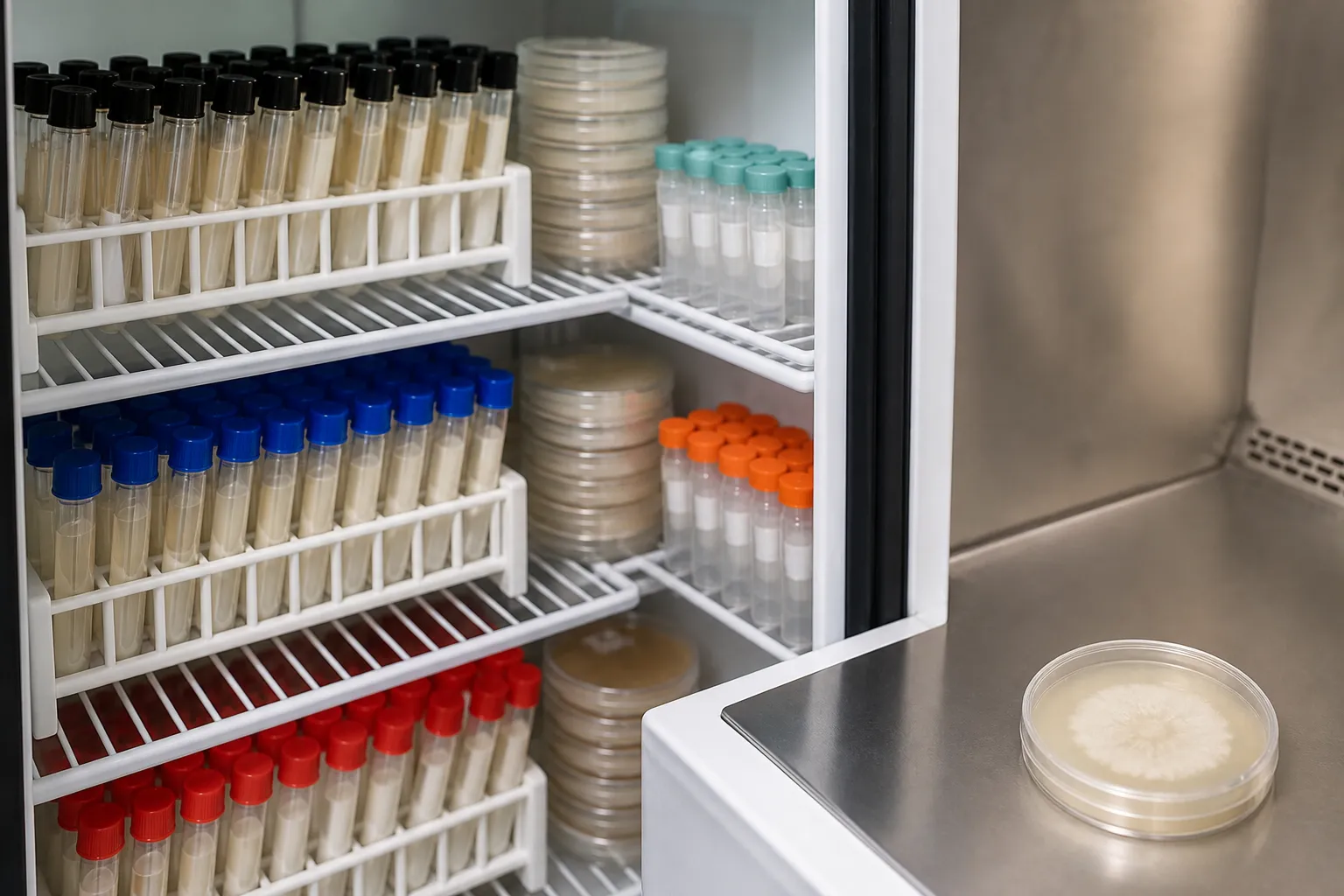
Begin with the question the collection must answer
Culture storage is not simply keeping white mycelium alive. A useful collection must preserve identity, recoverable growth, relevant production traits, and a record that connects every derivative to a verified parent. Those goals become harder as cultures are repeatedly transferred, exposed, mislabeled, dehydrated, contaminated, or selected for whatever sector happened to grow fastest on a plate.
Define the intended interval before choosing a container. A plate needed next week, a working slant expected to bridge a production season, and an irreplaceable strain intended for years are different preservation problems. No single temperature or transfer calendar is safe for every fungus. Species, strain, medium, physiological state, closure, and validated method all affect survival.
This guide describes collection design for cultivated mushroom fungi. It is not a sterile-technique protocol and does not replace the strain-specific instructions of a recognized collection. Professional long-term preservation can involve cryogenic equipment, controlled cooling, validated cryoprotectants, oxygen monitoring, and hazards that do not belong in an improvised home workflow.
Build a one-way master-to-production lineage
Keep the least-manipulated, best-documented material as the master tier. Derive a limited set of working cultures from that tier, then use those working cultures for production plates, liquid inoculum, or spawn. The arrows should point outward. A fast-looking production plate should not quietly become the new master because doing so loses the original lineage and may select an unrepresentative sector.
Assign every transfer a parent ID. If culture W-24-017 came from master M-009, the inventory should show when, by whom, on which medium, and at what passage it was made. Spawn or a fruiting block should trace back through the working item to the master. This makes it possible to isolate the affected branch when contamination or poor fruiting appears instead of distrusting the entire library.
Maintain more than one master unit when the strain is valuable, but do not keep supposed backups side by side in the same failing refrigerator. Separate storage units or a recognized deposit provide protection against power loss, door failure, water damage, theft, and a single labeling mistake. Duplicate tubes made from the same questionable plate are repeated uncertainty, not independent security.
Use plates for observation and slants for a defined interval
Petri dishes expose a broad surface that makes growth margins, sectors, pigments, and many contaminants easier to observe. That visibility is useful during isolation and pre-storage assessment, but a plate also has a high surface-to-volume ratio and a long perimeter that can lose moisture or admit contamination if handling or sealing fails.
An agar slant places more medium in a smaller container and can dry more slowly. That makes it a common working-storage format, not a universal archive. Medium composition changes growth and survival; tube material, fill angle, closure, seal, headspace, and gas exchange also matter. A tightly sealed tube can create a different environment from a vented culture, while a loose cap can exchange moisture and contaminants.
Inspect stored units through the container when possible. Record cracking, shrinkage, medium pulling away from the wall, unusual liquid, pigment, growth outside the inoculated region, a displaced cap, or label failure. Repeatedly opening a tube to “check” it creates new exposure and changes the very condition being evaluated. Quarantine an abnormal unit and recover a separate planned test unit rather than sampling the only master impulsively.
Treat temperature as a measured condition, not a label
Refrigeration slows many cultures, but some fungi are injured by temperatures tolerated by others. A named species does not guarantee that every strain, medium, or physiological state responds identically. Use the provider’s instructions or a method verified with the exact material. Do not convert a familiar refrigerator setting into a universal mushroom-culture recommendation.
Measure the storage space independently. Door openings, automatic defrost, shelf position, loading, room heat, power interruptions, and failing seals create excursions that a front-panel display may hide. Place a checked logger where samples actually sit, document alarm limits and contacts, and review both minimum and maximum readings. A single current reading cannot reconstruct a weekend failure.
Do not confuse an ordinary freezer with cryopreservation. ATCC describes long-term preservation of many fungi below −130°C and emphasizes controlled preparation, cooling, monitoring, recovery, and cryogenic safety. Its technical document also notes that methods vary with sporulation and organism behavior. Those conditions require purpose-built equipment and trained handling; liquid nitrogen can cause severe cold injury, oxygen displacement, or vial hazards.
Keep cultures out of food, medicine, and household storage. Institutional work must follow its biosafety, access, shipping, waste, and emergency rules. A culinary species is still a living laboratory culture that may carry an unknown contaminant.
Make the identifier carry a complete history
Give each physical unit a unique, durable identifier. Link it to the scientific name, strain or accession, source, acquisition terms, authentication evidence, parent, medium and lot, passage definition and count, preparation date, operator, storage position, review date, recovery results, and restrictions. A species name written on masking tape is not lineage.
Use a position format that another person can navigate—for example, appliance, shelf, rack, box, row, and column. Record moves immediately. Color caps may speed navigation, but color is not a unique ID and may be perceived differently, fade, or be replaced. The readable code on the item and the inventory record should remain authoritative.
Keep the inventory backed up separately from the storage appliance. Limit editing rights, retain change history, and reconcile the database against physical positions on a schedule. Empty positions and retired IDs should remain explainable. If an item is missing, record it as missing; do not silently reuse its number for a new tube.
Count passage consistently and watch for drift
Repeated transfer adds opportunities for contamination, labeling error, and selection. A culture can remain uniformly white while production behavior changes. Define what counts as a passage before collecting data: one transfer event, one expansion generation, or another documented rule. Do not reset the count when changing container types.
Set working limits from observed recovery and performance, not from an internet rule that ignores strain and process. Compare a suspect working line with an earlier verified stock using the same substrate, environment, and measurement plan. Record colonization time, contamination, yield, morphology, and failed or missing observations. Changing strain, substrate, room, and scoring method together cannot isolate culture drift.
Sectoring deserves documentation rather than reflexive selection. Photograph the plate under consistent lighting, mark the region sampled, and keep the parent relationship. Selecting the fastest edge on every transfer can impose an unintended criterion unrelated to stable fruiting. When a line departs materially from its verified behavior, quarantine it and return to an earlier stock instead of repeatedly “cleaning” it forward.
Demonstrate storage success with recovery testing
A tube that still looks white is not proven viable, pure, or correctly identified. Storage success is demonstrated by planned recovery. Use a sacrificial or designated test unit, transfer it to the appropriate medium under the correct conditions, and keep it separate from production until evaluation is complete.
Define the observations in advance: time to visible recovery, expected colony form, unexpected colonies or pigments, microscopy or molecular confirmation when warranted, and—where production identity matters—a controlled fruiting or performance check. Visual agar growth alone cannot authenticate every strain or rule out every contaminant.
Schedule recovery early enough to act. If all duplicate units were made together and are tested only after the presumed storage interval has expired, a failed test leaves no rescue path. Staggered review can reveal drying, temperature damage, or declining recovery while another verified unit can still be expanded. Record unsuccessful recovery and the time allowed before declaring failure; some preserved fungi recover slowly.
Write the failure plan before an alarm
Plan for refrigerator or freezer failure, temperature excursion, lost inventory, mislabeled racks, contamination, flooding, and staff absence. Assign an alarm contact, backup location, transport container, recovery priority, and authority to discard or quarantine material. The response should say which cultures move first and how their chain of identity remains intact.
After an excursion, preserve the logger record and the as-found state. Do not immediately transfer every culture and erase evidence of which units were affected. Quarantine the exposed branch, assess container integrity and duration, and use recovery tests appropriate to the consequence. A power event does not prove failure, but a normal-looking tube does not prove success.
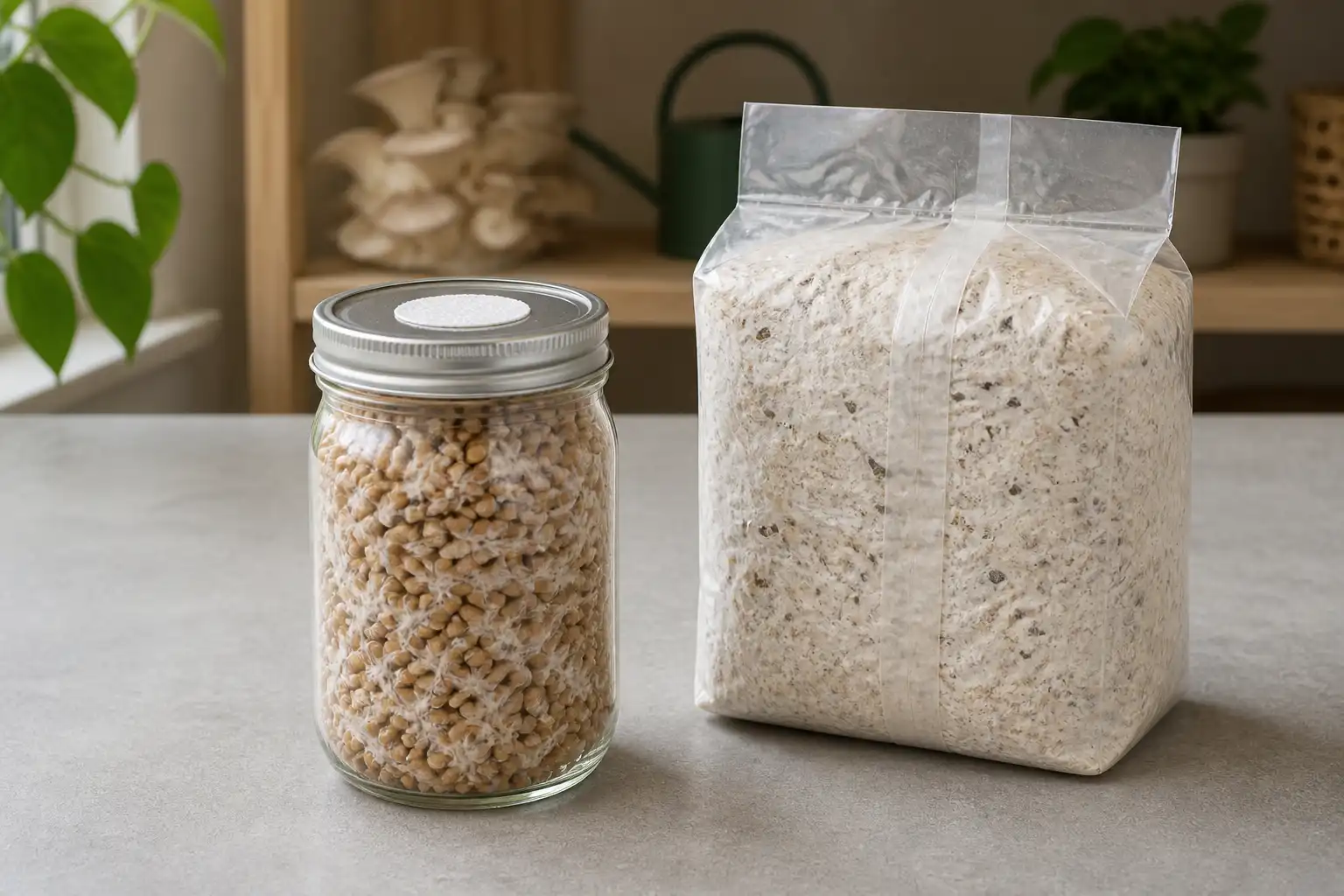
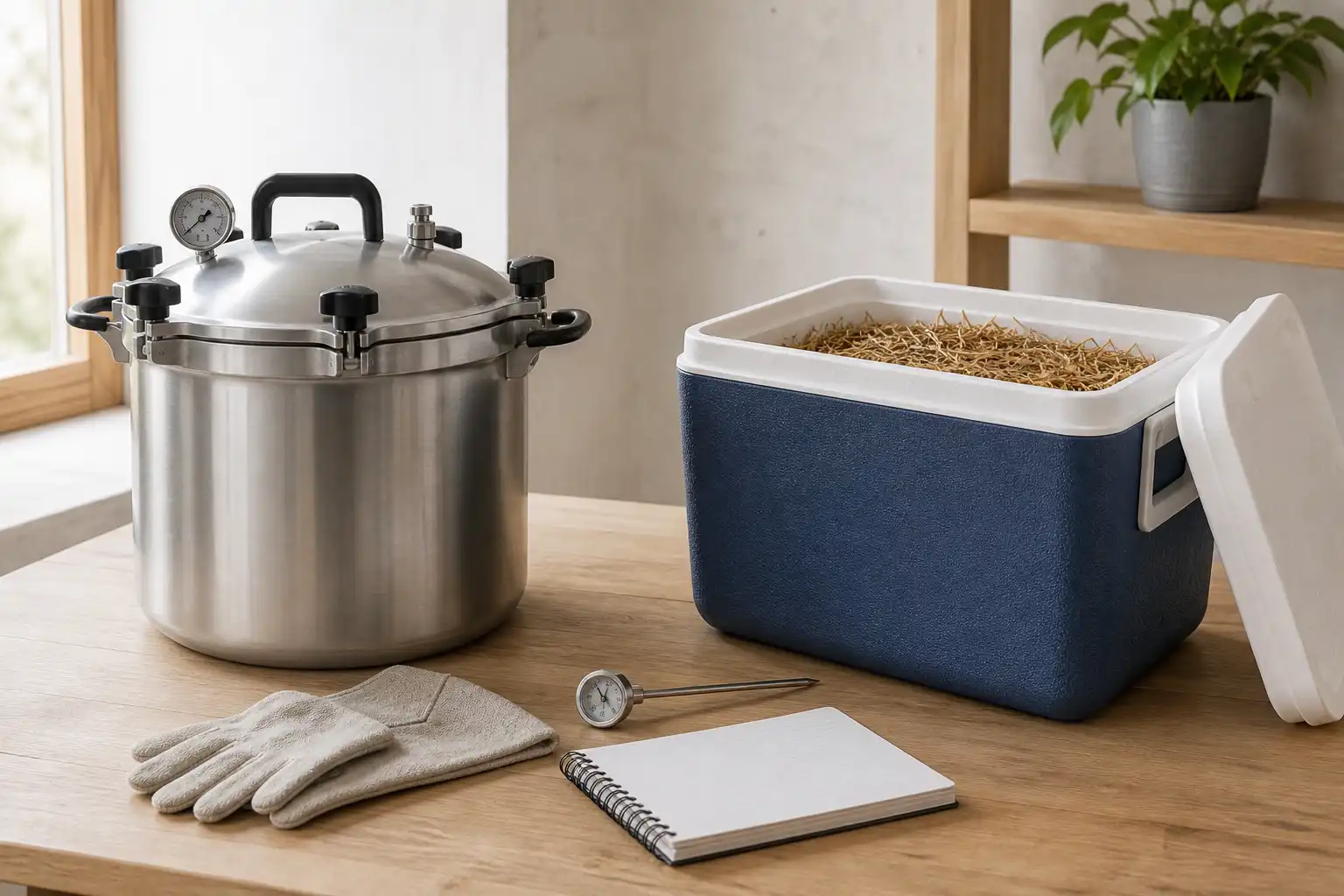
The grain spawn guide covers a production expansion stage; this page keeps long-term stock and working material conceptually separate. The sterilization and pasteurization guide explains why process control downstream cannot substitute for a traceable, verified master culture.
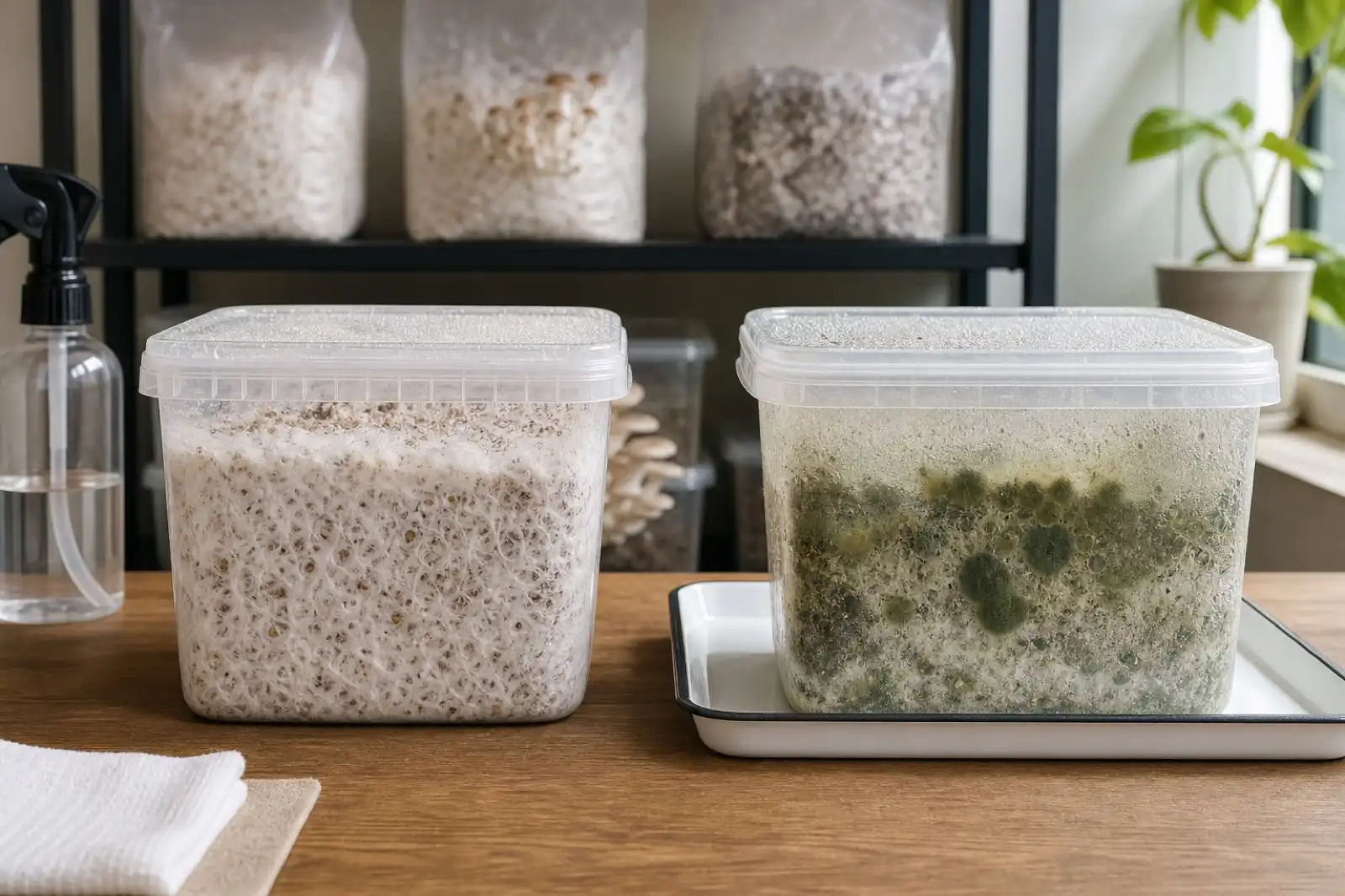
Storage cannot rescue a questionable isolate. Use the contamination guide to set conservative isolation and disposal decisions before a culture enters the master collection, then preserve only material with documented identity and clean growth.
Frequently asked questions
Define retirement criteria before a culture is valuable
Retire or quarantine stock when identity is uncertain, contamination recurs, the container fails, the medium desiccates beyond the validated condition, recovery differs materially, or records no longer connect it to a verified parent. Do not preserve a questionable tube indefinitely because it is old or rare. Record the decision, preserve any required evidence safely, and prevent accidental issue to production.
Inventory review should reconcile physical position with the database, confirm duplicate masters, inspect storage trends and alarms, identify cultures due for recovery testing, and remove expired working copies through an approved method. Access history matters when several people use the library. A small collection with complete lineage and successful recovery is more valuable than hundreds of tubes whose names, passages, and viability cannot be defended.
For irreplaceable or research-important strains, a recognized culture collection may offer authenticated deposit and preservation expertise beyond a home or farm refrigerator. Deposit agreements, biosafety, intellectual-property terms, shipping rules, and public availability require deliberate review. A local slant remains a working asset; it is not automatically a durable archive.
What is the difference between a master culture and a working culture?
Culture storage aims to preserve a known organism while limiting contamination, desiccation, mutation, senescence, and labeling loss. No single temperature or container suits every species and duration.
Can every mushroom culture be stored in a household refrigerator?
No. Cold tolerance and useful storage interval vary by species, strain, medium, closure, and protocol. A refrigerator can support a validated short- or intermediate-term method for some cultures, but it is not equivalent to professional cryopreservation.
Are agar slants better than Petri dishes for storage?
Slants often dry more slowly and expose less surface area, but they are not universally better. The organism, medium, tube, closure, gas exchange, temperature, and intended interval must all match a tested method.
How do I know a stored culture is still usable?
Recover a planned test unit onto the correct medium, inspect its growth separately from production, compare it with the expected morphology and history, and use additional identity or fruiting checks when the consequence of an error warrants them.
What information belongs on a culture inventory record?
Record a unique ID, scientific name and strain, source and authentication, parent ID, medium, passage, preparation date, storage position, restrictions, expected review date, recovery results, and every issue or transfer.
References
Source quality notes
MushroomScope cites sources that match the page scope, such as taxonomic databases, extension guidance, food-safety agencies, food-composition databases, and peer-reviewed or institutional health references. Sources support context and uncertainty; they do not turn an online page into specimen identification, medical advice, or a tested recipe record.
Frequently asked questions
What is the difference between a master culture and a working culture?
A master is the least-manipulated verified stock kept as the source of future working material. A working culture is a replaceable derivative used for routine expansion; production plates, liquid cultures, and spawn should not be returned to the master tier.
Can every mushroom culture be stored in a household refrigerator?
No. Cold tolerance and useful storage interval vary by species, strain, medium, closure, and protocol. A refrigerator can support a validated short- or intermediate-term method for some cultures, but it is not equivalent to professional cryopreservation.
Are agar slants better than Petri dishes for storage?
Slants often dry more slowly and expose less surface area, but they are not universally better. The organism, medium, tube, closure, gas exchange, temperature, and intended interval must all match a tested method.
How do I know a stored culture is still usable?
Recover a planned test unit onto the correct medium, inspect its growth separately from production, compare it with the expected morphology and history, and use additional identity or fruiting checks when the consequence of an error warrants them.
What information belongs on a culture inventory record?
Record a unique ID, scientific name and strain, source and authentication, parent ID, medium, passage, preparation date, storage position, restrictions, expected review date, recovery results, and every issue or transfer.
Related guides
growing
Mushroom Grain Spawn: How to Choose and Use It Safely
Use mushroom grain spawn as a labeled, clean inoculum for a documented growing method; learn what to verify, what to record, and when not to use it.
growing
Mushroom Contamination: Isolate, Record, and Prevent Repeat Problems
Recognize mushroom contamination without relying on color alone; isolate suspect batches, avoid food salvage, document the workflow, and prevent repeat issues.
growing
Pasteurize vs Sterilize Mushroom Substrate: A Home Grower’s Guide
Choose pasteurization or sterilization by substrate and workflow, then reduce contamination risk with a conservative, documented home-growing process.
Continue exploring
Browse more practical guides in Growing or visit the mushroom encyclopedia.