Growing
Mushroom Liquid Culture: Sterile Workflow and Test Protocol
Learn liquid culture as a controlled inoculum workflow: broth design, pressure sterilization, clean transfers, agar tests, storage, and contamination decisions.
Growing method
Start with authenticated culture
Use supplier-identified spawn or blocks and record substrate, stage, temperature, humidity, and visible changes.
Open the beginner growing hub →Food safety
Discard suspect batches
Unusual colors, slime, insects, or abnormal odor should be treated as a safety concern, not a climate tweak.
Review contamination guidance →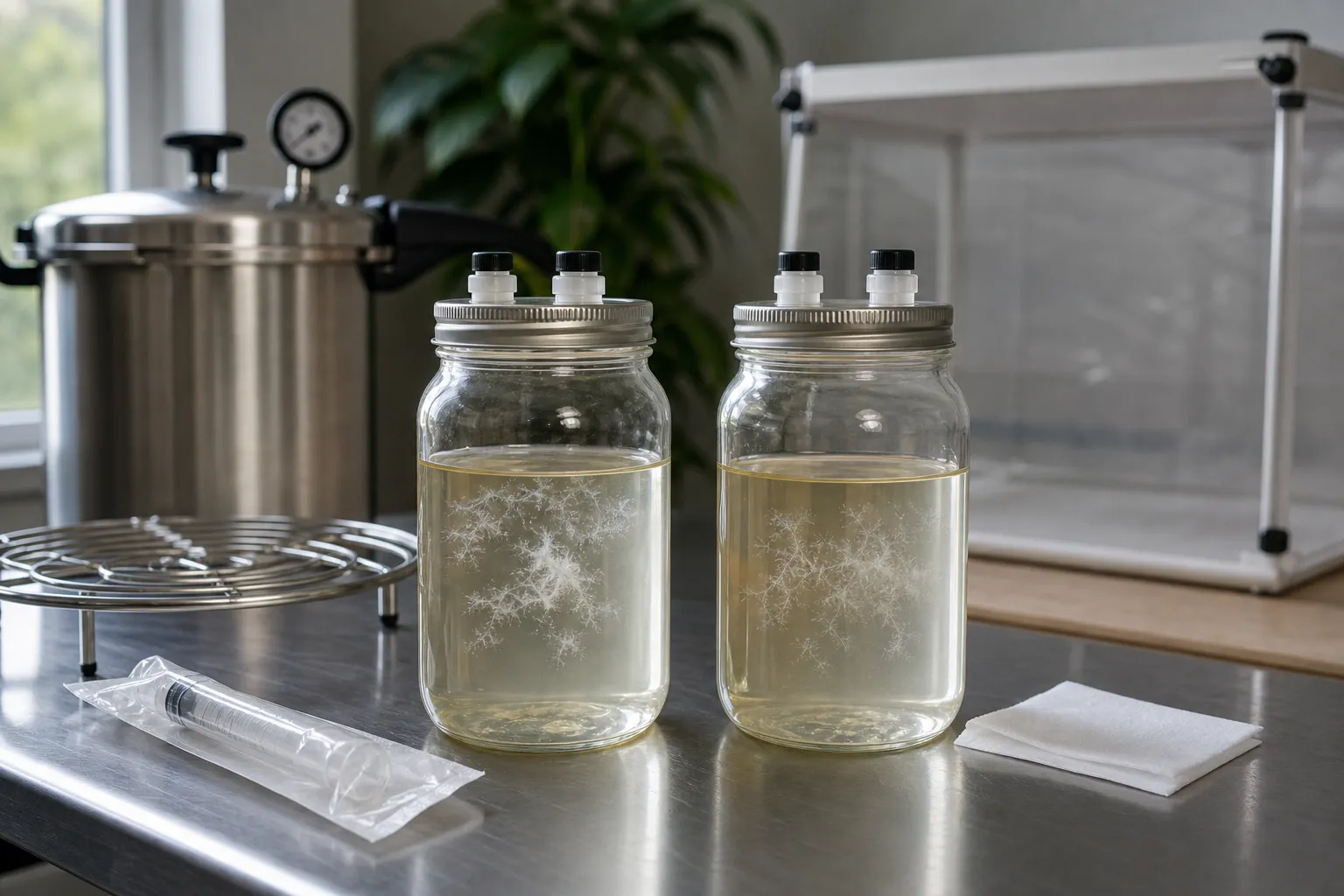
Liquid culture is mushroom mycelium growing in a sterilized nutrient broth. Its advantage is distribution: a small amount can reach many points in grain or another spawn substrate. Its disadvantage is invisibility: the same liquid that supports desired mycelium can support bacteria or yeast, and a jar can look reassuring while carrying organisms that become obvious only after transfer.
For that reason, this guide treats liquid culture as an inoculum-production workflow, not a shortcut. A usable batch has traceable source material, a measured broth, a validated sterilization process, controlled transfers, quarantine, and a clean agar test. White clouds in a jar are not a release criterion.
What liquid culture is—and is not
Liquid culture contains actively growing mycelium suspended in water with a small amount of soluble nutrient. It is not spawn: spawn is a solid carrier such as grain or sawdust colonized by mycelium. It is not a fruiting substrate, and mushrooms should not be expected to form inside the jar.
It also differs from a spore syringe. Spores are reproductive cells that germinate and combine, creating genetic variation. A culture is already living mycelium derived from an isolate or maintained line. Cornell describes culture production and spawn production as early, contamination-sensitive stages requiring skilled sterile work.
Decide whether liquid culture solves your problem
Liquid culture is useful when a grower needs repeatable small inoculations from a verified line. It can distribute quickly through grain and pass through a sterile syringe. It is less suitable when the operator lacks a pressure canner, clean transfer space, agar-testing capability, or a plan for labeling and disposal.
Beginners may get more reliable first harvests from purchased spawn or ready-to-fruit blocks. Learning culture work and learning fruiting conditions simultaneously creates too many possible failure points. The grain spawn guide explains the next solid-carrier stage and why liquid culture should not be confused with spawn.
Start with an authenticated source
Use a reputable commercial culture or a clean agar isolate whose identity and history are recorded. Do not inject tissue or liquid from an unidentified wild mushroom into food-production material. Cultivation multiplies both the organism and any uncertainty attached to it.
Record the supplier, strain or species label, lot, receipt date, and storage history. Assign every jar a batch identifier before sterilization. If labels are added after inoculation, jars can be mixed at the moment when traceability matters most.
Use a light, measured nutrient broth
A broth needs enough soluble carbon to support mycelium but does not benefit from being syrupy. Overly rich solutions can caramelize during pressure processing, create sediment, obscure observation, and favor competitors introduced later. Measure by weight and document the formula instead of judging color by eye.
Common growers use simple sugars or light malt-based nutrients, but exact recipes should follow the culture supplier or a validated protocol. Different ingredients vary in concentration and heat behavior. This draft intentionally avoids presenting one ratio as universal without a controlled test for the equipment and species.
Water and headspace are process variables
Use potable water appropriate for food preparation. Strongly chlorinated, unusually mineral-rich, or softened water may change growth or sediment; if troubleshooting, compare a documented alternate water source rather than changing several variables at once.
Leave enough headspace for safe mixing and pressure processing. A jar filled near its shoulder is hard to agitate and may wet the filter. Follow vessel and canner limits. Never improvise sealed containers that are not designed to tolerate heat and pressure.
Build lids for injection and filtered exchange
A common lid has a self-healing injection port and a filtered gas-exchange opening. The filter allows limited exchange while blocking particles under its specified conditions. It is not a guarantee against contamination and it should not be soaked with broth.
Inspect ports, gaskets, lids, and jars for cracks or degraded material. Replace damaged components. Foil may protect filter surfaces during processing according to the system design, but lid construction and tightening must follow the component and pressure-canner instructions.
Pressure steam is not ordinary boiling
Nutrient broth must begin sterile because even a small surviving population can expand rapidly. Pressure steam reaches conditions not achieved by an open boiling pot. CDC material explains steam sterilization principles; home mushroom work should also follow the pressure-canner manufacturer’s operating, venting, loading, cooling, and altitude instructions.
Do not copy a time from a video without matching jar volume, load, vessel, altitude, and validated process. This guide cannot certify a universal cycle. If the equipment documentation and chosen cultivation protocol conflict, stop and resolve that conflict before processing.
Cool completely before inoculating
After the cycle, allow pressure to return naturally and jars to cool fully. Forced cooling can damage glass or pull contaminated air through stressed seals. Warm broth may injure the desired culture and creates convection that complicates a still-air workspace.
Inspect cooled jars for cracks, leaks, displaced filters, unexpected loss of volume, or severe darkening. Keep at least one uninoculated control jar when practical. A control that later changes appearance signals a process or container problem independent of the inoculation source.
Prepare a still-air workflow
A still-air box reduces airborne movement; it does not sterilize what enters. Clean the room first, stop fans, close windows, wear clean clothing, wash hands, and sanitize gloves and the box’s work surface. Allow alcohol vapor to disperse and keep it away from flame or ignition sources.
Arrange materials so hands do not pass over sterile ports. Separate clean tools from used items. Rehearse movements before exposing anything. The goal is a short, deliberate transfer with no touching of sterile needles, syringe tips, agar wedges, or inner lid surfaces.
Choose the transfer method deliberately
An agar-to-liquid transfer starts with visible clean growth but requires opening a vessel and manipulating a wedge. A verified culture syringe can pass through a port with less open exposure, although the syringe itself must be trusted and tested. Liquid-to-liquid expansion multiplies volume quickly and also multiplies hidden contamination.
Use the smallest practical inoculum. More source liquid is not a substitute for sterility and can change broth concentration. Label immediately with source, receiving jar, date, and operator.
Incubation is species- and strain-specific
Keep jars in the authenticated strain supplier’s incubation range, out of direct sun and large daily temperature swings. “Room temperature” is not a precise setpoint; log the actual range. Excess heat can accelerate competitors and stress mycelium even when a shelf feels comfortable to a person.
Ambient indirect light is acceptable. Liquid culture does not require fruiting humidity or fresh-air cycles. Routine opening for “air” defeats the closed filtered system.
Agitation distributes mycelium and oxygen
Gentle periodic mixing breaks large clumps into many inoculation points and redistributes dissolved oxygen. A magnetic stirrer offers repeatability, while hand swirling can work for small jars. Neither should splash broth into the filter or whip excessive foam.
Document frequency and duration. Constant aggressive stirring may shear some cultures or warm the vessel. If changing from hand agitation to a stir plate, treat it as a process change rather than assuming faster is always better.
What healthy growth may look like
Expected mycelium often appears as white threads, small clouds, or soft fragments that gather when the jar rests and disperse with mixing. Appearance varies by species, nutrient, and agitation. Some broth ingredients create harmless sediment before inoculation.
Useful observations compare the inoculated jar with its own starting photograph and an uninoculated control. A uniform unexplained haze, persistent foam, colored growth, slimy strands, rapid gas, or an abnormal odor after opening for disposal are warning signs. Never deliberately sniff a questionable culture closely.
Why visual inspection cannot release a batch
Bacterial cells can remain too small to see individually. Yeasts may create subtle turbidity. Desired mycelium can grow alongside a contaminant, masking it. Clear liquid around white growth is encouraging but not proof.
This is the crucial difference between a hobby photo and a quality-control decision. Release requires a test on a medium where separate colony types can become visible.
Test every batch on agar
In a clean workspace, place a small drop of well-mixed culture onto sterile agar and close the plate promptly. Keep the test physically separate from master cultures. Incubate in a suitable range and observe the pattern over time.
Expected organized mycelial growth should emerge without greasy bacterial film, isolated yeast-like dots, colored mold, or multiple incompatible sectors that suggest a mixed source. Agar interpretation itself takes practice. When uncertain, quarantine and seek experienced cultivation help rather than inoculating a large grain batch.
A limited grain trial adds another checkpoint
Even after clean-looking agar, test a small jar of properly sterilized grain before committing a production batch. A limited trial protects time and materials and reveals how the culture recovers on the intended substrate.
Record inoculation volume, grain formula, moisture, temperature, and days to visible recovery. Do not use fast growth alone as proof of identity; contaminants can also grow quickly.
Contamination decisions should be conservative
Do not open visibly moldy jars in the clean workspace. Isolate them, follow local disposal guidance, and clean the external area. Do not attempt to rescue a questionable liquid culture by transferring the “clean-looking” side; liquid circulation removes meaningful spatial separation.
Review the whole chain: source, broth measurement, lid integrity, sterilization record, transfer motions, incubation, and control jar. The contamination guide helps categorize symptoms, while the substrate sterilization guide explains why pressure, load, and material matter.
Storage and culture aging
Storage life depends on species, broth, temperature, container, and initial cleanliness. Refrigeration can slow many culinary cultures, but not every species tolerates the same conditions. Follow supplier guidance and avoid presenting one shelf-life number as universal.
Label a use-by review date, minimize warm-cold cycling, and re-test after extended storage. Maintain a small verified master separately from working jars so routine syringe access does not expose the entire lineage.
A batch record makes failures useful
For every jar, record formula and weights, water source, container volume, lid type, processing parameters, inoculum source and volume, transfer date, temperature range, agitation, visual changes, agar plate identifiers, and final disposition. Photograph against consistent light without using photos as a sterility verdict.
Change one variable at a time. If nutrient, temperature, inoculum, and stirring all change together, even a successful jar teaches little that can be repeated.
Frequently asked questions
Is honey-water liquid culture always reliable?
No. Honey varies and can darken or create sediment. Reliability comes from a measured formula, validated processing, clean inoculum, and testing—not the ingredient name.
Can spores go directly into liquid culture?
They may germinate, but the result is genetically variable and contamination is hard to see. Germinating and isolating on agar provides more control.
Does faster cloud growth mean a better culture?
Not necessarily. Growth rate depends on strain and conditions, and contaminants may also spread rapidly. Verify on agar.
Can a contaminated culture be filtered clean?
Routine hobby filtration is not a validated rescue. Discard the batch and return to a verified source.
When is liquid culture ready to inoculate grain?
After sufficient expected growth and a clean agar test, within the strain’s documented window. Appearance alone is insufficient.
Safety and editorial disclosure
Pressure equipment, hot glass, needles, alcohol, and biological cultures each create hazards. Follow manufacturer instructions, use eye and hand protection appropriate to the operation, never combine open flame with alcohol vapor, and dispose of sharps and contaminated material under local rules.
The cover is an original AI editorial illustration checked for clear broth, plausible white mycelial wisps, closed jars, safe needle presentation, and distinction from grain spawn. It is not a laboratory record and cannot teach contamination diagnosis by appearance. No named laboratory specialist reviewed this draft.
Sources and editorial method
Cornell sources establish that culture and spawn production are skilled sterile stages and distinguish inoculum from fruiting blocks. CDC supports general steam-sterilization principles; equipment-specific operation must come from the pressure-canner maker and a validated cultivation protocol. Penn State Extension provides professional mushroom-production context. Because this editorial guide was not laboratory-validated, it deliberately omits a universal broth ratio or processing cycle and directs readers to equipment- and culture-specific instructions.
References
- Cornell Small Farms. Indoor Production. Commercial cultivation and sterile-production context.
- Cornell Small Farms. Seven Stages of Cultivation. Distinguishes culture, spawn, and later production stages.
- Penn State Extension. Mushroom resources. Professional mushroom-production context.
- U.S. Centers for Disease Control and Prevention. Steam Sterilization. General pressure-steam principles; not a home canner cycle.
Editorial status: reviewed by the MushroomScope editorial team on September 9, 2026; no named laboratory specialist reviewed or validated this workflow.
Source quality notes
MushroomScope cites sources that match the page scope, such as taxonomic databases, extension guidance, food-safety agencies, food-composition databases, and peer-reviewed or institutional health references. Sources support context and uncertainty; they do not turn an online page into specimen identification, medical advice, or a tested recipe record.
Frequently asked questions
Can a clear mushroom liquid culture still be contaminated?
Yes. Some bacteria, yeasts, and molds are not obvious in broth, so visual inspection is only a screen. Test a small sample on agar before expanding or inoculating valuable substrate.
What is the difference between liquid culture and spore solution?
Liquid culture contains living mycelium from a known culture, while spore solution contains genetically variable spores that must germinate and can conceal contaminants.
Why did liquid culture turn cloudy after inoculation?
Uniform haze, unexpected sediment, gas, discoloration, or sour odor can indicate contamination, although recipes also create harmless sediment. Quarantine and test rather than guessing.
Can liquid culture be sterilized by boiling a jar?
A validated pressure-steam process is the safer standard for nutrient broth and equipment; ordinary boiling does not reliably reproduce pressure sterilization conditions.
How should a liquid culture be tested before use?
Transfer one small drop onto sterile agar using clean technique, incubate separately, and confirm expected organized mycelial growth without bacterial film, yeast colonies, or colored molds.
Related guides
growing
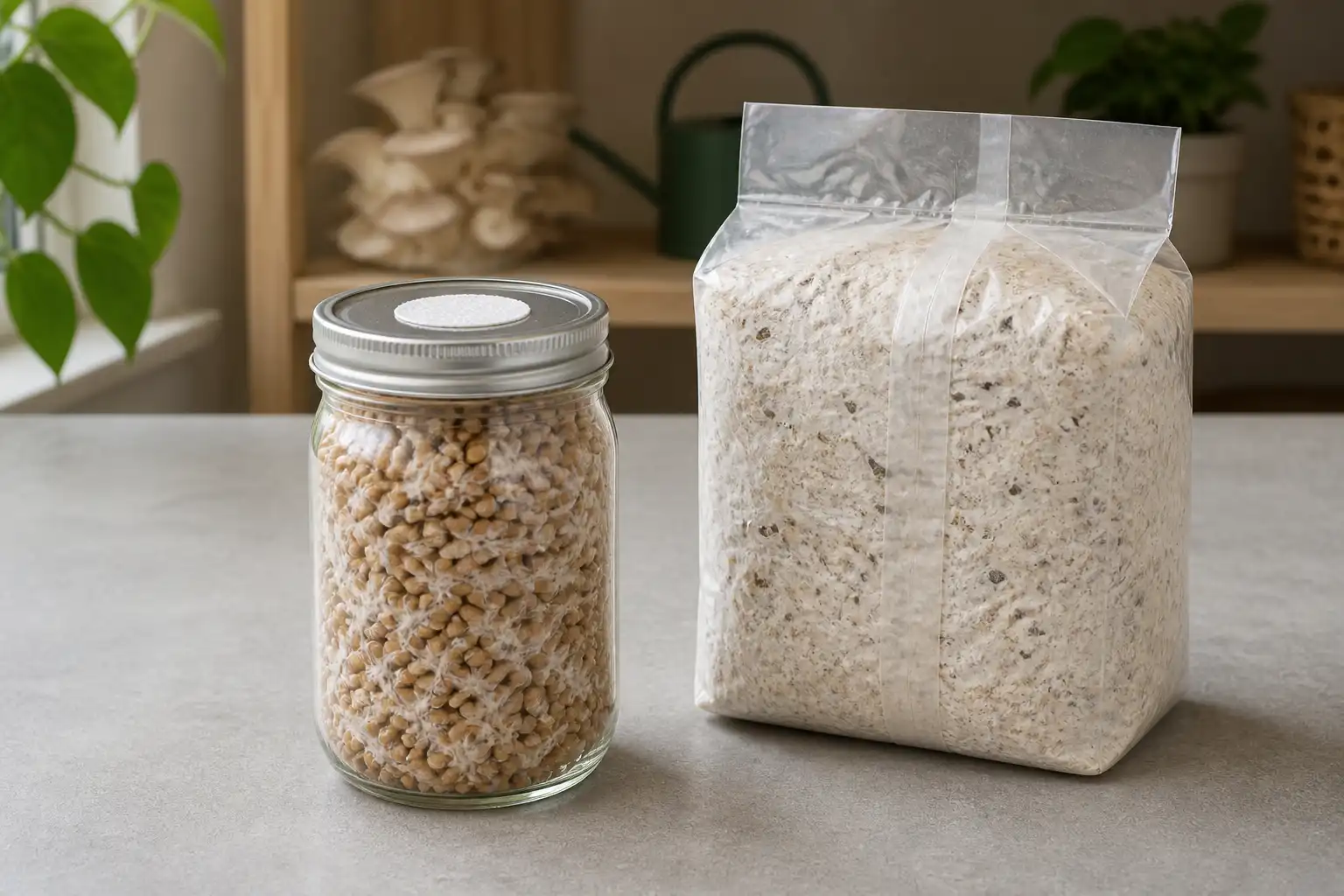
Mushroom Grain Spawn: How to Choose and Use It Safely
Use mushroom grain spawn as a labeled, clean inoculum for a documented growing method; learn what to verify, what to record, and when not to use it.
growing
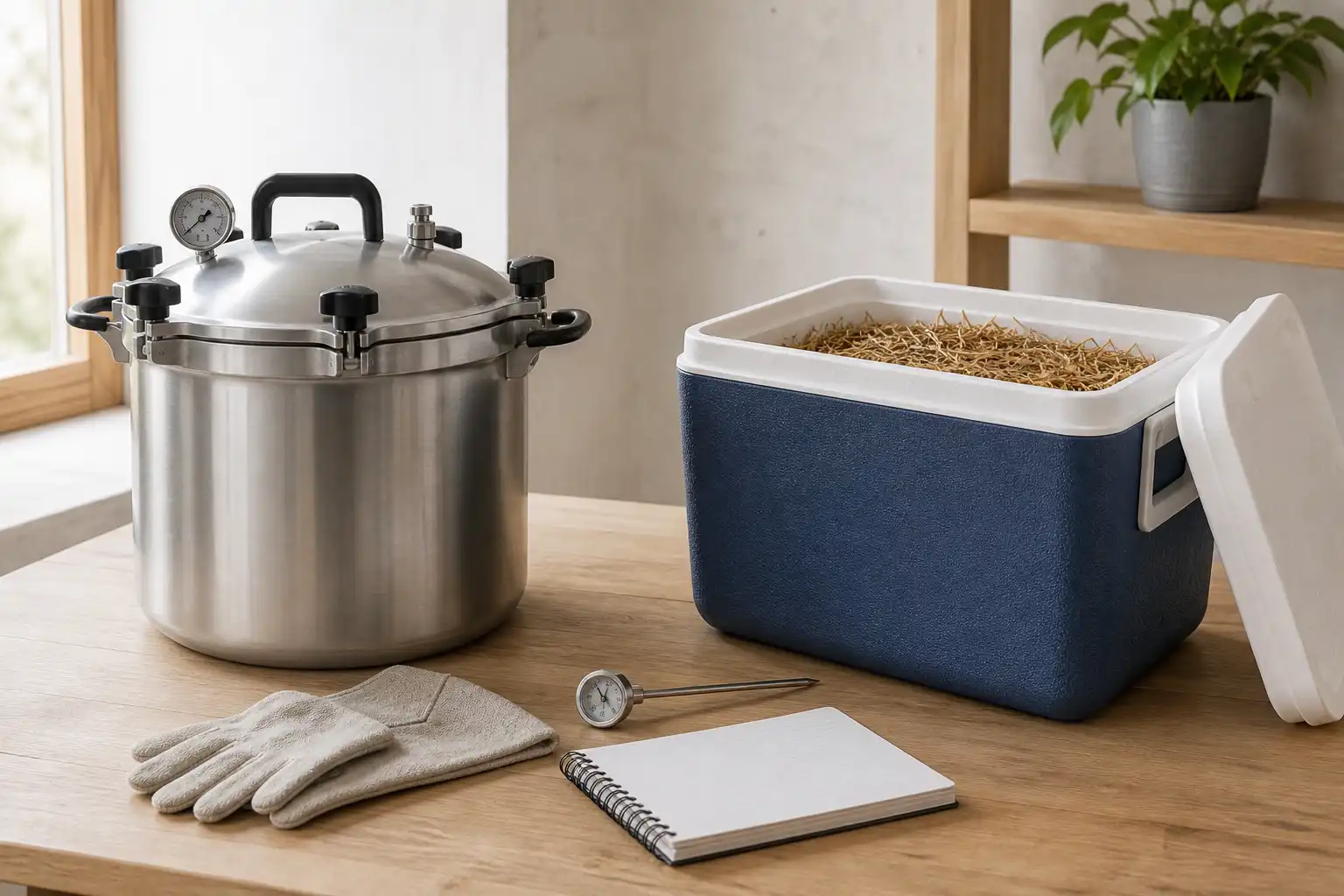
Pasteurize vs Sterilize Mushroom Substrate: A Home Grower’s Guide
Choose pasteurization or sterilization by substrate and workflow, then reduce contamination risk with a conservative, documented home-growing process.
growing
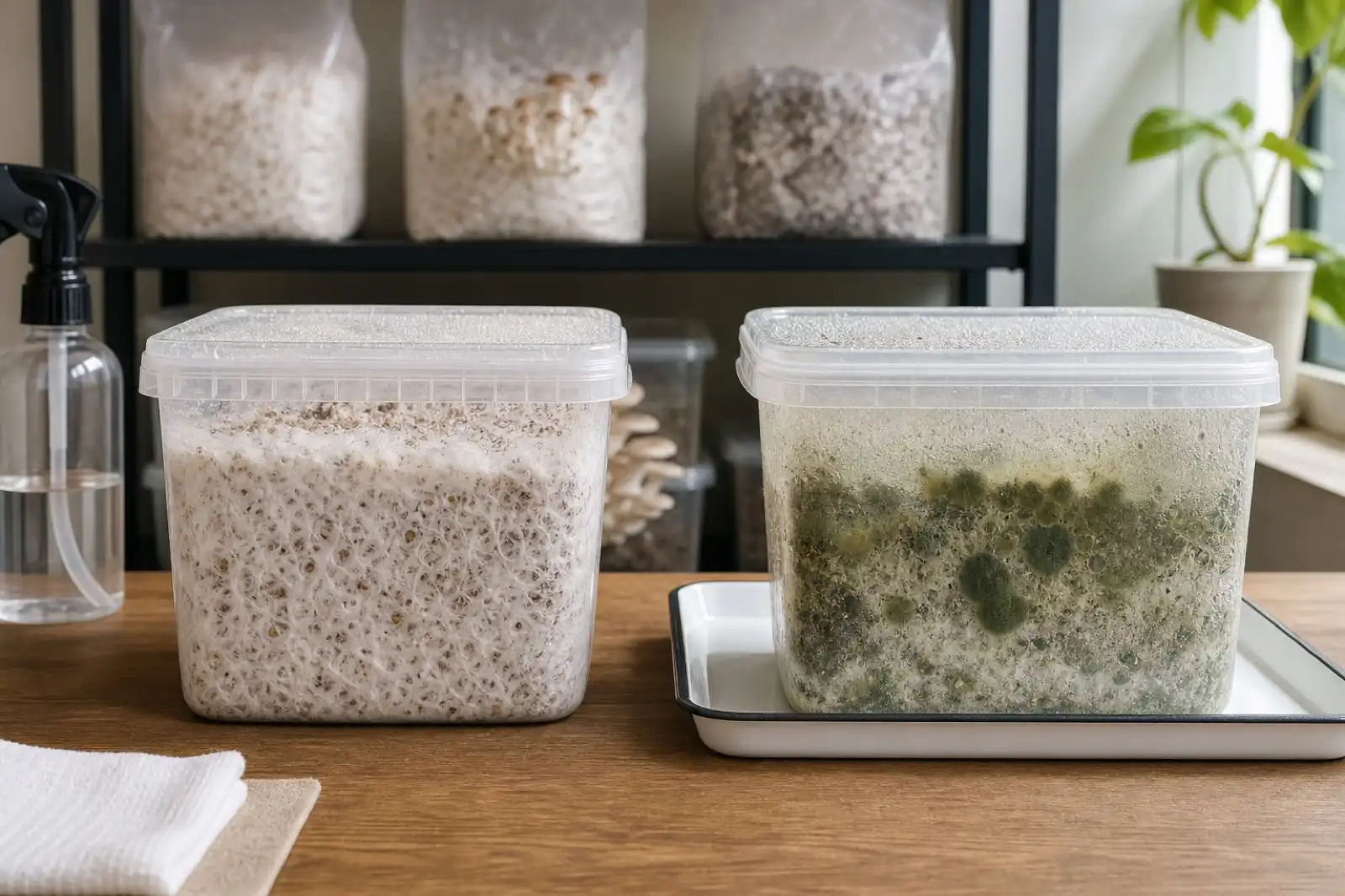
Mushroom Contamination: Isolate, Record, and Prevent Repeat Problems
Recognize mushroom contamination without relying on color alone; isolate suspect batches, avoid food salvage, document the workflow, and prevent repeat issues.
Continue exploring
Browse more practical guides in Growing or visit the mushroom encyclopedia.