Identification
Amanita Identification: Veils, Complete Bases, and Safety Limits
Document Amanita using veils, complete stem bases, free gills, white spores, tree ecology, regional keys, and strict no-consumption safety limits.
Safety first
Use as a field-record guide
Document the whole mushroom, habitat, substrate, and region before comparing names or photographs.
Open the identification safety hub →Decision limit
Do not use this as an edibility verdict
Wild mushroom consumption decisions require qualified local, in-person confirmation of the complete specimen.
Read the safety disclaimer →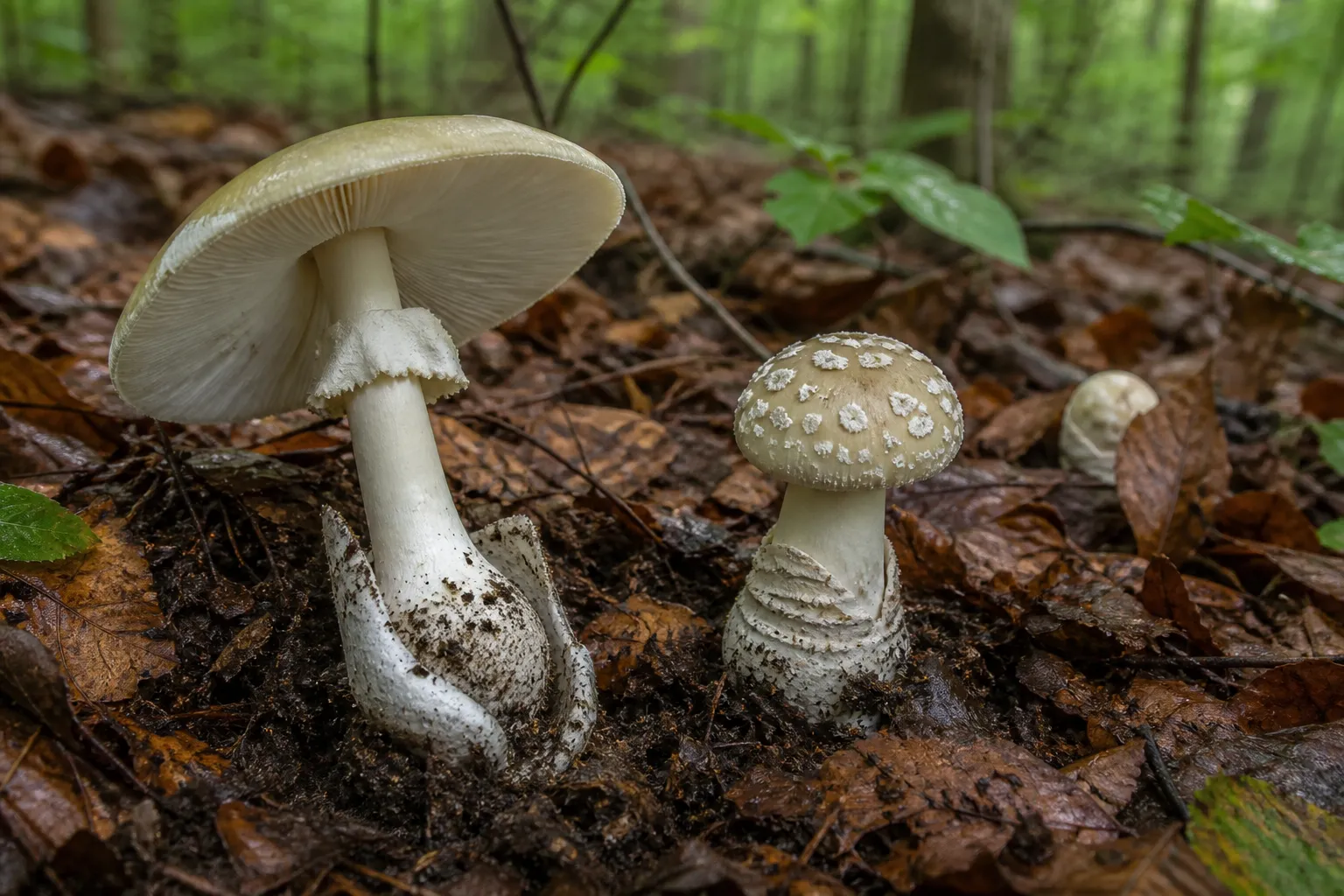
Amanita is not one visual pattern. The genus contains hundreds of species ranging across colors, sizes, veil forms, habitats, and toxicology. Some carry amatoxins capable of causing liver failure and death; others produce different syndromes; some have food histories in particular cultures. That diversity makes genus-level recognition useful for stopping a risky decision, but it makes online “edible Amanita” approval indefensible.
The practical goal of this guide is to preserve the structures a regional expert or key needs. It does not teach a shortcut for consumption.
Begin with the complete mushroom, not the cap
Cap color is memorable and unreliable. Rain removes patches, sun fades pigments, soil stains pale surfaces, and phone cameras shift white balance. The most consequential evidence may be underground: a bulb, loose sac, concentric veil rings, or friable universal-veil material around the stem base.
Never cut a suspected Amanita at soil level. Excavate around the base with permission, lift the specimen intact, wrap it separately, and photograph the hole and attachment. A trimmed market-style stem destroys evidence before comparison begins.
Universal veil: the first developmental layer
Many Amanita fruit bodies begin enclosed by a universal veil. As the mushroom expands, that tissue can remain on the cap as patches, warts, flakes, or powder and at the base as a sac, collar, rim, concentric rings, or irregular fragments.
The pattern varies by species. A death-cap-type sac is not the universal Amanita base. Some groups show stacked rings; others leave friable material; weather and soil can remove most remnants. Record what is present without using one absent sac to exclude the genus.
Partial veil and ring variation
A second membrane, the partial veil, may protect young gills and later hang as a skirt-like ring. Rings can be thick or fragile, high or low, persistent or lost. Some Amanita groups characteristically lack a ring.
Look for remnants on the cap margin and a ring zone on the stem, not only a perfect skirt. Photograph young buttons before the veil breaks and mature specimens after it does. Development explains structures better than a single adult.
Cap remnants are movable evidence
Universal-veil patches often sit on the cap surface rather than growing as part of the cap skin. Rain, animals, and handling may displace them. Their color can contrast with the cap or become stained.
Record patch distribution, texture, and whether the cap margin is smooth, grooved, or appendiculate. Do not scrape patches merely to see if they detach; preserve the original pattern for documentation.
Gills and their attachment
Many Amanita species have crowded white-to-cream gills that are free from the stem or narrowly attached. Color and attachment vary, and white gills also occur in unrelated dangerous and harmless genera.
Photograph the gill-stem junction under side light. A torn cap can make attached gills look free. Record short gills, edge color, bruising, and developmental changes rather than writing only “white gills.”
Spore deposit and microscopy
The spore deposit is generally white to cream. That helps distinguish dark-spored genera but does not prove Amanita and does not separate poisonous from nonpoisonous species. Use a mature cap over contrasting surfaces and protect it from drafts.
Microscopic keys may use spore dimensions, shape, amyloid reaction, basidia, clamps, and veil tissue. Chemical reactions require correct reagents and training. If the identification purpose has high consequences, microscopy or DNA may be necessary.
Stem texture and bulb architecture
The stem may be smooth, fibrous, powdery, patterned, or zoned. Bases range from rounded bulbs to elongated rooting forms. Universal-veil tissue can adhere tightly or form a loose membrane.
Photograph the cleaned and uncleaned base. Soil context shows how the structure sat underground; gentle cleaning reveals veil architecture. Do not wash away friable powder before it is documented.
Tree ecology narrows the regional set
Most Amanita species form mycorrhizal associations with trees. Fruit bodies arise from soil in forests, parks, lawns, and gardens where roots extend, sometimes far from the trunk. Oak, beech, birch, pine, spruce, and other hosts support different regional species.
Record all plausible trees, not just the nearest trunk. Note whether roots may come from a tree outside the frame. A mushroom in turf can still be mycorrhizal when mature trees line the street.
Geography is not optional
An olive-capped Amanita in California, eastern North America, Europe, or East Asia does not automatically carry the same species name. Toxic lookalikes can resemble edible mushrooms familiar to people from another country.
CDC’s 2025–2026 Northern California report described 39 suspected amatoxin cases, three liver transplants, and four deaths; many patients had previously foraged similar-looking mushrooms elsewhere. Regional expertise is therefore a safety control, not a taxonomic luxury.
Developmental stages prevent false rules
Buttons may resemble edible puffballs or young gilled mushrooms because gills and stem remain enclosed. Cutting a button lengthwise can reveal an internal cap-and-stem outline, but this is a warning screen, not permission to eat any solid white interior.
Older mushrooms may lose rings, cap patches, and basal material. Documenting several ages in one patch connects the unopened form to the mature structures and reduces the temptation to invent separate names.
Death caps and destroying angels
Amatoxin-containing Amanita include death-cap and destroying-angel groups. Typical field profiles may combine pale or olive caps, white gills, rings, and sac-like volvas, but real specimens can be weathered, fragmented, or atypical. Appearance alone does not reveal toxin content.
Amatoxin illness can begin after a delay, and a person may seem to improve before severe liver injury becomes apparent. Do not wait for a visual identification or symptom progression before contacting emergency services or poison control.
Fly agaric and panther-type syndromes are different
Red or orange caps with pale warts are associated in popular culture with Amanita muscaria, but cap color varies and related species differ by region. These mushrooms are linked to isoxazole compounds rather than the amatoxin syndrome.
NAMA emphasizes that muscarine is not the relevant explanation for A. muscaria poisoning. This distinction belongs to clinicians and toxicologists; readers should not diagnose themselves from a common name or anticipated symptom list.
Amanita smithiana and matsutake confusion
NAMA notes serious kidney-damaging poisonings involving Amanita smithiana in the Pacific Northwest, where it may be confused with matsutake. Both can be robust pale mushrooms associated with conifers, but veil structures, gills, odor, rooting base, and regional keys require careful evaluation.
This comparison demonstrates why a pleasant smell or valued habitat is not clearance. Missing the entire base is especially damaging when distinguishing robust white mushrooms.
Puffball-button confusion
An unopened Amanita can appear as a pale ball. A lengthwise section may reveal a developing cap, gills, and stem inside, unlike the uniform interior expected of a true immature puffball. Yet sectional appearance must be interpreted with the exterior, base, habitat, and expert guidance.
Never sample a “puffball” whose interior contains organized mushroom structures, discoloration, or uncertainty. The poisonous warning-sign guide explains why warning features trigger stopping rather than proving one toxin.
Volvariella, Volvopluteus, and other volva-bearing fungi
A basal sac is not exclusive to Amanita. Some unrelated saprotrophic mushrooms have volvas but differ in spore color, gill maturation, substrate, and absence of mycorrhizal tree ecology. Pink-spored groups may have pale young gills that later change.
A structure should direct the next comparison, not end it. Make a spore deposit and record whether the mushroom grows from soil, compost, wood chips, or wood.
A field documentation protocol
- Photograph the untouched patch, host trees, and growth spacing.
- Record date, region, recent rain, elevation, and land use.
- Select several stages only where collecting is legal.
- Excavate each full base and keep specimens separate.
- Photograph cap, margin, patches, gills, partial veil, stem, and universal veil.
- Section one specimen, make a spore deposit, and record odor without tasting.
- Measure cap, stem, bulb, and veil structures.
- Apply a current regional key and seek qualified local mycology help.
Use the complete identification workflow and safety checklist as record templates.
Photographing without losing evidence
Use neutral natural light and include a scale beside, not on, the specimen. Photograph the base before and after gentle cleaning. Capture underside attachment at cap level and avoid wide-angle distortion that enlarges the nearest structure.
Do not place several species together for one photograph. Mixed collections make it difficult to connect each cap to its base and can contaminate a food basket with fragments.
What an app cannot assess
Image classifiers may suggest Amanita but cannot reliably recover an underground base, determine spore reaction, verify host roots, resolve regional species, measure toxins, or assess specimen mixture. A high confidence score is not a biological confidence interval.
Use an app only to generate comparison candidates. Never use it to authorize eating, home detoxification, or delayed medical care.
Cooking does not solve Amanita toxicity
CDC states that cooking does not remove or inactivate mushroom toxins. Recipes claiming boiling, soaking, drying, pickling, or discarding water makes an unknown Amanita safe should not be generalized. Some traditional practices concern specific expertly identified taxa and do not transfer across the genus.
This page deliberately provides no edible-species list. The downside of a regional naming error includes irreversible organ injury.
Exposure response
After suspected ingestion, contact emergency services or a poison center immediately. Do not wait for symptoms, because serious amatoxin effects may be delayed. Follow professional instructions rather than inducing vomiting or administering home remedies.
Preserve uncooked specimens, cooked leftovers, trimmings, photographs, location, meal time, symptom time, and information about everyone exposed. Keep material away from further consumption while making it available for professional identification.
Children, pets, and yard fruitings
Remove access to unknown yard mushrooms when children or animals may eat them, using gloves or tools and local disposal guidance. Touching intact mushrooms is not the same exposure as ingestion, but wash hands after handling and prevent fragments from reaching mouths.
Photograph before removal if safe. Trees can support recurring fruiting, so one cleanup does not eliminate the underground fungus or future mushrooms.
Image and editorial limits
The cover is an original AI editorial illustration designed to show variation in universal-veil remnants, a partial-veil ring, white gills, and full bases. It was regenerated after the first candidate showed an overly regular base that could mislead. The accepted image remains illustrative, not a genus template or voucher.
This draft has editorial review only; no named toxicologist, clinician, or taxonomist reviewed it. Medical statements are limited to public-health guidance and do not constitute treatment advice.
Frequently asked questions
Can an Amanita lack a visible ring?
Yes. Some groups lack rings and fragile rings can disappear. Genus evaluation must include the universal veil, spores, ecology, and regional key.
Is every olive-capped Amanita a death cap?
No. Color overlaps and changes with age. Treat a possible death cap as high risk, but use complete regional evidence for naming.
Is touching Amanita dangerous?
Poisoning is primarily associated with ingestion. Still, handle unknown mushrooms hygienically, wash hands, and prevent children or pets from eating fragments.
Can a white spore print prove Amanita?
No. Many genera have pale spores. It supports one part of a complete structural and ecological record.
Why keep every specimen separate?
Different species can fruit together. Separation preserves the relationship between cap, gills, stem, base, and location and reduces fragment transfer.
Sources and editorial method
CDC MMWR reports support the severity, delayed-risk, regional-misidentification, and prompt-response boundaries. NAMA supports syndrome distinctions and expert identification context. GBIF supports the genus taxonomic framework. This guide emphasizes evidence preservation and stopping rules rather than edible identification.
References
- Centers for Disease Control and Prevention. Amanita Species Mushroom Poisonings — Northern California, November 2025–March 2026. Public-health evidence for delayed amatoxin risk, visual misidentification limits, and immediate poison-control response.
- Centers for Disease Control and Prevention. Health Care Utilization and Outcomes Associated with Accidental Poisonous Mushroom Ingestions — United States, 2016–2018. National accidental-ingestion context.
- North American Mycological Association. Mushroom Poisoning Syndromes. Syndrome context; not a substitute for emergency care.
- Global Biodiversity Information Facility. Amanita genus record. Taxonomic and occurrence-data checkpoint, not a regional key.
Editorial review: September 10, 2026. No named toxicologist, clinician, or taxonomist reviewed this page. Recheck public-health advice, poison-center access, taxonomy, and source links before acting on a real specimen.
Source quality notes
MushroomScope cites sources that match the page scope, such as taxonomic databases, extension guidance, food-safety agencies, food-composition databases, and peer-reviewed or institutional health references. Sources support context and uncertainty; they do not turn an online page into specimen identification, medical advice, or a tested recipe record.
Frequently asked questions
What features should be checked when Amanita is possible?
Document the entire stem base, universal-veil remnants, partial veil or ring, free-gill attachment, spore color, cap margin, developmental stage, tree partners, region, and microscopic evidence.
Does every Amanita have a sac-like volva?
No. Universal-veil remnants may form a loose sac, concentric rings, a collar, patches, powder, or be lost with age and weather, so one absent form does not exclude the genus.
Are white gills and a ring enough to identify Amanita?
No. Those characters occur elsewhere and may disappear in Amanita. The complete base, veil history, spores, ecology, region, and a current key must be evaluated together.
Can cooking make a poisonous Amanita safe?
No safe detoxification assumption should be made. CDC warns that cooking does not remove or inactivate mushroom toxins, and amatoxin-containing species can cause liver failure and death.
What should happen after a suspected Amanita ingestion?
Contact emergency services or a poison center immediately rather than waiting for symptoms. Preserve uncooked material, meal remnants, photographs, and timing for clinicians and mycologists.
Related guides
identification
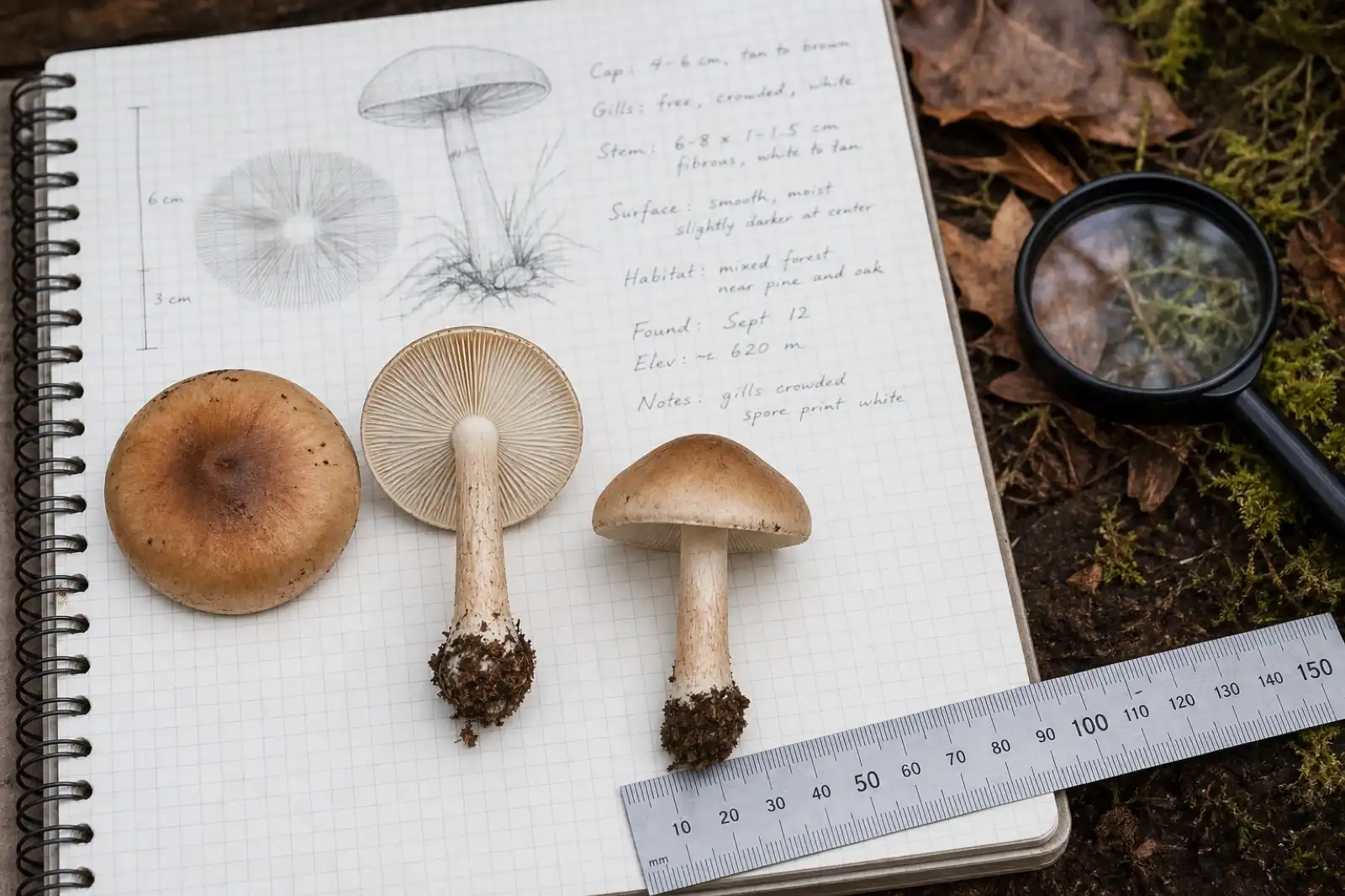
How to Identify Mushrooms: A Beginner's Field Guide
Build an identification from the whole specimen, substrate, habitat, spore deposit, and location—not from a single photograph.
identification
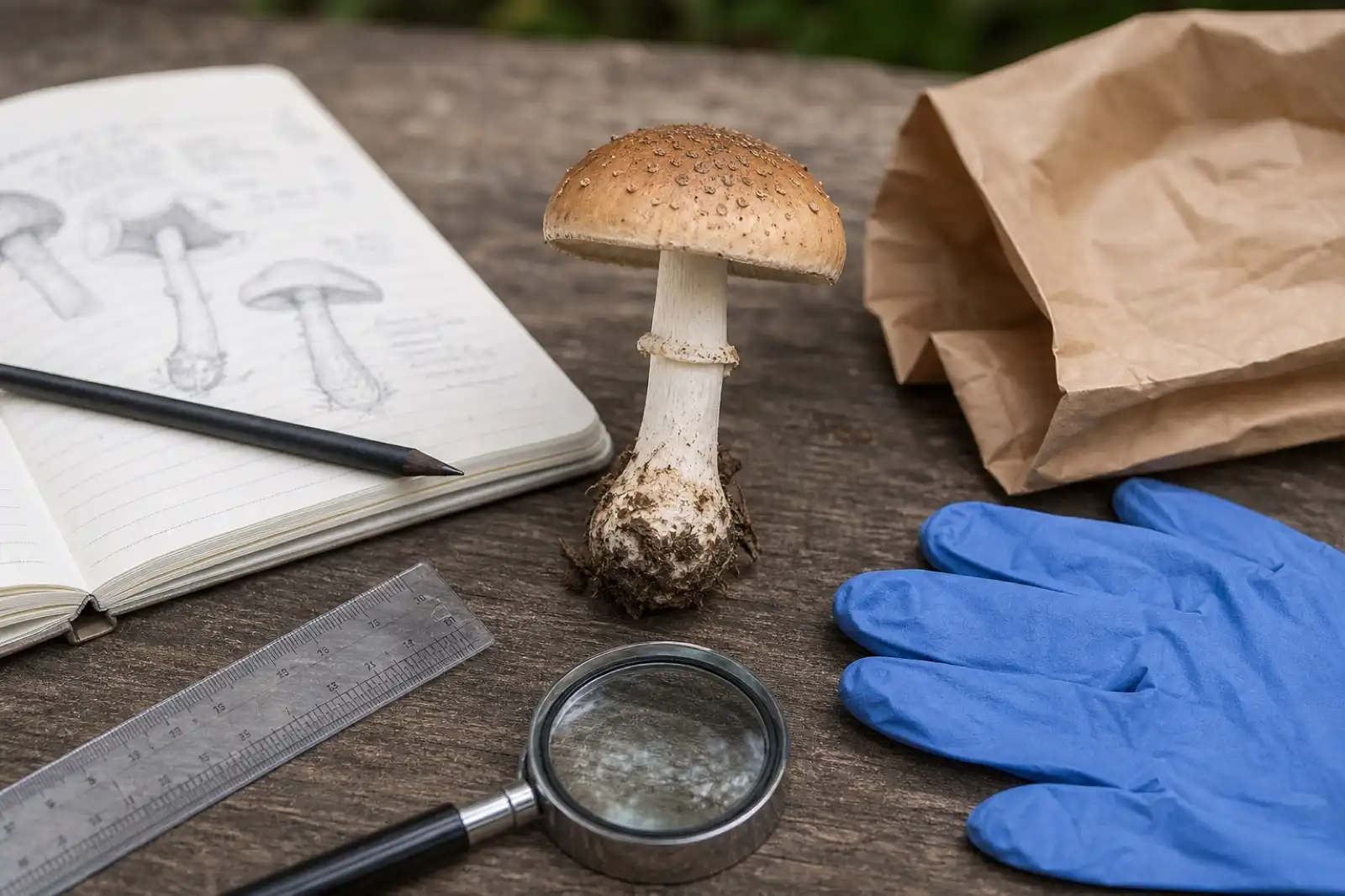
Mushroom Identification Safety Checklist
Use a conservative checklist before handling, documenting, or discussing any wild mushroom, especially when edibility is being considered.
identification
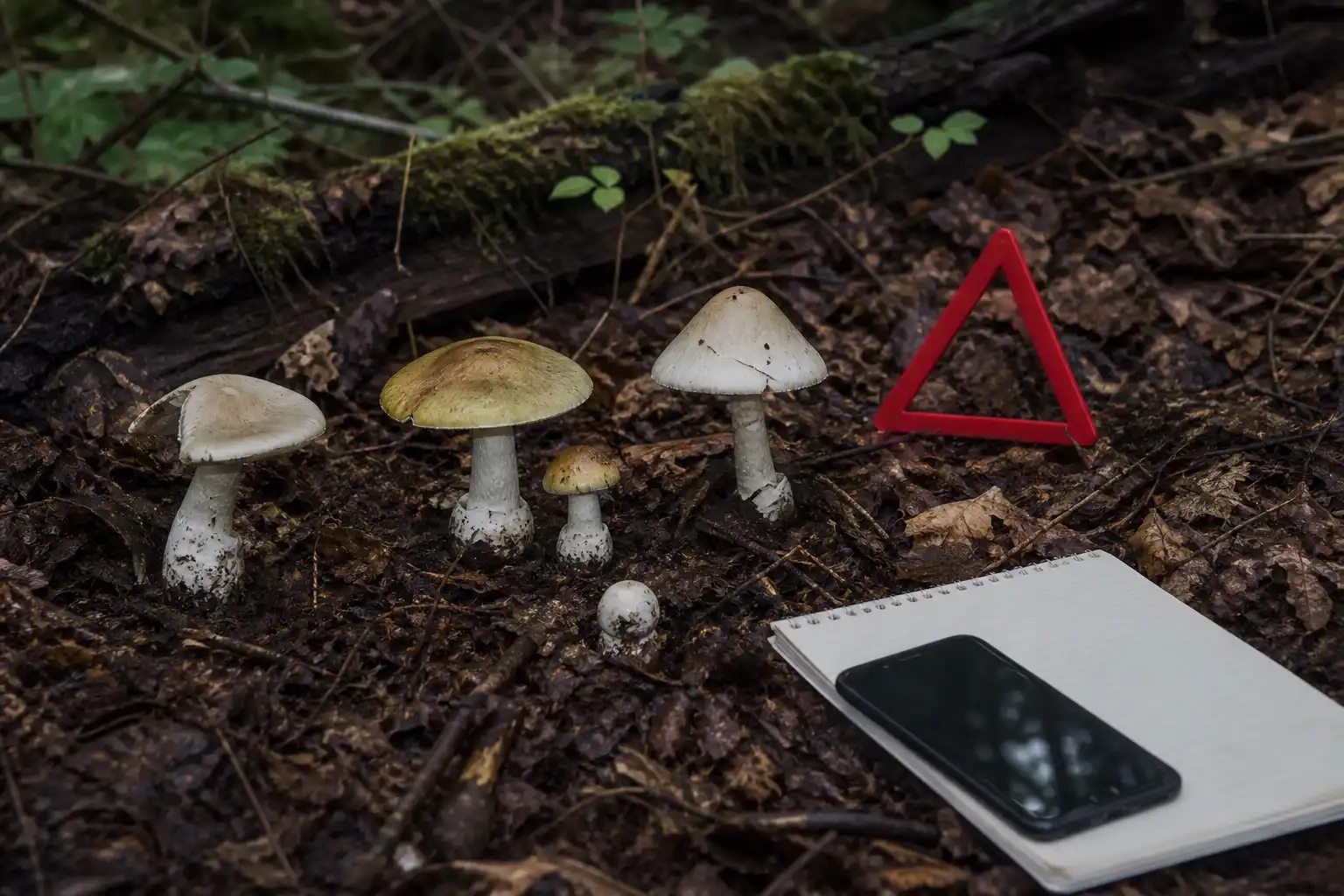
Poisonous Mushroom Warning Signs and Safety Rules
Learn why poisonous mushroom warning signs are unreliable alone, which safety rules matter, what to document, and when to seek urgent help.
Continue exploring
Browse more practical guides in Identification or visit the mushroom encyclopedia.