Identification
How to Identify Mushrooms: A Beginner's Field Guide
Build an identification from the whole specimen, substrate, habitat, spore deposit, and location—not from a single photograph.
By MushroomScope Editorial Team · · Updated
Safety first
Use as a field-record guide
Document the whole mushroom, habitat, substrate, and region before comparing names or photographs.
Open the identification safety hub →Decision limit
Do not use this as an edibility verdict
Wild mushroom consumption decisions require qualified local, in-person confirmation of the complete specimen.
Read the safety disclaimer →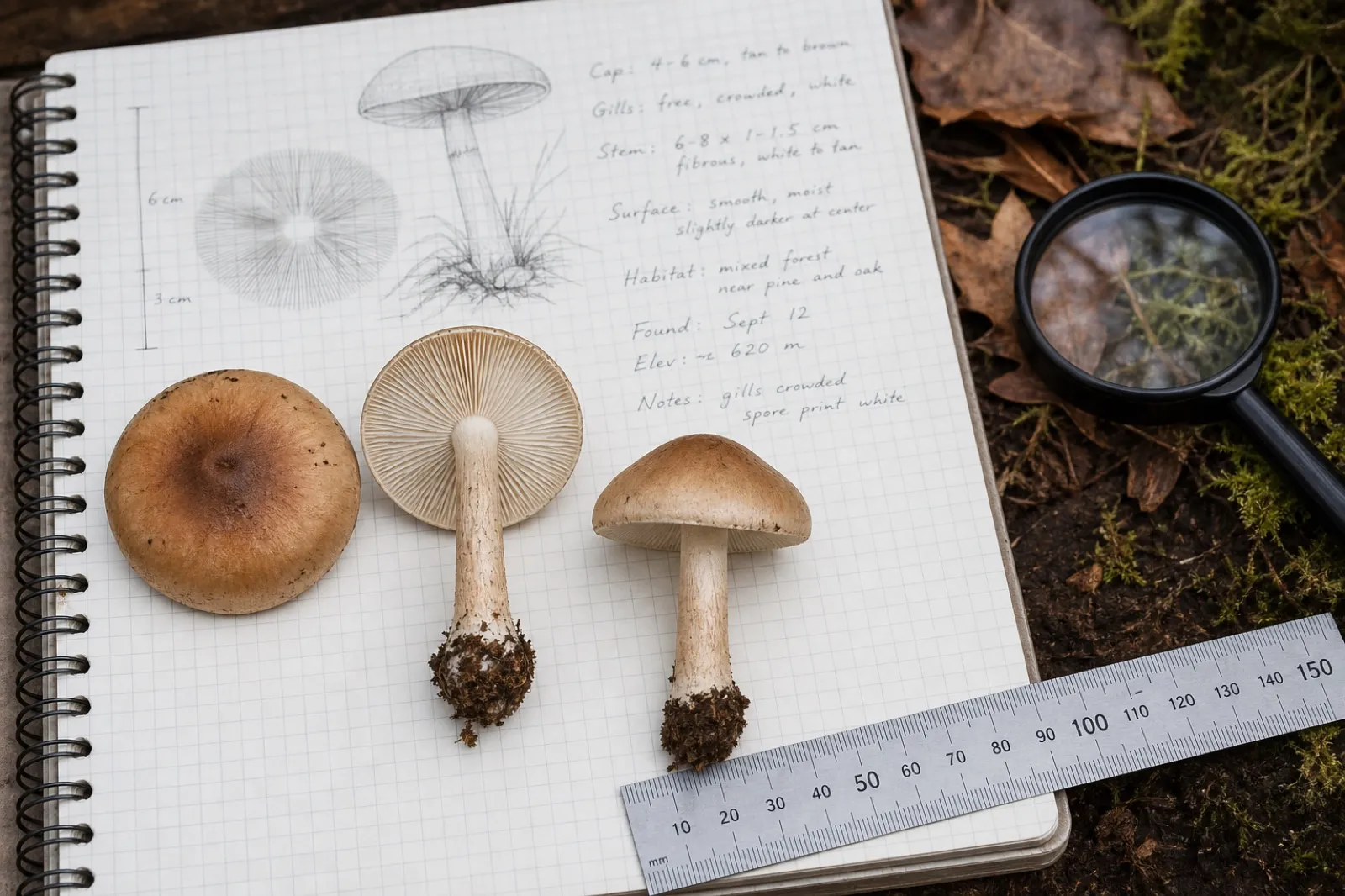
The outcome is a record, not a remote verdict
An identification begins by preserving evidence: the complete specimen, its habitat, its structures, and the questions that remain open. A name suggested by a photo, an app, or a common-name search is a hypothesis. It does not authenticate a species or establish that a wild mushroom is safe to eat.
University of Kentucky guidance emphasizes focused images of the cap, underside, whole mushroom, habitat, and a scale. Start there, then add written notes before anything is moved. When collection is legal and useful, retain an intact base and more than one age; a stem base, partial veil, or young pore surface can be decisive evidence that a cropped photograph loses.
Make an evidence record before comparing names
| Evidence | Record it this way | Do not conclude from it alone |
|---|---|---|
| Location and habitat | Country or region, date, weather, substrate, nearby plants, clustered or solitary growth | A species name based only on a host tree or season |
| Whole form | Cap width, stem proportions, base, and young and mature examples | Edibility from a familiar silhouette or cap color |
| Underside | Gills, pores, teeth, folds, or smooth surface; attachment and color | A genus from one underside photograph |
| Fresh changes | A timed photo of a clean cut or gentle bruise, with its exact location | Toxicity or safety from one color reaction |
| Reproductive evidence | A spore print on contrasting paper when safe and useful | Microscopic characters without microscopy |
Use measurements and natural-light images instead of color names alone. Moisture, age, light, and camera processing can change apparent color. The photo checklist provides a practical sequence; the spore-color guide explains how to document a print without treating it as a shortcut.
Work by exclusion, not resemblance
Choose the broad structure first: cap-and-stem mushroom, shelf fungus, cup, coral, puffball, jelly, or something else. Then ask which observations rule out a proposed match. A likely name should survive comparison with substrate, underside, stem base, developmental stage, and regional range—not merely share a color or shape.
Montana State University notes the value of an intact specimen for this comparison. If a feature cannot be observed, write it as missing rather than guessing. “Pore-bearing mushroom; base not collected; species unresolved” is more useful and safer than a confident but unsupported species label.
A practical field sequence
- Photograph the specimen where it grows, including substrate and nearby plants or trees.
- Photograph the cap, underside, entire stem, and the intact base with a scale. Add young and mature examples when present.
- Record date, location, weather, odor without close inhalation, texture, and any natural color changes.
- Where appropriate, make one clean cut and take timed photographs; make a spore print only away from food areas.
- Compare the full record with a current regional key and accepted taxonomy. Check whether every decisive feature fits.
- Stop at an unresolved result when a decisive character is missing or conflicts. Seek qualified local, in-person help before any consumption decision.
This workflow also makes expert review more efficient. It gives a local identifier the habitat, complete morphology, and uncertainty notes needed to explain why a name fits—or why it does not.
Keep technology in its place
Image search, community platforms, and identification apps can surface candidates, but they cannot inspect texture, odor, hidden tissue, spore dimensions, chemical tests, or local abundance. Treat their output as a comparison list. Preserve the original files and notes, and do not repeatedly edit images until a diagnostic color or shape appears stronger than it was.
GBIF can help check accepted names and occurrence data after a tentative identification, but a database occurrence is not a specimen determination. A regional key, herbarium, or local mycological group may be better placed to assess a real specimen.
Identify the fertile surface before comparing cap color
Determine whether the underside has true gills, pores, teeth, blunt folds, tubes, a smooth surface, or an enclosed spore mass. This first branch often narrows the candidate set more effectively than color. Photograph attachment to the stem and the margin.
For gills, record free, attached, notched, or decurrent attachment; spacing; short gills; edge color; and changes with age. For pores, record size, shape, color, bruising, and whether the tube layer separates. Use the gill guide and bolete guide as anatomy references, not edibility clearance.
Preserve veil remnants and the entire base
Partial veils can leave a ring, fibers, a cobwebby zone, or tissue on the cap margin. Universal veils can leave cap patches, a sac-like volva, collars around a bulb, or friable material at the base. Weather and handling may remove them, so compare young and mature specimens.
Cutting at ground level can eliminate decisive Amanita characters. Excavate carefully where permitted and photograph the base before cleaning. If it is missing, write “base not observed” and keep the identification unresolved. The stem-features guide explains rings, volvas, bulbs, rooting extensions, and interior structure.
Record controlled changes instead of relying on memory
Photograph untouched tissue first. Scratch or cut a defined area, note the starting color, and take timed photographs. Specify whether a reaction occurs on cap, pores, gills, stem surface, stem base, or internal flesh. Include an unhandled specimen for comparison.
Record odor cautiously and in plain language. Do not inhale deeply, taste an unidentified mushroom, or use chemical reagents without training. If a key requires a spore deposit, make it on adjoining light and dark nonabsorbent surfaces away from food areas and link it to the collection number.
Compare candidates with positive and negative evidence
Use a current regional key to generate a short list. For each candidate, compare range, season, habitat, substrate or host, growth pattern, cap, fertile surface, stem base, veil, spore color, staining, odor, and microscopy if required. Mark matches, conflicts, and missing data.
One decisive contradiction outweighs several generic matches. “Brown cap in woods” supports hundreds of possibilities; a white spore deposit cannot support a brown-spored candidate. Do not explain away a missing volva, wrong host, or incompatible pore surface because an image-search result resembles the cap.
Common names can cover several species, and taxonomy changes. Record the scientific name and reference concept used, date of determination, identifier, and confidence. Preserve earlier names so later reviewers can understand the change.
Use apps and communities as hypothesis tools
Image recognition can propose names to test, but it cannot inspect odor, texture, hidden tissue, spores, or microscopic characters. Training data may favor common photographed species and regions. Never use an app confidence percentage as probability of identity or safety.
When asking online, provide full-resolution images plus measurements and habitat notes. State what remains missing and ask which character would separate the leading candidates. Likes and repeated guesses are not independent expert confirmations.
DNA sequencing requires a documented voucher, appropriate marker, quality-controlled process, and reliable reference sequences. Molecular evidence complements rather than erases field documentation.
Apply a stop rule before any food decision
Stop when the base is missing, collections are mixed, decisive characters conflict, the specimen is degraded, the local key does not fit, or dangerous lookalikes have not been excluded. “Probably” is not a food-safety category. Seek a qualified local expert who can inspect complete fresh material in person.
Correct species identification still does not resolve pollution, pesticide exposure, freshness, allergy, interactions, or legal collection. Cooking cannot detoxify every poisonous mushroom. Beginners should learn through documentation and expert-led field groups rather than consumption experiments.
Eating and poisoning safety
Poison Control warns that lookalikes can fool even confident collectors and that cooking does not make a poisonous wild mushroom safe. Do not taste-test an unidentified specimen, use a single “rule,” or rely on online agreement before eating it.
After a suspected ingestion, contact local emergency services or a poison center promptly. Keep uncooked material, leftovers, packaging, and photographs only if it is safe to do so; do not delay care while waiting for an online identification.
Create a reusable determination record
A final record should preserve the field number, original photographs, measurements, substrate, associated plants, spore information, cut or bruise timing, candidate list, conflicts, identifier, reference used, and confidence. Export a copy outside the social platform where the discussion occurred. If the name changes, append the new determination instead of deleting the earlier one.
Revisit unresolved collections as learning exercises. List the exact missing character—complete base, mature gills, host, microscopy, or better location data—and plan how to capture it next season. An unresolved record with clear limitations is more valuable than a confident name that cannot be audited.
Before sharing a location, consider landowner privacy and conservation sensitivity. Precise coordinates can remain in a private scientific record while a public observation uses a broader locality. Identification quality does not require exposing a vulnerable site.
For teaching, compare one confirmed reference collection with one unresolved collection and explain why the second stops short. This trains attention to contradictory evidence rather than visual resemblance and keeps the page’s safety boundary operational.
Define what would change the conclusion
End every determination with the evidence that could strengthen or overturn it. Name the required view, measurement, microscopic feature, host confirmation, or expert comparison. This makes confidence testable and prevents a tentative label from becoming permanent merely through repetition. If that evidence can no longer be recovered, retain the conservative confidence level.
When an edible name has been proposed, use the edible mushroom lookalikes comparison method to build a regional alternative set and record the structures that could reject the candidate.
References
Source quality notes
MushroomScope cites sources that match the page scope, such as taxonomic databases, extension guidance, food-safety agencies, food-composition databases, and peer-reviewed or institutional health references. Sources support context and uncertainty; they do not turn an online page into specimen identification, medical advice, or a tested recipe record.
Frequently asked questions
Can this beginner's field guide confirm that a mushroom is edible?
No. This guide organizes observations only. Never eat a wild mushroom unless a qualified local expert has examined the complete specimen in person.
Is one photograph enough for identification?
No. Photograph the cap, fertile surface, intact stem base, habitat, substrate, and several developmental stages, and record location and date.
What should I do when features conflict?
Keep the identification unresolved. Recheck local keys and current taxonomy, preserve the original observations, and seek qualified in-person help.
Related guides
identification
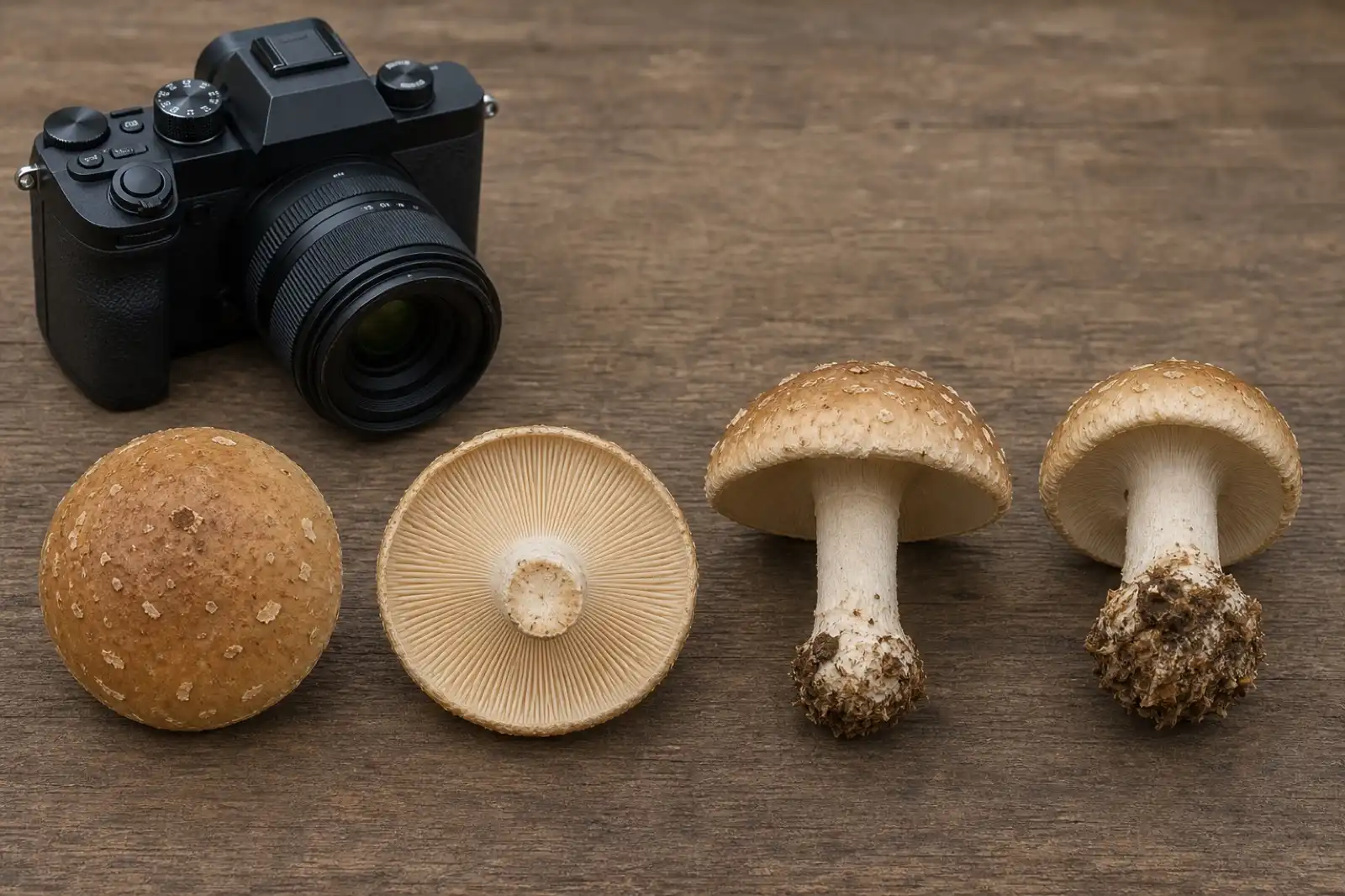
Mushroom Photography Checklist for Identification
Capture the cap, underside, complete stem base, habitat, scale, and specimens at different ages before asking for identification help.
identification
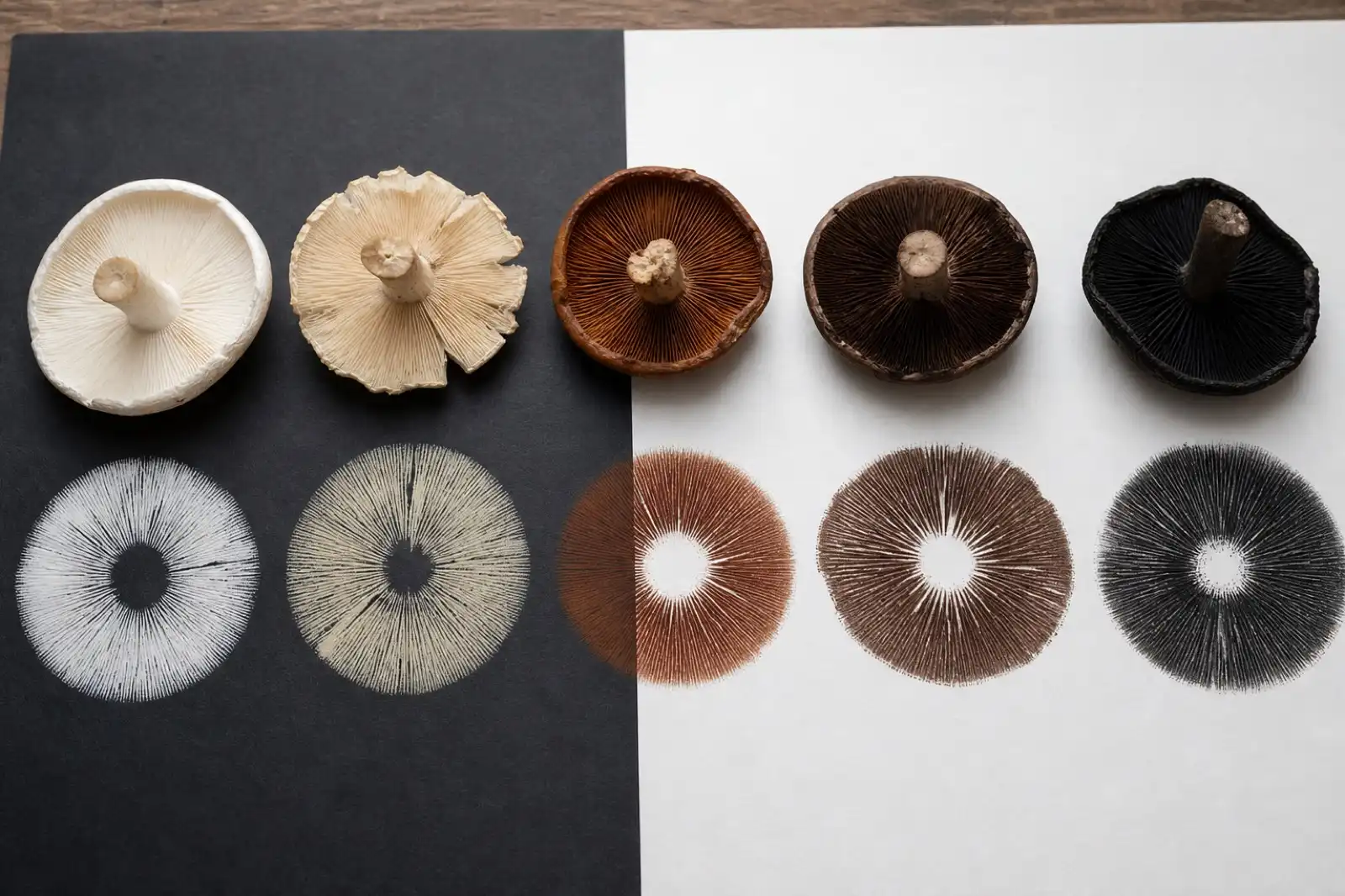
Mushroom Spore Print Colors and How to Record Them
Use a controlled spore deposit to distinguish broad color groups while recognizing that print color alone never identifies a species.
identification
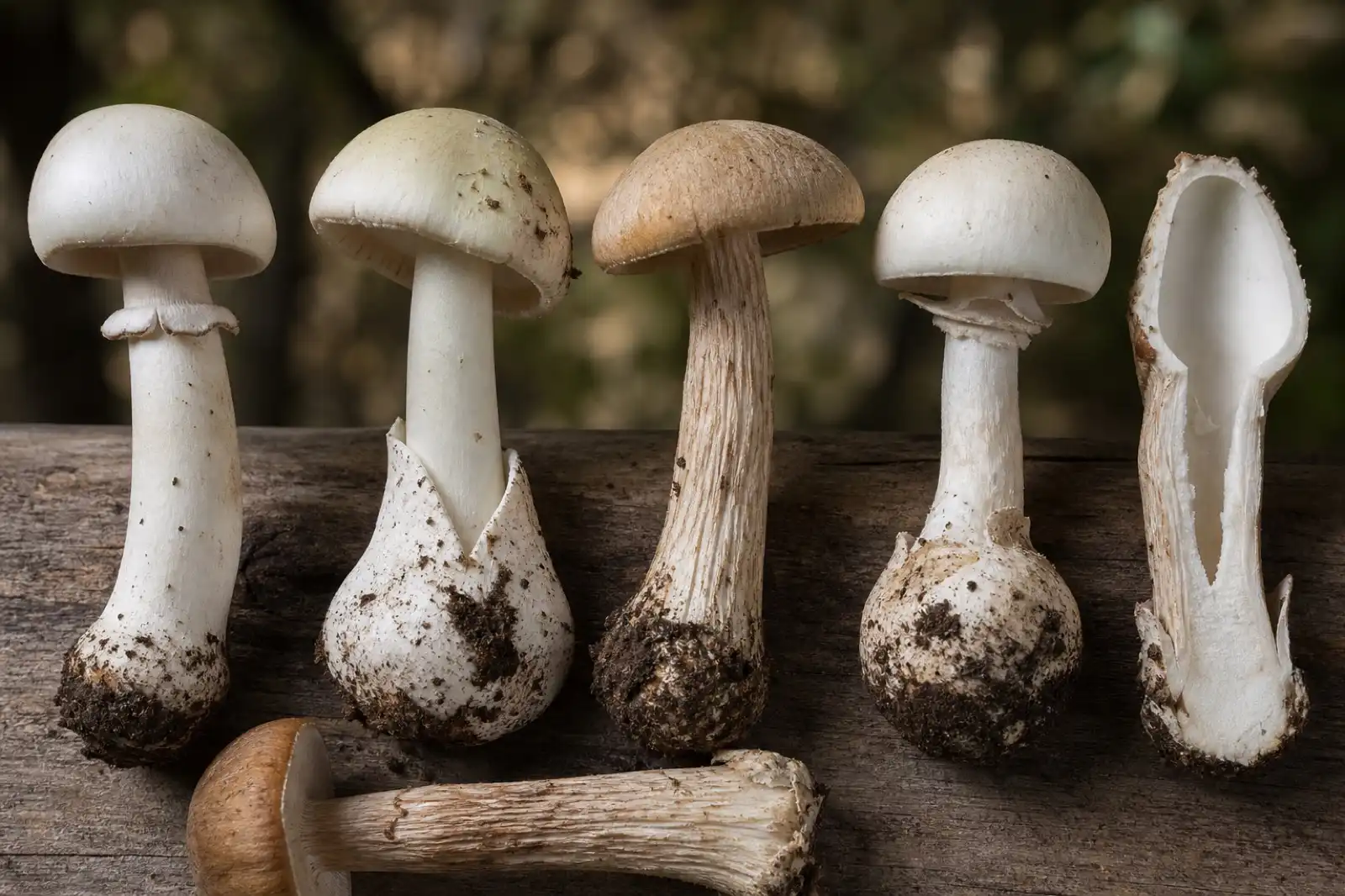
Mushroom Stem Features: Rings, Volvas, Texture, and Base
Document mushroom stem shape, attachment, rings, volvas, buried bases, internal structure, bruising, and texture without using one feature to decide edibility.
Continue exploring
Browse more practical guides in Identification or visit the mushroom encyclopedia.