Identification
Mushroom Stem Features: Rings, Volvas, Texture, and Base
Document mushroom stem shape, attachment, rings, volvas, buried bases, internal structure, bruising, and texture without using one feature to decide edibility.
By MushroomScope Editorial Team · · Updated
Safety first
Use as a field-record guide
Document the whole mushroom, habitat, substrate, and region before comparing names or photographs.
Open the identification safety hub →Decision limit
Do not use this as an edibility verdict
Wild mushroom consumption decisions require qualified local, in-person confirmation of the complete specimen.
Read the safety disclaimer →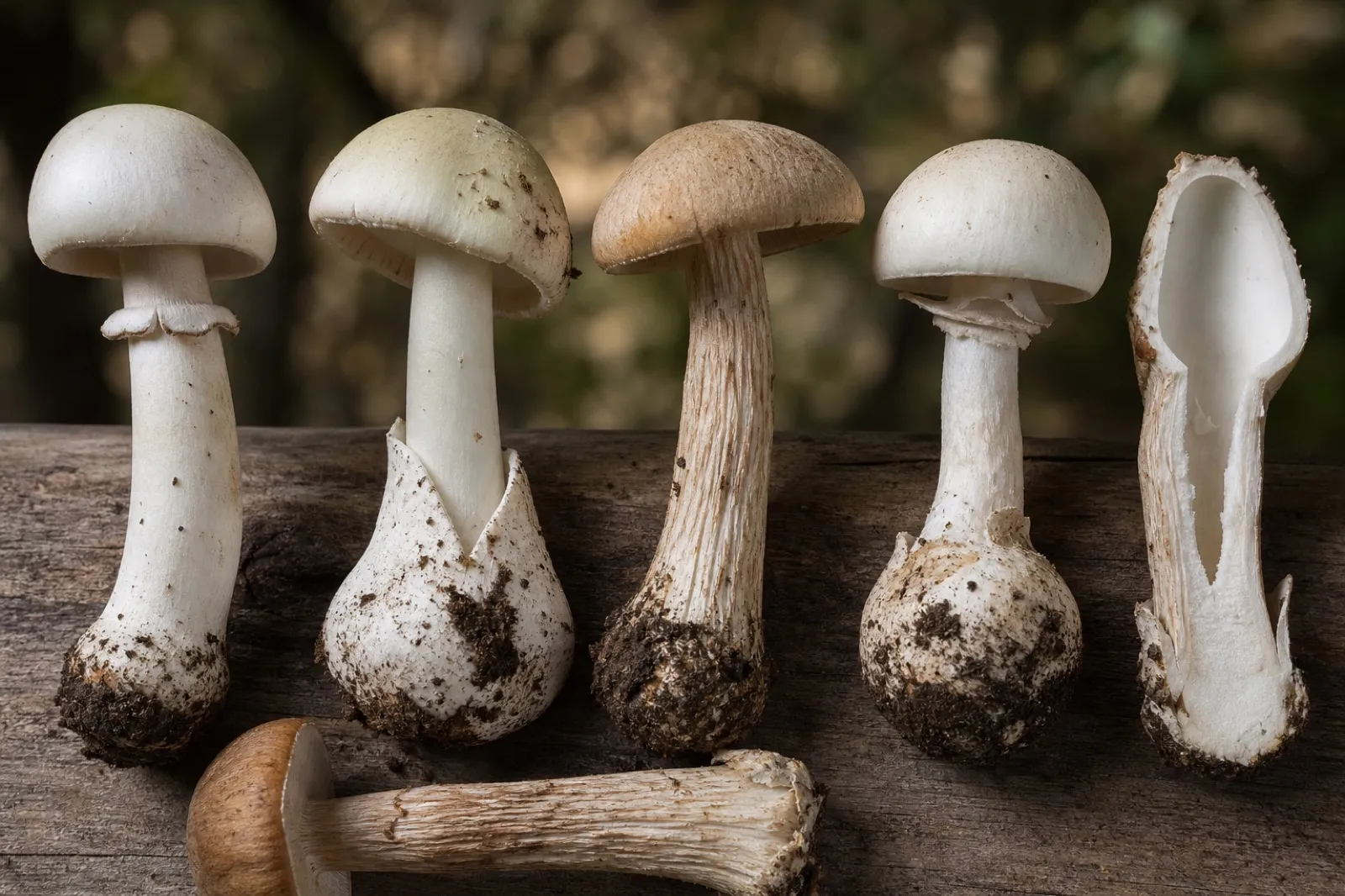
Treat the stem and intact base as diagnostic evidence
Document the complete mushroom stem, including buried tissue, rings, volvas, internal structure, and surface texture. The central task is the intact stem and its base. A defensible observation separates what was directly seen from what was inferred. Common names, image-search results, and app suggestions can generate hypotheses, but none establishes identity or edibility.
Photograph the stem while it is still attached, including the angle at which it enters soil or wood. Where collection is permitted, loosen material around the base and lift from beneath so bulbs, volvas, rooting extensions, and mycelial cords remain connected. Place the intact specimen beside a scale before cleaning; the first frame should preserve what later brushing and sectioning will remove.
What to examine
- ring or veil remnants: Record the feature in plain language, add a measurement or photograph, and note variation among specimens.
- volva or basal bulb: Record the feature in plain language, add a measurement or photograph, and note variation among specimens.
- solid or hollow interior: Record the feature in plain language, add a measurement or photograph, and note variation among specimens.
- surface ornamentation: Record the feature in plain language, add a measurement or photograph, and note variation among specimens.
- attachment to substrate: Record the feature in plain language, add a measurement or photograph, and note variation among specimens.
Stem characters change at different rates. A fragile ring can collapse within hours, a cortina can become only a rusty fibrillose zone after spores fall, and a solid young stem may become chambered with age or insects. Record young and mature specimens separately and distinguish “not visible” from “absent.” Regional keys often depend on combinations—base architecture, veil type, surface ornament, flesh, and spore color—not a single silhouette.
A repeatable field method
- Photograph the attachment and excavated base before removing soil or veil tissue.
- Measure stem length and width at apex, middle, lower stem, and bulb; note central, eccentric, or lateral placement.
- Describe ring or cortina structure from above and below, and photograph at least one unopened developmental stage.
- Section one representative from cap through base to record solid, stuffed, chambered, hollow, pithy, or larval-damaged tissue.
- Record timed bruising by tissue location and connect every image to the same numbered specimen.
- Compare the resulting character bundle with a current regional key; leave the name unresolved if the base or veil evidence was lost.
Excavate the base before describing stem shape
A mushroom pulled or cut at soil level may lose the most important part of its stem. Where collection is lawful, loosen soil in a circle around the specimen and lift from beneath rather than tugging the cap. Photograph the undisturbed base with attached soil and substrate, then brush it gently for a second view. Record whether it is bulbous, tapered, rooting, pinched, abruptly marginate, enclosed in a cup, or connected to cords or wood.
A cup-like volva may be buried, torn into patches, or reduced to rings around a bulb. Its absence cannot be claimed when the base is missing. Conversely, loose leaf tissue or a sheath of soil is not automatically a volva. Look for coherent mushroom tissue attached to the base and document it from several angles. Pale gilled mushrooms with an unknown base should remain unresolved, especially where dangerous Amanita species occur.
Buried wood can make a wood-growing mushroom appear terrestrial. Photograph the hole and any attached fibers or bark. Do not detach cords solely to make a tidy studio image. Habitat and physical attachment are part of the stem record, not background decoration.
Describe the stem from top to bottom
Divide the stem into apex, middle, lower section, and base. Compare width at each point and measure rather than using “thin” or “thick” alone. A stem may be equal, clavate, ventricose, tapered upward, tapered downward, or laterally attached. Note whether it is central, off-center, or absent, and whether several fruit bodies share a fused base.
Surface texture can change along its length. Photograph powder, fine hairs, longitudinal fibers, scales, pits, netting, grooves, slime, or a polished surface with side lighting. A reticulate network on a bolete stem is different from simple vertical fibers; zooming and sharpening should not invent a repeated mesh. Record the color above and below any ring because zones can differ.
Gently flex one collected representative when a key requires texture. Record whether the stem snaps cleanly, bends, shreds into fibers, feels cartilaginous, or is brittle like the cap. Do not use this as a taste or edibility test. Old, waterlogged, frozen, or insect-damaged tissue may behave differently from fresh material.
Section the stem lengthwise
After exterior photographs, cut one specimen vertically through cap, stem, and complete base. Show whether the stem is solid, stuffed with soft material, chambered, or hollow; whether the cavity is continuous; and whether flesh changes color. Make an immediate photograph and timed follow-ups under similar light when staining matters.
Hollowing can increase with age or insect activity, so compare young and mature specimens. A single tunnel made by larvae is not the same as a naturally hollow stem. Record flesh thickness and any internal line, color zone, pith, or watery area. Do not salvage food from a specimen whose identity or condition is doubtful.
Record rings as structures rather than checkboxes
A ring can be membranous, skirt-like, cottony, cobwebby, double-edged, thick, thin, movable, fixed, ascending, descending, or only a fragile zone. Photograph young specimens before the partial veil breaks, then mature specimens from above and below the ring. Note its position and whether it persists, collapses against the stem, adheres to the cap margin, or disappears.
An apparent ring may be a color boundary, spore deposit, handling mark, or debris. Look for actual veil tissue. A ring is not a universal sign of edibility: both edible and dangerous mushrooms can have one, and some specimens of a normally ringed species may lose it. Combine the feature with gill attachment, spore color, base, habitat, and regional keys.
For a movable ring, photograph its original position before testing. Do not repeatedly slide fragile tissue until it detaches, and never treat mobility as decisive by itself. If the ring was already missing, record “not observed” rather than “absent.”
Distinguish volvas, bulbs, and rooting bases
A sac-like volva can surround the base, while other universal-veil remains form concentric collars, patches, or friable material on a bulb. Photograph the transition between stem and structure, the interior and exterior of any cup, and matching veil remnants on the cap. Weather can wash tissue away, so multiple ages help.
A bulb without a volva occurs in many groups. Describe whether it is rounded, spindle-shaped, abruptly rimmed, or gradually swollen. Some stems extend deeply as a rooting pseudorhiza; measure the visible extension and document what it attaches to. Do not force a deep root from compact soil if excavation would cause unacceptable damage.
The combination of a volva and pale gills deserves particular caution, but no short checklist clears a mushroom for food. If the base was cut, leave the determination incomplete and seek another intact specimen for study rather than guessing.
Observe bruising, latex, and surface changes safely
Photograph the untouched stem first. Make a small scrape or cut at a labeled location, note the starting color, and capture changes at defined intervals. Specify whether color develops on the surface, in flesh, at the base, or after pressure. A blue, yellow, red, brown, or black change can mean different things in different groups.
Moisture can create dark handling marks that resemble staining. Compare an unhandled control specimen and use neutral light. Latex may emerge from gills or flesh rather than the stem alone; record its initial color and later change without tasting it. Strongly scented or irritating specimens should not be held near the face.
Chemical reagents belong to trained workflows with safety documentation. They do not authenticate edibility, and treated material must be separated from anything intended for food. Record reagent, concentration, tissue location, timing, and control when a professional key calls for a test.
Separate field observations from candidate names
Write a plain-language stem description before consulting image recognition: “65 mm long, 9–13 mm wide, widening to an abrupt 24 mm bulb; dry white fibers; fragile superior skirt; solid; no color change in ten minutes.” This remains useful even if taxonomy changes. “Looks like species X” does not preserve the evidence.
Build a comparison table for plausible local candidates. Include complete base, ring structure, stem surface, interior, staining, gill or pore attachment, spore deposit, substrate, and season. Mark missing characters explicitly. One attractive match should not outweigh a contradictory volva, spore color, or host.
The photo checklist provides the views needed to share this evidence, while the gill-types guide helps connect underside attachment to the stem. Keep separate collections separate; a cap from one and a base from another can create a fictional combination.
Interpretation limits
Remote reviewers need the unglamorous stem views: the soil-coated base, ring underside, stem apex beside the gills, longitudinal section, and timed stain. A cap-only upload cannot establish that a volva was absent or that a stem was naturally hollow. If microscopy or sequencing is pursued, retain a dried voucher linked to those views; a sequence name is only as trustworthy as the specimen and reference data behind it.
If an unknown mushroom has been eaten, do not spend treatment time reconstructing a missing stem base online. Contact emergency services or a poison center promptly. Preserve complete uncooked specimens, trimmings, leftovers, photographs, collection location, and meal timing when safe; professional identifiers may need the very basal and veil characters that were omitted from a food photograph.
Connect stem evidence with underside and habitat
Carry the numbered stem record into the species encyclopedia and pair it with the relevant identification guides. A useful comparison keeps one cap, underside, stem, base, and spore record linked; borrowing a base from a second collection creates a character combination that no real specimen possessed.
Stem features organize a hypothesis but cannot establish food safety. Never eat a wild mushroom based on a ring, volva, hollow stem, color change, or online image match. Seek a qualified local expert who can inspect the complete fresh collection, and keep uncertainty explicit when decisive tissue is absent.
A complete-stem case study
The parasol mushroom guide shows why ring mobility, lower-stem zigzags and an excavated base must remain linked to one specimen rather than being inferred from separate photographs.
References
- National Center for Biotechnology Information. NCBI Taxonomy Browser. Lineage and current-name context; a database name does not replace specimen characters.
- Global Biodiversity Information Facility. Species Search. Regional occurrence context to evaluate alongside an intact stem record.
- Mushroom Observer. Observation database. Examples of community identifications whose value depends on complete, linked specimen photographs.
Source quality notes
MushroomScope cites sources that match the page scope, such as taxonomic databases, extension guidance, food-safety agencies, food-composition databases, and peer-reviewed or institutional health references. Sources support context and uncertainty; they do not turn an online page into specimen identification, medical advice, or a tested recipe record.
Frequently asked questions
Can mushroom stem features: rings, volvas, texture, and base confirm that a mushroom is edible?
No. This guide organizes observations only. Never eat a wild mushroom unless a qualified local expert has examined the complete specimen in person.
Is one photograph enough for identification?
No. Photograph the cap, fertile surface, intact stem base, habitat, substrate, and several developmental stages, and record location and date.
What should I do when features conflict?
Keep the identification unresolved. Recheck local keys and current taxonomy, preserve the original observations, and seek qualified in-person help.
Related guides
identification
Mushroom Cap Shapes: A Practical Identification Guide
Compare mushroom cap shapes from convex and bell-shaped to flat, depressed, funnel-shaped, and uplifted, while recording age, margin, surface, and profile.
identification
Mushroom Gill Types: Attachment, Spacing, and Color
Compare free, attached, notched, adnate, and decurrent mushroom gills while recording spacing, short gills, edge details, bruising, and color changes.
identification
How to Identify Mushrooms: A Beginner's Field Guide
Build an identification from the whole specimen, substrate, habitat, spore deposit, and location—not from a single photograph.
Continue exploring
Browse more practical guides in Identification or visit the mushroom encyclopedia.