Identification
Mushroom Cap Shapes: A Practical Identification Guide
Compare mushroom cap shapes from convex and bell-shaped to flat, depressed, funnel-shaped, and uplifted, while recording age, margin, surface, and profile.
By MushroomScope Editorial Team · · Updated
Safety first
Use as a field-record guide
Document the whole mushroom, habitat, substrate, and region before comparing names or photographs.
Open the identification safety hub →Decision limit
Do not use this as an edibility verdict
Wild mushroom consumption decisions require qualified local, in-person confirmation of the complete specimen.
Read the safety disclaimer →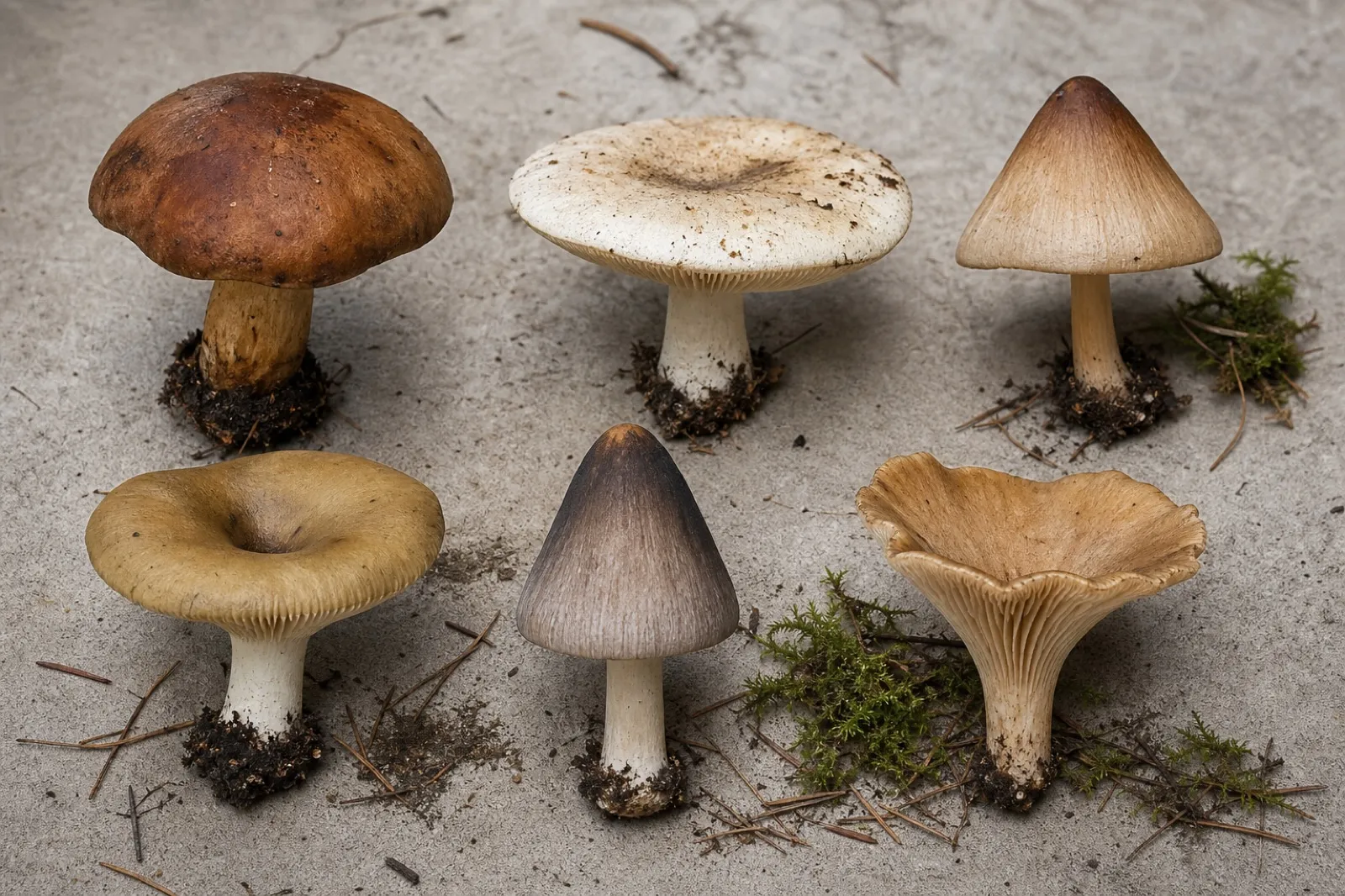
Why cap shape is useful but never decisive alone
Cap shape is one of the first characters a field observer notices, yet it is also one of the easiest to oversimplify. A young cap may begin nearly spherical, expand through a convex stage, become flat, and finally develop an uplifted or depressed margin. Rain, drought, crowding, insects, and uneven growth can distort the expected profile.
The goal is therefore not to attach one permanent label to a mushroom. Record the profile visible at a stated developmental stage, then combine it with cap surface, margin, fertile surface, stem, complete base, flesh, spore deposit, habitat, season, and region. A cap-shape match can narrow a key; it cannot confirm a species or edibility.
Use ordinary descriptive language alongside technical vocabulary. “Broadly convex, 62 mm wide, with a low central bump and slightly inrolled margin” preserves more information than “umbrella shaped.” Photograph the specimen rather than forcing an uncertain observation into a glossary term.
Establish a consistent viewing angle
Shape changes with camera position. A top-down image records outline and zoning but hides height, central depression, and margin orientation. A low side view shows the profile but may exaggerate perspective. Capture both, keeping the lens roughly level with the midpoint of the cap for the profile image.
Include a ruler in the same plane as the cap, without covering diagnostic tissue. Record cap width at the broadest point and cap height from the attachment area to the highest point when a key uses that measurement. For irregular caps, take two perpendicular widths.
Photograph several specimens before collection. A single abnormal fruit body may have grown against a log or neighboring mushroom. A group showing young, middle, and mature stages reveals the developmental sequence that a field guide is describing.
Rounded young caps: globose, hemispherical, and ovoid
A globose cap is approximately spherical. A hemispherical cap resembles half a sphere, with a rounded summit and sides descending toward the margin. Ovoid describes an egg-like outline that is longer in one direction. These terms often apply to immature mushrooms whose caps have not fully separated from the stem.
Young veil tissue can conceal the gills or pores and make a cap appear smoother and more regular than it will later become. Do not identify a mushroom from a closed “button” stage alone. If lawful and appropriate, document other fruit bodies at the site rather than forcing open the young specimen and destroying veil characters.
The difference among globose, hemispherical, and ovoid is sometimes gradual. Record the photograph and measurements; a regional key may care more about veil remnants, the complete stem base, or how the cap expands than about the exact adjective.
Convex and plano-convex profiles
Convex is the common dome shape: the center is elevated and the surface curves downward toward the margin. The curve may be shallow or strongly rounded. Plano-convex means broadly convex but approaching flat, often an intermediate or mature stage.
These are widespread forms across unrelated groups. “Convex brown mushroom” is therefore not a useful identification by itself. Add whether the margin is inrolled, straight, or extended; whether the surface is dry, greasy, viscid, fibrous, or scaly; and whether the fertile surface has gills, pores, teeth, folds, or another structure.
Measure instead of estimating from a cropped photograph. A 20 mm convex cap and a 200 mm convex cap may belong to entirely different comparison sets.
Bell-shaped, conical, and campanulate caps
Campanulate means bell-shaped: the center is high, the sides descend relatively steeply, and the margin flares outward. Conical describes a more continuously tapering profile, sometimes with a rounded rather than sharp apex.
The boundary is not mathematical. A young mushroom may be conical-campanulate and later become broadly bell-shaped or nearly flat. State the combined term when that is more honest than selecting one illustration.
Look at the margin for translucent striations, splitting, hanging veil fragments, or waviness. Thin caps may show gill lines through moist tissue, while drying can reduce their visibility. Photograph in soft natural light rather than using flash that creates false highlights.
Umbonate, papillate, and centrally elevated caps
An umbo is a localized central elevation on a broader cap. It can be broad and low, sharply defined, or prominent. A very small, nipple-like central projection may be described as papillate. The surrounding cap can still be convex, flat, or depressed, so record both components: “plano-convex with a broad umbo,” for example.
Do not confuse an umbo with a cap that is uniformly conical. View the transition between center and surrounding surface. Also check several specimens because dehydration or mechanical damage can exaggerate the center.
Umbonate profiles occur in many groups, including toxic and edible taxa. The feature has meaning only inside a complete key.
Flat, plane, and uplifted caps
A plane cap is approximately flat across most of its width. Few natural caps are perfectly level; use the term for the dominant profile rather than a laboratory plane. Many mushrooms reach this shape at maturity after passing through convex stages.
An uplifted or upturned cap has margins raised above the central area. This can expose the gills or other fertile surface from the side. Old age, dry weather, or crowding may produce an irregular uplifted margin even when the typical species description is different.
Record whether uplifting occurs consistently across healthy mature specimens. An overmature, decayed cap should not be the sole basis for describing the normal form.
Depressed, umbilicate, and funnel-shaped caps
A depressed cap has a central area lower than the surrounding surface. The depression may be shallow and broad. Umbilicate describes a small, navel-like central depression. Infundibuliform means distinctly funnel-shaped, with the cap sloping into a deep center.
These terms describe degrees and patterns rather than rigid boxes. A cap can move from convex to centrally depressed as it expands. Some mushrooms become funnel-shaped while others retain a shallow depression. Photograph a side section when the depth is hard to show.
Observe whether gills or folds run down the stem, but do not assume that every funnel-shaped fungus has the same fertile-surface structure. The gill-types guide explains attachment terms that should be recorded separately.
Irregular, lobed, saddle-shaped, and shelf-like forms
Not every fungus has a circular cap on a central stem. Lobed caps have broad divisions or uneven outlines. Saddle-shaped caps curve upward and downward around a central attachment. Fan-shaped, kidney-shaped, or shelf-like forms often have lateral stems or no obvious stem and may grow from wood.
Crowded clusters can force normally regular caps into fan-like or wavy forms. Separate a growth effect from a stable character by examining uncrowded specimens at the same site. For wood-growing shelves, record the attachment area, upper surface, edge, thickness, underside, and whether multiple tiers overlap.
Terms such as “brain-like” or “coral-like” can be useful first impressions, but replace them with precise structural notes. The false morel comparison shows why folds, pits, attachment, and internal structure must be evaluated together.
The margin is a separate character
Describe the cap edge even when the overall profile seems obvious. An inrolled margin curves inward toward the stem; a downturned margin points downward; a straight margin extends outward; and an uplifted margin rises. These states can change with age.
Also record whether the margin is smooth, scalloped, lobed, split, appendiculate with hanging veil fragments, radially striate, or translucent-striate. A ribbed appearance may come from the cap tissue, from gills showing through, or from dehydration, so inspect closely.
Take a close side photograph that includes the edge and underside. A top photograph alone often loses the most useful margin information.
Surface texture modifies the shape description
A smooth cap can be dry, silky, greasy, sticky, or gelatinous. Other caps may be fibrous, suede-like, granular, cracked, concentrically zoned, covered with scales, or dotted with veil remnants. State whether decorations are embedded in the skin or removable.
Moisture matters. A viscid surface may dry before the specimen is examined, while hygrophanous tissue changes color as water evaporates. Record weather and touch observations without licking or tasting. If a cap was already handled or washed, say so.
Do not mistake adhering leaves or soil for natural scales, and do not clean the cap before photographing. Surface and profile together are more informative than either alone.
Build an age sequence rather than a single label
Arrange observations by stage: closed or very young, expanding, mature, and overmature. For each, record cap width, profile, center, margin, surface, and fertile-surface exposure. This can reveal transitions such as hemispherical → convex → plane → uplifted, or convex → depressed → funnel-shaped.
Avoid assuming that nearby mushrooms represent an age sequence merely because their sizes differ. Confirm that the character set and substrate are consistent; mixed species can fruit side by side.
A developmental sequence is especially valuable when a key describes how a veil breaks, whether the margin loses striations, or when a central depression appears.
Common observation errors
Perspective distortion is the most frequent photographic error. Wide-angle phone lenses can enlarge the foreground edge and make a flat cap appear domed. Step back and use moderate zoom, then take a true side view.
Other errors include describing only the largest specimen, treating damage as normal form, recording cap color under colored artificial light, and copying a term from an app without verifying its meaning. Cropping out the stem base or underside sacrifices characters that may matter more than cap shape.
Do not turn a cap-shape diagram into an edibility chart. Closely similar profiles occur in toxic, non-toxic, edible, and unknown taxa.
A complete cap record
For each collection, write a compact description in a consistent order: dimensions; developmental stage; overall profile; center; margin orientation and ornament; surface texture and moisture; colors in natural light; changes after handling; and variation among specimens.
Then connect that record to the rest of the mushroom: fertile-surface type and attachment, stem characters, complete base, flesh, spore deposit, substrate, associated trees, date, and region. The stem-features guide and general identification workflow cover those next steps.
If characters conflict with the proposed species, keep the record unresolved. This page cannot authenticate a wild mushroom or determine whether it is safe to eat.
References
Source quality notes
MushroomScope cites sources that match the page scope, such as taxonomic databases, extension guidance, food-safety agencies, food-composition databases, and peer-reviewed or institutional health references. Sources support context and uncertainty; they do not turn an online page into specimen identification, medical advice, or a tested recipe record.
Frequently asked questions
Can mushroom cap shapes: a practical identification guide confirm that a mushroom is edible?
No. This guide organizes observations only. Never eat a wild mushroom unless a qualified local expert has examined the complete specimen in person.
Is one photograph enough for identification?
No. Photograph the cap, fertile surface, intact stem base, habitat, substrate, and several developmental stages, and record location and date.
What should I do when features conflict?
Keep the identification unresolved. Recheck local keys and current taxonomy, preserve the original observations, and seek qualified in-person help.
Does one mushroom keep the same cap shape as it grows?
Often not. Many caps progress from rounded or convex to flat, depressed, uplifted, or irregular, so several developmental stages are more informative than one specimen.
Is an umbo the same as a pointed cap?
No. An umbo is a localized central elevation on a broader cap profile. Record whether it is broad, low, sharply defined, or nipple-like instead of using pointed as a complete description.
Related guides
identification
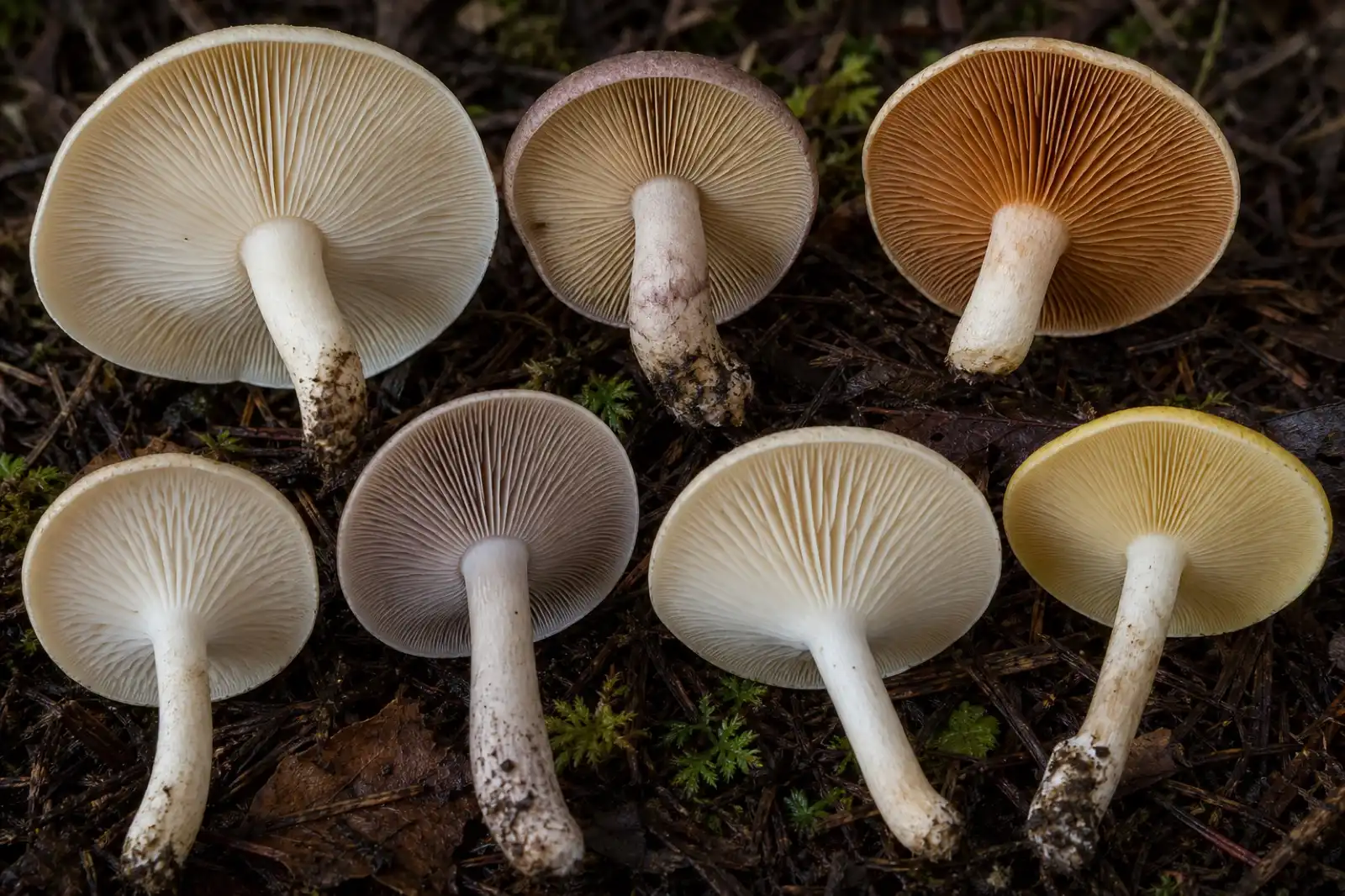
Mushroom Gill Types: Attachment, Spacing, and Color
Compare free, attached, notched, adnate, and decurrent mushroom gills while recording spacing, short gills, edge details, bruising, and color changes.

identification
Mushroom Stem Features: Rings, Volvas, Texture, and Base
Document mushroom stem shape, attachment, rings, volvas, buried bases, internal structure, bruising, and texture without using one feature to decide edibility.
identification
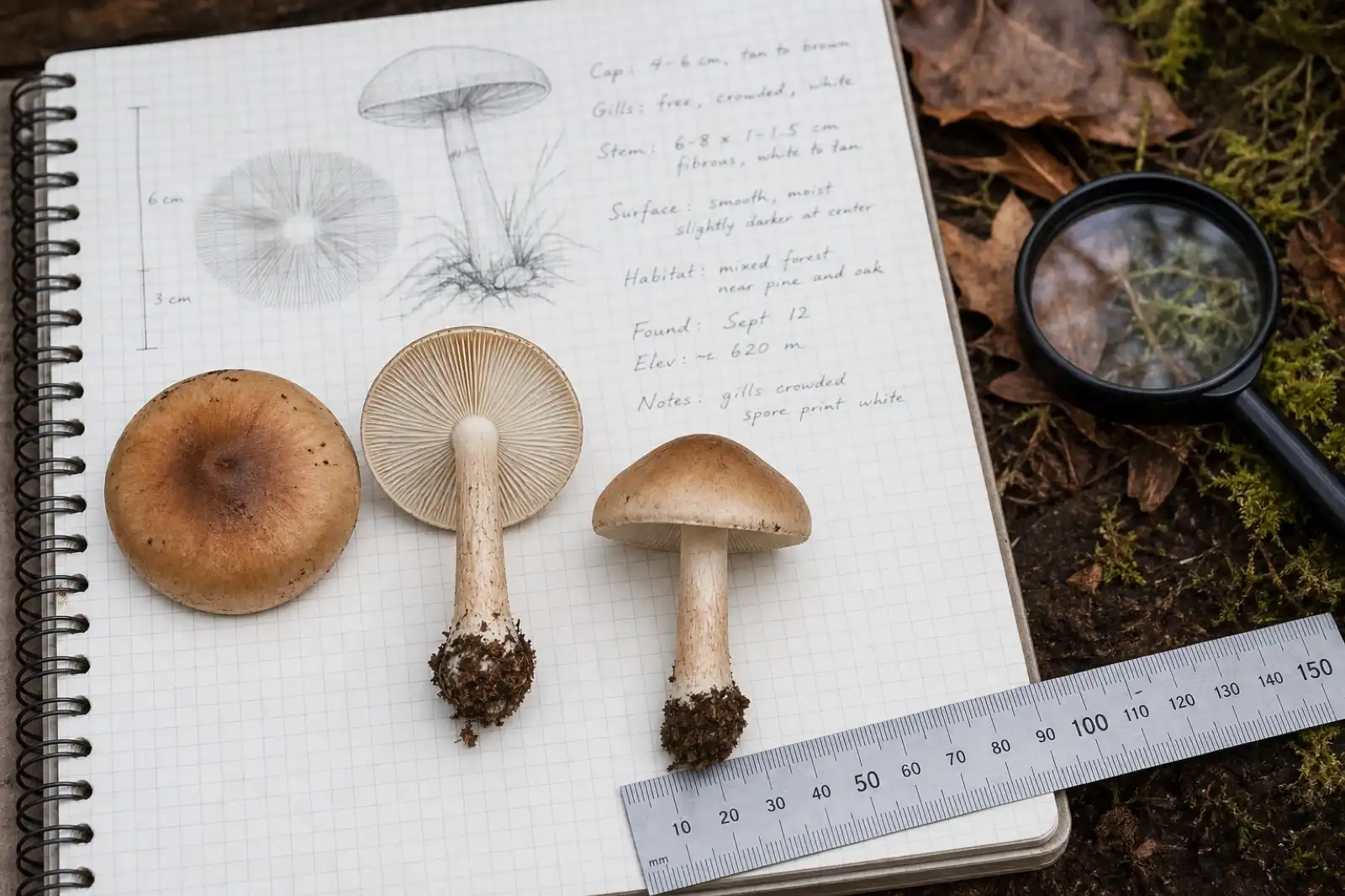
How to Identify Mushrooms: A Beginner's Field Guide
Build an identification from the whole specimen, substrate, habitat, spore deposit, and location—not from a single photograph.
Continue exploring
Browse more practical guides in Identification or visit the mushroom encyclopedia.