Identification
False Morel vs. Morel: Identification and Safety
Compare cap attachment, internal structure, folds, habitat, and season while treating every uncertain specimen as unsafe.
By MushroomScope Editorial Team · · Updated
Safety first
Use as a field-record guide
Document the whole mushroom, habitat, substrate, and region before comparing names or photographs.
Open the identification safety hub →Decision limit
Do not use this as an edibility verdict
Wild mushroom consumption decisions require qualified local, in-person confirmation of the complete specimen.
Read the safety disclaimer →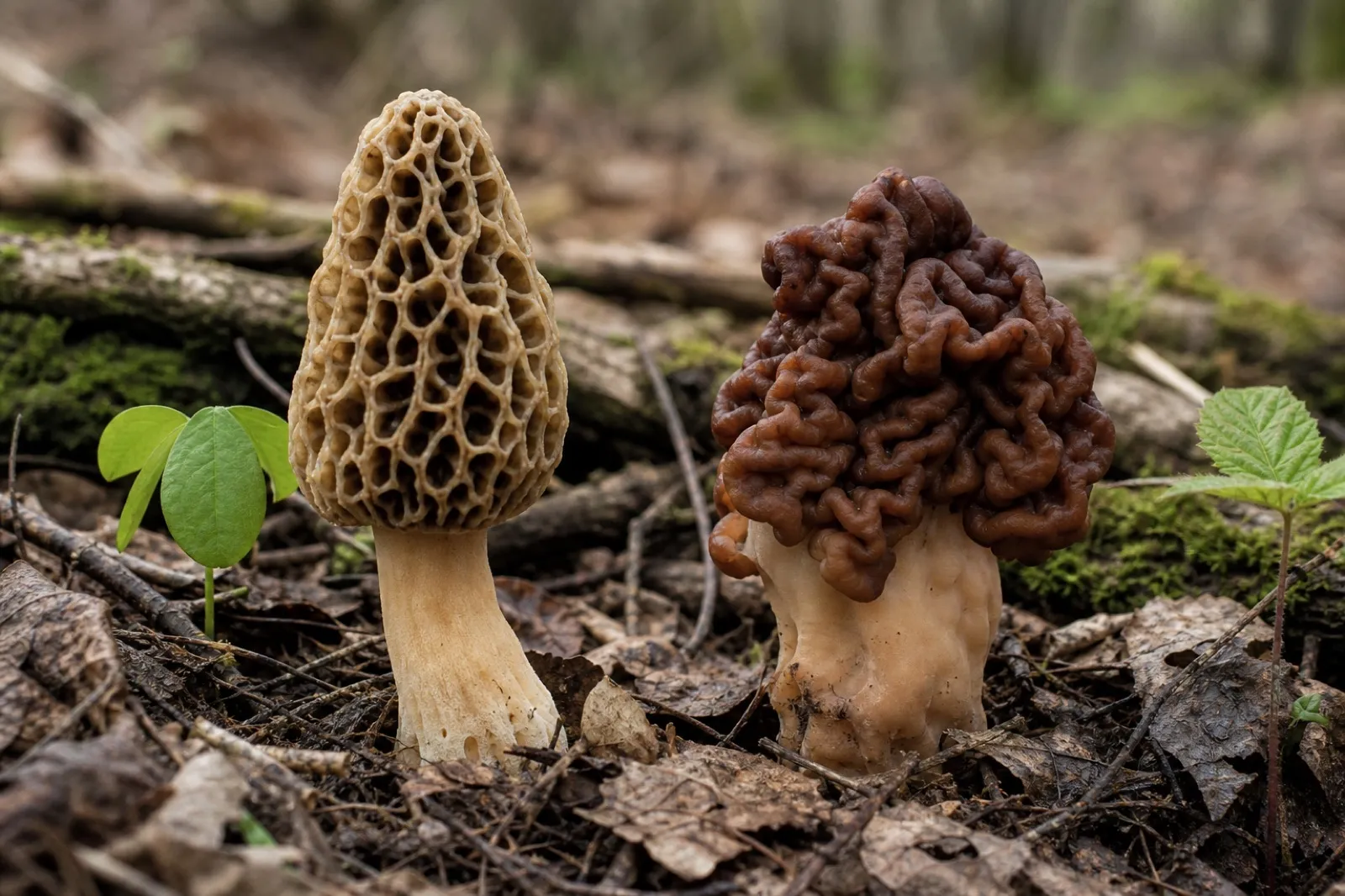
The safe conclusion comes first
True morels belong to Morchella. Several unrelated spring fungi—especially species of Gyromitra, Verpa, and sometimes Helvella—may be called “false morels.” The common-name category is imprecise, and risk is not identical across every species or region. That is exactly why a photograph or one memorable slogan is not enough to clear a specimen for food.
A practical comparison uses several independent characters: the cap surface, how the cap joins the stem, the structure seen in a lengthwise section, habitat, season, geography, and variation across multiple fruit bodies. If the complete set does not agree with a current regional key, the collection remains unidentified and uneaten.
This guide helps document differences; it cannot authenticate a meal. Do not taste a specimen as an identification test. Do not rely on an app, an image search, a market name, or a stranger’s online vote. A qualified local identifier needs to examine the complete material in person before any food decision.
True morel and false morel are not single species
“True morel” describes a genus, not one globally uniform mushroom. Morchella species differ by region and can change color, shape, and proportions as they age. Some names used in older field guides have been revised as molecular research clarified species boundaries.
“False morel” is even broader. Gyromitra includes fungi with different shapes and toxicological histories. Verpa caps are attached differently from typical Morchella, while some Helvella can enter a beginner’s comparison because they are folded or saddle-shaped. A rule learned for one taxon may fail with another.
Use distribution databases such as GBIF to check whether a proposed species is documented in the region, but treat occurrence records as context rather than identification proof. Records can be sparse, mislabeled, or based on older taxonomy. A local mycological society or regional key is more useful than a global image gallery.
Compare the cap surface in natural light
Pits and ridges on a true morel
A typical true morel cap has a structured network of ridges surrounding distinct pits. The fertile surface lines the ridges and pits, creating a honeycomb-like architecture. The pattern may be elongated or irregular, and color can range from pale tan through yellow-brown, gray, or dark brown depending on species, maturity, moisture, and lighting.
The word “honeycomb” is helpful only when it describes real, bounded pits. Dirt, decay, insect damage, camera sharpening, and a deeply wrinkled false morel can confuse a quick visual impression. Photograph the cap from several angles and include a scale.
Lobes, folds, and brain-like tissue
Many Gyromitra have folded, lobed, or convoluted caps often described as brain-like. The surface may form broad wrinkles and chambers rather than a regular field of pits. Some are reddish brown; others are tan or darker. Shape changes with age, and not every specimen looks like a textbook photograph.
“Brain-like means poisonous, honeycomb means edible” is not a safe standalone rule. It can help reject a suspicious specimen, but food clearance still requires every decisive character and local expertise.
Examine how the cap attaches to the stem
In many true morels, cap tissue is attached to the stem along or near the lower edge, with no long skirt of cap hanging freely. Some Morchella groups have a small groove where cap and stem meet, so attachment language must be applied with a species-aware key.
In Verpa, the cap is typically attached only at or near the top of the stem and hangs down like a thimble. A lengthwise section makes this easier to see than an exterior photograph. Some false-morel caps also have irregular attachment points or lobes fused to the stem in ways that do not match the simple diagrams repeated online.
Do not pull the cap from the stem to test attachment; that destroys information. Slice a retained voucher vertically from cap tip through the complete stem base, photograph both halves, and record the attachment before the tissue dries.
A longitudinal section is essential
The continuous cavity expected in a typical true morel
A typical mature Morchella section shows one continuous hollow space running through the cap and stem. The interior should not be packed with cottony material or divided into numerous independent chambers. The cap wall and attachment should be visible in the same cut.
“Hollow” alone is still insufficient. Insects can excavate tissue, old specimens can collapse, and other fungi can contain open spaces. Evaluate the continuous structure together with exterior pits, cap attachment, ecology, and regional fit.
Chambered or stuffed interiors require rejection
Many Gyromitra reveal convoluted, chambered flesh inside the cap. Some morel-like fungi may have cottony material within the stem, particularly when young. These findings conflict with the expected continuous cavity of a typical true morel and should end any food consideration.
Cut more than one specimen when lawful collection permits. A single damaged fruit body may be misleading, while a group containing inconsistent interiors could represent mixed species—a serious collecting hazard.
Stem characters provide supporting evidence
True-morel stems are often pale, finely granular, and relatively even, but proportions vary. Record length, width, texture, bruising, and whether the base is enlarged. Photograph the entire base rather than snapping the stem at ground level.
False-morel stems can be grooved, irregular, chambered, or differently proportioned, but no universal false-morel stem description covers every species. Stem characters are supporting evidence, not a replacement for cap architecture and sectioning.
Never infer safety because a stem looks clean or because slugs have eaten the mushroom. Animals can tolerate exposures differently from people, and feeding damage does not authenticate species.
Habitat, trees, season, and region
Both true and false morels may fruit in spring, sometimes in overlapping woodland habitats. Depending on region and species, true morels may be associated with particular hardwoods, conifers, old orchards, river bottoms, burns, disturbed soil, or landscaping material. False morels may occur near conifers, woody debris, soil, or similar forest settings.
Habitat can strengthen or weaken an identification, but it rarely proves one. Record exact substrate: mineral soil, leaf litter, buried wood, visible log, mulch, or a burn area. Note nearby living and dead trees, elevation, slope, recent disturbance, and date. Avoid converting broad habitat tendencies into universal rules.
Regional distribution matters because the likely species in western North America may differ from those in eastern North America, Europe, or Asia. Importing a foreign checklist into a local food decision is unsafe.
A repeatable documentation method
- Photograph the undisturbed group, surrounding habitat, substrate, and nearby trees.
- Record location, date, recent weather, elevation if known, and whether specimens are solitary or grouped.
- Collect only where lawful and retain the complete stem base. Keep each apparent type separate.
- Photograph cap pits or folds, the cap-stem junction, stem surface, and several developmental stages in neutral light.
- Cut representative specimens lengthwise from cap tip through the stem base and photograph the interiors immediately.
- Compare the complete character set with a current regional key; do not browse for the closest-looking photograph.
- Preserve a voucher when seeking expert help and label it with the field notes. Keep it away from edible collections.
- If any decisive feature conflicts or is missing, record the identification as unresolved.
The broader mushroom identification safety checklist explains how to keep observation, hypothesis, and food decisions separate. The cap-shape guide can help describe form without pretending shape alone establishes identity.
Toxicity of false morels
Some Gyromitra are associated with gyromitrin and its toxic breakdown products. Illness can involve gastrointestinal and neurologic effects and may become severe. Toxin concentration and individual susceptibility can vary, so a history of eating a similarly named mushroom without symptoms does not make a new collection safe.
Do not use boiling, drying, repeated water changes, or traditional preparation as a home detoxification experiment. Preparation can expose other people to contaminated material or fumes, and partial toxin reduction is not reliable clearance. CDC’s 2026 public-health foraging guidance describes Gyromitra false morels as not edible and notes possible nausea, vomiting, abdominal pain, diarrhea, and seizures.
Different countries and communities may have traditions involving particular false morels. This page takes a conservative global safety position: when identity and toxin exposure cannot be controlled, do not eat the specimen.
Correctly identified true morels still require care
“True morel” does not mean safe raw. CDC investigated a 2023 Montana restaurant outbreak in which 51 people reported gastrointestinal illness after dining; consumption of morels was strongly associated with illness, raw consumption had the stronger association, and severe outcomes occurred. The outbreak specimen was identified as a true morel, Morchella sextelata.
CDC advises thorough cooking to reduce potential toxic effects. Correct identification also does not remove risks from spoilage, contamination, improper storage, individual sensitivity, or excessive portions. First-time consumers should not combine a new mushroom with alcohol or multiple unfamiliar foods in a way that makes a reaction difficult to interpret.
This is not a cooking guide or permission to consume a wild collection. In-person expert confirmation comes before preparation, and local public-health advice takes priority.
If someone may have eaten the wrong mushroom
Do not wait for symptoms and do not wait for a social-media identification. In the United States, call Poison Control at 1-800-222-1222 or use Poison Control’s official online service; call emergency services for severe symptoms. Elsewhere, contact the local poison center or emergency medical service.
Do not induce vomiting or give a home remedy unless a poison specialist instructs you. Preserve uncooked mushrooms, cooked leftovers, cleaning scraps, photographs, and the collection location if doing so is safe. Keep materials separated and label them. Record the time eaten, estimated amount, preparation, number of people exposed, and symptom timing.
Urgent warning signs include repeated vomiting, severe diarrhea, dehydration, confusion, fainting, seizures, breathing difficulty, or rapidly worsening illness. Symptoms and timing cannot reliably identify the mushroom at home; professional toxicology advice is needed.
Identification limits and final decision
Remote communities can help improve photographs and suggest taxa, but viewers cannot reliably assess hidden structure, texture, odor, or microscopic features. Agreement among commenters is not equivalent to specimen authentication. DNA data also require a documented voucher, appropriate methods, and trustworthy reference sequences.
Use the weakest missing decisive character to set confidence. If the cap attachment was not photographed, the specimen was not sectioned, the base is missing, regional fit is uncertain, or multiple kinds were mixed, the safe conclusion is “not identified.” No webpage can convert that uncertainty into edibility.
References
Source quality notes
MushroomScope cites sources that match the page scope, such as taxonomic databases, extension guidance, food-safety agencies, food-composition databases, and peer-reviewed or institutional health references. Sources support context and uncertainty; they do not turn an online page into specimen identification, medical advice, or a tested recipe record.
Frequently asked questions
Can false morel vs. morel: identification and safety confirm that a mushroom is edible?
No. This guide organizes observations only. Never eat a wild mushroom unless a qualified local expert has examined the complete specimen in person.
Is one photograph enough for identification?
No. Photograph the cap, fertile surface, intact stem base, habitat, substrate, and several developmental stages, and record location and date.
What should I do when features conflict?
Keep the identification unresolved. Recheck local keys and current taxonomy, preserve the original observations, and seek qualified in-person help.
Does cooking make a false morel safe?
Do not rely on cooking, drying, or inherited preparation methods to make a suspected false morel safe. Toxicity can be serious and variable; leave it uneaten.
Are true morels safe to eat raw?
No. CDC investigated serious illness linked to true morels and advises thorough cooking. Correct identity does not remove preparation, spoilage, contamination, or individual-reaction risks.
Related guides
identification
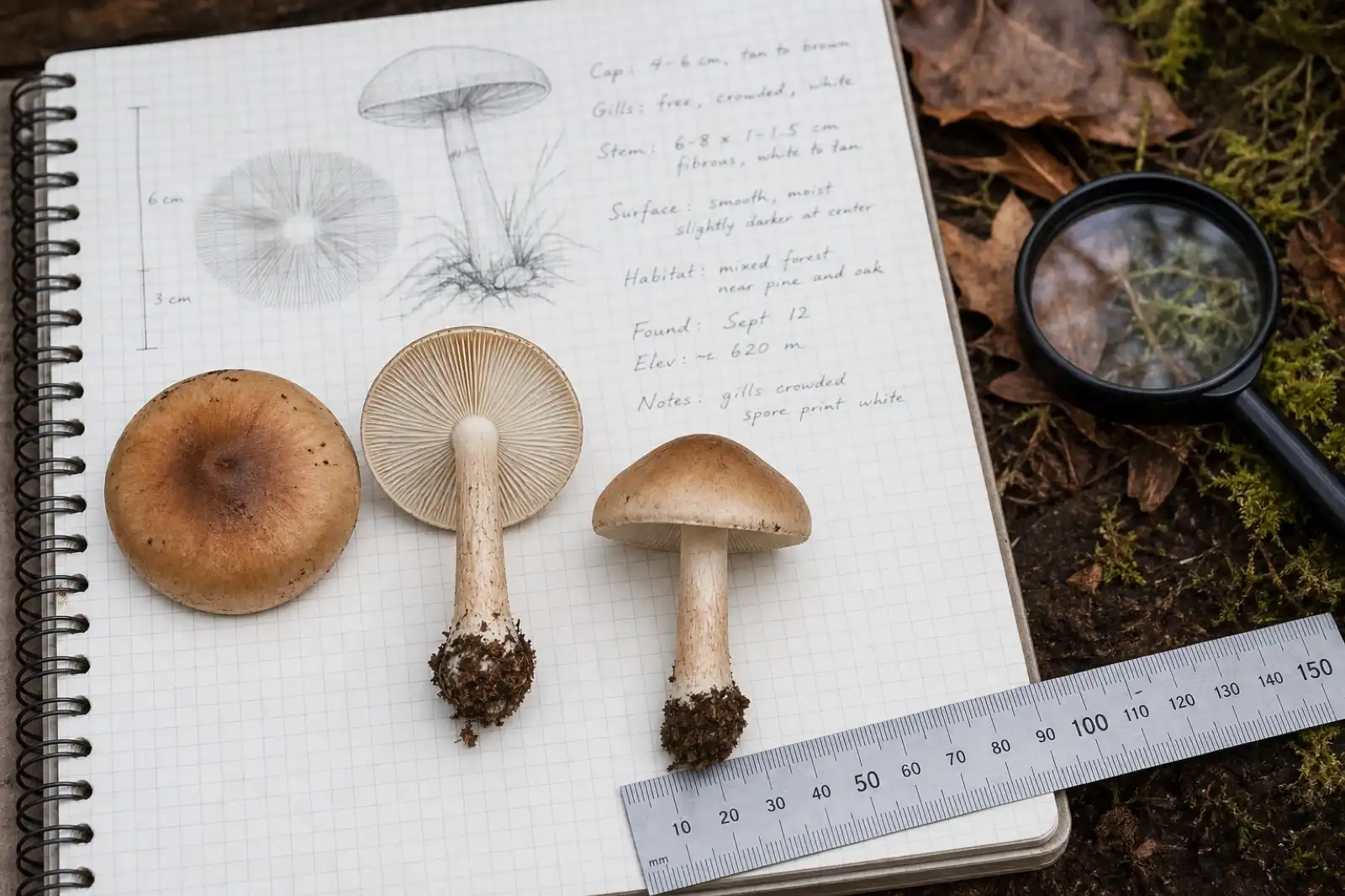
How to Identify Mushrooms: A Beginner's Field Guide
Build an identification from the whole specimen, substrate, habitat, spore deposit, and location—not from a single photograph.
identification
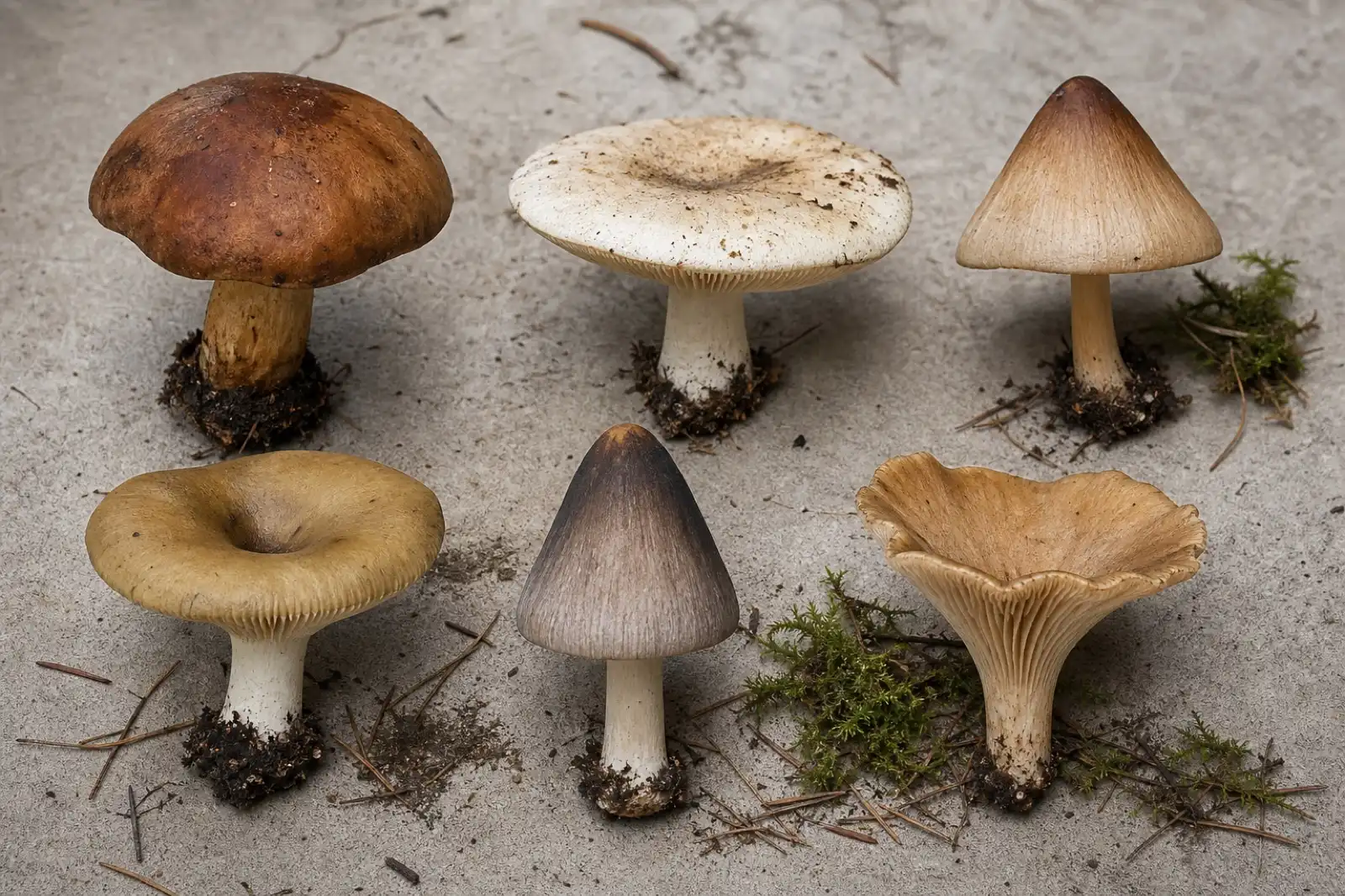
Mushroom Cap Shapes: A Practical Identification Guide
Compare mushroom cap shapes from convex and bell-shaped to flat, depressed, funnel-shaped, and uplifted, while recording age, margin, surface, and profile.
identification
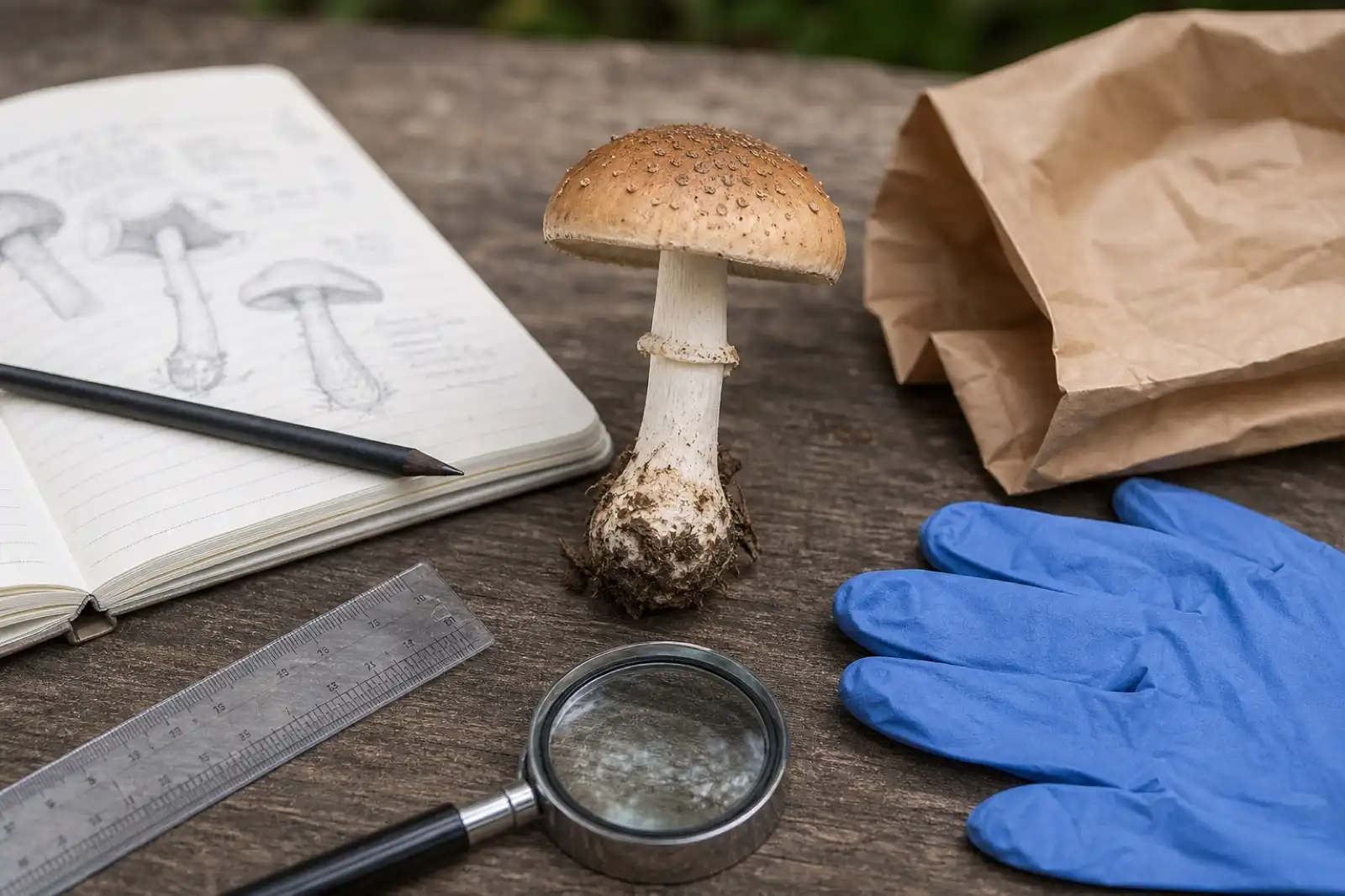
Mushroom Identification Safety Checklist
Use a conservative checklist before handling, documenting, or discussing any wild mushroom, especially when edibility is being considered.
Continue exploring
Browse more practical guides in Identification or visit the mushroom encyclopedia.