Mushroom Encyclopedia
Parasol Mushroom: Stem Pattern, Ring, Spores, and Lookalikes
Document a parasol candidate using cap development, free gills, a movable ring, snakeskin stem pattern, intact base, spores, habitat, and regional lookalikes.
By MushroomScope Editorial Team · · Updated
Species context
Treat profiles as reference material
Species profiles summarize documented traits, taxonomy, and lookalikes, but natural variation can be substantial.
Use the safety checklist →Decision limit
A profile cannot authenticate a specimen
Do not eat a wild mushroom from an online match, single feature, or generated image.
Read the safety disclaimer →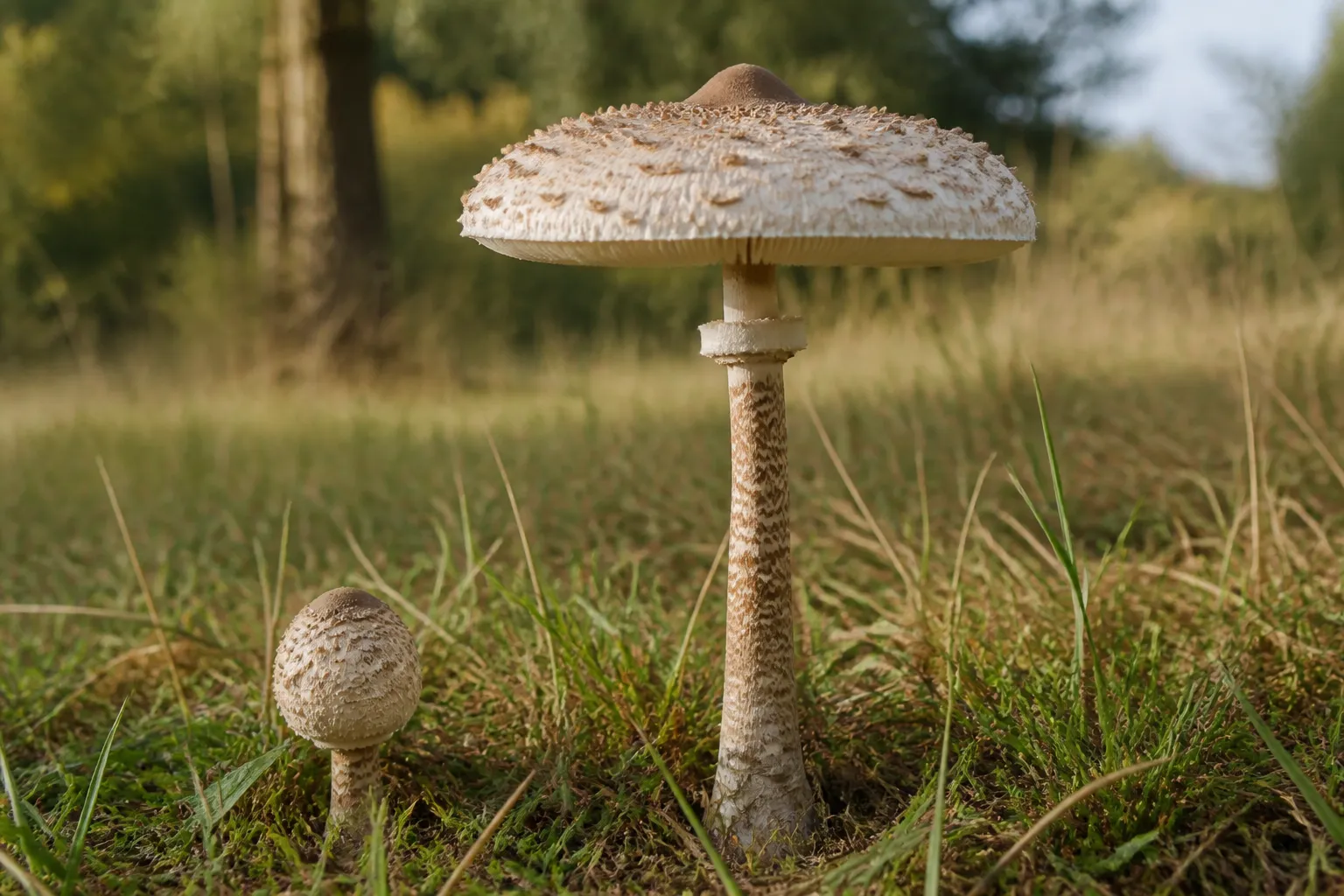
Quick facts
- Scientific name
- Macrolepiota procera
- Common names
- Parasol mushroom
- Taxonomy
- Macrolepiota · Agaricaceae
- Edibility context
- Edible: This database label is context, not remote clearance of a wild specimen; identity, preparation, spoilage, contamination, and individual reaction matter.
- Spore print
- White.
- Toxicity context
- None Known: Risk includes misidentification and individual reaction. Consult current local toxicology guidance before any food decision.
- Season
- July, August, September, October
- Growing difficulty
- Not Cultivated
- Regions
- Europe, Asia, Africa, introduced elsewhere
Safety limit: These labels summarize documented context; they never authenticate a wild specimen. Cooking does not make a poisonous species safe.
Identification overview
Very large umbrella-like cap with brown scales, free pale gills, and a tall snakeskin-patterned stem with a movable ring. Crowded white free gills. Tall hollow stem with brown zigzag pattern and a thick movable ring. White, soft in the cap and fibrous in the stem. Observe several ages because rain, drying, insects, and decomposition can alter color and texture. Photograph the undisturbed growth, upper surface, fertile surface, complete attachment, and a lengthwise section. A white spore deposit is supporting evidence, never a species verdict.
Habitat and season
A parasol candidate should arise from soil in grassland, pasture, a woodland opening, or an edge rather than directly from a log. Record mowing, irrigation, grazing, recent turf installation and nearby trees because managed warm-season lawns disproportionately raise the Chlorophyllum molybdites comparison. European records do not establish that the same species concept applies to a lookalike photographed on another continent. Fruiting often clusters in late summer and autumn, but rain and local climate shift the calendar.
Similar species
- Chlorophyllum molybdites — poisonous, often green-spored, and common in warm lawns.
- Chlorophyllum rhacodes group — flesh stains and taxonomy differ.
Add Amanita whenever the base is missing or shows a cup, sac, concentric collaring, or other universal-veil material. Add small Lepiota species when stature is modest rather than assuming every scaled cap belongs to a large edible group. Regional keys may require microscopy for spore dimensions, germ-pore form and pileipellis structure. An image-recognition result cannot substitute for those observations.
Food and safety context
Parasol mushroom has a documented food-use context when the organism is correctly identified and the material is fresh, clean, and cooked. That reputation does not transfer to a wild specimen identified online. Individual allergy, gastrointestinal intolerance, spoilage, environmental contamination, and cross-contamination remain possible. Cooking does not make a poisonous species safe.
Green-spored parasol poisoning commonly produces marked gastrointestinal symptoms. If vomiting, diarrhea, abdominal pain, confusion, breathing difficulty, or any symptom follows a wild-mushroom meal, contact local emergency services or a poison center promptly. Keep uncooked caps and stems, cooking scraps, photographs, meal timing and a list of everyone exposed for professional assessment.
Cultivation context
Reliable home production of Macrolepiota procera is not established like commercial oyster or shiitake block culture. A defensible cultivation report needs an authenticated strain, inoculum history, soil or compost composition, moisture and temperature records, fruiting observations and a retained voucher. A bag sold under a common name is not proof of species identity or food suitability.
How to document a parasol candidate
- Photograph the fairy ring, troop or solitary fruit body in its managed-grassland or woodland-edge setting.
- Excavate one complete stem base and photograph any bulb, collar, sac or adhering veil material.
- Record cap diameter, stem height, free-gill gap, ring construction, stem zigzags and timed staining from a fresh section.
- Make a mature deposit across black and white surfaces; record white, cream, gray-green or green in neutral light.
- Compare the entire record with a current regional key and a qualified local identifier before any food discussion.
Use a complete field record
Treat every observation as a linked specimen record. Give the photographed fruit body an identifier, keep cap and stem measurements from that individual together, and label the spore deposit with the same identifier. A white deposit from one specimen cannot resolve a second green-spored individual collected from the same lawn. Photograph the ring before moving it and the stem surface before soil or handling obscures the zigzag pattern.
Check the key field characters
A parasol mushroom record should be built from the entire stature of the fruit body. Document the large umbrella-like cap, brown scales, free pale gills, tall stem, movable ring, and snakeskin-like stem pattern. The base should be photographed intact because volva-like structures or bulbous bases can redirect the identification. Size is helpful but not decisive; young specimens may be drumstick-shaped, and mature caps may flatten broadly. Include nearby habitat such as grassland, pasture edge, woodland margin, or disturbed soil.
Lookalike decisions are especially important in warm lawns and disturbed habitats. Chlorophyllum molybdites is a common poisonous comparison in some regions and can produce greenish mature spores. Other Chlorophyllum species and large lepiotoid mushrooms require attention to staining, ring structure, stem ornamentation, and spore color. Do not identify a parasol from an overhead cap photograph. A complete record should include the underside, stem pattern, ring movement, bruising reactions, spore deposit, and local range. When any of those are missing, the safest conclusion is that the collection remains unresolved.
Food use should be conservative even where true parasol mushrooms are established edibles. Large size and pleasant appearance can invite overconfidence, but mature specimens may be buggy, contaminated, or confused with hazardous lawn species. Avoid material from chemically treated lawns, roadsides, and public areas with unknown exposure. For publication quality, describe whether the specimen was solitary, scattered, or in a ring; whether the cap scales were raised or flat; and whether the stem pattern continued below the ring. Those details give readers a reusable framework rather than a single visual impression.
Reader decision checklist
Use this checklist to decide whether an observation is strong enough for learning, not whether it is safe to eat. For Parasol mushroom, the record is stronger when these points are answered in writing: tall patterned stem and movable ring are documented; spore color has been checked when food use is discussed; green-spored and staining lookalikes are considered; complete base is visible. If one of these points is missing, mark the identification as tentative and collect more evidence before comparing it with food, cultivation, or supplement information.
Negative evidence must name the specific alternative and the contradicting observation. “Large scaled cap” supports several genera; “mature white deposit, strongly patterned lower stem, movable double ring and no red staining” is more discriminating, while still requiring regional review. Conversely, a green deposit, smooth stem, pronounced red-orange cut flesh, or a saclike base should stop the M. procera hypothesis rather than being explained away.
Taxonomy note: large parasol-like mushrooms are treated differently across modern field guides, so regional names and older cookbook labels should be checked against current local keys before publication or collection use.
Record spore color before considering a parasol name
Photograph a deposit on adjoining light and dark nonabsorbent surfaces in neutral light and keep it linked to the complete specimen. Greenish mature spores are a critical warning in regions with Chlorophyllum molybdites. Spore color still must agree with the movable ring, patterned stem, free gills, intact base, habitat, and a current regional key.
Follow the cap from drumstick to open parasol
A useful record includes more than one developmental stage. A young Macrolepiota procera candidate may resemble a tall drumstick: the cap is still closed around the upper stem while the stalk has already elongated. As expansion continues, the pale cap surface breaks into brown scales around a darker, comparatively smooth central umbo. A mature cap becomes broadly convex and then nearly flat. Rain can wash or flatten scales, and drought can crack the surface, so the arrangement of scales and the persistent central disc are more informative than a single color label.
Photograph the cap edge as well as its center. The margin can retain fragments from the partial veil, but those fragments are not equivalent to a universal veil or a cup at the base. Measure several fruit bodies rather than treating large size as proof: stature supports a parasol-group hypothesis, while stem ornamentation, ring structure, gill attachment, spore color, and geography do the separating work. An overhead photograph hides nearly all of those characters.
Test the ring and stem pattern without damaging the specimen
The tall stem should be documented from the cap attachment to the swollen base. On a developed true-parasol candidate, the lower stem surface commonly shows contrasting brown zigzags or broken bands over a paler ground—the often-described snakeskin pattern. Photograph that pattern in diffuse light before handling, because mud, rubbing, and an overexposed phone image can erase the contrast. A smooth-looking stem in a poor photograph is missing evidence, not evidence of smoothness.
The substantial ring is commonly described as double-edged and movable on a mature stem. Demonstrate mobility only with gentle pressure after photographing its upper and lower surfaces; do not tear a young veil merely to make the character appear. Record whether the ring slides freely, remains partly attached, or has collapsed. Ring mobility is supportive but not a food-safety test, because other large lepiotoid mushrooms can also carry prominent rings.
Recover the base intact. M. procera can have a bulbous enlargement, but a bulb is not the membranous cup or sac associated with some Amanita. Dig beside the stem rather than pulling upward, photograph soil still attached, and then clean one side enough to show the base structure. If the base is missing, the observation cannot safely exclude high-consequence comparisons.
Separate free gills from a mature spore deposit
The gills of a parasol candidate are crowded, pale and free: they stop short of the stem rather than running down it. Photograph the underside square-on and include the gap around the stem. Young green-spored lepiotas also begin with pale gills, which is why immature gill color must not be used to clear a lawn specimen. The Missouri Department of Conservation describes Chlorophyllum molybdites gills as white at first and gray-green to darker as spores mature.
For a deposit, use a mature cap and place portions over adjoining black and white nonabsorbent surfaces. Cover it against drafts, note elapsed time, and examine the deposit in neutral daylight. A white deposit supports Macrolepiota procera; a gray-green or green deposit redirects the record toward C. molybdites. A weak or absent deposit is inconclusive. Sterile or immature material may fail to show the expected color, a limitation also emphasized in the clinical review of C. molybdites poisoning.
Compare the lawn lookalike before discussing food
Chlorophyllum molybdites deserves a deliberate comparison because it produces large, scaled, ringed mushrooms in lawns and managed grassy places. Mature greenish spores are a powerful separating character, but waiting for green gills is unsafe: young fruit bodies can remain white-gilled. Note lawn irrigation, warm weather, mowing, fairy-ring growth and disturbed soil, then pair habitat with spore deposit, stem ornamentation, bruising, ring form and local range.
This is not a minor upset-stomach footnote. Published case reports and reviews document severe vomiting, diarrhea and abdominal pain after C. molybdites ingestion, sometimes requiring hospital care. Cooking is not a dependable correction for a mistaken identity. If a collection lacks a mature deposit or the full stem and base, stop the food discussion rather than filling gaps with cap resemblance.
The Chlorophyllum rhacodes complex presents a different problem. Shaggy cap scales, staining flesh, a less characteristically snakeskin-patterned stem and regional taxonomic treatments can separate candidates, but names and species boundaries differ between field guides. Record a fresh cross-section through cap and stem, timing any reddish or orange staining instead of writing only “bruised.” Microscopy or regional expert review may still be necessary.
Small Lepiota species should not be forced through a large-parasol checklist. Their size, ring structure and stem ornamentation differ, and some contain dangerous toxins. Likewise, any sac, cup, patches suggestive of a universal veil, or uncertain buried base requires an Amanita-focused assessment. One matching parasol feature cannot overrule a contradictory high-risk feature.
Map habitat, management, and geographic limits
True parasol records are associated with open woodland, edges, meadows, pasture and other grassy ground rather than growth directly from visible wood. A field note should distinguish old unimproved grassland from irrigated lawn, recently laid turf, roadside verge, grazed pasture and woodland opening. Include nearby tree cover, recent mowing, fertilizers or herbicides, pet activity, livestock, road spray and any contaminated fill. Those details affect both identification context and whether material would be appropriate to handle as food even after expert confirmation.
Do not export a European species concept unchanged to every continent. GBIF occurrence maps are evidence of submitted records, not automatic verification of a specimen or proof that every mapped name reflects the same modern concept. In North America and other regions with abundant C. molybdites or related Macrolepiota and Chlorophyllum, a current regional key and experienced local identifier are especially important. Save photographs, measurements and a dried voucher when lawful and useful; geographic coordinates can be reduced in public records to protect sensitive sites.
Why cultivation claims need strain-level evidence
Unlike familiar indoor oyster production, parasol cultivation is not standardized as a reliable beginner block crop. A seller’s “parasol spawn” label is not enough to establish species identity, fruiting performance or food suitability. A defensible cultivation report would identify the authenticated culture, substrate composition, treatment method, inoculation rate, incubation temperature, fruiting trigger, contamination history and voucher or sequence evidence. Without those records, a failed bag says little about the biology of M. procera.
For home growers interested primarily in a dependable food crop, the beginner mushroom-growing guide explains why species with established commercial strains and repeatable fruiting systems are a better starting point. For field observations, use the stem-features guide to document rings, ornamentation and bases consistently. These links support separate growing and identification tasks; they do not turn a parasol candidate into an approved edible specimen.
Editorial evidence boundary
This page received editorial review, not review by a named clinical toxicologist or professional field mycologist. It organizes observable characters and cites taxonomy, government field information and clinical toxicology literature. It cannot identify a specimen remotely. For symptoms after any wild-mushroom exposure, contact local emergency services or a poison center promptly and retain uncooked material, trimmings, photographs and timing details for professional assessment.
References
- Global Biodiversity Information Facility. Macrolepiota procera species record. Taxonomic backbone and occurrence context.
- National Center for Biotechnology Information. NCBI Taxonomy Browser — Macrolepiota procera. Independent lineage and nomenclature checkpoint.
- North American Mycological Association. Mushroom Poisoning Syndromes. Poisoning response and syndrome context.
- U.S. Food and Drug Administration. Selecting and Serving Produce Safely. General handling guidance for mushrooms used as food.
- Missouri Department of Conservation. Green-Spored Lepiota. Mature gill and spore color, lawn habitat, and poisonous status of Chlorophyllum molybdites.
- Lehmann, P. F., and Khazan, U. Mushroom poisoning by Chlorophyllum molybdites in the Midwest United States. Clinical cases, gastrointestinal syndrome, distribution, and the limitation of sterile material.
Editorial review: September 4, 2026. No named clinical expert or field mycologist reviewed this page. Taxonomy, regional range, and poison-response contacts should be rechecked at every substantive update.
Source quality notes
MushroomScope cites sources that match the page scope, such as taxonomic databases, extension guidance, food-safety agencies, food-composition databases, and peer-reviewed or institutional health references. Sources support context and uncertainty; they do not turn an online page into specimen identification, medical advice, or a tested recipe record.
Frequently asked questions
Can Parasol mushroom be identified from one photograph?
No. Identification requires the complete specimen, fertile surface, attachment, substrate, habitat, region, developmental stage, and sometimes microscopy or DNA.
Is wild Parasol mushroom safe to eat?
This page cannot clear a wild specimen for food. Obtain in-person confirmation from a qualified local identifier and follow local guidance; cooking cannot make a poisonous lookalike safe.
Which habitat details matter for a parasol record?
Record grassland, pasture, verge or woodland-edge setting, nearby trees, turf treatment, road exposure, region, and whether fruit bodies are solitary, scattered, or arranged in an arc or ring.
What is the spore print of Parasol mushroom?
The expected deposit is white, but print color overlaps among fungi and cannot confirm this species by itself.
Can Parasol mushroom be cultivated at home?
It is not a simple beginner crop; use authenticated commercial material and species-specific professional guidance rather than wild tissue.
Related guides
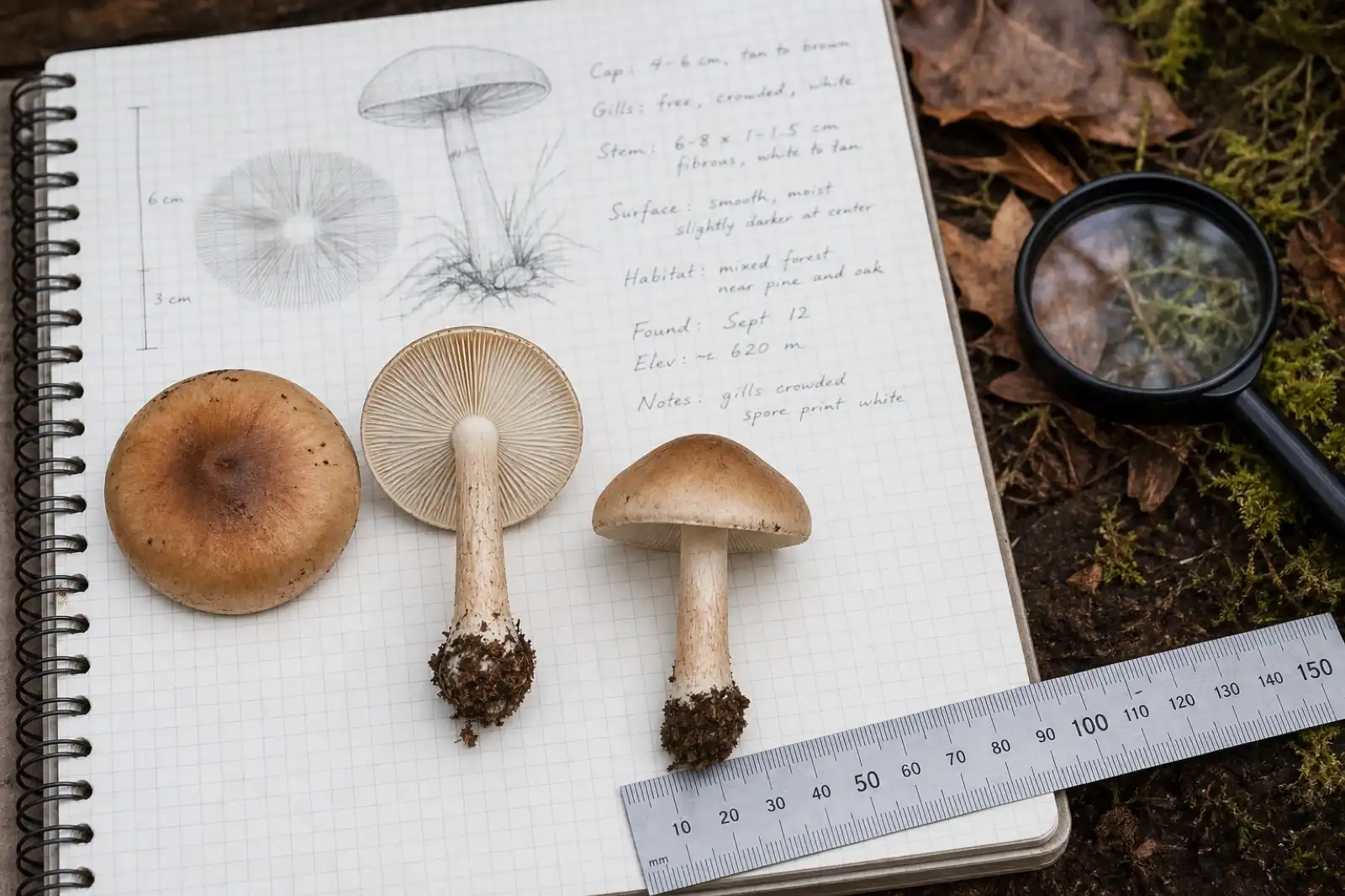
identification
How to Identify Mushrooms: A Beginner's Field Guide
Build an identification from the whole specimen, substrate, habitat, spore deposit, and location—not from a single photograph.
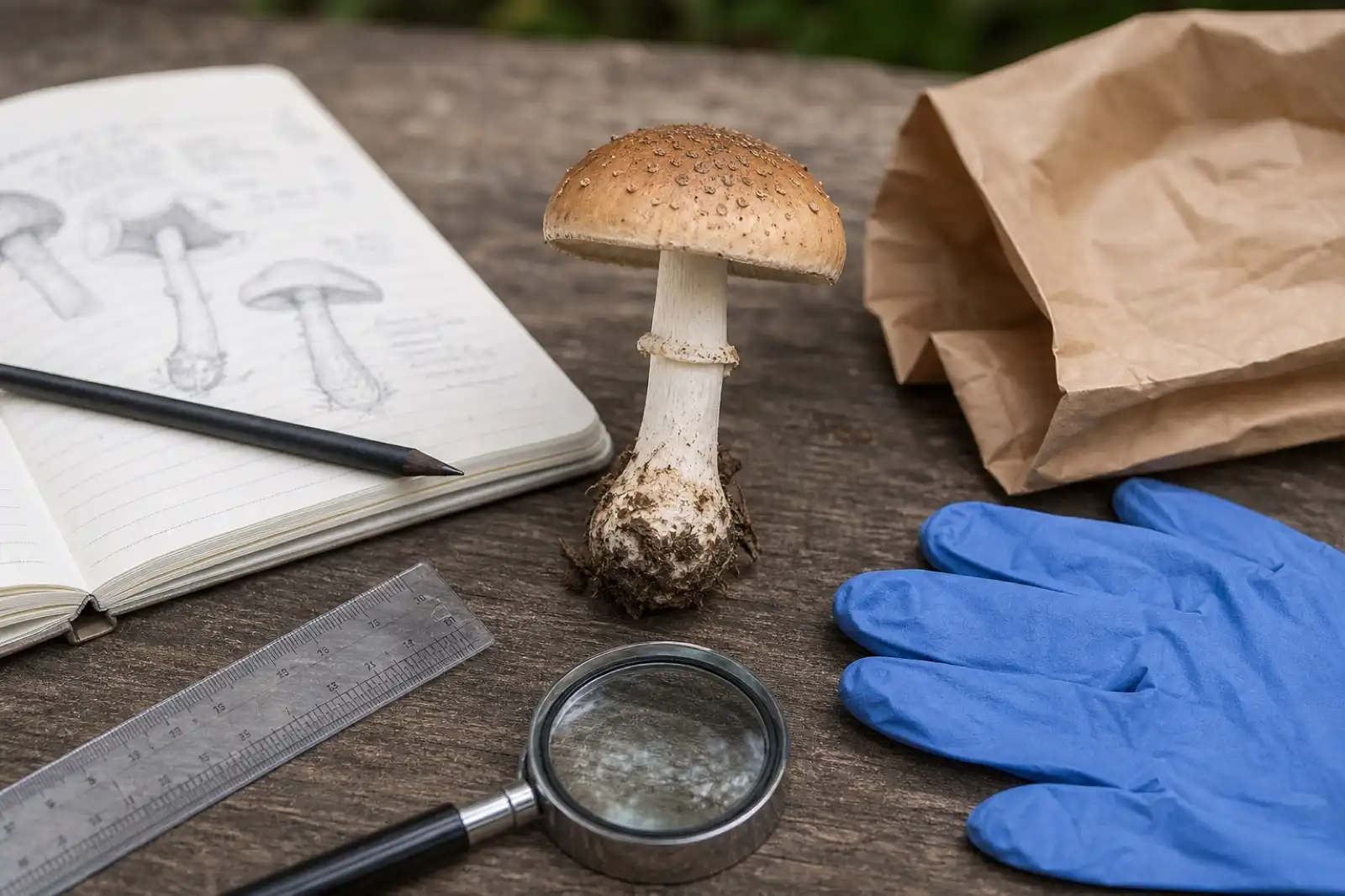
identification
Mushroom Identification Safety Checklist
Use a conservative checklist before handling, documenting, or discussing any wild mushroom, especially when edibility is being considered.
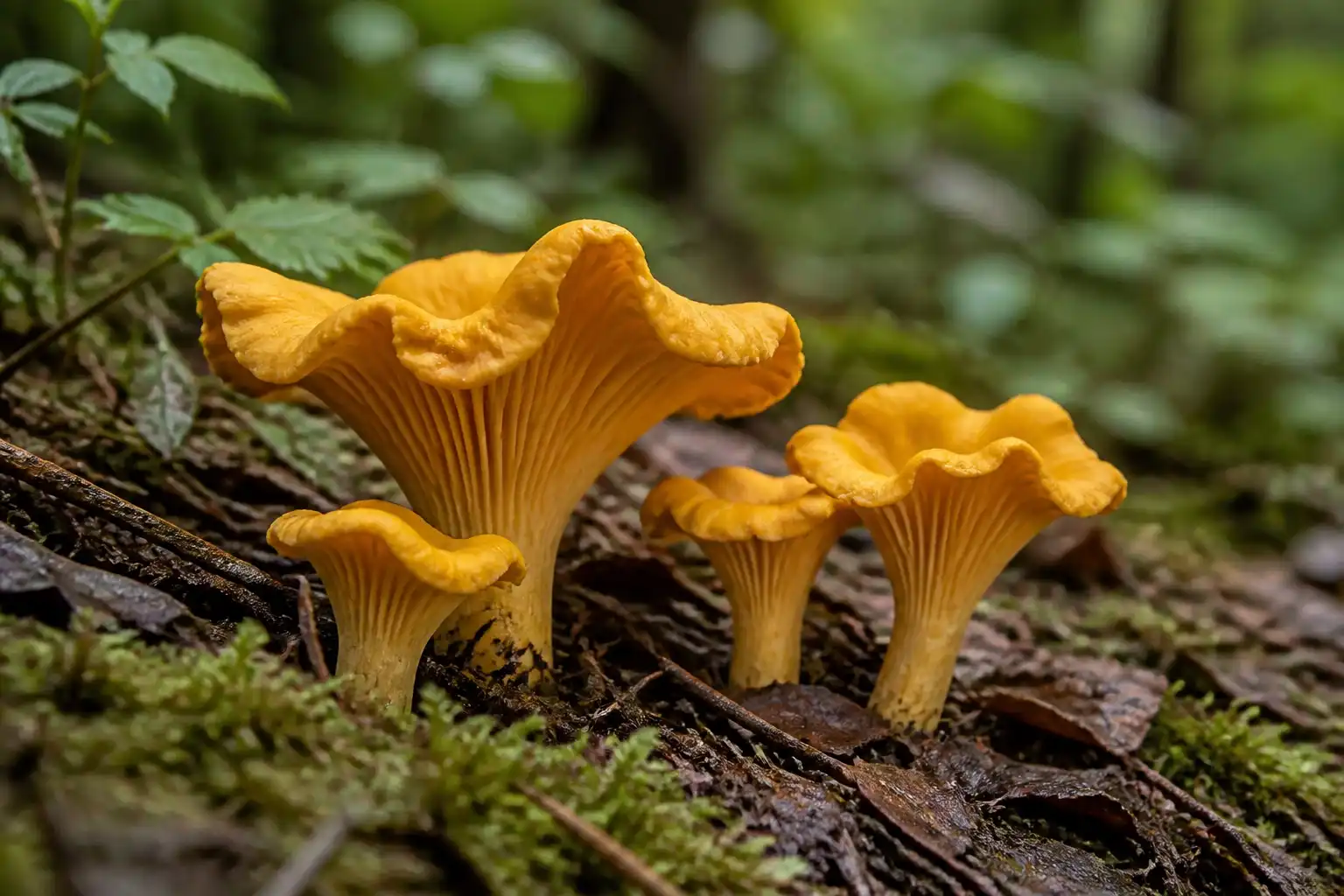
mushrooms
Cantharellus cibarius: Chanterelle Identification Guide
Learn chanterelle identification, false gills, habitat, season, poisonous lookalikes, edibility, nutrition, and why wild finds need local verification.
Continue exploring
Browse more practical guides in Mushroom Encyclopedia or visit the mushroom encyclopedia.