Identification
Bolete Identification: Pores, Staining, and Lookalikes
Learn how to document a bolete's pores, flesh staining, stem, habitat, and lookalikes without treating any one feature as an edibility test.
By MushroomScope Editorial Team · · Updated
Safety first
Use as a field-record guide
Document the whole mushroom, habitat, substrate, and region before comparing names or photographs.
Open the identification safety hub →Decision limit
Do not use this as an edibility verdict
Wild mushroom consumption decisions require qualified local, in-person confirmation of the complete specimen.
Read the safety disclaimer →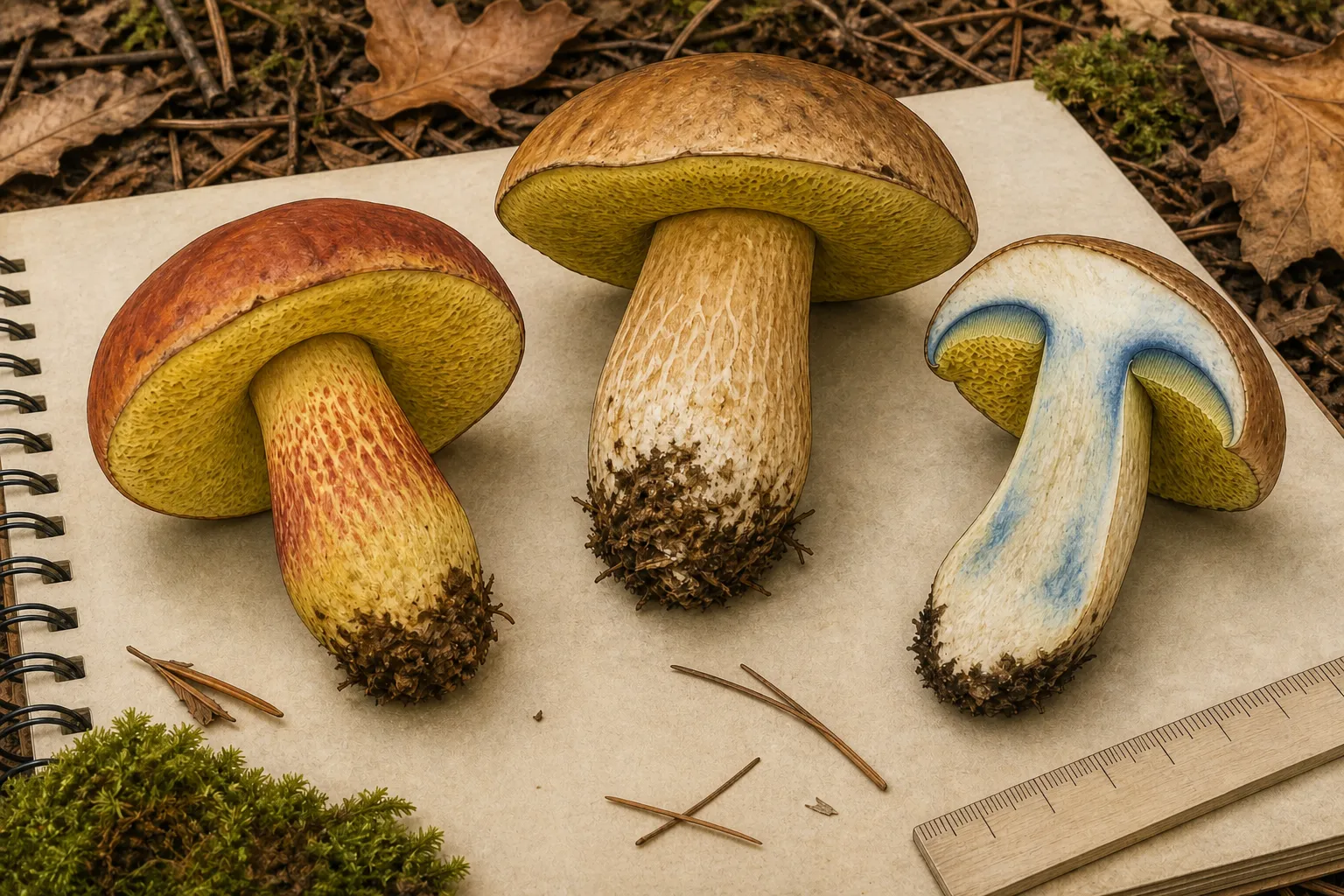
Start with the underside, then keep going
In field-guide use, a bolete is usually recognized by a cap-and-stem form with a spongy surface of tube openings (pores) under the cap rather than thin gills. That observation is useful, but it is only a starting category. The USDA Forest Service description of king bolete, for example, distinguishes its pore-filled tube layer from gills and also relies on pore color, a thick stem, and other traits. A photograph of brown cap plus pores cannot reliably name a species.
Treat this page as a documentation protocol, not a foraging rule. Bolete names, combinations of features, and possible species vary by region. Keep a specimen unidentified when habitat, pore surface, flesh reaction, stem details, or season does not fit a current local key.
Confirm a pore surface
Turn the mushroom over before judging the cap. Photograph the underside in even light and look for a layer of many small openings leading into tubes. Record the following without converting them into a verdict:
- Pore color and shape: Note fresh and mature color, whether openings are round or angular, and whether they change where touched.
- Tube layer: Take a side view or a clean cross-section so the depth and attachment of the layer can be seen.
- Cap and stem: Measure the cap and stem, then note texture, net-like reticulation, dots, or color zones.
- Flesh reaction: Make one fresh cut, photograph it immediately and again after a short interval, and state exactly where any color appears.
Color shifts are characters, not safety labels. The USDA Forest Service description of king bolete includes pale young pores and the absence of blue bruising, but that combination belongs to a complete species description rather than a universal edibility rule. A reaction—or its absence—cannot settle a species name by itself.
Readers evaluating a pale-pored, reticulate-stemmed candidate can use the porcini field guide to document tube depth, the stem network, living-tree context, and regional Boletus edulis complex limits. It remains a comparison record, not an edibility clearance.
Separate tubes, pores, and other undersides
“No gills” is not enough to call a specimen a bolete. Look at the entire fertile surface and how it attaches to the cap. A typical bolete underside presents the openings of many vertical tubes; a clean section through the cap can show that tube layer. Other fungi may have folds, blunt ridges, teeth, an almost smooth surface, or pores arranged on a shelf-like fruit body attached to wood.
Do not tear away the underside before photographing it. First capture a straight-on view, an oblique view that shows depth, and the junction between tubes and stem. Then, if collection is legal and the specimen can be handled safely, make a clean vertical section through cap and stem. Label every image with the same specimen number. A loose pore surface photographed without the cap, stem, and habitat loses much of its identification value.
Also record age. Young pores can be small and pale, while mature pores may be wider or differently colored. Weathering, insect damage, handling, and camera white balance can alter the apparent color. Comparing several fruit bodies at different stages is more informative than choosing the most photogenic cap.
Build a comparison record
Use a repeatable record that another person can review. Montana State University recommends collecting the complete specimen and documenting features that might otherwise be missed. Where collection is legal, keep the stem base intact; photograph the mushroom in place first.
| Record | What to capture | Why it matters |
|---|---|---|
| Habitat | Soil or wood association, nearby trees, site, date, and weather | Ecology can eliminate possibilities, but does not prove one. |
| Cap | Width, color in natural light, texture, cracks, margin, and age | Cap color alone is variable and easily misleading. |
| Pores and tubes | Close underside image, pore color, attachment, and a cross-section | This confirms the structure being described and preserves age-related changes. |
| Stem | Full length, base, surface pattern, and dimensions | Reticulation or dots may be useful only in a full regional comparison. |
| Cut and print | Timed images of a fresh cut; a spore print when safe and useful | Reactions and spore color add evidence, not a shortcut. |
The mushroom photo checklist expands this into a reusable set of field images. If the underside is not genuinely pore-bearing, switch to the broader mushroom identification guide rather than forcing it into a bolete comparison.
Use staining carefully
Pressing pores or cutting flesh can produce a reaction immediately, slowly, weakly, or not at all. Record the initial color, the location of contact, elapsed time, and light conditions. Avoid repeated bruising, which can make a subtle reaction look stronger or muddy the color.
Michigan State University Extension notes that some bolete descriptions use red-to-orange pores and blue staining as cautionary features for collectors. That is conservative field advice, not a universal identification key. It does not mean every blue-staining bolete is toxic, every non-blue bolete is edible, or that a phone image can replace a regional identification. Do not taste-test or cook a specimen to resolve uncertainty.
Create a timed sequence rather than writing only “stains blue.” Photograph the untouched pore surface and flesh, the same area immediately after pressure or cutting, and the reaction again at a recorded interval. State whether color began in the pores, tube layer, cap flesh, or stem flesh. Note whether it spread, darkened, faded, or remained local. Keep the lighting and camera angle as consistent as practical. The broader bruising and color-change protocol separates injury reactions from spores, exposed pigments, latex, age, and decay.
A lack of visible change also needs context. Old, dry, frozen, waterlogged, or repeatedly handled material may not behave like a fresh specimen. Do not intensify damage to force a reaction and do not apply household chemicals based on an unsourced internet test. Chemical reactions and microscopy belong to properly documented keys and trained workflows.
Examine the stem from apex to base
Photograph the stem while it is still attached, then record the top, middle, and base separately. Look for a net-like raised pattern, fine dots, coarse scabers, longitudinal fibers, bruising, cavities, or color zones. Describe what is visible instead of deciding too early that a pattern is “reticulation.” Side lighting can reveal whether markings are raised, recessed, or merely differences in color.
The complete base matters even when no cup-like structure is expected. A broken stem can hide attachment, basal color, mycelium, or substrate. Where collecting is permitted, loosen the soil around one representative specimen and lift it without slicing off the base. Keep soil and leaf litter with the habitat record, but do not carry an unknown specimen loose beside food.
Measure rather than estimate. Cap width, total height, stem width at several points, and the relative thickness of the tube layer can help a local expert compare descriptions. Measurements should be tied to the individual specimen; a ruler placed somewhere in the scene without sharing the mushroom’s plane can distort scale.
Record trees, substrate, and geographic limits
Many bolete-like fungi are associated with particular trees, so photograph trunks, leaves or needles, bark, and the wider site. Record whether the fruit body emerged from mineral soil, leaf litter, moss, buried wood, or visible wood. “In a forest” is usually too broad. If you cannot identify a nearby tree, upload clear tree features separately rather than guessing its name.
Location should be specific enough for ecology but shared responsibly. Country, state or province, broad habitat, elevation when relevant, and date are usually more useful than a vague regional label. Follow land rules and avoid publishing precise coordinates for sensitive sites. A name from another continent may represent a related species or a historically broad concept, so use a current key or checklist written for the region where the specimen was found.
Season and weather support the record but do not authenticate a mushroom. Note recent rain, frost, drought, and whether several fruit bodies appeared together. Return visits can document development, yet a later photograph should never be assumed to show the exact same individual unless it was marked and tracked appropriately.
Lookalikes are a comparison problem
Several mushrooms and fungal groups can have pores. A shelf-like polypore on wood, a pored mushroom without a central stem, or a gilled mushroom photographed poorly may not belong in the same comparison set as a ground-growing bolete. Start by describing the structure rather than by selecting a name.
Within boletes, similar cap colors can conceal differences in pore color, stem pattern, host association, flesh reaction, odor, and microscopic characters. A useful answer may therefore be “pore-bearing mushroom, species unresolved.” That conclusion protects the specimen record from false certainty and gives a local identifier better evidence to work with.
Build a short candidate table from a current regional reference and try to disprove each candidate. Compare the same fields for every option: pore structure and age, stem surface, complete base, timed staining, cap texture, flesh color, substrate, nearby trees, region, and season. Mark missing evidence explicitly. Do not silently treat an unphotographed feature as absent.
If two candidates remain separated by spore dimensions, microscopic ornamentation, reagents, or specialist taxonomy, stop at the level the evidence supports. A genus-level or family-level record can still be scientifically useful when its photographs, locality, date, and habitat are complete. It is safer and more accurate than selecting a species because a gallery image has the same cap color.
Prepare a specimen for qualified review
Montana State University’s submission guidance emphasizes complete material and supporting information. Contact the local herbarium, extension office, mycological society, or other qualified identifier before mailing or delivering anything, because submission rules differ. Ask whether fresh or dried material is accepted, how specimens should be packaged, and which location and habitat fields are required.
Keep photographs linked to a specimen code. Include collection date, general locality, substrate, nearby trees, measurements, odor recorded without tasting, staining sequence, and collector contact information. Do not seal fresh mushrooms in plastic for an extended period unless the receiving expert specifically instructs it; deterioration can erase useful characters and create a handling problem.
An expert identification is not automatically permission to eat. The reviewer may be assessing taxonomy only, and edibility guidance can depend on local species concepts, condition, preparation, individual sensitivity, and legal or institutional policy. Ask what level of determination was reached and preserve uncertainty in any public record.
Consumption and poisoning safety
Never use pores, a blue reaction, a popular rule of thumb, an app score, or a social-media consensus as an edibility test. Poison Control advises that wild mushrooms should not be eaten unless identified by an expert; lookalikes can be convincing, and cooking does not make a poisonous mushroom safe.
If someone may have eaten an unidentified mushroom, contact local emergency services or a poison center promptly. Preserve uncooked material, leftovers, packaging, and photographs only if it is safe to do so. Do not wait for an online identification before seeking help.
References
Source quality notes
MushroomScope cites sources that match the page scope, such as taxonomic databases, extension guidance, food-safety agencies, food-composition databases, and peer-reviewed or institutional health references. Sources support context and uncertainty; they do not turn an online page into specimen identification, medical advice, or a tested recipe record.
Frequently asked questions
Do pores instead of gills identify a bolete as edible?
No. A pore-bearing underside helps describe a specimen, but it does not identify a species or establish edibility. Keep the record unresolved until a qualified local expert can assess the complete specimen.
Does blue staining mean a bolete is poisonous?
No single color-change reaction is a universal toxicity test. Record where and how quickly a change occurs, then use it with the full set of characters and a current regional key; do not use it to make an eating decision.
What should I photograph on a suspected bolete?
Photograph the cap, pore surface, whole stem and base, a fresh cut showing any change over time, substrate, nearby trees, several ages, and a scale. Retain habitat and date notes with the images.
Related guides
identification
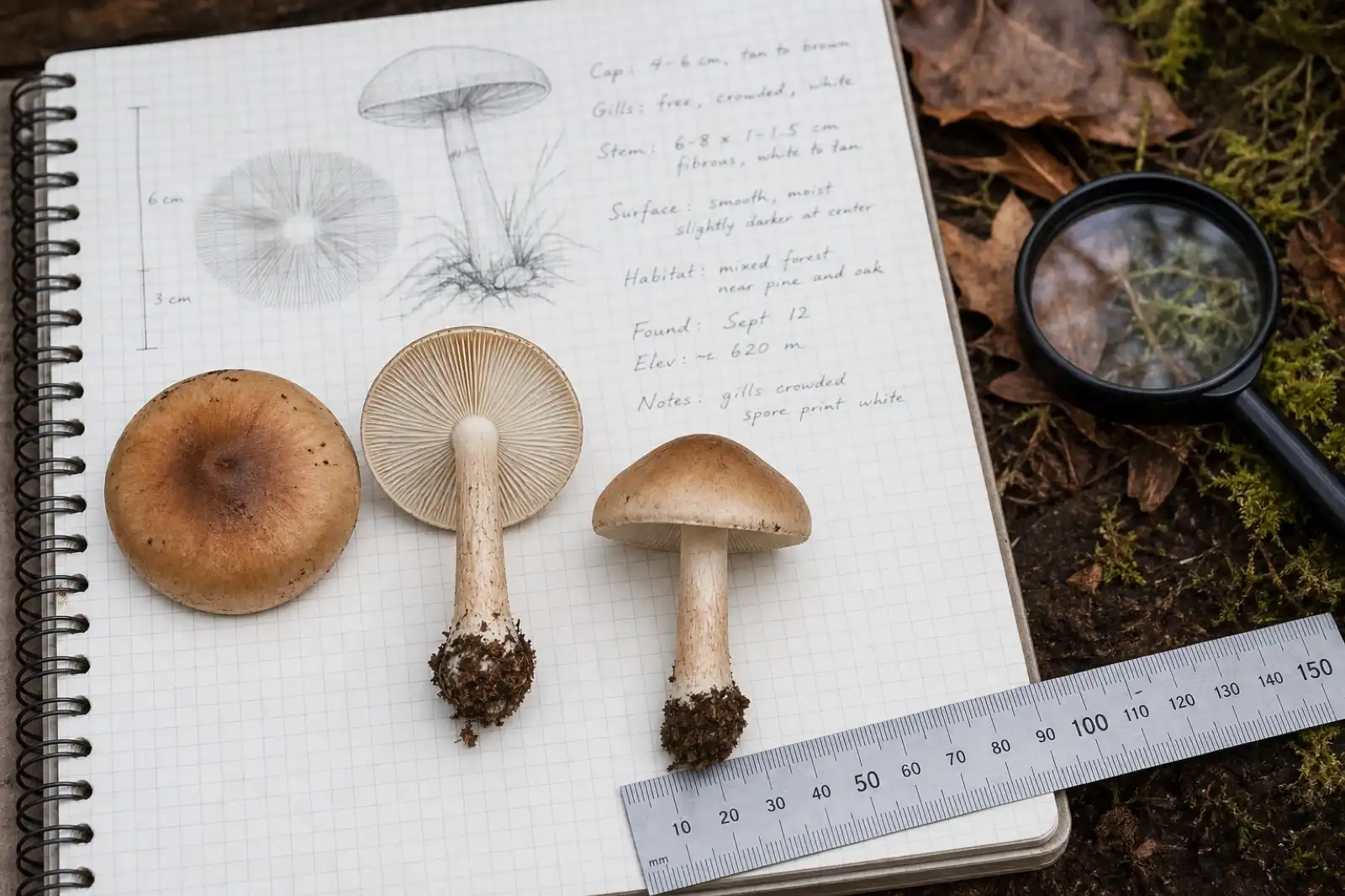
How to Identify Mushrooms: A Beginner's Field Guide
Build an identification from the whole specimen, substrate, habitat, spore deposit, and location—not from a single photograph.
identification
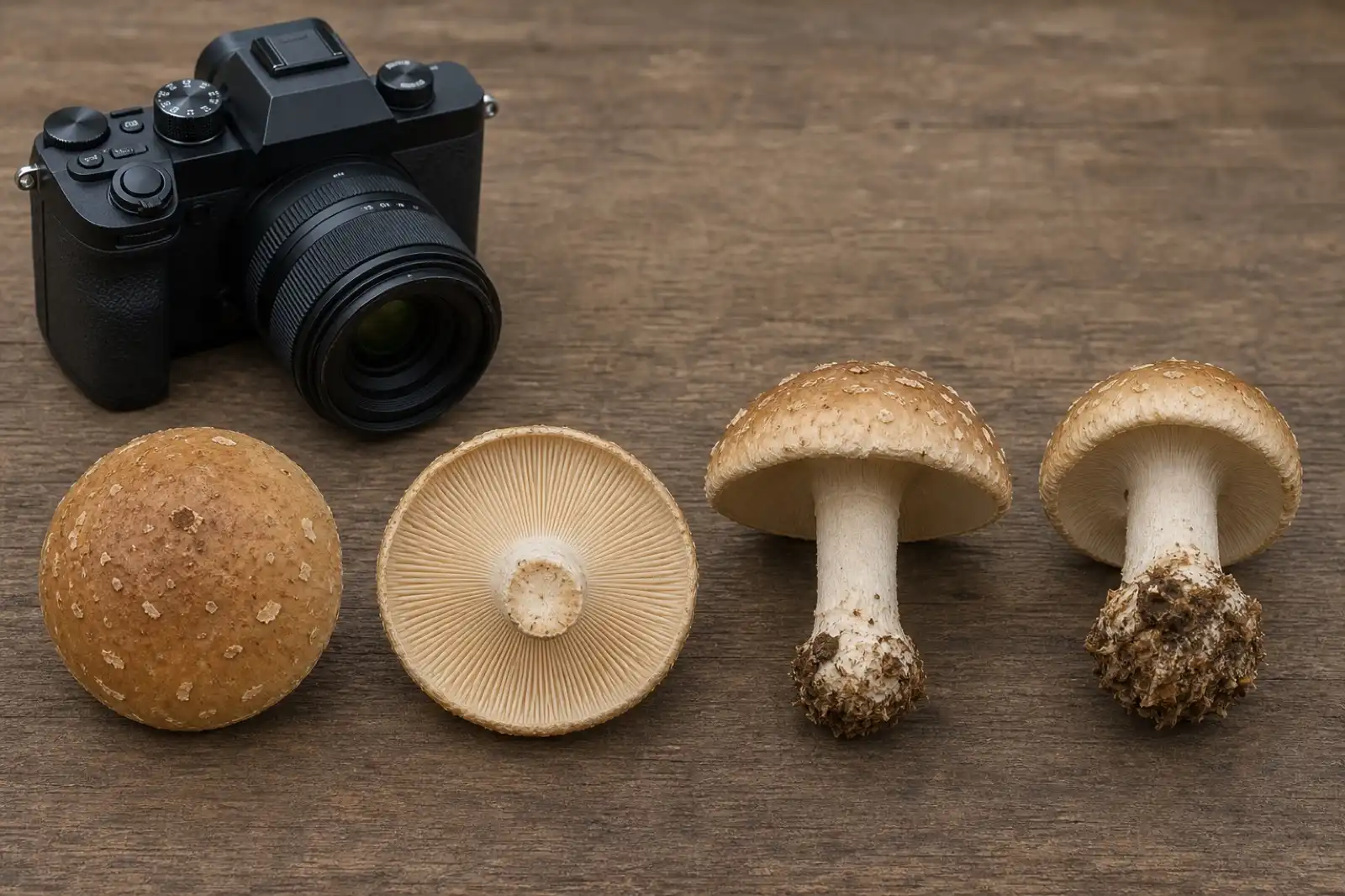
Mushroom Photography Checklist for Identification
Capture the cap, underside, complete stem base, habitat, scale, and specimens at different ages before asking for identification help.
identification
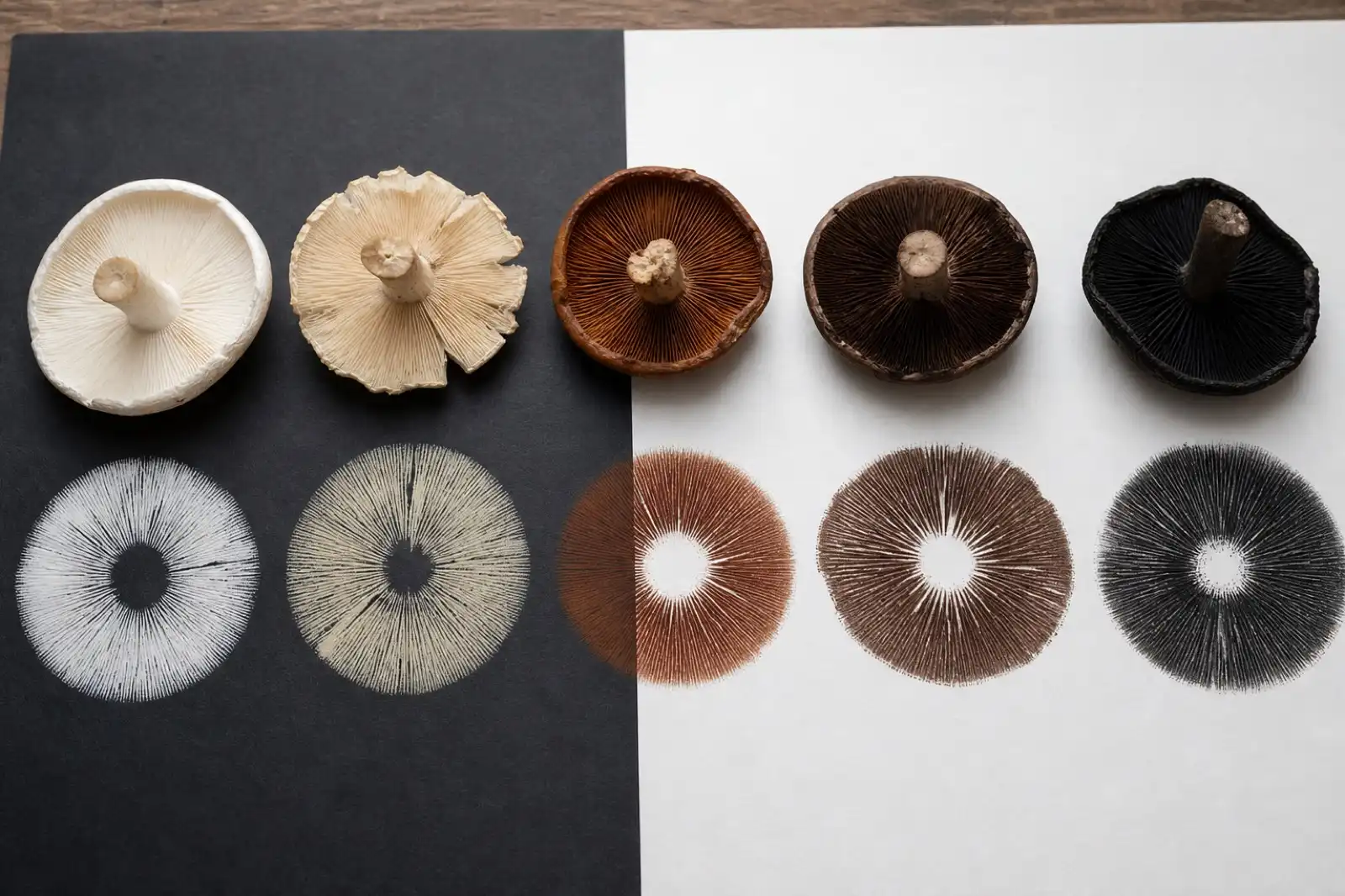
Mushroom Spore Print Colors and How to Record Them
Use a controlled spore deposit to distinguish broad color groups while recognizing that print color alone never identifies a species.
Continue exploring
Browse more practical guides in Identification or visit the mushroom encyclopedia.