Mushroom Encyclopedia
Common Rustgill: Gymnopilus penetrans Field Guide
Document common rustgills by ochre caps, yellow gills that rust with age, ringless stems, conifer wood, rusty spores, bitter flesh, and lookalikes.
Species context
Treat profiles as reference material
Species profiles summarize documented traits, taxonomy, and lookalikes, but natural variation can be substantial.
Use the safety checklist →Decision limit
A profile cannot authenticate a specimen
Do not eat a wild mushroom from an online match, single feature, or generated image.
Read the safety disclaimer →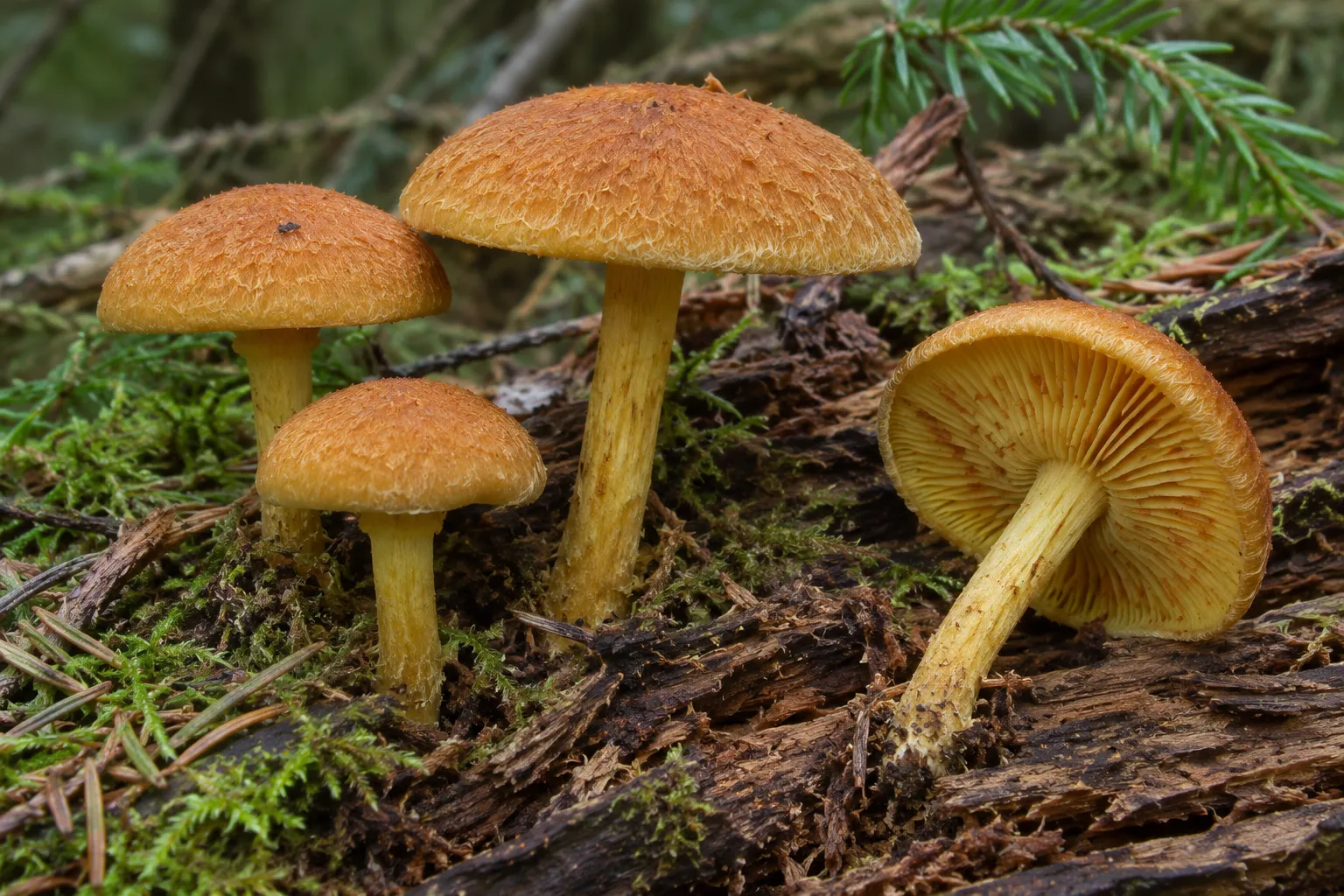
Quick facts
- Scientific name
- Gymnopilus penetrans
- Common names
- Common rustgill, Common rusty-gill
- Taxonomy
- Gymnopilus · Hymenogastraceae
- Edibility context
- Inedible: Bitter flesh and confusion within Gymnopilus and other wood-growing groups make it unsuitable for casual food use.
- Spore print
- Rusty orange to rusty brown, with ornamented spores requiring microscopy.
- Toxicity context
- Unknown: Do not infer chemistry or safety from genus reputation. Treat an uncertain ingestion conservatively and seek local professional advice.
- Season
- August, September, October, November, December
- Growing difficulty
- Expert
- Regions
- Europe, North America, temperate regions with verified records
Safety limit: These labels summarize documented context; they never authenticate a wild specimen. Cooking does not make a poisonous species safe.
Common rustgill, Gymnopilus penetrans, is best recorded as a color transition on decaying conifer wood. Fresh gills are yellow; maturing spores produce rusty flecks and eventually a rusty-orange deposit. That sequence, a dry ochre cap, and a ringless yellowish stem form a useful hypothesis, but several wood-growing brown-spored mushrooms overlap. Substrate, developmental stages, veil evidence, deposit, microscopy, and a regional key must remain linked.
This page owns the species-level common-rustgill intent. The gill-types guide explains attachment terminology, while the spore-color guide covers deposit controls. Neither replaces comparison with dangerous brown-spored wood inhabitants.
Prove the substrate instead of naming the nearest tree
Photograph the complete wood unit before collecting. Record bark, exposed end grain, needles, cones, branch arrangement, decay class, diameter, and whether the wood is a log, stump, buried fragment, or processed forestry waste. Common rustgill is strongly associated with conifer wood, but moss and soil can conceal the attachment.
Excavate one base carefully when lawful. A mushroom apparently growing from soil may connect to a buried root or chip. Conversely, a fruit body beside a pine log may arise from different buried wood. Preserve attached fibers and photograph the junction. Host identification should be reported at the confidence the wood supports, not upgraded from landscape context.
Track cap color and fibers through development
Number young, middle-aged, and mature caps in the same colony. Measure width, height, margin curvature, and center color. Young caps are convex; older caps broaden and may become nearly flat. Ochre-yellow, tawny, and orange-brown descriptions should be anchored to diffuse daylight and a neutral reference.
Use side lighting to reveal fine radial fibrils without exaggerating them. The center may be darker and somewhat more textured, but coarse scales should widen the comparison. Rain can flatten fibers and deepen color; drying can make the same cap look paler and silkier. Record weather and surface moisture with each frame.
Follow yellow gills into the rusty phase
Photograph one underside at each stage. Record attachment at the stem, gill spacing, short-gill pattern, edge color, bruising, and the first rusty spots. Mature spores often collect unevenly, so rusty flecks on yellow gills can be more informative than a uniformly old brown underside.
Do not treat every orange-brown gill as a rustgill. Cortinarius, Galerina, Pholiota, and other wood- or litter-associated mushrooms can converge in color. Keep the cap, gills, stem, substrate, and deposit connected to the same specimen code, especially when several species share a log.
Search for veil evidence and a true ring
Inspect young caps before the margin separates from the stem. Common rustgill lacks a persistent conventional ring, although fleeting veil fibers may occur. Photograph the upper stem from several angles and distinguish attached fibers from spore deposits, slug damage, or tissue left by a neighboring cap.
Measure stem width at apex, middle, and base, then section it. Record yellow tones, longitudinal fibers, basal darkening, internal cavities, and any color change. A missing ring on a mature damaged specimen proves little. The dangerous funeral-bell comparison requires especially careful veil, cap, spore, and microscopic assessment.
Use bitterness only under an expert protocol
Field literature often describes Gymnopilus flesh as bitter. A tiny taste-and-spit test is not appropriate for beginners, mixed collections, children, or a specimen that could belong to a dangerous group. Never swallow material. Where an experienced mycologist uses taste under a local protocol, record the amount, delay, intensity, duration, and rinsing.
Bitterness supports a character set; it does not identify the species or establish toxicity. Weathered material may taste weak, and observer responses differ. Odor, tissue color, and bruising should be recorded independently rather than folded into a general impression.
Make a controlled rusty deposit
Choose a mature cap whose gills still retain structure. Place it over white and clear nonabsorbent surfaces, cover it against drafts, and note duration. A thick deposit should be rusty orange to rusty brown. Thin deposits, reflected light, or stained paper can make the color look yellow, cinnamon, or nearly dark brown.
Photograph the deposit with the cap code and retain part for microscopy. Do not scrape spores from a mixed container and call them a print. If no deposit forms, preserve that failure; an immature cap or dry weather may explain it, but the missing evidence should not be silently replaced with an expected result.
Measure spores and cap tissues
Calibrated microscopy should record spore length, width, profile, ornament, and sample size in the mount specified by the key. Gymnopilus spores are ornamented, but exact dimensions and ornament appearance matter. Examine basidia, cystidia, gill edge, cap cuticle, and veil tissue when regional alternatives demand them.
Report the measured range and outliers. A copied literature dimension does not describe a collection. DNA data can help only when the sequence remains tied to a dried voucher and adequate morphology; an environmental sequence without a documented fruit body cannot retroactively verify a photograph.
Separate common rustgill from larger and riskier lookalikes
Spectacular rustgill is generally larger and more robust, often clustered, with stronger veil development and a ring or ring zone. The scaly-rustgill complex tends to show more conspicuous cap scales, but species concepts and names vary regionally. Size alone changes with moisture and substrate, so measure instead of relying on “small.”
Funeral bell is a consequential comparison on wood. It often shows a ring or ring zone and a hygrophanous cap, but weathering can erase easy characters. Other Galerina, Pholiota, Cortinarius, and orange wood decomposers add overlap. If the purpose involves consumption or exposure response, uncertainty must end the identification attempt rather than invite a shortcut.
Record the decomposer’s position in the log
Map fruit bodies along the wood: bark intact or lost, upper versus ground-facing surface, cut end versus mid-log, moss cover, moisture, and neighboring fungi. Repeat the map after rain. A colony that returns at a particular decay boundary provides ecological evidence beyond one attractive cluster.
Avoid claiming that the fungus alone caused a tree’s death. Fruiting on a fallen log demonstrates decomposition at the observed time, not the history of the tree. In managed woodland, note whether timber was felled, storm-thrown, burned, chipped, or treated, because those histories shape both habitat and interpretation.
Keep chemistry claims narrower than the evidence
The genus Gymnopilus attracts attention for variable secondary chemistry, but a genus name does not predict the compounds or effects of a particular collection. This page makes no psychoactive, medicinal, or edible claim. Chemical conclusions require authenticated material, validated analytical methods, and appropriate expertise.
For an uncertain ingestion, preserve remnants, photographs, and packaging; record species hypotheses, amount, preparation, symptoms, and timing. Contact local poison control or medical services when symptoms or uncertainty warrant it. Do not use a cap color or online genus suggestion to decide that monitoring is unnecessary.
Audit the editorial image against field-photo baselines
The 1536 × 1024 cover is an original AI-assisted editorial image compared beside MushroomScope’s Smoky Bracket and Hairy Bracket natural-light baselines. It retains diffuse woodland light, restrained ochre color, realistic conifer wood and moss texture, complete attachments, ringless stems, and one readable yellow-gilled underside with rusty spotting. It contains no text, watermark, logo, collage seam, stretching, or obvious fused anatomy.
The image remains illustrative. Spore color, bitterness, exact substrate, veil remnants, and microscopic characters cannot be authenticated from it. Real records must keep those evidence layers independent.
Build a reviewable common-rustgill record
Assign each fruit body a code before collection. Link habitat frames, cap series, underside, stem, print, slide, and dried material to that code. Preserve raw images and note automated camera enhancement. Dry representative young and mature specimens promptly with airflow and retain complete metadata where collection is lawful.
Revisit the log across wet and dry intervals. Record new flushes, changing gill color, competing fungi, and wood deterioration. State unresolved questions: unknown conifer species, lost veil evidence, failed print, incomplete microscopy, or uncertain regional name. A transparent Gymnopilus record is more valuable than a confident species label built from color alone.
Run a fixed-area gill maturation census
Choose three caps at different stages and photograph the same one-centimeter gill sector beside the stem under fixed diffuse light. Count pale yellow, rusty-spotted, and fully rusty gill faces separately. Repeat after a measured interval while leaving at least one cap in place. The result is a collection-specific maturation series, not a promise that every cap changes at the same speed.
Compare the census with a labeled spore print from each collected stage. Rust color appearing only as a deposit from an overlapping cap is different from pigment developing across the gills. Insects, bruising, and water tracks can create brown marks, so record their shape and distribution. A timed sector makes the phrase “gills rust with age” testable and keeps it from becoming decorative template language.
Measure the decay niche within a conifer log
At each cluster, record bark coverage, wood hardness, moisture, diameter, distance from the cut end, contact with soil, moss depth, and whether the fruit bodies arise from sapwood, heartwood, or an unresolved crevice. Use a blunt probe only on already decayed material and avoid enlarging cavities. Photograph a cross-section only where the wood is naturally broken.
Repeat the survey along the same log at fixed intervals. Common rustgill may occupy a particular moisture and decay band while other fungi use adjacent zones. This pattern is more informative than simply writing “on dead wood.” It also prevents a nearby broadleaf branch from being mistaken for the substrate when multiple pieces overlap beneath moss.
Separate colony boundaries on crowded wood
Colored caps can make a log appear to hold one uniform population. Map clusters and retain at least one complete, separately bagged voucher from each distinct cap form or gill stage. Do not pool prints or microscopy until their characters agree. Mark fruit bodies with a persistent ring, hygrophanous cap, coarse scales, or substantially different stature as separate hypotheses.
This discipline is especially important when a dangerous Galerina group might share the substrate. The absence of a ring in one rustgill does not clear a neighboring mushroom. Every food or exposure decision must follow the individual specimen, and this page supplies no consumption clearance for any member of the colony.
References
- NCBI Taxonomy Browser: Gymnopilus penetrans — current name and sequence-linked taxonomy.
- GBIF species search: Gymnopilus penetrans — occurrence and voucher leads requiring record review.
- First Nature: Gymnopilus penetrans — morphology, ecology, season, and comparisons.
- North American Mycological Association: mushroom poisoning syndromes — conservative exposure-response context.
Editorial status: reviewed by the MushroomScope editorial team on November 21, 2026; no named mycologist, toxicologist, clinician, or food-safety expert reviewed this page.
Source quality notes
MushroomScope cites sources that match the page scope, such as taxonomic databases, extension guidance, food-safety agencies, food-composition databases, and peer-reviewed or institutional health references. Sources support context and uncertainty; they do not turn an online page into specimen identification, medical advice, or a tested recipe record.
Frequently asked questions
Why is it called a rustgill?
The gills begin yellowish and acquire rusty-orange tones as the spores mature. That color sequence is useful but is shared by multiple wood-growing brown-spored mushrooms.
Does growth on a conifer log prove common rustgill?
No. Several Gymnopilus and other brown-spored genera fruit on conifer wood. Cap surface, veil, ring, gills, taste under expert protocol, spores, microscopy, and regional range must agree.
Is common rustgill edible?
No food clearance is provided. It is bitter, easy to confuse with other wood-growing mushrooms, and not treated here as an edible species.
Does common rustgill have a ring?
A persistent ring is normally absent. Young specimens may show fleeting veil fibers, so a damaged ringless stem alone cannot establish the species.
Can rusty spores identify Gymnopilus penetrans?
No. A rusty deposit narrows the field, but spore size and ornament, cap and gill tissues, veil characters, substrate, taste, and a current regional key remain necessary.
Related guides
mushrooms
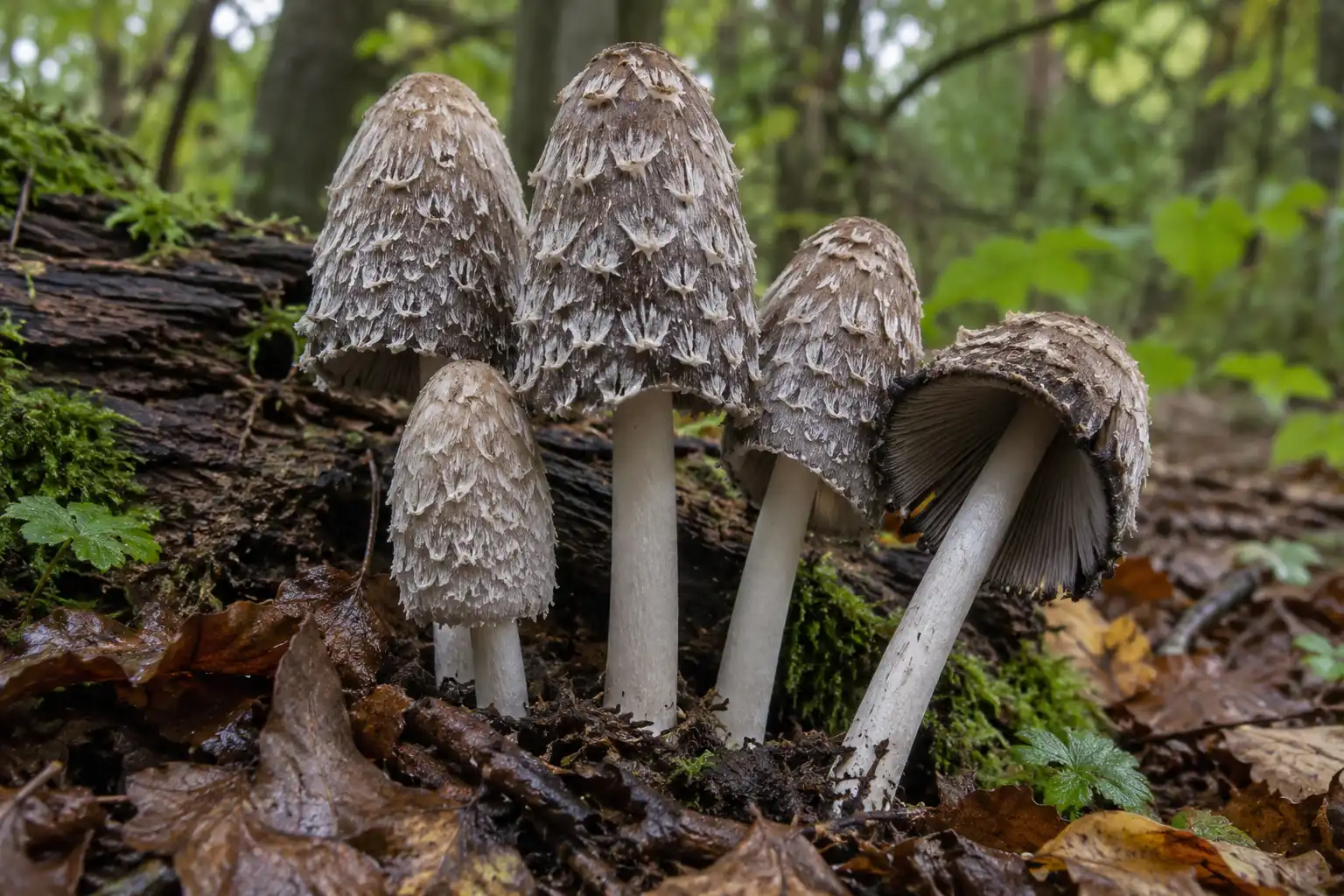
Scaly Inkcap: Coprinopsis variegata Identification Guide
Identify scaly inkcap by shaggy veil patches, clustered hardwood habitat, darkening gills, deliquescence, spores, and careful lookalike separation.
identification
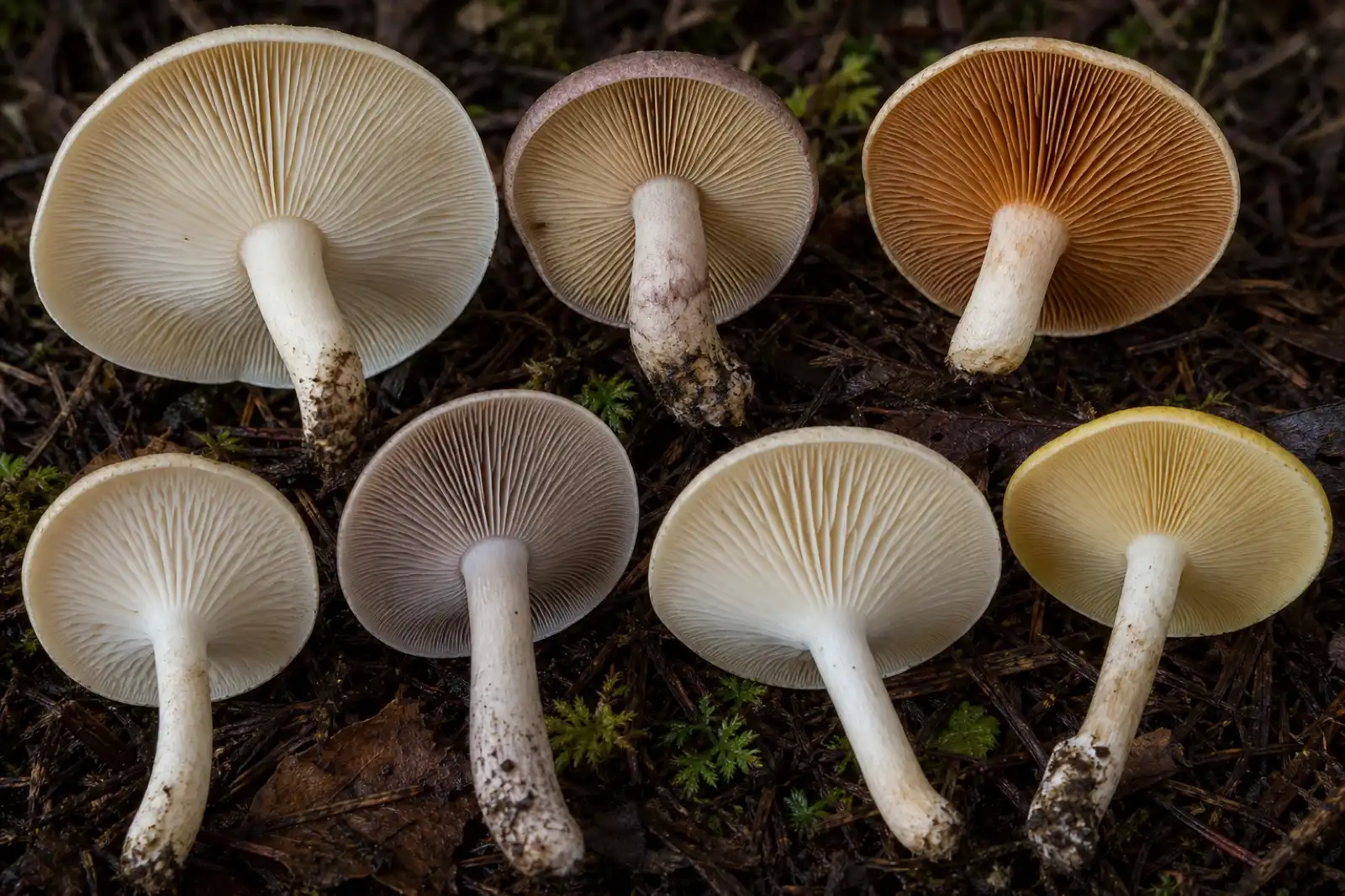
Mushroom Gill Types: Attachment, Spacing, and Color
Compare free, attached, notched, adnate, and decurrent mushroom gills while recording spacing, short gills, edge details, bruising, and color changes.
identification
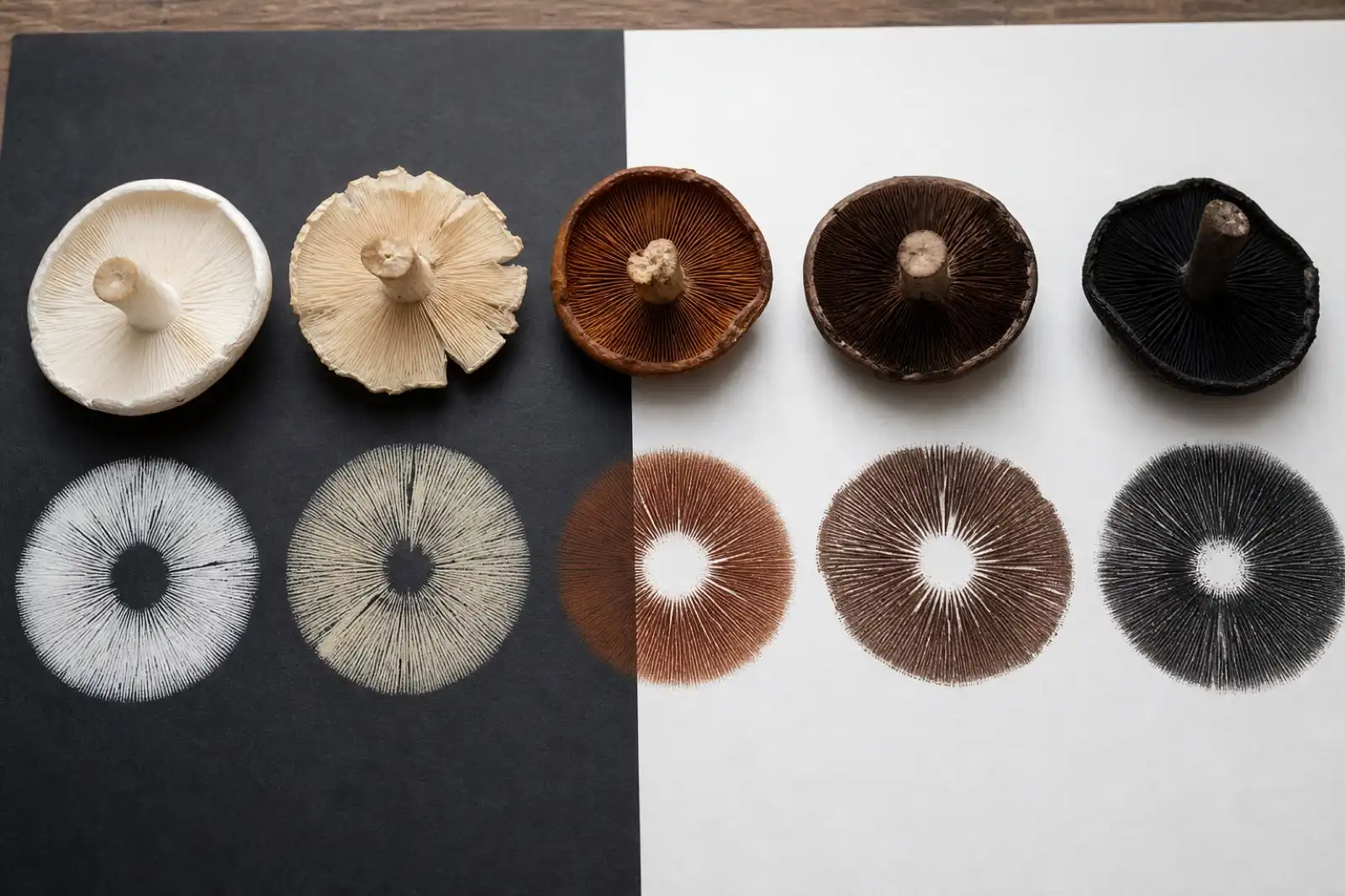
Mushroom Spore Print Colors and How to Record Them
Use a controlled spore deposit to distinguish broad color groups while recognizing that print color alone never identifies a species.
Continue exploring
Browse more practical guides in Mushroom Encyclopedia or visit the mushroom encyclopedia.