Mushroom Encyclopedia
Giant Club Fungus: Clavariadelphus pistillaris Guide
Identify giant club fungus through its unbranched ochre clubs, wrinkled surface, complete base, beech-wood habitat, spores, aging, and coral-fungus lookalikes.
Species context
Treat profiles as reference material
Species profiles summarize documented traits, taxonomy, and lookalikes, but natural variation can be substantial.
Use the safety checklist →Decision limit
A profile cannot authenticate a specimen
Do not eat a wild mushroom from an online match, single feature, or generated image.
Read the safety disclaimer →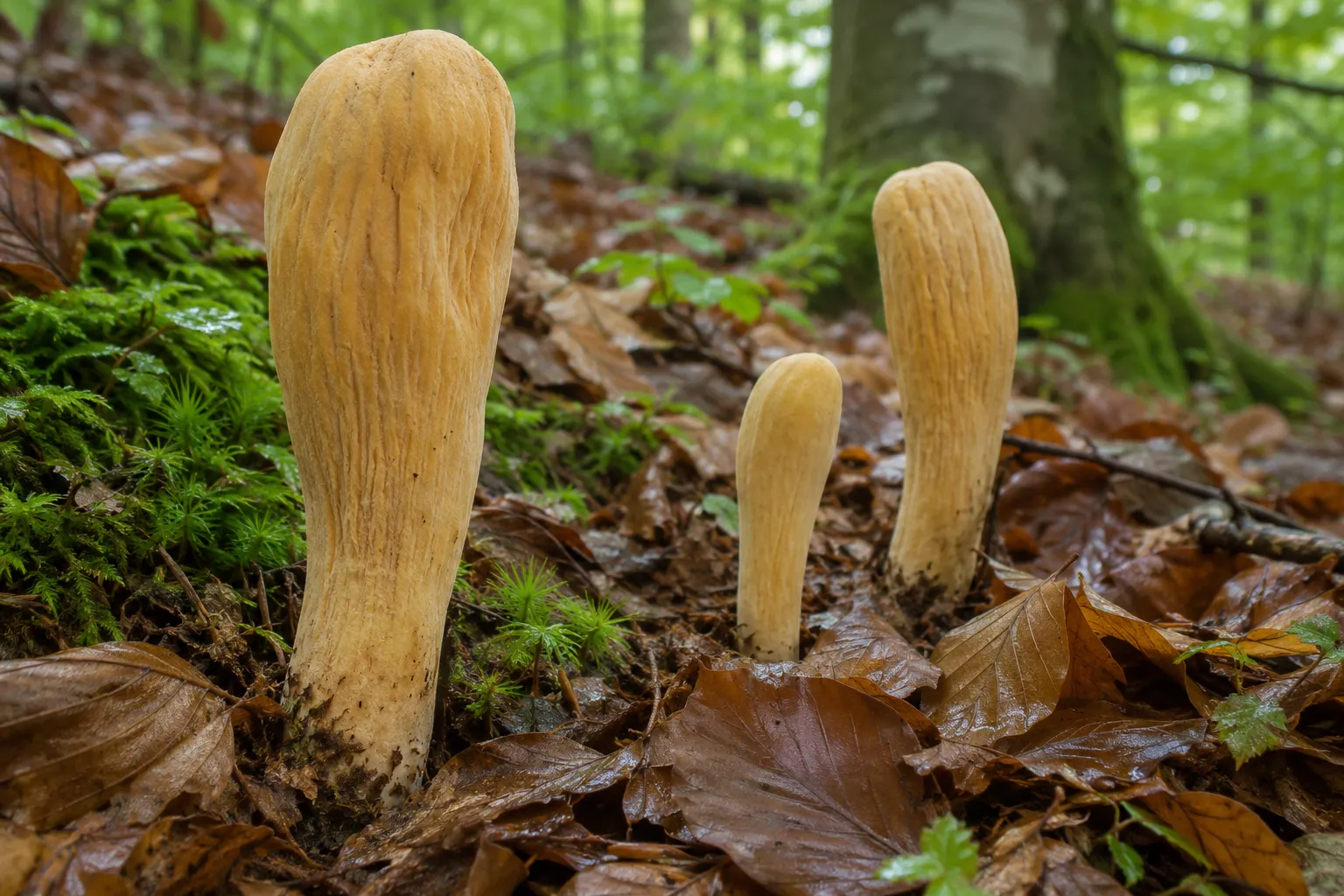
Quick facts
- Scientific name
- Clavariadelphus pistillaris
- Common names
- Giant club fungus, Pestle-shaped coral
- Taxonomy
- Clavariadelphus · Clavariadelphaceae
- Edibility context
- Inedible: Not recommended for food; bitterness, conservation concerns, condition, and identification uncertainty outweigh culinary value.
- Spore print
- Pale ochre to cream deposit; microscopic spores and basidia support separation from other clubs.
- Toxicity context
- Unknown: Do not use an unverified club fungus as food; several club and coral fungi require microscopic and regional separation.
- Season
- August, September, October, November
- Growing difficulty
- Expert
- Regions
- Europe, temperate records elsewhere requiring current regional verification
Safety limit: These labels summarize documented context; they never authenticate a wild specimen. Cooking does not make a poisonous species safe.
Giant club fungus replaces the familiar cap-and-stem plan with one upright, blunt club. The external surface itself carries the fertile layer, while the fruit body narrows into litter without a sharply separate stem. That architecture is distinctive enough to guide observation, but not enough to prove Clavariadelphus pistillaris from a photograph.
Build the record around architecture, surface development, flesh, habitat, regional range, and microscopy. Do not taste an unknown club fungus, and do not remove scarce woodland material merely to complete a checklist. When the site or specimen cannot support a full review, “unbranched club fungus” is the more accurate result.
Photograph the complete club before touching it
Use a low side view that includes the apex, widest point, narrowing base, and soil attachment. Record total height and width at the top, middle, and base. A ruler held beside rather than against the fruit body preserves the surface. Include neighboring clubs to show whether they are solitary, scattered, or in a small group.
The apparent outline changes with lens angle. Photograph from two perpendicular sides and from above, using neutral natural light. Avoid ultra-wide phone lenses at close range because they exaggerate the nearest club and distort the head-to-base proportion.
Confirm that the fruit body is unbranched
A true giant club is a single continuous structure. Follow the surface from the base to the blunt apex and inspect hidden litter for divisions. Damage, fused neighbors, and insect feeding can simulate branching, while a young coral fungus may not yet show its full architecture.
The violet coral guide demonstrates why branch hierarchy matters. Record any forks, flattened lobes, wounds, or fused bases explicitly rather than editing them out of the photograph.
Track ochre color without making it decisive
Young material may be pale cream to buff; mature clubs often deepen toward ochre, tan, or brownish yellow. Handling, age, drying, rain, camera white balance, and surrounding green light can shift the apparent color. Place a grey reference card outside the crop when accurate color documentation matters.
Color supports but does not decide the identification. Note whether bruising creates a reddish, brownish, or otherwise altered zone and how long it takes. Do not cut or rub several fruit bodies just to force a reaction when one lawful sample or naturally damaged area is sufficient.
Record wrinkles as a surface system
Longitudinal grooves and wrinkles can become more pronounced with growth and drying. Photograph the upper, middle, and lower thirds under raking light. Distinguish regular shallow folds from cracks, slug tracks, or collapse in senescent tissue.
Because the fertile surface lies externally, weathering changes more than appearance: it can remove spores and obscure tissue needed for microscopy. Pair a fresh mature specimen with an older one when available, but do not treat age differences as separate taxa.
Section one representative club only when justified
A longitudinal section should show solid pale flesh rather than a hollow stem beneath a separate cap. Record firmness, moisture, discoloration, insect tunnels, and the boundary between clean and decayed tissue. Photograph immediately and again after a measured interval if bruising is relevant.
Do not taste the flesh. Older guides sometimes mention bitterness, but taste is not required to document the species hypothesis and creates unnecessary exposure. Odor can be described from intact material without prolonged close inhalation.
Use beech woodland as evidence, not proof
Many European treatments connect this species strongly with mature beech woodland, often on calcareous or base-rich soils. Photograph bark, leaves, mast, stand structure, and the exact ground layer. If beech identity or soil chemistry is unknown, say so. The habitat guide separates observed trees from inferred partners.
Record slope, drainage, moss, litter depth, canopy continuity, deadwood, and management. A club beneath beech may still belong to a different species; conversely, regional taxonomic and ecological treatments can differ. Habitat narrows a hypothesis but cannot replace anatomy.
Compare the wrinkled club on scale and branching
The wrinkled club, often called Clavulina rugosa, is generally smaller, paler, and more irregular, and may divide toward the apex. The site’s violet coral guide provides a contrasting branched architecture. Compare measured stature, color, apex shape, base, branch development, flesh, spores, and regional habitat.
A damaged giant club can become irregular, while an unusually stout wrinkled club can mislead a size-only comparison. Use several intact developmental stages before deciding which key to follow.
Separate truncated and branched relatives
Clavariadelphus truncatus often presents a flattened or truncated apex rather than a smoothly blunt one, although development and damage complicate that distinction. Other Clavariadelphus names may be relevant outside Europe. Current regional keys and spores are necessary when range or apex form conflicts with the expected profile.
Ramaria and other coral fungi usually divide repeatedly. Count branch orders from the base upward rather than calling the whole mass “club-shaped.” When only a broken terminal branch is present, a confident name is not defensible.
For the smaller pale comparison, the wrinkled club fungus guide maps longitudinal folds, limited forking, complete bases, and woodland substrate. It keeps a twisted ivory Clavulina record separate from the stout ochre pestle described here.
Make a controlled spore record
Because spores form over the external upper surface, a conventional cap print is awkward. Stand a mature specimen so a known side faces clean glass or dark paper without crushing it, protect it from drafts, and record duration and humidity. A sparse pale deposit may be difficult to distinguish from tissue dust.
Microscopic review can include spore dimensions and shape, ornament or smoothness, basidia, clamps, and tissue features specified by the chosen key. State reagent, calibration, sample count, and measured range. Never imply that database microscopy was performed on the observed specimen.
Treat distribution maps as leads
GBIF can expose vouchers, observations, name histories, and institutional records, but mapped points are not equal in certainty. Check identifier, date, basis of record, media, and source institution. NCBI provides taxonomic and sequence-linked context rather than verification of a field photograph.
If a record lies outside a familiar range, preserve a lawful voucher and seek local review. Do not use one image to announce a range extension. Name changes and uneven survey effort can make online maps incomplete or misleading.
Document conservation context before collection
Large woodland clubs can be locally uncommon and may reflect long-continuity habitat. Check protected-site rules, local red lists, and landowner permission. A set of scaled photographs, habitat notes, and a non-destructive surface swab may be more appropriate than removal.
Map the fruit bodies without exposing sensitive coordinates publicly when the site is vulnerable. Revisit after rain to record longevity and senescence. Leave intact clubs to complete spore release and support woodland invertebrates.
Keep food and safety claims conservative
This guide does not recommend giant club fungus as food. Reports of bitterness or poor quality, regional uncertainty, age, contamination, and conservation value all argue against casual collecting. A webpage cannot inspect the base, flesh, spores, habitat, or condition of a real specimen.
If illness follows wild mushroom ingestion, contact emergency services or a poison center promptly. Keep uncooked material, leftovers, photographs, location, and timing. Do not wait for an online identification before seeking care.
Audit the editorial image against field evidence
The cover is an original AI editorial image. It was compared with the site’s Scarlet Waxcap and Purple Brittlegill baselines for filtered natural light, damp woodland materials, restrained color, realistic depth of field, complete bases, and unforced environmental composition. The 1536-by-1024 source is sharp at responsive sizes and shows no text, watermark, logo, collage seam, or coral-like branching.
The image presents plausible blunt ochre clubs and beech litter, but it is not a specimen record. Size, wrinkles, host identity, flesh, spores, and exact taxonomy remain illustrative. It must not be used to validate food use or a new occurrence.
Build a reviewable giant-club record
- Photograph the complete attachment and two side profiles.
- Measure height and width at the apex, middle, and base.
- Confirm that each fruit body is genuinely unbranched.
- Record surface color, wrinkles, bruising, and age in neutral light.
- Document beech and soil evidence without assuming a partnership.
- Section one lawful representative specimen only when necessary.
- Compare truncated clubs, wrinkled clubs, and branched coral fungi.
- Use microscopy and a current regional key for a species-level claim.
The value of the record lies in connected evidence, not in the novelty of the silhouette. A large ochre club begins the inquiry; architecture, habitat, tissue, spores, and regional review complete it.
Separate abundance from fruit-body size
One very large club does not demonstrate that a population is abundant or stable. Count fruit bodies along a defined route or within a mapped patch, record the searched area and effort, and distinguish fresh, damaged, and senescent clubs. Repeat the same method in later seasons before drawing conclusions about trend. Rainfall and timing can change visible fruiting even when the underlying organism persists.
For a woodland-management note, connect the count to canopy, litter disturbance, path widening, soil compaction, and recent forestry work. Do not publish precise coordinates for a vulnerable site without considering local recording practice. These measurements add ecological value while avoiding a common error: using the impressive stature of one fruit body as a substitute for population evidence.
References
- GBIF species search: Clavariadelphus pistillaris — occurrence records and taxonomic source links.
- NCBI Taxonomy Browser: Clavariadelphus pistillaris — taxonomic and sequence-linked context.
- First Nature: Clavariadelphus pistillaris — field morphology, woodland habitat, season, and comparisons.
- North American Mycological Association: poisoning syndromes — conservative response guidance for suspected mushroom poisoning.
Source quality notes
MushroomScope cites sources that match the page scope, such as taxonomic databases, extension guidance, food-safety agencies, food-composition databases, and peer-reviewed or institutional health references. Sources support context and uncertainty; they do not turn an online page into specimen identification, medical advice, or a tested recipe record.
Frequently asked questions
What does giant club fungus look like?
It forms a single stout, unbranched, upright club with a blunt top, ochre to buff surface, and subtle longitudinal wrinkles. A complete base and several ages should be documented.
Does giant club fungus have gills or pores?
No exposed gills or pores are present. The spore-bearing surface covers much of the outside of the upper club, so surface condition and microscopy matter.
Where is Clavariadelphus pistillaris found?
It is associated especially with mature broadleaf woodland, often beech on calcareous soils in Europe. Host, soil, region, and current local records should be checked.
How is it separated from coral fungi?
The fruit body is unbranched rather than coral-like. Color alone is insufficient; compare architecture, flesh, bruising, spores, habitat, and regional keys.
Is giant club fungus edible?
This guide does not recommend it as food. Reports describe poor or bitter culinary quality, exact identification can be difficult, and remote review cannot assess a real collection.
Related guides
mushrooms
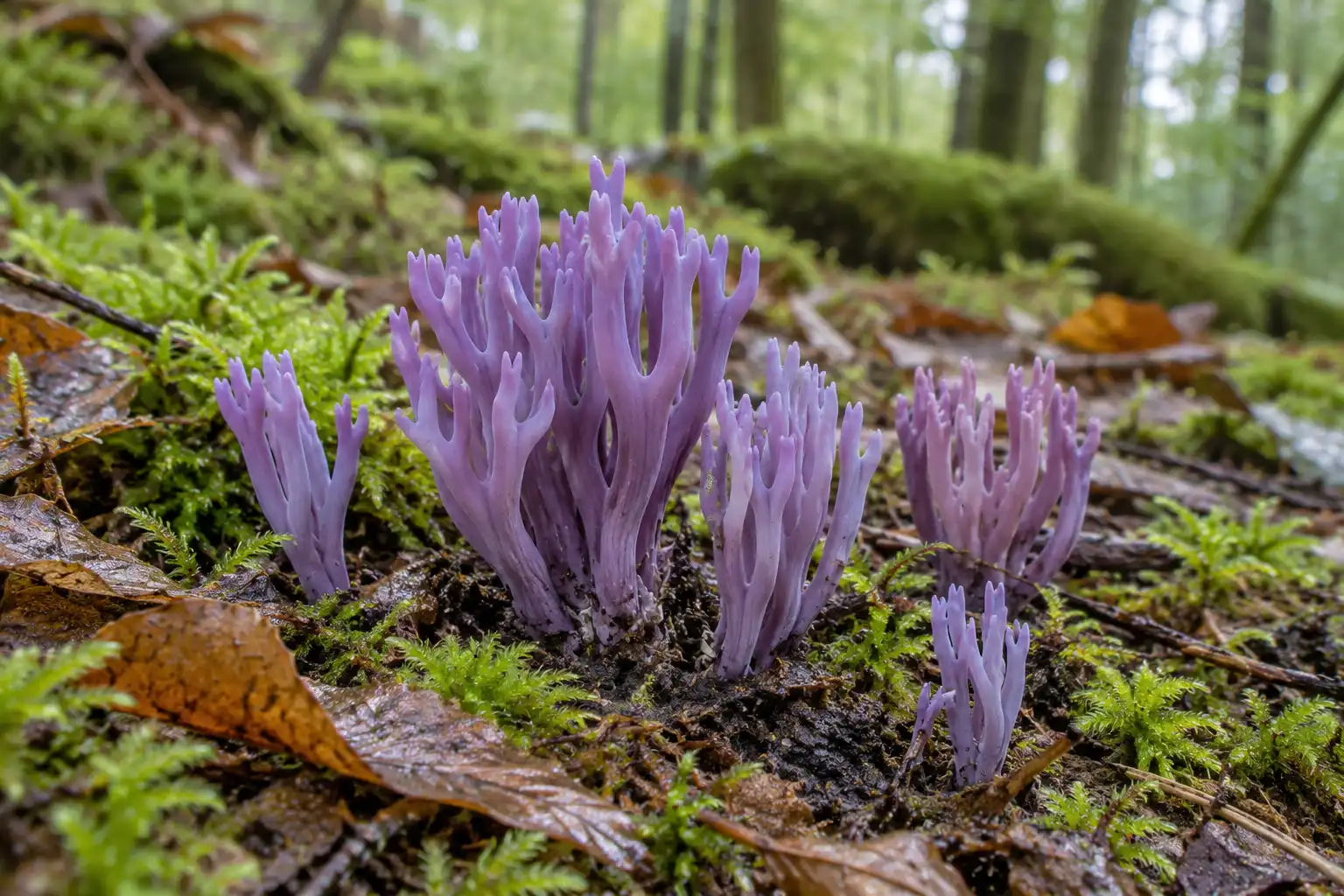
Violet Coral Fungus: Branching Form, Ecology, and Lookalikes
Study violet coral fungus through its lilac branching form, woodland ecology, regional limits, similar fungi, documentation, and safety boundaries.
mushrooms
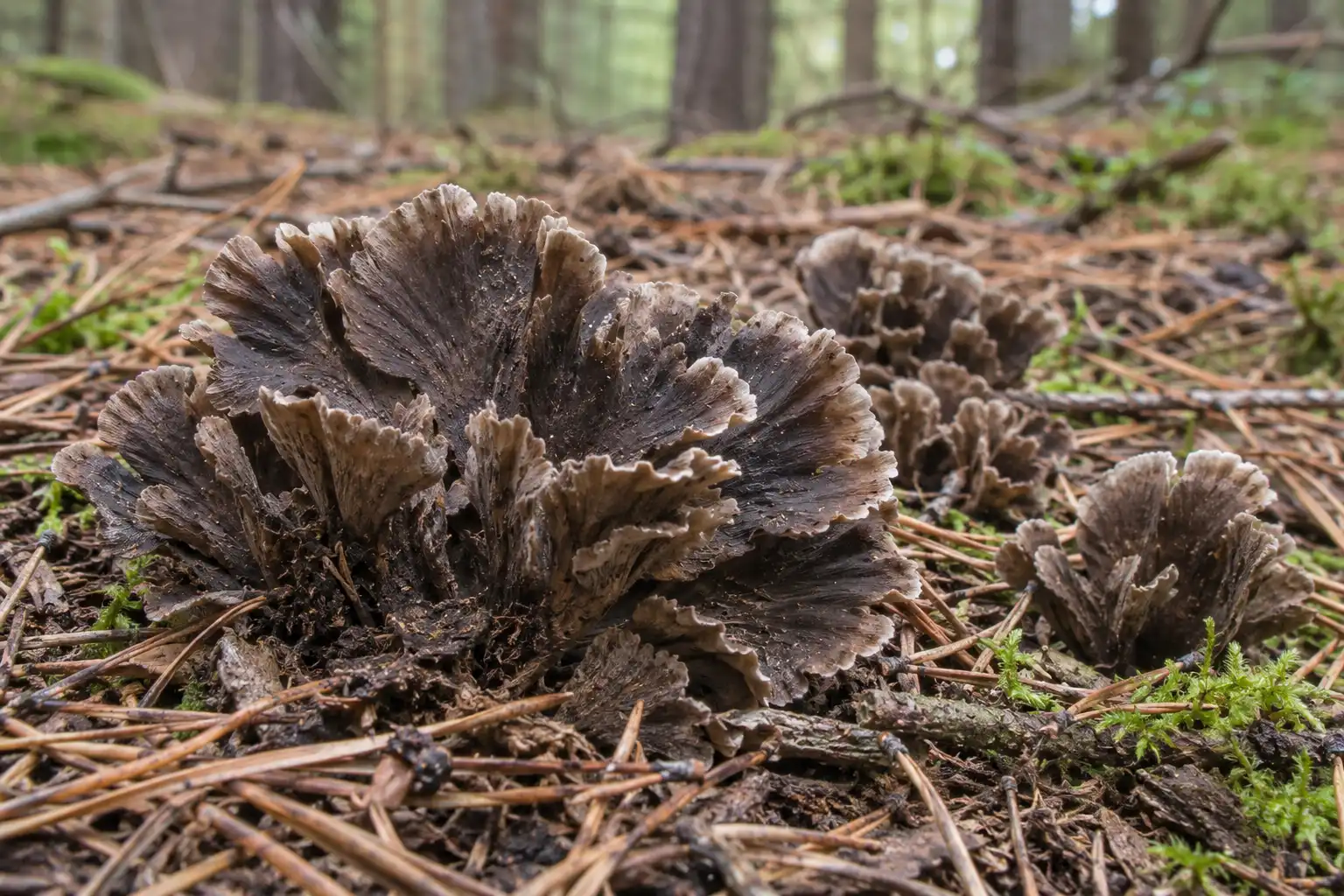
Earthfan Fungus: Rosettes, Pine Ecology, and Lookalikes
Study earthfan fungus through its leathery fan rosettes, fringed margins, conifer-litter ecology, lookalikes, field measurements, and safety limits.
identification
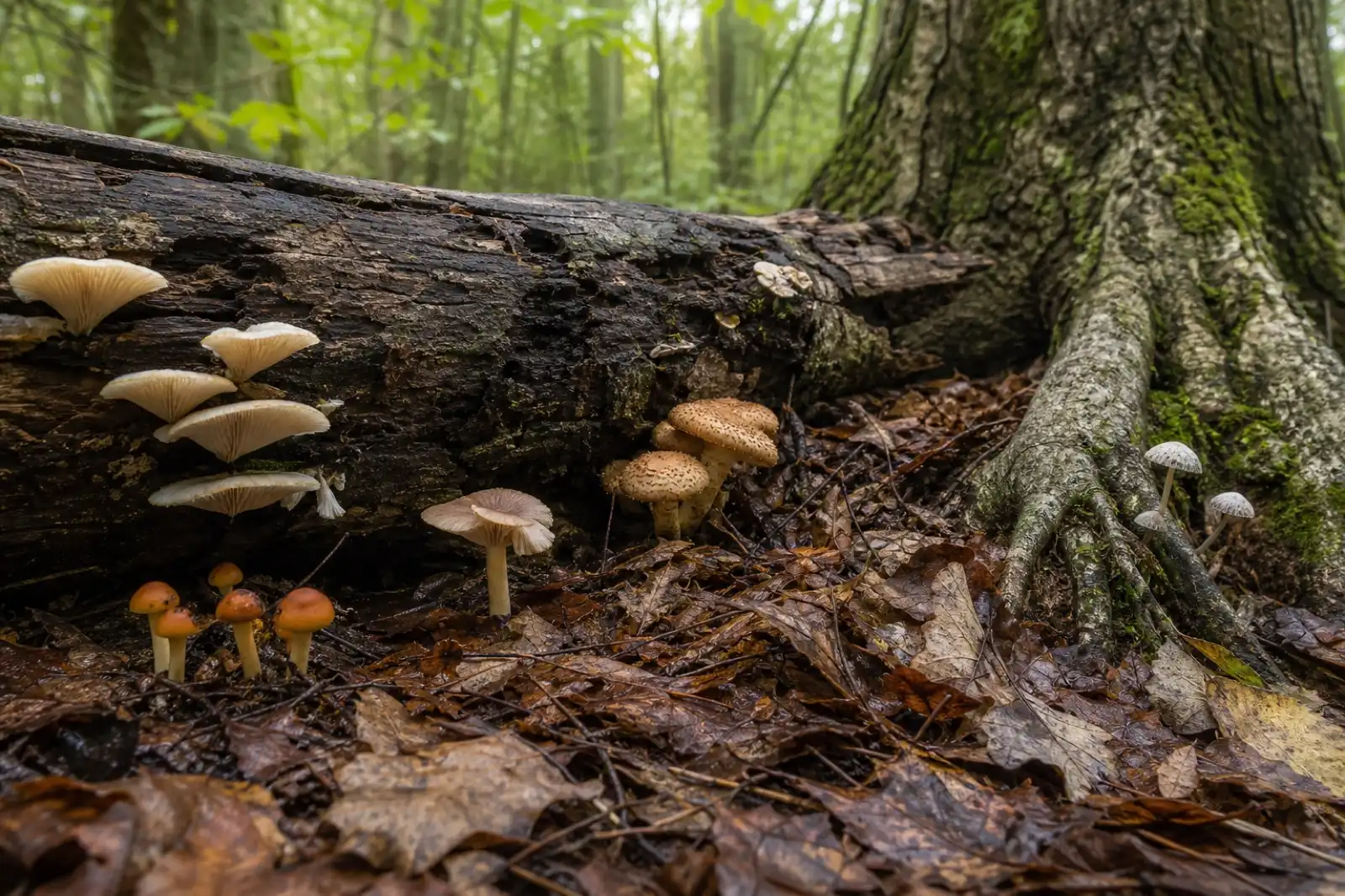
Using Habitat to Identify Mushrooms
Record substrate, associated plants, soil, wood type, moisture, elevation, and fruiting pattern as identification evidence.
Continue exploring
Browse more practical guides in Mushroom Encyclopedia or visit the mushroom encyclopedia.