Mushroom Encyclopedia
Earthfan Fungus: Rosettes, Pine Ecology, and Lookalikes
Study earthfan fungus through its leathery fan rosettes, fringed margins, conifer-litter ecology, lookalikes, field measurements, and safety limits.
Species context
Treat profiles as reference material
Species profiles summarize documented traits, taxonomy, and lookalikes, but natural variation can be substantial.
Use the safety checklist →Decision limit
A profile cannot authenticate a specimen
Do not eat a wild mushroom from an online match, single feature, or generated image.
Read the safety disclaimer →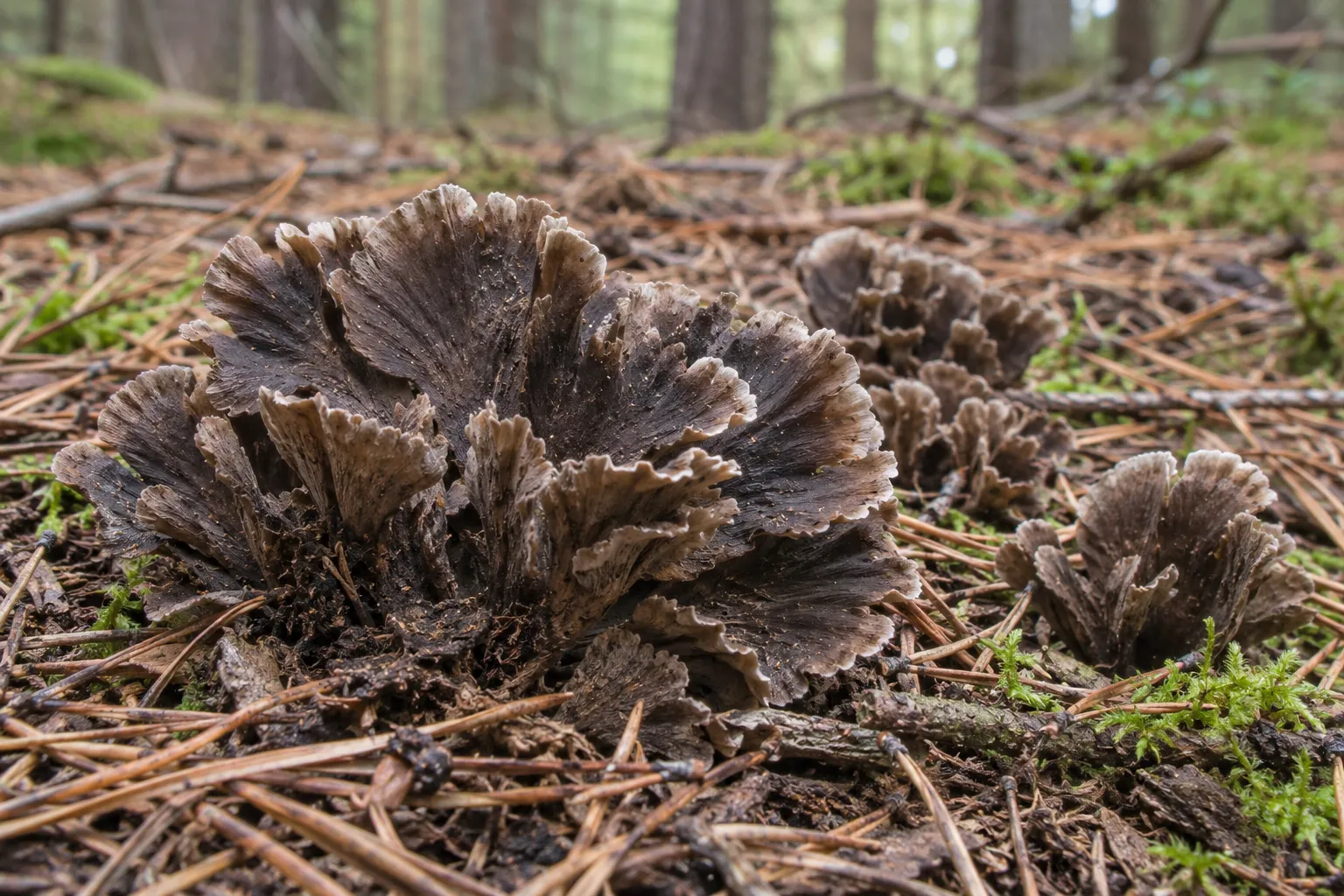
Quick facts
- Scientific name
- Thelephora terrestris
- Common names
- earthfan fungus, common fiber vase
- Taxonomy
- Thelephora · Thelephoraceae
- Edibility context
- Inedible: Not recommended as food; tough texture and identification uncertainty remain.
- Spore print
- Brown, with ornamented spores requiring microscopy for useful comparison.
- Toxicity context
- Unknown: No food-safety conclusion should be drawn from this page.
- Season
- July, August, September, October, November
- Growing difficulty
- Expert
- Regions
- Europe, North America, Asia, Oceania
Safety limit: These labels summarize documented context; they never authenticate a wild specimen. Cooking does not make a poisonous species safe.
Earthfan fungus usually refers to Thelephora terrestris, a brown, tough fungus that builds overlapping fans and rosettes on woodland ground. From above it can resemble a dead flower, a small turkey-tail cluster, or curled leaf litter. The reliable evidence lies underneath that resemblance: direct ground attachment, thin fibrous lobes, a wrinkled non-poroid fertile surface, conifer-rich habitat, and microscopic characters interpreted with a regional key.
Map the rosette before lifting litter
Begin with a square-on photograph of the complete colony and a scale. Mark the outline of each rosette, gaps between groups, and any fans that wrap around needles, twigs, seedlings, or stones. Measure maximum diameter, height, lobe width, and distance between neighboring clusters. These dimensions preserve architecture that breaks easily during collection.
The fruit body may have no obvious center. Fans can fuse, split, overlap, and hide their attachment. Do not count every visible lobe as a separate organism. Describe connected structures as one fruiting cluster until bases or genetic evidence show otherwise.
Examine margins, zones, and fibers
Fresh growing margins are often paler than the interior and may look finely fringed. Older zones can darken, collect soil, or become algae-stained. Photograph the edge against a neutral background and use a hand lens to distinguish real hairs or fibers from adhering pine needles.
Record radial zoning, ridges, cracks, and thickness at the margin and toward the base. A side-lit image can reveal fibers without the saturation used in dramatic nature photography. The leathery texture should bend rather than crumble when fresh, while old dry fans may become brittle. Handling condition belongs in the record.
Find the fertile surface without inventing an underside
Folded earthfans can make upper and lower surfaces hard to orient. The hymenial surface is wrinkled or shallowly ridged, not lined with gills and not perforated by the regular pores of a polypore. Photograph both faces of a naturally detached fragment and note which side faced outward or downward.
A magnified surface image should show continuous tissue between wrinkles. Dirt-filled pits are not pores. If a specimen clearly has a field of tube openings, compare a polypore instead. The mushroom pore-surface guide explains how to document true pores with a measured square.
Trace soil, roots, and buried debris
Earthfan is often seen among pine needles and moss, but the picture must distinguish visible cover from actual attachment. Move only loose litter where permitted and follow one margin toward its base. Record mineral soil, humus depth, buried woody material, roots, container media, or landscaping fabric.
The fungus is associated with plant roots in ectomycorrhizal systems, frequently involving conifers, but a fruit body beside a pine does not identify the root partner. List nearby verified plants and their distance. Root-tip or molecular work is needed for a partner-specific claim. Use the habitat identification guide to keep substrate and association separate.
Compare forest and nursery settings
In woodland, record canopy, plantation history, stand age if known, soil drainage, moss, and litter depth. In a nursery, add container type, substrate batch, irrigation zone, seedling species, and whether rosettes originate inside a pot or from ground beneath it. Avoid transferring conclusions between these settings without matching conditions.
Fruit bodies may surround young stems or debris. That visual relationship does not prove the fungus caused chlorosis, wilting, or mortality. Nursery decline can involve water, salts, temperature, pathogens, roots, and handling. Plant-health decisions require root inspection and qualified local advice, not removal of visible fans alone.
Separate turkey tail by attachment and pores
Turkey tail forms thin zoned brackets on dead wood and has a true pore surface below. Earthfan usually arises from ground or litter and lacks those regular pores. Buried sticks can mislead, so expose only enough attachment to document the substrate. The turkey tail guide provides a structure-first comparison.
Color zones overlap: both can show brown, gray, buff, and pale margins. Therefore “looks like a tiny turkey tail” is a starting observation, not a determination. A clear pore close-up and substrate trace carry more weight than a colorful top view.
Compare other terrestrial fans and vases
Other Thelephora species can form cups, vases, rosettes, or branched masses. Thelephora caryophyllea is often more distinctly vase-like, but damaged or crowded material overlaps. Podoscypha and other fan fungi may differ in texture, growth form, tropical distribution, and microscopy. Some leathery litter fungi actually arise from buried wood.
Record spore color, size, shape, ornamentation, clamp connections where relevant, tissue construction, odor without tasting, and geography. Use mature tissue from a labelled specimen. A cautious “Thelephora species” record is preferable when regional keys or microscopy do not support T. terrestris.
Measure a radial transect
Choose one intact rosette and photograph it with a north mark. Along four radii, measure lobe height, width, thickness, edge color, and degree of overlap at fixed intervals. Score litter contact and damage separately. Repeat after a week of dry weather and after rain without moving the fruit body.
The transect shows whether pale growth is concentrated at active margins and how the flexible fans respond to moisture. It does not establish an annual growth rate or prove that rainfall caused a new lobe. State missing visits and damaged sections rather than interpolating them.
Document persistence and decay
Thin leathery fruit bodies can persist after active growth. Note whether margins are fresh and flexible, central tissue is faded, surfaces carry algae, or lobes crumble when lightly moved. Mark old and new tissue in photographs. A colony that remains visible in winter may represent durable dead tissue rather than continuous sporulation.
Invertebrate grazing, trampling, frost, and needle fall alter the silhouette. Repeated fixed-angle photographs help separate development from damage. Do not clear a large area for a clean picture; litter context is ecological evidence and removal changes the microhabitat.
Microscopy and voucher workflow
Assign a field number before sampling. Keep a whole rosette or representative wedge connected to its images. Make a spore deposit when mature material permits, but do not infer a pale print merely because little material is visible. Record microscope calibration, mount, magnification, and the number of ornamented spores measured.
Dry the specimen promptly with labels protected from heat and moisture. Preserve a note showing which face was considered fertile. A flat brown fragment in an envelope can be almost uninterpretable without its original orientation, attachment, and habitat photographs.
Food, handling, and site safety
Earthfan is not recommended here as food. Its tough texture does not establish toxicity or safety, and remote images cannot exclude other leathery fungi, contaminated substrate, or individual reactions. Do not taste unknown material. Wash hands after handling specimens from treated nursery media or polluted sites.
If symptoms occur after wild-mushroom exposure, contact local emergency or poison-control services. Retain uncooked material, photographs, and timing. Do not wait for social-media consensus. Necessary safety language is repeated because emergency response should remain accessible even on a page about an inedible-looking species.
A defensible observation record
Photograph the site, colony plan, side profile, margins, both surfaces, attachment, and nearby verified plants. Record coordinates at an appropriate privacy level, elevation, date, weather, litter depth, soil condition, dimensions, texture, and odor without tasting. State whether the setting is natural woodland, plantation, landscaped bed, or nursery.
Separate observation from interpretation: “fans wrap around a pine seedling” is visible; “the fungus is killing the seedling” requires different evidence. Link every microscope slide and dried piece to the field number. These habits make a modest record useful even if the species name later changes.
Editorial and evidence limits
This article has editorial review only and no named mycologist, forest pathologist, nursery specialist, or clinician reviewer. GBIF and NCBI support name and occurrence context, not remote identification. Forest ecosystem literature supports ecological framing, and NAMA supports conservative poisoning response. No source here authorizes ingestion or nursery treatment.
The original AI editorial image was accepted after comparison with two natural-light site baselines for restrained color, realistic forest texture, complete terrestrial bases, pine-needle scale, and lack of text or watermark. It is not a field photograph and must not be used to confirm Thelephora terrestris.
Keep root-association evidence separate from fruiting form
An ectomycorrhizal interpretation needs more than a fan beside a tree. If the research question concerns plant partners, sample roots only with permission and an appropriate protocol, keep root tips linked to exact plants and soil positions, and use qualified morphological or molecular analysis. A fruit-body barcode identifies the sampled fruit body; it does not automatically identify every colonized root in a mixed soil sample.
For ordinary field recording, avoid destructive root work. Instead document plant composition, measured trunk or seedling distances, soil surface, and repeated fruiting positions. Phrase the result as habitat context. That evidence remains valuable and checkable without turning a plausible ecological relationship into an unsupported partner claim.
The giant club fungus guide covers another terrestrial woodland form whose blunt upright club, beech-litter context, and external fertile surface create a separate identification intent from earthfan rosettes.
References
- Global Biodiversity Information Facility. Thelephora terrestris search and occurrence context.
- National Center for Biotechnology Information. Thelephora terrestris taxonomy search.
- USDA Forest Service. Fungi and Forest Ecosystems. Forest-fungus ecological context.
- North American Mycological Association. Mushroom Poisoning Syndromes. Conservative response context.
Editorial status: reviewed by the MushroomScope editorial team on October 27, 2026; no named mycologist, forest pathologist, nursery specialist, or clinician reviewed this page.
Source quality notes
MushroomScope cites sources that match the page scope, such as taxonomic databases, extension guidance, food-safety agencies, food-composition databases, and peer-reviewed or institutional health references. Sources support context and uncertainty; they do not turn an online page into specimen identification, medical advice, or a tested recipe record.
Frequently asked questions
Why is Thelephora terrestris called earthfan?
Its tough fruit bodies rise from soil or litter as overlapping fan-shaped lobes that can merge into irregular rosettes.
Does earthfan grow on wood like turkey tail?
It usually appears terrestrial among litter and may wrap around seedlings or debris. Trace the base because buried wood can complicate the scene.
What does the fertile surface look like?
The exposed surfaces are wrinkled to slightly ridged rather than poroid or gilled; surface orientation can be confusing in folded rosettes.
Can earthfan harm nursery seedlings?
Fruiting can occur around seedlings and containers, but a visible rosette alone does not diagnose plant decline. Root and nursery problems need site-specific assessment.
Is earthfan fungus edible?
This guide does not recommend it as food. The fruit body is thin and leathery, and remote identification cannot establish safety.
Related guides
mushrooms
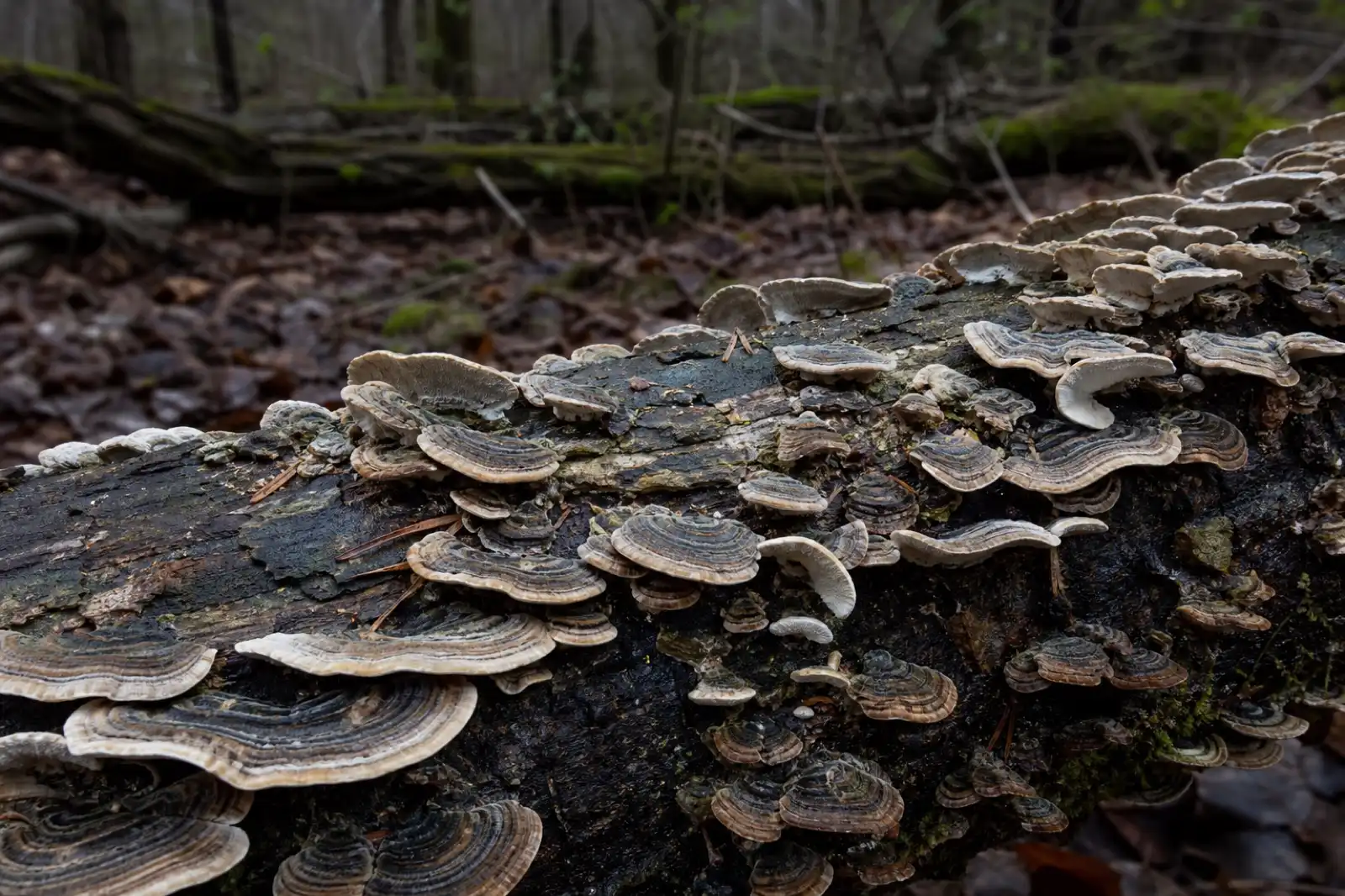
Trametes versicolor: Turkey Tail Mushroom Species Guide
Learn Trametes versicolor identification, pore features, hardwood habitat, cultivation, extract evidence, lookalikes, supplement safety, and FAQs.
mushrooms
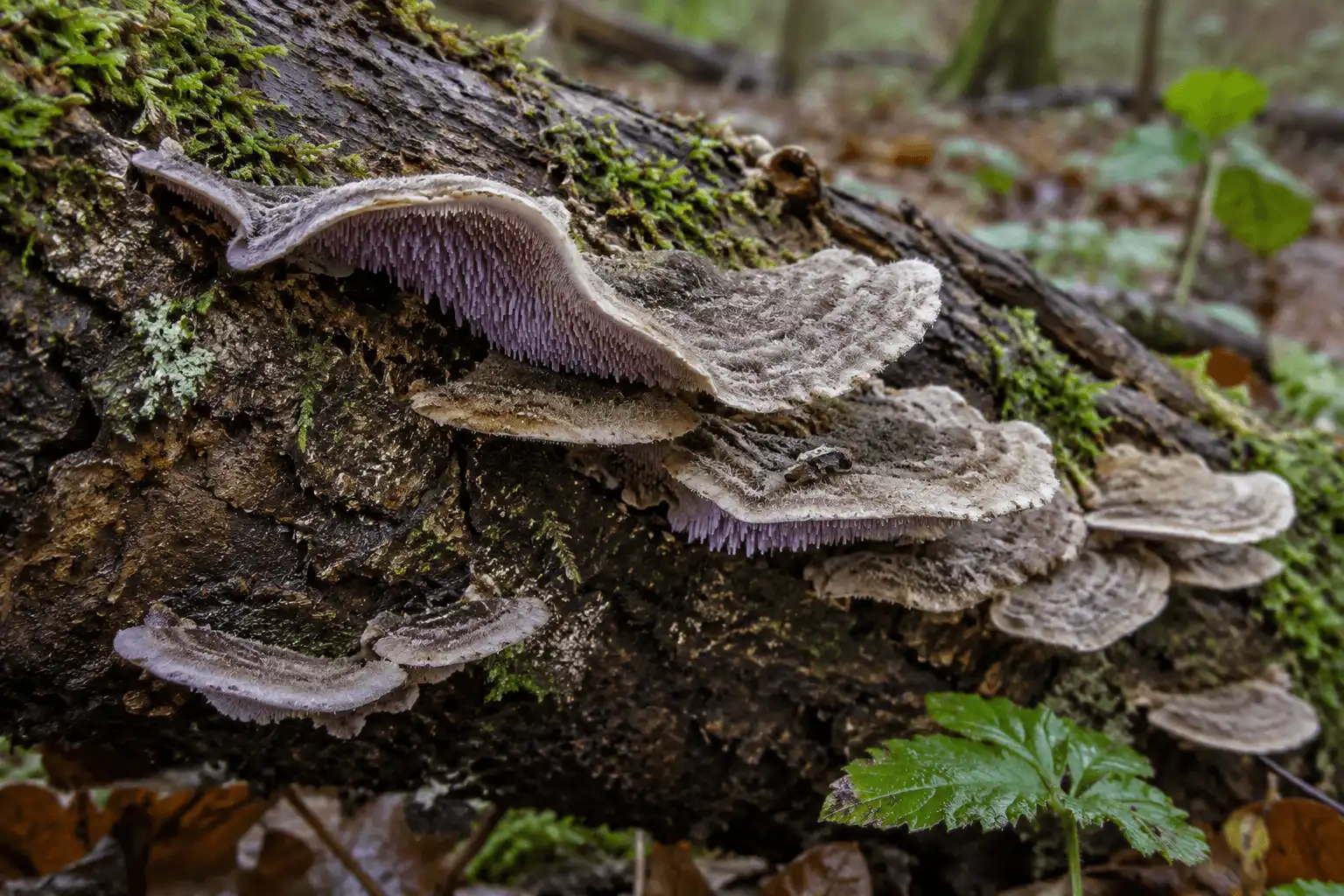
Violet-Toothed Polypore: Purple Pores, Teeth, and Hardwood Ecology
Document violet-toothed polypore by thin zoned brackets, fresh violet margins, a pore surface that tears into teeth, hardwood decay, aging, and lookalikes.
identification
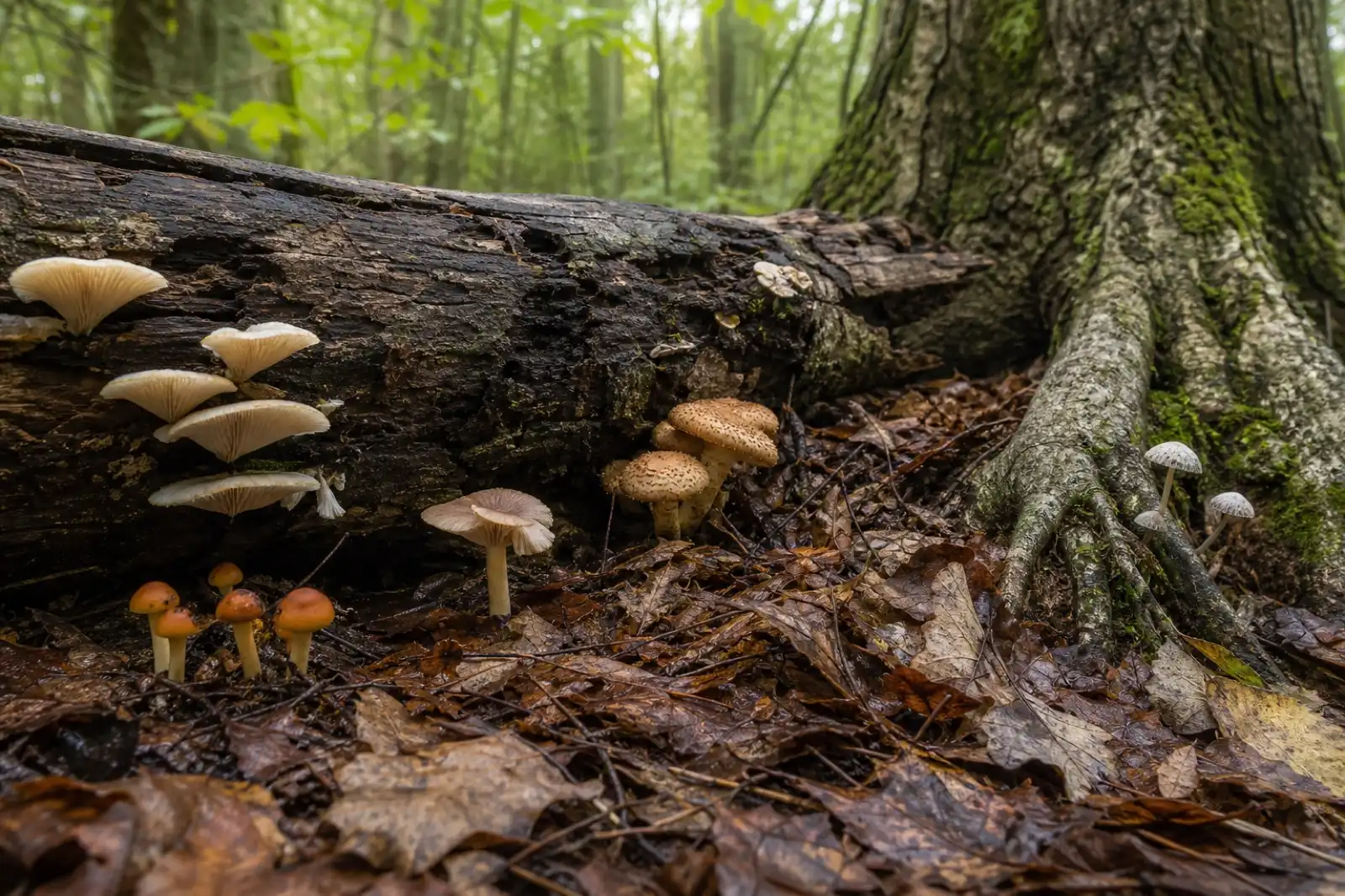
Using Habitat to Identify Mushrooms
Record substrate, associated plants, soil, wood type, moisture, elevation, and fruiting pattern as identification evidence.
Continue exploring
Browse more practical guides in Mushroom Encyclopedia or visit the mushroom encyclopedia.