Identification
Using Habitat to Identify Mushrooms
Record substrate, associated plants, soil, wood type, moisture, elevation, and fruiting pattern as identification evidence.
By MushroomScope Editorial Team · · Updated
Safety first
Use as a field-record guide
Document the whole mushroom, habitat, substrate, and region before comparing names or photographs.
Open the identification safety hub →Decision limit
Do not use this as an edibility verdict
Wild mushroom consumption decisions require qualified local, in-person confirmation of the complete specimen.
Read the safety disclaimer →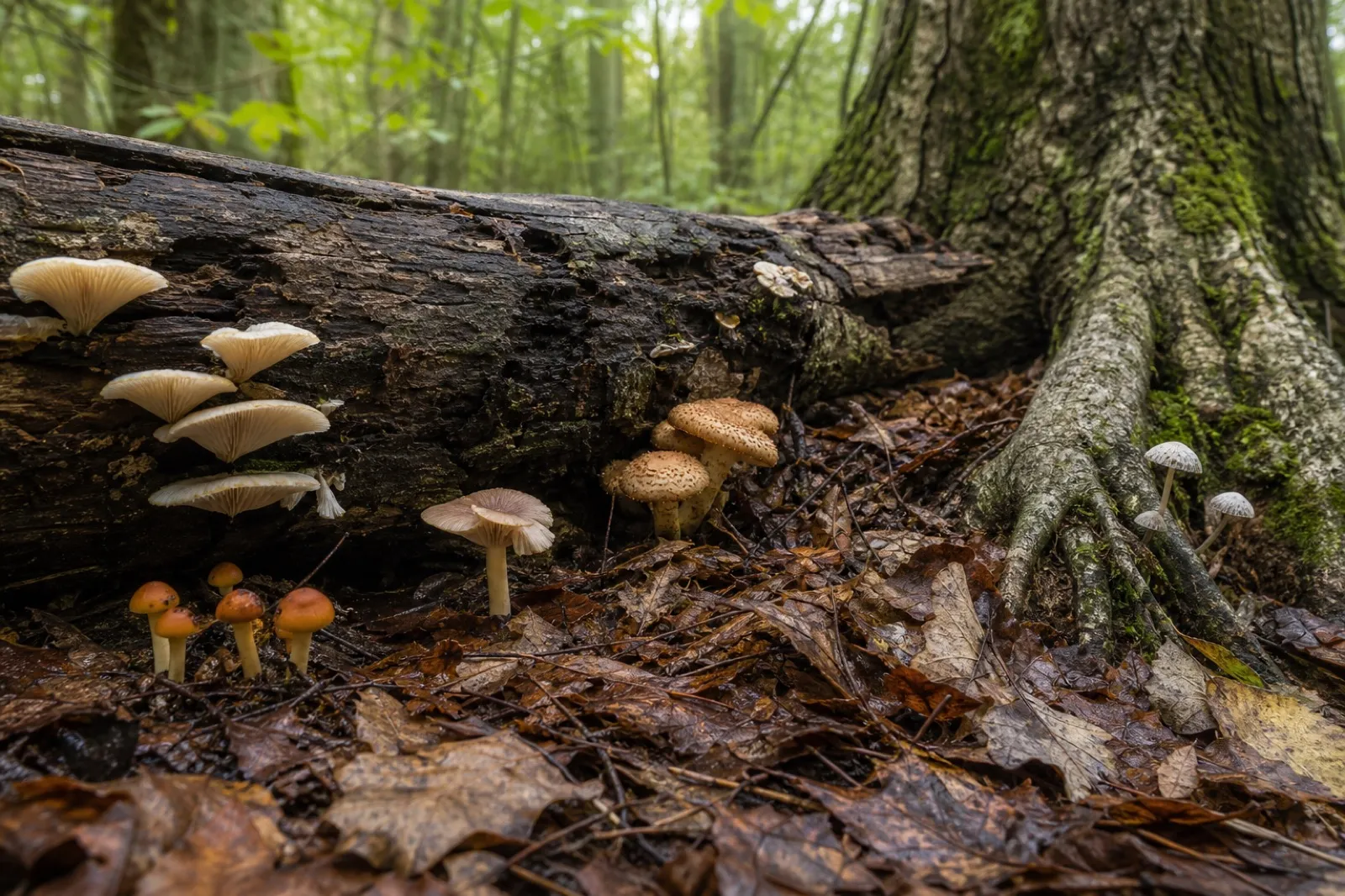
Use habitat to narrow candidates without claiming identity
Record substrate, associated plants, soil, wood type, moisture, elevation, and fruiting pattern as identification evidence. The central task is ecology and substrate. A defensible observation separates what was directly seen from what was inferred. Common names, image-search results, and app suggestions can generate hypotheses, but none establishes identity or edibility.
Begin with a site frame wide enough to show canopy, ground layer, slope, and the fruiting pattern. Then move closer without hiding the point of emergence. Assign the collection a field number and record coordinates privately, coordinate accuracy, elevation, date, recent rainfall, and land use. Habitat evidence loses value when a close-up cannot be reconnected to its actual patch.
What to examine
- hardwood or conifer association: Record the feature in plain language, add a measurement or photograph, and note variation among specimens.
- living or dead wood: Record the feature in plain language, add a measurement or photograph, and note variation among specimens.
- soil, litter, dung, or moss: Record the feature in plain language, add a measurement or photograph, and note variation among specimens.
- single, clustered, or shelf-like growth: Record the feature in plain language, add a measurement or photograph, and note variation among specimens.
- region and elevation: Record the feature in plain language, add a measurement or photograph, and note variation among specimens.
Treat each ecological claim as a confidence statement. “On oak” requires wood or roots that were independently identified as oak; “beneath probable oak” is a different, weaker observation. Rain-darkened bark, buried landscaping timber, mixed roots, and transported wood chips commonly create false certainty. A regional key can use habitat to narrow candidates only when the substrate record is as careful as the mushroom record.
A repeatable field method
- Make one landscape frame and one ground-level frame before touching the collection.
- Trace the point of emergence to soil, litter, dung, moss, exposed wood, or buried material; photograph the connection.
- Record living or dead host evidence separately from nearby vegetation, with leaf, bud, cone, and bark images where available.
- Measure the radius and pattern of the fruiting group and give separate field numbers to different substrate patches.
- Add morphology, spore, and microscopic evidence only after the ecological observations are fixed in writing.
- Mark substrate or host as unknown when disturbance, decay, or mixed roots prevent a defensible conclusion.
Record the exact substrate before naming the habitat
“On the ground” can mean mineral soil, leaf litter, moss over wood, buried roots, a decomposed log, wood chips, dung, or a cone. Photograph the attachment before moving the mushroom. If collection is legal, inspect the immediate base for wood fibers, bark, compacted needles, attached plant roots, or a buried branch. Do not assume terrestrial growth merely because no log is visible.
For wood, record standing tree, stump, fallen trunk, branch, manufactured chips, fence post, or buried construction material. Note whether bark remains, how soft the wood is, whether the fruit body emerges from a wound, and whether the host is living or dead. Photograph leaves, needles, cones, bark, and buds needed for host identification. “Hardwood” and “conifer” are useful only when supported by evidence.
Dung, compost, mulch, lawns, greenhouses, and garden beds are distinct substrates with different possible species and contamination concerns. Record irrigation, imported soil or chips, recent landscaping, animal access, and chemical treatment when known. Never use an apparently clean habitat as proof that a mushroom is safe to eat.
Map nearby trees without assuming partnership
Many mushrooms form mycorrhizal associations with living trees, but the nearest trunk is not automatically the partner. Stand at the collection and photograph a full circle of the canopy and ground. List plausible trees within a measured distance, including young plants and roots extending from beyond the frame. Record whether the site is a pure stand, mixed woodland, edge, park, plantation, or disturbed landscape.
The porcini guide applies this evidence ranking to a bolete complex, while the yellowfoot guide shows how moss, drainage, conifers, and late-season moisture describe a different mycorrhizal setting. Neither habitat pattern proves a species without matching morphology.
Learn enough tree identification to document bark, leaves or needles, branching, cones, and habitat, but keep uncertainty explicit. “Probable oak; leaf photographed” is better than a confident unsupported host. A mushroom associated with birch in one region may have different close relatives with other hosts elsewhere, so use a current regional key.
Saprotrophic mushrooms also respond to vegetation because plants shape litter, moisture, pH, and deadwood. Tree notes remain useful even when no direct symbiosis is claimed. The goal is to define the ecological candidate set, not to turn one tree into a species diagnosis.
Describe moisture, terrain, and disturbance
Record slope position, drainage, soil compaction, standing water, stream proximity, aspect, canopy cover, and exposed versus sheltered conditions. Note recent rain and longer weather patterns rather than only the conditions during the visit. A mushroom found after rain may have developed through a preceding dry or cool period.
Disturbance can be equally important. Paths, mowed turf, burned ground, logging, flood deposits, construction fill, gardens, and wood-chip beds create temporary substrates. Photograph the boundary between disturbed and undisturbed areas. Record road distance, pollution sources, pesticide or herbicide use, and dog or livestock access when food discussions might arise.
Elevation and broad landform help explain temperature and vegetation. Save coordinates privately with an accuracy estimate, but generalize public locations for rare taxa, private land, and sites vulnerable to overcollection. Follow land-manager rules for access, photography, and collecting.
Use growth pattern as ecological evidence
Photograph whether fruit bodies are solitary, scattered, gregarious, clustered from one base, arranged in a line, forming a fairy ring, overlapping on wood, or emerging at several points along buried roots. Include a wide frame with scale. A close-up can hide the very pattern that suggests buried wood or a spreading mycelium.
Separate collections when mushrooms occur on different logs, soil patches, or substrate types. Similar caps in one photograph can belong to different species. Assign each collection a field number and link its cap, underside, base, substrate, and habitat images. The photo checklist gives a repeatable capture order.
Return visits can show whether fruiting recurs on the same log, migrates along a root zone, follows irrigation, or appears only after a seasonal trigger. Repeated location is supporting evidence, not proof that every later fruit body is the same species.
Combine habitat with morphology in a candidate table
Start with observed facts: region, date, elevation, substrate, host evidence, growth pattern, cap, fertile surface, stem base, spore deposit, odor if safely recorded, and staining. Then list plausible local taxa and mark which facts support or contradict each. A strong habitat match cannot rescue incompatible spores or anatomy.
Use habitat to reject impossible candidates before choosing among visually similar ones. A mushroom known only from conifer wood is a poor fit for a verified living hardwood; a mycorrhizal forest species is a poor fit for a sterile indoor block. Yet host records and taxonomy can change, and introduced wood chips can move organisms, so unusual observations deserve documentation rather than instant dismissal.
For a worked conifer-root example, the cauliflower fungus guide shows how tree condition, distance from the trunk, hidden roots, and regional Sparassis boundaries belong in the same record as the branched fruit body.
When the substrate is hidden or the tree uncertain, mark it unknown. Do not invent ecological precision to complete a checklist. A later expert may identify the overlooked wood fiber or plant photograph, while a false certainty can misdirect the entire determination.
Compare habitats across seasons and regions
Fruiting calendars are regional and weather-dependent. Record the actual date and recent conditions instead of labeling a mushroom “autumn” or “spring” from memory. At tropical, coastal, alpine, and continental sites, the same month can represent very different biological seasons. The mushroom season guide explains how to use timing without overconfidence.
Check occurrence data in GBIF or a vetted local atlas for geographic plausibility, but examine record quality. A map point may be old, misidentified, georeferenced imprecisely, or based on a broad taxonomic concept. Absence from a map is not proof of absence, and presence in the country is not proof for one specimen.
Use local conservation and foraging regulations. Some places prohibit collection, restrict quantities, protect species, or require permits. Habitat documentation can be completed non-destructively when removal is not allowed.
Recognize what habitat cannot establish
Several unrelated fungi share lawns, wood chips, conifer logs, or oak woodland. Substrate narrows the question but does not confirm edibility, toxicity, or species. Microscopy, chemistry, DNA, or expert examination may still be necessary. A correct habitat note also cannot reveal environmental residues or individual food tolerance.
Never eat a wild mushroom because it grew in a “clean” forest or beside the “right” tree. For a food decision, seek a qualified local expert who can examine the complete fresh collection and rule out relevant dangerous species. If exposure has already occurred and symptoms are possible, contact local poison-control or emergency services rather than waiting for habitat-based identification online.
Interpretation limits
Occurrence platforms are most useful when the habitat record remains revisable. Upload the wide scene, point of emergence, host evidence, and collection number rather than only the most attractive cap. If a later reviewer changes the fungal name or host, the original ecological observations should still be recoverable. Sequence data are stronger when tied to a voucher and exact substrate record; an unvouchered sequence cannot repair a missing field context.
After a suspected poisoning, habitat can help a professional reconstruct the candidate set, but medical care comes first. Contact emergency services or a poison center promptly. When safe, retain uncooked specimens, food remnants, collection photographs, coordinates, substrate notes, meal time, and symptom timing; do not delay care while returning to the site or waiting for online agreement.
Combine ecology with a complete specimen record
Use the species encyclopedia only after the substrate and host observations have narrowed the local alternatives. The identification guides supply the complementary anatomy, spore, and photography methods needed when several fungi share the same woodland or landscaped habitat.
Pair habitat notes with the complete identification workflow and preserve both matching and conflicting evidence. “Unknown substrate” is a valid result; it is safer and scientifically more useful than a fabricated host association.
Preserve uncertainty in shared occurrence data
When uploading an observation, separate directly observed substrate from inferred host association and state coordinate precision. Do not select a species merely because a platform map shows it nearby. Attach the habitat frames and collection notes so later reviewers can revise the ecology or name without losing the original evidence.
References
- National Center for Biotechnology Information. NCBI Taxonomy Browser. Nomenclature and lineage context for checking the taxon attached to an ecological record.
- Global Biodiversity Information Facility. Species Search. Occurrence records whose coordinates, date, basis of record, and identification quality must be evaluated before ecological use.
- Mushroom Observer. Observation database. Community records that can preserve habitat photographs and identification discussion when original evidence is supplied.
Source quality notes
MushroomScope cites sources that match the page scope, such as taxonomic databases, extension guidance, food-safety agencies, food-composition databases, and peer-reviewed or institutional health references. Sources support context and uncertainty; they do not turn an online page into specimen identification, medical advice, or a tested recipe record.
Frequently asked questions
Can using habitat to identify mushrooms confirm that a mushroom is edible?
No. This guide organizes observations only. Never eat a wild mushroom unless a qualified local expert has examined the complete specimen in person.
Is one photograph enough for identification?
No. Photograph the cap, fertile surface, intact stem base, habitat, substrate, and several developmental stages, and record location and date.
What should I do when features conflict?
Keep the identification unresolved. Recheck local keys and current taxonomy, preserve the original observations, and seek qualified in-person help.
Related guides
identification
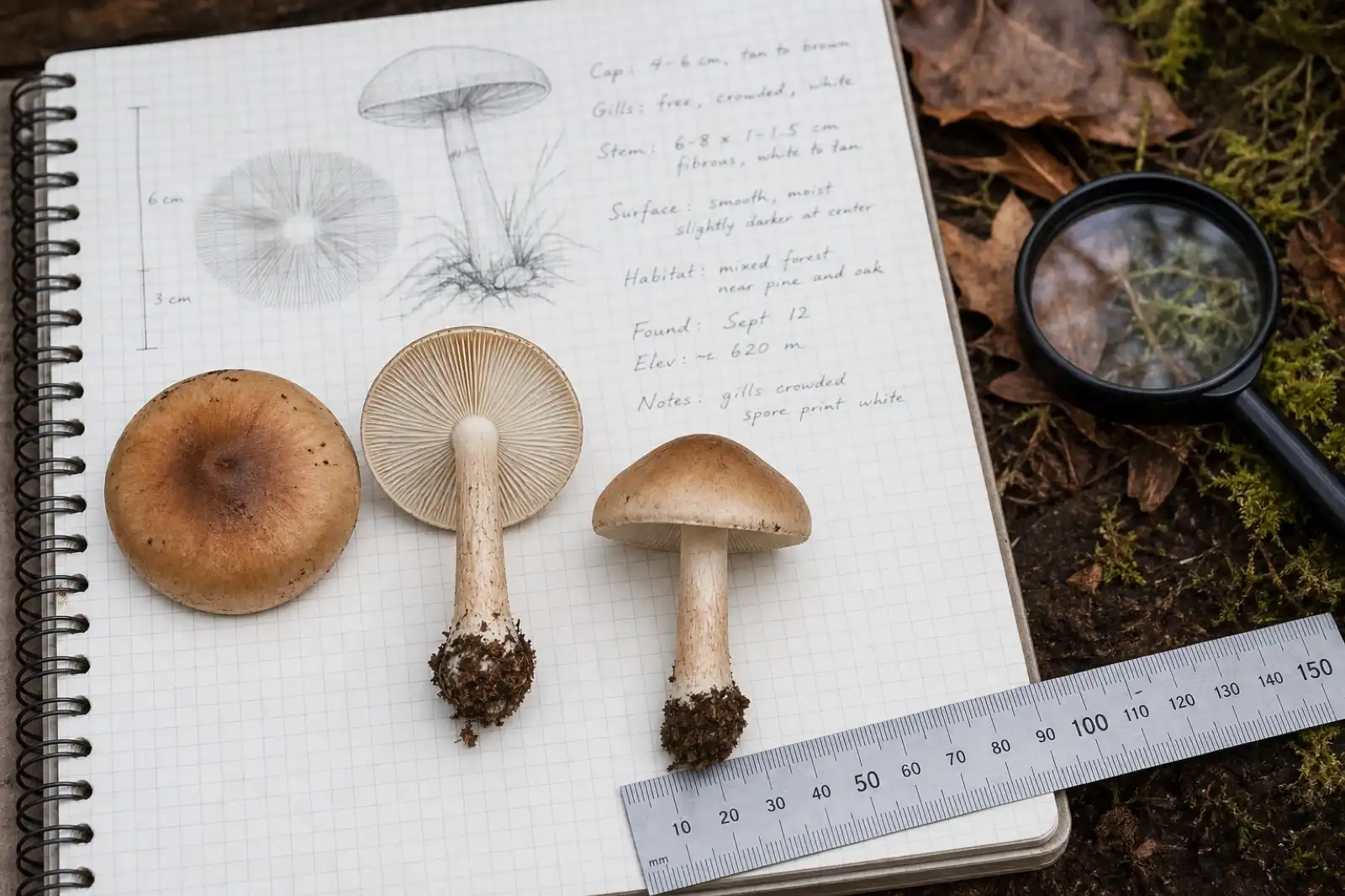
How to Identify Mushrooms: A Beginner's Field Guide
Build an identification from the whole specimen, substrate, habitat, spore deposit, and location—not from a single photograph.
identification
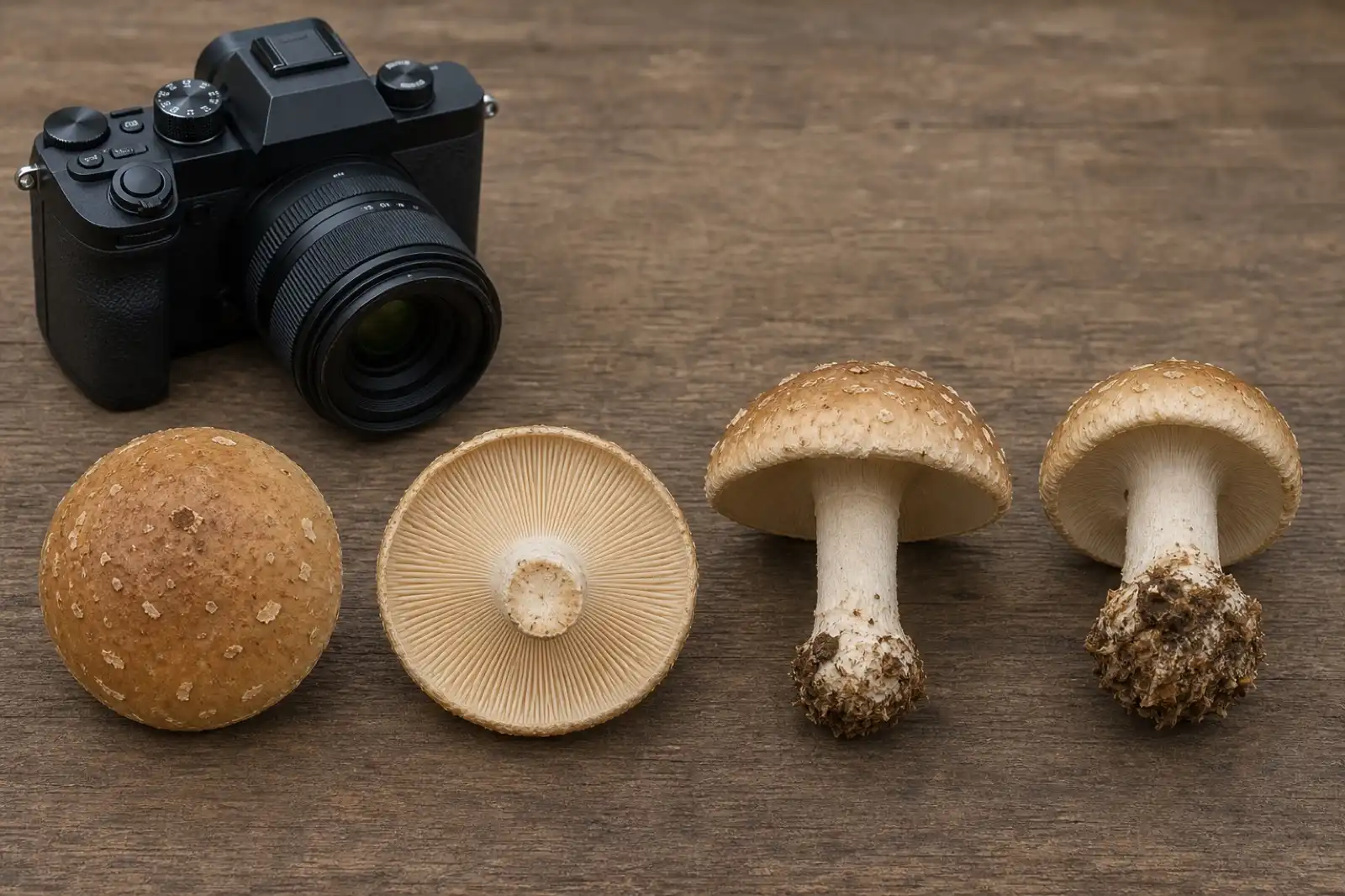
Mushroom Photography Checklist for Identification
Capture the cap, underside, complete stem base, habitat, scale, and specimens at different ages before asking for identification help.
mushrooms
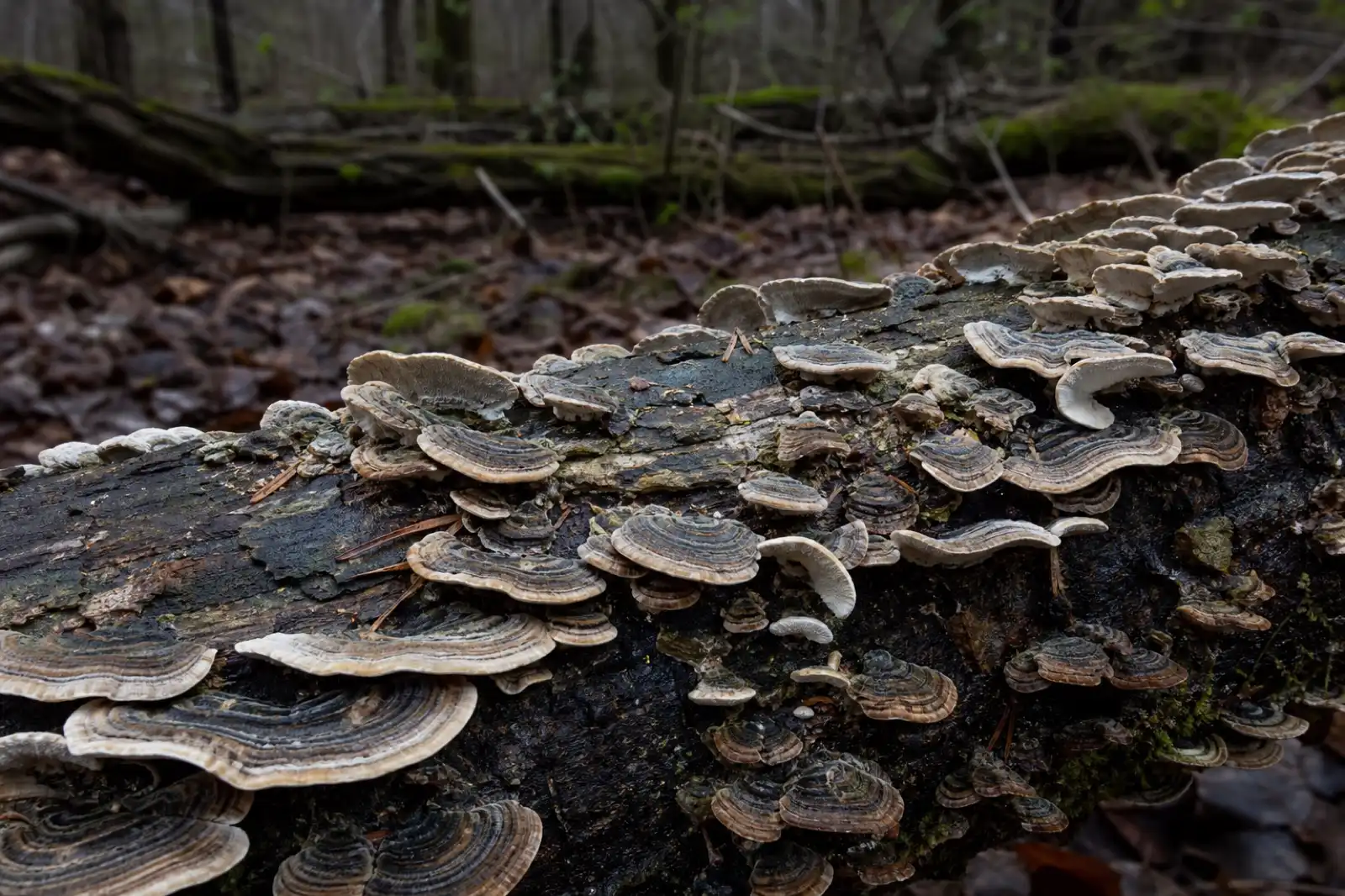
Trametes versicolor: Turkey Tail Mushroom Species Guide
Learn Trametes versicolor identification, pore features, hardwood habitat, cultivation, extract evidence, lookalikes, supplement safety, and FAQs.
Continue exploring
Browse more practical guides in Identification or visit the mushroom encyclopedia.