Mushroom Encyclopedia
Hairy Bracket Fungus: Trametes hirsuta Field Guide
Document Trametes hirsuta by its hairy zoned cap, pale round pores, tough white flesh, hardwood habitat, decay context, microscopy, and lookalikes.
Species context
Treat profiles as reference material
Species profiles summarize documented traits, taxonomy, and lookalikes, but natural variation can be substantial.
Use the safety checklist →Decision limit
A profile cannot authenticate a specimen
Do not eat a wild mushroom from an online match, single feature, or generated image.
Read the safety disclaimer →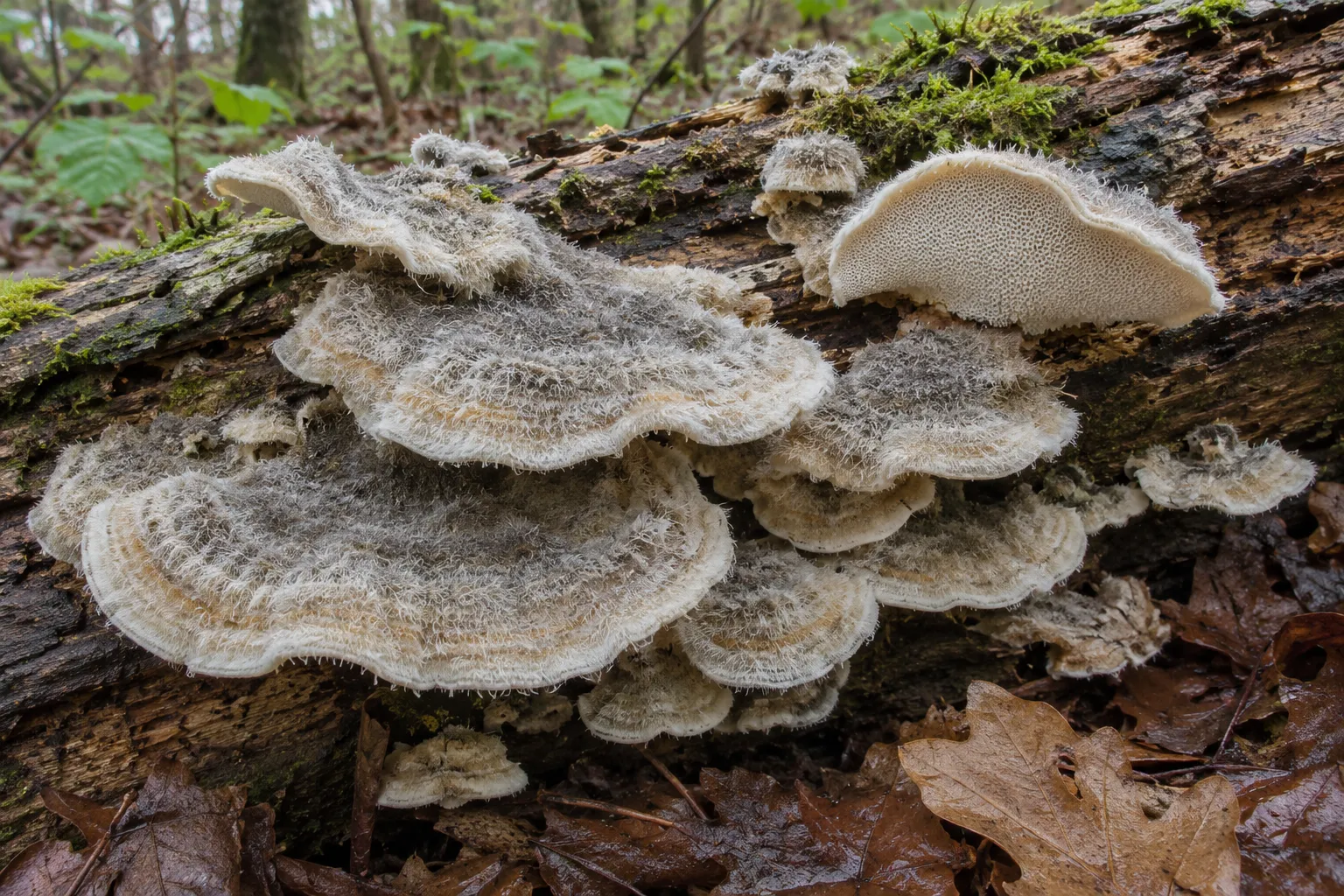
Quick facts
- Scientific name
- Trametes hirsuta
- Common names
- Hairy bracket, Hairy trametes
- Taxonomy
- Trametes · Polyporaceae
- Edibility context
- Inedible: Tough and corky rather than a culinary mushroom; no food recommendation is made.
- Spore print
- White; normally difficult to obtain from a shelf, and not diagnostic without microscopic characters.
- Toxicity context
- Unknown: No food clearance is offered, and remote identification cannot exclude other bracket fungi or contaminated wood.
- Season
- January, March, May, July, September, November
- Growing difficulty
- Expert
- Regions
- Europe, North America, temperate regions with verified records
Safety limit: These labels summarize documented context; they never authenticate a wild specimen. Cooking does not make a poisonous species safe.
Hairy bracket fungus, Trametes hirsuta, is a tough wood-decay polypore with muted zoned caps and a conspicuously hairy upper surface. The name is useful only when the hairs are joined to the correct pale pore surface, cap thickness, flesh, substrate, microscopy, and region. A fuzzy gray shelf in a photograph is not enough.
This guide addresses T. hirsuta. The turkey tail guide owns the thin, sharply multizoned T. versicolor intent, and the smoky bracket guide covers a different fungus with a gray pore layer. Compare characters on the same numbered bracket rather than choosing the best cap and underside from different colonies.
Record the complete wood unit and attachment
Start with an overview showing the log, branch, stump, or dead portion of a standing tree. Record wood diameter, bark retention, exposed end grain, ground contact, moisture, softness, and plausible tree evidence. Do not name a host from the nearest leaf; a fallen log may have moved, and roots or branches from several trees can overlap.
Map every fruiting patch along a measured section. Note upper, lateral, and underside positions, because water exposure and orientation affect algae, color, and cap form. Photograph the broad attachment and any resupinate pore layer running along the wood. A detached shelf loses ecological and structural evidence.
Measure shelves rather than describing them as large or small
For several fresh and weathered brackets, record width along the wood, projection, thickness at base and margin, and spacing between shelves. Mature caps are semicircular or fan-shaped and often overlap in tiers. Their gray-white, buff, or pale brown zones can be subtle rather than the bright bands associated with turkey tail.
Use a scale in the plane of the cap. Foreshortening can make a deep shelf look thin, and stacked caps conceal basal thickness. Record whether margins are actively pale, rounded, sharp, eroded, or darkened. Fresh growth and an old persistent body should not be averaged into one color description.
Demonstrate the hairs with controlled light
The upper surface bears coarse hairs or dense tomentum. Photograph it dry with low raking light so individual hairs cast small shadows. Add a macro frame at the base, mid-cap, and margin. Wet hairs can collapse into dark streaks; algae and moss can create false fuzz on any old bracket.
Score hair length and density comparatively rather than claiming an unaided exact measurement. Retain a small legally collected section if microscopy is planned. Abrasion, frost, browsing, and long exposure can remove hairs, so a weathered smooth patch does not automatically exclude the species when protected areas retain the expected texture.
Inspect the pore surface as a measured structure
Turn the camera parallel to the underside and include a millimeter scale. Mature T. hirsuta has many small, pale, round to angular pores. Count pores across several one-millimeter lines rather than selecting the clearest patch. Record bruising, stains, insect galleries, and zones where tubes are immature or eroded.
The pore-surface guide explains how to separate true pores from gills, folds, teeth, and cracks. Elongated maze-like openings demand comparison with mazegills. A dark smoky pore layer suggests Bjerkandera rather than being dismissed as dirt.
For a thinner zoned shelf whose elongated pores bruise pink-brown, use the blushing bracket guide; its maze surface and hardwood-host record separate that intent from the fine round pores and coarse cap hairs documented here.
Cut one section from cap to wood
Where collection is legal, cut a radial slice through the attachment, upper surface, pale context, tube layer, and active margin. Photograph the fresh section with scale and white balance. Record total thickness, context thickness, tube depth, zoning, moisture, and any dark boundary line.
Hairy bracket flesh is tough, corky, and pale. A clean section helps distinguish surface staining from a genuinely colored context or pore layer. Keep the cut piece with its field number. Sections from loose shelves at the base of a log cannot be reliably reassigned after several species have fruited together.
Separate turkey tail by a character matrix
Turkey tail is commonly thinner and more flexible, with sharper concentric bands that may include brown, orange, blue-gray, or nearly black. Its upper surface is velvety, but usually not as coarsely hairy. Both have pale pores, both grow on hardwood, and both can fade, so no single color band is decisive.
Score cap thickness, zone contrast, hair coarseness, pore density, context, attachment, and microscopic characters for each specimen. Downy bracket may be pale with weaker zoning and fine pubescence. Smoky bracket adds a gray pore layer. False turkey tail has a smooth to wrinkled underside rather than a true pore layer. The comparison is strongest when it states which alternative each observed character excludes.
Link microscopy and sequence data to a voucher
Collect only when permitted and retain part of the wood attachment. Attempt a spore deposit over contrasting surfaces, but report “no deposit obtained” when an old or dry shelf does not release spores. A white deposit is broadly shared among polypores and cannot finish the identification.
Measure spores from a documented mount using calibrated equipment and the current regional treatment. Record medium, magnification, count, complete range, shape, wall, and relevant hyphal characters. If sequencing is used, document tissue taken from inside the numbered bracket, extraction controls, read quality, reference coverage, and the taxonomic concept behind the database name.
Describe white rot without making a hazard diagnosis
Species in this ecological group decompose components of dead wood. Fruiting on a fallen log is normal recycling. Fruiting on a dead stub attached to a living tree shows colonized dead tissue but does not measure the remaining strength of the trunk, roots, or unions. Conversely, a small fruit body does not prove decay is minor.
For a tree near people or property, record exact fruiting position, dead and live tissue boundaries, cavities, cracks, lean, root disturbance, and changes through time, then seek a qualified local tree-risk assessment. The species page cannot substitute for sounding, resistance testing, or site-specific judgment.
Run an equal-area pore and hair comparison
Choose fresh, mid-aged, and weathered brackets from one connected colony. On each, photograph a fixed cap area near the base and margin under identical raking light, then photograph a fixed underside area with the same scale. Count visible hair bundles and pores only inside marked frames; record obscured areas rather than estimating through algae or damage.
This paired record tests how the two surfaces change with age. It can show that hairs abrade while pores enlarge or erode, preventing an old specimen from being compared uncritically with a fresh key illustration. It cannot prove all shelves are genetically identical; retain separate vouchers when morphology diverges.
Map protected and exposed margins
Select paired shelves on the same wood unit: one under an overhang and one exposed to rain and sun. At repeat visits measure margin extension from fixed reference marks, color, flexibility, algal cover, hair condition, and pore-edge integrity. Do not install covers or water the shelves.
Report the microhabitat contrast and time interval. A sheltered cap may retain hairs while an exposed one bleaches, but orientation, age, and local wood moisture remain alternatives. This method improves interpretation of variable field photographs without turning correlation into a growth rule.
Separate persistent shelves from current growth
Old hairy brackets can remain attached after their active season, so a winter count is not automatically a count of recent fruiting. At the first visit, mark the outline of each intact shelf on a scaled photograph and record margin color, softness, pore condition, algae, insect damage, and whether the context bends or cracks. Return after a defined wet interval and repeat the same view without trimming the margins.
New pale tissue extending beyond the earlier outline is stronger evidence of current growth than persistence alone. A shelf that merely becomes wetter or cleaner should not be scored as new. Record losses as well as gains: detached bodies, eroded pores, and buried margins explain changes in colony appearance. The method estimates visible renewal on one wood unit; it does not establish annuality, spore production, or the age of internal mycelium without additional evidence.
Keep food and handling claims proportionate
Hairy bracket is tough and nonculinary. Do not infer edibility from the genus name, animal feeding, tea traditions involving another species, or a phone identification. Contaminated roadside or treated wood introduces risks that a field character cannot detect.
Wash hands after handling decayed material and avoid inhaling dust from dry fruit bodies or rotten wood. If an unknown fungus was swallowed, preserve samples and photographs and contact local poison-control, veterinary, or medical services as appropriate. A web page should not delay professional advice.
Audit the editorial image against bracket baselines
The 1536 × 1024 cover is an original AI-assisted editorial image. It was compared directly with Hairy Curtain Crust and Smoky Bracket baselines. It matches their diffuse woodland light, subdued color, damp hardwood, complete attachment, realistic leaf litter, and visible pore surfaces. The coarse hairs are intentionally prominent to teach which structure needs real documentation; no text, watermark, logo, collage seam, stretch, or banding was found.
The image remains illustrative. It cannot prove pore density, hair dimensions, microscopic anatomy, host, decay extent, or safety, and it must never be used as a visual matching test.
Build a reviewable hairy bracket record
- Photograph the complete wood unit and every fruiting zone.
- Measure width, projection, thickness, attachment, and margin state.
- Demonstrate hairs with dry raking-light macro images.
- Count pale pores in scaled, undamaged underside areas.
- Cut and document one specimen-linked radial section.
- Compare turkey tail, downy bracket, smoky bracket, and false turkey tail explicitly.
- Link microscopy or sequence data to retained tissue and wood.
- Separate decomposition evidence from any tree-risk conclusion.
References
- NCBI Taxonomy Browser: Trametes hirsuta — taxonomy and sequence-linked context.
- GBIF species search: Trametes hirsuta — occurrence and voucher leads requiring record-level review.
- First Nature: Trametes hirsuta — field morphology, pore surface, habitat, and comparison characters.
- Forest Research: tree decay fungi — context for recording decay without replacing a site assessment.
Editorial status: reviewed by the MushroomScope editorial team on November 18, 2026; no named mycologist, arborist, toxicologist, clinician, or food-safety expert reviewed this page.
Source quality notes
MushroomScope cites sources that match the page scope, such as taxonomic databases, extension guidance, food-safety agencies, food-composition databases, and peer-reviewed or institutional health references. Sources support context and uncertainty; they do not turn an online page into specimen identification, medical advice, or a tested recipe record.
Frequently asked questions
What makes a hairy bracket fungus hairy?
The upper cap bears conspicuous coarse hairs or a velvety-tomentose covering, best documented with low side light and magnification rather than inferred from a pale fuzzy photograph.
How does Trametes hirsuta differ from turkey tail?
Hairy bracket is usually thicker, coarser-haired, and more muted gray to buff. Turkey tail is thinner and commonly has sharper multicolored zones, but pores and microscopy should also be compared.
Does hairy bracket have gills underneath?
No. A mature underside has many small pale round to angular pores. Gill-like folds or elongated maze pores point toward other bracket fungi.
Does hairy bracket mean a living tree is dangerous?
Not by itself. Record whether fruiting is on dead wood or living structure; a species image cannot measure internal decay or replace an on-site tree-risk assessment.
Is Trametes hirsuta edible?
It is tough and leathery and is not treated here as food. Remote identification cannot establish species, cleanliness, or safety.
Related guides
mushrooms
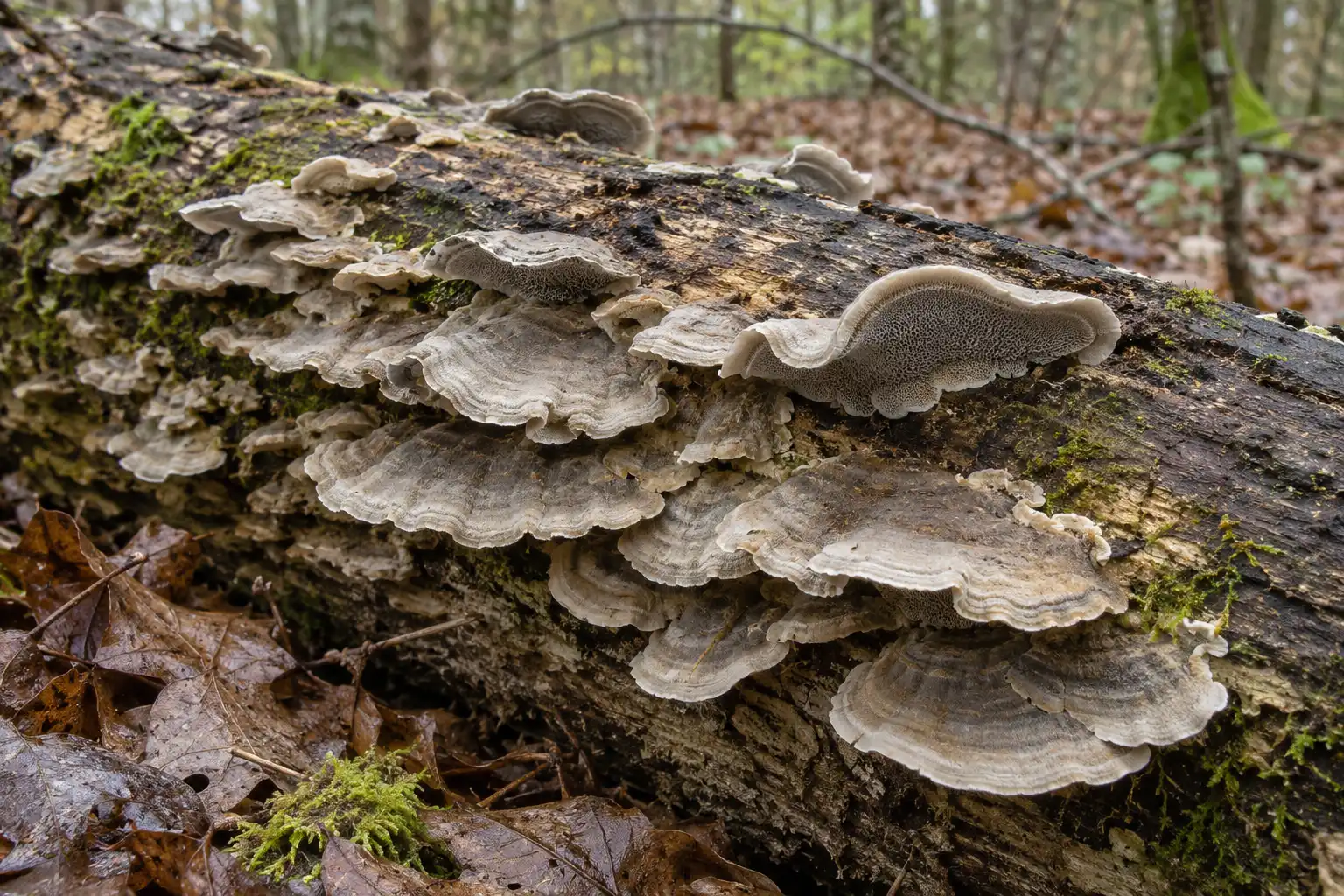
Smoky Bracket Fungus: Bjerkandera adusta Field Guide
Document Bjerkandera adusta by its thin grey brackets, smoky pore surface, white rot, hardwood attachment, section, microscopy, lookalikes, and decay context.
mushrooms
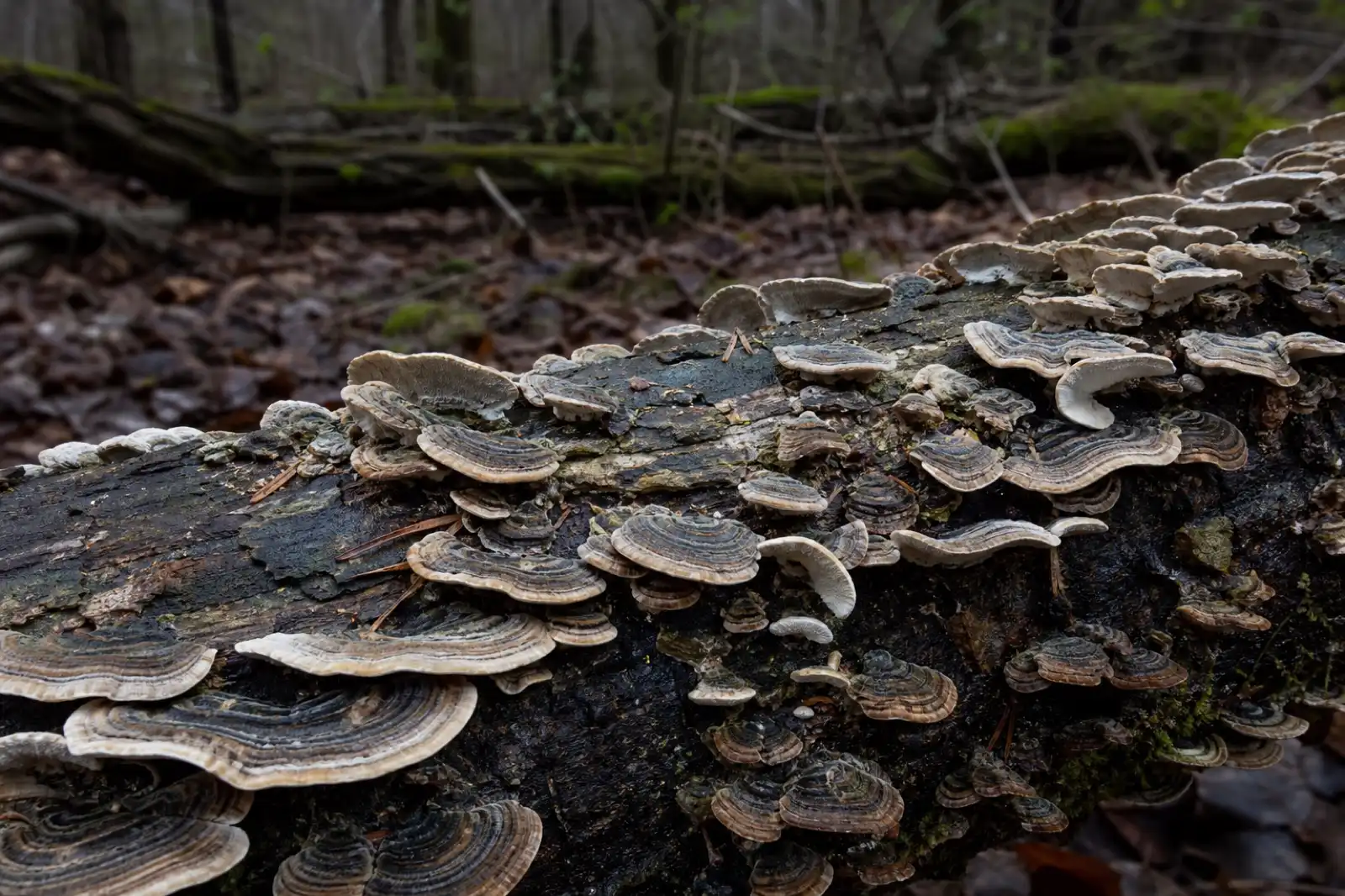
Trametes versicolor: Turkey Tail Mushroom Species Guide
Learn Trametes versicolor identification, pore features, hardwood habitat, cultivation, extract evidence, lookalikes, supplement safety, and FAQs.
identification
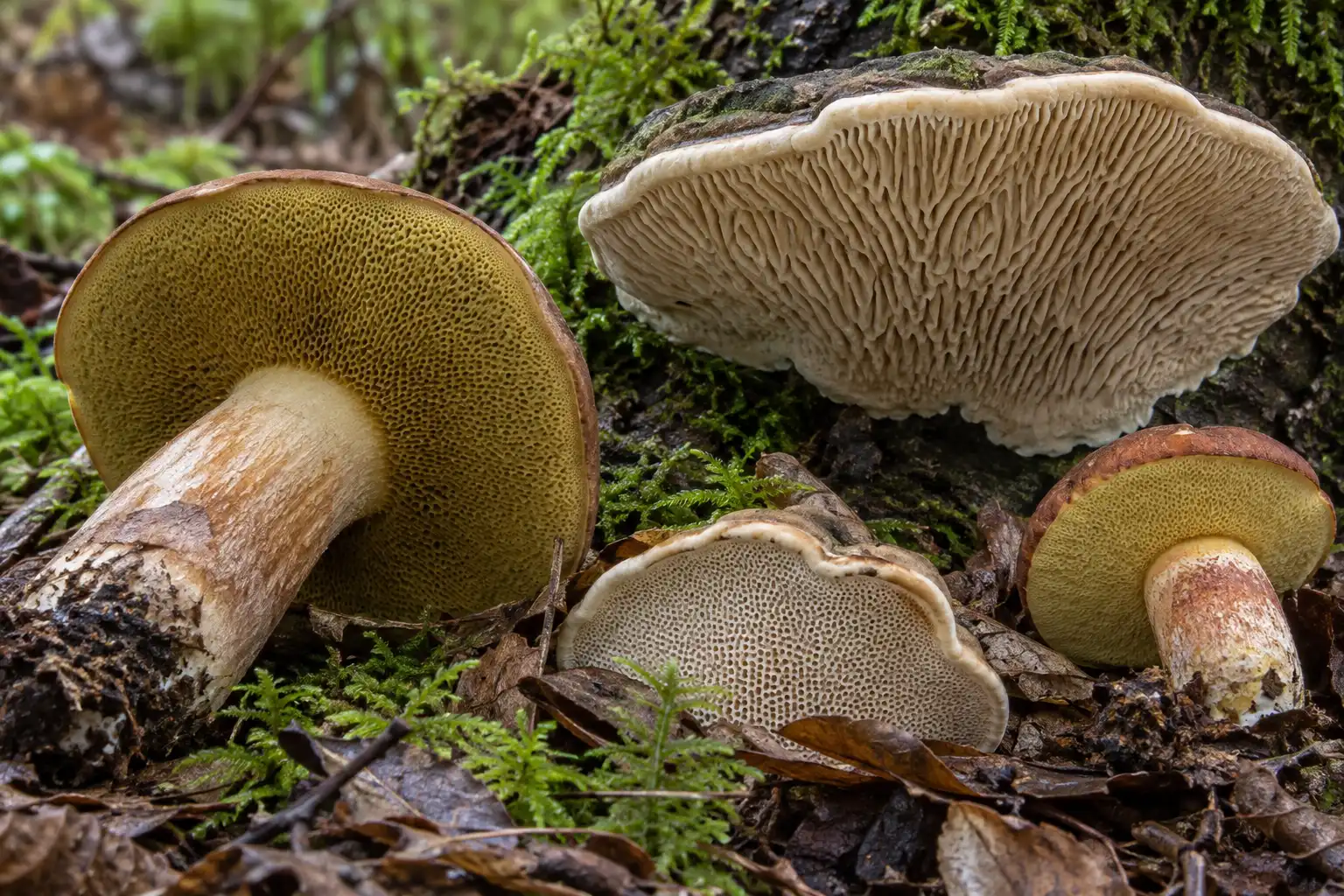
Mushroom Pore Surfaces: A Field Guide to Boletes and Polypores
Learn to document mushroom pore size, shape, attachment, bruising, tube layers, substrate, and context without treating pores as proof of identity or edibility.
Continue exploring
Browse more practical guides in Mushroom Encyclopedia or visit the mushroom encyclopedia.