Mushroom Encyclopedia
Smoky Bracket Fungus: Bjerkandera adusta Field Guide
Document Bjerkandera adusta by its thin grey brackets, smoky pore surface, white rot, hardwood attachment, section, microscopy, lookalikes, and decay context.
By MushroomScope Editorial Team · · Updated
Species context
Treat profiles as reference material
Species profiles summarize documented traits, taxonomy, and lookalikes, but natural variation can be substantial.
Use the safety checklist →Decision limit
A profile cannot authenticate a specimen
Do not eat a wild mushroom from an online match, single feature, or generated image.
Read the safety disclaimer →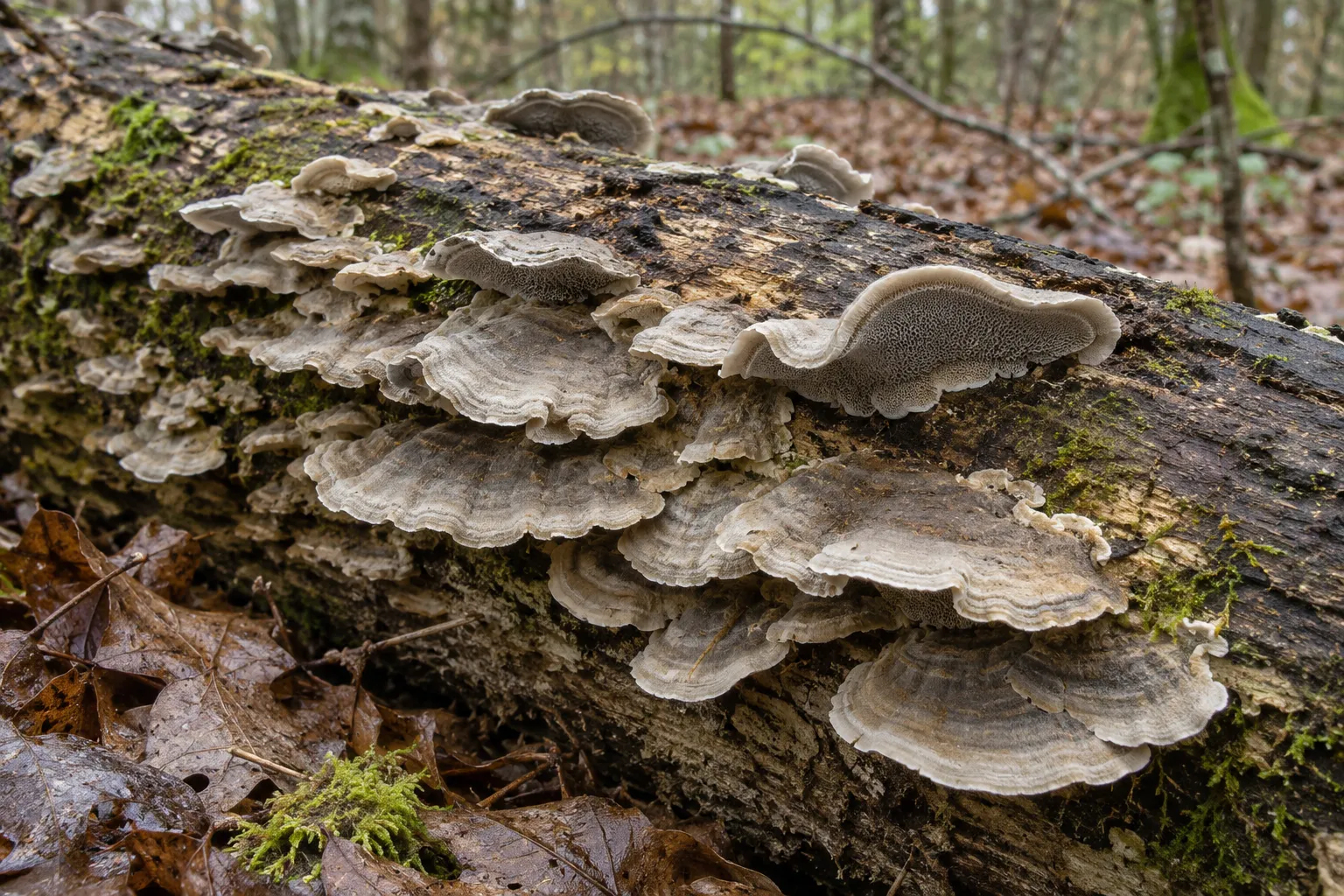
Quick facts
- Scientific name
- Bjerkandera adusta
- Common names
- Smoky bracket, Smoky polypore, Burnt polypore
- Taxonomy
- Bjerkandera · Meruliaceae
- Edibility context
- Inedible: Thin, tough fruit bodies are not treated as food, and this page does not recommend ingestion.
- Spore print
- White; spores and hyphal structures require microscopy for close comparisons.
- Toxicity context
- Unknown: No home medicinal or food preparation is supported here; avoid ingesting unidentified brackets.
- Season
- July, August, September, October, November, December
- Growing difficulty
- Expert
- Regions
- Europe, North America, temperate regions worldwide with verified records
Safety limit: These labels summarize documented context; they never authenticate a wild specimen. Cooking does not make a poisonous species safe.
Smoky bracket is a thin wood-decaying polypore whose most informative character lies underneath. The upper surface can resemble many grey or tan shelf fungi, but a fresh fruit body develops a fine smoke-grey pore layer that contrasts with its pale active margin. That contrast, combined with bracket thickness, tissue section, hardwood attachment, decay pattern, and microscopy, supports a Bjerkandera adusta hypothesis.
The species is ecologically important as a white-rot decomposer. It is not presented here as food or medicine. Photographing an upper surface alone loses the decisive pore evidence and encourages confusion with turkey tail, hairy brackets, and other thin polypores.
Map the bracket colony before taking a close-up
Start with the entire log, stump, branch, or wound. Record whether brackets form separate shelves, fuse into rows, or transition into a flat pore-bearing crust. Note orientation, height above soil, bark retention, exposed sapwood, moisture, shade, and the length of the occupied wood.
Mark several zones along the colony. Old dark shelves and a pale fresh margin can coexist, and different fungi may occupy adjacent sectors. A single beauty photograph cannot show whether one organism covers the wood or several bracket species overlap.
Inspect the smoky pore surface first
Turn naturally accessible edges toward diffuse light and use a hand lens or macro lens. The underside should resolve into minute pores rather than gill blades or smooth crust. Fresh pores may begin pale and become smoke-grey to darker grey with age, handling, or drying; record the state rather than assigning one fixed color.
The pore-surface guide explains how to describe pore shape and density. Photograph beside a millimeter scale, count openings along a measured line in several areas, and report a range. Do not count a blurred image or treat dirt-filled pores as smaller openings.
Preserve the pale active margin
A growing bracket often has a pale cream edge outside the darker pore field. Measure its width at several points and photograph the boundary between active margin and mature hymenium. Rain, abrasion, algae, and frost can erase or discolor that edge on persistent material.
The pale zone is supporting evidence, not a standalone test. Other brackets have white margins, while a fully weathered smoky bracket may have little active growth. Revisit after rain to distinguish a newly extending margin from exposed torn flesh.
Read upper-surface zoning conservatively
Caps are thin and semicircular to irregular, often grey-brown, buff, or tan with subdued concentric zones. Young surfaces can be finely hairy; older ones become smoother, darkened, green with algae, or bleached. Photograph dry and damp states under neutral light because saturation can make weak zones look like turkey-tail bands.
Record radius, thickness, overlap, texture, and edge shape. Strong orange, blue, red, and black bands are not required and should not be invented through editing. Upper zoning narrows the comparison only when linked to the smoky pores below.
Cut one lawful sample through cap and pores
Where collection is permitted and abundant, take a narrow radial section through one numbered mature bracket. Photograph the profile with a scale. Record the thickness of upper context and pore tubes, their color boundary, flexibility, and whether layers are sharply separated.
Smoky bracket is typically thin, with pale context above a distinctly darker tube layer. A section helps distinguish surface staining from tissue architecture and reveals whether several annual layers are present. Do not cut living-tree tissue simply to obtain a specimen.
Verify lateral attachment and resupinate growth
Fruit bodies usually lack a stem and attach directly to wood. Some colonies extend flat along the substrate before forming shelf edges. Photograph the transition at both ends of a row. A flat pore patch is easily overlooked or mistaken for a different crust fungus when the shelves receive all attention.
Trace only loose bark or already exposed wood. The habitat identification guide separates observed attachment from an assumed tree species. A bracket on the ground may still be attached to a buried branch.
Document deciduous wood without guessing the tree
The species is commonly associated with dead broadleaf wood. Record bark, wood anatomy, branching, retained leaves or buds, and site management before naming a host. “Hardwood” is a useful observation when species-level tree evidence is missing; an unsupported oak or beech label weakens the record.
Note whether the fungus occupies a fallen log, stump, cut branch, standing snag, or dead portion of a living tree. Fruiting on a wound does not by itself establish the cause of decline. Trees fail through interacting fungi, drought, roots, storms, and structural defects.
Separate white rot from fruit-body identity
White-rot fungi degrade lignin as well as cellulose, often leaving pale fibrous wood. Photograph sound wood and decayed wood at an already broken surface, recording softness, fibers, moisture, and cubical versus stringy texture. Do not excavate a tree or strike structural wood to demonstrate decay.
Decay type supports ecology but is shared by many polypores. Conversely, dark or wet wood beneath a bracket may conceal a pale fibrous interior. Treat fruit-body characters, wood condition, and tree risk as three related but separate observations.
Compare turkey tail by underside, not color bands
The turkey tail guide covers Trametes versicolor. Turkey tail commonly has stronger multicolored zones and a white to cream pore surface. Smoky bracket is usually more subdued above and grey below. Weathering, algae, and camera color can obscure both distinctions.
Compare brackets from the same wood unit: upper texture, zone colors, pore color, pore density, thickness, context section, and microscopy. Do not name a shelf “turkey tail” because it is zoned or “smoky bracket” because it is grey.
Keep Bjerkandera fumosa in the comparison
Bjerkandera fumosa can overlap in geography and wood habitat. It is often described as thicker and more buff-toned, with differences in pore surface and context, but variable and weathered collections may not separate cleanly by a single field trait.
Use a current regional key, section several ages, and document spores and hyphal characters. Preserve a voucher when the distinction matters. Database photographs are useful for generating questions, not for replacing specimen-based comparison.
Exclude pale-pored hairy Trametes
Species such as Trametes hirsuta can form pale zoned hairy brackets on hardwood. Check whether the upper hairs are coarse or merely fine young tomentum, whether the underside remains white or cream, and whether pore size and context match the relevant key.
Old caps collect algae and dirt, while undersides darken through handling. Photograph a fresh margin and protected pore area before cleaning. A grey smear on a white pore surface is not equivalent to naturally smoky pore tissue.
Make a controlled white spore deposit
A white deposit may be obtained from an actively sporulating fresh bracket. Suspend or place the pore surface over dark and transparent media without crushing it, protect from drafts, and record duration and humidity. Sparse bracket deposits can be difficult to see.
Spore color alone will not distinguish most candidate polypores. Keep released material tied to the numbered fruit body and use it for calibrated microscopy. Do not scrape tube tissue onto the surface and call the debris a print.
Apply microscopy to close cases
Regional keys may use spore size and shape, basidia, cystidia-like elements, hyphal construction, clamp connections, and reactions in tissue. Report mounting medium, reagent, optics, calibration, sample count, and measurement ranges. Sample a clean mature pore layer rather than a mixed old colony.
Sequence evidence can help with difficult or research material, but a sequence needs a voucher, clean tissue, quality control, and appropriate reference data. A database match without specimen context does not repair a contaminated sample or incorrect locality record.
Interpret distribution records cautiously
GBIF can reveal specimen and observation records, while NCBI connects the name to taxonomic and molecular resources. Inspect the underlying record type, identifier, institution, date, location precision, and taxonomic name history. Aggregated points are not equal in evidentiary strength.
Describe verified temperate records without claiming uniform global abundance. A persistent bracket can be observed outside its fresh-growth season, and a photograph dated in winter does not prove that fruiting began then.
Record seasonal growth separately from persistence
Mark the margin of selected brackets in a non-damaging photograph and revisit after rainfall. Measure outward extension, new pore color, cracking, insect damage, and drying. Persistent old shelves may remain visible for months after active growth stops.
This distinction improves phenology data: “seen in December” describes observation, while a pale expanding margin or measured extension supports active growth. Avoid writing universal monthly calendars from one site.
Keep tree-risk claims within evidence
Fruit bodies on a living or standing tree indicate fungal activity in associated wood, but they do not quantify remaining wall thickness, root stability, load, or failure probability. Do not strike, drill, or excavate a tree based on this page. Photograph location and restrict access if an immediate hazard is plausible.
For a tree near people or structures, consult a qualified local arborist who can integrate species identification with structural assessment. The fungus name and the risk decision are different conclusions.
Do not turn environmental research into treatment advice
Wood-decay fungi are studied for enzymes, pollutant transformation, and other laboratory applications. Such research may use a defined strain, purified enzyme, controlled concentration, and measured endpoint. It does not establish that a wild bracket is safe to eat, brew, inhale, or use as medicine.
This page makes no therapeutic claim. Avoid home exposure to cultures or contaminated wood dust, and use appropriate institutional controls for laboratory work. People with respiratory sensitivity should minimize handling of actively sporulating material.
Measure a pore-color transect instead of choosing the darkest patch
Place three equal-area sampling windows along one numbered bracket: within the pale growing margin, at mid-radius, and near the attachment. Photograph them perpendicular to the surface with the same neutral color card and magnification. Count pores across several measured spans and record discoloration, bruising, insect loss, and water films separately.
The result can show a pale active edge grading into a smoky gray older surface without turning that gradient into a universal color chart. Compare several brackets on the same wood unit. If one has a different pore geometry or tissue thickness, retain it as a separate specimen rather than averaging a mixed colony.
Compare protected and exposed margins after rain
Select paired brackets on the sheltered underside and exposed upper side of the same log. Record margin width, saturation, cracking, algal film, and measured outward extension after comparable rain intervals. A protected pale margin may remain legible while an exposed shelf bleaches or erodes.
This matched design helps separate weathering from species difference. It does not prove that exposure caused every contrast; wood moisture and colony age may differ. Preserve those variables in the record and avoid scraping surfaces clean for a more convenient photograph.
Keep a wood-section provenance ledger
When lawful sampling is justified, label the exact bracket and the wood chip beneath its attachment before cutting. Record bark state, decay hardness, cut orientation, depth, color transition, and whether the sample came from living, standing-dead, or fallen wood. Store fungus and substrate identifiers together.
White-rot texture is ecological context, not a species barcode. Other fungi can occupy the same log, and a small pale pocket does not assign all decay to Bjerkandera adusta. The ledger lets microscopy, culture, or sequence data return to the correct colony instead of a convenient but untraceable piece of wood. For a smooth violet crust rather than a gray pore layer, follow the silver leaf fungus guide and its separate plant-disease evidence boundary.
If the underside forms branching maze pores and a controlled fresh bruise becomes pink-brown, compare the blushing bracket guide instead of stretching the smoky-pore concept to cover every gray-brown shelf.
Audit the editorial image and its limits
The cover is an original AI editorial image at 1536 by 1024 pixels with a unique source hash. It was compared side by side with the site’s Scarlet Waxcap and Purple Brittlegill natural-light baselines for soft forest light, restrained color, visible substrate, plausible scale, fine texture, realistic depth of field, and absence of text, logos, or watermarks.
It clearly shows bracket layering, wood attachment, grey zoning, and several pore-bearing undersides, but it is not a voucher. Exact pore density, host identity, tissue section, and species characters remain illustrative. The visual passed crop and clarity review for editorial use, not identification or tree-risk decisions.
Build a repeatable smoky-bracket record
- Photograph the entire occupied wood unit and map separate colonies.
- Capture upper surfaces, pale margins, and protected pore surfaces.
- Measure bracket radius, thickness, margin width, and pore density.
- Section one lawful abundant specimen through context and tubes.
- Record wood type, decay texture, position, and management history.
- Compare turkey tail, B. fumosa, and pale-pored Trametes.
- Obtain a controlled spore deposit and microscopy when necessary.
- Preserve a voucher and state the confidence level.
That sequence makes the smoky underside part of a complete ecological record rather than a shortcut. It also preserves the safety boundaries: a species hypothesis does not establish food use, medical value, or the structural condition of a tree.
If the context and pore surface are orange rather than smoky gray, compare the measured underside with the cinnabar polypore guide. The shared shelf form is less informative than pore color, tissue color, and regional evidence.
For a pale pore surface paired with coarse gray-white cap hairs, use the hairy bracket fungus guide instead of treating every weathered gray shelf as smoky bracket.
References
- GBIF species search: Bjerkandera adusta — occurrence records and taxonomic source links.
- NCBI Taxonomy Browser: Bjerkandera adusta — taxonomic and sequence-linked context.
- First Nature: Bjerkandera adusta — field characters, habitat, and comparison notes.
- US Forest Service Wood Handbook — wood structure and decay context for interpreting affected substrate.
Source quality notes
MushroomScope cites sources that match the page scope, such as taxonomic databases, extension guidance, food-safety agencies, food-composition databases, and peer-reviewed or institutional health references. Sources support context and uncertainty; they do not turn an online page into specimen identification, medical advice, or a tested recipe record.
Frequently asked questions
Why is Bjerkandera adusta called smoky bracket?
Its fertile underside commonly matures to a smoke-grey or dark grey pore surface, contrasting with a paler sterile margin and grey-brown zoned upper surface.
Does smoky bracket have gills?
No. The underside is made of minute pores. A clear macro photograph or hand lens should show openings rather than radiating gill blades.
What wood does smoky bracket decay?
It is most often recorded on dead deciduous wood, including fallen logs, stumps, branches, and wounds. The actual attached wood and its condition should be documented.
Is smoky bracket the same as turkey tail?
No. Turkey tail usually has stronger multicolored zoning and a pale pore surface, while smoky bracket has thin grey-brown caps and a characteristic smoky grey hymenium. Full structure and microscopy still matter.
Is smoky bracket edible or medicinal?
This guide makes no food or treatment recommendation. The fruit bodies are thin and tough, and laboratory or environmental research does not establish a safe or effective home preparation.
Related guides
mushrooms
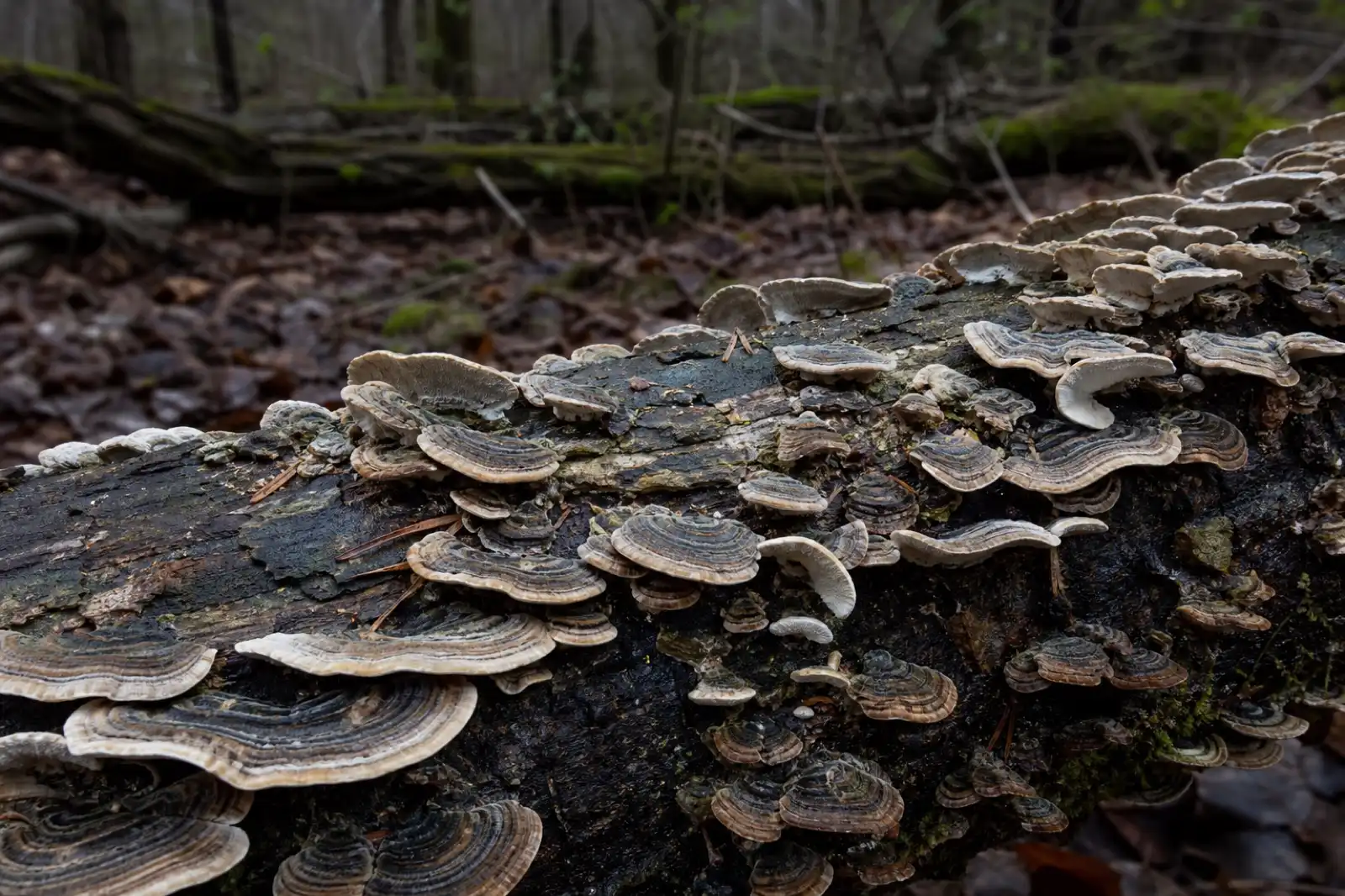
Trametes versicolor: Turkey Tail Mushroom Species Guide
Learn Trametes versicolor identification, pore features, hardwood habitat, cultivation, extract evidence, lookalikes, supplement safety, and FAQs.
mushrooms
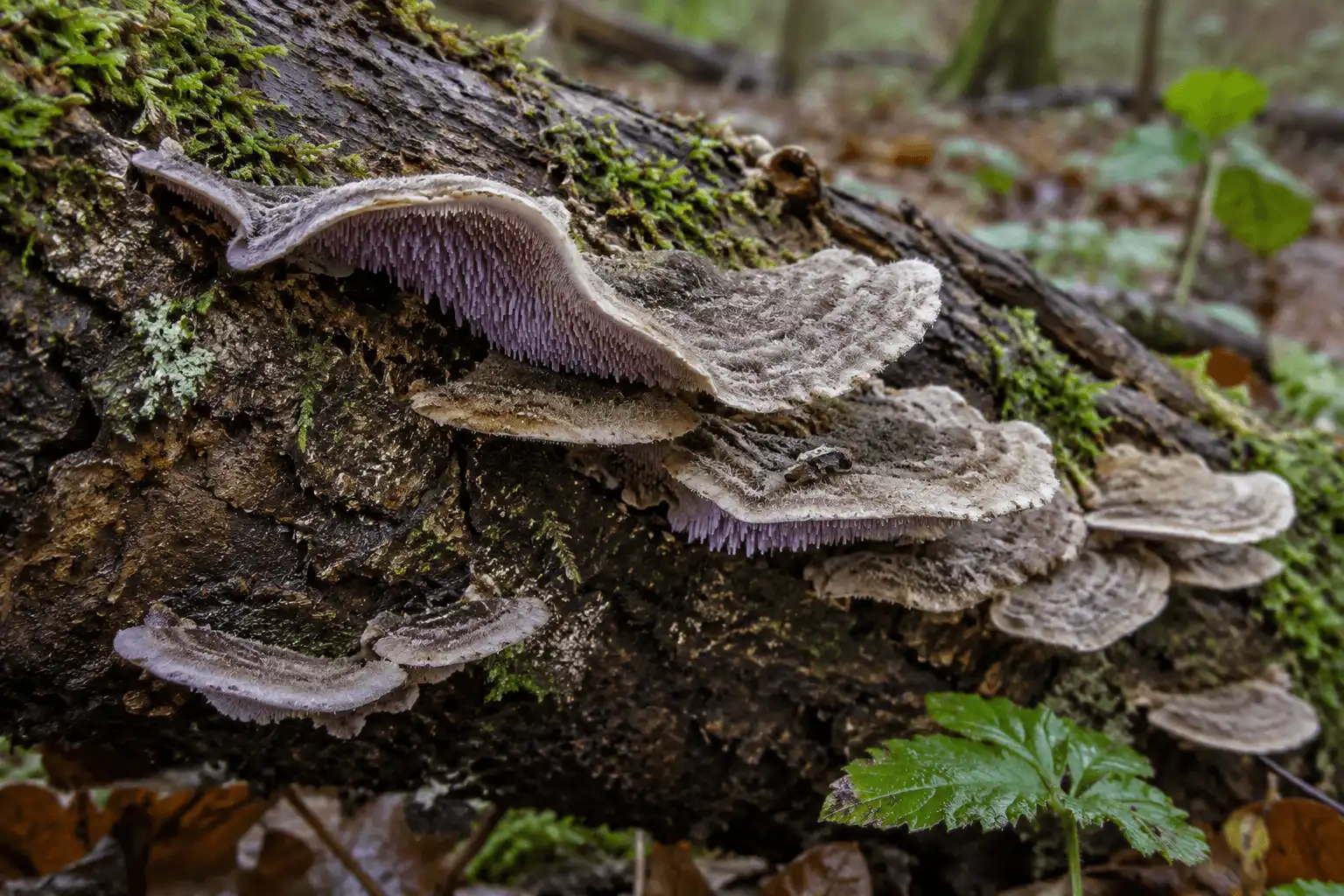
Violet-Toothed Polypore: Purple Pores, Teeth, and Hardwood Ecology
Document violet-toothed polypore by thin zoned brackets, fresh violet margins, a pore surface that tears into teeth, hardwood decay, aging, and lookalikes.
mushrooms
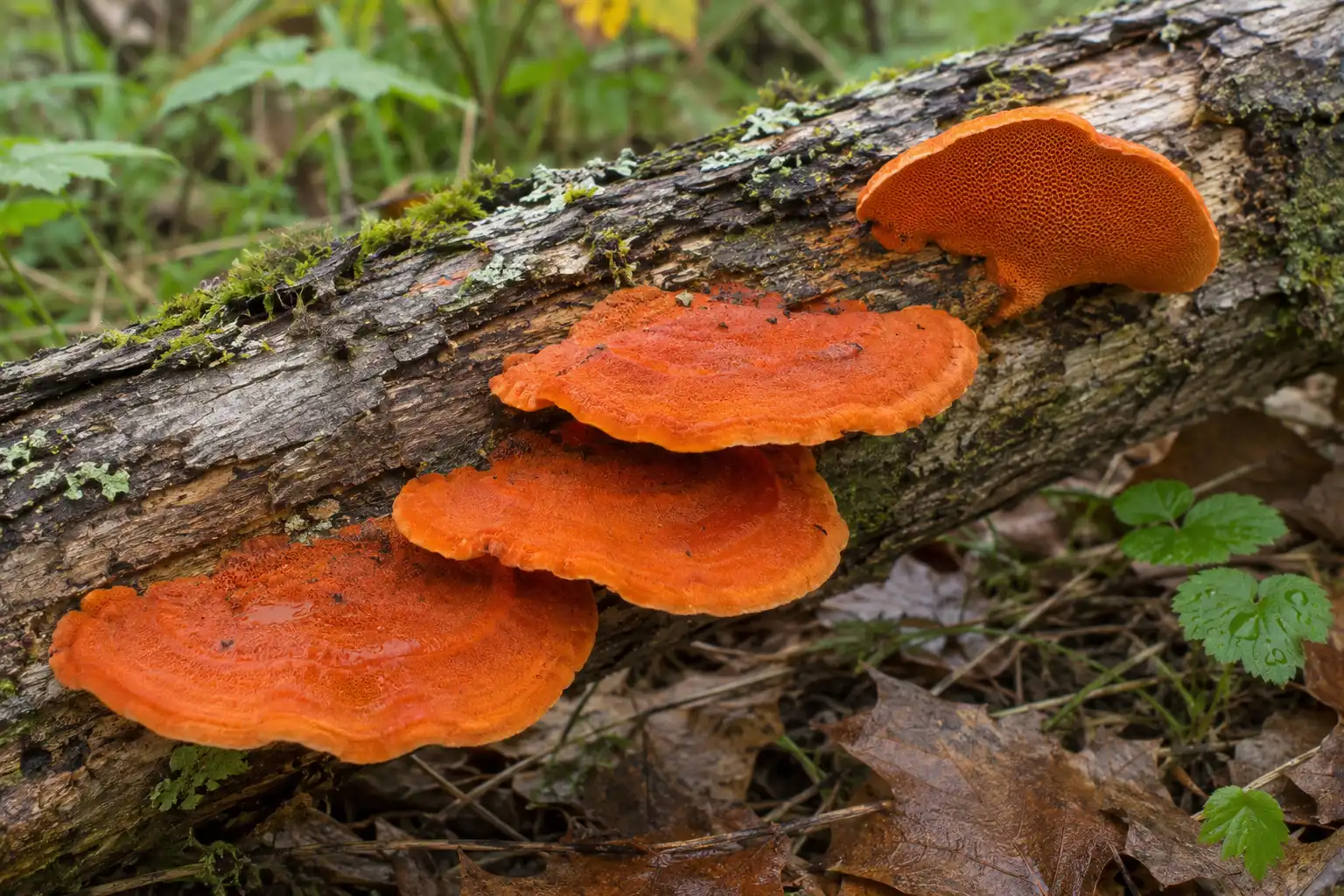
Cinnabar Polypore: Pycnoporus cinnabarinus Field Guide
Document cinnabar polypore by its orange shelf, matching pore surface, hardwood substrate, weathering, decay ecology, microscopy, and bracket lookalikes.
Continue exploring
Browse more practical guides in Mushroom Encyclopedia or visit the mushroom encyclopedia.