Mushroom Encyclopedia
Cinnabar Polypore: Pycnoporus cinnabarinus Field Guide
Document cinnabar polypore by its orange shelf, matching pore surface, hardwood substrate, weathering, decay ecology, microscopy, and bracket lookalikes.
Species context
Treat profiles as reference material
Species profiles summarize documented traits, taxonomy, and lookalikes, but natural variation can be substantial.
Use the safety checklist →Decision limit
A profile cannot authenticate a specimen
Do not eat a wild mushroom from an online match, single feature, or generated image.
Read the safety disclaimer →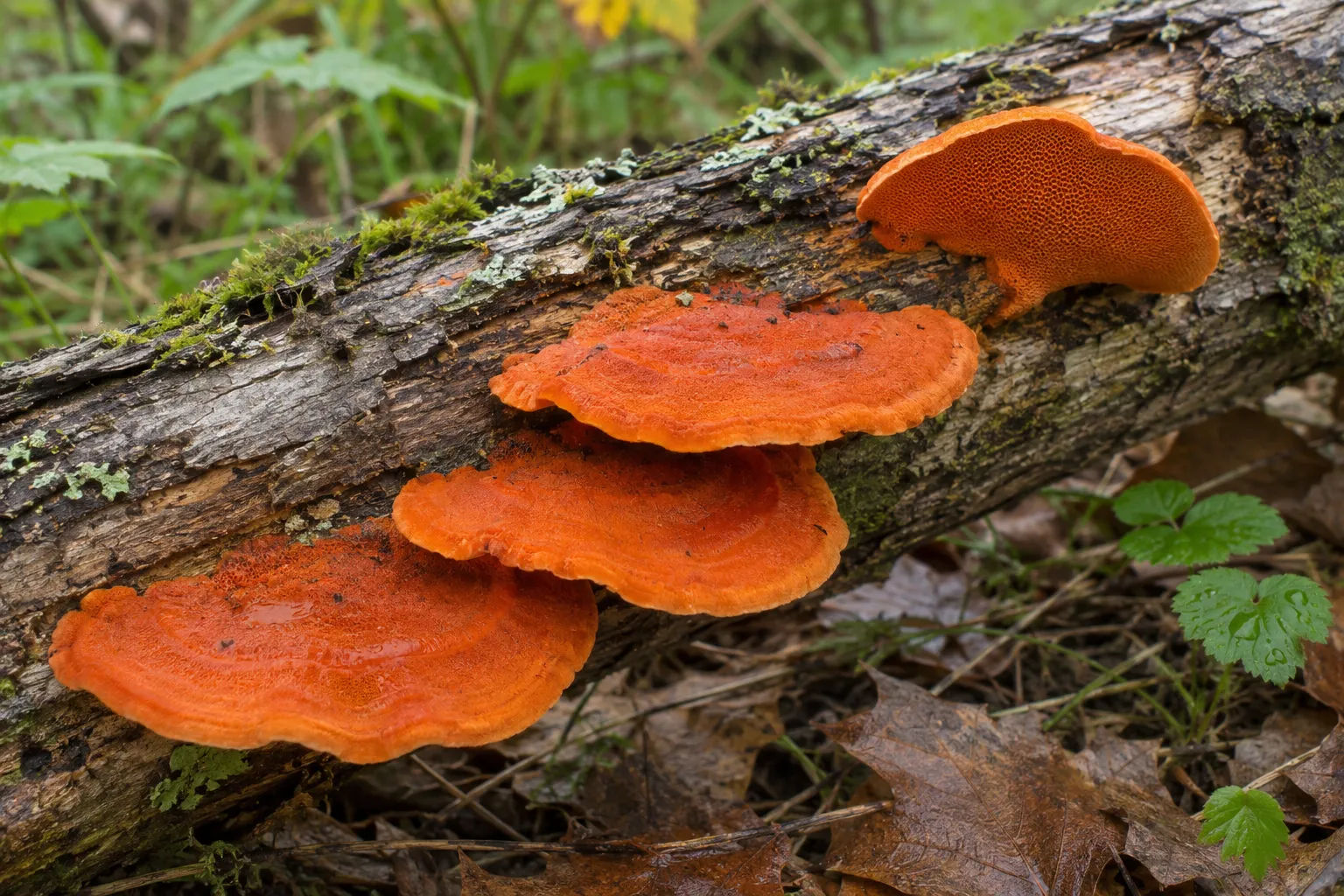
Quick facts
- Scientific name
- Pycnoporus cinnabarinus
- Common names
- Cinnabar polypore, Cinnabar bracket
- Taxonomy
- Pycnoporus · Polyporaceae
- Edibility context
- Inedible: The tough corky fruit body is not presented as food; no wild collection is cleared for consumption here.
- Spore print
- White; exact work can require spore measurements, hyphal-system characters, and regional comparison within Pycnoporus.
- Toxicity context
- Unknown: This guide makes no safety claim for ingestion and treats uncertain orange brackets conservatively.
- Season
- June, July, August, September, October, November
- Growing difficulty
- Expert
- Regions
- Europe, North America, temperate Asia, regional records requiring verification
Safety limit: These labels summarize documented context; they never authenticate a wild specimen. Cooking does not make a poisonous species safe.
Cinnabar polypore attracts attention because orange extends through the whole fruit body: the upper shelf, thin internal context, and pore surface can all carry a vivid red-orange or cinnabar tone. Color makes Pycnoporus cinnabarinus an efficient field hypothesis, but it does not finish the identification. Light, age, algae, abrasion, and regional relatives can change the appearance, and several unrelated fungi produce orange shelves or crusts.
A defensible record connects both surfaces, pore scale, attachment, hardwood substrate, internal tissue, weathering, region, and microscopy where a precise name matters. This page develops that record without treating the editorial cover or a single photograph as proof.
Photograph both surfaces before naming the bracket
Begin with the entire branch or log, then photograph the upper surface, margin, attachment, and underside of the same numbered shelf. A mirror can reveal pores without breaking a fresh bracket. If collection is permitted, remove only one representative and preserve the attachment edge rather than tearing off the diagnostic base.
Fresh upper surfaces are commonly cinnabar, vermilion, or red-orange. Young shelves may be finely velvety; older ones can become smoother, bleached, dirty, or colonized. Record protected color beneath overlaps and compare it with exposed margins. Camera saturation can turn ordinary orange into neon red, so include a neutral card and retain the original file.
The underside should show a true field of small pores in a broadly matching orange tone. That same-color pore surface is more useful than an orange cap alone. The pore-surface guide explains how to separate holes, tubes, teeth, folds, and damaged tissue.
Measure pores instead of calling them fine
Make a perpendicular macro photograph with a millimeter scale. Count pores along several measured transects in fresh protected areas, then report the range rather than choosing the neatest patch. Near the margin, pores may be incomplete; old surfaces may be stretched, clogged, or eroded.
Describe pore shape as round, angular, elongated, or maze-like only after examining more than one zone. Orange debris and insect grazing can create false holes. A hand lens should reveal tube mouths rather than a cracked crust. If the surface is smooth or gilled, redirect the identification rather than explaining the mismatch away.
Section the shelf through cap, tubes, and attachment. Record total thickness, tube-layer depth, context color, and whether zones are sharply separated. The orange context expected here contrasts with many brackets that place pigment only on their surface.
Establish a real hardwood substrate
Cinnabar polypore is a decomposer of dead hardwood. Photograph bark, exposed grain, branch diameter, decay class, soil contact, and whether the wood is standing, fallen, piled, or worked. Record a host only when buds, leaves, bark, anatomy, or site records genuinely support it.
Open woodland edges, storm debris, slash, and sunny clearings can provide the alternating moisture and light in which orange shelves are conspicuous. That observation should not be converted into a rigid habitat rule. A shaded log can support the fungus, and a bright orange bracket can occur in other settings.
Distinguish fruiting substrate from nearby material. A bracket on one branch in a mixed brush pile is not evidence for every tree species in the pile. The habitat guide provides a useful substrate-confidence ladder.
Track fading as a time series
Revisit a marked shelf after rain, a dry interval, and the first cold spell. Use the same camera position and neutral color reference. Record new margin growth, bleaching, cracking, algae, insect channels, and whether protected pores retain stronger orange than the exposed cap.
Persistent brackets can remain after active growth. An old pale shelf should not be assumed to represent the fresh color described in a guide, while a new bright margin on an old bracket can create misleading bands. A chronological series separates development from taxonomic pattern.
Do not paint, wet, scrape, or break shelves merely to intensify photographs. Minimal sampling preserves decay habitat and makes the record more representative of natural condition.
Compare turkey tail by underside and context
The turkey tail guide covers a common zoned hardwood bracket. Turkey tail typically has multiple contrasting upper bands and a whitish to pale pore surface. Cinnabar polypore instead tends toward orange tissue and orange pores, with much less multicolored zoning.
Weather complicates the comparison. A turkey-tail colony can include rust or orange zones, while a faded cinnabar shelf can lose saturation. Turn the bracket over, measure pores, make a section, and connect the specimen to a current regional key. A top-only photograph cannot resolve the pair reliably.
The smoky bracket guide supplies another comparison in the thin zoned-bracket group. Its gray-brown palette and pale pores show why underside color and tissue are more transferable characters than overall fan shape.
Separate crusts and effused-reflexed fungi
Some orange wood fungi spread as flat crusts and only curl outward at the margin. Others form gelatinous pads, teeth, or smooth fertile surfaces. Photograph the transition from flat growth to any projecting shelf and examine whether a tube layer is present.
A true bracket has organized context and tubes that can be followed in section. A cracked orange film on wood may resemble pores in a distant image but lacks that construction. Conversely, a resupinate portion can belong to the same colony as a shelf, so structure must be recorded rather than reduced to “flat equals different.”
Avoid naming orange mold, lichen, paint, or mineral staining as fungal tissue. Texture, growth margin, section, and repeat observation help determine whether the color belongs to a fruit body.
Treat regional Pycnoporus names carefully
The genus includes closely related orange-red polypores whose ranges and species concepts require current regional treatment. Pycnoporus sanguineus is often associated with warmer climates, but geography alone cannot decide a specimen. Imported timber, changing records, and overlapping characters can confound a map-based answer.
At species level, record spore dimensions, basidia, hyphal system, skeletal and binding hyphae, clamp connections, and relevant reactions specified by the key. State calibration, reagent, number measured, and observed range. Molecular evidence can be important in research collections, but a sequence without a documented voucher and contamination control is not a shortcut.
GBIF occurrence maps expose source records of uneven quality. NCBI connects names with taxonomic and sequence context. Use both to locate evidence, then inspect voucher, identifier, date, locality precision, and the species concept used.
Interpret white rot without assigning tree death
Cinnabar polypore is associated with white rot, a decay process that modifies lignified wood. A fruiting body on a fallen branch supports active decomposition; it does not demonstrate that the fungus killed a living tree. Storm breakage, pruning, drought, and other organisms may have produced the dead substrate first.
Record wood density with a non-destructive field description, visible delignification, cubical versus fibrous fracture, moisture, and other fruit bodies. Avoid laboratory-level conclusions from appearance alone. Enzyme research on Pycnoporus is relevant to biotechnology, but it should not be converted into untested household remediation or health claims.
Leave enough shelves for spore production and habitat. Dead wood supports fungi, insects, and nutrient cycling; removing every vivid bracket for display diminishes the very context that makes the observation valuable.
Keep food and medicinal claims out of the identification
The fruit body is tough and is not presented here as food. Bright color is not a toxicity test, and a history of laboratory chemistry does not establish safety or clinical benefit from eating or brewing a wild bracket. Do not taste an uncertain collection.
If ingestion occurs and symptoms develop, contact the appropriate poison center or medical service and retain the specimen, photographs, location, timing, and any prepared material. Online comments should not delay professional advice.
Build a reviewable cinnabar-polypore record
- Photograph the complete hardwood substrate and colony.
- Link upper surface, margin, attachment, and underside to one numbered shelf.
- Measure pore density on several protected transects.
- Section cap, context, tube layer, and attachment with a scale.
- Record fresh and weathered color with a neutral reference.
- Compare pale-pored zoned brackets and orange crusts structurally.
- Use current regional Pycnoporus treatments and calibrated microscopy.
- Preserve a voucher when the record extends range or supports research.
These steps convert “bright orange bracket” into a testable observation. No single step is decisive, but agreement among them can support a strong identification.
Audit the editorial image
The cover is a 1536 by 1024 pixel original AI editorial image reviewed beside the site’s Scarlet Waxcap and Purple Brittlegill natural-light covers. It uses diffuse daylight, restrained woodland colors, visible bark scale, complete lateral attachments, and a moderate depth of field. The foreground pores remain clear without sharpening halos, and the file contains no text, watermark, logo, or collage.
The image communicates thin orange shelves on hardwood and exposes one matching pore surface. It cannot establish pore density, tissue anatomy, host species, location, or identity; those generated details remain illustrative and are not field evidence.
References
- GBIF species search: Pycnoporus cinnabarinus — occurrence and taxonomic source records.
- NCBI Taxonomy Browser: Pycnoporus cinnabarinus — taxonomic and sequence-linked context.
- USDA Forest Service fungi research — wood-decay and forest-fungus research context.
- North American Mycological Association: poisoning syndromes — conservative response guidance for suspected poisoning.
Source quality notes
MushroomScope cites sources that match the page scope, such as taxonomic databases, extension guidance, food-safety agencies, food-composition databases, and peer-reviewed or institutional health references. Sources support context and uncertainty; they do not turn an online page into specimen identification, medical advice, or a tested recipe record.
Frequently asked questions
What color is the pore surface of cinnabar polypore?
The pore surface is normally cinnabar to orange-red, broadly matching the upper shelf rather than contrasting white. Weathered margins and old surfaces can fade, so fresh protected pores should be checked.
Where does cinnabar polypore grow?
It fruits on dead hardwood branches, logs, slash, and occasionally worked wood, often in open or disturbed places where the substrate receives light and cycles between wet and dry.
Is every orange bracket Pycnoporus cinnabarinus?
No. Orange crusts, other Pycnoporus species, young Trametes, and unrelated brackets can overlap in color. Both surfaces, pore scale, wood, region, tissue, and microscopy should agree.
Does cinnabar polypore have gills?
No. It has a field of fine pores on the underside. A gilled orange mushroom or a smooth fertile surface belongs on a different identification pathway.
Is cinnabar polypore edible?
It is tough and not presented here as food. This page is an ecology and identification guide and does not authorize consumption of a wild collection.
Related guides
mushrooms
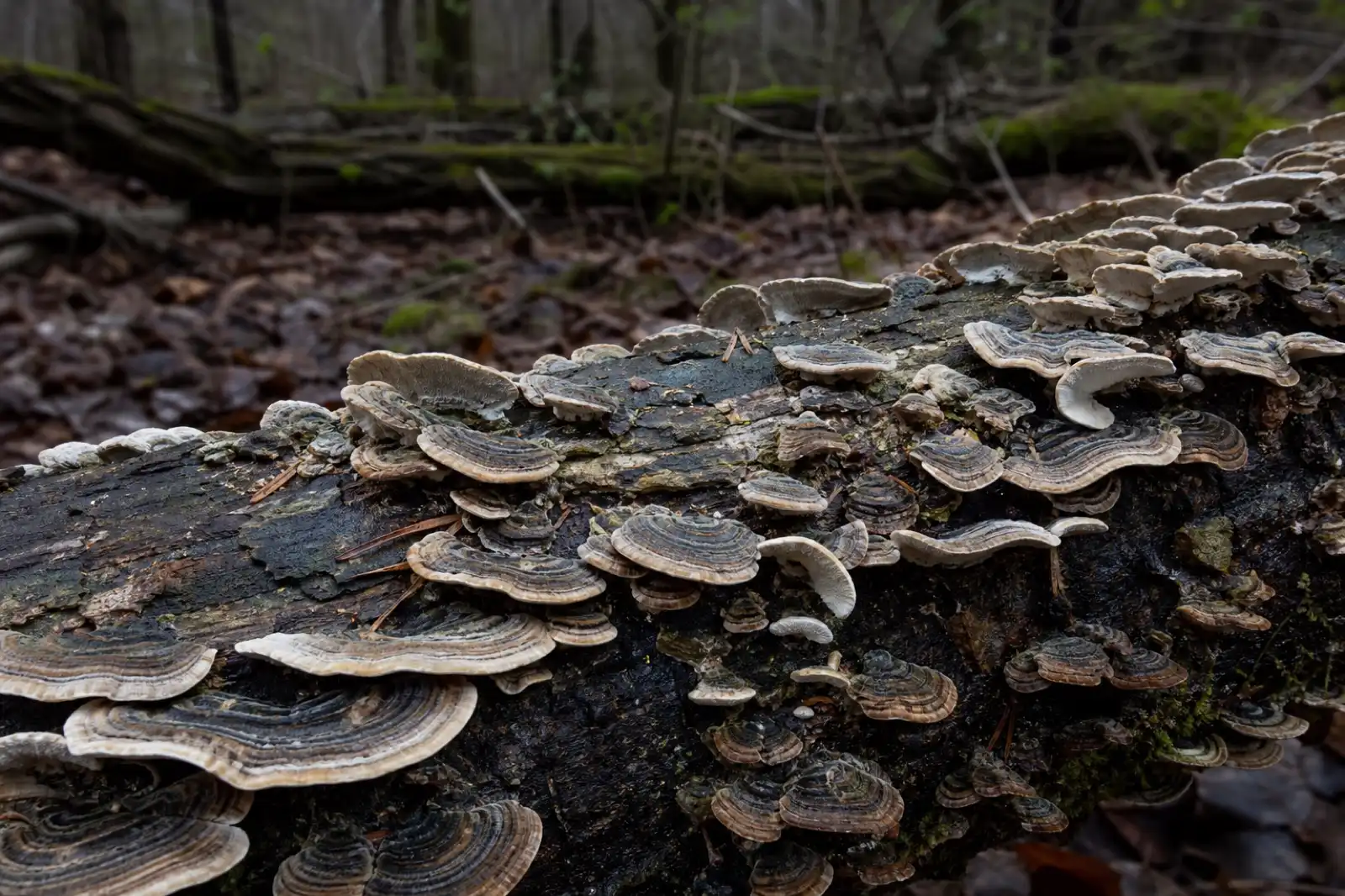
Trametes versicolor: Turkey Tail Mushroom Species Guide
Learn Trametes versicolor identification, pore features, hardwood habitat, cultivation, extract evidence, lookalikes, supplement safety, and FAQs.
mushrooms
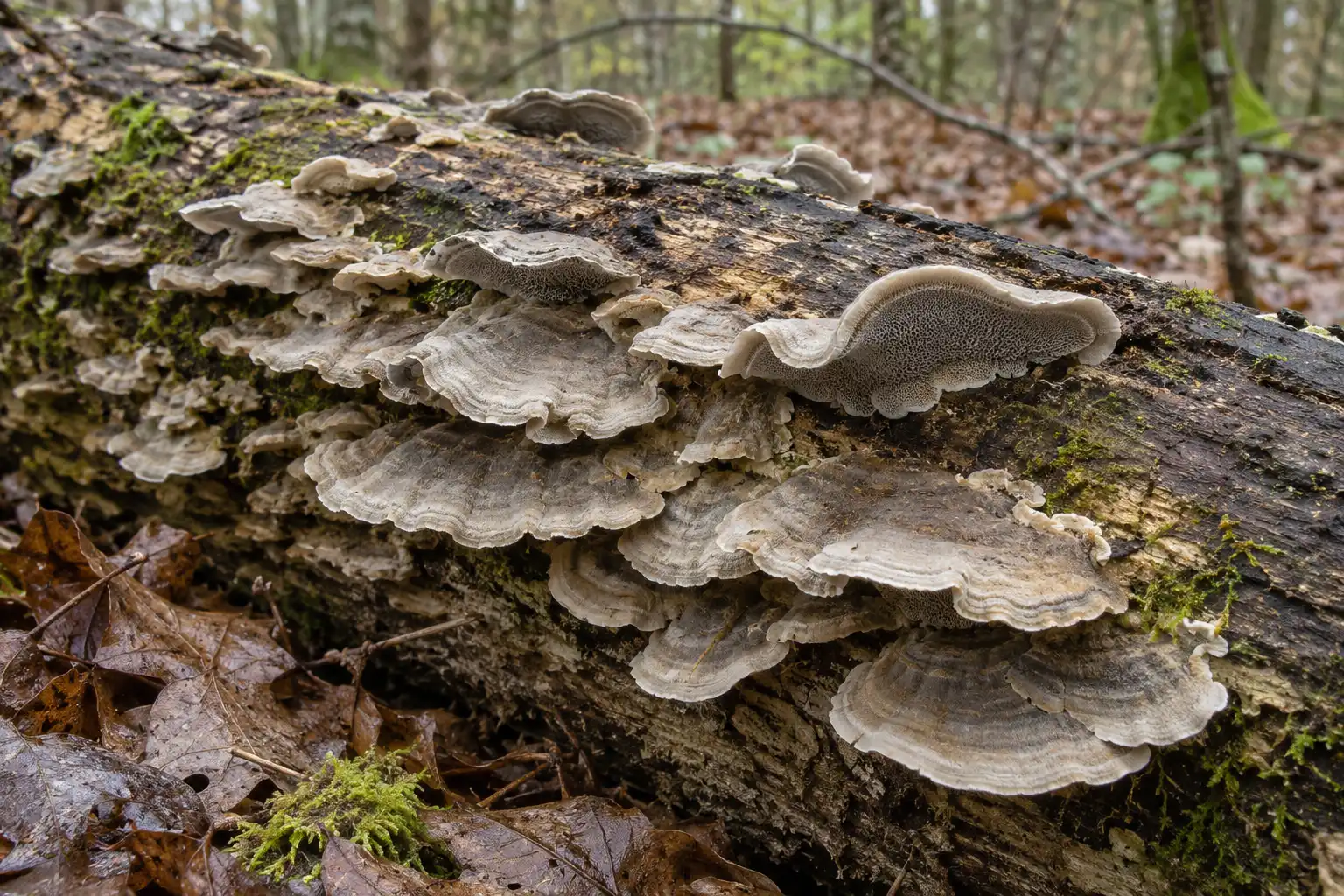
Smoky Bracket Fungus: Bjerkandera adusta Field Guide
Document Bjerkandera adusta by its thin grey brackets, smoky pore surface, white rot, hardwood attachment, section, microscopy, lookalikes, and decay context.
mushrooms
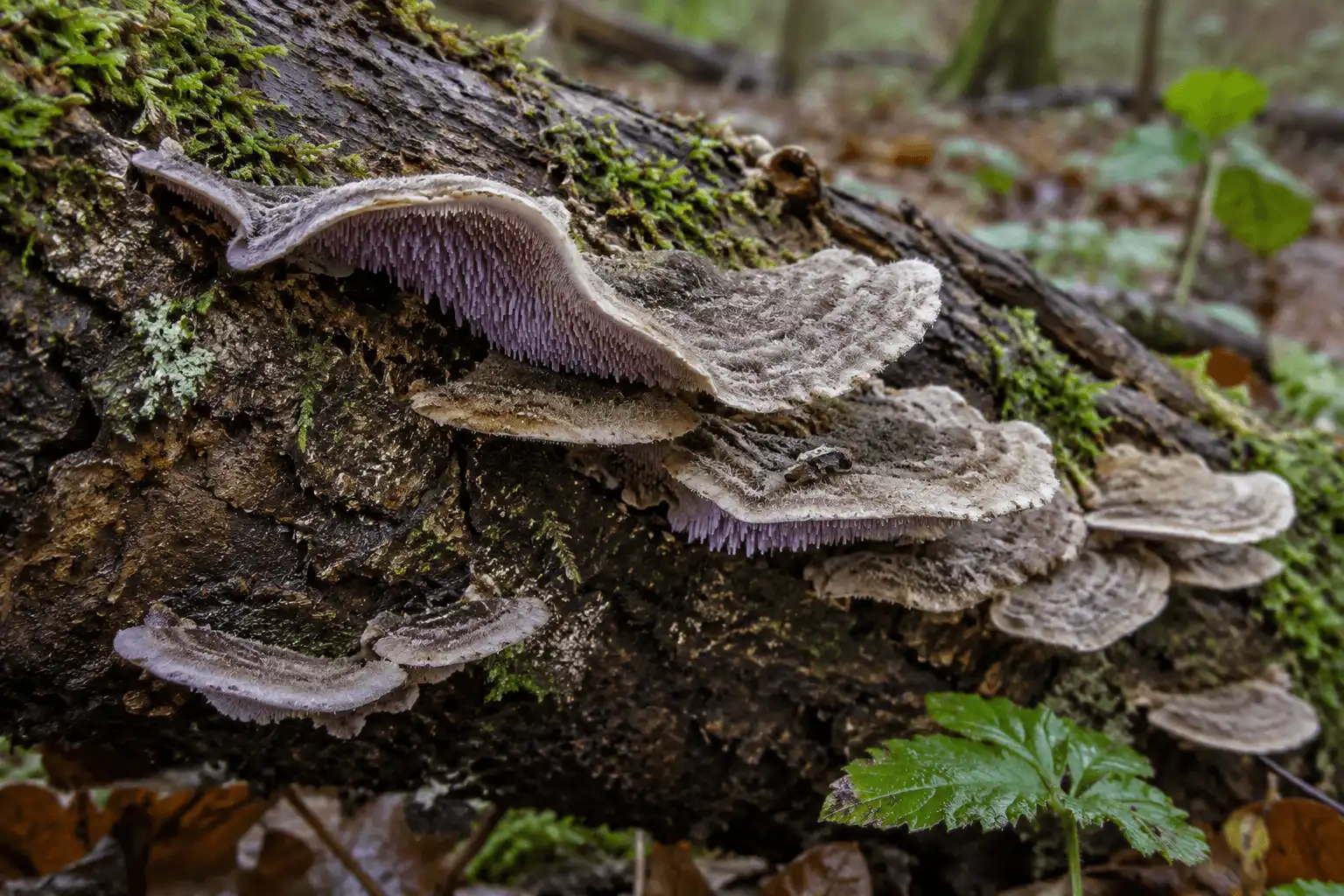
Violet-Toothed Polypore: Purple Pores, Teeth, and Hardwood Ecology
Document violet-toothed polypore by thin zoned brackets, fresh violet margins, a pore surface that tears into teeth, hardwood decay, aging, and lookalikes.
Continue exploring
Browse more practical guides in Mushroom Encyclopedia or visit the mushroom encyclopedia.