Mushroom Encyclopedia
Lilac Bonnet Mushroom: Striate Caps, Gills, and Safety
Document lilac bonnet mushrooms by cap striations, pale gills, slender stems, variable color, litter ecology, odor limits, and close Mycena lookalikes.
Species context
Treat profiles as reference material
Species profiles summarize documented traits, taxonomy, and lookalikes, but natural variation can be substantial.
Use the safety checklist →Decision limit
A profile cannot authenticate a specimen
Do not eat a wild mushroom from an online match, single feature, or generated image.
Read the safety disclaimer →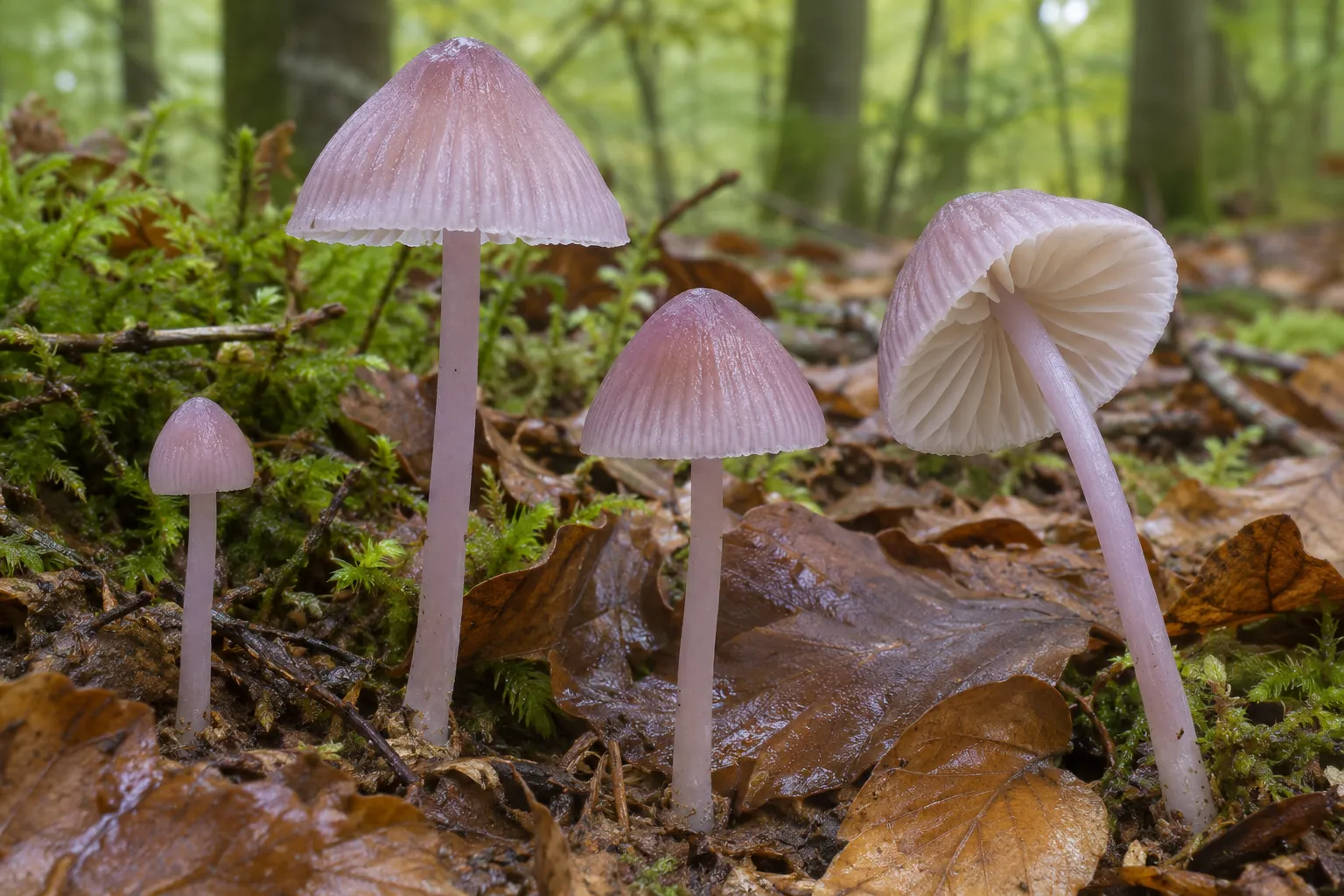
Quick facts
- Scientific name
- Mycena pura
- Common names
- Lilac bonnet, lilac mycena
- Taxonomy
- Mycena · Mycenaceae
- Edibility context
- Inedible: Not recommended for consumption; remote identification of small bonnet mushrooms is unsafe.
- Spore print
- White; useful against dark-spored candidates but not sufficient to resolve similar Mycena.
- Toxicity context
- Moderate: Potentially bioactive or toxic chemistry and difficult species separation support a no-food boundary.
- Season
- August, September, October, November
- Growing difficulty
- Expert
- Regions
- Europe, temperate Asia, North American records requiring regional interpretation
Safety limit: These labels summarize documented context; they never authenticate a wild specimen. Cooking does not make a poisonous species safe.
Lilac bonnet, Mycena pura, is a small woodland mushroom whose memorable color is also its least stable feature. A fresh moist cap may be lilac, rosy violet, or pink-purple; an older or drier cap can fade toward gray, cream, or nearly white. A defensible record combines the thin bell-shaped cap, translucent radial striations, pale attached gills, slender ringless stem, litter ecology, white spores, odor observation, and the limits of separating similar bonnet species.
This guide owns the species-level field-record intent. The common bonnet guide covers a grayer, commonly wood-associated clustered species, while the grooved bonnet guide focuses on a strongly furrowed gray-brown cap and decurrent tooth. No photograph or color match establishes edibility, and this page gives no food clearance.
Map the fruiting pattern and litter connection
Photograph the group before touching it. Count fruit bodies within a measured plot and mark whether they are solitary, loosely scattered, or sharing an apparent base. Lilac bonnets often arise through litter, but buried twigs can make the substrate ambiguous. Clear one base carefully and record whether it connects to leaf mould, needles, fine wood, or soil.
List nearby trees only as habitat context. A beech leaf beside a cap does not prove a biological association, and mixed woodland can contain several overlapping litter layers. Record canopy, dominant litter, slope, drainage, moisture, and recent rain. Photograph the horizon of litter in section if the precise decomposing layer matters.
A wide environmental view should accompany macro photographs. It prevents a delicate two-centimeter mushroom from appearing falsely robust and preserves spacing, substrate, and community context.
Measure cap change across moisture and age
Choose young, middle-aged, and expanded fruit bodies. Measure cap diameter and height, then photograph each directly above and at cap level. Young caps are commonly conical or bell-shaped; older caps may broaden while retaining a central rise. Record splits, waviness, and damage rather than forcing every body into an ideal outline.
Describe color by zones: disc, mid-cap, margin, and striations. Include a neutral color target under the same light. Moisture can deepen lilac and make the margin translucent; drying can shift the cap toward pinkish buff, gray, or pale cream. Phone white balance and saturation can turn a subtle bonnet into a neon purple mushroom, so preserve an unedited frame.
Measure how far radial translucence extends from the margin toward the disc. These lines often correspond to the gills visible through thin cap tissue. They are not deep structural grooves by default. Raking light, a cap-level view, and a vertical section help separate translucent striation from true furrowing.
Photograph the gill attachment square-on
Support one cap without snapping its stem and take an underside view with a scale. Record gill color, thickness, spacing at mid-radius, short gills, forks, cross-veins, edge color, and attachment. The pale gills are relatively broad for the small cap and meet the stem rather than running conspicuously far down it.
Cut one mature specimen vertically through cap and stem. The section shows cap thickness and the exact gill-stem junction. Use the gill-types guide to name what is visible without turning a slight tooth or curved junction into a stronger character than the specimen supports.
Do not infer spore color from pale gills. Make a deposit from a mature cap across black and white nonabsorbent surfaces under a ventilated cover. A white deposit fits the concept but is shared across many bonnet mushrooms and therefore cannot close the identification.
Preserve the entire slender stem
Measure stem length and width at apex, middle, and base. Record color, translucence, surface bloom, fibers, compression, hollowness, and any liquid released when damaged. The stem is delicate, ringless, and lacks a volva. Absence of a basal structure should be confirmed on an excavated base rather than a stem snapped at litter level.
Photograph the base before cleaning. Fine hairs, adhering litter, and mycelial threads can disappear during handling. Keep cap, gills, stem, and base from the same numbered specimen together; assembling a description from different bodies can create a combination none actually possessed.
Treat odor as an observer test, not a verdict
Lilac bonnet is frequently described as radish-like, but odor language is subjective. Smell an intact cap, freshly exposed gills, and a cut stem separately outdoors. Have observers write their impressions before discussion, and repeat after a fixed interval. Record temperature and specimen condition because cold, old, dry, or waterlogged material can release little odor.
Never taste an unknown Mycena to strengthen an odor impression. Odor can support a record only after structure, substrate, and spore evidence agree, and even then similar taxa may share it.
Separate rosy bonnet without relying on saturation
The name Mycena rosea is used for a larger, often more consistently pink bonnet, but treatment of the M. pura complex varies among references and regions. Compare measured cap and stem sizes, color zones under neutral light, gill attachment, odor, habitat, and microscopy. A pink photograph alone cannot decide which name applies.
When publishing a record, state the taxonomic source and date. If microscopy or sequencing was not done, label the confidence accordingly. A transparent “Mycena pura group” record is more useful than an unsupported exact name.
Distinguish amethyst deceiver by proportions
Amethyst deceiver, Laccaria amethystina, can share violet color and woodland litter. Its gills are usually thicker, more widely spaced, and often dusted by white spores at maturity; the fruit body tends to be tougher and more fibrous. Lilac bonnet is typically more delicate, with thinner translucent cap tissue and bonnet-like proportions.
Compare the same measurements rather than impressions: gills per centimeter at mid-radius, cap thickness in section, stem width, and the ratio of cap width to stem width. Old faded bodies of either species weaken the color distinction, making structural documentation essential.
Compare wood-growing and grooved bonnets
The common bonnet frequently grows in clusters from stumps or buried wood and is generally gray-brown. Prove whether the substrate is wood before using that distinction. The grooved bonnet has a markedly furrowed gray-brown cap and a characteristic gill attachment pattern, not merely faint lines seen through thin wet tissue.
Many small Mycena cannot be resolved reliably from field photographs. Microscopic work may examine spore dimensions and shape, basidia, cheilocystidia, pleurocystidia, pileipellis, and clamp connections. Record the chemical and mounting methods used; a measurement without preparation context is difficult to compare.
Design a microscopy record that can be challenged
Select a mature but intact specimen and retain a second body as a voucher rather than consuming all material in slides. Photograph the gill edge before sampling. Make separate preparations from the gill edge, gill face, cap skin, and stem surface so structures are not assigned to the wrong tissue. Record mount medium, stain, objective, calibration date, and whether dimensions exclude ornaments or projecting contents.
Measure a series rather than the most convenient cell. For spores, state the number measured and report length, width, shape, and the source specimen; for cystidia, preserve outlines and contents in images instead of reducing them to one average. A white spore deposit confirms neither genus nor species, while a handful of uncalibrated measurements can create false precision.
If the field characters fit the Mycena pura group but microscopy conflicts with the chosen regional key, keep the group-level label and ask a specialist to review the voucher. Sequence data can be valuable, but a database match also depends on reference quality, locus, coverage, and taxonomic annotation. Report the method and uncertainty rather than presenting a percentage match as automatic identification.
Keep chemistry and food claims within evidence
Lilac bonnet is not recommended as food. Small bonnet mushrooms are difficult to identify safely, regional taxonomic concepts differ, and chemistry reported from one studied collection should not be turned into a dose or medical claim. This page does not diagnose poisoning or suggest therapeutic use.
If an unknown mushroom was eaten, save remaining material and photographs, record the time and estimated amount, and contact local poison-control or medical services. Do not wait for symptoms or use a web match as reassurance. Do not induce vomiting unless a qualified professional directs it.
Build a cap-fading and gill-maturity series
Select three intact fruit bodies at different stages and photograph them in place with a scale and neutral color target. If collection is permitted, keep them in separate ventilated containers. Photograph cap color, margin translucence, gills, and stem immediately, then after fixed intervals under the same diffuse light. Note whether color change follows moisture loss rather than age alone.
For the mature cap, start a labeled spore deposit while retaining a younger body intact. Log exact times and humidity. Link every photograph, section, deposit, and microscopy slide to its specimen number. This turns variable lilac color into an auditable observation rather than a search-engine color match.
Image provenance and limitations
The 1536 × 1024 cover is an original AI-assisted editorial image. It was opened beside the site’s Scarlet Waxcap and Verdigris Agaric references and checked for thin translucent-striate caps, pale attached gills, slender ringless stems, complete litter-level bases, realistic size cues, diffuse woodland light, restrained lilac color, natural leaf and moss texture, clean crop, and absence of text, logo, watermark, collage seams, or obvious malformed anatomy. It is an editorial illustration, not a voucher photograph or identification test.
References
- NCBI Taxonomy Browser: Mycena pura — current taxonomic record and linked molecular resources.
- First Nature: Mycena pura — field characters, habitat, season, and comparison context.
- GBIF species search: Mycena pura — occurrence data interpreted with regional identification limits.
- North American Mycological Association: mushroom poisoning syndromes — conservative response context for an unknown ingestion.
Source quality notes
MushroomScope cites sources that match the page scope, such as taxonomic databases, extension guidance, food-safety agencies, food-composition databases, and peer-reviewed or institutional health references. Sources support context and uncertainty; they do not turn an online page into specimen identification, medical advice, or a tested recipe record.
Frequently asked questions
Is every small lilac woodland mushroom Mycena pura?
No. Color shifts with age and moisture, several Mycena and other genera can be lilac, and species-level separation may require microscopy or DNA evidence.
What do lilac bonnet cap striations show?
The thin moist cap can reveal radial lines corresponding to the gills beneath. Record how far those translucent striations extend rather than treating any grooved cap as diagnostic.
Does lilac bonnet have a radish-like odor?
Many accounts describe a radish-like odor, but observer sensitivity and specimen condition vary. Odor is supporting evidence, never a stand-alone identification.
Where does Mycena pura grow?
It is associated with decomposing litter in broadleaf, coniferous, and mixed woodland, usually appearing singly or in loose groups rather than dense cultivated clusters.
Can lilac bonnet mushrooms be eaten?
No food clearance is given. The species is not recommended for consumption, small Mycena are difficult to identify safely, and toxic compounds have been reported in this group.
Related guides
mushrooms
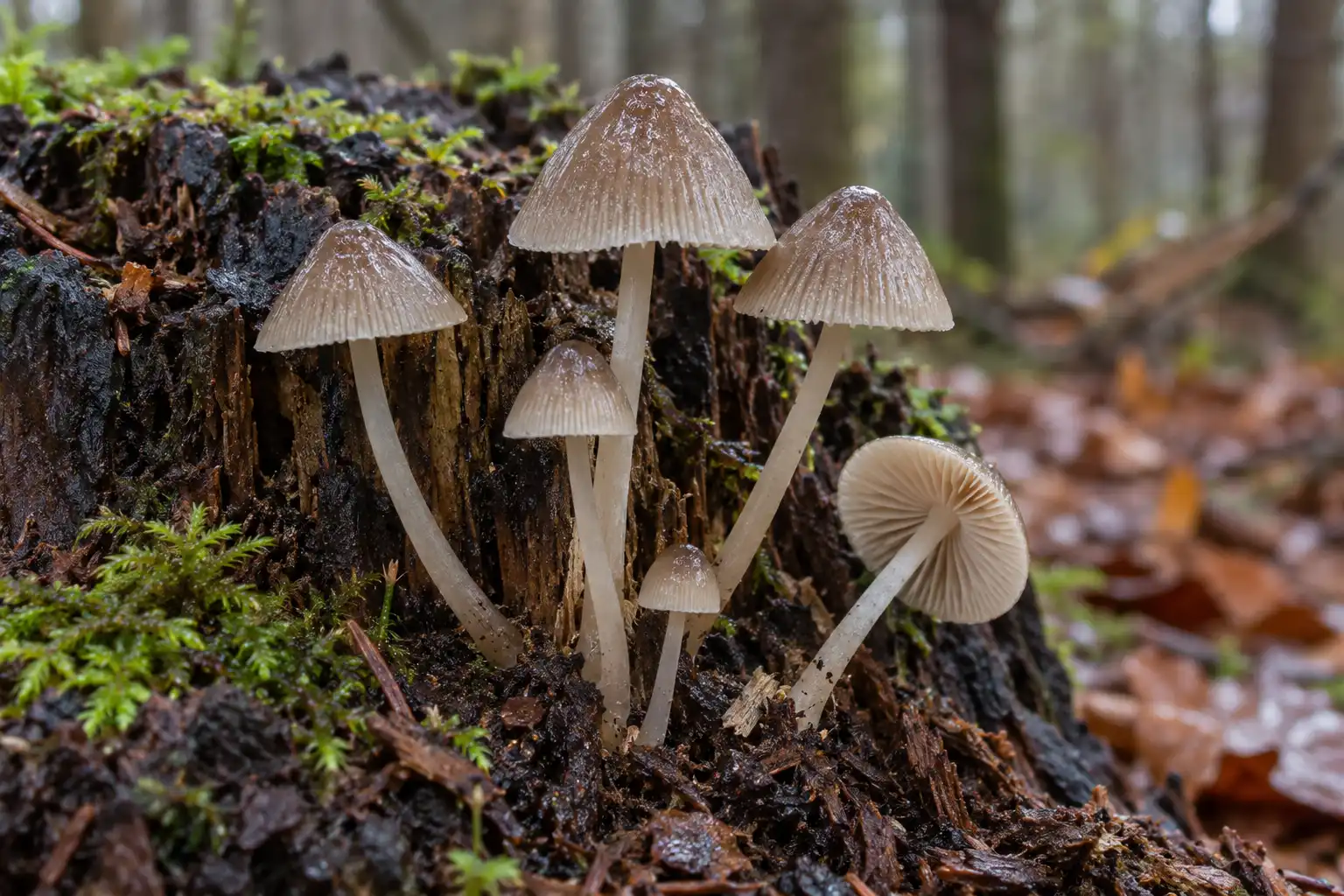
Common Bonnet Mushroom: Wood, Form, and Identification Limits
Identify the Common bonnet by its wood attachment, cap striations, gill development, clustered habit, microscopy limits, ecology, and close lookalikes.
mushrooms
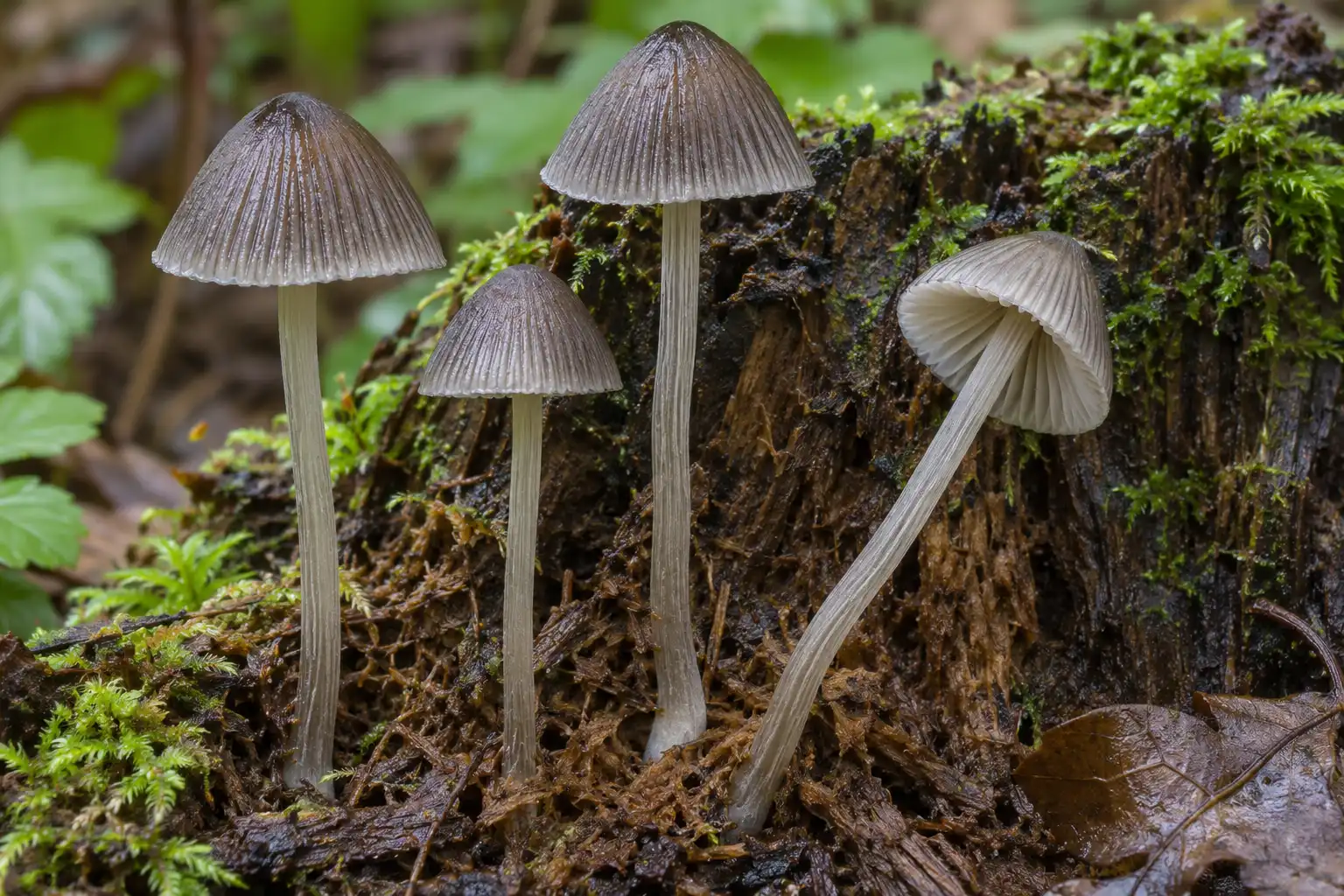
Grooved Bonnet: Mycena polygramma Field Guide
Document Mycena polygramma by its longitudinally grooved stem, gray striate cap, pale gills, hardwood habitat, microscopy, and regional lookalikes.
identification
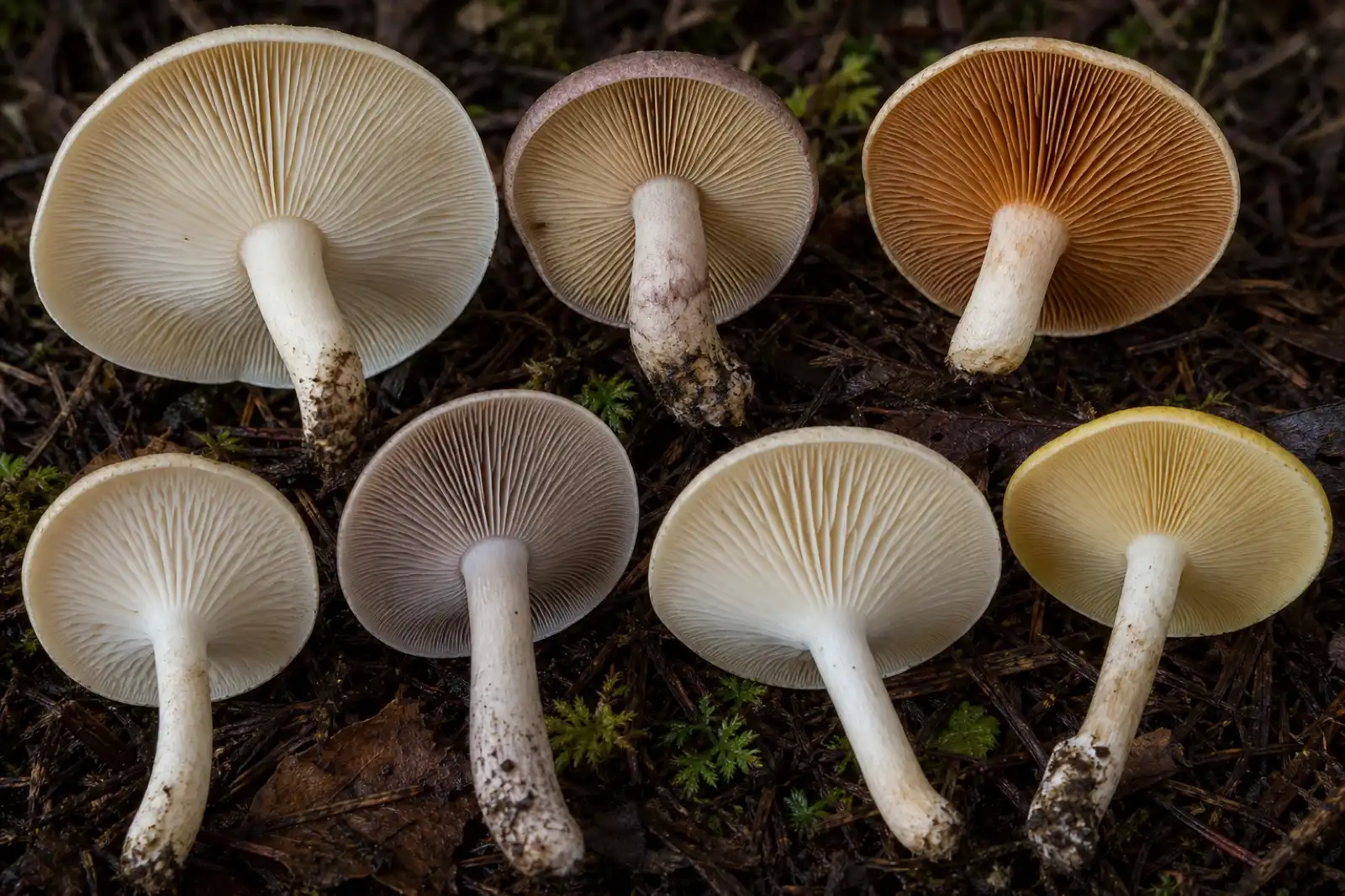
Mushroom Gill Types: Attachment, Spacing, and Color
Compare free, attached, notched, adnate, and decurrent mushroom gills while recording spacing, short gills, edge details, bruising, and color changes.
Continue exploring
Browse more practical guides in Mushroom Encyclopedia or visit the mushroom encyclopedia.