Mushroom Encyclopedia
Scarlet Caterpillarclub: Cordyceps militaris Field Guide
Document Cordyceps militaris by orange club-shaped stromata, embedded perithecia, buried moth pupae, woodland season, microscopy, culture limits, and lookalikes.
Species context
Treat profiles as reference material
Species profiles summarize documented traits, taxonomy, and lookalikes, but natural variation can be substantial.
Use the safety checklist →Decision limit
A profile cannot authenticate a specimen
Do not eat a wild mushroom from an online match, single feature, or generated image.
Read the safety disclaimer →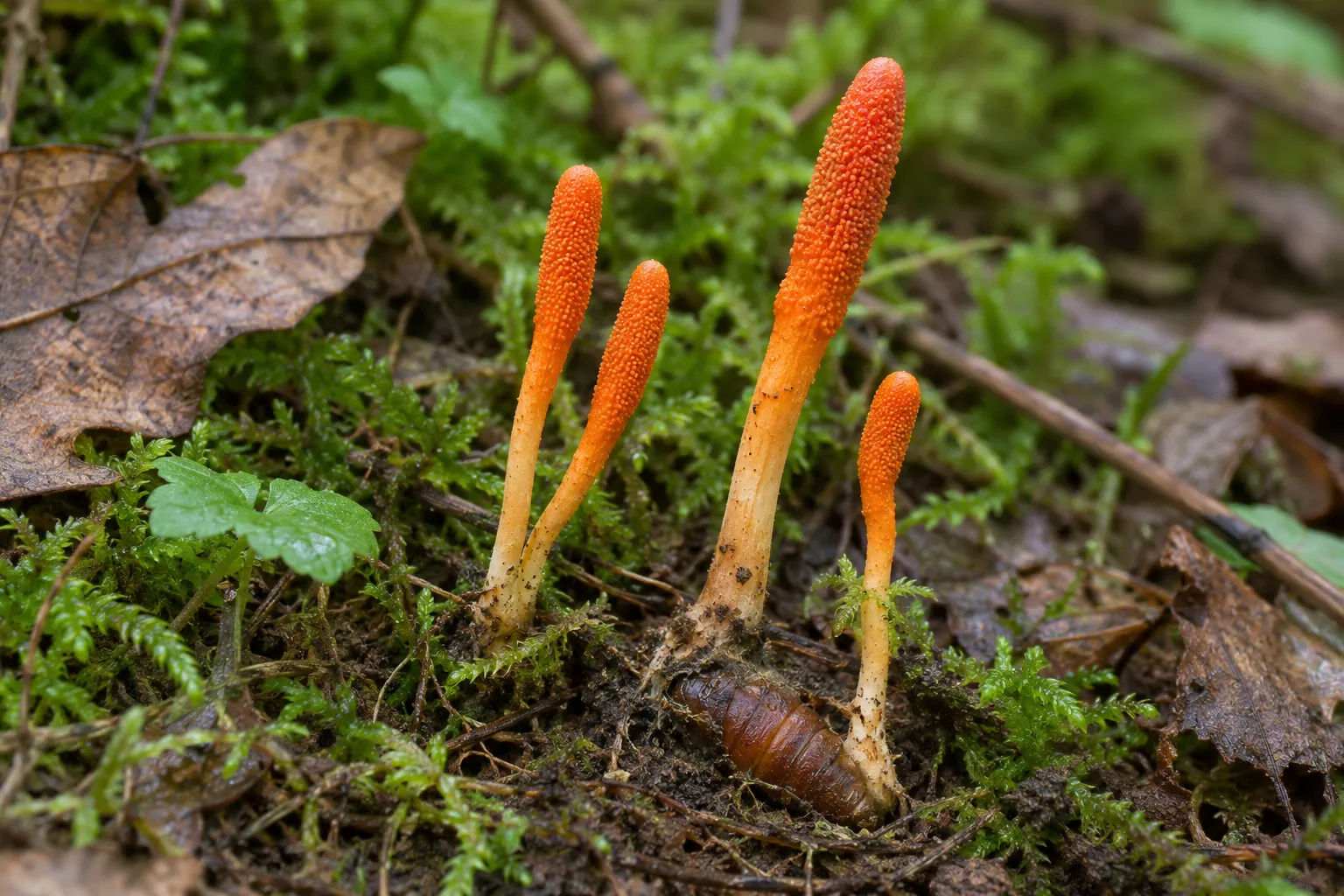
Quick facts
- Scientific name
- Cordyceps militaris
- Common names
- Scarlet caterpillarclub, Scarlet caterpillar fungus, Orange caterpillarclub
- Taxonomy
- Cordyceps · Cordycipitaceae
- Edibility context
- Unknown: Not presented as wild food; commercial culture and extracts are different materials requiring product-specific safety assessment.
- Spore print
- A conventional cap print is not applicable; microscopy examines asci, long multiseptate ascospores, and their secondary fragments.
- Toxicity context
- Unknown: Orange color and a Cordyceps label do not establish ingestion safety, dose, purity, or clinical benefit.
- Season
- June, July, August, September, October, November
- Growing difficulty
- Expert
- Regions
- Europe, North America, Asia, widespread temperate records requiring local verification
Safety limit: These labels summarize documented context; they never authenticate a wild specimen. Cooking does not make a poisonous species safe.
Scarlet caterpillarclub is visually simple above ground and biologically complex below it. A narrow orange club emerges through moss or litter, but its base continues to a colonized insect pupa. The visible structure is a fungal stroma: a platform containing many microscopic sexual fruiting chambers, not a cap-and-stem mushroom.
The host connection is central to the record. Orange color alone can match unrelated coral fungi, clubs, slime molds and immature ascomycetes. A defensible Cordyceps militaris observation combines the entire stroma, embedded perithecia, buried host, habitat, season and mature microscopic structures.
Photograph the complete club before following the base
Begin at site scale. Photograph the fruit bodies in moss, leaf litter or grass with a ruler in the same plane. Count stromata, measure their total height and the length and width of the fertile upper portion, and record whether they arise separately or from one concealed point.
The fertile area should be orange to scarlet and finely granular or pimpled. Those bumps correspond to embedded perithecia and their openings. The lower sterile portion is commonly narrower and may be paler. Make side, tip and base photographs of the same numbered club so color and texture are not borrowed from different specimens.
Do not interpret soil stuck to a smooth club as perithecial texture. A hand lens should reveal repeated, organized small elevations or openings. Likewise, a branched orange coral with uniform surface texture belongs in another comparison even if it shares the same woodland floor.
Trace the insect host with minimal excavation
Where collection is lawful and enough fruit bodies are present, loosen litter around one base with a small spoon or wooden probe. Follow the stroma downward without pulling. The attached host may be a brown, mummified moth pupa several centimeters below the surface or hidden beneath a moss mat.
Photograph the connection before separating anything. Record depth, orientation, host dimensions, surrounding roots and whether multiple stromata join the same host. If the base breaks, state that attachment was not confirmed rather than placing an unattached pupa beside the fungus for a staged photograph.
Host identification is a separate specialist task. Pupal shape may support Lepidoptera, but an exact insect family or species often requires retained morphology or molecular evidence. “Attached to a buried moth pupa” is better than an unsupported species name.
The habitat identification guide helps separate the physical substrate from nearby plants. Trees describe microhabitat; the insect is the direct biological host.
Read the pimpled surface as perithecial architecture
Cut a thin longitudinal section through a permitted mature stroma. Under magnification, perithecia should appear as closely packed flask-shaped chambers embedded near the surface of the fertile upper part. Their necks open outward and create the granular field seen with a lens.
Record whether perithecia are immersed or projecting, their distribution, and the boundary between fertile and sterile tissue. A photograph of one broken bump cannot describe the whole stroma. Sample from middle and upper fertile zones and keep the section linked to the host-connected voucher.
Microscopy uses asci and very long, multiseptate ascospores that can break into smaller secondary spores. Record mount medium, calibration, maturity, number measured and whether dimensions refer to intact spores or fragments. Mixing those units can create false species differences.
Separate orange clubs by contradiction
Orange Clavulinopsis and related coral fungi can form simple clubs in grass or litter. They do not arise from an insect pupa and do not contain the same embedded perithecial field. Check the base and fertile architecture rather than relying on a brighter or duller shade of orange.
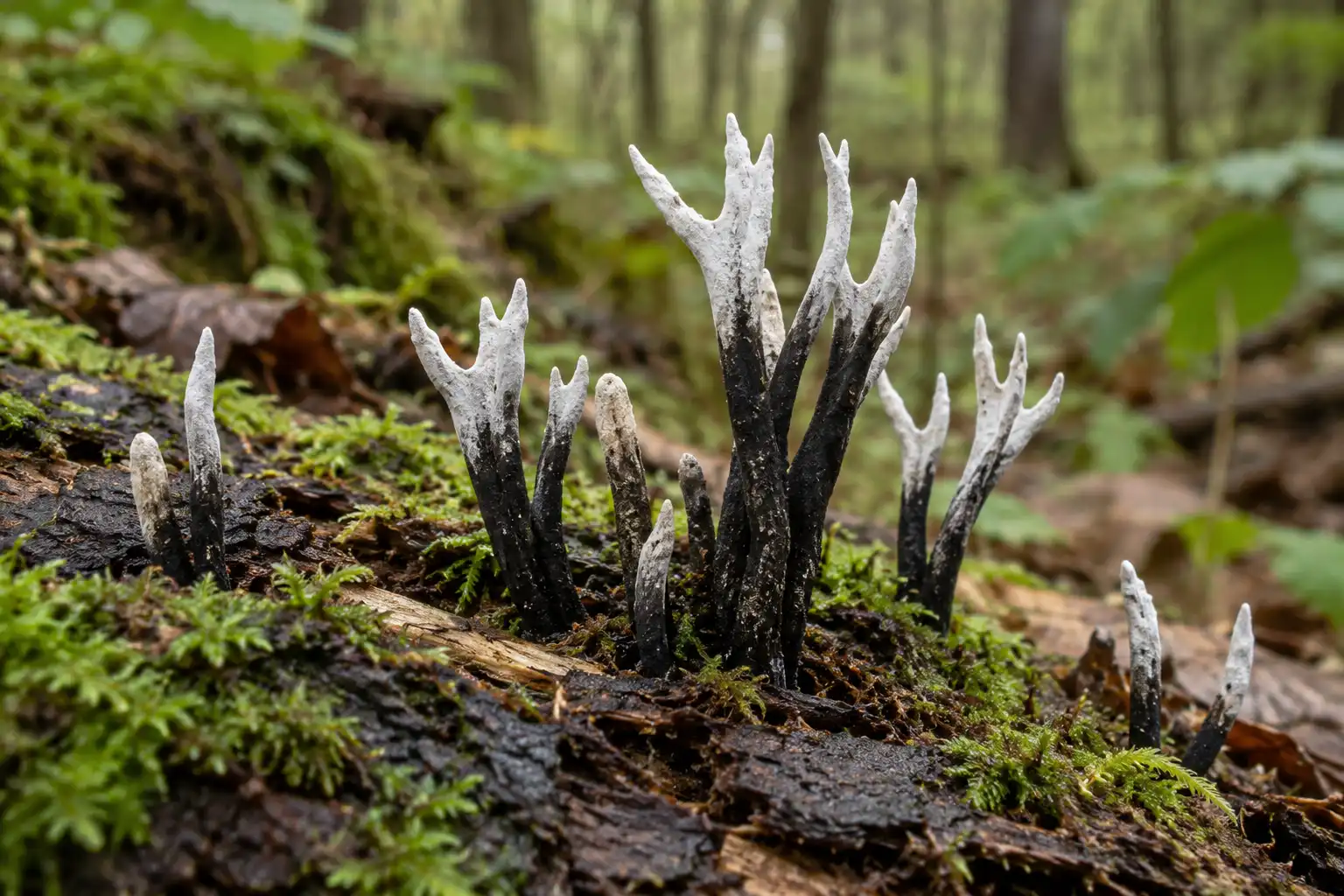
The jelly baby fungus guide documents an irregular gelatinous head on a distinct stem. Its fertile surface is smooth and its substrate relationship differs. The candlesnuff fungus guide covers dark-tipped branching stromata on decaying wood, providing a strong contrast in color, branching and substrate.
Other insect-associated fungi may grow as clubs, cushions or stalked heads from larvae, pupae or adult insects. Photograph host stage and stroma construction, then use a current regional key. “Cordyceps” is a broad ecological idea in popular use, not proof of one modern genus or species.
Record the fruiting site as a host microhabitat
Measure litter depth, moss cover, soil moisture, shade, slope and recent rain. Note whether clubs occur beside paths, in open grass, under broadleaf litter or in conifer moss. These observations help explain emergence and detection without claiming that a tree species is the fungal host.
Establish a small fixed plot and revisit it at weekly intervals. Mark each club on a sketch, record new emergence, color change, collapse and grazing, and avoid trampling concealed hosts. One pupa may support several stromata, so fruit-body count is not the same as host count.
Absence in a later year does not establish local extinction. Insect populations, infection, pupation depth, weather and fruiting probability all vary. A useful monitoring record keeps those denominators separate.
Keep wild ecology separate from laboratory cultivation
Cordyceps militaris can be cultured and fruited under controlled conditions, often on formulated media rather than intact wild insects. Authentication, strain history, inoculum, nutrient composition, container geometry, light spectrum, temperature, humidity, gas exchange and contamination control can all alter yield and form.
Record biological efficiency only when dry substrate inputs and fresh or dry product outputs are defined. A vivid orange crop does not prove species identity, compound concentration or absence of contaminants. Repeated subculture can also change performance, so preserve master-culture provenance and passage counts.
Laboratory fruiting is not evidence that releasing culture into woodland is appropriate. Do not inoculate wild insect populations or move colonized material between sites.
Preserve the host-stroma junction for later review
Dry the connected host and stroma with their field code intact rather than separating them into convenient fragments. Support the narrow junction with folded archival tissue so it does not snap during transport. Photograph both sides of the pupa, every emergence point, and any silk, soil case, plant fiber or predator damage before drying changes the surface.
If tissue is divided for DNA work, mark the exact sampled zone on the voucher photograph. Fungal tissue from the fertile tip answers a different question from insect tissue inside the pupa, and an unlabelled mixed extraction can obscure both identities. Include a negative extraction control and deposit raw sequence data and voucher location when results are published.
The host condition can also reveal timing without providing an exact date. Record whether the pupal shell is intact, collapsed, split, consumed internally or invaded by another organism. Do not infer that the fungus attacked a healthy free-living adult; the observed evidence concerns one colonized immature host. A carefully preserved junction lets an entomologist and mycologist revisit that relationship instead of relying on the orange club alone.
Keep supplement and medical claims out of the field name
Retail products may use cultivated fruit bodies, mycelium, fermentation biomass, extracts or blends. A label saying “cordyceps” may refer to different species or materials. Field identification of C. militaris cannot establish what is inside a capsule, and the presence of a studied compound cannot establish prevention or treatment of disease.
Evaluate a product by exact scientific name, material used, strain or voucher where available, extraction method, serving amount, other ingredients, lot testing, contaminants and applicable regulation. People who are pregnant, breastfeeding, allergic to fungi, immunocompromised, preparing for surgery or using anticoagulant, glucose-lowering or immune-modifying medicines should seek clinician or pharmacist advice before concentrated products.
This page provides no diagnosis, treatment or dosing recommendation. Do not delay conventional care for an extract or wild preparation.
Apply conservative collection and safety boundaries
Wild stromata are not presented as food. The attached insect, soil bacteria, environmental contamination, decomposition and lookalikes remain unresolved by a photograph. Do not taste an orange club as an identification test.
If an unidentified fungus or supplement is consumed and symptoms occur, contact the appropriate poison center or medical service. Retain uncooked material, packaging, lot number, photographs, location, preparation and timing. Severe breathing difficulty, confusion, fainting or persistent symptoms require urgent care.
Collect minimally. One complete voucher with host attachment and data is more informative than a bag of broken clubs whose bases cannot be reconstructed.
Build a reviewable scarlet-caterpillarclub record
- Photograph the complete patch with a millimeter scale.
- Measure total stroma and fertile-zone dimensions separately.
- Confirm organized perithecial bumps with a hand lens.
- Trace one base gently and photograph its host attachment in place.
- Record host stage only to the certainty supported by insect evidence.
- Section mature fertile tissue and measure asci and spores with calibration.
- Preserve stroma, attached host, photographs and site metadata under one voucher code.
The sequence prevents a memorable orange shape from replacing the host and anatomy that define the observation.
Audit the editorial image
The 1536 by 1024 RGB cover is an original AI editorial image reviewed beside the site’s Candlesnuff Fungus and Jelly Baby Fungus natural-light covers. It shows slender complete bases, expanded granular fertile zones, restrained orange-red color, damp moss and leaf-litter scale under diffuse light. One partly exposed pupa illustrates the ecological connection without gore. The image is sharp at the subject without halos and contains no text, logo, watermark or collage.
The generated host and perithecia cannot establish insect identity, microscopic structures or species. The cover is explicitly credited and licensed as an original AI editorial asset and is not presented as a voucher photograph.
References
Not every brightly colored upright fungus is an insect parasite. The yellow stagshorn identification guide covers forked gelatinous fruit bodies attached to rotten conifer wood; substrate attachment and branching separate that search intent from caterpillarclub anatomy.
- GBIF species search: Cordyceps militaris — occurrence and taxonomic source records.
- NCBI Taxonomy Browser: Cordyceps militaris — taxonomic and sequence-linked context.
- USDA Forest Service fungi research — forest-fungus and entomopathogenic research context.
- North American Mycological Association: poisoning syndromes — conservative response guidance for suspected poisoning.
Source quality notes
MushroomScope cites sources that match the page scope, such as taxonomic databases, extension guidance, food-safety agencies, food-composition databases, and peer-reviewed or institutional health references. Sources support context and uncertainty; they do not turn an online page into specimen identification, medical advice, or a tested recipe record.
Frequently asked questions
What insect does scarlet caterpillarclub grow from?
Cordyceps militaris commonly fruits from buried pupae of moths and related lepidopterans. The host may be concealed in litter, so attachment should be traced gently rather than assumed from an orange club alone.
Why is the upper club bumpy?
The fertile stroma contains many embedded flask-shaped perithecia whose openings create a finely pimpled surface. A smooth orange club without that fertile texture requires a different comparison.
Does scarlet caterpillarclub have a mushroom cap?
No. It produces upright club-shaped stromata with an expanded fertile upper portion and narrower sterile base, not a cap with gills or pores.
Can every orange Cordyceps be named C. militaris from a photograph?
No. Host, stroma construction, perithecia, asci, fragmented ascospores, region and current taxonomy must agree; cultivated material also needs strain provenance.
Is wild scarlet caterpillarclub safe to eat?
This guide makes no food or supplement recommendation. A photograph cannot establish species, host condition, contamination, product identity, dose or medical suitability.
Related guides
mushrooms
Candlesnuff Fungus: Antler Form, Wood Ecology, and Lookalikes
Study candlesnuff fungus through its black-and-white antler form, hardwood ecology, life stages, similar Xylaria, documentation, and safety limits.
mushrooms
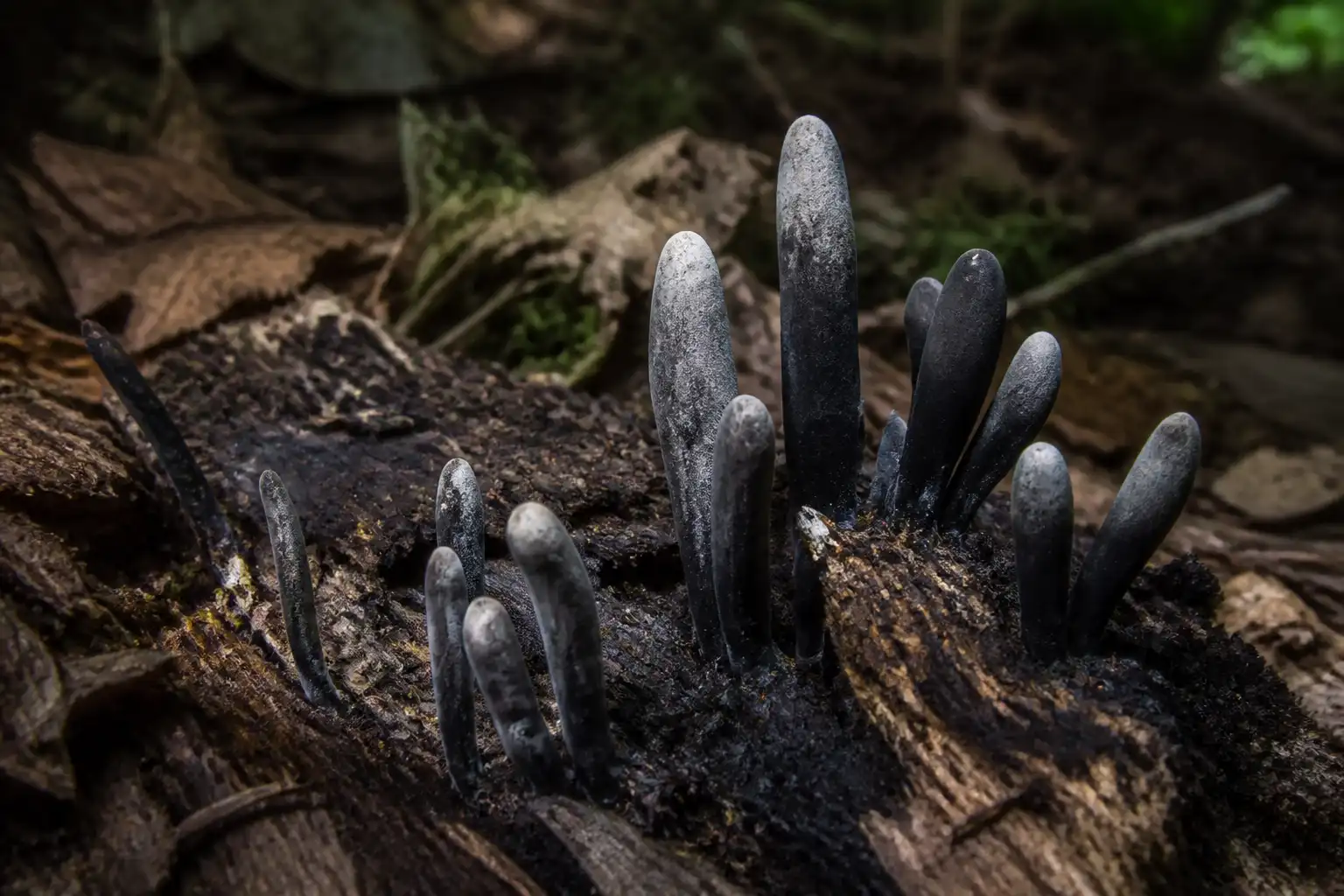
Dead Man's Fingers Fungus: Xylaria Stromata and Wood Decay
Document Xylaria polymorpha by club-shaped stromata, gray conidial bloom, black mature surface, perithecia, hardwood origin, development, and lookalikes.
identification
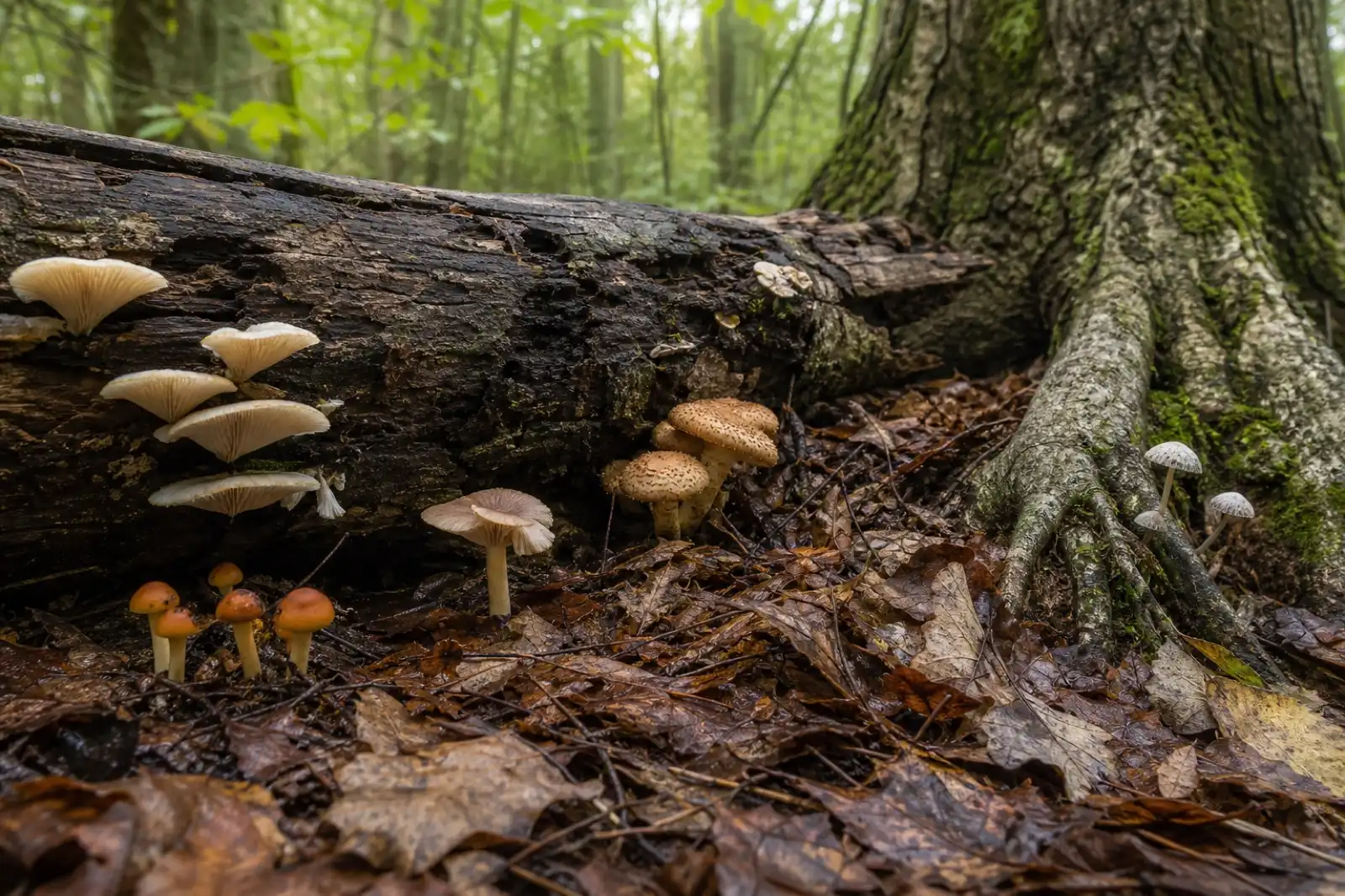
Using Habitat to Identify Mushrooms
Record substrate, associated plants, soil, wood type, moisture, elevation, and fruiting pattern as identification evidence.
Continue exploring
Browse more practical guides in Mushroom Encyclopedia or visit the mushroom encyclopedia.