Mushroom Encyclopedia
Candlesnuff Fungus: Antler Form, Wood Ecology, and Lookalikes
Study candlesnuff fungus through its black-and-white antler form, hardwood ecology, life stages, similar Xylaria, documentation, and safety limits.
Species context
Treat profiles as reference material
Species profiles summarize documented traits, taxonomy, and lookalikes, but natural variation can be substantial.
Use the safety checklist →Decision limit
A profile cannot authenticate a specimen
Do not eat a wild mushroom from an online match, single feature, or generated image.
Read the safety disclaimer →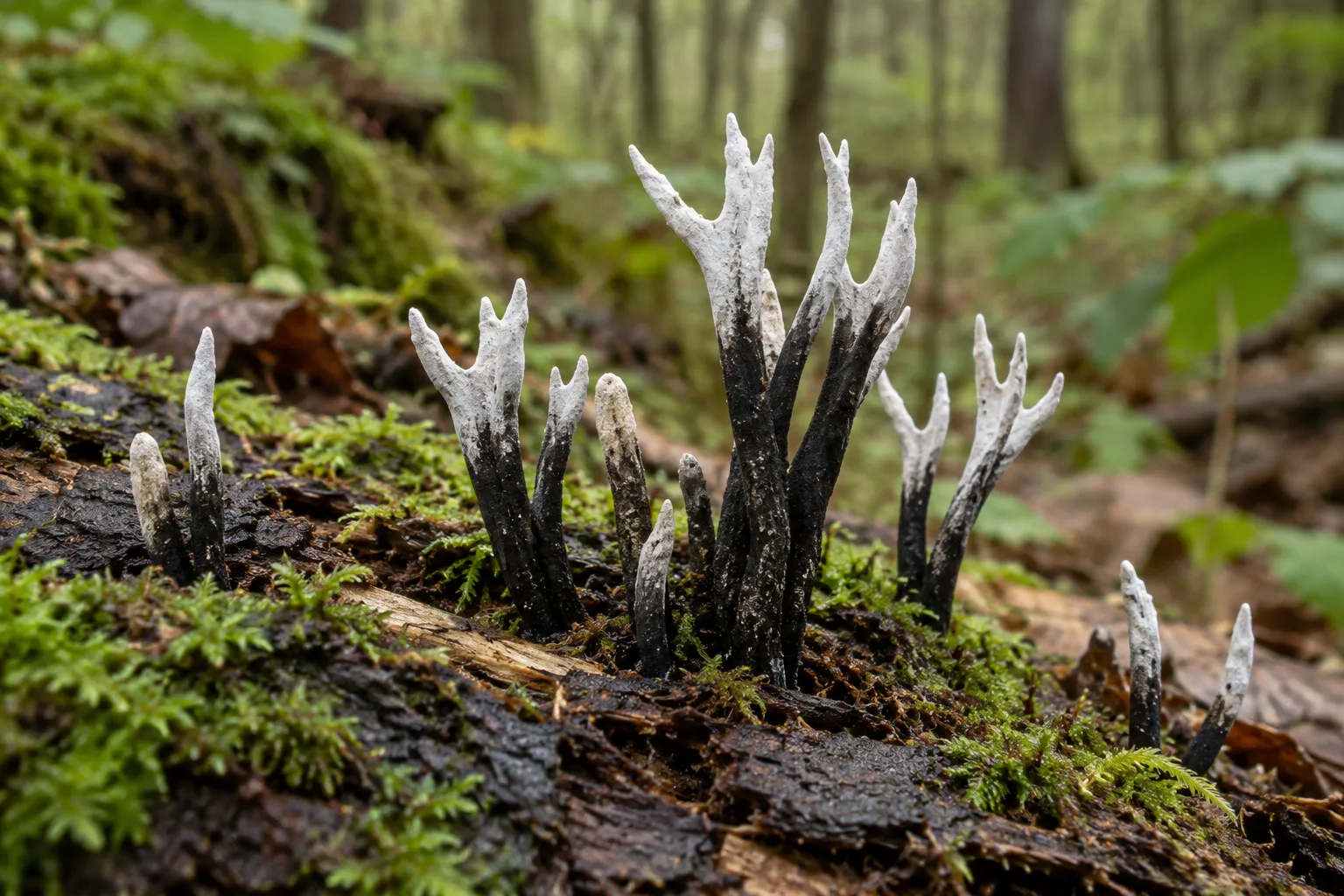
Quick facts
- Scientific name
- Xylaria hypoxylon
- Common names
- candlesnuff fungus, candlestick fungus, carbon antlers
- Taxonomy
- Xylaria · Xylariaceae
- Edibility context
- Inedible: Not recommended as food; the fruit body is tough and identification uncertainty remains.
- Spore print
- Blackish when mature spores can be collected.
- Toxicity context
- Unknown: No food-safety clearance should be inferred from this page or from a photograph.
- Season
- July, August, September, October, November, December
- Growing difficulty
- Expert
- Regions
- Europe, North America, Asia, Oceania
Safety limit: These labels summarize documented context; they never authenticate a wild specimen. Cooking does not make a poisonous species safe.
Candlesnuff fungus is a small wood decomposer whose two-tone fruit bodies can look as if black twigs were dipped in white ash. The name usually refers to Xylaria hypoxylon, but the common name does not resolve every slender Xylaria. Age changes the visible surface, buried wood hides the true substrate, and several related fungi produce dark persistent clubs. A defensible record combines the entire stroma, its attachment, developmental stage, internal construction, spores, locality, and a current regional key.
Read the fruit body from base to tip
Start with an undisturbed group and a millimeter scale. Typical stromata are upright, narrow, and tough. The lower portion is black and often cylindrical, while the upper part may flatten, split, or fork like small antlers. Young upper surfaces can be coated in pale gray or white powder. Mature specimens may become darker throughout, develop a subtly bumpy surface, or lose delicate forks.
Do not select one dramatic fork and ignore the rest of the colony. Photograph simple clubs, forked bodies, broken tips, and old black structures separately. Measure total height, width at the base, width below the first division, and the number of terminal branches. Those observations describe a population without pretending that one silhouette is fixed.
The white coating marks a life stage
The pale material on young tips is commonly associated with an asexual state that produces conidia. It is not frost, mold, or proof of a species by itself. Rubbed, rain-washed, or old fruit bodies can lack an obvious coating. Conversely, pale debris and secondary molds can make unrelated dark wood fungi look superficially similar.
Use a hand lens. Record whether the pale layer is evenly powdery, patchy, granular, or composed of separate growth. Photograph the boundary where white tissue grades into black. Avoid wiping the surface before documentation; handling destroys precisely the age evidence needed for comparison.
Trace the substrate before calling it terrestrial
Candlesnuff fungus decomposes wood, especially decaying broadleaf material. A cluster beside a log is not necessarily attached to the visible log, and a cluster apparently in soil may arise from a buried stick, root fragment, stump edge, or old woody fruit structure. Photograph the emergence point and gently remove loose litter only when access rules allow.
The habitat identification guide explains how to distinguish soil, litter, and buried wood without destructive excavation. Note bark if present, wood hardness, diameter, decay class, moisture, and surrounding trees. Write “decayed broadleaf wood” when the host cannot be established; an unsupported tree name adds false precision.
Mature black surfaces contain different evidence
As sexual structures mature, embedded flask-like perithecia can give the surface a finely dotted or pimply appearance. A clean longitudinal section may show a pale interior beneath a dark rind. Make the section only after exterior photographs and use one representative specimen where collection is lawful.
Under magnification, mature spores and their dimensions help separate similar taxa. A blackish deposit may be difficult to obtain from a small upright stroma. Placing mature material over clean glass in a humid but not wet chamber can preserve any discharge. Absence of a visible deposit is not evidence for a pale-spored species; it may simply mean the structure was immature, dry, or exhausted.
Separate dead man’s fingers by architecture, not nickname
Xylaria polymorpha, commonly called dead man’s fingers, usually forms thicker, blunt, swollen fingers. Its bodies can cluster at stump bases or buried wood and become black outside, so habitat alone does not separate it. The dead man’s fingers guide details the broader, club-like profile and internal evidence.
Small or immature material can overlap. Record ratios rather than adjectives: height divided by maximum width, width at the base versus tip, and distance to the first branch. Candlesnuff material is often more slender and frequently branched above, but a single unbranched body should remain provisional.
Compare other slender Xylaria in context
Names within Xylaria are tied to mature anatomy, spores, and substrate. Xylaria carpophila is associated especially with old beech fruit structures and may appear as thin dark threads with pale tips. Other species occur on particular fruits, petioles, or wood. Buried substrate can conceal these associations.
A useful field label may therefore be “Xylaria cf. hypoxylon” until mature material is studied. “Cf.” communicates a comparison, not certainty. Retain collection date and photographs because one site can show pale asexual tips and dark mature stromata at different visits.
Build a developmental sequence
Return to a marked cluster without disturbing it. From the same camera position, photograph it every seven to fourteen days. Record rainfall, surface moisture, loss of white coating, darkening, branching damage, and the appearance of embedded dots. Use a small fixed ruler placed beside—not on—the colony.
This sequence prevents a common error: treating pale-tipped and uniformly black stages as different species merely because they were photographed on different days. It also shows persistence. Xylaria stromata can remain visible long after soft mushrooms have collapsed, so presence does not give an exact fruiting date.
Ecology is decomposition, not a living-tree diagnosis
The fungus participates in breaking down dead woody material. Finding it near a tree does not demonstrate that it killed the tree, nor does one fruiting establish the full decay history. Separate observations of dead substrate from claims about disease. If stromata emerge from a stump or root, document whether tissue is dead, partly dead, or connected to a living tree before seeking arboricultural advice.
Wood decay communities are layered. Mosses, slime molds, other fungi, invertebrates, and bacteria can occupy the same log. Do not assume every dark club on a piece of wood belongs to one organism. Give separate field numbers to structures that differ in texture, branching, or attachment.
A measured microplot improves the record
Mark a 20-by-20-centimeter plot around a cluster without attaching anything to the wood. Count stromata by three categories: pale-tipped, mixed pale-and-black, and fully black. Measure five representatives from each available category. Record exposed wood area, moss cover, and moisture after a dry day and after rain.
The resulting table is more informative than “many candlesnuff fungi.” It can reveal whether surface appearance tracks size or exposure, and it documents sampling limits. It does not prove a causal relationship, but it provides a repeatable observation another recorder can check.
Food and handling boundary
Preserve a useful voucher without flattening the evidence
When a record genuinely warrants collection and rules permit it, take one young and one mature stroma with a small piece of attached wood. Keep them in separate paper packets labeled with the same site record and different specimen suffixes. Photograph each before drying. Gentle warm-air drying preserves the carbonaceous body better than a sealed plastic bag, where condensation can encourage secondary mold and erase the powdery surface. Include the wood orientation and emergence point in the notes. A voucher without substrate, locality, date, and developmental stage loses much of the evidence that makes this fungus distinguishable.
Do not press wet stromata flat between paper. Their three-dimensional branching and embedded surface structures matter. If microscopy is planned, reserve intact mature tissue and note which surface produced spores. A curator can decide whether the material is sufficient; collecting more after the context is lost rarely repairs a weak record.
Candlesnuff fungus is not presented here as food. The stromata are small and tough, species-level identification may require microscopy, and dark wood fungi include multiple lookalikes. Do not taste unknown fungi as an identification test. Ordinary photographic handling is not equivalent to ingestion, but wash hands after field work and keep specimens away from food preparation.
If illness follows mushroom ingestion, contact local emergency services or a poison center promptly. Preserve uncooked material, photographs, location, timing, and any packaging. Do not delay care while seeking a crowd-sourced name.
Evidence limits and editorial method
GBIF and NCBI help check names, lineage, and records; they do not confirm a photographed specimen. Forest Service material supports wood-decay context rather than a claim about one tree. NAMA supports conservative exposure response, not an edible classification. Regional monographs and microscopy remain necessary where a species-level record matters.
The cover is an original AI editorial image. It was compared with MushroomScope natural-light macro covers for woodland lighting, complete attachment, restrained color, texture, coherent antler branching, and absence of text or watermark. It is not field evidence. Editorial review only; no named field mycologist or clinician independently reviewed this page.
Frequently asked questions
Are the white tips spores?
The powdery young surface commonly produces asexual conidia. Mature sexual spores arise from embedded structures in darker tissue, so the visible white layer and a mature spore discharge represent different parts of the life cycle.
Can it grow on conifer wood?
Records are most often associated with broadleaf wood. When the host is uncertain, document wood characters and surrounding trees without forcing a name; regional treatments may clarify local substrate breadth.
Does touching make it turn black?
The major pale-to-black change is developmental and weather-related, not a useful instant bruising test. Rubbing can remove pale powder and expose darker tissue, which is damage rather than diagnostic chemistry.
Is every forked black club candlesnuff fungus?
No. Other Xylaria and unrelated stromatic fungi overlap. Attachment, scale, maturity, surface anatomy, spores, and geography must agree.
Should a whole colony be collected?
No. Photograph first. If collection is lawful and scientifically justified, take the smallest representative sample that preserves base and mature tissue, leaving most of the colony and substrate intact.
The scarlet caterpillarclub guide provides the substrate-first contrast for an orange, unbranched stroma connected to a buried insect pupa. Candlesnuff remains a wood-decay record with dark-tipped branching stromata, not an insect-host record.
References
- GBIF — Xylaria hypoxylon. Taxonomic backbone and occurrence context.
- NCBI Taxonomy Browser — Xylaria hypoxylon. Lineage and name checkpoint.
- USDA Forest Service — Wood Decay Fungi. Dead-wood ecology context.
- NAMA — Mushroom Poisoning Syndromes. Conservative exposure-response guidance.
Sources support specific claims and are not endorsements. Editorial review completed October 26, 2026; no named clinical expert or field mycologist independently reviewed this page.
Source quality notes
MushroomScope cites sources that match the page scope, such as taxonomic databases, extension guidance, food-safety agencies, food-composition databases, and peer-reviewed or institutional health references. Sources support context and uncertainty; they do not turn an online page into specimen identification, medical advice, or a tested recipe record.
Frequently asked questions
Why are candlesnuff fungus tips white?
Young fertile structures often carry a pale powdery conidial coating above a darker base. The coating can weather away, so color must be interpreted with age and surface texture.
Does candlesnuff fungus always branch like antlers?
No. Fruiting bodies range from simple clubs to flattened or forked antler forms, and old material may lose tips or become uniformly black.
What wood supports candlesnuff fungus?
It is most often documented on decaying broadleaf wood, including buried pieces that make it appear to grow from soil. Exact substrate should be traced rather than guessed.
Can a photograph confirm Xylaria hypoxylon?
No. A useful determination may require mature structures, substrate, geography, a sectional view, spores, and comparison with a current regional key.
Is candlesnuff fungus edible?
This guide does not recommend it as food. It is tough, easily confused with other small dark stromatic fungi, and remote identification cannot establish food safety.
Related guides
mushrooms
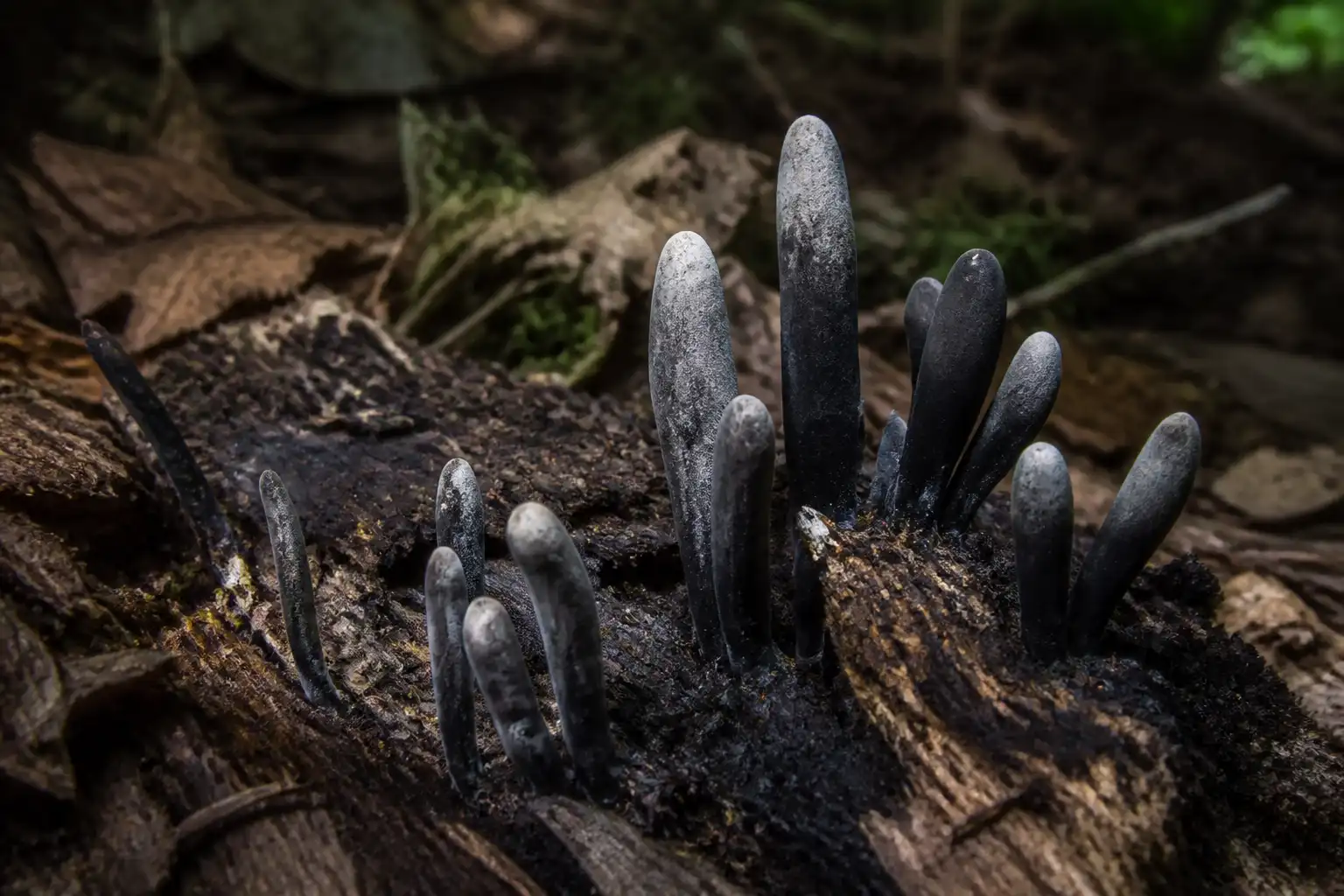
Dead Man's Fingers Fungus: Xylaria Stromata and Wood Decay
Document Xylaria polymorpha by club-shaped stromata, gray conidial bloom, black mature surface, perithecia, hardwood origin, development, and lookalikes.
mushrooms
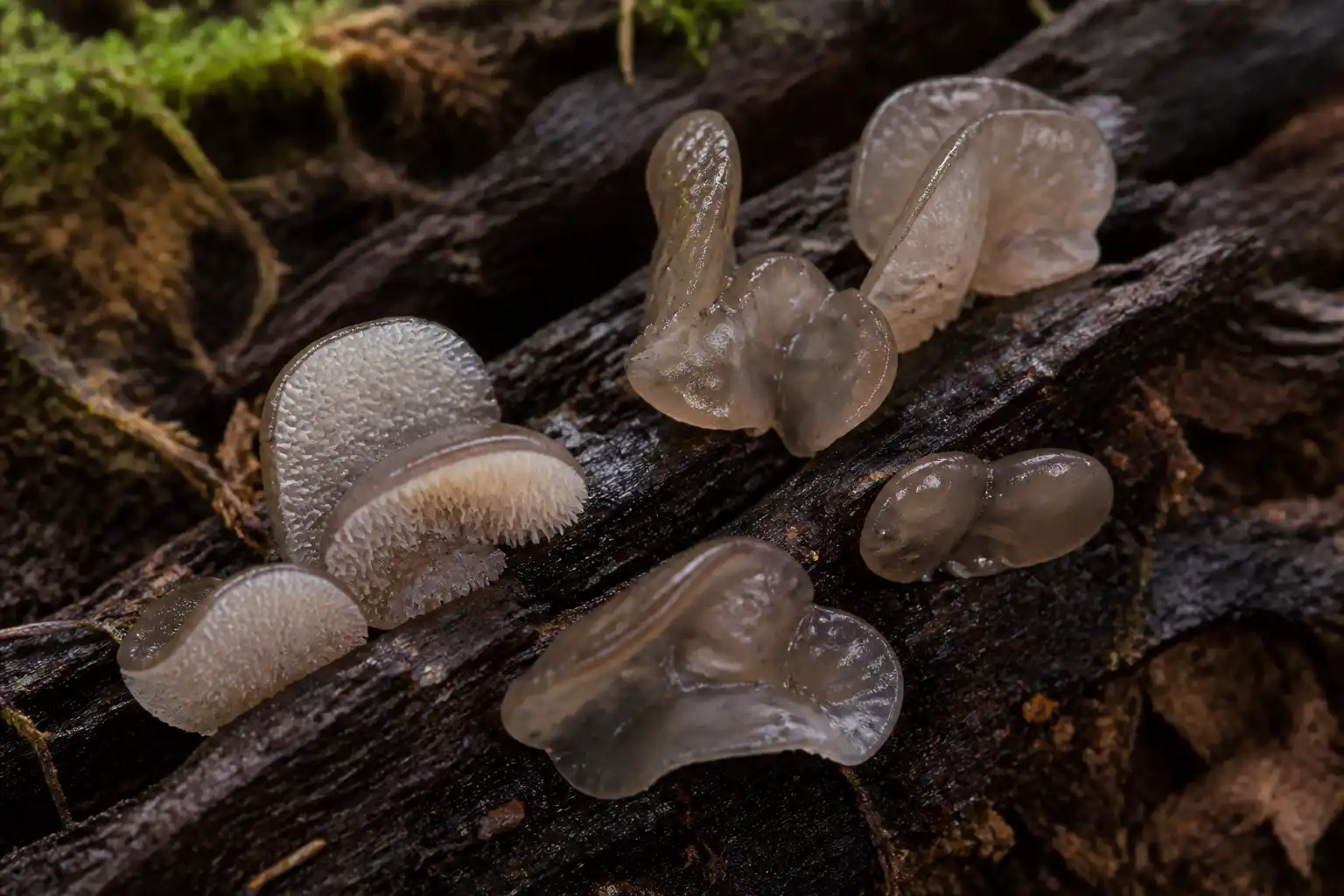
Jelly Tooth Fungus: Gelatinous Texture, Teeth, and Conifer Wood
Document jelly tooth fungus by its translucent lobes, toothed underside and decayed conifer substrate, with lookalikes, microscopy limits, and safety.
identification
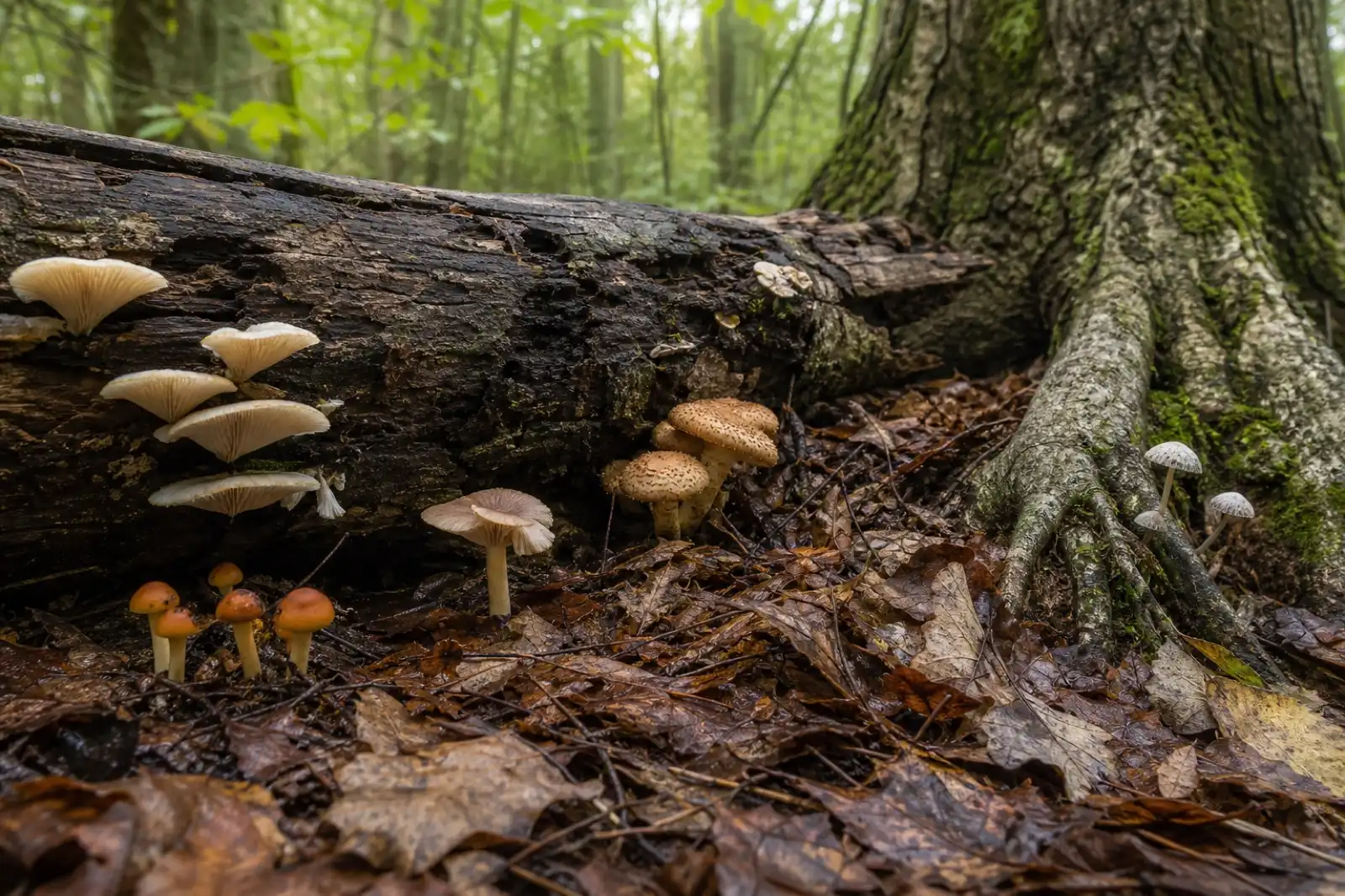
Using Habitat to Identify Mushrooms
Record substrate, associated plants, soil, wood type, moisture, elevation, and fruiting pattern as identification evidence.
Continue exploring
Browse more practical guides in Mushroom Encyclopedia or visit the mushroom encyclopedia.