Mushroom Encyclopedia
Violet Webcap: Cortinarius violaceus Field Guide
Document violet webcap by its dry velvety purple cap, bulbous violet stem, cortina, rusty spores, woodland partners, lookalikes, and evidence limits.
By MushroomScope Editorial Team · · Updated
Species context
Treat profiles as reference material
Species profiles summarize documented traits, taxonomy, and lookalikes, but natural variation can be substantial.
Use the safety checklist →Decision limit
A profile cannot authenticate a specimen
Do not eat a wild mushroom from an online match, single feature, or generated image.
Read the safety disclaimer →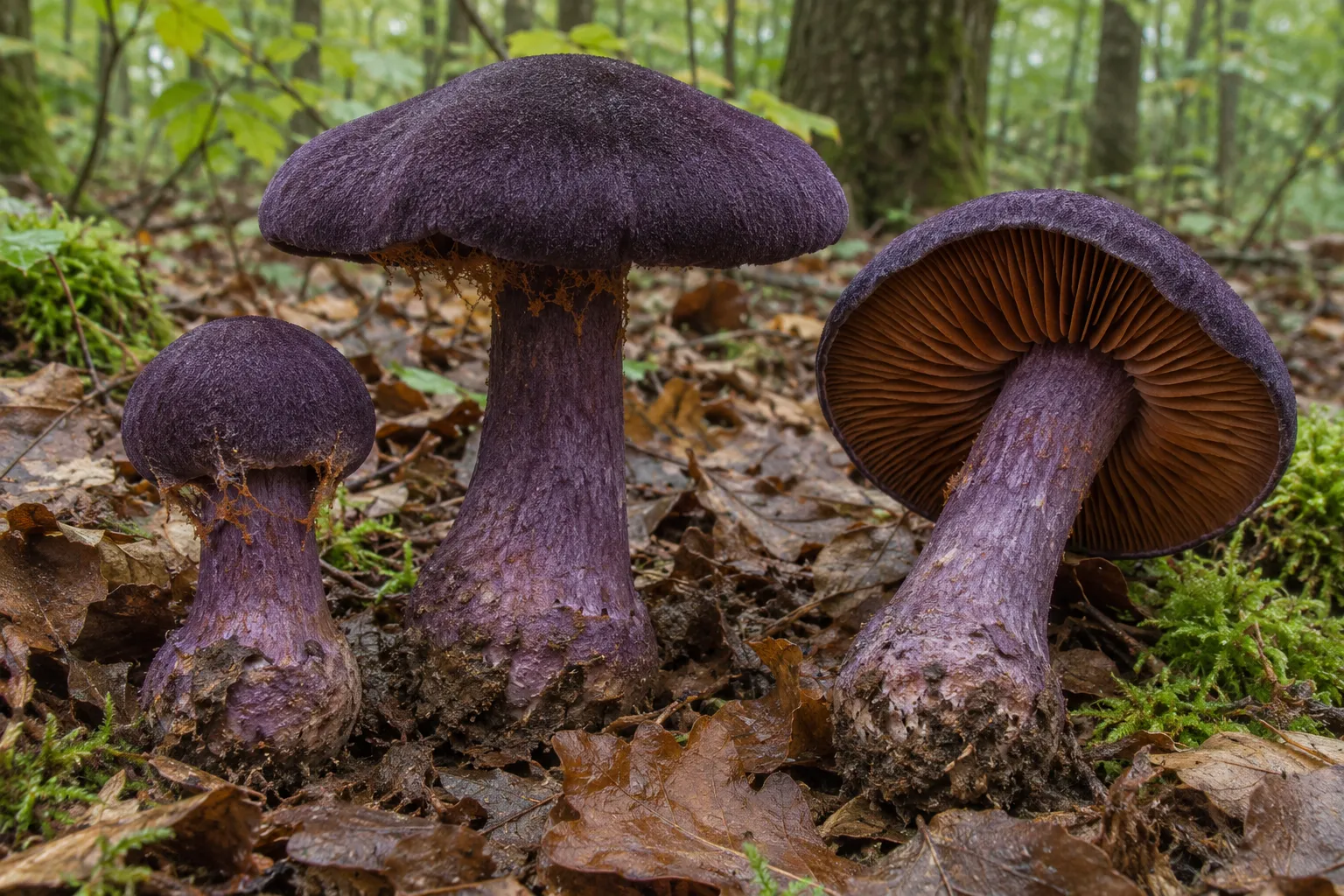
Quick facts
- Scientific name
- Cortinarius violaceus
- Common names
- Violet webcap, Violet cort
- Taxonomy
- Cortinarius · Cortinariaceae
- Edibility context
- Unknown: No food recommendation is made; the genus contains dangerous species and a webpage cannot authenticate a collection.
- Spore print
- Rusty brown.
- Toxicity context
- Unknown: Treat every uncertain Cortinarius collection as inedible and seek poison or medical guidance promptly after suspected ingestion.
- Season
- August, September, October, November
- Growing difficulty
- Not Cultivated
- Regions
- Europe, North America, temperate Northern Hemisphere records requiring regional interpretation
Safety limit: These labels summarize documented context; they never authenticate a wild specimen. Cooking does not make a poisonous species safe.
Violet webcap is memorable, but “the very purple mushroom” is not an identification. Cortinarius violaceus is supported by a dry finely velvety cap, violet flesh, a stout swollen stem, a cobwebby partial veil in youth, rusty-brown spores at maturity, and a specimen-linked woodland record. Each feature changes with development, so a defensible record must connect young and mature fruit bodies from one colony.
This page addresses the species-level record. The spore-color guide explains how to make and interpret a deposit, while the wood blewit guide covers a common pale-spored purple lookalike. Neither a photograph nor this article confirms edibility.
Establish color under neutral light
Photograph the group with an unedited neutral reference and a millimeter scale. Record cap, gill, flesh, and stem colors separately. A cap may be near black-violet while damaged flesh is paler lilac and mature gills are rusty. Automatic white balance can turn violet blue, magenta, or brown, so preserve the original file and note the light source.
Do not diagnose the species by saturation. Measure cap width, stem length, and stem width at apex, midpoint, and base. The substantial build and swollen base matter more than a dramatic purple close-up. Photograph the complete base before cleaning; leaf litter can hide its outline or make several stems look fused.
Read the dry velvety cap surface
The cap should be dry, with fine radial fibers or a suede-like texture visible under raking light. Make one image perpendicular to the surface and another at a low angle. Rain can add droplets without making the underlying surface viscid. Allow an untouched cap to drain under shelter and note whether the sheen disappears.
Compare this texture with the slimy, often pale-scaled surface in the blue roundhead guide. A wet blue-green roundhead can look violet after camera processing, but surface structure, veil remnants, and spore color describe a different organism. Never wipe a cap before its first texture record.
Follow the cortina before it disappears
Search for an unopened or partly expanded fruit body. A cortina is a web of fine fibers stretching from the cap margin to the stem, not a solid membrane. Photograph it from several angles before handling. As the cap expands, fibers collapse onto the upper stem and catch rusty spores, sometimes leaving only a narrow fibrillose zone.
Label each image by developmental stage. A mature stem without an obvious web does not prove that no cortina existed. Conversely, a few stray plant fibers are not veil evidence. Trace fibers to the cap margin, confirm that they share the specimen, and look for the same transition across neighboring ages.
Pair gill maturation with a deposit
Young gills can be strongly violet. They become cinnamon to rusty brown as ornamented spores accumulate, while protected edges may retain violet longer. Photograph the same cap before and after expansion when possible. Record attachment with a radial section rather than relying on a low-angle view.
Take a deposit from a mature, specimen-coded cap across pale and dark nonabsorbent surfaces. Rusty brown supports Cortinarius but does not establish the species. A weak deposit can look gray or purple against the wrong background; report duration, humidity, and whether the cap was mature instead of forcing a color.
Section the stout stem and swollen base
Make a single longitudinal section through cap, stem, and base. Record whether violet coloration continues through the flesh, whether insect channels or waterlogging have altered it, and whether the base is clavate or abruptly bulbous. Do not infer a volva from adhering pale mycelium or compressed litter.
Keep one half for a dried voucher where collection is lawful. A section also exposes whether two adjacent caps share a base, prevents the cap-only bias common in photographs, and makes later microscopic results traceable to the documented fruit body.
Map the living-tree context
Write “fruiting from soil through beech litter” or “from mossy soil beneath spruce,” not simply “on leaves.” Map every plausible ectomycorrhizal tree within the local root zone, record trunk distance and canopy position, and separate living roots from nearby dead wood. The nearest tree is a hypothesis, not proven host evidence.
Regional work has shown that the name and its close lineages need geographic care. Hardwood-associated and conifer-associated records should not be collapsed because their photographs look alike. Preserve coordinates at an appropriate privacy level, elevation, forest type, and a voucher so a later regional treatment can reinterpret the observation.
Use microscopy with explicit provenance
Prepare spores from a deposit or mature gill and state which source was used. Report mounting medium, calibration, number measured, full length and width ranges, and ornament visibility. Measurements copied from a key belong to the reference, not to the collection.
Large specialized cells and spore characters may support placement, but microscopy must be interpreted with a current regional key. If the specimen is old, contaminated, or produces too few spores, retain a genus-level label. DNA can test a difficult record only when the sequence is tied to a voucher and compared with curated reference material.
Separate three purple lookalike pathways
Wood blewits can be lilac, especially when young, but lack a cortina and normally yield a pale pinkish-buff deposit. Their cap is smoother and the whole fruit body often fades toward tan. Deposit color must come from the collected cap; brown litter dust on gills is not a rusty spore print.
Blue roundheads may carry violet-blue or green-blue caps, a ring zone, and darkening gills. Their cap is normally slimy rather than dry-velvety, and pale veil fragments can remain on the margin. Dark purple Entoloma species follow another route: pink spores, different veil evidence, and angular spores under microscopy.
Other violet webcaps are the hardest comparison because they share rusty spores and a cortina. Record cap viscosity, odor without tasting, veil color, flesh changes, spore ornament, host zone, and region. When those data do not resolve the group, “violet Cortinarius” is a stronger record than a species name chosen from color.
Build a repeatable colony record
Lay a fixed transect through the fruiting area without disturbing it. Mark cap positions, developmental stage, distance to candidate trees, litter depth, and moisture. Revisit after rain using the same search width. A flush count is not a count of underground individuals, and absence in one visit does not demonstrate biological disappearance.
Link each photograph, section, deposit, and microscope slide to one specimen code. This prevents the young cortina from one mushroom, the mature deposit from another, and a habitat photograph from a third site being assembled into an apparently complete but false record.
Keep toxicity decisions conservative
No purple color, field photograph, app result, or webpage clears a wild Cortinarius for food. The genus contains species associated with serious delayed poisoning, and delayed symptoms make casual experimentation especially unsafe. Do not taste an unknown webcap as a field test.
After suspected ingestion, contact local poison or emergency services promptly rather than waiting for symptoms. Preserve uncooked material, trimmings, photographs, meal timing, and the estimated amount when safe. The task for a webpage is to preserve evidence, not to diagnose or direct treatment.
Audit a mixed purple collection specimen by specimen
Purple mushrooms are often gathered into one tray because color makes them seem related. Before any microscopy, assign a code to every complete fruit body and build a matrix for cap texture, gill attachment and age, veil evidence, stem proportions, base shape, flesh color, deposit, and exact collection point. Keep tissue packets and prints physically separated.
Sort only after the matrix is complete. A smooth lilac cap with pale spores may be a blewit even when it stood beside a dry dark-violet webcap; a small widely gilled specimen may follow a Laccaria route. Never transfer the best cortina, deposit, or bulbous base from one row to another. Mixed collections are a common way to manufacture an identification that no individual mushroom actually supports.
Photograph the sorted rows together with labels, then return to the site map. If two morphologies occupy different tree zones or fruiting arcs, record that pattern without claiming separate mycelia. The audit protects both toxicology evidence and occurrence data while leaving genuinely incomplete specimens unresolved.
Preserve a voucher that can survive taxonomic change
Where collection is lawful and justified, dry a representative promptly with its complete base, a small cap section, deposit slide, field label, and original images. The label should include coordinates at an appropriate privacy level, elevation, date, collector, candidate trees, substrate wording, key used, and every test actually performed. Do not add a DNA result unless the sequence can be traced to that voucher.
Names in a difficult genus can change as regional lineages are revised. A well-linked voucher can be reexamined; a saturated photograph labeled “violet mushroom” cannot. Preserve the original determination and later annotations rather than overwriting history, so future reviewers can see why the name changed.
Frequently asked questions in context
Does the purple flesh prove the species?
No. It is useful only with cap texture, veil history, mature spore color, measurements, ecology, microscopy, and the regional species set.
Can a mature mushroom lose every visible web?
Yes. Expansion and weather can leave only rusty fibrils on the upper stem. That is why a developmental series is more informative than one old cap.
Should an observer dig around tree roots to prove a host?
No. Record nearby trees and fruiting geometry without damaging roots. Direct host proof requires methods beyond proximity and should not be claimed from a field photograph.
References
- Index Fungorum. Cortinarius violaceus name record. Current-name and nomenclatural context.
- NCBI Taxonomy. Cortinarius violaceus. Taxon identifiers, lineage, and linked sequence context.
- Harrower et al. New species in Cortinarius section Cortinarius. Regional lineage, ecology, morphology, and phylogenetic boundaries.
- North American Mycological Association. Mushroom Poisoning Syndromes. Conservative poisoning-response context.
Editorial review: November 27, 2026. This article has editorial review only and no named mycologist or clinician review. Regional taxonomy, host evidence, microscopy, and poison-response contacts should be rechecked at every substantive update.
Source quality notes
MushroomScope cites sources that match the page scope, such as taxonomic databases, extension guidance, food-safety agencies, food-composition databases, and peer-reviewed or institutional health references. Sources support context and uncertainty; they do not turn an online page into specimen identification, medical advice, or a tested recipe record.
Frequently asked questions
What combination supports a violet webcap record?
Use the dry finely velvety violet cap, violet flesh and swollen stem, young cortina, rusty-brown mature spores, woodland context, calibrated microscopy, and a current regional key together.
Is every dark purple mushroom Cortinarius violaceus?
No. Blewits, purple roundheads, dark Entoloma species, and other violet webcaps can overlap in color. Gill maturation, veil structure, deposit color, cap texture, spores, and ecology separate the records.
Why must the youngest fruit body be documented?
The cobwebby cortina and violet gills are easiest to see before expansion. Older specimens may retain only rusty fibers and brown gills, erasing evidence that distinguishes a webcap from purple lookalikes.
Can a photograph confirm violet webcap?
No. Photographs can preserve visible characters but cannot establish the spore deposit, microscopic measurements, host relationship, regional lineage, or safe food identity.
Is violet webcap safe to eat?
This guide makes no food recommendation. Cortinarius includes dangerously toxic species, remote identification cannot exclude them, and a correct species name would not assess contamination or individual response.
Related guides
mushrooms
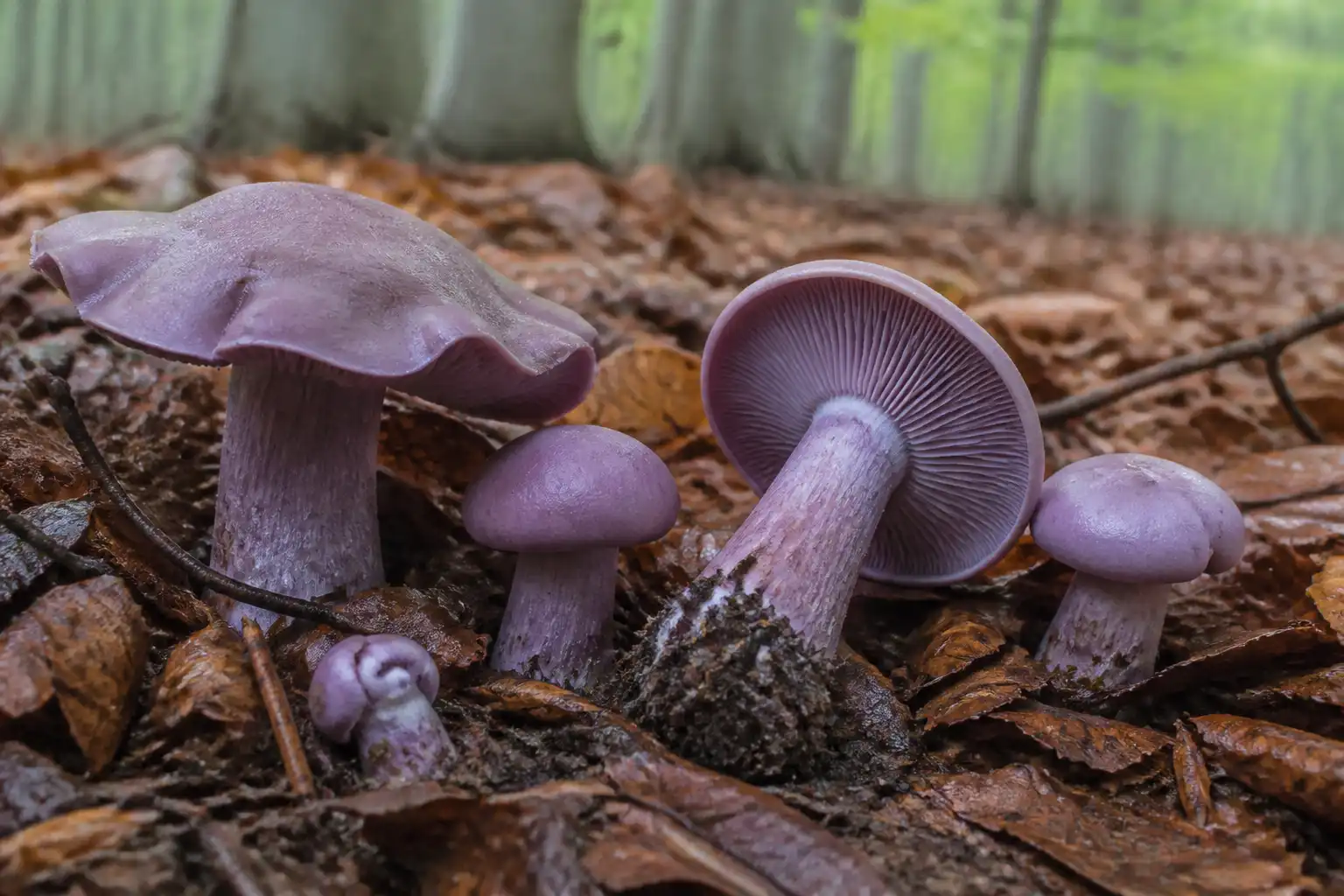
Blewit Mushrooms: Identification and Lookalike Separation
Identify blewits by violet gills, fibrous stems, pale spores, litter ecology, and careful separation from rusty-spored Cortinarius lookalikes.
mushrooms
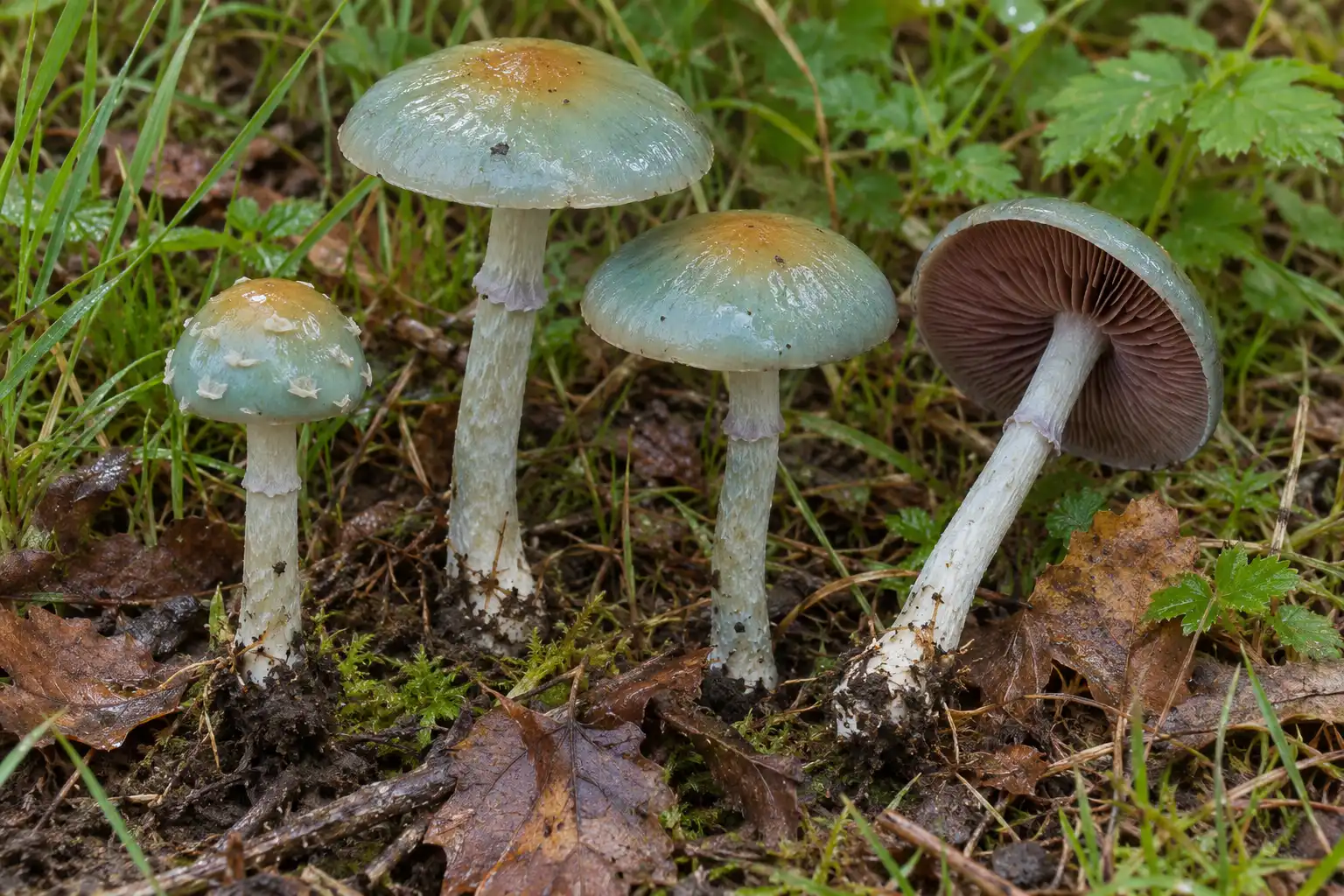
Blue Roundhead: Fading Caps, Dark Gills, and Veil Evidence
Document blue roundheads by fading blue-green caps, sparse veil remnants, brown-purple gills, dark spores, grassy litter habitat, and verdigris differences.
identification
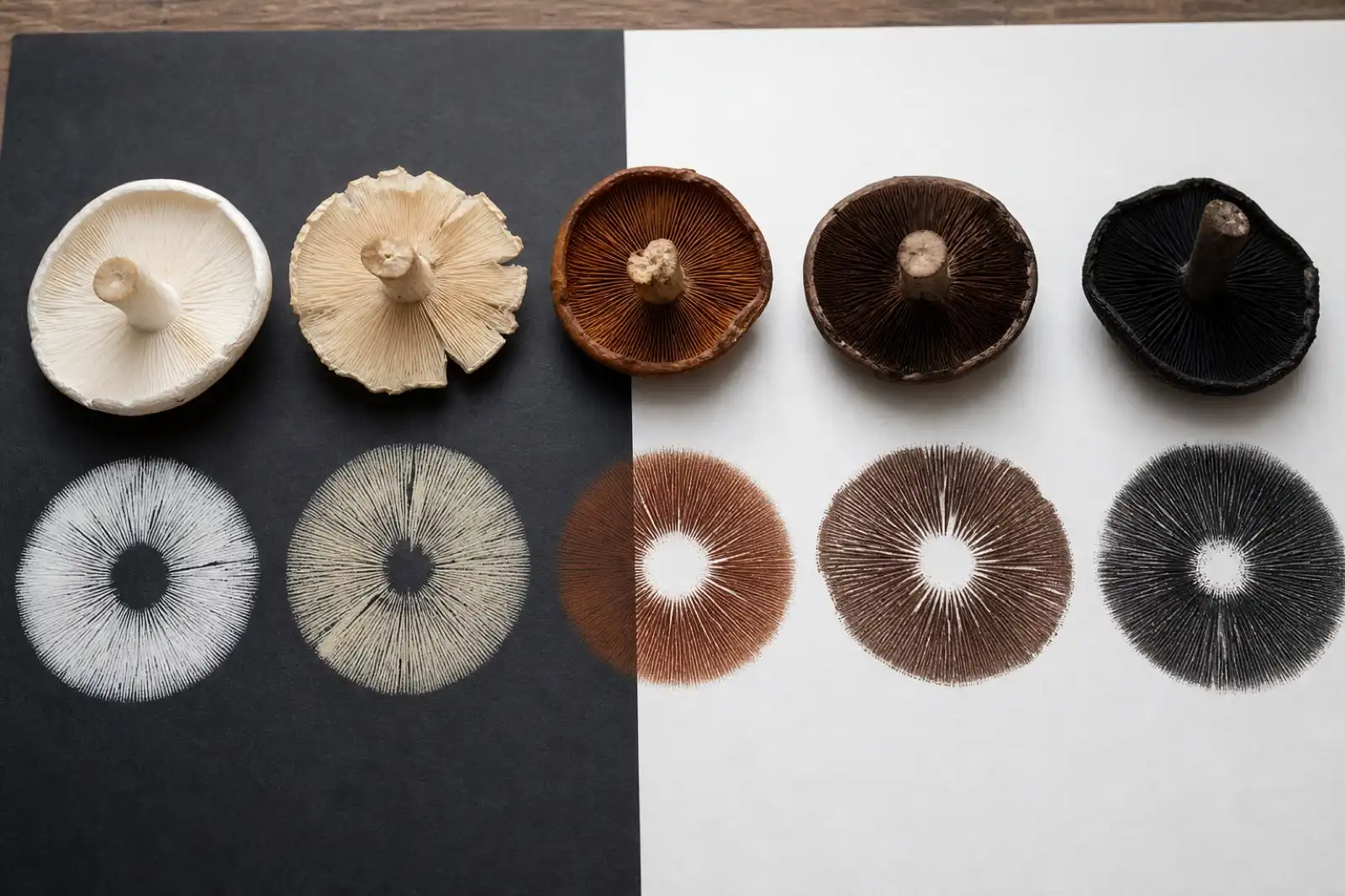
Mushroom Spore Print Colors and How to Record Them
Use a controlled spore deposit to distinguish broad color groups while recognizing that print color alone never identifies a species.
Continue exploring
Browse more practical guides in Mushroom Encyclopedia or visit the mushroom encyclopedia.