Mushroom Encyclopedia
Winter Polypore: Stalked Pores and Cold-Season Wood Ecology
Document Lentinus brumalis by its stalked tan cap, angular decurrent pores, cold-season hardwood habitat, measurements, lookalikes, and evidence limits.
Species context
Treat profiles as reference material
Species profiles summarize documented traits, taxonomy, and lookalikes, but natural variation can be substantial.
Use the safety checklist →Decision limit
A profile cannot authenticate a specimen
Do not eat a wild mushroom from an online match, single feature, or generated image.
Read the safety disclaimer →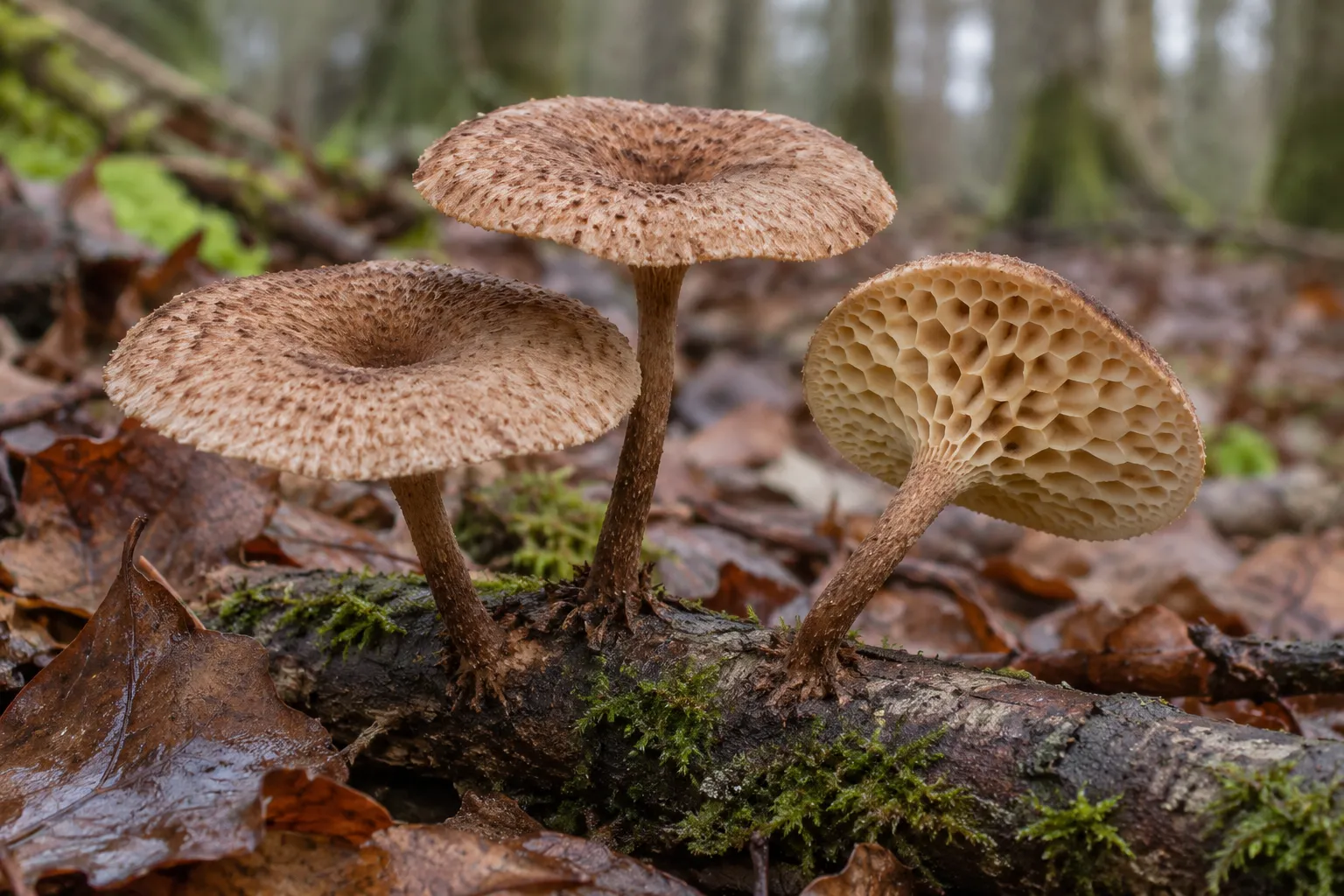
Quick facts
- Scientific name
- Lentinus brumalis
- Common names
- Winter polypore
- Taxonomy
- Lentinus · Polyporaceae
- Edibility context
- Inedible: Tough and nonculinary in this guide; no remote food clearance is provided.
- Spore print
- White; difficult to obtain and shared by many polypores.
- Toxicity context
- Unknown: No food recommendation is made, and an image cannot exclude other stalked wood fungi.
- Season
- October, November, December, January, February, March, April
- Growing difficulty
- Expert
- Regions
- Europe, Asia, North America with concept verification
- Recorded synonyms
- Polyporus brumalis
Safety limit: These labels summarize documented context; they never authenticate a wild specimen. Cooking does not make a poisonous species safe.
Winter polypore, Lentinus brumalis—often encountered in older literature as Polyporus brumalis—is a small stalked decomposer of dead broadleaved wood. Its round tan cap can resemble an ordinary cap-and-stem mushroom until the underside is examined: the fertile layer consists of angular pores, not gills. A defensible record joins that pore structure to cap measurements, stem texture, attachment, substrate, season, region, and a stated taxonomic reference.
The winter-polypore intent is narrower than a general bracket guide. The birch polypore guide covers a broad sessile annual bracket without a slender central stem, while the oak mazegill guide covers a thick bracket with deep labyrinthine tubes. Here the useful question is how to document a small stipitate polypore without mistaking radial-looking pore walls for gills.
Record the branch before the mushroom
Begin with an overview of the entire fallen branch, twig, or small log. Record diameter, length of the occupied section, ground contact, bark retention, end-grain condition, moisture, softness, orientation, and whether fruit bodies arise from exposed wood, bark fissures, or partly buried material. Include a site view showing woodland type and management.
Do not assign a host from loose leaves. Trace attached buds or twigs, inspect bark and wood anatomy, or retain “unknown broadleaf.” The fungus may fruit from a buried branch whose source tree is no longer obvious. Substrate identity is evidence only when it belongs to the occupied wood.
Map every fruit body along a measured section and number them. A cap portrait from one individual, an underside from another, and a stem base from a third cannot be silently combined into one idealized organism.
Measure the cap through development
Photograph young convex, expanding, and mature depressed caps in the same colony when available. Record diameter, depth of the central depression, margin curvature, surface dryness, scale density, and the radius of any color zones. Use a ruler in the cap plane and neutral light.
The cap may be tan, ochre, or brown with darker fibrils or fine scales. Weather can wash off ornament, darken wet tissue, or crack an old margin. Describe the measured specimen rather than importing a color from a field guide. A funnel silhouette is shared by unrelated gilled and poroid fungi.
Return after a documented interval if the site can be revisited without disturbance. Cap expansion and margin change provide stronger developmental evidence than arranging detached specimens by size.
Demonstrate enclosed angular pores
Turn the camera parallel to the underside and include a millimeter scale. Winter polypore has a tube layer divided into angular openings that may be stretched radially near the stem. Trace several complete pore walls in a magnified image. Enclosed cells distinguish pores from continuous blade-like gills.
Count pores across measured lines near the cap edge, mid-radius, and stem. Record the full range, zones obscured by damage, and whether openings run down the stem. Do not quote a density measured only in the neatest area. The pore-surface guide explains how camera angle and broken walls can create false gills or teeth.
The editorial cover exaggerates pore size for legibility and therefore cannot supply measurements. Real records require a scale and specimen-linked macro photograph.
Document the stem from cap to wood
Measure stem length and diameter at top, middle, and base. Record central versus eccentric attachment, color gradient, hairs or velvety texture, bending, and whether the base is fused to bark, emerging through a crack, or attached to exposed wood. Photograph the intact base before lifting any loose bark.
Several stalked polypores develop darker lower stems. “Dark foot” is not a binary character: record the boundary, texture, and proportion involved. Soil splash, wet bark, and shadow can imitate pigmentation. A clean section can show whether the color is superficial or internal.
If multiple fruit bodies share a point, document whether stems remain discrete. Crowding can distort caps and move a nominally central stem off-center.
Cut one vertical section
When collection is legal and sufficiently abundant, cut one numbered specimen from cap center through stem and attachment. Photograph the fresh section with scale. Measure cap flesh, tube depth, pore-wall thickness, stem core, surface layer, and any color transition at the base.
The section confirms that the underside belongs to a tube layer and helps separate fused debris from anatomy. Preserve part of the cap, pore layer, stem, and attached wood together. A cap alone discards the characters that distinguish many small wood fungi.
Dry the voucher promptly with airflow. Record drying temperature and later shrinkage. Measurements taken after drying should be labeled as such rather than mixed with fresh dimensions.
Separate spring polypore with matched measurements
The spring polypore concept, often called Lentinus arcularius or Polyporus arcularius, overlaps in a stalked cap and angular pores. It is commonly described with conspicuous large polygonal openings and a ciliate or fringed margin. Season can overlap, so a date cannot decide the record.
Compare cap diameter, pore range at three radii, margin hairs, stem proportions, substrate, local phenology, and microscopy using a current regional key. Preserve photographs showing the same specimen’s margin and pores. If characters cross published boundaries, retain a broader identification and state which evidence is missing.
Names in this group have moved among genera. Database disagreement is not solved by choosing the newest-looking webpage; cite the authority and access date behind the name used.
Exclude gilled wood fungi at the wall level
A radial view can make elongated pore walls resemble gills. Rotate the specimen under magnification. Pores form repeated enclosed chambers with cross-walls; gills form blades that remain open between them. Broken pore walls can create short tooth-like remnants, so inspect a protected fresh zone.
Do not use a white spore deposit as the deciding character. Many polypores and gilled wood fungi produce pale deposits. Report whether a deposit was obtained, how it was collected, and which microscopic features were measured.
If the underside genuinely has continuous gills, leave this page and use a gilled-wood comparison rather than forcing the specimen into the expected seasonal name.
Treat the cold-season name as context
“Winter” describes a frequent phenology, not a guarantee. Mild coastal climates, elevation, snow cover, rainfall, and the persistence of old caps alter observation dates. Record whether tissue is pliable and actively margined or dry, faded, and insect worn.
Build a local fruiting timeline from repeated visits to the same mapped branch. Record new emergence, cap expansion, spore release attempts, frost exposure, damage, and loss. The series documents one site; it does not define a universal fruiting temperature.
Avoid moving wood or watering fruit bodies to extend the sequence. Those interventions change the microhabitat and weaken ecological interpretation.
Keep taxonomy attached to evidence
Preserve Polyporus brumalis as a searchable synonym while stating that this page uses Lentinus brumalis. Database records may reflect different publication dates, regional concepts, or unresolved sequences. Occurrence dots need voucher review before they become a confident range claim.
For microscopy, document mount medium, calibration, magnification, number of structures measured, full ranges, shape, wall characters, and which numbered specimen was used. If sequencing is justified, record clean inner tissue, controls, read quality, reference coverage, and the taxonomic concept assigned by the reference.
A sequence label without a voucher and field record cannot repair a mixed or contaminated collection.
Interpret decomposition conservatively
Winter polypore is a saprotroph of dead broadleaved material. Its presence on a fallen branch records decomposition, not the health of every nearby tree. A fruit body on a dead attached twig does not measure trunk stability, and a small colony does not prove decay is trivial.
Record the exact living/dead boundary. For woody structures near people or property, use qualified local assessment rather than a species page. The question “what fungus is this?” is separate from “what is the probability and consequence of failure?”
Keep food and cultivation claims bounded
This guide treats the tough fruit body as nonculinary. A species hypothesis does not clear roadside wood, treated lumber, polluted sites, mixed collections, spoilage, or individual reaction. Do not infer edibility from the cap-and-stem form or from another member of a broad genus.
No household cultivation parameters are asserted. Research culture work requires authenticated material, sterile controls, and a defined objective. Fruiting on a branch indoors after collection would not establish a safe food strain.
If an unknown mushroom was swallowed, preserve material and photographs and contact local poison-control, veterinary, or medical services promptly. A web page cannot confirm edibility or replace exposure advice.
Audit the editorial image and its limits
The selected cover is an original 1536 × 1024 RGB AI editorial image with a unique hash. An initial generation was rejected because it produced gills. The replacement was compared side by side with Smoky Bracket and Hairy Bracket covers for diffuse natural light, restrained palette, realistic branch and leaf textures, complete attachment, clean crop, and lack of text, watermark, logo, collage seams, stretching, or banding.
The replacement correctly communicates enclosed pores rather than gills, but the openings are intentionally oversized and honeycomb-like. Exact pore density, cap ornament, stem texture, substrate, and species remain illustrative. The image is not identification evidence.
Build an auditable winter-polypore record
- Photograph the whole branch and conservatively identify the host.
- Number each fruit body and keep surfaces linked.
- Measure cap, depression, margin, stem, and attachment.
- Photograph enclosed angular pores square-on with scale.
- Cut one specimen-linked vertical section where lawful.
- Compare spring polypore and genuinely gilled wood fungi.
- Record phenology without treating a winter date as proof.
- Cite the taxonomic concept and preserve a voucher.
References
- NCBI Taxonomy Browser: Lentinus brumalis — taxonomy and sequence-linked context.
- GBIF species search: Lentinus brumalis — occurrence and voucher leads requiring record-level verification.
- Species Fungorum search — nomenclatural lookup for current and historical combinations.
- NAMA mushroom poisoning syndromes — conservative response context for uncertain mushroom exposures.
Editorial status: reviewed by the MushroomScope editorial team on November 22, 2026; no named mycologist, toxicologist, clinician, or food-safety expert reviewed this page.
Source quality notes
MushroomScope cites sources that match the page scope, such as taxonomic databases, extension guidance, food-safety agencies, food-composition databases, and peer-reviewed or institutional health references. Sources support context and uncertainty; they do not turn an online page into specimen identification, medical advice, or a tested recipe record.
Frequently asked questions
Why is Lentinus brumalis called winter polypore?
It often fruits in cool seasons and can persist into winter, but season varies by region and weather. A cold date is supporting context, not identification.
Does winter polypore have gills?
No. The underside has angular pores whose walls can look radial near the stem. A square-on macro view should reveal enclosed openings rather than continuous blades.
Why do some sources call it Polyporus brumalis?
Polyporus brumalis is a widely encountered historical combination. Current databases may place the species in Lentinus, so a record should preserve both names and state the taxonomy used.
Which wood does winter polypore use?
It fruits on dead broadleaved twigs, branches, and small logs. Host identity and wood condition should be documented rather than assumed from nearby vegetation.
Is winter polypore edible?
It is generally treated as tough and nonculinary. This guide does not authorize eating an unknown stalked fungus.
Related guides
mushrooms
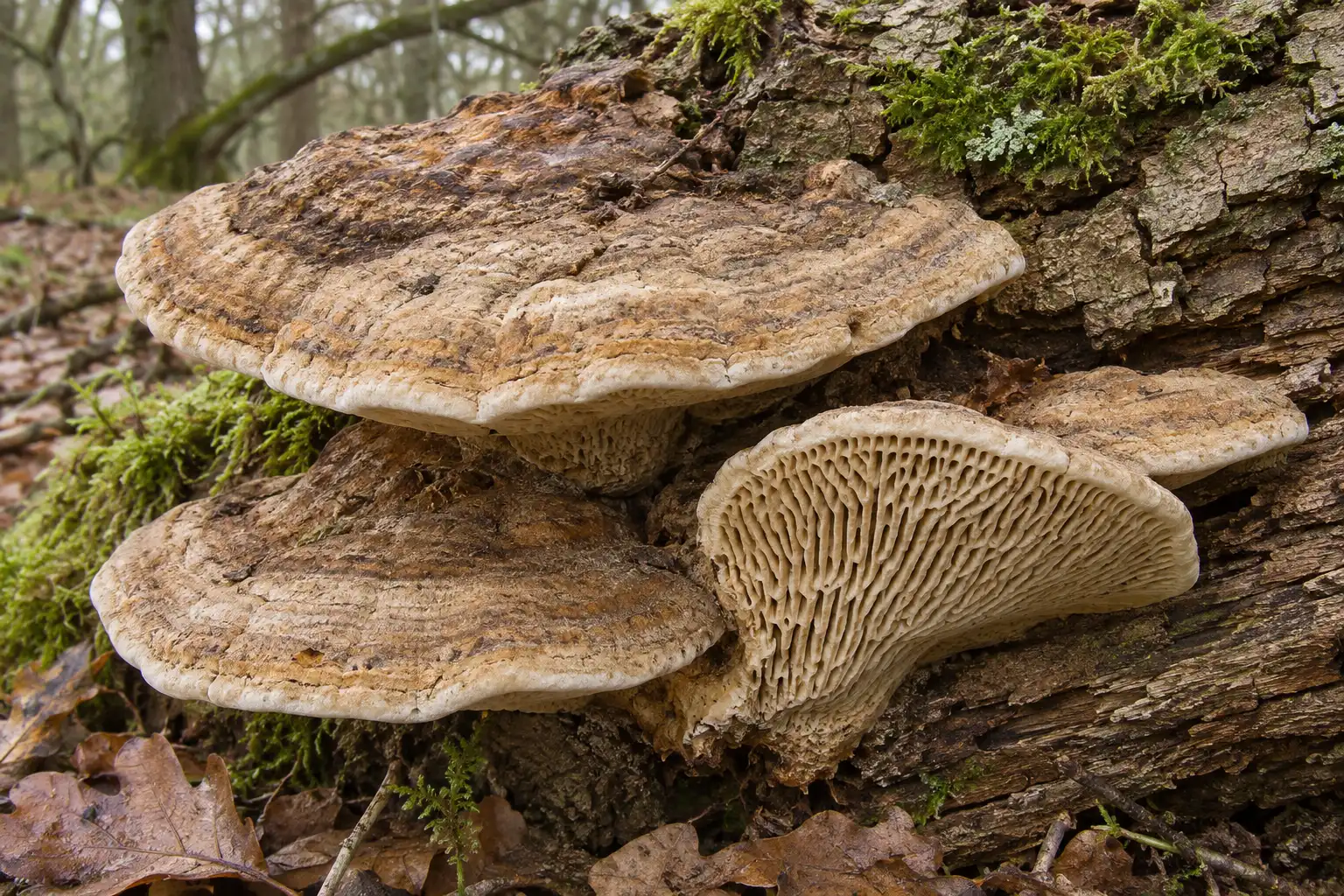
Oak Mazegill: Maze Pores, Corky Brackets, and Oak Decay
Document oak mazegill by thick corky brackets, maze-like pores, oak attachment, brown-rot context, persistent growth, lookalikes, and safe field records.
mushrooms
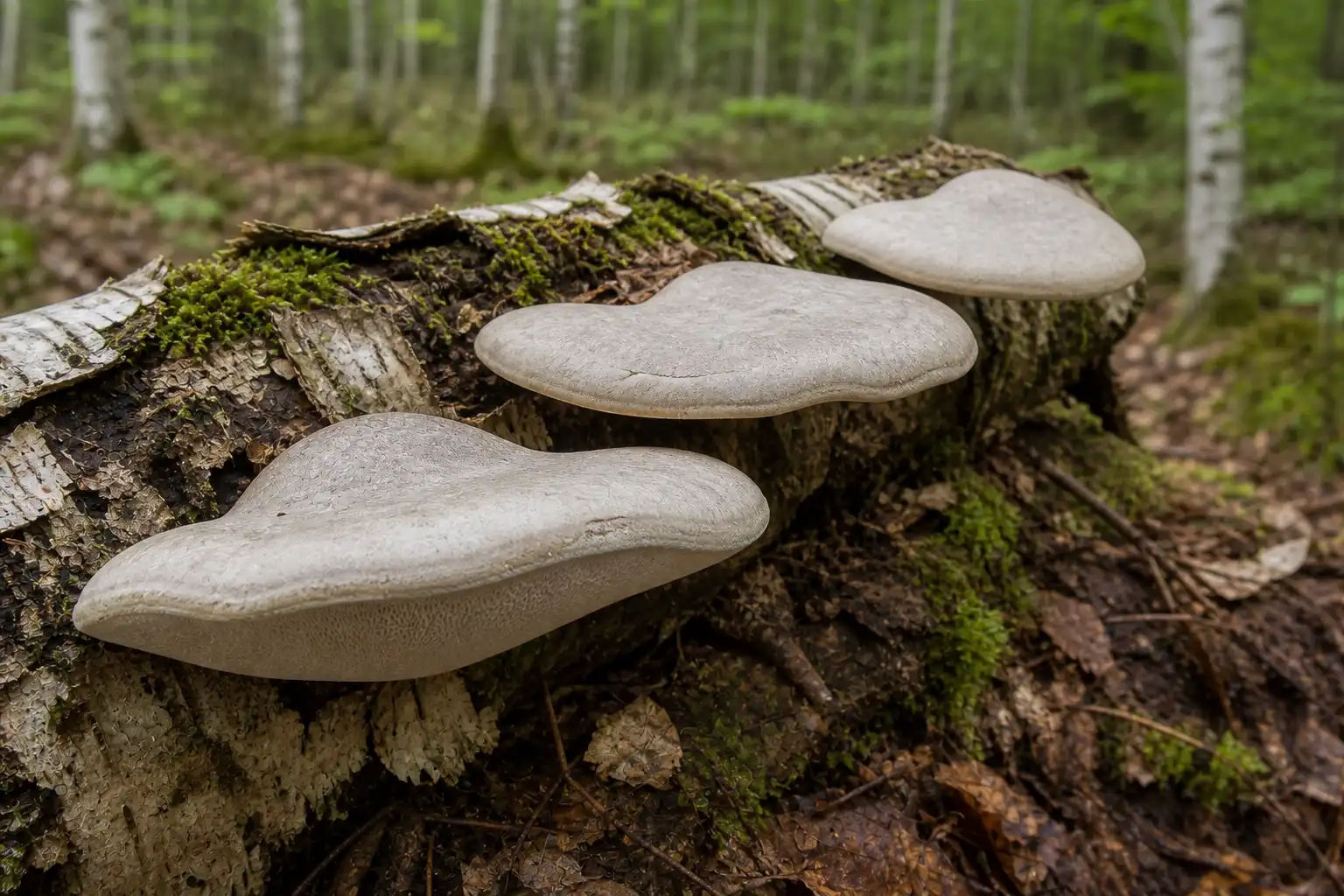
Birch Polypore: Fomitopsis betulina Host and Decay Guide
Identify birch polypore through verified birch hosts, annual bracket development, fine white pores, brown rot, and perennial lookalike separation.
identification
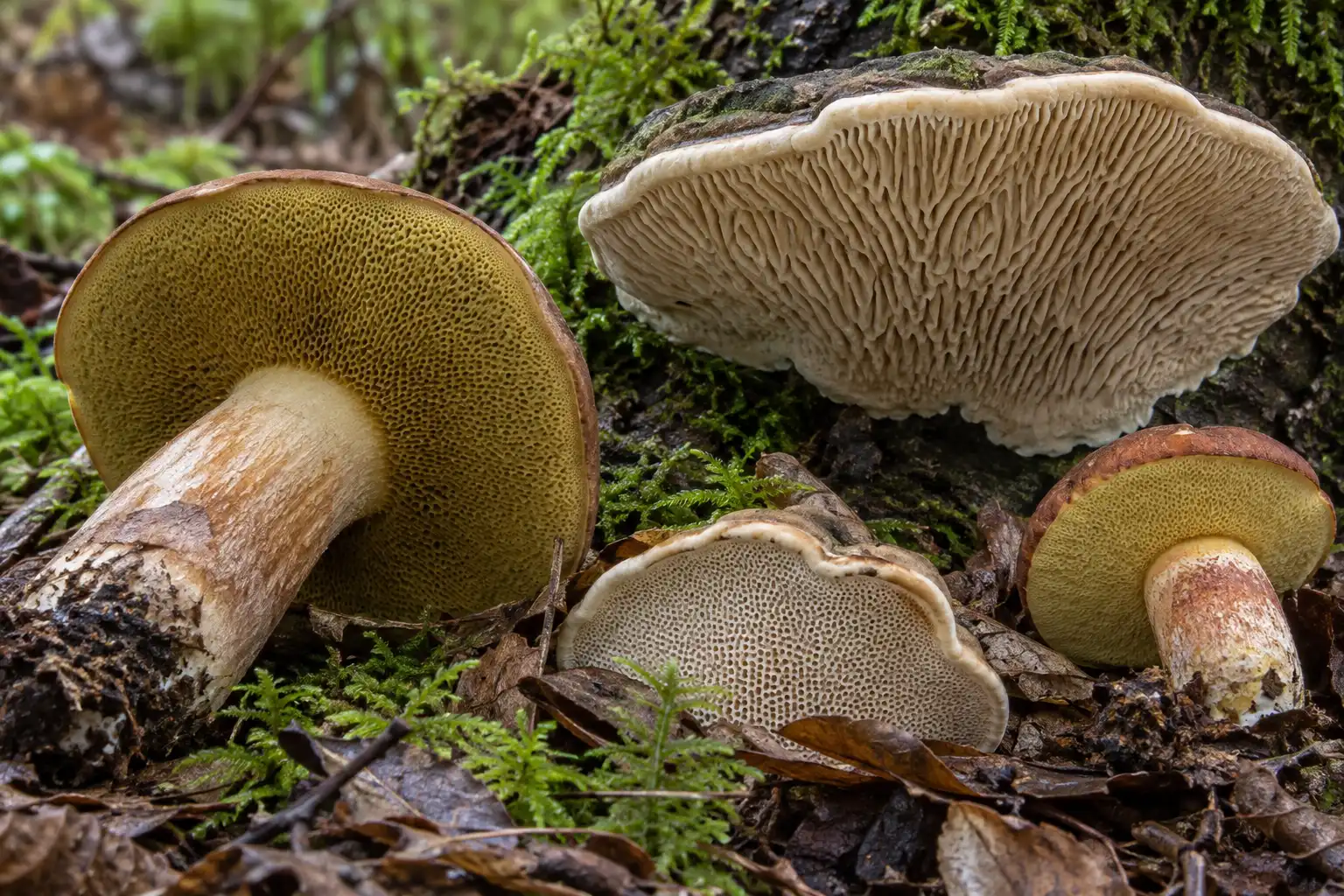
Mushroom Pore Surfaces: A Field Guide to Boletes and Polypores
Learn to document mushroom pore size, shape, attachment, bruising, tube layers, substrate, and context without treating pores as proof of identity or edibility.
Continue exploring
Browse more practical guides in Mushroom Encyclopedia or visit the mushroom encyclopedia.