Mushroom Encyclopedia
Oak Mazegill: Maze Pores, Corky Brackets, and Oak Decay
Document oak mazegill by thick corky brackets, maze-like pores, oak attachment, brown-rot context, persistent growth, lookalikes, and safe field records.
Species context
Treat profiles as reference material
Species profiles summarize documented traits, taxonomy, and lookalikes, but natural variation can be substantial.
Use the safety checklist →Decision limit
A profile cannot authenticate a specimen
Do not eat a wild mushroom from an online match, single feature, or generated image.
Read the safety disclaimer →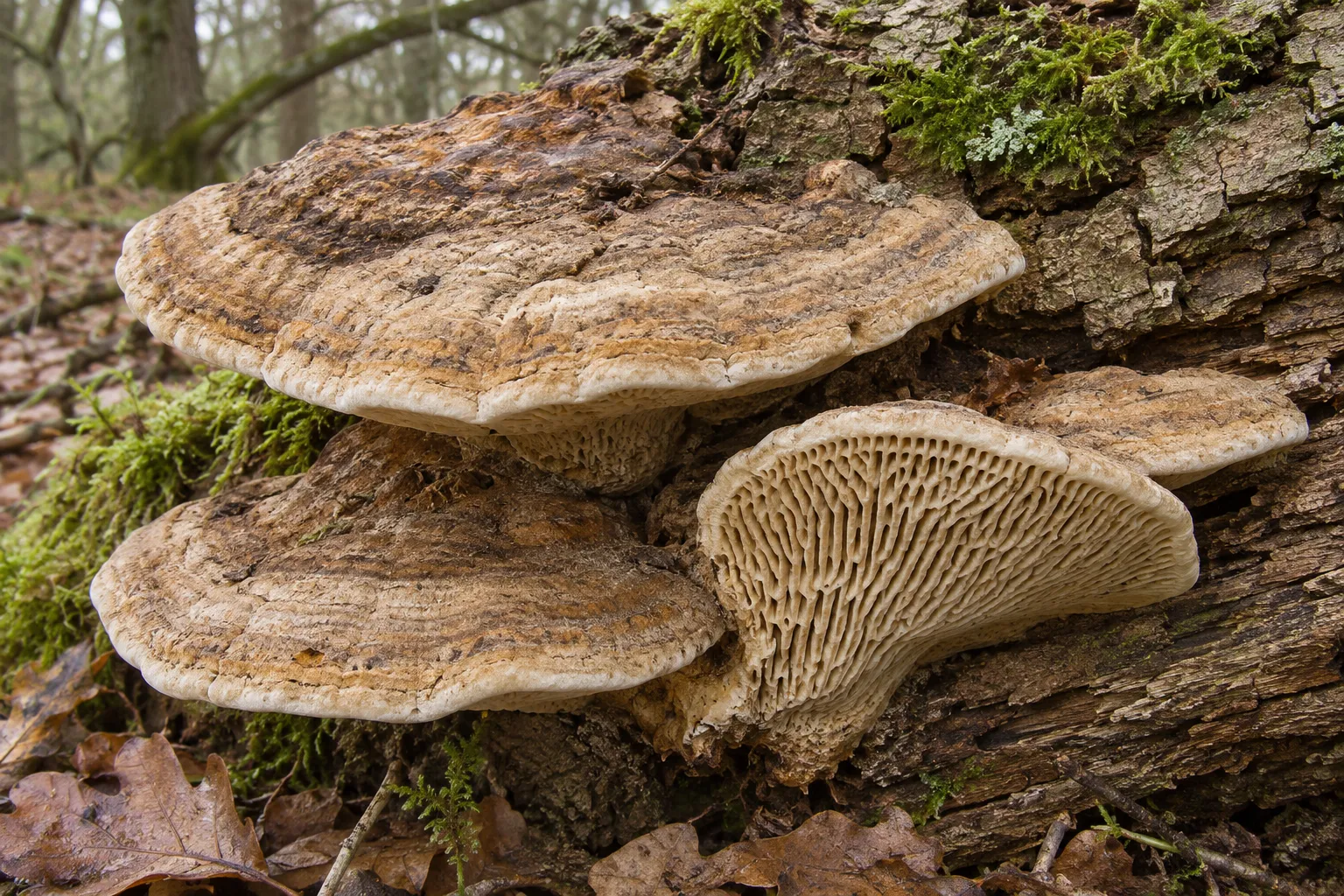
Quick facts
- Scientific name
- Daedalea quercina
- Common names
- Oak mazegill, Maze-gill fungus
- Taxonomy
- Daedalea · Fomitopsidaceae
- Edibility context
- Inedible: The fruit body is woody and unsuitable for food; no remote identification supports ingestion.
- Spore print
- White; a field deposit is often difficult to obtain from a persistent bracket, so microscopy and tissue anatomy may be needed.
- Toxicity context
- None Known: Physical toughness and identification uncertainty, rather than a food use, define the safety boundary.
- Season
- January, February, March, April, May, June, July, August, September, October, November, December
- Growing difficulty
- Expert
- Regions
- Europe, North America, temperate regions with verified oak-associated records
Safety limit: These labels summarize documented context; they never authenticate a wild specimen. Cooking does not make a poisonous species safe.
The oak mazegill, Daedalea quercina, turns a familiar bracket shape into a diagnostic underside: thick-walled pores stretch, fork, and reconnect like a maze. The common name can mislead beginners into calling those ridges gills, but their construction, the corky cross-section, and the oak substrate place the fungus among polypores.
This guide separates pore architecture, host evidence, fruit-body age, and decay interpretation. It does not use a bracket photograph to certify tree safety. A fruit body reveals established fungal activity, while structural risk depends on tree condition, defect location, retained wood, loading, and professional inspection.
Confirm the wood before naming the fungus
Photograph the bracket in place, then document bark, end grain, leaves, buds, attached twigs, and surrounding trees. Oak is the strongest ecological clue, but a log beneath an oak canopy may belong to another hardwood. If the wood cannot be confirmed, record it as unknown rather than allowing the common name to supply the host.
The Swedish study of oak mazegill describes fruit bodies on oak logs, stumps, snags, fallen branches, and dead branches of living trees. Record whether the substrate is standing or fallen, living or dead, intact or hollow, and whether the bracket emerges from exposed heartwood, bark, or an old wound.
Map the cap from pale margin to weathered center
Fresh growth is generally palest near the outer margin. Older cap zones become tan, gray-brown, cracked, algae-stained, or mossy. Photograph concentric zones under diffuse light and measure thickness at the margin, middle, and attachment. A ruler held parallel to the cap avoids perspective exaggeration.
Do not scrape away weathering merely to make the specimen resemble a field guide. Surface colonizers and damage help establish persistence. Note whether several brackets overlap, fuse, or remain separate and whether their growth margins are active at the same time.
Photograph the maze pores square-on
The fertile surface is cream to ochre and composed of elongated openings separated by thick ridges. Openings branch and rejoin, producing the daedaloid pattern behind the genus name. Photograph directly below with a scale, then take an oblique frame that shows pore depth and the transition into the cap margin.
The pore-surface guide distinguishes round, angular, elongated, maze-like, and tooth-form surfaces. Weathering can split walls and make old pores look toothed. Use a fresh zone and an old zone from the same bracket to avoid treating age damage as a different hymenium type.
A small tan cap carried on a distinct slender stem belongs to a different comparison. The winter polypore guide documents angular pores that descend toward a stem on thin fallen hardwood, not the massive sessile oak construction described here.
Cut a legal damaged edge to read the context
Where collection is permitted, examine an already damaged margin or a minimal section. The interior is thick, pale buff, and corky to woody, without the layered tubes and soft flesh of many annual brackets. Record cap tissue and pore layer separately, with their thicknesses and any dark boundary lines.
A hand lens can show whether apparent gills are walls between tubes. Do not remove a large persistent fruit body solely for confirmation. A small labeled fragment and high-resolution in-place photographs preserve more ecological value and stronger provenance.
Distinguish persistence from a precise age claim
Oak mazegill brackets can persist across seasons and may add new tissue, but size alone cannot provide a birthday. Mark fresh pale margins, weathered cap zones, algal cover, insect galleries, and layered pore tissue. Rephotograph a known bracket from fixed points rather than guessing age from one encounter.
Winter and dry-season brackets may be inactive yet recognizable. Record whether the pore surface looks freshly pale or uniformly weathered. “Found in November” describes observation date, not necessarily when the bracket first formed or last released spores.
Interpret oak brown rot without predicting failure
The USDA Forest Service identifies this species with brown heart rot of oaks. Brown-rot fungi preferentially remove cellulose and hemicellulose, leaving modified lignin and wood that can become brown, cubically cracked, and brittle. Photograph exposed decay only where it already exists; do not create wounds in a living tree.
A bracket indicates that colonization is not superficial, but it does not measure the remaining sound shell. For a living tree near a house, road, trail, or play area, use a qualified arborist. Species identification, decay extent, and hazard assessment are related but separate questions.
Compare tinder fungus by pore geometry
Tinder fungus often forms a hoof-like gray bracket with fine round pores and multiple hard growth zones. It occurs on several hardwoods, especially birch and beech in many regions. Oak mazegill generally presents a broader, coarser maze underneath and a strong oak association.
The tinder fungus guide shows why cap silhouette alone is weak. Compare host, attachment width, pore geometry, context thickness, and growth zoning. An old oak mazegill with damaged pores may need a fresh margin or microscopy for confidence.
Separate artist’s conk with a controlled bruise
Artist’s conk has a white pore surface of extremely small round pores that marks brown when scratched, which is the basis of its common name. Its shelf is often flatter and broadly attached. Oak mazegill’s coarse elongated openings remain visible without drawing a line through the pore layer.
Use the artist’s conk guide to compare equal-scale underside photographs. A brown mark is not enough: many pore surfaces discolor after damage, while the uninjured pore architecture carries stronger information.
Exclude birch polypore through host and texture
Birch polypore is pale, rounded to hoof-like, and characteristically tied to birch. Its underside consists of fine round pores, and the fruit body is more simply shaped than an old zoned oak mazegill. The birch polypore guide keeps that host-specific intent distinct.
When bark has fallen, verify wood anatomy or label the host uncertain. A pale bracket on an unidentified log cannot inherit a species name from the nearest standing tree.
Record the bracket as insect habitat
Persistent fruit bodies are habitat as well as reproductive structures. The Swedish study sampled insects emerging from D. quercina across 25 oak-rich sites, illustrating that old brackets participate in a wider saproxylic community. Photograph exit holes, galleries, and associated organisms without assuming every insect caused the original decay.
Avoid breaking open occupied brackets for curiosity. If research sampling is authorized, label each fragment to site, tree, bracket position, date, and storage conditions. Otherwise, repeated non-destructive photography can document changes while leaving the microhabitat intact.
Treat distribution records as bounded evidence
GBIF accepts Daedalea quercina and supplies a global occurrence framework. Check record age, coordinate uncertainty, host notes, specimen basis, and current identification before using any map point. A record without substrate evidence is weaker for an oak specialist than a vouchered collection with host wood.
The University of Agder presents oak mazegill among fungi associated with hollow oak habitat. The USDA guide describes North American ecology. These sources support regional questions, not a claim that every maze-pored bracket worldwide belongs to one species.
Keep food and cultivation claims outside this field intent
The corky, woody bracket is not a food mushroom. This page makes no supplement or therapeutic claim from laboratory compounds and does not infer human benefit from traditional uses. Chemical isolation, clinical effect, dosage, and safety are separate evidence levels.
Deliberately inoculating living oaks with a heart-rot fungus would conflict with ordinary tree care. Laboratory culture or authorized decay research requires containment, authenticated material, and a defined research purpose; it is not a beginner home-growing project.
Build an auditable oak-mazegill record
- Establish the exact host from bark, wood, leaves, buds, or a qualified record.
- Photograph the bracket’s full attachment before handling it.
- Measure cap width, projection, and thickness at fixed points.
- Capture fresh and weathered cap zones under neutral light.
- Photograph maze pores square-on with a millimeter scale.
- Record pore depth and corky context at an existing damaged edge.
- Separate fungal identification from any tree-risk conclusion.
- Leave persistent brackets in place unless sampling is permitted and necessary.
The habitat identification guide offers a consistent substrate record when the host is uncertain.
Image and evidence limits
The 1536 × 1024 cover is an original AI editorial image. It was reviewed beside the site’s scarlet waxcap and purple brittlegill natural-light covers for the same restrained daylight, natural materials, depth of field, color, and texture standard. The lead passes for a complete oak attachment, corky thickness, diagnostic elongated maze pores, plausible weathering, clean crop, sharpness, and absence of text, watermark, logo, stretching, or obvious cloned anatomy. It is not a voucher photograph or proof of identity.
References
For thinner zoned brackets with radiating gill-like plates, the birch mazegill guide compares plate depth, cap hairs, birch confidence, and persistent-shelf condition rather than relying on “maze” alone.
- Global Biodiversity Information Facility. Daedalea quercina. Accepted-name and occurrence checkpoint.
- U.S. Forest Service. Mushrooms of the National Forests in Alaska. Maze-surface identification, oak brown-rot context, and food boundary.
- Jonsell, M. et al. Insect fauna in fruit bodies of Daedalea quercina. Oak specialization, fruit-body dimensions, persistence, and saproxylic habitat evidence.
- University of Agder Natural Museum and Botanical Garden. Hollow oak fungi. Oak-habitat specialization context.
Editorial review: November 4, 2026. No named mycologist, arborist, clinician, or toxicologist reviewed this page.
Source quality notes
MushroomScope cites sources that match the page scope, such as taxonomic databases, extension guidance, food-safety agencies, food-composition databases, and peer-reviewed or institutional health references. Sources support context and uncertainty; they do not turn an online page into specimen identification, medical advice, or a tested recipe record.
Frequently asked questions
Why is oak mazegill called a mazegill?
Its fertile underside develops thick-walled elongated pores that branch and join into a maze. They are pores, not true agaric gills, and should be photographed from directly below and in cross-section.
Does Daedalea quercina only grow on oak?
Oak is its defining and strongly preferred host, especially in European accounts, although verified records on other hardwoods exist. Confirm the actual wood rather than relying on nearby trees.
Is oak mazegill annual or perennial?
Its tough fruit bodies can persist and add tissue across more than one season. Record fresh pale margins, weathered zones, and pore-layer structure rather than assigning age from size alone.
Is oak mazegill edible?
No food use is recommended. The fruit body is exceptionally tough and corky, and a website cannot establish the identity or condition of a real bracket.
What decay does oak mazegill cause?
It is associated with brown rot of oak heartwood. A bracket indicates established wood colonization, but it does not by itself quantify remaining structural strength or predict when a tree or branch will fail.
Related guides
identification
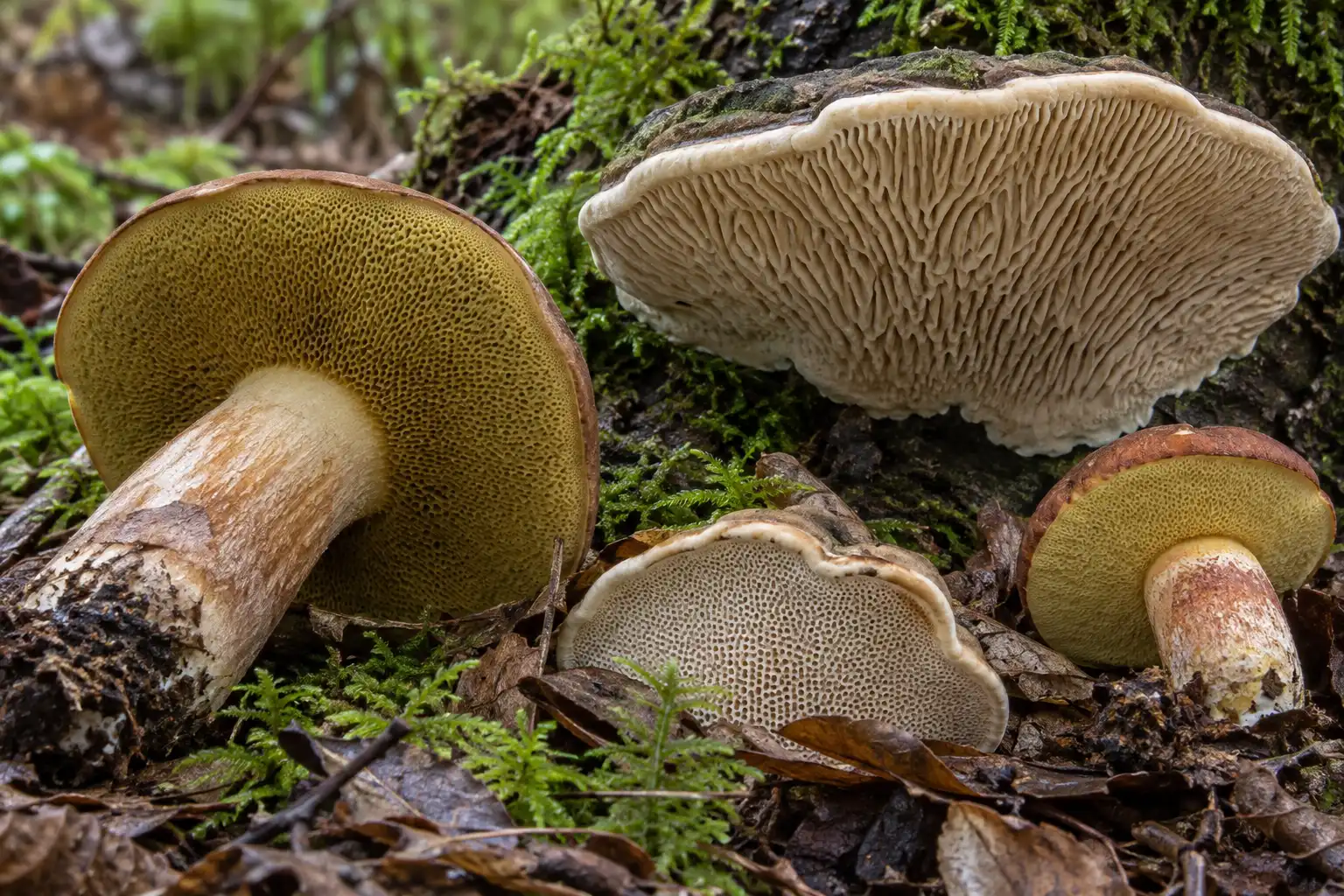
Mushroom Pore Surfaces: A Field Guide to Boletes and Polypores
Learn to document mushroom pore size, shape, attachment, bruising, tube layers, substrate, and context without treating pores as proof of identity or edibility.
mushrooms
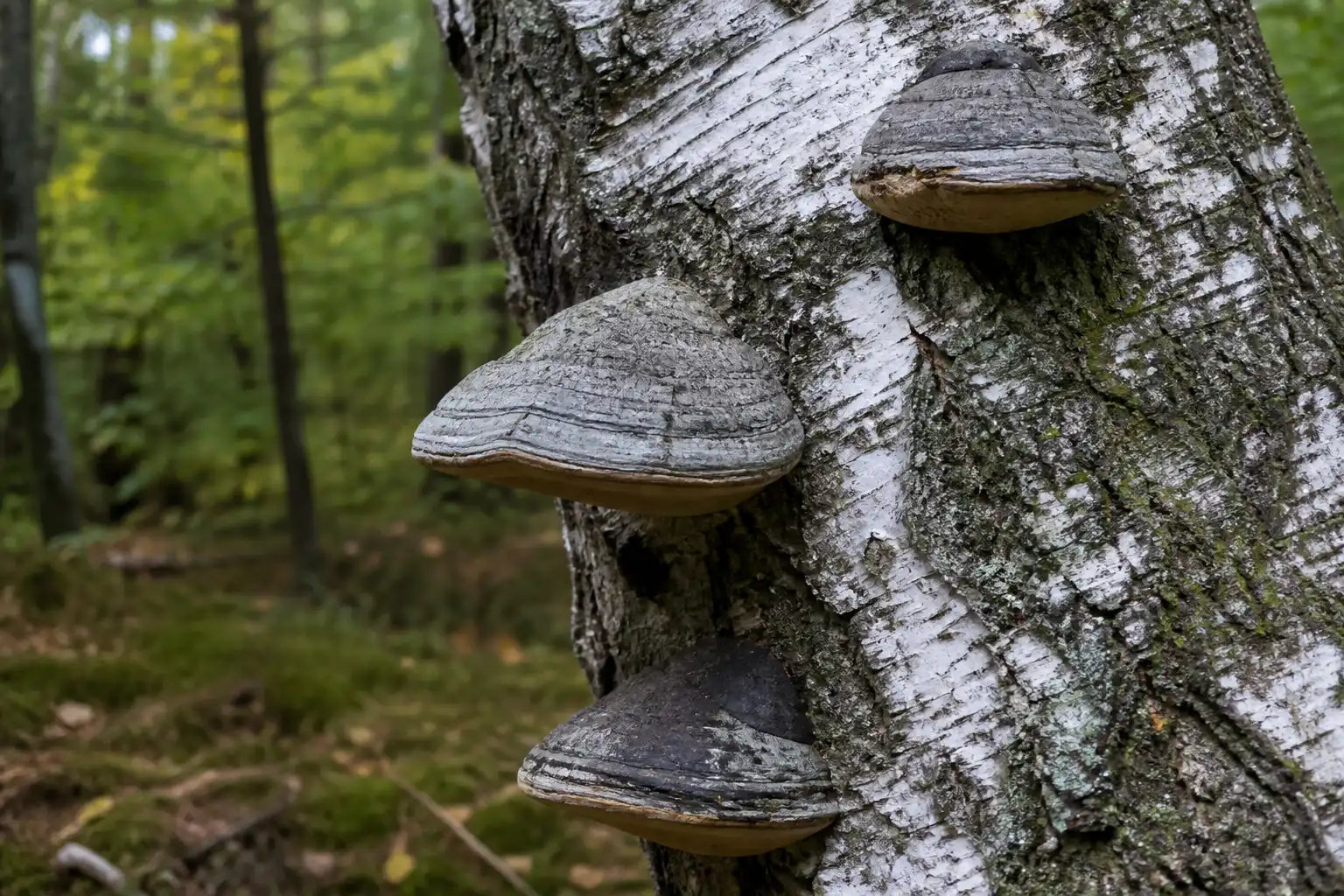
Tinder Fungus: Perennial Brackets, Birch Ecology, and Amadou
Understand tinder fungus hoof-shaped brackets, perennial pore layers, birch and beech ecology, similar conks, decay, amadou history, and safety limits.
mushrooms
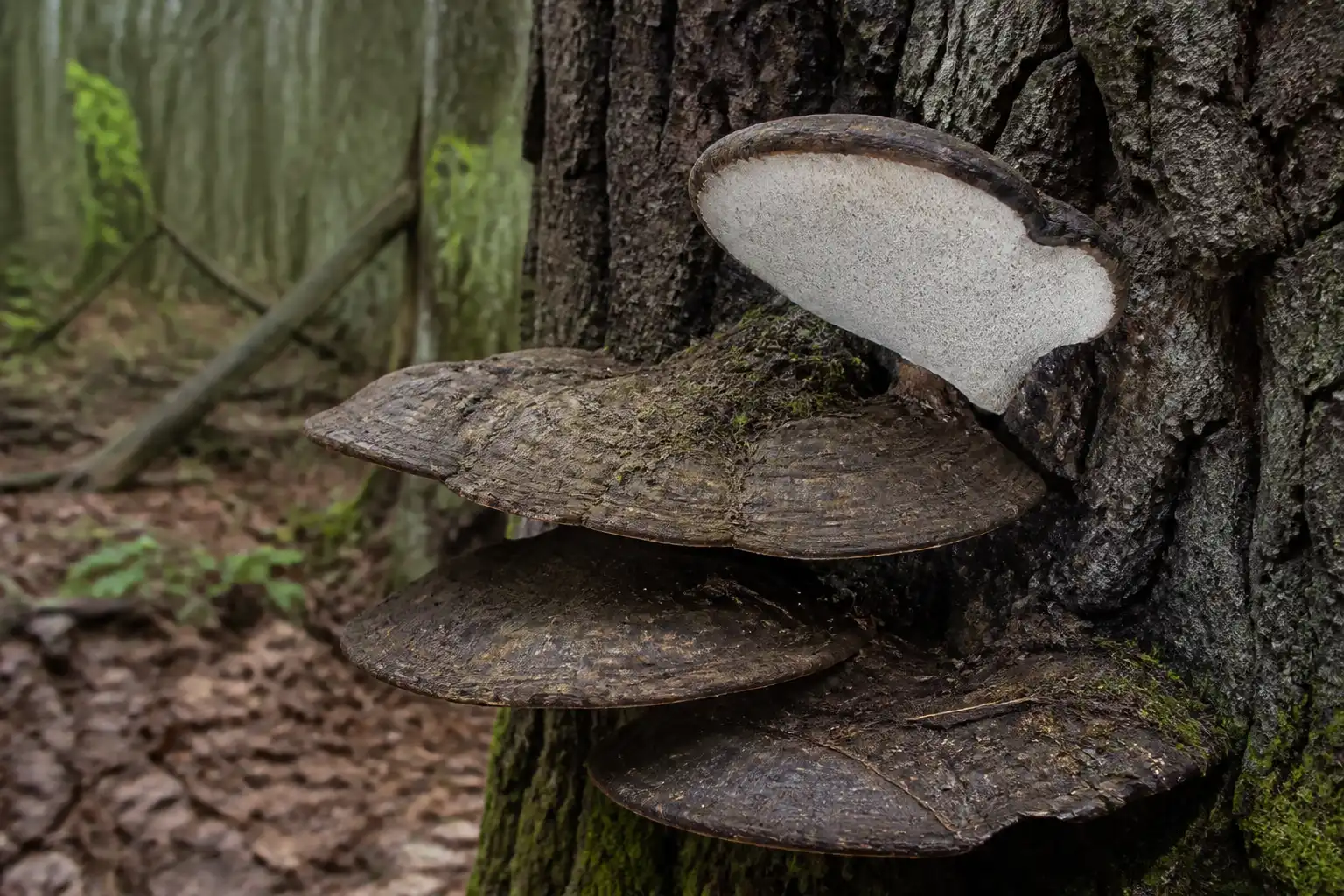
Ganoderma applanatum: Artist’s conk Species Guide
Learn Artist’s conk identification, habitat, season, lookalikes, safety, food context, and cultivation limits with current taxonomy and sources.
Continue exploring
Browse more practical guides in Mushroom Encyclopedia or visit the mushroom encyclopedia.