Mushroom Encyclopedia
Birch Mazegill: Maze-Gill Underside, Birch Wood, and Lookalikes
Document birch mazegill by zoned hairy brackets, maze-like gill plates, birch attachment, decay stage, lookalikes, persistence, and safe field records.
By MushroomScope Editorial Team · · Updated
Species context
Treat profiles as reference material
Species profiles summarize documented traits, taxonomy, and lookalikes, but natural variation can be substantial.
Use the safety checklist →Decision limit
A profile cannot authenticate a specimen
Do not eat a wild mushroom from an online match, single feature, or generated image.
Read the safety disclaimer →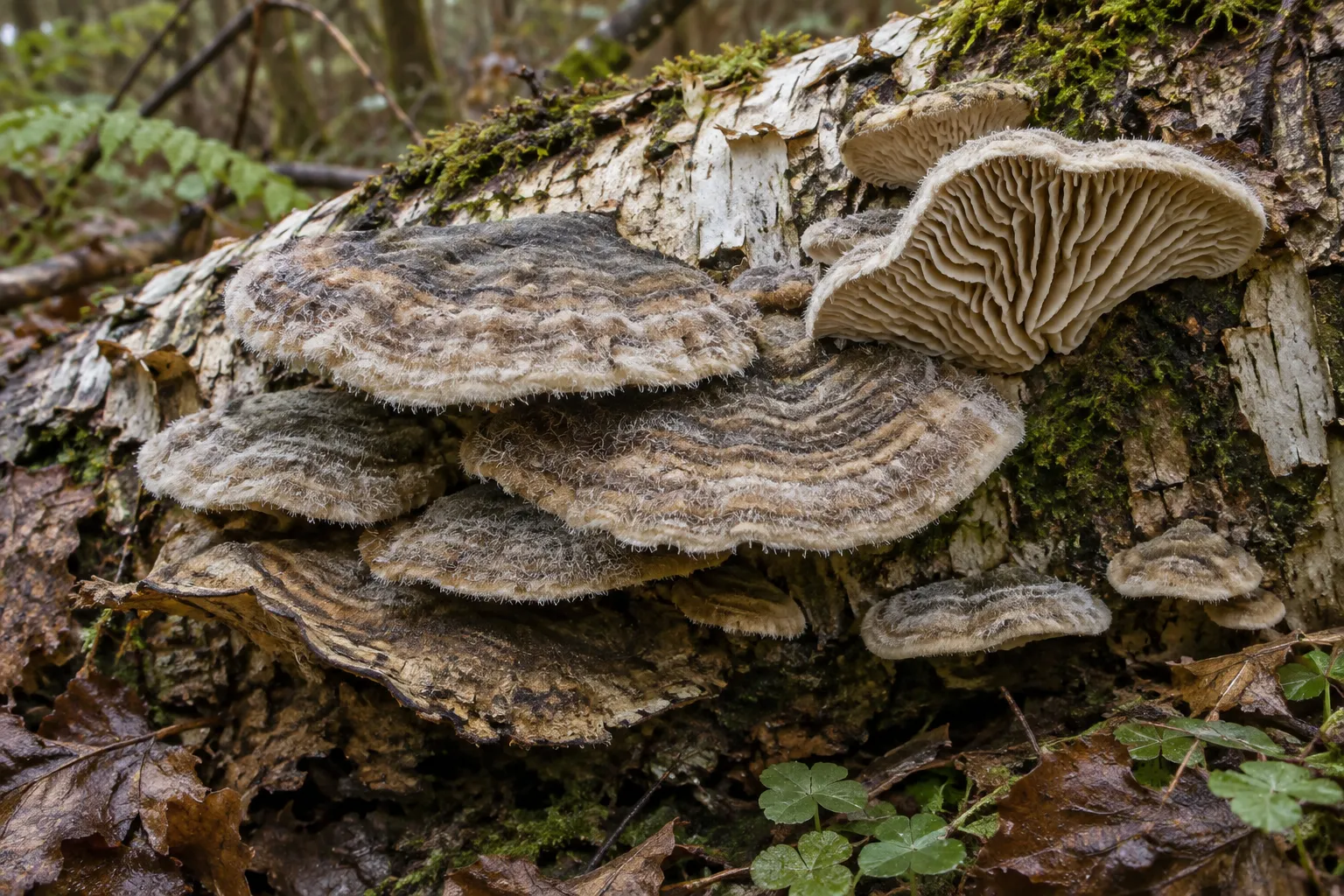
Quick facts
- Scientific name
- Lenzites betulina
- Common names
- birch mazegill, multicolor gill polypore, gilled polypore
- Taxonomy
- Lenzites · Polyporaceae
- Edibility context
- Inedible: Tough corky fruit bodies are not recommended as food, and wild identity cannot be established from a photograph.
- Spore print
- White; a print alone does not separate pale-spored wood brackets.
- Toxicity context
- Low: No characteristic severe toxin syndrome is asserted; the practical boundary is inedibility, contamination, and mistaken identity.
- Season
- January, April, September, December
- Growing difficulty
- Expert
- Regions
- Europe, North America, temperate records requiring current regional verification
Safety limit: These labels summarize documented context; they never authenticate a wild specimen. Cooking does not make a poisonous species safe.
Birch mazegill combines two appearances that can mislead when photographed separately. From above, its hairy concentric zones can resemble turkey tail and other thin brackets. From below, radiating plates look like mushroom gills. A complete specimen shows that the plates fork and reconnect into elongated mazes within a tough wood-attached bracket.
The name Lenzites betulina also invites an assumption that every collection must be on birch. Birch is an important host, but the record still needs independent wood evidence, region, fertile-surface architecture, cap texture, and condition. This guide focuses on building that falsifiable record.
Photograph the colony before selecting a bracket
Show the full log, branch, or stump and the distribution of shelves. Record whether brackets form rows, overlapping tiers, scattered fans, or resupinate patches. Add a scale at the wood surface so cap width and projection are not exaggerated by macro framing.
Trace at least three brackets to their actual attachments. Loose old shelves can lodge beneath an unrelated log. Photograph bark, end grain, retained twigs, leaves, and the surrounding stand before assigning the host.
Grade birch host confidence explicitly
White peeling bark with dark lenticels can support birch, but bark age and decay change its appearance. Stronger records combine connected wood, bark, buds or leaves, branching pattern, and site trees. A detached pale log in a mixed woodland should remain “probable birch” or “unknown hardwood” when evidence is incomplete.
The birch polypore guide provides a useful contrast: a host-specialized pale bracket with a pore surface and different cap construction. Similar host does not imply similar fungus.
Read the upper zones as texture and age
Fresh margins may be pale and actively growing, while older inner zones accumulate gray, tan, brown, green algae, dirt and wear. Photograph with raking side light to show hairs. A wet frontal flash can flatten the texture and turn every zone into a high-contrast stripe.
Measure the width of active margin and older bands on several caps. Do not interpret each colored band as one year of growth without a repeated observation. Weather and episodic growth can produce multiple visual zones over shorter periods.
Turn the bracket and map the fertile surface
The underside is the decisive field view. Photograph from the attachment to the margin. Record whether plates are straight, forked, cross-connected, broken into elongated pores, or eroded. Use a ruler in the same plane and count channels per centimeter in several zones.
The structures are often called gills in common descriptions, but their branching maze architecture belongs to a polypore. The pore-surface guide explains why round pores, elongated pores, daedaloid mazes, and plate-like forms should be documented as a continuum rather than forced into cap-mushroom terminology.
Compare fresh margin and old inner tissue
Cut a narrow lawful voucher from margin to attachment. Record cap hairs, context thickness, plate depth, color boundaries, flexibility, insect tunnels, and whether tissue tears fibrously or snaps. Fresh margins may be thinner and paler than the weathered base.
Old brackets can persist after active sporulation has declined. Algae on top and missing plate edges below are condition notes, not new species characters. Prefer an intact fresh margin for microscopy and keep the old tissue as ecological context.
Separate turkey tail by the underside
Turkey tail can share thin overlapping fans, vivid zones, and a hairy upper surface. Its underside usually carries small pores rather than robust radiating plates. A top-only photograph cannot resolve the comparison, and cap color varies too widely to rescue it.
The turkey tail guide owns the thin zoned Trametes intent. Photograph both undersides at comparable scale; “more colorful” is not a reliable separator.
Separate oak mazegill by construction and host
Oak mazegill typically forms thicker, heavier brackets with coarse maze walls on oak. Birch mazegill tends toward thinner fanlike caps and more gill-like radiating plates, but specimens vary and old tissue can blur the distinction.
Use the oak mazegill guide to compare wall thickness, channel shape, flesh depth, host confidence, and cap surface. The comparison is structural, not a rule that substitutes common names for host examination.
Compare Daedaleopsis and other elongated-pore fungi
Blushing bracket and related Daedaleopsis species may have elongated, labyrinthine pores and can show pink, brown, or red bruising. Record a matched untouched control and pressed area with timed photographs. Staining is informative only when fertile-surface form, cap texture, host, and region agree.
Do not bruise every fruit body in a colony. One minimal test and an unhandled control preserve both evidence and habitat. Very old or frozen surfaces may fail to show an expected response.
Document persistence without counting shelves twice
Use fixed bark cracks and branch ends to map individual brackets. At each visit, classify margins as expanding, stable, eroded, insect-damaged, algae-covered, or absent. New pale tissue on an old shelf differs from a new shelf beside it.
Year-round visibility is not year-round active sporulation. If spore activity matters, pair repeated condition photographs with properly timed microscopy or deposits and weather notes. Avoid tapping dry brackets near the face to create a visible spore cloud.
Keep decay ecology separate from hazard claims
The fungus decomposes dead hardwood and produces white rot, but visible shelves do not quantify internal strength. On a fallen log, record decay class, bark retention, cracks, moisture and other fungi. On a standing dead limb or tree near a target, seek a qualified arborist assessment.
Removing brackets does not remove established mycelium. A fruit body is evidence of a fungal system, not a standalone repair target or an exact map of internal decay.
Use microscopy and vouchers with provenance
Collect only where lawful and necessary. Link a minimal voucher to in-situ images, host evidence, coordinates generalized when conservation requires it, date, collector, and collection number. Dry it promptly with contained airflow and label fragments so upper and fertile surfaces remain associated.
Record spore measurements with calibration, mounting medium, number measured, and maturity. White spores from an unlinked print do not distinguish the many pale-spored bracket fungi.
Quantify the maze instead of naming it by impression
Choose three radial transects from attachment to margin on one intact bracket. At fixed distances, measure plate depth, average spacing, number of forks, and number of cross-connections within a one-centimeter window. Photograph the ruler and fertile surface in the same plane. Repeat on a fresh and a weathered cap so erosion is not mistaken for naturally wider channels.
The pattern may shift outward: inner plates can be crowded and heavily connected while the active margin is shallower and more regularly radiating. Report that gradient rather than selecting the single most maze-like patch. If the surface alternates between elongated pores and plate-like runs, keep both observations; they help a regional key more than a forced “gills” or “pores” label.
Test cap-hair retention without damaging the colony
Use raking light and a macro series on three cap zones: fresh margin, middle band, and older attachment area. Record whether hairs are upright, matted by rain, worn away, or obscured by algae. A dry soft brush may be used only on a detached voucher, with an adjacent untouched control, because cleaning a living colony removes ecological evidence.
Pair hair condition with cap thickness and color. A green older band may be algal occupation rather than fungal pigment, and a smooth patch may be abrasion rather than a naturally glabrous cap. These distinctions make upper-surface comparison useful without allowing it to override the underside.
Separate one log’s pattern from a host rule
If multiple bracket species share a birch log, map their positions by circumference and distance from the cut end. Note bark retention, contact with soil, moisture, sun exposure, cracks, and decay class in occupied and apparently unoccupied zones. This can reveal microhabitat differences worth retesting, but one log cannot establish a universal preference.
An absence of birch mazegill from the driest face does not prove moisture caused its distribution, and visible shelves do not mark the full mycelial boundary. Repeat after seasonal changes and retain zero observations. Ecological conclusions should grow from replicated logs and dates, not from the neatest photograph.
Interpret database records carefully
GBIF supports occurrence discovery, while NCBI provides a lineage checkpoint. Neither validates an image automatically. Older records may use broader concepts, uncertain hosts, duplicate observations, or names affected by later phylogenetic work.
Check regional literature and preserve the name used by each cited record. If genus placement differs among sources, report the difference rather than silently merging the evidence.
Do not infer edibility from resemblance
Birch mazegill is tough and not recommended as food in this guide. The more important safety point is that a website cannot confirm an unknown bracket. Never taste a shelf to distinguish it from turkey tail, and do not brew an unidentified persistent fungus as tea.
If illness follows consumption of a wild fungus, contact local emergency or poison-control services. Retain photographs, leftovers, preparation details, amount, and symptom timing. NAMA supports conservative poisoning communication, not image identification.
Build a reproducible field record
- Photograph colony, wood, bark, and surrounding trees.
- Measure several caps and their projections.
- Capture zoned hairs under side light.
- Photograph the complete underside at scale.
- Count channels and measure plate depth in fixed zones.
- Record fresh and weathered tissue separately.
- Preserve a minimal linked voucher when expert work is planned.
This sequence makes the name falsifiable. A record can remain at “mazegill-like hardwood bracket” until host, fertile surface, region, and microscopy justify more precision.
Image and evidence limits
The cover is an original 1536×1024 RGB AI editorial image. It was reviewed beside Scarlet Waxcap and Purple Brittlegill reference covers for natural woodland light, restrained color, clear substrate attachment, complete fruit bodies, plausible scale, sharp texture, and modest depth of field. The distinctive underside is visible, and there is no text, watermark, logo, collage seam, stretching, or obvious repeated malformed shelf. It remains illustrative context, not a voucher.
First Nature provides a regional field account; GBIF and NCBI support taxonomic checkpoints; NAMA supports emergency-response context. No named mycologist or clinician reviewed this page. Review status is editorial.
References
See the linked GBIF, NCBI, First Nature, and NAMA sources listed above.
Source quality notes
MushroomScope cites sources that match the page scope, such as taxonomic databases, extension guidance, food-safety agencies, food-composition databases, and peer-reviewed or institutional health references. Sources support context and uncertainty; they do not turn an online page into specimen identification, medical advice, or a tested recipe record.
Frequently asked questions
Does birch mazegill have true gills?
Its underside has tough radiating plates that branch and connect into maze-like channels. They look gill-like but belong to a wood-decay polypore body plan.
Does birch mazegill grow only on birch?
Birch is a prominent host reflected in the common name, but records occur on other hardwoods. Host evidence should be documented rather than inferred from the fungus name.
How is birch mazegill separated from turkey tail?
Turkey tail usually has a pore surface underneath, while birch mazegill develops elongated maze-like plates. Cap zoning alone is not enough.
Can old brackets still be identified?
Persistent brackets retain some architecture, but algae, bleaching, insects and eroded fertile surfaces reduce confidence. Record condition and seek fresh margins or microscopy.
Is birch mazegill edible?
This guide does not recommend it as food. The fruit bodies are tough, and an online image cannot establish identity, cleanliness, or individual safety.
Related guides
mushrooms
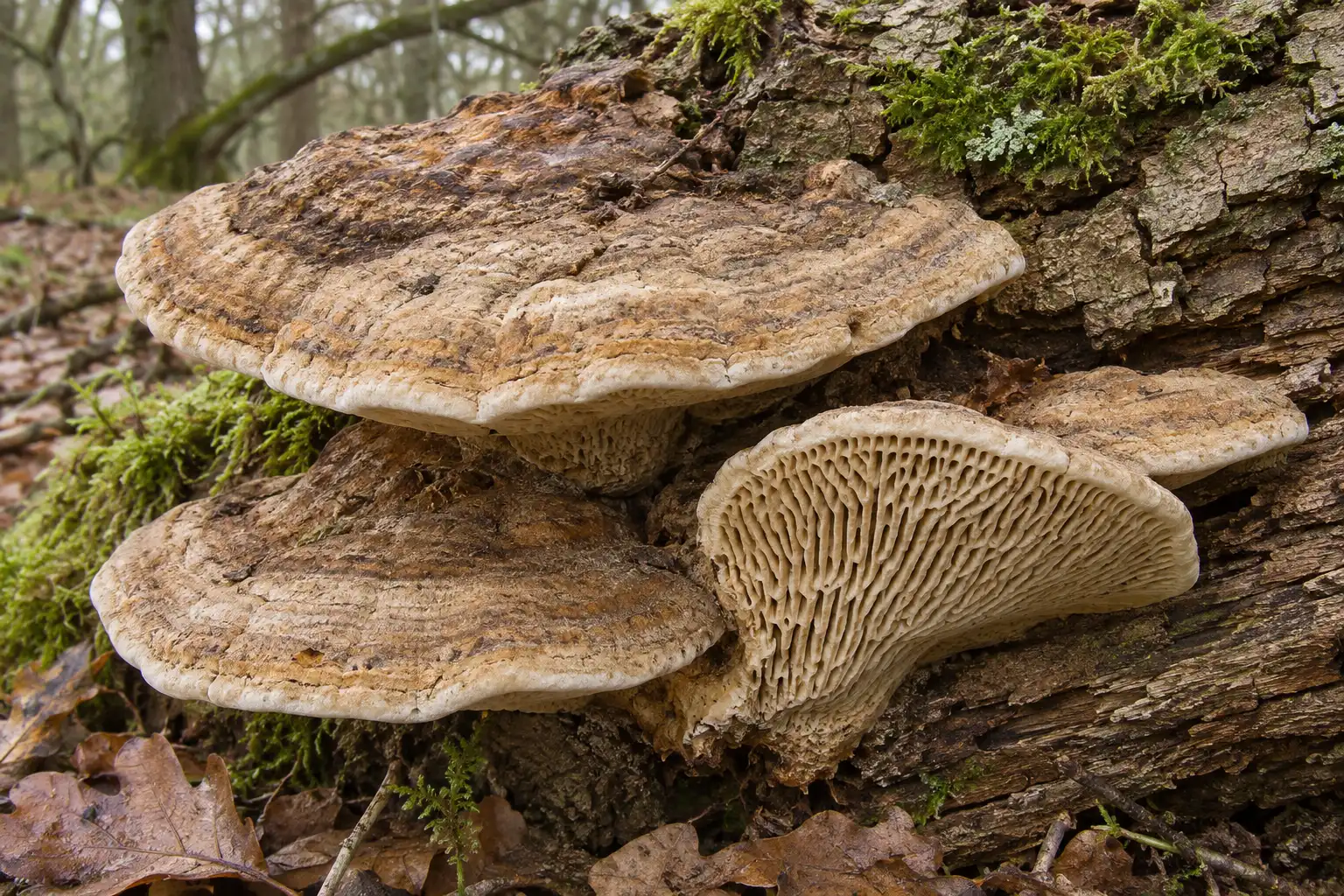
Oak Mazegill: Maze Pores, Corky Brackets, and Oak Decay
Document oak mazegill by thick corky brackets, maze-like pores, oak attachment, brown-rot context, persistent growth, lookalikes, and safe field records.
mushrooms
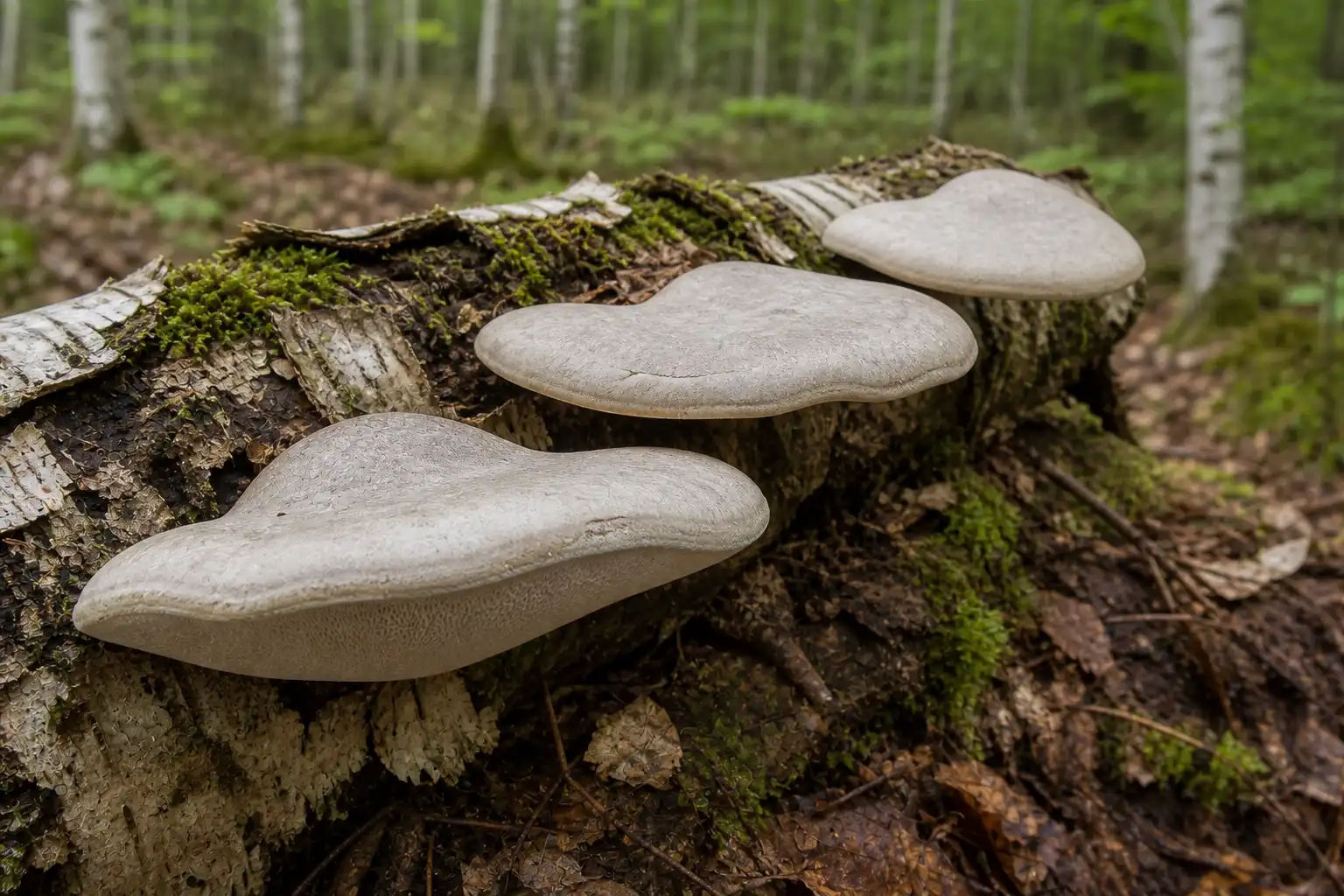
Birch Polypore: Fomitopsis betulina Host and Decay Guide
Identify birch polypore through verified birch hosts, annual bracket development, fine white pores, brown rot, and perennial lookalike separation.
mushrooms
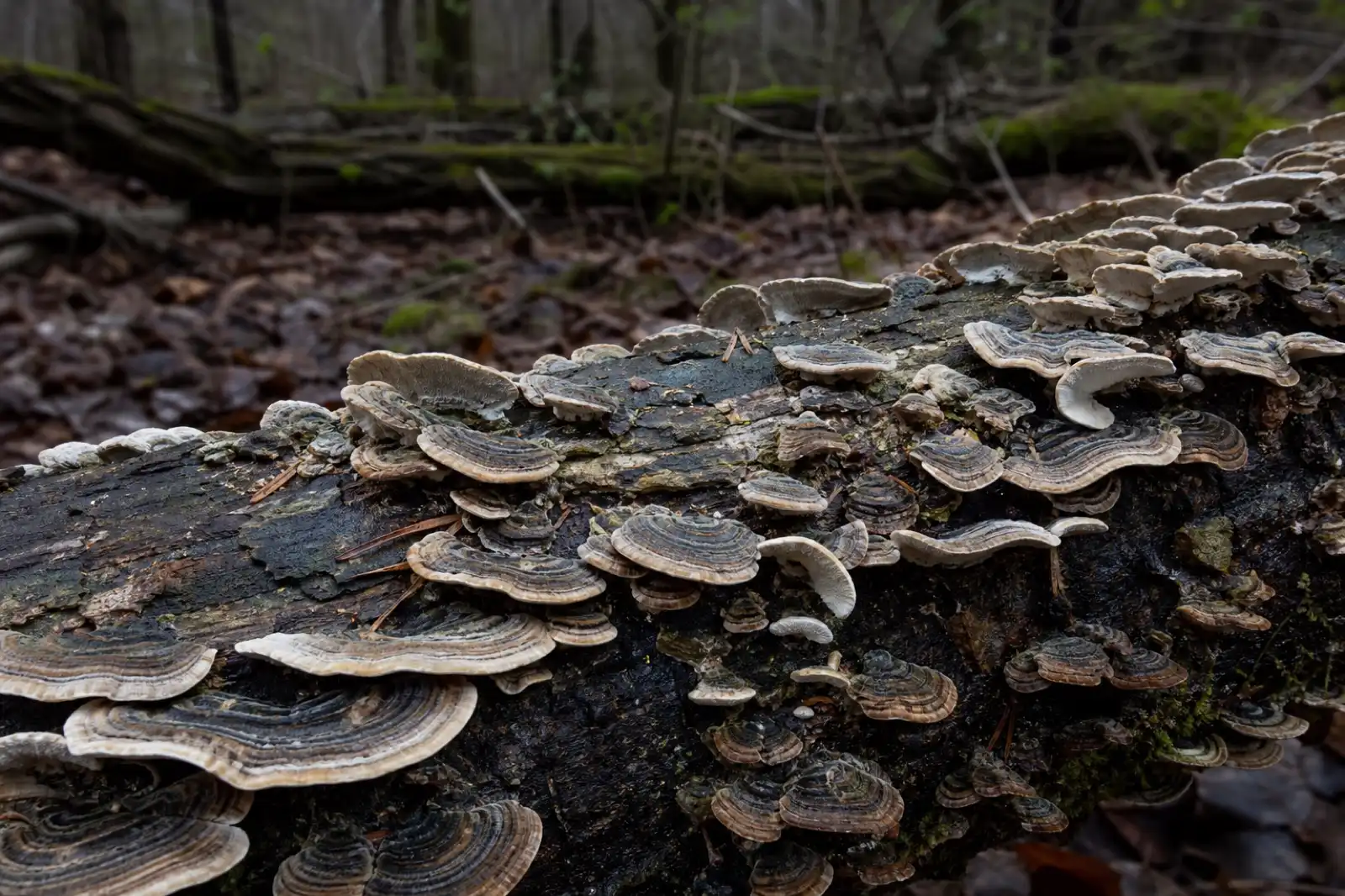
Trametes versicolor: Turkey Tail Mushroom Species Guide
Learn Trametes versicolor identification, pore features, hardwood habitat, cultivation, extract evidence, lookalikes, supplement safety, and FAQs.
Continue exploring
Browse more practical guides in Mushroom Encyclopedia or visit the mushroom encyclopedia.