Health
Turkey Tail Mushroom Research: PSK, Products, and Safety
Turkey tail research on PSK and other extracts is product- and setting-specific; it does not validate self-treatment, foraged material, or every supplement.
By MushroomScope Editorial Team · · Updated · Editorially reviewed
Evidence context
Food, extracts, and supplements differ
Health conclusions depend on species, fungal part, preparation, dose, population, and measured outcome.
Open the nutrition evidence hub →Medical limit
Educational, not medical advice
Do not delay diagnosis or replace prescribed care with mushroom foods or supplements.
Read the editorial policy →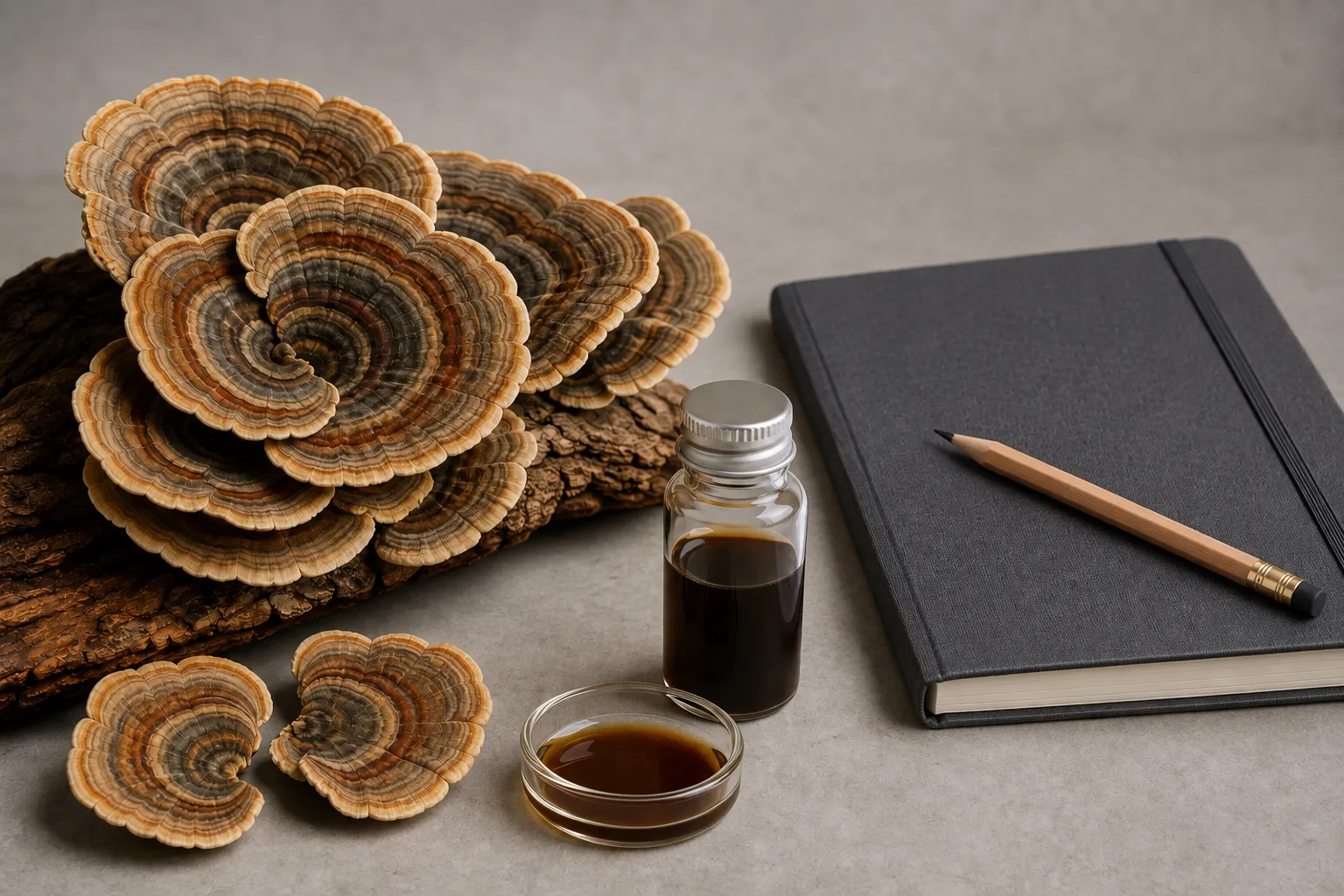
Bottom line
Turkey tail is the common name for Trametes versicolor (also called Coriolus versicolor in some research). It is easy to lose the most important detail in discussions of this mushroom: clinical papers often study a named manufactured preparation in a defined oncology setting, alongside standard care. They do not automatically describe a culinary serving, a tea, a whole dried bracket, a foraged specimen, or every retail product labeled “turkey tail.”
The National Cancer Institute’s PDQ summary distinguishes turkey tail from polysaccharide-K (PSK) and discusses the clinical literature in its product and treatment context. This page follows that boundary. It does not recommend turkey tail for cancer or any other condition, and it does not convert laboratory activity or a supplement label into a medical claim.
First identify what the study actually tested
The name on the front of a package is not enough to match it to a paper. Before drawing a conclusion, identify the intervention with the same care used for a medicine study.
| Ask this question | Why it matters |
|---|---|
| Was the material a named PSK or PSP preparation, another extract, or whole mushroom? | Different preparations can have different source material, processing, constituents, and dose. |
| Was the fungal identity and production method documented? | “Turkey tail” is a common name, while research interventions can be strain- and manufacturer-specific. |
| Who was studied and what standard treatment did they receive? | An adjunct study does not show that the product can replace oncology care or help people in another setting. |
| What outcome was measured and for how long? | A laboratory marker, symptom questionnaire, progression outcome, and survival outcome are not equivalent. |
| Does a retail label match the tested preparation? | A broad claim such as “beta-glucans” or “hot-water extract” does not demonstrate equivalence. |
PSK and PSP are often mentioned together, but they should not be treated as interchangeable with each other or with any mushroom powder. NCI describes PSK as a particular mushroom product used in Japan as an adjunct in cancer care; it also notes that PSK and PSP differ in their source and composition. That history is not U.S. FDA approval of a turkey-tail product for cancer treatment.
What clinical reviews can—and cannot—tell us
Systematic reviews can summarize a body of research, but their usefulness depends on the studies they include. The lung-cancer review by Fritz and colleagues found clinical and preclinical studies of PSK and Coriolus extracts, while also calling for larger, more rigorous randomized trials. A more recent review of medicinal-mushroom clinical studies describes frequent limitations such as small samples, nonrandomized designs, different preparations, and outcomes that cannot be cleanly pooled.
Those limits matter. A promising result for a named intervention in one diagnosis, alongside one conventional regimen, does not establish that a consumer product prevents recurrence, treats cancer, improves immunity in healthy people, or is safe with a different treatment. It also cannot tell a person whether a product purchased today contains the same material studied years ago.
When reading a headline or abstract, keep the conclusion proportional:
- A cell or animal result can suggest a research question; it cannot prove a human benefit.
- A small or observational human study can inform future trials; it cannot establish routine use.
- A systematic review can reveal patterns and uncertainty; it does not make unlike products equivalent.
- An adjunct study means the product was studied with standard treatment. It never means “instead of” treatment.
Read the evidence by preparation, cancer setting, and treatment era
The NCI evidence tables are more useful than a single “works” or “does not work” verdict because they keep product, dose, diagnosis, study design, concurrent therapy, and outcome together. Several cited PSK studies concern postoperative gastric or colorectal cancer care in Japan and combine PSK with chemotherapy regimens used in those trials. That is a narrow historical and clinical question—not evidence that a current U.S. retail powder prevents cancer, treats an established cancer alone, or belongs in every modern regimen.
Treatment era matters too. Supportive care, staging, surgery, chemotherapy, targeted therapy, and immunotherapy have changed. An older adjunct trial can remain scientifically informative while being difficult to transfer to a person receiving a different regimen today. The treating oncology team is needed to judge whether the original population and co-treatment resemble the current situation and whether adding an untested supplement could complicate treatment or adverse-event attribution.
The 2023 systematic review of clinical mushroom-supplement studies reached a deliberately limited conclusion: results across multiple mushrooms and products were heterogeneous, studies were often small or nonrandomized, and the evidence was not sufficient to recommend routine mushroom use for people with cancer. That finding should not be flattened into either a cure claim or a claim that every preparation has been disproved. It means the product-specific evidence remains too uncertain for self-treatment or routine substitution.
Separate three questions that marketing often merges
An evidence review should answer three independent questions:
- Was a defined intervention associated with a clinical outcome in a defined study? This is a question about that protocol, population, comparator, and result.
- Is the product in hand equivalent to the study intervention? This requires identity, composition, manufacturing, dose, and quality evidence—not a shared common name.
- Is using that product appropriate for this person now? This depends on diagnosis, treatment, medicines, allergies, organ function, timing, and clinician judgment.
A “yes” or promising signal at the first step does not supply the missing evidence for steps two and three. Conversely, a third-party test for contaminants may improve confidence in one product-quality attribute while saying nothing about cancer outcomes. Keeping these questions separate prevents a laboratory assay, certification seal, historical trial, and individualized treatment decision from being presented as one continuous proof chain.
Separate outcomes before deciding how strong a result is
Clinical papers may report survival, disease progression, treatment completion, infection, laboratory immune markers, symptoms, quality of life, or adverse events. These outcomes answer different questions. A change in a laboratory marker is not automatically evidence that a person lives longer, feels better, or experiences fewer treatment complications.
Check whether the outcome was specified before the study began, how many outcomes were tested, and whether the difference was both statistically and clinically meaningful. A relative percentage can sound dramatic while representing a small absolute difference, especially in a small sample. Read the participant counts and confidence intervals when available rather than relying on promotional summaries.
Also identify the comparison group. A study comparing standard care plus a named preparation with standard care alone asks an adjunct question. It does not compare the preparation with no treatment, prove that standard care can be reduced, or establish benefit in people without the studied diagnosis. If treatment regimens have changed since the trial, applicability to current care may be limited.
Systematic reviews inherit these differences. Pooling studies can increase precision only when interventions, populations, methods, and outcomes are sufficiently comparable. When a review describes heterogeneity or high risk of bias, the correct response is greater uncertainty—not a stronger umbrella claim for “mushrooms.”
Do not transfer PSK evidence to a generic beta-glucan claim
PSK is discussed as a defined preparation in particular research and regulatory contexts. A retail product that lists “polysaccharides,” “beta-glucans,” mycelium, fruiting body, or an extraction ratio has not thereby demonstrated equivalence to PSK. The words may describe broad constituents or manufacturing choices without establishing the same composition, dose, purity, or clinical use.
Beta-glucans are a diverse class of polysaccharides found in multiple organisms, and assay methods can produce results that are not directly comparable. A percentage on a supplement label does not show that the measured material has the same structure or biological behavior as a study intervention. See the mushroom beta-glucan evidence guide for the assay and extrapolation limits.
Likewise, a hot-water tea made from a whole bracket, a culinary preparation, and an industrial standardized extract are not dose-equivalent categories. Increasing the amount of an unmatched product cannot close that evidence gap and can increase exposure to side effects, contaminants, or interacting ingredients.
Product labels, regulation, and quality questions
In the United States, dietary supplements are regulated differently from prescription drugs. The FDA explains that companies are responsible for ensuring supplements are safe and properly labeled before marketing, but supplements are not pre-approved by the FDA for effectiveness in the way drugs are. Market availability therefore does not demonstrate that a product matches a clinical preparation or works for a particular disease.
If you are discussing a product with a qualified clinician or pharmacist, bring the complete label rather than relying on a product name. Useful details include the scientific name as listed, fungal part or culture material, extraction process, amount per serving, all other ingredients, lot number, manufacturer, and any independent identity or contaminant testing. “Full spectrum,” an extraction ratio, or a percentage claim alone cannot establish clinical equivalence.
The mushroom supplement guide provides a general label-reading checklist. It complements—not replaces—advice tailored to a treatment plan.
Build a product-to-study worksheet for a clinician
Before an appointment, place the product label and cited paper side by side and record only what can be verified:
| Field | Retail product | Study intervention |
|---|---|---|
| Exact name and manufacturer | Copy the complete label | Copy the preparation name used by the paper |
| Fungal identity and material | Species, fruiting body, mycelium, culture substrate, or unspecified | Source and strain information reported by the investigators |
| Preparation | Extract type, ratio, standardization, or unspecified | Manufacturing and standardization described in the study |
| Dose and schedule | Per serving and proposed daily use | Trial dose, timing, duration, and route |
| Other ingredients | List every active and inactive ingredient | Note whether a single preparation or combination was tested |
| Population and treatment | The patient’s actual diagnosis and regimen belong with the clinician | Inclusion criteria and standard therapy used in the trial |
| Outcome and uncertainty | Do not fill this with marketing language | Primary outcome, effect estimate, adverse events, and study limits |
A blank or “unspecified” field is meaningful. Do not fill missing manufacturing or identity details with assumptions from the brand website, another lot, or a similarly named product. Provide photographs of the Supplement Facts panel, ingredients, directions, warnings, lot, and expiration information so the care team reviews the actual item.
Third-party certification may address a defined identity, quality, or manufacturing scope, but it does not prove cancer efficacy or equivalence to PSK. Verify what a seal covers with the certifier rather than treating the logo as a medical endorsement.
Safety is treatment- and product-specific
There is no single safety answer for “turkey tail.” People receiving chemotherapy, immunotherapy, radiation, transplant-related care, surgery, or medicines with a narrow safety margin should not add a supplement independently. Interactions, gastrointestinal effects, allergy, contamination, and product quality can matter differently by person and product.
Bring a planned or current product to the oncology team or pharmacist before use, including the label and dose. Seek urgent medical help for severe allergic symptoms or any acute reaction. Do not use a mushroom product to delay assessment of symptoms or to replace prescribed care.
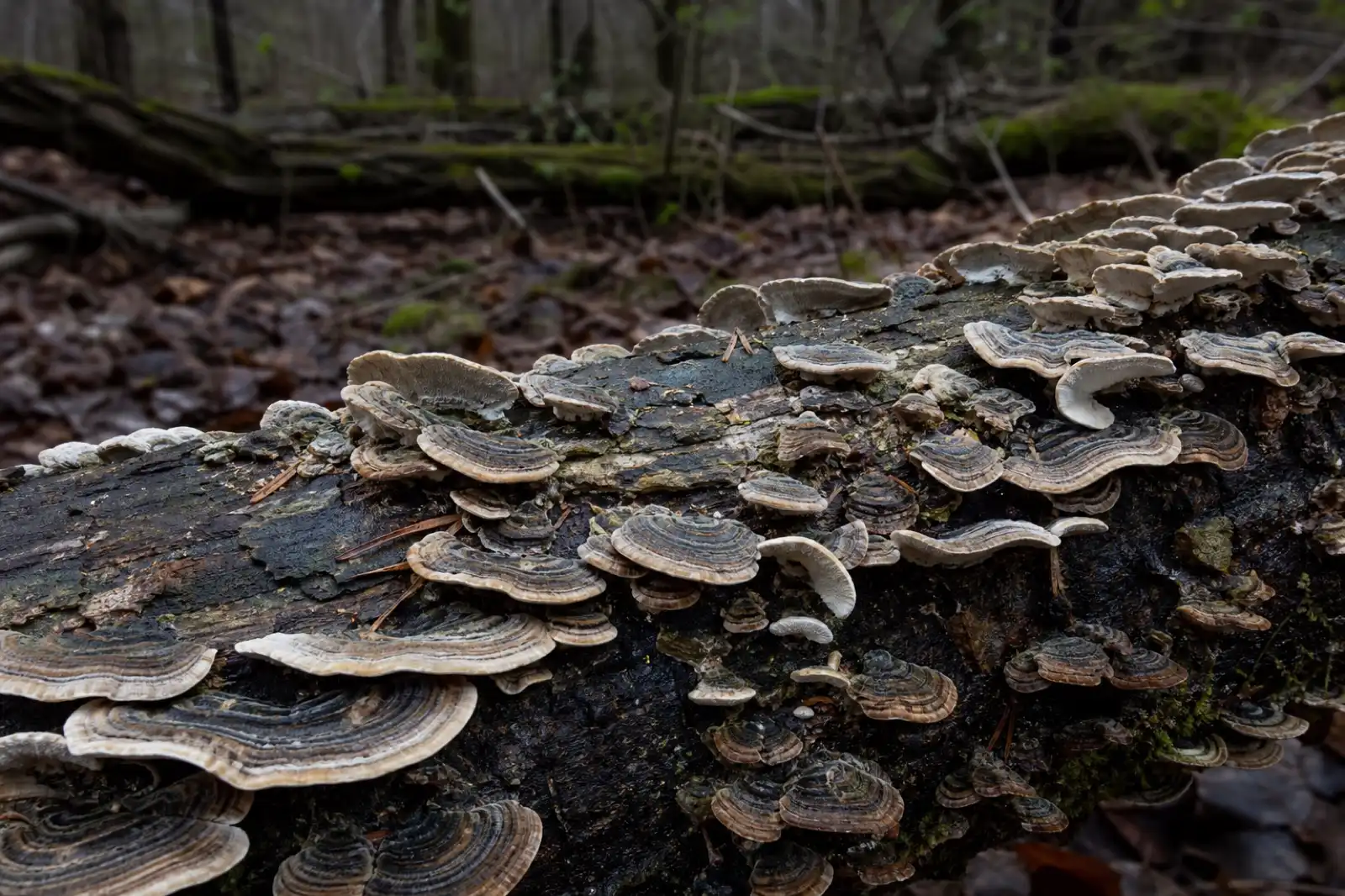
For species context and the limits of online identification, see the turkey tail species guide. Wild lookalikes and a photograph cannot authenticate what is in a supplement or make a collected mushroom appropriate for self-treatment.
Respond to adverse effects without self-testing the cause
Stop using the product and seek guidance appropriate to the severity of the reaction. Emergency symptoms such as breathing difficulty, facial or throat swelling, fainting, or other severe acute changes require urgent medical care. For less severe symptoms, contact the treating clinician or pharmacist promptly rather than lowering and raising the dose to test a theory during cancer care.
Keep the container, label, lot number, purchase source, dose history, other medicines and supplements, and symptom timeline. Do not discard the product until a clinician or relevant reporting authority advises what information or sample may be useful, but keep it secured from accidental use. A temporal association can be important without proving which ingredient caused the event.
Do not assume that “natural” means non-interacting, that a prior tolerated food serving predicts extract tolerance, or that stopping prescribed therapy will clarify a supplement reaction safely. Treatment decisions belong with the oncology team. Report suspected supplement adverse events through the appropriate national system when advised. In the United States, FDA’s Form 3500 instructions include dietary supplements among the products for which consumers and health professionals can submit suspected adverse outcomes. Causation does not have to be proven before a report is made; retain the exact product and event details so the report is useful.
Product recalls, formulation changes, and lot differences can also matter. Recheck the exact label and current regulatory information rather than relying on an older review of the brand name.
A safer way to evaluate a claim
Use this short sequence when a turkey-tail claim cites a study:
- Name the exact intervention. Find PSK, PSP, or the preparation name—not just “turkey tail.”
- Match the clinical setting. Check diagnosis, treatment, population, dose, and outcome.
- Check the study design. Look for randomization, comparison group, follow-up, attrition, and whether the result has been replicated.
- Compare the retail product cautiously. If its identity and manufacture do not match the paper, do not infer equivalence.
- Keep care decisions with the clinical team. A citation is not an individualized safety review.
Audit evidence transfer with four explicit gates
Before a turkey-tail claim reaches a patient-facing conclusion, it should pass four separate gates. The identity gate asks whether the intervention was PSK, PSP, another named extract, whole fruiting body, mycelial material, or an incompletely described product. The protocol gate checks dose, route, duration and manufacturing standardization. The clinical-context gate checks cancer type and stage, surgery, concurrent regimen and treatment era. The outcome gate separates survival or progression from laboratory markers, symptoms and exploratory endpoints.
A claim that fails one gate is not repaired by strength at another. A randomized adjunct trial cannot authenticate a retail powder; a certificate for contaminants cannot demonstrate clinical benefit; a mechanistic beta-glucan paper cannot determine compatibility with immunotherapy. This framework is intentionally stricter than matching the words “turkey tail,” because the shared common name is the easiest part of the evidence chain and the least informative about equivalence.
For an older trial, record the exact comparator and background therapy before asking whether the result applies now. Changes in staging, supportive care and systemic treatment can alter both baseline risk and the incremental effect of an adjunct. The appropriate conclusion may be that a study remains historically informative but is not directly transferable to a present regimen. That is a useful evidence judgment, not a dismissal of the paper.
Keep a lot-specific decision record
A clinical conversation is more productive when it concerns the exact container rather than a product category. Photograph the front label, Supplement Facts panel, other ingredients, warnings, lot and expiration information. Record the proposed amount, start date, reason for use, cited study and every prescription, over-the-counter medicine and supplement already taken. If the seller cites PSK or PSP, ask for evidence that the lot’s identity, composition and dose match that preparation; an extraction ratio or total-polysaccharide number alone does not establish the match.
The record should also state the decision and owner: avoid, defer pending more information, or use only under the treating team’s plan. If use proceeds, document what outcome is being monitored, the review date and the stop conditions. New rash, gastrointestinal symptoms, laboratory changes or treatment changes should be evaluated without informal stop-and-rechallenge experiments. The published mushroom supplement guide explains the broader product-risk process, while the mushroom photo checklist shows why field images cannot authenticate a supplement ingredient or establish edibility.
References
- National Cancer Institute — Mushrooms (PDQ®): Turkey Tail and PSK
- Fritz et al. — Polysaccharide K and Coriolus versicolor extracts for lung cancer: a systematic review
- Medicinal Mushroom Supplements in Cancer: A Systematic Review of Clinical Studies
- FDA — Dietary Supplements
- FDA — Instructions for Completing Form FDA 3500
Editorial method and revision note
This page was reviewed by the MushroomScope editorial team, not by a named oncologist, pharmacist, or dietitian. Sources were selected to cover the NCI’s product-specific clinical summary, systematic reviews of human studies, U.S. supplement regulation, and the official adverse-event reporting pathway. Claims are kept at the level of the cited intervention and study setting; laboratory findings are not promoted as clinical outcomes, and retail products are not assumed equivalent to PSK or PSP.
September 5, 2026: added the preparation–setting–treatment-era evidence map, separated study efficacy from product equivalence and individual appropriateness, and clarified the FDA adverse-event reporting pathway. The page remains educational and does not replace oncology or pharmacy advice.
Source quality notes
MushroomScope cites sources that match the page scope, such as taxonomic databases, extension guidance, food-safety agencies, food-composition databases, and peer-reviewed or institutional health references. Sources support context and uncertainty; they do not turn an online page into specimen identification, medical advice, or a tested recipe record.
Frequently asked questions
Does turkey tail cure or treat cancer?
No. Research on particular manufactured preparations used alongside conventional care does not establish that turkey tail cures cancer, replaces oncology treatment, or works as self-treatment. Do not delay diagnosis or prescribed care.
Are PSK, PSP, tea, whole turkey tail, and retail powders interchangeable?
No. They can differ in fungal material, strain, production method, composition, dose, regulation, and evidence. A result for a named preparation does not validate a tea, foraged specimen, generic powder, or another supplement label.
What should someone in cancer treatment do before considering a turkey tail supplement?
Bring the exact product label, ingredient list, dose, and lot information to the oncology team or pharmacist. They can assess the treatment plan, potential interactions, product quality, and whether a study actually matches the product and clinical situation.
Does PSK research prove that a U.S. turkey tail supplement is equivalent?
No. Equivalence requires product-specific identity, composition, manufacture, dose, and quality evidence. A shared common name, extraction ratio, or beta-glucan claim does not establish that a retail supplement matches PSK.
Why does the treatment era of a turkey tail study matter?
Cancer staging, surgery, supportive care, chemotherapy, targeted therapy, and immunotherapy change over time. An older adjunct trial may be informative without showing that its preparation belongs with a different modern regimen.
Related guides
mushrooms
Trametes versicolor: Turkey Tail Mushroom Species Guide
Learn Trametes versicolor identification, pore features, hardwood habitat, cultivation, extract evidence, lookalikes, supplement safety, and FAQs.

health
Mushroom Supplements: Labels, Testing, and Safety
Learn how to check mushroom supplement identity, fungal part, extraction, dose, lot testing, claims, interactions, and regulatory limits.
health
Mushroom Beta-Glucans: Evidence, Sources, and Limits
Fungal beta-glucans differ in structure, source, dose, and preparation; evidence for one purified product cannot validate every mushroom food or supplement.
Continue exploring
Browse more practical guides in Health or visit the mushroom encyclopedia.