Mushroom Encyclopedia
Bleeding Tooth Fungus: Guttation, Teeth, and Conifer Ecology
Document bleeding tooth fungus by red guttation, toothed undersides, conifer habitat, aging colors, bitter context, microscopy, and close Hydnellum lookalikes.
Species context
Treat profiles as reference material
Species profiles summarize documented traits, taxonomy, and lookalikes, but natural variation can be substantial.
Use the safety checklist →Decision limit
A profile cannot authenticate a specimen
Do not eat a wild mushroom from an online match, single feature, or generated image.
Read the safety disclaimer →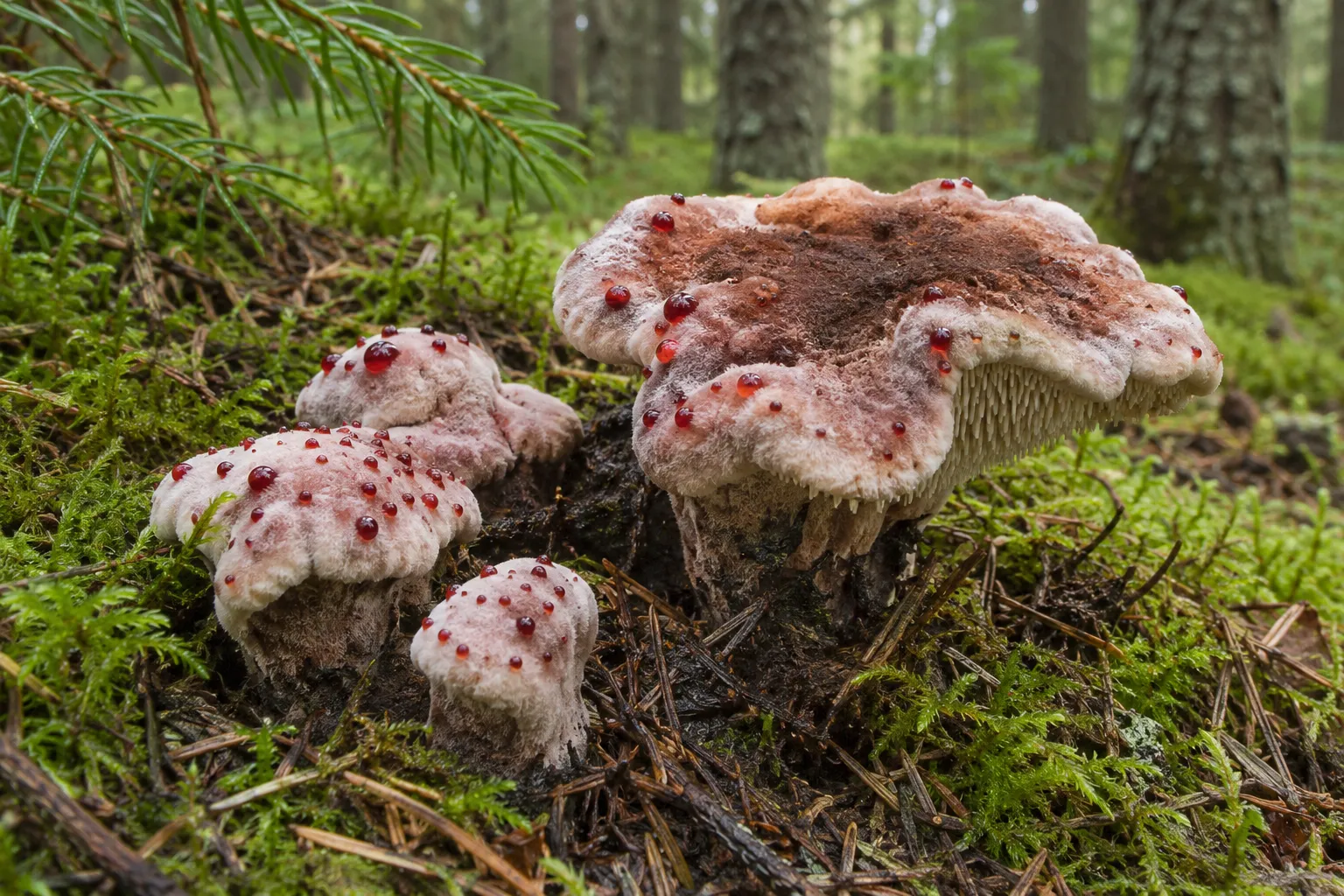
Quick facts
- Scientific name
- Hydnellum peckii
- Common names
- Bleeding tooth fungus, Devil's tooth, Strawberries and cream fungus
- Taxonomy
- Hydnellum · Bankeraceae
- Edibility context
- Inedible: Tough and intensely bitter; not presented as food and not cleared for tasting.
- Spore print
- Brown; species work also uses ornamented spore measurements and tissue characters.
- Toxicity context
- Unknown: A dramatic appearance is not a toxicity test, and this page makes no ingestion-safety claim.
- Season
- July, August, September, October, November
- Growing difficulty
- Expert
- Regions
- North America, Europe, temperate conifer forests, regional records requiring verification
Safety limit: These labels summarize documented context; they never authenticate a wild specimen. Cooking does not make a poisonous species safe.
Bleeding tooth fungus is often introduced through one extraordinary feature: ruby-red drops on a pale cap. That image is memorable, but it is a poor stopping point. The droplets are a moisture-dependent event on actively growing tissue, not a permanent badge, and several unrelated fungi can exude colored liquid. A useful record must connect the droplets to a tooth-bearing fruit body, its changing cap, tough internal context, forest floor, potential tree partners, region and microscopic evidence.
Hydnellum peckii is also a lesson in life-stage bias. Young fruit bodies can look pale, plush and almost soft. Mature ones become irregular, pitted and brown, neighboring caps may fuse, and litter can be swallowed by expanding tissue. An observer who searches only for a white cap dotted with red may walk past the same organism later in the season.
Confirm teeth before interpreting the red drops
Photograph the whole colony, then use a mirror to view a cap edge without uprooting it. The fertile surface should consist of many separate downward teeth, not gills, pores or torn flesh. Make a perpendicular macro image beside a millimeter scale and record tooth length, density, color and the transition from protected margin to mature center.
The hedgehog mushroom guide explains the same broad fertile-surface plan in a different construction. Hydnum fruit bodies are generally fleshy and conventionally cap-and-stem shaped. Hydnellum peckii is tougher, frequently fused and irregular, with litter incorporated around the base. Teeth establish the correct comparison group; they do not by themselves provide the species name.
If an apparent spine is actually a split pore wall, a hanging fiber or an insect channel, redirect the record. A clean section through the fertile layer shows whether teeth arise as organized tissue. Keep top, underside and section photographs tied to the same numbered specimen.
Record guttation as an event, not a diagnostic label
Guttation is the release of liquid from growing tissue under particular water and pressure conditions. On young bleeding tooth fungus, droplets can be clear to pink or deep red. Record their size, distribution and translucency before touching them, along with recent rain, soil wetness and temperature. Do not add water, squeeze the cap or stage droplets for a photograph.
Revisit the colony after a dry interval and after rain from the same camera position. Drops may shrink, darken, spread into the cap or disappear. New growth may produce fresh beads while older cap zones remain dry. That sequence is more informative than treating “bleeding” as a binary field character.
Red exudate does not mean blood, poison or a medical substance. Pigmented fungal liquid has no direct implication for danger or benefit. Avoid sensational captions that turn an ecological observation into a toxicity claim.
Map the cap from pale margin to brown center
Young surfaces may be whitish or blush pink and finely velvety. With age they can become salmon, rusty brown or dark brown, and may develop pits, radial wrinkles or concentric zones. Photograph protected margins and exposed centers with the same neutral color reference. Report color as a range linked to location and age.
Measure separate caps before assuming that a broad mass is one fruit body. Adjacent fruit bodies commonly fuse. Mark boundary lines, depressions and points where litter is incorporated. A fixed overhead photograph with a scale makes later expansion or fusion visible.
Section only when collection is permitted and the population can support it. Record cap thickness, color bands, moisture and the transition into the short stem. Tough fibrous or corky tissue is an important separation from soft edible-looking tooth fungi. A field note about bitterness should come from established literature or trained taxonomic practice, not casual tasting of an unknown wild fungus.
Prove that the fruit body comes from soil
Clear a small amount of loose litter at one edge rather than pulling the colony. The base should connect to soil or densely incorporated litter. A buried twig can create the illusion of wood growth, so photograph the attachment in place. The fungus forms ectomycorrhizal relationships with living trees and is not simply consuming a visible log.
Use the habitat identification guide to grade host evidence. Record tree species only when needles, buds, cones, bark and site knowledge support the name. Plot the distances to plausible conifers and note mixed broadleaf trees. “Under spruce” is stronger when a spruce root zone dominates the plot than when one tree stands beyond several other hosts.
Soil acidity, nutrient status, canopy history and disturbance can matter to Hydnellum communities. Do not infer those variables from moss alone. A repeatable site record includes coordinates at an appropriate privacy precision, slope, drainage, litter depth, canopy composition and management signs.
Separate Hydnellum species with a current regional key
Several Hydnellum species share tough tooth-bearing fruit bodies, brown spores, fused caps and occasional guttation. H. ferrugineum is a particularly close photographic comparison. Color descriptions overlap across age, lighting and preservation, so a red-drop photograph cannot reliably decide between them.
Document odor without forcing a familiar analogy. Under laboratory conditions, record spore dimensions from calibrated equipment, ornamentation, hyphal characters and any reactions required by the key. State how many spores were measured and preserve the full range rather than a preferred average. A voucher connects those observations with a physical specimen and allows later re-examination when species concepts change.
GBIF maps can reveal candidate records, but each point inherits the certainty and date of its source. NCBI links taxonomic names to sequence records with their own voucher and identification histories. Use databases to find evidence, not to replace morphology or local expertise.
Distinguish soft hedgehog mushrooms and other tooth fungi
The presence of teeth first separates the specimen from gilled agarics and most boletes. Within tooth fungi, compare texture, attachment and spore color. Edible hedgehog mushrooms are normally fleshy, with distinct caps and stems and pale spores. Hydnellum fruit bodies are typically tough, irregular, often fused and brown-spored.
Other genera such as Sarcodon can produce robust terrestrial tooth fungi associated with trees. Cap scales, flesh reactions, odor, spores and current taxonomy determine the route. The goal is not to memorize one dramatic photograph but to create a table in which each candidate must explain the same measured characters.
Do not use an image-search match as edible clearance. Even a correct genus identification leaves species, condition, contamination and individual response unresolved.
Read conservation signals cautiously
Tooth-fungus communities can be sensitive to forest continuity, nitrogen deposition, soil change and management, and some regions monitor particular Hydnellum species. A single fruiting absence does not prove local loss: underground mycelium can persist without producing visible fruit bodies in a dry year.
For monitoring, establish a fixed plot and separate fruit-body count from occupied area. Photograph from fixed points, record weather and avoid trampling the colony. Do not excavate every cap. If a record may be locally important, share coordinates privately with the relevant conservation recorder rather than broadcasting a vulnerable site.
The organism’s relationship with trees also means that ordinary “grow kit” assumptions do not apply. Laboratory culture is not equivalent to forming a functioning mycorrhiza or producing fruit bodies in a forest.
Keep safety claims proportional to the evidence
Bleeding tooth fungus is generally treated as inedible because it is tough and extremely bitter. That statement is not an invitation to taste-test a specimen. Guttation color cannot diagnose toxicity, and the lack of a famous poisoning syndrome cannot establish safety.
If any wild fungus is eaten and symptoms occur, contact the appropriate poison center or medical service. Retain uncooked material, photographs, location, timing and preparation details. Online identification should not delay professional care.
Build a reviewable field record
- Photograph the colony, surrounding trees and undisturbed attachment.
- Link pale margins, brown centers, droplets and toothed underside to numbered specimens.
- Measure cap dimensions, tooth length and the occupied patch.
- Record recent rain and revisit to document guttation change.
- Grade host evidence rather than naming the nearest tree automatically.
- Section one representative only when lawful and ecologically appropriate.
- Use a current regional key, calibrated microscopy and a voucher for a consequential record.
This workflow remains useful when the red droplets are absent. It replaces a viral visual cue with evidence that another observer can test.
It also preserves negative evidence: missing teeth, an unattached base, soft flesh, or a hardwood-decay habit should remain explicit contradictions rather than being edited out of the final identification note.
Audit the editorial image
The 1536 by 1024 RGB cover is an original AI editorial image reviewed beside the site’s Hedgehog Mushroom and Deadly Webcap natural-light covers. It shows complete soil attachments, restrained conifer-floor color, diffuse daylight, a visible field of teeth and age variation from pale pink margins to a brown center. Sharpness is concentrated on the fruit bodies without halos; there is no text, logo, watermark or collage.
The image deliberately illustrates guttation and tooth structure but cannot establish scale, spore characters, host identity or species. Its droplets and morphology are not field evidence, and the alt text labels it as an original AI editorial asset.
References
- GBIF species search: Hydnellum peckii — occurrence and taxonomic source records.
- NCBI Taxonomy Browser: Hydnellum peckii — taxonomic and sequence-linked context.
- USDA Forest Service fungi research — forest-fungus and mycorrhizal research context.
- North American Mycological Association: poisoning syndromes — conservative response guidance for suspected poisoning.
Source quality notes
MushroomScope cites sources that match the page scope, such as taxonomic databases, extension guidance, food-safety agencies, food-composition databases, and peer-reviewed or institutional health references. Sources support context and uncertainty; they do not turn an online page into specimen identification, medical advice, or a tested recipe record.
Frequently asked questions
Why does bleeding tooth fungus produce red droplets?
Young hydrated fruit bodies can exude pigmented liquid through guttation. Droplets depend on active growth and moisture, so their absence on an older or drier specimen does not settle the identification.
Does Hydnellum peckii have gills?
No. Its fertile underside bears many short downward teeth or spines. A specimen with true blade-like gills follows a different identification pathway.
Where does bleeding tooth fungus grow?
It is an ectomycorrhizal forest fungus associated mainly with conifers. Records should connect the fruit body to nearby potential hosts, soil and litter rather than simply naming the nearest tree.
Is every pale fungus with red drops Hydnellum peckii?
No. Guttation occurs in several fungi, and red liquid is not species-specific. Cap texture, teeth, flesh, odor, taste records made by qualified workers, host, region, spores and current keys must agree.
Is bleeding tooth fungus edible?
It is generally described as inedible because of its tough texture and intensely bitter context. This field guide does not authorize tasting or eating a wild collection.
Related guides
mushrooms
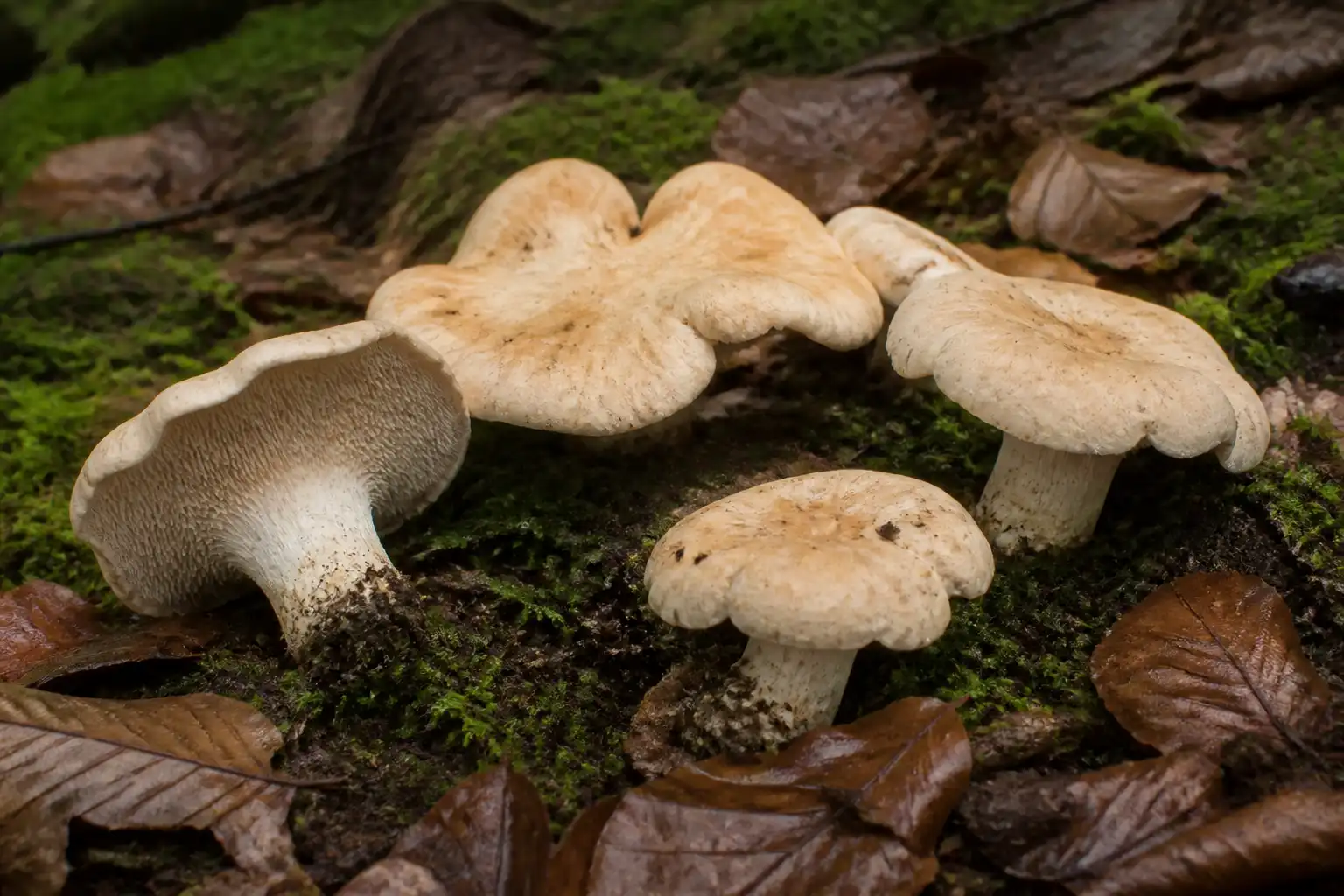
Hedgehog Mushroom: Teeth, Woodland Ecology, and Lookalikes
Identify hedgehog mushrooms by soft downward teeth, irregular buff caps, woodland ecology, white spores, and separation from other toothed fungi.
identification
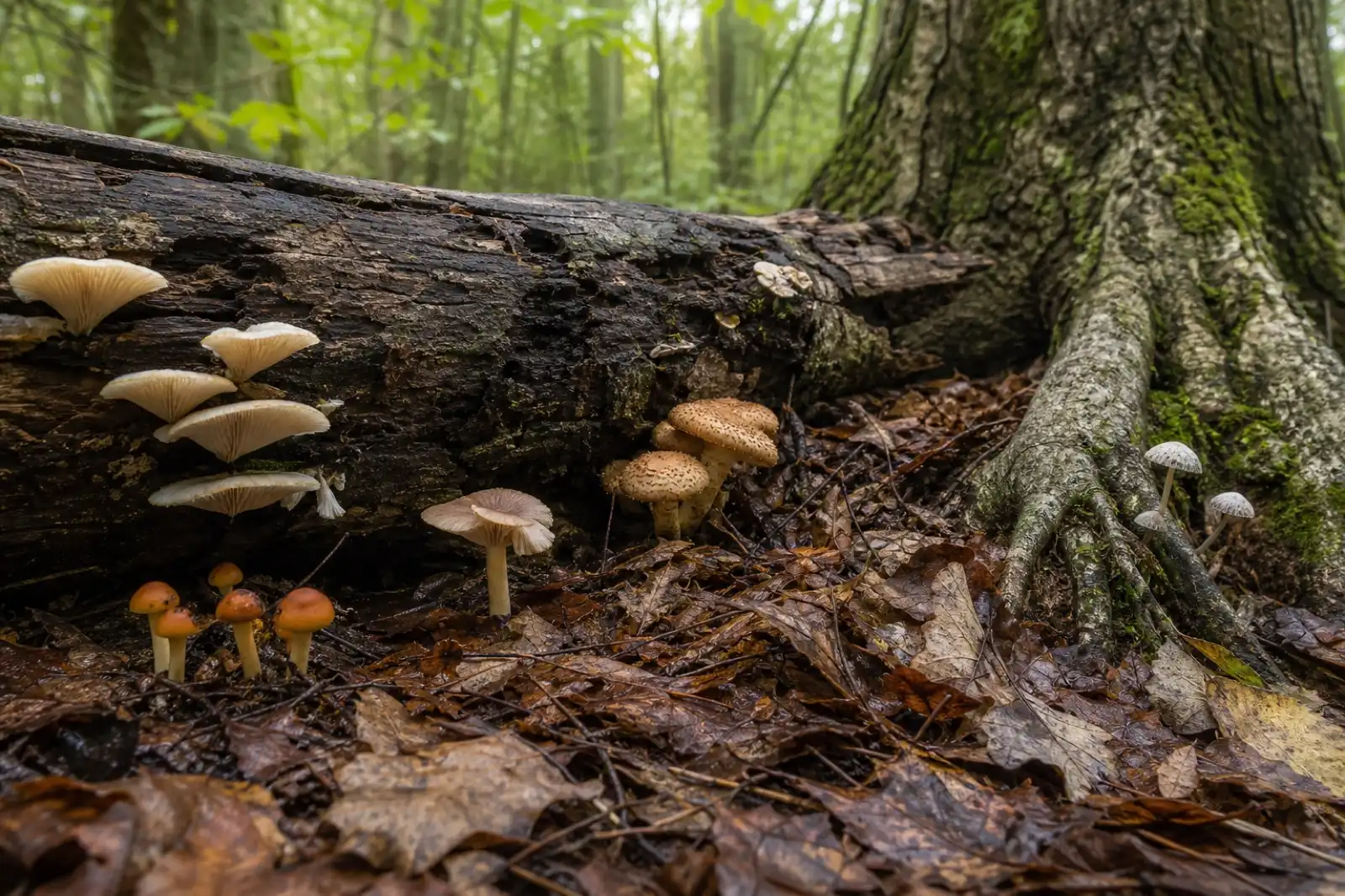
Using Habitat to Identify Mushrooms
Record substrate, associated plants, soil, wood type, moisture, elevation, and fruiting pattern as identification evidence.
identification
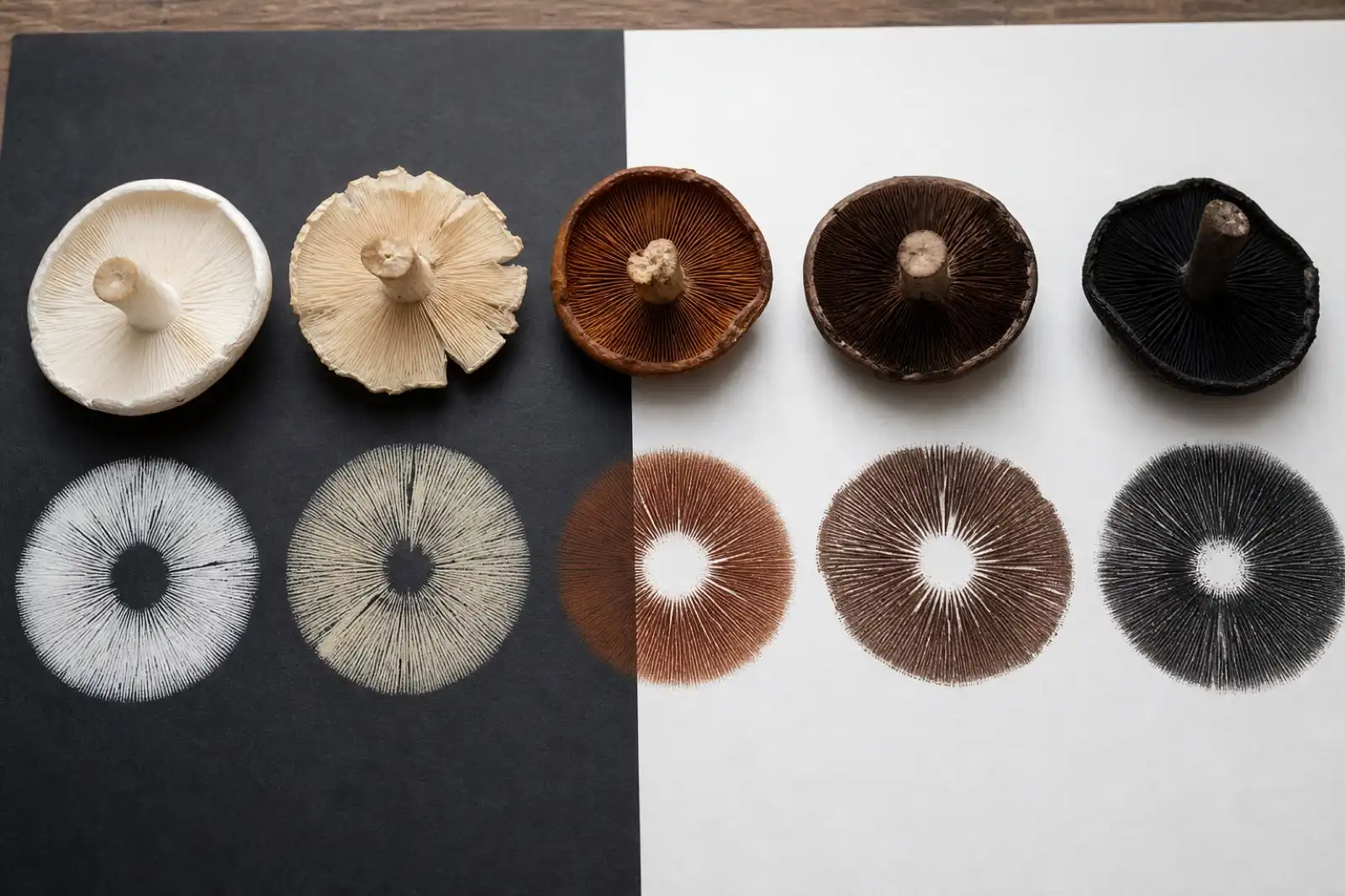
Mushroom Spore Print Colors and How to Record Them
Use a controlled spore deposit to distinguish broad color groups while recognizing that print color alone never identifies a species.
Continue exploring
Browse more practical guides in Mushroom Encyclopedia or visit the mushroom encyclopedia.