Mushroom Encyclopedia
Collared Parachute: Marasmius rotula Field Guide
Document Marasmius rotula by its pleated white cap, wiry dark stem, gill collar, hardwood-twig habitat, revival after drying, microscopy, and lookalikes.
Species context
Treat profiles as reference material
Species profiles summarize documented traits, taxonomy, and lookalikes, but natural variation can be substantial.
Use the safety checklist →Decision limit
A profile cannot authenticate a specimen
Do not eat a wild mushroom from an online match, single feature, or generated image.
Read the safety disclaimer →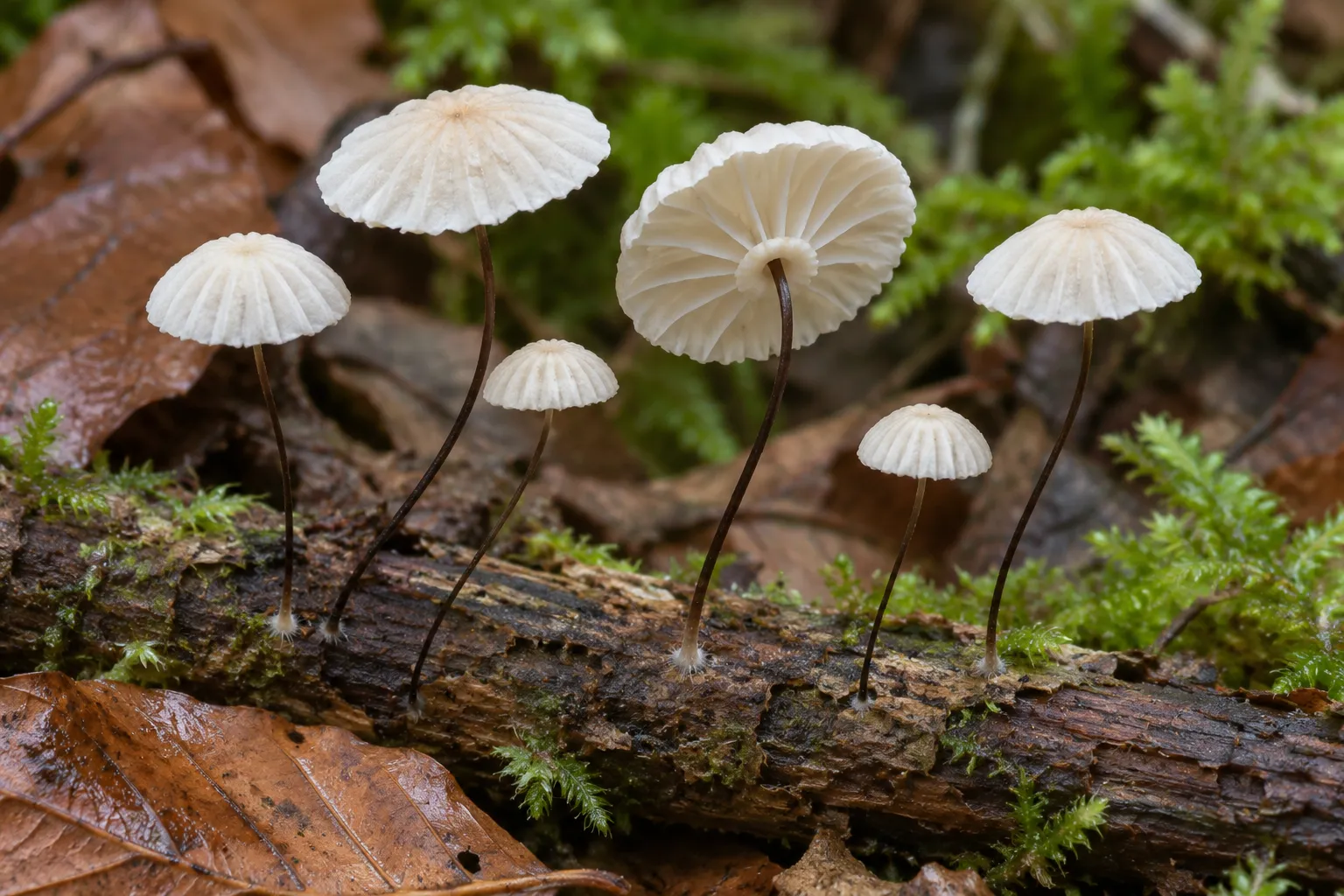
Quick facts
- Scientific name
- Marasmius rotula
- Common names
- Collared parachute, Pinwheel mushroom, Horsehair parachute
- Taxonomy
- Marasmius · Marasmiaceae
- Edibility context
- Unknown: Not a practical food mushroom; minute size and identification uncertainty make collection for eating inappropriate.
- Spore print
- White; microscopic spores, cystidia, cap tissues and clamp connections may be needed for a regional determination.
- Toxicity context
- Unknown: No food clearance is offered; mixed tiny mushrooms and remote identification create avoidable risk.
- Season
- June, July, August, September, October, November
- Growing difficulty
- Expert
- Regions
- Europe, North America, temperate records elsewhere requiring regional confirmation
Safety limit: These labels summarize documented context; they never authenticate a wild specimen. Cooking does not make a poisonous species safe.
The collared parachute, Marasmius rotula, is built around a feature that a top-down photograph cannot show. Its tiny white cap is folded like a paper parasol, but the sparse gills underneath stop on a circular collar around the hair-thin stem. That collarium, combined with a dark wiry stem and a genuine attachment to fallen hardwood, makes a useful hypothesis. None of those characters alone confirms the species.
This is a documentation guide for a minute wood decomposer. It is not a foraging recommendation. Photograph the complete substrate unit, keep underside images linked to their caps, and use a current regional key when similar leaf- and twig-inhabiting parachutes occur.
Establish scale before describing the cap
Photograph the colony in place with a millimeter ruler beside the twig. Include an ordinary leaf fragment or moss patch for environmental scale, but do not rely on those objects for measurement. Record cap diameter, stem height, stem width, and the number of fruit bodies on one defined length of wood. “Tiny” is not a reproducible character.
Make a low side view, a direct top view, and an underside view of the same numbered fruit body. The cap begins convex and may flatten or become centrally depressed. Its strong radial furrows produce a scalloped margin, while the central disc may appear cream, buff or slightly darker. Note whether the grooves are structural folds or cracks created during drying.
Prove the collarium with an angled underside
The collar is the page’s central distinction. Use a hand lens or macro lens to show where every gill terminates. In a useful frame, the pale gills join a small ring of tissue that encircles the dark stem, leaving the gills indirectly attached. A blown highlight or shallow focus can erase this gap and make the gills look conventionally attached.
Count full-length gills across one cap and note any shorter intervening folds. The gill-types guide explains attachment terms, but a collarium deserves its own photograph rather than a label copied from a description. If the collar cannot be seen, report a small parachute mushroom and keep the species unresolved.
Trace the wiry stem to its exact attachment
Follow a stem from cap to base without pulling it from the wood. The upper portion can be paler; the lower stem becomes reddish brown to nearly black, glossy, tough and hairlike. Photograph curvature and color under neutral light. A shadow should not be mistaken for pigmentation, and two overlapping stems should not be recorded as a fork.
Expose only enough litter to show whether the base enters a hardwood twig, leaf petiole, bark fragment or buried woody piece. The habitat documentation guide separates visible substrate from an assumed host. “On leaf litter” is incomplete when the mycelium is actually using a twig hidden below the leaves.
Treat the whole twig as the sampling unit
Measure the occupied length and diameter of the twig, bark cover, contact with soil, moisture, and stage of decay. Record nearby tree evidence separately; a beech leaf lying on oak wood does not identify the substrate. If lawful, retain a short labelled piece with several maturity stages rather than detaching anonymous caps.
Map fruit-body positions along the wood. A line of caps following one decorticated groove supports a wood-decay observation, while scattered caps from several buried fragments require separate substrate labels. This simple map prevents a crowded photograph from becoming a false claim about one colony.
Document drying and re-expansion without forcing a result
Members of Marasmius are famous for marcescence: some fruit bodies shrivel during dry conditions and can revive when moisture returns. Test only material already collected legally for study. Photograph a labelled cap dry, record its dimensions, expose it to a documented humid chamber without submerging it, and repeat the same views at fixed intervals.
Report cap expansion, color, gill spacing and stem posture. Do not call every change “revival”; water uptake in damaged tissue is different from an intact fruit body resuming a recognizable form. A positive result supports the genus concept but does not distinguish M. rotula from every relative.
Separate leaf parachutes by preserving the substrate
Several minute Marasmius species occupy leaves, petioles or fine wood. M. capillaris is especially associated with fallen oak leaves in many treatments, while M. bulliardii is another small leaf-litter parachute. Substrate preference is useful only when the object beneath the stem was actually retained and identified.
Create a comparison table with substrate unit, cap diameter, central color, collarium visibility, stem color, gill count and microscopic characters. Do not turn “twig versus leaf” into an absolute shortcut; fine veins, petioles and decorticated fragments can be misread in the field, and regional species concepts differ.
Exclude bonnet mushrooms structurally
Small bonnet mushrooms can share pale striate caps and delicate stems. The common bonnet guide shows gills that meet the stem directly, a different stem texture and a substantially larger wood-fruiting body. Other Mycena species can be minute, so size is not the deciding feature.
Compare the collarium, stem toughness, cap pleating, substrate, odor or latex only when safely observed, and microscopy. Never break every small mushroom merely to search for fluid. A missing reaction in old or dry material is weak evidence.
Make a labelled spore and microscopy packet
A white spore deposit is difficult to see from a tiny cap. Place several mature caps from one documented collection over clean dark glass, protect them from drafts, and keep a blank control beside the setup. Record duration and humidity. Tissue crumbs are not a print, and pooled caps must not mix distinct collections.
Microscopy may include spore dimensions and shape, basidia, cheilocystidia, pileipellis elements and clamp connections required by the chosen key. Calibrate the scale, state reagent and magnification, measure a defined number of mature structures, and report the full observed range. Database text cannot replace specimen-linked measurements.
Use occurrence records as leads, not verdicts
GBIF records can indicate where named collections have been reported, and NCBI can connect names with sequence-linked material. Review voucher status, date, coordinate uncertainty and the taxonomic name used by the source. A map point does not authenticate a new photograph.
First Nature provides a European field account with the characteristic collar and hardwood context. Outside that regional frame, consult local literature or a mycological group. If a collection lacks the collarium image, substrate object or microscopy required by the local key, keep the label at genus level.
Keep food and collection boundaries proportionate
These fruit bodies are too small and insubstantial to justify food collection. More importantly, an online page cannot inspect a mixed handful of minute woodland mushrooms. Do not infer safety from a familiar common name, white cap, or absence of an obvious poisonous feature.
If illness follows wild mushroom ingestion, contact local emergency services or a poison center promptly. Retain uncooked material, leftovers, photographs, location and timing. Do not wait for an internet identification before seeking care.
Collect sparingly. A complete photographic series and one proportionate voucher are more useful than stripping every cap from a twig. Follow landowner, protected-area and local collection rules.
Audit the editorial image
The 1536 × 1024 cover is an original AI-assisted editorial image. It was opened beside the site’s Clustered Bonnet and Common Bonnet covers. The accepted image uses diffuse woodland light, restrained cream and brown color, a wet hardwood twig, credible moss and leaf texture, complete stems, and controlled depth of field. It contains no text, watermark, logo or collage seam.
One cap is angled to expose widely spaced gills ending on a visible collar. That image is an educational illustration, not evidence that every depicted structure would coexist in one real collection. It cannot establish dimensions, spores, substrate identity or species.
Build a reviewable collared-parachute record
- Photograph the occupied twig before moving it.
- Measure caps, stems and the defined substrate unit.
- Capture top, side and sharp underside views of numbered fruit bodies.
- Demonstrate the collarium rather than assuming it from the common name.
- Retain the exact leaf, petiole or wood fragment beneath the base.
- Record a controlled drying and re-expansion sequence only when useful.
- Compare leaf parachutes and bonnets with a regional key.
- Add a labelled spore and microscopy packet when species-level confidence matters.
The best record explains both why Marasmius rotula is plausible and which missing evidence still limits the name. A sharp cap portrait without collar or substrate evidence is attractive but taxonomically incomplete.
For a repeat visit, mark a fixed search strip without disturbing the wood and record rainfall, twig moisture, fresh caps, collapsed caps and persistent dry caps separately. Photograph the same twig face with a scale. The resulting sequence can describe fruit-body persistence and weather response, but it cannot reveal the full mycelial boundary or prove that every cap belongs to one genetic individual. Preserve that distinction in captions and field notes.
References
- GBIF species search: Marasmius rotula — occurrence, name and voucher leads.
- NCBI Taxonomy Browser: Marasmius rotula — nomenclatural and sequence-linked context.
- First Nature: Marasmius rotula — European morphology, habitat and collarium description.
- North American Mycological Association: mushroom poisoning syndromes — conservative response guidance after suspected ingestion.
Editorial status: reviewed by the MushroomScope editorial team on November 14, 2026; no named mycologist, toxicologist, clinician, or food-safety expert reviewed this page.
Source quality notes
MushroomScope cites sources that match the page scope, such as taxonomic databases, extension guidance, food-safety agencies, food-composition databases, and peer-reviewed or institutional health references. Sources support context and uncertainty; they do not turn an online page into specimen identification, medical advice, or a tested recipe record.
Frequently asked questions
Why is it called the collared parachute?
Its small pleated cap resembles a parachute, while the sparse gills terminate on a tiny collar that surrounds but does not directly join the stem.
Where does Marasmius rotula grow?
It decomposes small fallen hardwood twigs and woody debris in damp broadleaf woodland; the exact attachment should be exposed rather than inferred from nearby leaves.
Can a dry collared parachute revive after rain?
Marcescent fruit bodies can shrivel in dry weather and expand again when moistened, but revival is variable and does not establish species identity by itself.
How is it different from a bonnet mushroom?
The collared parachute has a tough dark wiry stem, a strongly pleated pale cap, and gills attached to a collar. Bonnet mushrooms generally have gills attached directly to the stem and different microscopic tissues.
Is the collared parachute edible?
It is too small and insubstantial for practical food use, and this page cannot confirm a wild specimen. Do not use an online image match as food clearance.
Related guides
identification
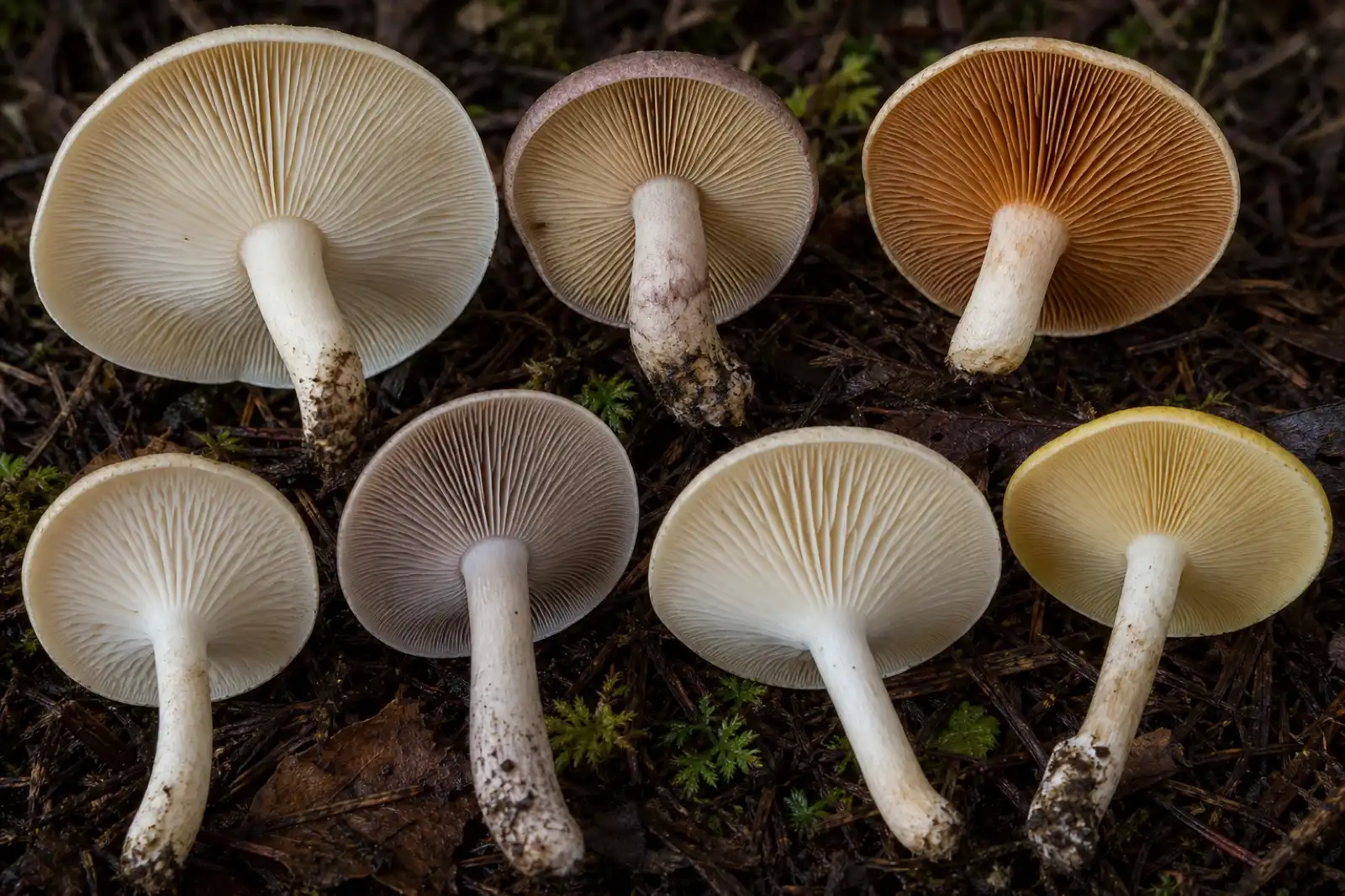
Mushroom Gill Types: Attachment, Spacing, and Color
Compare free, attached, notched, adnate, and decurrent mushroom gills while recording spacing, short gills, edge details, bruising, and color changes.
identification
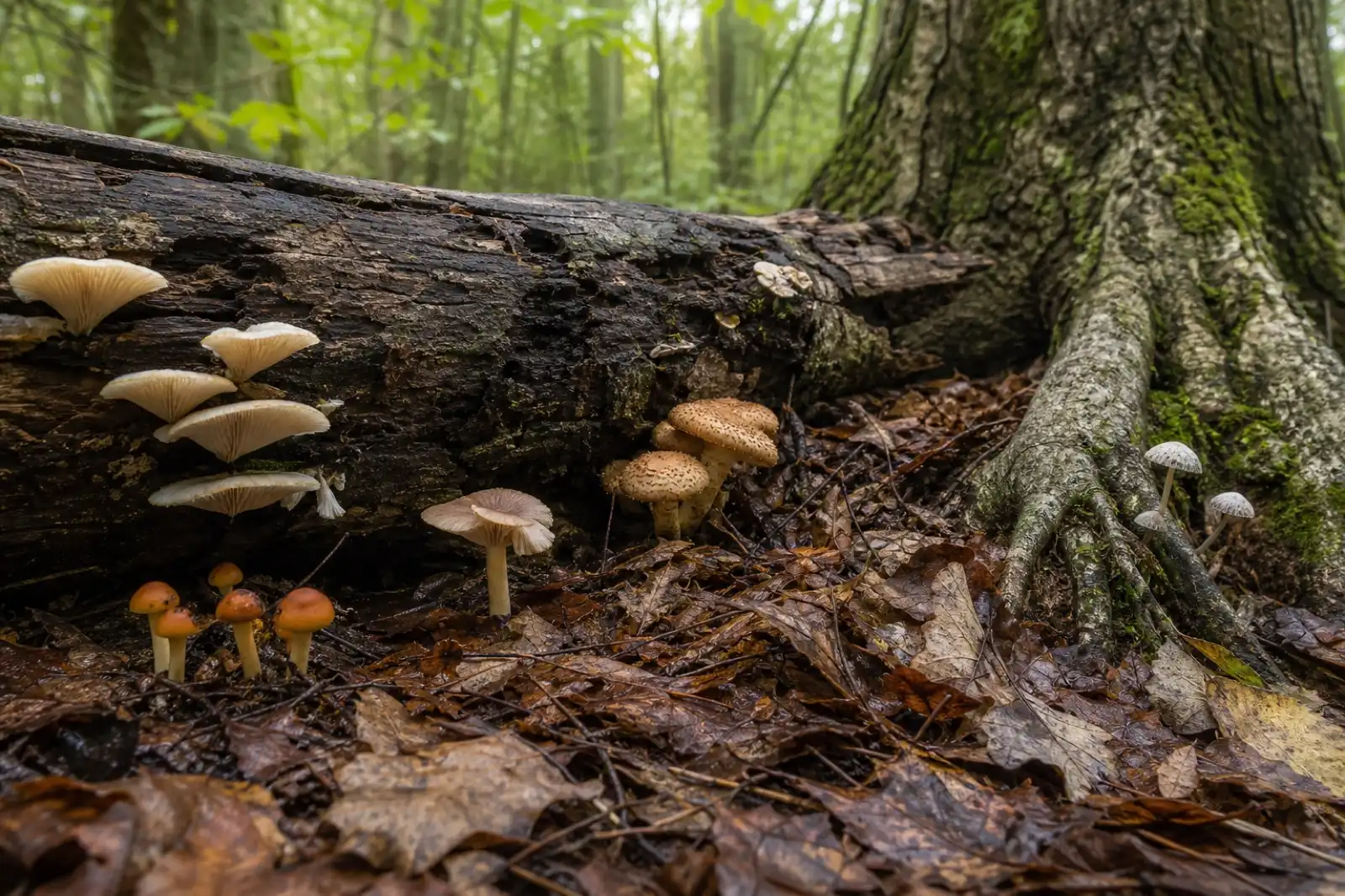
Using Habitat to Identify Mushrooms
Record substrate, associated plants, soil, wood type, moisture, elevation, and fruiting pattern as identification evidence.
mushrooms
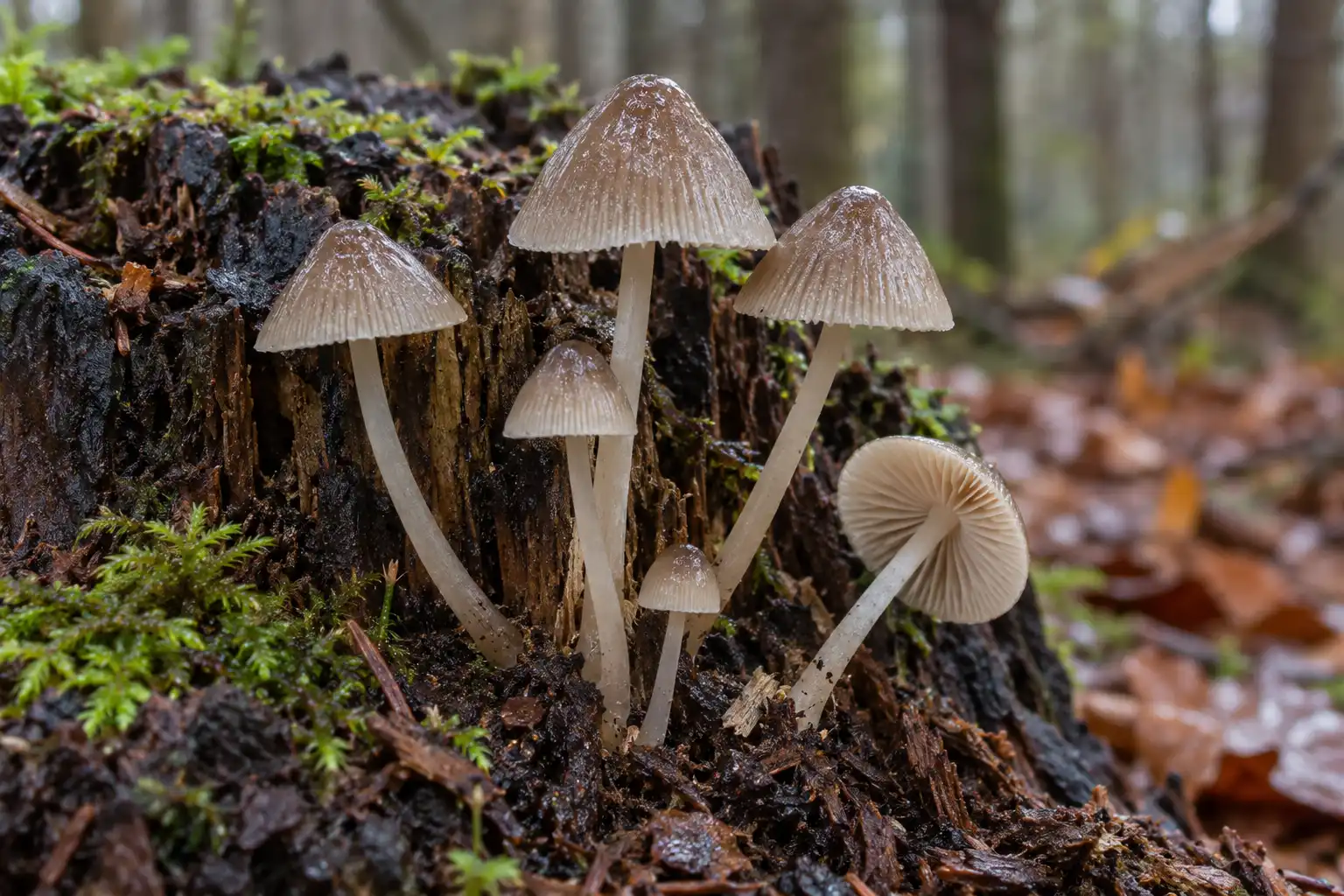
Common Bonnet Mushroom: Wood, Form, and Identification Limits
Identify the Common bonnet by its wood attachment, cap striations, gill development, clustered habit, microscopy limits, ecology, and close lookalikes.
Continue exploring
Browse more practical guides in Mushroom Encyclopedia or visit the mushroom encyclopedia.