Mushroom Encyclopedia
Common Bird's Nest Fungus: Crucibulum laeve Field Guide
Document Crucibulum laeve by its smooth tan cups, pale peridioles, shaggy lid, splash dispersal, woody substrate, microscopy, and fluted lookalikes.
Species context
Treat profiles as reference material
Species profiles summarize documented traits, taxonomy, and lookalikes, but natural variation can be substantial.
Use the safety checklist →Decision limit
A profile cannot authenticate a specimen
Do not eat a wild mushroom from an online match, single feature, or generated image.
Read the safety disclaimer →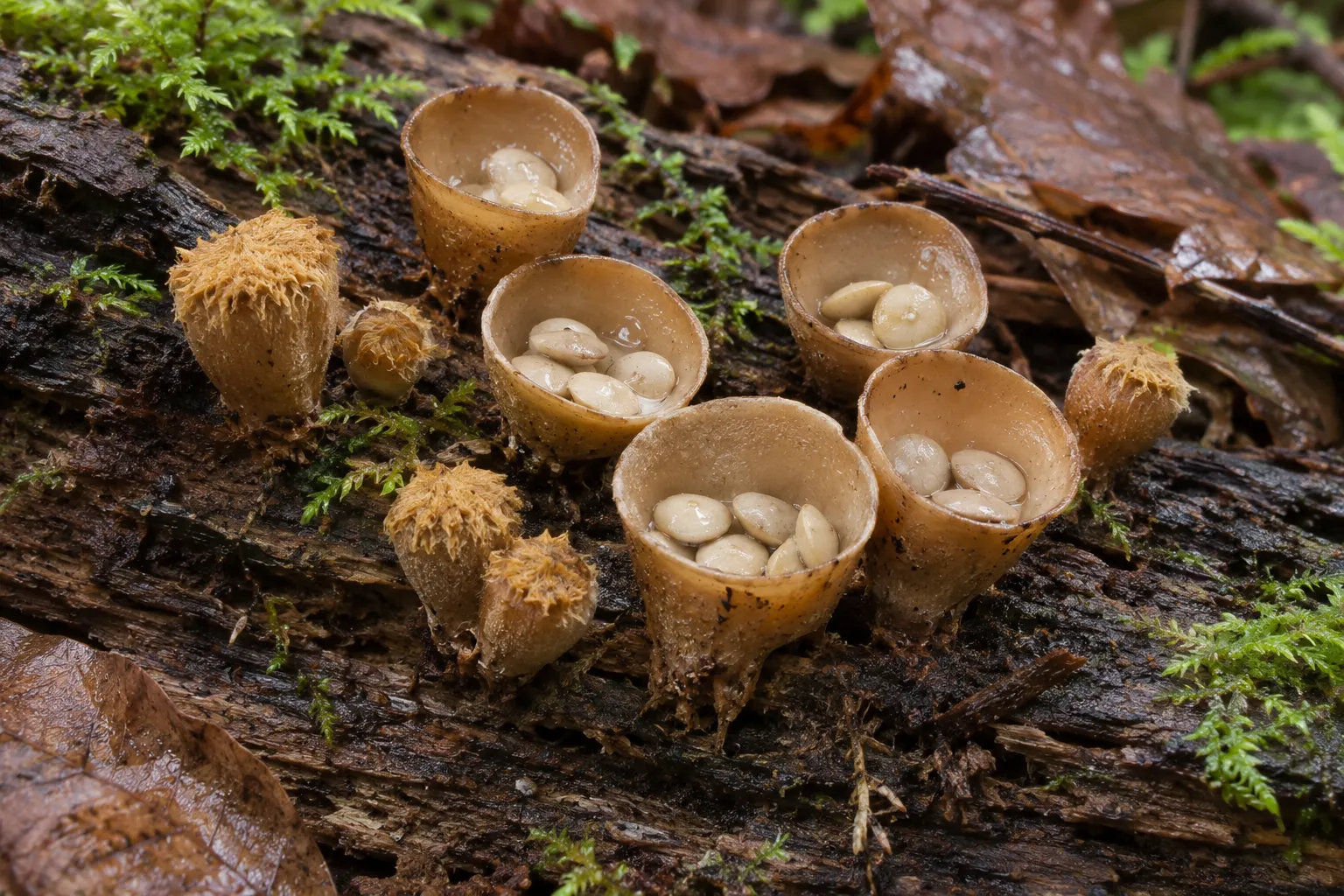
Quick facts
- Scientific name
- Crucibulum laeve
- Common names
- Common bird's nest fungus, White-egg bird's nest fungus
- Taxonomy
- Crucibulum · Nidulariaceae
- Edibility context
- Unknown: Not recommended for food use; the fruit bodies are minute and tough, and similar splash-cup fungi require careful separation.
- Spore print
- A conventional loose print is not the useful test; spores remain packaged in peridioles and should be examined from a specimen-linked mount.
- Toxicity context
- Unknown: No food clearance is offered, and an online image cannot authenticate a specimen or rule out contamination.
- Season
- June, July, August, September, October, November
- Growing difficulty
- Expert
- Regions
- Europe, North America, other temperate regions with verified records
Safety limit: These labels summarize documented context; they never authenticate a wild specimen. Cooking does not make a poisonous species safe.
Common bird’s nest fungus, Crucibulum laeve, turns a rain drop into a dispersal event. Its tiny tan cups hold several pale, lens-shaped packets that resemble eggs in a nest. Those packets are peridioles containing spores, not eggs, seeds, snail capsules, or loose stones. The complete record joins cup development, smooth inner wall, peridiole color and attachment, exact substrate, scale, microscopy, and regional literature.
This page is specifically about C. laeve. The existing fluted bird’s nest guide owns the prominently grooved Cyathus striatus intent. A photograph that shows only “tiny cups with eggs” cannot safely collapse those species.
Start with scale and the occupied material
Make an overview before moving any debris. Show the wood chip, twig, mulch bed, dead stem, or log surface carrying the colony. Add a millimeter scale beside the cups without pressing them. Record the colony’s occupied length, number of open and closed bodies, exposure to rain, and whether the material touches soil.
Do not name the host tree from the nearest leaf. Mulch may have traveled far from its source, and a cup on a buried chip can look terrestrial. Describe what the evidence supports: hardwood chip, bark fragment, fibrous stem, or unidentified woody debris. The habitat documentation guide provides a repeatable way to separate substrate observations from landscape assumptions.
Follow a cup from shaggy button to open nest
Young bodies are roughly barrel-shaped and closed by an epiphragm, a temporary membrane across the top. Their outside may look yellow-brown and shaggy. Photograph several ages in one colony rather than peeling the lid from a juvenile. Natural development shows whether the membrane thins, tears, and exposes the contents.
For mature cups, measure height, rim width, basal width, and wall thickness on several intact examples. Record whether the rim is circular, flared, torn, or compressed by neighboring debris. Weathering changes color and removes hairs, so a range from one connected colony is more useful than two unmatched internet photographs.
Inspect the smooth interior without confusing “smooth” with featureless
The inner wall of a mature common bird’s nest is comparatively smooth and tan to ochre. It lacks the strong vertical fluting that defines the most obvious comparison, Cyathus striatus. Use low raking light and a side view; a wet reflective surface can hide fine texture or create false bands.
“Smooth” is a relative field character, not a substitute for magnification. Photograph the rim and interior at the same scale as a known comparison where possible. Dirt tracks, collapsed tissue, and drying cracks should not be promoted into taxonomic ridges.
Count and map the pale peridioles
Count visible peridioles in several naturally opened cups. Record their color, diameter, thickness, overlap, and whether sediment or algae obscures them. They are commonly pale cream to whitish and shaped like tiny flattened lenses. Avoid rearranging them for a more symmetrical picture.
Each peridiole has layered walls and is connected to the cup through a specialized funicular apparatus. A forceful rain splash can eject the packet; its cord can unwind and help it catch on nearby material. That mechanism is more specific than saying the fungus “throws eggs.” It also explains why an emptied cup remains valid evidence rather than a different species.
Observe splash dispersal without staging a misleading result
A useful field series records the same marked patch before and after natural rain. Place removable reference markers outside the colony, photograph from a fixed position, and log rainfall timing. Note cups that remain full, lose packets, accumulate water, or become buried by splash debris.
Do not pour water into a cup for a dramatic video. Artificial streams differ from raindrop impacts and can wash peridioles between neighboring fruit bodies. If a controlled demonstration is undertaken for education, keep it separate from the field record, state drop height and volume, use a legally collected mature body, and never present it as a natural event.
Separate common and fluted bird’s nests by a character set
The strongest visible separation from fluted bird’s nest is the combination of a smooth tan inner cup and pale peridioles. C. striatus normally shows distinct vertical ribs inside a darker, more strongly textured cup. Compare mature bodies; a closed juvenile does not expose the decisive inner wall.
Other Cyathus species overlap in size and habitat. Cup flare, outer hairs, inner texture, peridiole color, tunics, cord structures, spore dimensions, and substrate all matter. A mulch bed can support more than one splash-cup fungus, so do not assume every cup in a wide photograph belongs to the closest specimen.
Link microscopy to one numbered cup
If collection is lawful, retain one mature cup with its substrate and number it before removal. Photograph the intact contents. Mount spores from a single peridiole and record the mount medium, calibration, magnification, number measured, full size range, shape, wall, and any germ pore specified by the key.
Keep peridiole and cup material together. Loose pale discs collected from a mixed colony can no longer support a specimen-level conclusion. A DNA result also needs traceable tissue, clean handling, readable sequence, reference coverage, and a taxonomic concept; a database label alone cannot repair a mixed sample.
Treat a mulch appearance as decomposition, not plant disease
The fungus breaks down dead organic material. Its fruit bodies on bark mulch do not show that it is attacking living garden plants, and their disappearance does not prove the mulch has stopped decomposing. Record moisture, chip size, shade, irrigation, and time since mulching if the goal is to study where fruiting becomes visible.
Divide a bed into equal observation plots instead of comparing a wet shaded corner with a dry exposed edge. Count open cups, closed bodies, and old empty cups after comparable weather intervals. The result describes visible fruiting, not the full distribution of mycelium in the bed.
Keep a peridiole-loss ledger across one rain event
Choose at least ten naturally open cups that can be relocated without touching them. Give each cup a map number and photograph its contents from the same angle immediately before forecast rain. Count only packets whose boundaries are visible; record “obscured” when water, leaf fragments, or overlap prevents a defensible number. After rain, repeat the frame and note newly empty cups, displaced packets on nearby stems, collapsed walls, and sediment added to the interior.
Use a nearby control area with similar cups that was sheltered from direct drops by an existing log overhang. Do not install a cover that changes airflow or redirects runoff onto another colony. The comparison can test whether visible packet loss coincides with splash exposure at that site. It cannot measure dispersal distance for packets that were not recovered, and it cannot prove that every missing peridiole attached successfully or released spores.
If a packet is found on vegetation, photograph its position and the connecting cord before handling. Record horizontal and vertical distance from the most plausible source cup, but label the source uncertain when several cups sit within splash range. This ledger preserves absence as data instead of converting an emptied cup into a dramatic but unsupported dispersal story.
Pair cup development with wood moisture, not weather adjectives
“Damp weather” is too vague for a developmental record. At fixed points beside, not through, the colony, measure wood-surface moisture with the same method and record recent rainfall, shade duration, air temperature, and substrate thickness. Photograph closed bodies, newly opened cups, full cups, and weathered empty cups inside equal-area plots.
Repeat after dry and wet intervals without watering the fungus. A rise in visible mature cups may follow conditions established days earlier, and old cups can persist after the surface dries. Report the lag and the counts rather than claiming one shower caused fruiting. Compare wood chips with intact log wood only as separate substrate classes; their water storage, heating, and exposed surface area differ.
The method also prevents a landscaping conclusion from outrunning the evidence. A fruiting patch indicates that this piece of lignin-rich material supported reproduction under the recorded conditions. It does not establish the moisture state of a wall, root system, or all mulch in the bed.
Keep food and safety conclusions proportional
Common bird’s nest fruit bodies are tiny and tough, with no practical reason to treat them as food. This page does not recommend tasting them. Pale packets do not establish edibility, and a remote photograph cannot exclude another species, contaminated substrate, pesticide exposure, or animal waste.
If a child or animal may have swallowed an unknown fungus, preserve material and photographs and contact an appropriate poison-control, veterinary, or medical service. Do not wait for a social-media identification. Record time, estimated amount, symptoms, location, and any treatment already given.
Audit the editorial image
The 1536 × 1024 cover is an original AI-assisted editorial image. It was opened beside the site’s Fluted Bird’s Nest and Hairy Curtain Crust baselines. The accepted frame uses diffuse woodland light, restrained browns and greens, damp fibrous wood, complete attachments, mixed developmental stages, smooth mature cup interiors, and pale lens-shaped peridioles. It contains no text, watermark, logo, collage seam, stretch, banding, or obvious repeated colony geometry.
The picture deliberately avoids the conspicuous inner ribs of C. striatus, but it remains an illustration rather than a voucher. It cannot prove dimensions, microscopy, substrate identity, distribution, or safety. Its role is to show which evidence a real observation should preserve.
Build a reviewable common bird’s nest record
- Photograph the entire colony and exact woody material.
- Add scale without touching the fruit bodies.
- Record naturally closed, opening, full, and emptied cups.
- Light the mature interior to test whether it is truly unfluted.
- Count pale peridioles without rearranging them.
- Compare Crucibulum and regional Cyathus with a current key.
- Link microscopy or sequence data to a numbered cup and substrate.
- Keep decomposition, plant-health, and food claims inside the evidence.
The useful search image is not merely a miniature nest. It is a small, woody-debris splash cup whose smooth tan interior, pale peridioles, shaggy lidded juvenile stage, scale, and specimen-linked microscopic evidence agree.
References
- GBIF species search: Crucibulum laeve — occurrence, voucher, and nomenclatural leads that require record-level checking.
- NCBI Taxonomy Browser: Crucibulum laeve — taxonomy and sequence-linked context.
- First Nature: Crucibulum laeve — cup development, peridioles, habitat, season, and comparison characters.
- North American Mycological Association: mushroom poisoning syndromes — conservative response guidance after suspected ingestion.
Editorial status: reviewed by the MushroomScope editorial team on November 17, 2026; no named mycologist, toxicologist, clinician, or food-safety expert reviewed this page.
Source quality notes
MushroomScope cites sources that match the page scope, such as taxonomic databases, extension guidance, food-safety agencies, food-composition databases, and peer-reviewed or institutional health references. Sources support context and uncertainty; they do not turn an online page into specimen identification, medical advice, or a tested recipe record.
Frequently asked questions
What are the little eggs inside common bird's nest fungus?
They are peridioles: spore-bearing packets rather than eggs or seeds. Rain splashes them from the cup, and a cord can help them catch nearby vegetation or debris.
How does Crucibulum laeve differ from fluted bird's nest fungus?
Mature Crucibulum laeve has a comparatively smooth inner cup wall and pale peridioles. Cyathus striatus has conspicuous vertical grooves inside a darker cup and commonly darker peridioles.
Why do young common bird's nest fungi look closed?
Young cups are covered by a temporary epiphragm and may have a shaggy yellow-brown exterior. The lid ruptures as the cup matures and exposes the peridioles.
Where should I look for common bird's nest fungus?
Search damp decaying wood, wood chips, plant stems, bark mulch, and other lignin-rich debris. Record the exact material because a close-up alone removes useful ecological evidence.
Is common bird's nest fungus edible?
This guide gives no food recommendation. The fruit bodies are tiny and tough, and remote identification cannot establish a collection's identity, cleanliness, or safety.
Related guides
mushrooms
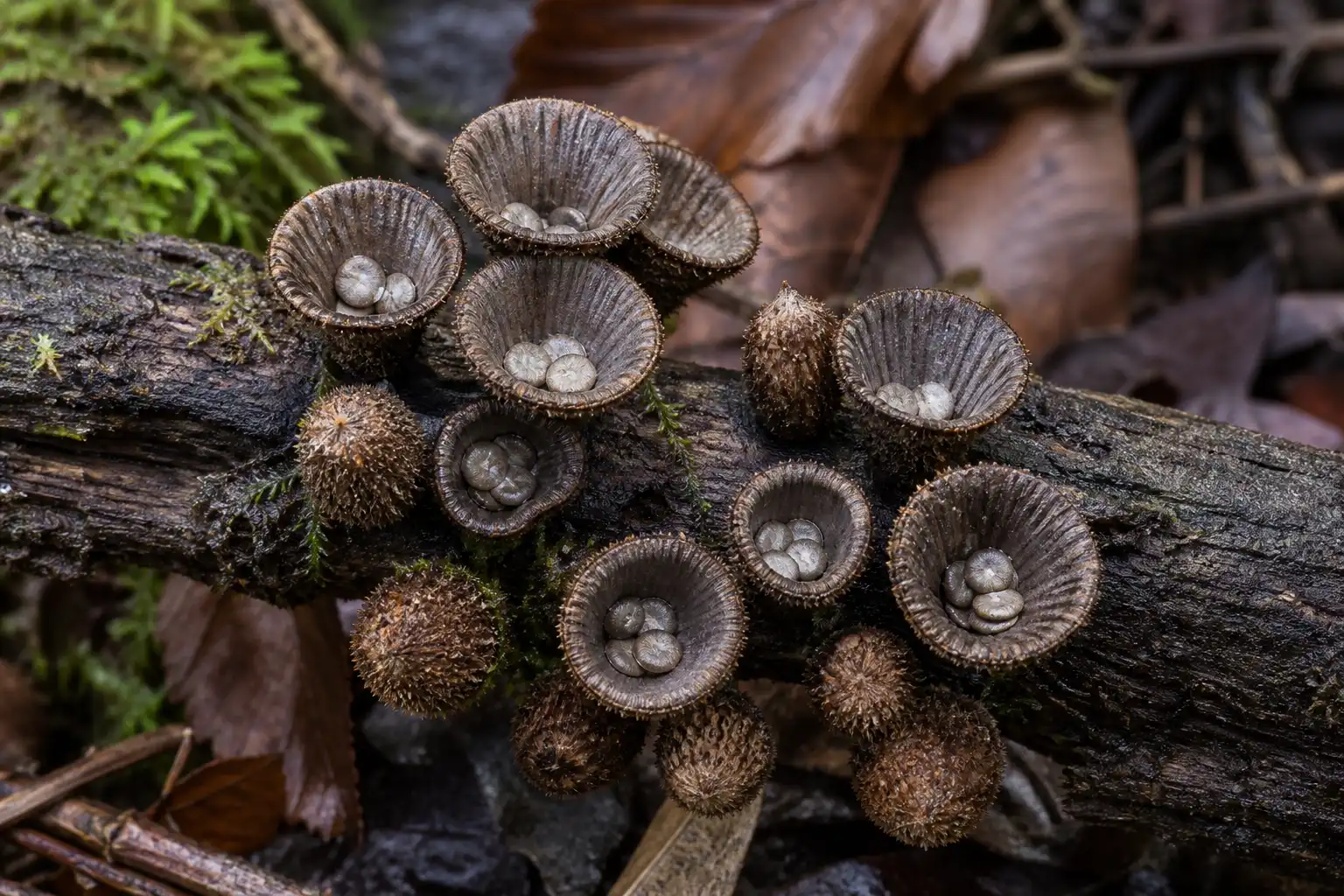
Fluted Bird's Nest Fungus: Cups, Peridioles, and Rain Dispersal
Document Cyathus striatus by its shaggy closed cups, fluted inner walls, disk-like peridioles, decaying-wood habitat, rain-splash dispersal, and lookalikes.
identification
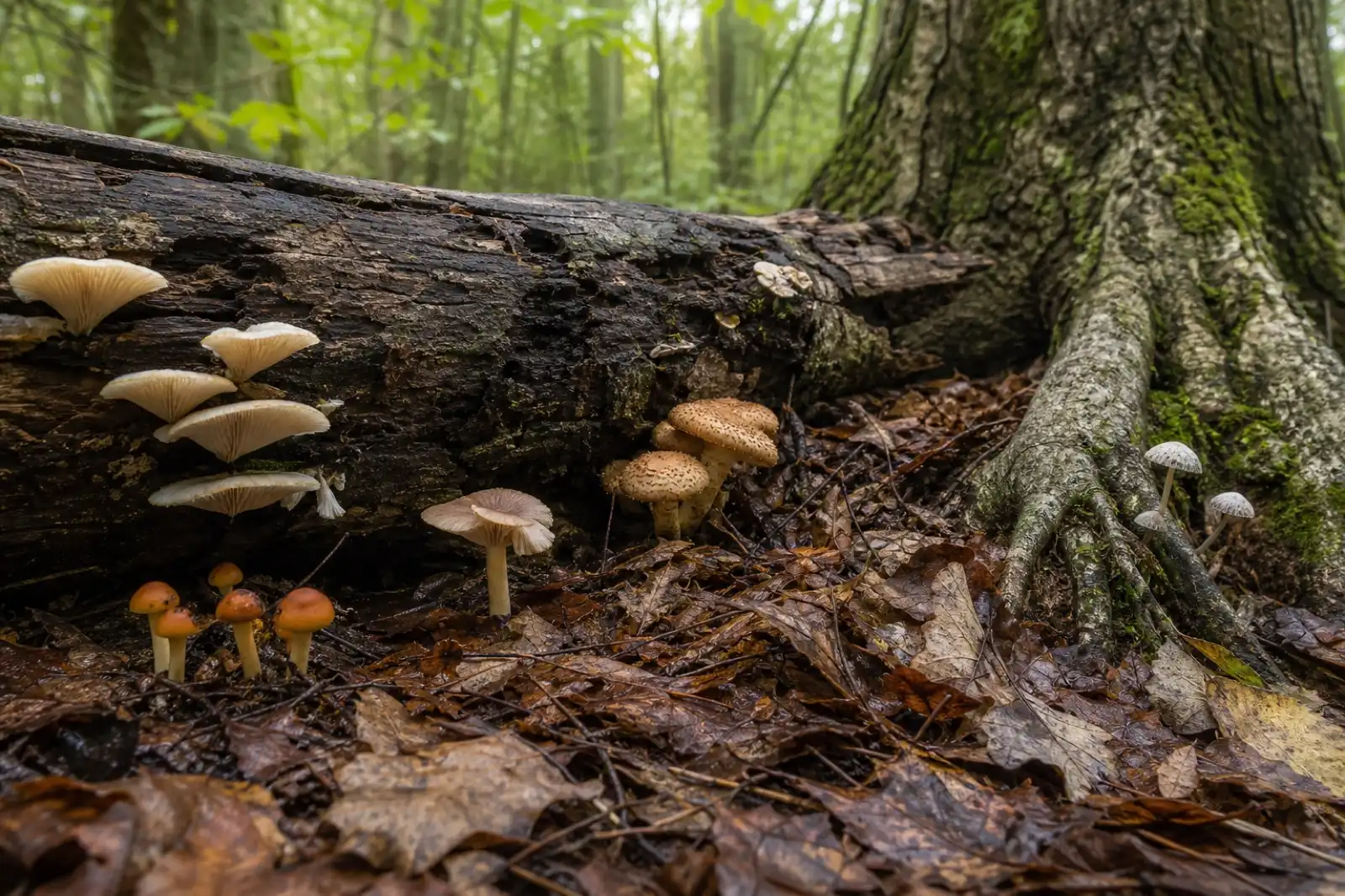
Using Habitat to Identify Mushrooms
Record substrate, associated plants, soil, wood type, moisture, elevation, and fruiting pattern as identification evidence.
mushrooms
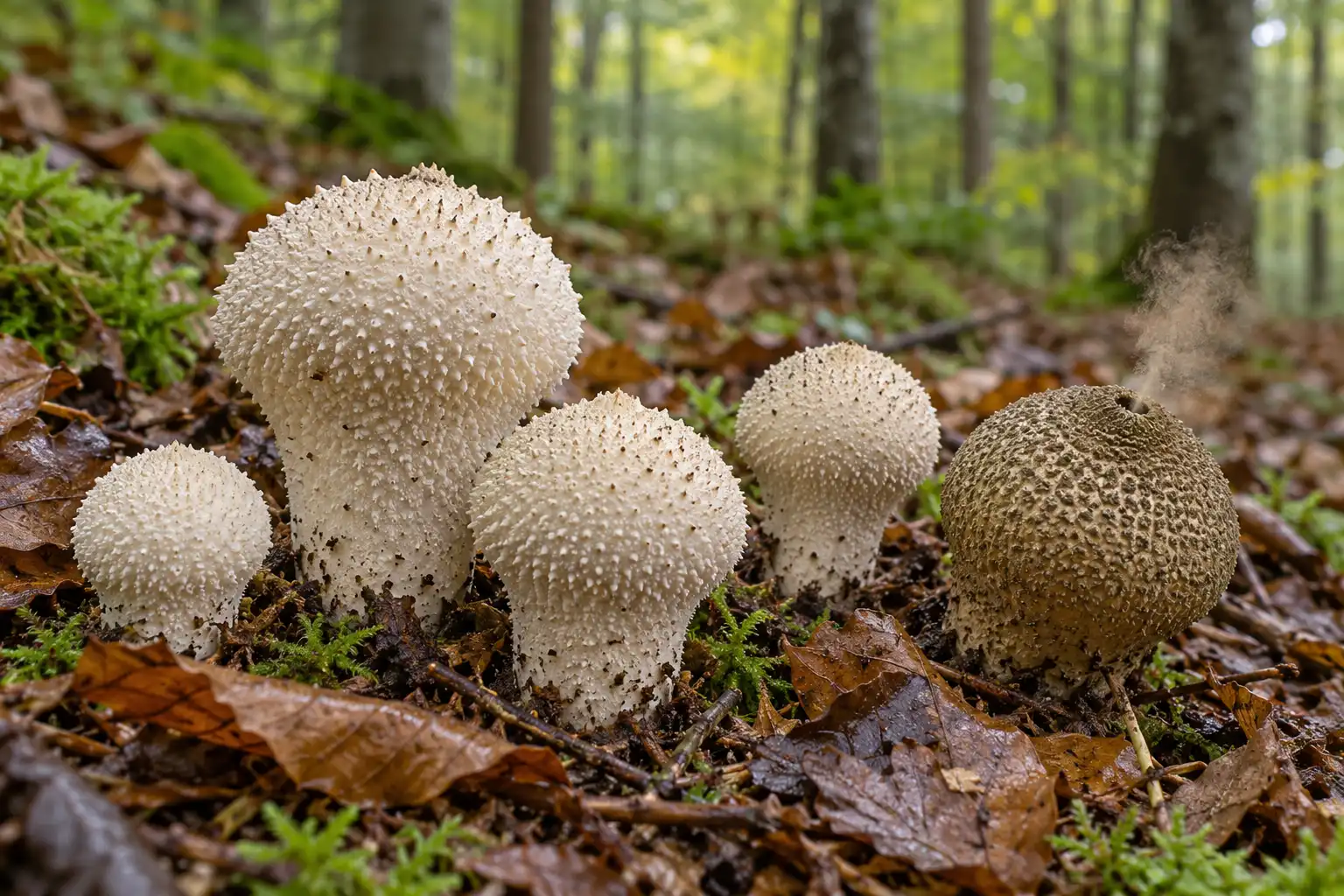
Common Puffball: Spines, Interior, Spores, and Lookalikes
Document common puffballs through pear shape, detachable spines, sterile base, interior changes, apical pore, woodland ecology, and lookalike limits.
Continue exploring
Browse more practical guides in Mushroom Encyclopedia or visit the mushroom encyclopedia.