Mushroom Encyclopedia
Coral Tooth Fungus (Hericium coralloides): Identification and Ecology
Learn how coral tooth fungus branches and forms teeth, where it grows on hardwood, how it differs from other Hericium, and why photos cannot confirm edibility.
Species context
Treat profiles as reference material
Species profiles summarize documented traits, taxonomy, and lookalikes, but natural variation can be substantial.
Use the safety checklist →Decision limit
A profile cannot authenticate a specimen
Do not eat a wild mushroom from an online match, single feature, or generated image.
Read the safety disclaimer →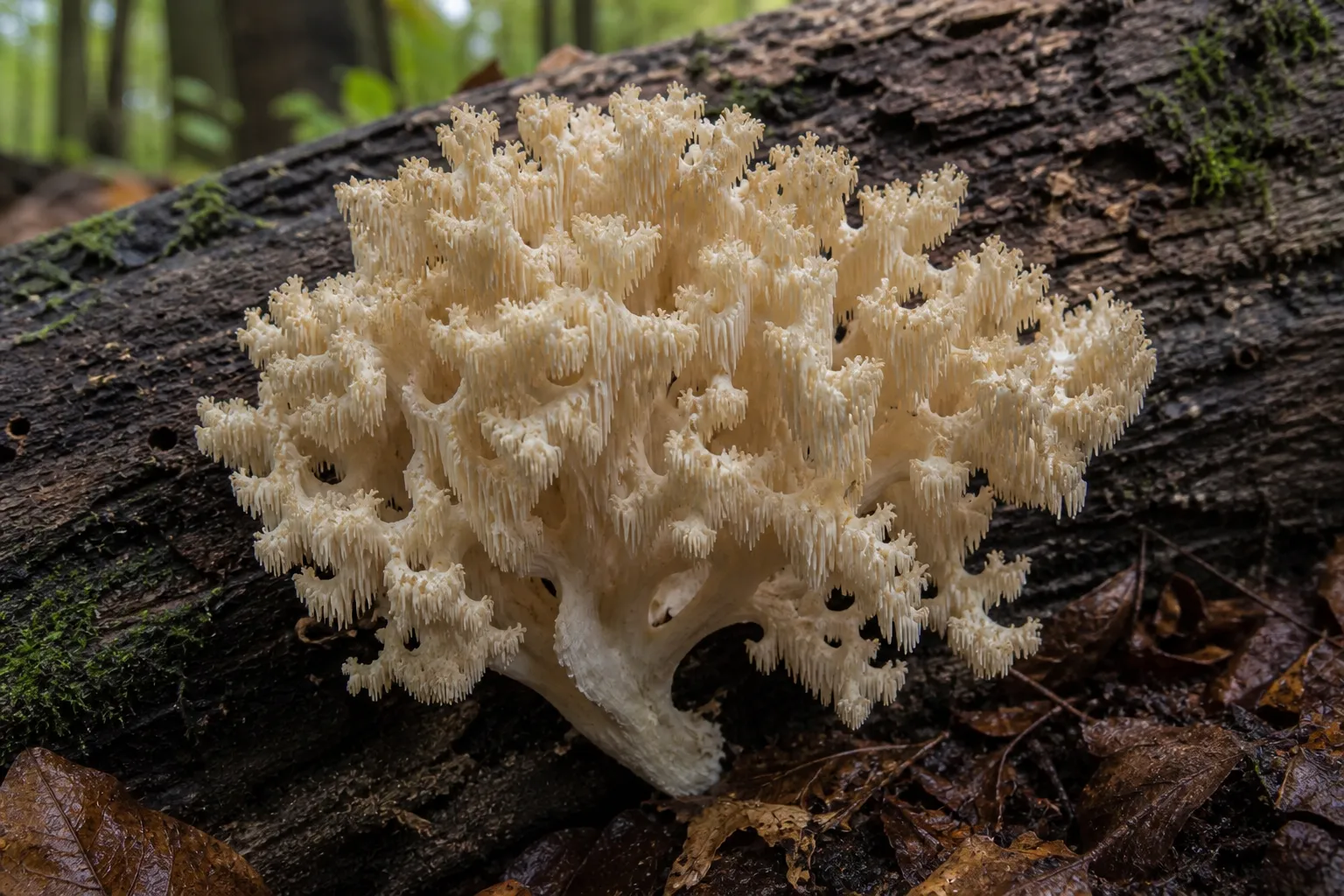
Quick facts
- Scientific name
- Hericium coralloides
- Common names
- coral tooth fungus, coral tooth mushroom
- Taxonomy
- Hericium · Hericiaceae
- Edibility context
- Edible: Reported food use is not remote clearance. Confirm identity in person and consider freshness, contamination, local rules, and individual reaction.
- Spore print
- White.
- Toxicity context
- None Known: Practical risks include misidentification, spoilage, contamination, and individual allergy or intolerance.
- Season
- August, September, October, November
- Growing difficulty
- Moderate
- Regions
- temperate Northern Hemisphere records, Europe, Asia, North America under regionally interpreted names
Safety limit: These labels summarize documented context; they never authenticate a wild specimen. Cooking does not make a poisonous species safe.
Coral tooth is a branching tooth fungus, not a coral mushroom
Hericium coralloides produces an unusually architectural fruit body. A fresh specimen is white to cream and divides repeatedly into an open framework. Short teeth hang from many branch surfaces. Those teeth, not gills or pores, form the spore-bearing layer. Branching, teeth, and direct hardwood attachment establish the useful starting concept.
The common name can mislead. “Coral mushroom” is used for unrelated branching fungi, especially Ramaria and Clavulina. Those fungi do not become Hericium because their silhouette resembles coral. A young or damaged coral tooth may not yet show every expected character, either. Identification must follow structures, ecology, region, and developmental stage rather than one name or photograph.
This page is a species guide and documentation aid. It cannot authenticate a specimen or decide whether it is edible. If food use is contemplated, obtain in-person confirmation from someone qualified to evaluate the intact collection locally.
Read the fruit body from attachment to tooth tips
Begin at the wood. Coral tooth has no conventional cap and stem. Its branches arise from a shared base attached to dead or declining hardwood. Photograph that base before moving anything. A specimen apparently growing from soil may connect to buried wood, but aggressive digging destroys evidence and habitat.
Follow the framework outward. Mature branches divide repeatedly and leave open spaces rather than merging into one dense pom-pom. Examine their undersides and sides for fine downward teeth. Tooth length and distribution change during development, so compare several areas instead of selecting the neatest tip. Natural-light close-ups are more useful than a saturated phone image.
Fresh tissue is generally white to cream. Age, handling, dry weather, insects, or bacterial deterioration can introduce yellow, tan, or brown zones. Discoloration is a condition record, not a species verdict. Note texture and odor without tasting. Softening, slime, widespread browning, or a sour or putrid odor should end food consideration even after identification.
The spore deposit is white, but that has low resolving power because several tooth fungi also have pale spores. The spore-print method records one character; it never confirms this species alone.
Separate coral tooth from other Hericium forms
Lion’s mane forms a compact mass
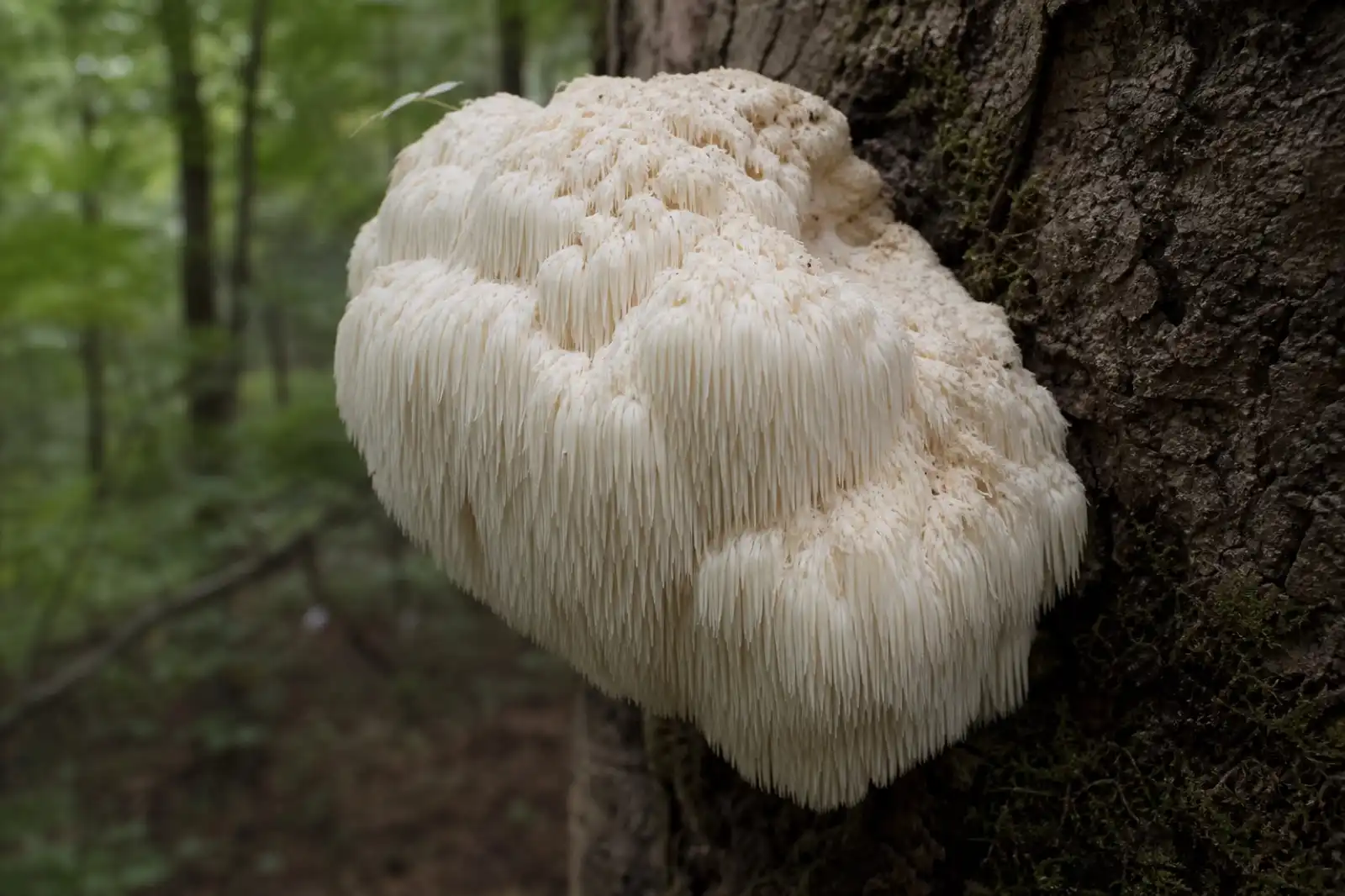
Lion’s mane, Hericium erinaceus, usually develops as a compact, largely unbranched body with conspicuous long hanging spines. Coral tooth presents a more open repeated branching system, with shorter teeth distributed along branches. The distinction is straightforward in ideal mature examples but weaker in young, weathered, or malformed fruit bodies. The lion’s mane species guide covers that species’ separate cultivated and evidence intent.
Other branched Hericium require regional interpretation
Names applied to branched Hericium have not always been used consistently across continents and older field guides. H. americanum is common in North American comparisons, while European and Asian literature may organize records differently. Branch density, tooth placement and length, host, spores, hyphal characters, and geography can matter. A current regional key is more defensible than transferring a name from a photograph posted in another country.
Soil corals lack a tooth-bearing surface
Species of Ramaria, Clavulina, and other coral-like genera can be repeatedly branched and pale. Their fertile surface is not made of the hanging teeth seen in Hericium. Many arise from soil or litter, although substrate impressions can deceive. Documenting the attachment, fertile surface, and nearby wood prevents silhouette-only comparison.
Hardwood condition explains where fruit bodies appear
Coral tooth is a wood-decay fungus associated with dead or declining broadleaf wood, including fallen trunks, large branches, and logs. Host reports include beech, maple, and other hardwoods, but no host list is universal: tree communities, naming practice, and sampling vary by region. Identify the tree independently where possible from bark, leaves, buds, and stand context.
Record whether wood is standing or fallen, barked or bare, solid or advanced in decay, shaded or exposed. Note whether the fungus emerges from a wound, broken end, underside, or buried portion. These details remain useful if the fungal name later changes. GBIF provides occurrence context, but mapped points inherit the quality and historical names of their source datasets.
Dead wood is habitat for insects, mosses, fungi, and cavity-dependent organisms. Avoid peeling bark or breaking logs to search for more. Where collecting is permitted, take only what a documented purpose needs and leave representative material to mature and release spores.
Season follows local weather rather than a fixed calendar
Temperate records often cluster in late summer and autumn, when moisture and temperature align, but fruiting shifts with latitude, elevation, rainfall, and the log’s thermal behavior. A month list copied between regions is weaker than local dated observations. Record recent rainfall, temperatures, canopy exposure, and wood condition with the date.
Repeat observations are especially useful. Photographing the same fruit body from a safe distance over several days can show tooth development, color change, insect damage, and collapse. Do not repeatedly handle it just to create a time series.
Phenology records become more comparable when observation effort is recorded too. A ten-minute trail walk cannot be compared directly with a three-hour survey across several stands. Note the distance searched, number of suitable logs examined, and whether the site was visited after the same weather event. An absence record is meaningful only when method and habitat opportunity are visible.
The fruit body is temporary evidence of a longer wood-decay process. It does not reveal how far mycelium extends, when colonization began, or whether another fungus occupies adjacent wood. Avoid turning one fruiting into a precise claim about tree death or structural stability. On a standing tree near people or property, document the location and seek a qualified arborist’s assessment; the image is not a remote hazard rating.
Food reports do not clear a wild collection
Coral tooth has a food-use reputation, particularly while young and fresh, but edibility statements assume correct identification and legal collection from an uncontaminated site. A roadside log, treated timber, industrial property, sprayed landscape, or flood-debris pile adds exposure questions cooking cannot resolve. A known edible species can also spoil.
If qualified local expertise confirms a legal collection, retain an uncooked portion and photographs, cook it thoroughly, and begin with a modest portion. Allergy or gastrointestinal intolerance remains possible. Never serve a first-time wild collection to someone unable to communicate symptoms clearly. The FDA source below supplies general produce hygiene, not wild-mushroom certification.
For symptoms after an unidentified or wild mushroom, contact local emergency services or a poison center promptly. Preserve uncooked material, trimmings, packaging, photographs, location, and the time eaten. Do not wait for social-media identification or induce vomiting unless a medical professional directs it. NAMA’s syndrome overview explains why symptom timing helps responders but is not a home diagnostic tool.
Cultivation starts with authenticated culture
Some Hericium strains grow on sterilized hardwood-based blocks, but “grows like lion’s mane” is not a complete method. Strain, substrate, sterilization, gas exchange, colonization temperature, humidity, fresh air, and harvest timing interact. A culture supplier’s protocol is safer than universal numbers copied from another species or system.
Label species and supplier lot, separate clean inoculation from fruiting and waste areas, and record dates and abnormalities. Unexpected green, black, orange, or pink growth, persistent foul odor, slime, or unidentified fruit bodies are reasons to isolate and discard a food block. Do not clone an uncertain wild collection for eating; cultivation reproduces the wrong organism as readily as the intended one.
Compare batches by changing one variable at a time. Record substrate dry weight and water addition, inoculation percentage, container type, filter specification, colonization time, pin-set position, room readings, and harvest mass. One successful block does not establish an optimal recipe, while repeated failures cannot be diagnosed from room humidity alone. Sensor placement, calibration drift, internal block temperature, and carbon-dioxide accumulation may separate recorded conditions from those at the fruit body.
Harvest before teeth discolor or the structure collapses, using clean tools and cooling promptly if intended as food. Cultivation notes show what happened to one authenticated batch; they do not prove that a visually similar wild collection is the same organism.
Build a record another person can audit
Use the mushroom photo checklist to capture habitat, attachment, overall form, branch junctions, and tooth close-ups in natural light. Add measurements from several branches, a written color description, host evidence, odor, date, weather, and region. If lawful, preserve a small dried voucher linked to the field notes.
Compare the complete record with a current regional key and local occurrence data. Image recognition can assemble candidates, but cannot inspect microscopy or repair missing habitat evidence. The identification safety checklist explains why agreement among observations is still not remote food clearance.
References
- Global Biodiversity Information Facility. Hericium coralloides species record. Taxonomic backbone and occurrence context; individual records still require evaluation.
- U.S. Forest Service. Ecology and Management of Early Successional Habitats in the Central Hardwood Region. Broader dead-wood and hardwood-habitat management context, not a species key.
- North American Mycological Association. Mushroom Poisoning Syndromes. Conservative poison-response context.
- U.S. Food and Drug Administration. Selecting and Serving Produce Safely. General handling boundaries; it does not certify wild food.
Editorial review: August 26, 2026. This page has editorial review only and has not been reviewed by a named mycologist or clinician. Taxonomy, distribution, and poison-response contacts should be rechecked at every substantive update.
Source quality notes
MushroomScope cites sources that match the page scope, such as taxonomic databases, extension guidance, food-safety agencies, food-composition databases, and peer-reviewed or institutional health references. Sources support context and uncertainty; they do not turn an online page into specimen identification, medical advice, or a tested recipe record.
Frequently asked questions
What separates coral tooth fungus from lion's mane?
Coral tooth forms an open, repeatedly branching framework with many relatively short teeth distributed along branches. Lion's mane usually forms a more compact, unbranched mass with longer hanging spines.
Does coral tooth fungus grow from soil?
It is a wood-decay fungus associated with dead or declining hardwood. A fruit body that seems terrestrial may be attached to buried wood, so document the substrate carefully.
Can a photograph confirm Hericium coralloides?
No. Photographs document branching and teeth, but identification also depends on attachment, host wood, region, maturity, microscopy, and a current regional key.
Is wild coral tooth fungus safe to eat?
This guide cannot clear a wild collection for food. Identity, local regulations, freshness, contamination, individual reaction, and preparation all matter; seek in-person local expertise.
Can coral tooth fungus be cultivated like lion's mane?
Some Hericium cultures fruit on sterilized hardwood-based substrates, but species and strain requirements matter. Use authenticated commercial culture and its supplier protocol.
Related guides
mushrooms
Hericium erinaceus: Lion’s Mane Mushroom Species Guide
Learn lion’s mane identification, hardwood ecology, cultivation, nutrition, supplement evidence, lookalikes, safety limits, and practical FAQs.
identification
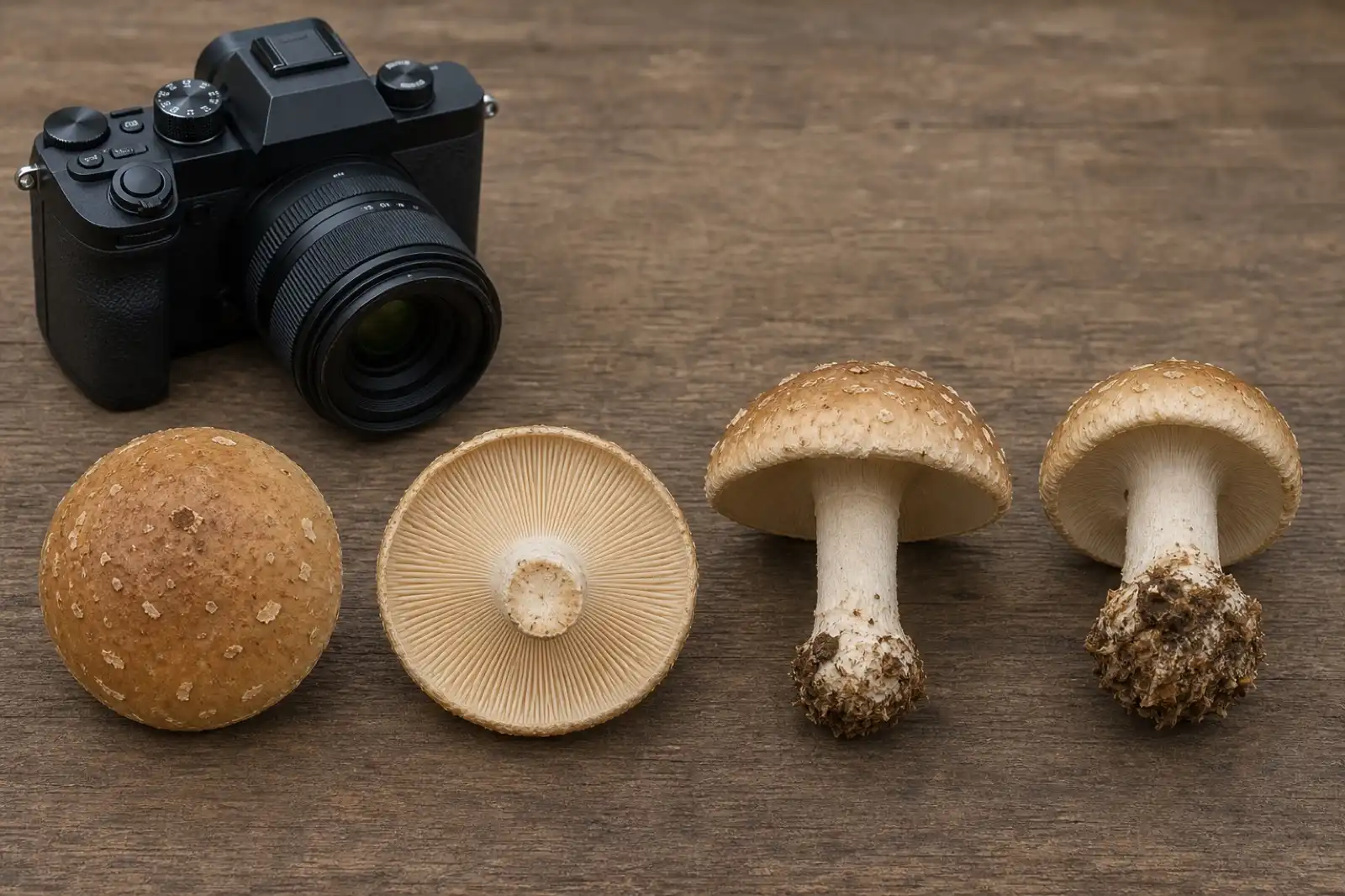
Mushroom Photography Checklist for Identification
Capture the cap, underside, complete stem base, habitat, scale, and specimens at different ages before asking for identification help.
identification
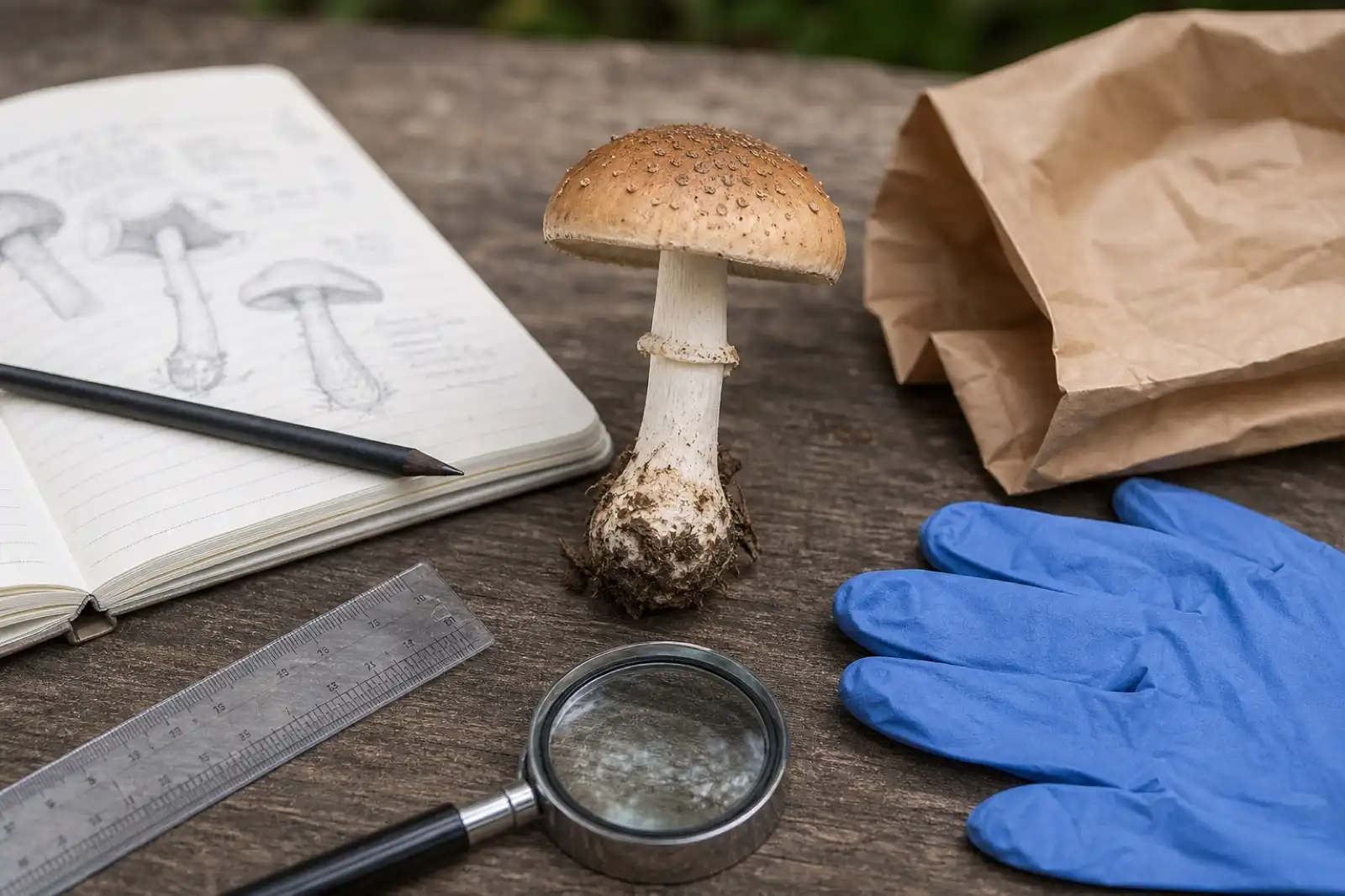
Mushroom Identification Safety Checklist
Use a conservative checklist before handling, documenting, or discussing any wild mushroom, especially when edibility is being considered.
Continue exploring
Browse more practical guides in Mushroom Encyclopedia or visit the mushroom encyclopedia.