Mushroom Encyclopedia
Hericium erinaceus: Lion’s Mane Mushroom Species Guide
Learn lion’s mane identification, hardwood ecology, cultivation, nutrition, supplement evidence, lookalikes, safety limits, and practical FAQs.
By MushroomScope Editorial Team · · Updated
Species context
Treat profiles as reference material
Species profiles summarize documented traits, taxonomy, and lookalikes, but natural variation can be substantial.
Use the safety checklist →Decision limit
A profile cannot authenticate a specimen
Do not eat a wild mushroom from an online match, single feature, or generated image.
Read the safety disclaimer →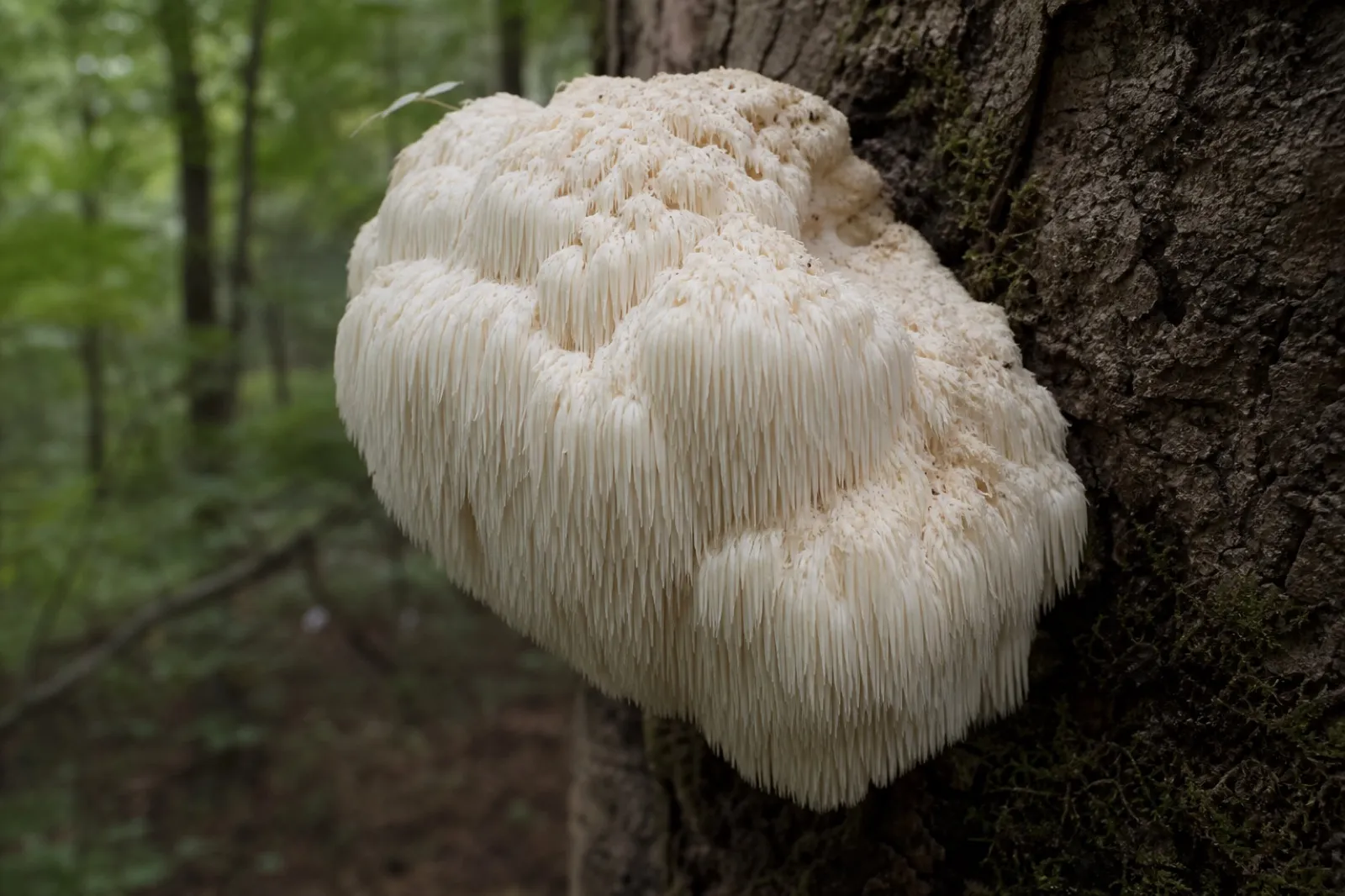
Quick facts
- Scientific name
- Hericium erinaceus
- Common names
- lion's mane, bearded tooth mushroom, pom-pom mushroom
- Taxonomy
- Hericium · Hericiaceae
- Edibility context
- Edible: Young cultivated fruit bodies are eaten cooked; verify local conservation rules before any wild collection.
- Spore print
- White.
- Toxicity context
- None Known: No characteristic food poisoning is recognized for cooked cultivated lion's mane, but allergy and gastrointestinal intolerance can occur; supplement evidence is limited.
- Season
- August, September, October, November
- Growing difficulty
- Moderate
- Regions
- Europe, Asia, North America, with regional Hericium relatives, cultivated worldwide
Safety limit: These labels summarize documented context; they never authenticate a wild specimen. Cooking does not make a poisonous species safe.
What makes lion’s mane a distinct Hericium species guide
Hericium erinaceus forms a compact white fruit body whose fertile surface is made of downward-pointing teeth. It has no ordinary cap, gills, or pores. That architecture separates the first identification question—“is this a toothed wood fungus?”—from the harder question of which Hericium species and whether a particular specimen is fit for any use.
This page focuses on the organism: its form, hardwood ecology, regional naming limits, and cultivation biology. The home-growing guide covers a block-based production workflow, while the lion’s mane evidence review evaluates human health claims. Those pages should not be collapsed into the species account because identification, crop management, and clinical evidence answer different searches.
Read the fruit body from attachment to tooth tip
Begin at the wood. A typical mature lion’s mane is attached through a short, concealed base and expands into one dense, largely unbranched mass. Numerous soft teeth hang from the exposed surfaces. Fresh tissue is white; cream or pale yellow often appears with age, drying, handling, or poor fruiting conditions. The interior is solid and white rather than hollow or composed of many separate coral branches.
Use a developmental sequence, not one perfect photograph
Very young growth may look like a rounded white cushion before its teeth extend. During expansion, lobes can make the outline irregular, but the fruit body should retain a compact core. At useful maturity the teeth are conspicuous and hang downward. An old body may yellow, shrink, become tough, collect debris, or lose its clean outline. Cultivated bodies exposed to excessive carbon dioxide can become unusually branched, so malformed crop photographs are weak field references.
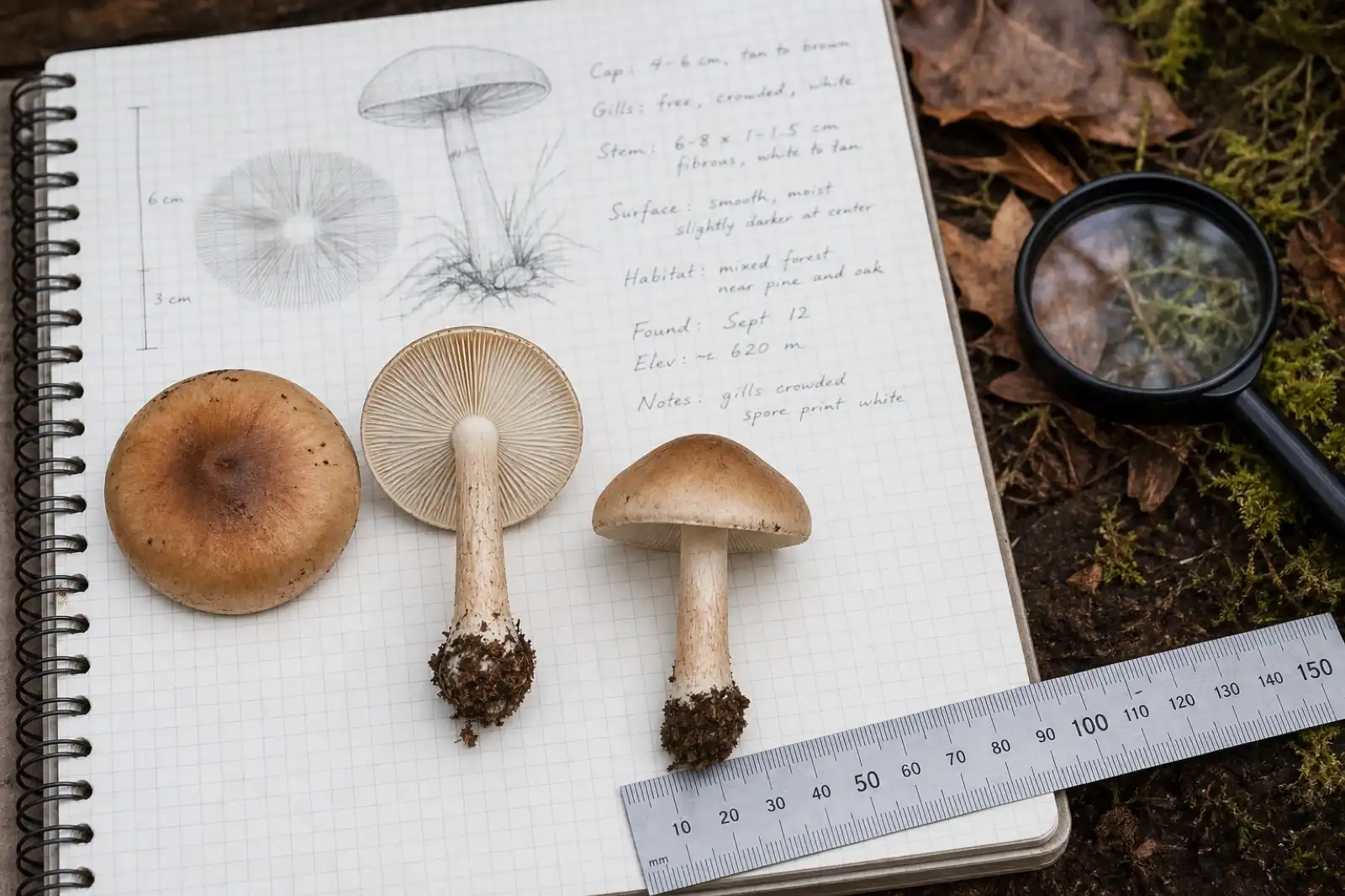
A defensible record includes a scale beside the whole body, a close view of the teeth, the attachment point, the cut interior when lawful collection is appropriate, and the host or substrate. Record color in neutral daylight. A white spore deposit is compatible with Hericium, but white spores occur in many unrelated fungi and cannot confirm the species.
Measure the features that actually separate forms
“White and shaggy” is a search description, not a diagnosis. Note whether the body has one compact core or a repeatedly branching framework; whether teeth descend from the main mass or line many slender branches; the approximate tooth length on mature portions; and whether several bodies arise independently or share a base. Weather-damaged material may need microscopy, sequence data, or a specialist’s regional key.
The mushroom’s silhouette also changes with viewpoint. A side photograph can hide a branched back, and a close crop can remove the attachment and host. That is why this page cannot confirm a wild specimen—or its edibility—from an uploaded image.
Separate lion’s mane from its closest lookalikes
North American Hericium americanum usually produces a branched body with long teeth arising from the branches. Hericium coralloides is more openly and repeatedly branched, with teeth distributed along the branch system. The coral tooth guide shows why “coral-shaped” and “toothed” must be documented separately rather than treated as interchangeable common names.
Other toothed fungi may form caps or shelves with spines only underneath. Still others grow from soil and incorporate buried wood, creating a false impression of terrestrial growth. Pale coral fungi such as Ramaria and Clavulina branch but do not carry a surface of hanging teeth. These distinctions are structural; color alone is especially weak because many young fungi are white or cream.
Regional naming matters. Older field guides, market labels, and internet photographs may apply lion’s mane broadly to several Hericium forms. A North American observation should not inherit a European name merely because the outline looks familiar. Use a current local key and preserve the name and identification method attached to any cited specimen record.
Taxonomy and name boundaries
| Rank | Name |
|---|---|
| Kingdom | Fungi |
| Phylum | Basidiomycota |
| Class | Agaricomycetes |
| Order | Russulales |
| Family | Hericiaceae |
| Genus | Hericium |
| Species | Hericium erinaceus |
GBIF currently treats Hericium erinaceus as an accepted species and provides a backbone for occurrence records. A database match is not independent verification of every uploaded observation: coordinates can be imprecise, names can reflect older concepts, and citizen-science records vary in documentation quality. For research notes, save the database name, record identifier, access date, geography, and original determiner instead of copying a map as proof of local occurrence.
Hardwood ecology is part of the evidence
Lion’s mane is a wood-decaying fungus associated with broadleaf trees. Wild bodies can emerge from wounds or cavities on living trees, from dead sections of a standing trunk, or from fallen hardwood. The visible mushroom may therefore signal internal decay. Observe standing specimens from a position clear of unstable limbs, and do not probe a hazardous tree merely to expose an attachment.
Host reporting should be specific but honest. Record whether the wood is living, dead, standing, or fallen; photograph bark, leaves, buds, or nearby retained twigs; and state “unidentified hardwood” when tree evidence is insufficient. A confident fungal name paired with a guessed host creates false ecological precision. The same principle applies to wood that is buried or heavily decomposed.
Fruiting is commonly noticed from late summer into autumn in temperate regions, but rainfall, temperature, latitude, tree condition, and local lineage all shift timing. An August-to-November range is a planning aid, not an identification character. Repeated observations of the same tree are more informative than forcing one date into a universal season chart.
Wild collection rules and conservation status vary by jurisdiction. Photographing a scarce population, leaving young bodies to mature, and recording the substrate can provide more value than removing every fruit body. Obtain landowner permission and check protected-area rules before collection.
Why cultivation produces different-looking mushrooms
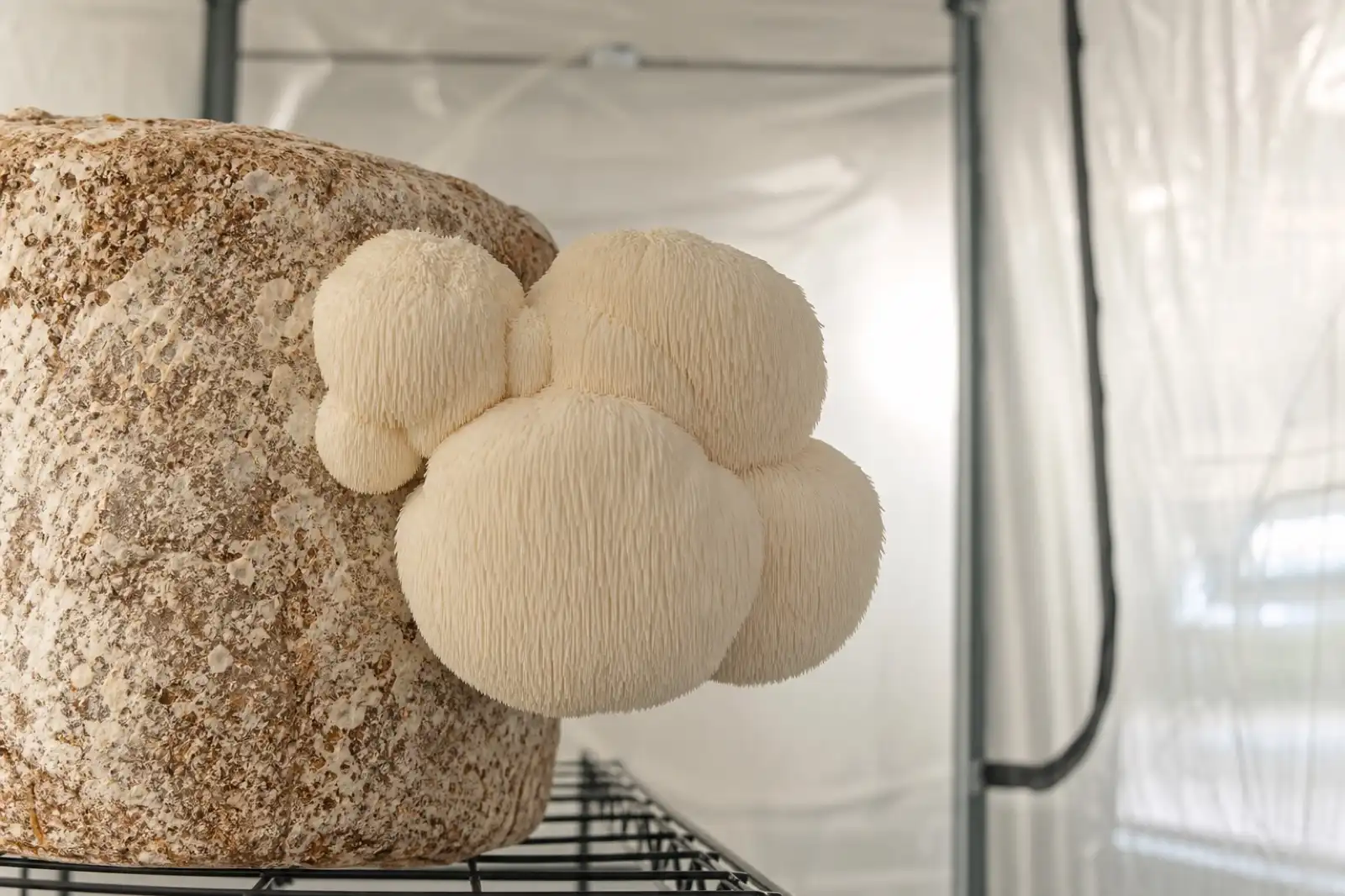
Commercial lion’s mane is commonly grown from authenticated culture on sterilized, supplemented hardwood-based blocks. The bag opening creates a fruiting interface: it limits exposed area, retains moisture in the block, and directs where the body forms. A large opening can encourage several small bodies and faster drying; a small side opening can concentrate growth but still requires enough fresh air around it.
Carbon dioxide, humidity, evaporation, temperature, light, and strain act together. Insufficient fresh-air exchange often yields elongated or coral-like growth rather than a compact pom-pom. Dry air can brown tooth tips before the body finishes expanding. Direct water collecting on the surface can discolor or damage tissue even when room humidity is inadequate. These symptoms are diagnostic clues, not universal prescriptions; compare them with the culture supplier’s expected morphology and stage-specific settings.
For a meaningful crop record, log the culture and supplier, substrate formula, wet block mass, inoculation and full-colonization dates, bag cut, room conditions, first visible primordia, harvest date, fresh yield, and abnormalities. Photograph the same opening at a consistent scale. That record makes a second batch comparable and is more useful than copying an unexplained humidity number from another strain.
Use only food-compatible, untreated substrate ingredients and sound cultures. A fruiting block with unexpected colored mold, foul odor, slime, insects, or an unrecognized fruit body should be isolated and discarded according to supplier guidance. Resemblance to lion’s mane does not authenticate contaminated output.
Harvest quality and kitchen use
Cultivated bodies intended for food are generally harvested while white to cream, firm, and well formed, before extensive yellowing, drying, or softness. Cornell’s production materials provide commercial context, but exact timing remains strain- and system-dependent. A clean knife can remove the body without tearing deeply into the block. Cool the harvest promptly in breathable food-safe packaging.
The branched internal tissue releases moisture during cooking and can take on browned edges when it is given enough pan contact. Thick compact pieces can be cut into slabs; loose lobes are better separated along natural seams. The lion’s mane mushroom steak recipe uses a dry-pan phase before fat is added so evaporation and browning are treated as separate jobs. “Steak” describes the cut and technique, not nutritional equivalence to meat.
USDA FoodData Central can support ingredient-specific comparisons when an appropriate entry exists, but composition varies with culture, substrate, water content, maturity, and cooking. Do not transfer a value from a powder or generic mushroom entry to a fresh cultivated serving without stating the mismatch.
Keep food, supplement, and clinical claims separate
Fresh cooked lion’s mane, dried fruit-body powder, mycelium grown on grain, and concentrated extracts are different materials. A study of one cannot establish the composition, dose, or effect of another. The 2025 systematic review by Spelman and colleagues found a limited, heterogeneous body of human evidence alongside preclinical work. It does not establish lion’s mane as a treatment or prevention for dementia, depression, nerve injury, cancer, or another disease.
Readers evaluating a supplement should look for the scientific name, fungal part, extraction details, serving amount, lot identity, contaminant testing, and manufacturer contact information. A ratio such as “10:1” does not by itself prove identity, purity, bioavailability, or equivalence to a trial preparation. New cognitive, mood, sensory, or motor symptoms require clinical assessment rather than self-treatment with a mushroom product.
MushroomScope’s health material is editorially reviewed and has no named clinician reviewer. The dedicated evidence page explains individual trials and product-matching limits; this species page states only the boundary necessary to prevent a taxonomy or food description from becoming a medical promise.
Safety boundaries for food and field observations
Use cultivated lion’s mane sold as food when cooking from a web recipe. A wild white toothed fungus requires in-person assessment using the entire specimen, substrate, geography, maturity, and—when needed—microscopy or DNA. Cooking does not correct a mistaken identification or remove every environmental contaminant.
People can experience allergy or gastrointestinal intolerance even to established foods. Start with a modest portion if the food is new to you, use clean utensils, prevent cross-contamination, refrigerate promptly, and discard spoiled product. Seek urgent care for breathing difficulty, facial swelling, confusion, persistent severe vomiting, or serious symptoms after mushroom consumption. In the United States, contact Poison Control at 1-800-222-1222; elsewhere use the local poison center or emergency service. Keep a sample and packaging when it is safe to do so.
Supplement exposure raises different questions from a meal, including dose, interactions, contaminants, and duration. Discuss use with a qualified clinician when pregnant, breastfeeding, preparing for surgery, managing a medical condition, or taking medicines. Do not stop prescribed treatment because of a mushroom claim.
Diagnose cultivated form with a spatial crop record
When a block produces compact teeth in one position and coral-like branches in another, record the crop as a map rather than assigning one cause to the whole room. Mark shelf, block face, opening orientation, distance from humidification and fresh-air inlets, temperature, relative-humidity sensor location, and the time each photograph was taken. Also retain the strain, substrate, bag density, colonization time, initiation date, and handling history. A room average can conceal a boundary layer around the fruit body, while a single photograph cannot separate strain expression from local environment.
Compare like developmental stages. Early branches may lengthen into a normal toothed mass, while prolonged branching, drying tips, yellowing, or soft tissue can represent different combinations of air exchange, evaporation, age, or handling. Change one documented variable at a time and keep an unchanged comparison group. The pinning conditions guide covers readiness and microclimate diagnosis; this species guide supplies the Hericium morphology that the crop record should preserve.
Grade harvest quality separately from biological identity
An authenticated culture may still produce a poor-quality crop. Record mass, tooth length range, color, firmness, aroma, attached substrate, insect damage, bruising, trim loss, and time to cooling for each harvest lot. These fields help distinguish identity from market quality and make later comparisons with the harvest timing guide reproducible. They also prevent a larger but overmature fruit body from being treated automatically as a better result.
For photographs used in public identification material, include the attachment point and more than one side of the fruit body. A clean studio image can illustrate kitchen form but removes the wood relationship and growth architecture needed for a field record. Conversely, a wild photograph may document ecology without establishing food condition, legal collection, or the identity of a packaged supplement.
Frequently asked questions
Is every white pom-pom mushroom lion’s mane?
No. Compactness, branching pattern, tooth placement, attachment, host, maturity, and region all matter. Several Hericium species and unrelated tooth fungi can look similar in a cropped photograph.
Does yellow color mean the mushroom is poisonous?
Yellowing can accompany age, drying, bruising, or cultivation stress; it is not a stand-alone toxicity test. Reject spoiled commercial product and never use color alone to decide whether a wild specimen is edible.
Can lion’s mane grow from conifer wood?
The species is principally associated with hardwood. A conifer report deserves careful rechecking of both the tree and fungus, including the possibility of buried or mixed wood and a different toothed species.
Why did a grow block make coral-like branches?
Restricted fresh-air exchange is a common contributor, but strain, opening geometry, humidity, evaporation, and temperature can also change form. Compare the crop with authenticated supplier examples and change one recorded variable at a time.
Is culinary lion’s mane proven to improve memory?
No. A cultivated food serving is not equivalent to the defined powders or extracts used in small human studies, and current evidence does not establish prevention or treatment of cognitive disease.
References
- Global Biodiversity Information Facility. Hericium erinaceus species record. Used for accepted-name and occurrence-context checks; individual records still require evaluation.
- U.S. Department of Agriculture. FoodData Central. Used for ingredient-matched food-composition context rather than product-specific claims.
- Cornell Small Farms Program. Specialty mushroom cultivation resources. Used for hardwood-block production, harvest, and post-harvest context.
- Spelman K, et al. Benefits, side effects, and uses of Hericium erinaceus as a supplement: a systematic review. Used to bound clinical and product-equivalence claims.
- National Center for Biotechnology Information. NCBI Taxonomy Browser. Cross-check for lineage and scientific-name context.
Last editorial review: September 12, 2026. Editorial review only; no named mycologist, clinician, or dietitian reviewed this page.
Source quality notes
MushroomScope cites sources that match the page scope, such as taxonomic databases, extension guidance, food-safety agencies, food-composition databases, and peer-reviewed or institutional health references. Sources support context and uncertainty; they do not turn an online page into specimen identification, medical advice, or a tested recipe record.
Frequently asked questions
Is every white pom-pom mushroom lion's mane?
No. Compactness, branching pattern, tooth placement, attachment, host, maturity, and region all matter. Several Hericium species and unrelated tooth fungi can look similar in a cropped photograph.
Does yellow color mean lion's mane is poisonous?
Yellowing can accompany age, drying, bruising, or cultivation stress; it is not a toxicity test. Reject spoiled commercial product and never use color alone to decide whether a wild specimen is edible.
Can lion's mane grow from conifer wood?
Hericium erinaceus is principally associated with hardwood. A conifer report deserves careful rechecking of both the tree and fungus, including buried or mixed wood and a different toothed species.
Why did a lion's mane grow block make coral-like branches?
Restricted fresh-air exchange is a common contributor, but strain, opening geometry, humidity, evaporation, and temperature can also change form. Compare with authenticated supplier examples and change one recorded variable at a time.
Is culinary lion's mane proven to improve memory?
No. A cultivated food serving is not equivalent to the defined powders or extracts used in small human studies, and current evidence does not establish prevention or treatment of cognitive disease.
Related guides
growing
How to Grow Lion's Mane Mushrooms at Home
Lion's mane needs clean culture, hardwood-based substrate, high humidity without saturation, and adequate fresh air for compact fruiting bodies.

health
Lion's Mane Benefits: What Human Research Can and Cannot Show
Small human trials of lion’s mane examine specific products and outcomes; they do not establish prevention or treatment of neurological disease.
identification
How to Identify Mushrooms: A Beginner's Field Guide
Build an identification from the whole specimen, substrate, habitat, spore deposit, and location—not from a single photograph.
Continue exploring
Browse more practical guides in Mushroom Encyclopedia or visit the mushroom encyclopedia.