Mushroom Encyclopedia
Destroying Angel Mushrooms: White Amanita Identification
Document destroying angel Amanitas by white gills, ring, saclike volva, complete stem base, tree habitat, regional species, amatoxin risk, and lookalikes.
Species context
Treat profiles as reference material
Species profiles summarize documented traits, taxonomy, and lookalikes, but natural variation can be substantial.
Use the safety checklist →Decision limit
A profile cannot authenticate a specimen
Do not eat a wild mushroom from an online match, single feature, or generated image.
Read the safety disclaimer →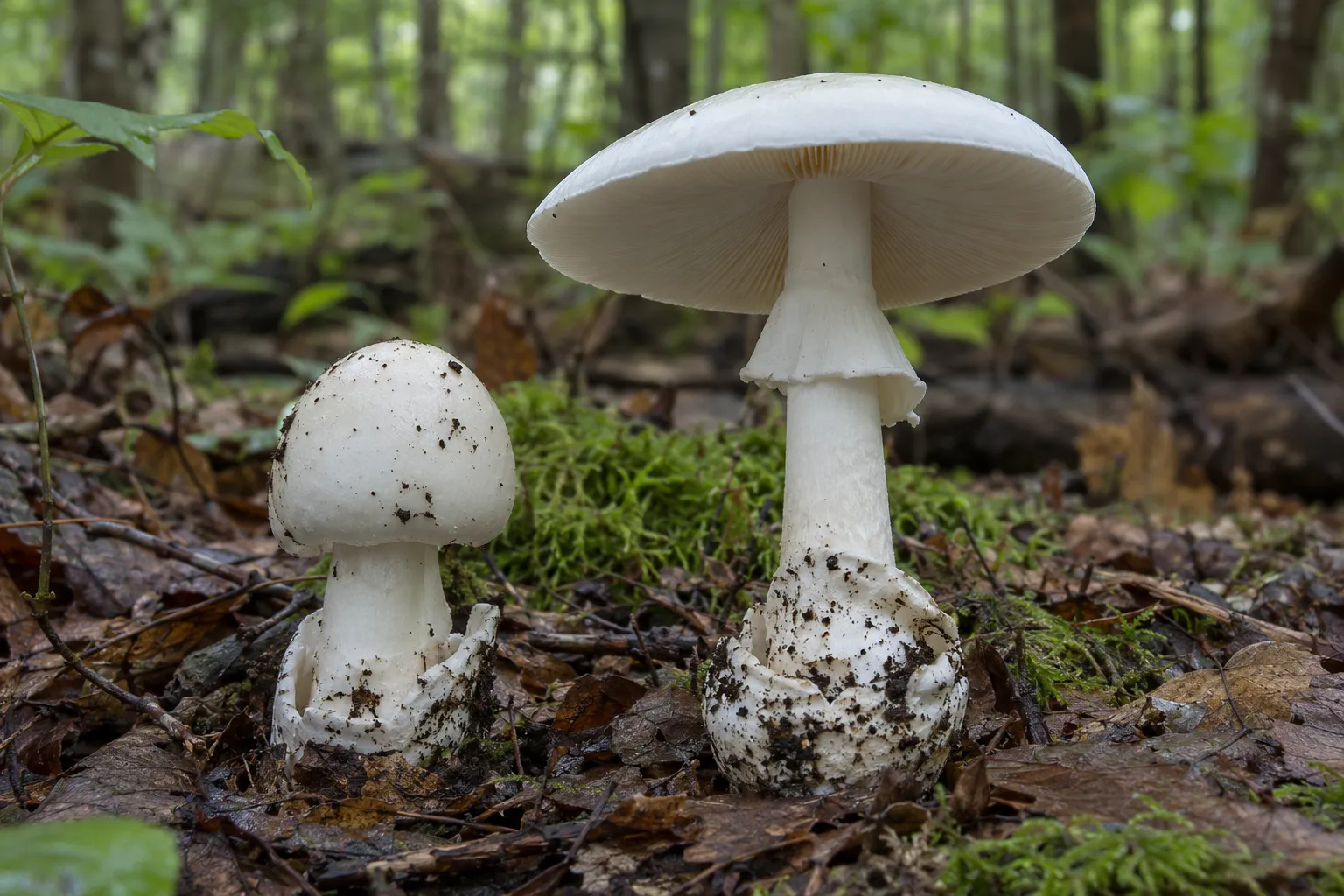
Quick facts
- Scientific name
- Amanita bisporigera complex
- Common names
- Destroying angel, Eastern North American destroying angel
- Taxonomy
- Amanita · Amanitaceae
- Edibility context
- Inedible: Potentially lethal; never taste or eat an unidentified white-gilled mushroom.
- Spore print
- White.
- Toxicity context
- Deadly: Amatoxins can cause delayed gastrointestinal symptoms and life-threatening hepatic failure.
- Season
- June, July, August, September, October
- Growing difficulty
- Expert
- Regions
- eastern North America for the A. bisporigera complex, other regions with different white lethal Amanitas, local species concepts requiring current keys
Safety limit: These labels summarize documented context; they never authenticate a wild specimen. Cooking does not make a poisonous species safe.
“Destroying angel” is a safety name for several white, amatoxin-containing Amanita species, not one mushroom distributed unchanged around the world. In eastern North America, Amanita bisporigera and related taxa are central to the concept; other continents and regions have different lethal white Amanitas. The practical field task is therefore twofold: recognize the high-risk architecture early, and avoid pretending that a photograph resolves the exact species.
A mature destroying angel commonly combines free white gills, a white spore deposit, a partial-veil ring, and a swollen base sitting in a membranous universal-veil sac. Every one of those features can be hidden or damaged. The correct response to uncertainty is exclusion from food and, after exposure, urgent professional care.
Treat a white Amanita pattern as a stop signal
Begin with the entire organism, not cap color. Photograph the mushroom in place with surrounding trees, litter, and soil. Then document the cap, underside, stem, ring, and excavated base as a connected series. White caps occur in many genera, but the combination of free pale gills, ring, and volva is the critical high-risk pattern.
Do not taste an unknown specimen, and do not accept “probably a parasol” or “probably an Agaricus” from a top-down photograph. The identification safety checklist explains why missing underside and base evidence prevents an edibility conclusion.
Follow the universal veil into the soil
The universal veil encloses the young Amanita. As the stem expands, the veil often remains as a white membranous cup or sac around the bulb. That structure may be entirely below the litter line. Dig a wide circle with a tool and lift the specimen with the surrounding soil; pulling the stem can leave the volva behind and create a dangerously incomplete specimen.
Photograph the base before cleaning. Record whether the veil forms a free sac, adherent limb, rings, powdery fragments, or irregular patches. Measure the bulb and stem. A destroying-angel type generally shows a distinct saclike volva, unlike the concentric shaggy zones typical of fly agaric, but damaged or collapsed tissue can blur that distinction.
One clean longitudinal section can reveal the bulb outline and whether a supposed “egg” contains an internal cap-and-stem mushroom. That check also helps separate Amanita buttons from puffballs, whose edible decisions require an entirely different and still cautious interior assessment.
Check gill attachment and color development
Turn the cap and photograph the gills square-on. Destroying-angel gills are crowded, white, and free or nearly free from the stem. Record short-gill tiers and any discoloration caused by dirt, age, insects, or handling. The gills do not mature to chocolate brown as they do in common Agaricus species.
Gill color must be assessed across development. A very young Agaricus can have pale gills before they turn pink and brown, while old or stained white gills can appear cream. A spore deposit adds another independent character: deadly white Amanitas produce white spores, whereas Agaricus deposits are dark brown and Volvopluteus deposits are pinkish.
The stem-features guide shows how to record ring and base together. A free-gilled white mushroom with an unseen base is not cleared by a familiar ring.
Record the partial veil without requiring perfection
The partial veil covers developing gills and normally leaves a skirtlike ring on the upper stem. Photograph attached veil in buttons, the ring on fresh adults, and scars on older stems. Note position, thickness, striation, tears, and whether it moves. Weather, slugs, and handling can destroy it, so an apparently ringless old mushroom is not automatically outside Amanita.
Likewise, the cap may be pure white, slightly cream, or weathered tan. Surface fibers, adhering soil, and veil fragments vary. Odor can become unpleasant with age, but smell is neither a species confirmation nor an antidote to the structural evidence.
Map trees, roots, and fruiting position
Destroying angels are ectomycorrhizal partners of living trees. List nearby tree genera, measure distance from each trunk, and photograph canopy and bark where possible. Hardwood woodland, mixed forest, wooded lawns, and park edges can all contain suitable roots. A mushroom emerging beside buried woody debris may still be connected to living roots rather than feeding on the debris.
Record repeated fruiting locations over several visits. A mapped arc around an oak or other host can strengthen ecological context, but it does not replace morphology. Do not assume that a white mushroom in open grass lacks a tree partner; roots extend well beyond the visible canopy.
Regional context is essential. “Destroying angel” in Europe, western North America, eastern North America, and Asia may refer to different species. Use current local literature, and let the identification stop at “white lethal Amanita group” when characters or expertise do not support a narrower name.
Separate lookalikes with independent character sets
For Agaricus, look for gills changing from pale through pink to brown, a brown spore deposit, and absence of a universal-veil sac. Some toxic yellow-staining Agaricus add their own hazard, so identifying “not an Amanita” does not automatically mean edible.
For Volvopluteus or Volvariella, a volva may be present, but a stem ring is absent and mature gills and spores become pink. White Leucoagaricus and Leucocoprinus can have free pale gills and a ring but lack a true saclike volva at the complete base. White Tricholoma species generally lack both ring and volva and have gills attached differently.
These comparisons fail when the specimen is partial. A severed Amanita can appear to “lack” a volva; a young Agaricus can appear white-spored before a deposit is obtained; a damaged ring can disappear. Use at least three independent character systems—veil architecture, gill/spore development, and ecology—before even considering a genus-level conclusion.
Understand why amatoxin poisoning is an emergency
Amatoxins inhibit RNA polymerase II and disrupt essential cellular function, with the liver particularly vulnerable. A dangerous feature of the syndrome is delayed onset: severe vomiting and diarrhea may begin hours after ingestion, and a period of apparent improvement can precede worsening liver injury. Waiting for symptoms or for symptoms to return can lose critical treatment time.
Cooking, drying, freezing, soaking, alcohol, or folk tests must not be treated as reliable detoxification. Silver spoons, onion color, insect feeding, odor, and taste do not detect amatoxins. A single mixed fragment in a meal can matter.
After any plausible ingestion, call emergency services and poison control immediately. State the time, amount, preparation, number and age of people exposed, symptoms, and location. Keep raw specimens, stem bases, cooked leftovers, cleaning scraps, and photographs. Do not induce vomiting unless instructed. The poisonous mushroom warning guide gives a concise emergency record.
Use a high-risk Amanita worksheet
For each specimen, record:
- Cap width, profile, color, surface texture, margin, and development stage.
- Gill color, spacing, short-gill tiers, and attachment under neutral light.
- Ring position, structure, and damage; stem measurements and texture.
- Entire excavated bulb and volva, photographed dirty, cleaned, and in section.
- Spore-deposit outcome, tree genera, distance to hosts, soil and litter context.
- Regional key, alternatives, microscopy or sequencing, verifier, and confidence.
Keep observation separate from diagnosis. “White free gills; membranous sac enclosing a 32 mm bulb” can be reviewed. “Safe white mushroom” cannot. If the specimen was involved in exposure, medical response takes priority over completing the worksheet.
Preserve specimens responsibly
Where collection is legal, retain one intact representative in a rigid container, never loose with food mushrooms. Label it with date, location, photographs, and collector. Refrigerate short-term if poison-control or a mycologist may examine it; follow their instructions for transport or drying. Wash hands and tools after handling mixed collections, not because intact skin is the typical poisoning route, but to prevent fragments from reaching food or children.
Community reports should obscure precise coordinates when site protection calls for it while retaining habitat and region. If a specialist revises the identification, keep the evidence and revision trail. Taxonomic humility does not weaken the safety message: inability to choose among lethal white Amanitas is itself sufficient reason not to eat the collection.
Audit mixed baskets and shared preparation surfaces
A poisoning investigation must consider more than the mushroom a collector intended to gather. Empty the remaining basket or container onto a clean surface and photograph every fragment from both sides. Group pieces by cap surface, gill color, stem tissue, ring remnants, and base material; do not assume all white fragments came from one species. Record whether trimming occurred outdoors, whether bases were discarded, and whether knives, cutting boards, pans, or storage bags also held the suspect collection.
This reconstruction is for responders and identifiers, not a home clearance procedure. Keep suspect material away from food, children, and pets, and follow poison-control instructions for packaging. A positive name can help, but a delayed amatoxin-compatible exposure should receive urgent medical attention even when the remaining fragments cannot be identified to species. Conversely, a photograph of one harmless lookalike cannot prove that a different fragment was absent from the meal. The unit of safety is the complete exposure history, not the best-looking specimen saved afterward.
Keep pale death caps in the comparison set
Not every deadly member of Amanita section Phalloideae is uniformly white. Pale forms of death cap can overlap with destroying angels, while typical olive pigment may be weak after rain or hidden in a button. Preserve the complete volva, ring, mature gills, host context, and regional evidence; from a safety standpoint an unresolved deadly amanita requires the same emergency boundary.
References
- CDC. Amanita poisoning outbreak report. Clinical course and public-health context.
- North American Mycological Association. Mushroom poisoning syndromes. Amatoxin syndrome and response context.
- Poison Control. Wild mushroom warning. Immediate exposure guidance.
- NCBI. Taxonomy Browser: Amanita bisporigera. Nomenclatural checkpoint.
- GBIF. Amanita bisporigera species record. Distribution context with record-quality limits.
Editorial review: October 15, 2026. This page has no named expert or clinical reviewer and cannot replace poison-control, medical, or regional mycological assessment.
Source quality notes
MushroomScope cites sources that match the page scope, such as taxonomic databases, extension guidance, food-safety agencies, food-composition databases, and peer-reviewed or institutional health references. Sources support context and uncertainty; they do not turn an online page into specimen identification, medical advice, or a tested recipe record.
Frequently asked questions
What is a destroying angel mushroom?
The name covers several deadly white Amanita species rather than one worldwide species. They commonly combine a white cap, free white gills, white spore deposit, skirtlike ring, and bulb enclosed by a saclike volva near compatible trees.
Can a destroying angel lose its ring or volva?
Yes. Weather, animals, age, handling, and careless collection can damage veil structures. The volva may remain underground, which is why the complete base must be excavated and why one missing feature cannot establish safety.
Are all white mushrooms destroying angels?
No, but an unknown white-gilled mushroom must not be eaten. Agaricus, Leucoagaricus, Volvopluteus, and other groups differ in gill maturation, spore color, attachment, substrate, ring, and volva, yet partial specimens can be dangerously misleading.
What makes destroying angels deadly?
They can contain amatoxins that inhibit RNA polymerase II and cause delayed gastrointestinal illness followed by severe liver injury. Apparent improvement can occur before organ failure, so symptoms require urgent medical evaluation.
What should I do after possible ingestion?
Contact emergency medical services and poison control immediately; do not wait for symptoms or an online name. Preserve specimens, food remnants, photographs, and timing information, and follow professional instructions.
Related guides
identification
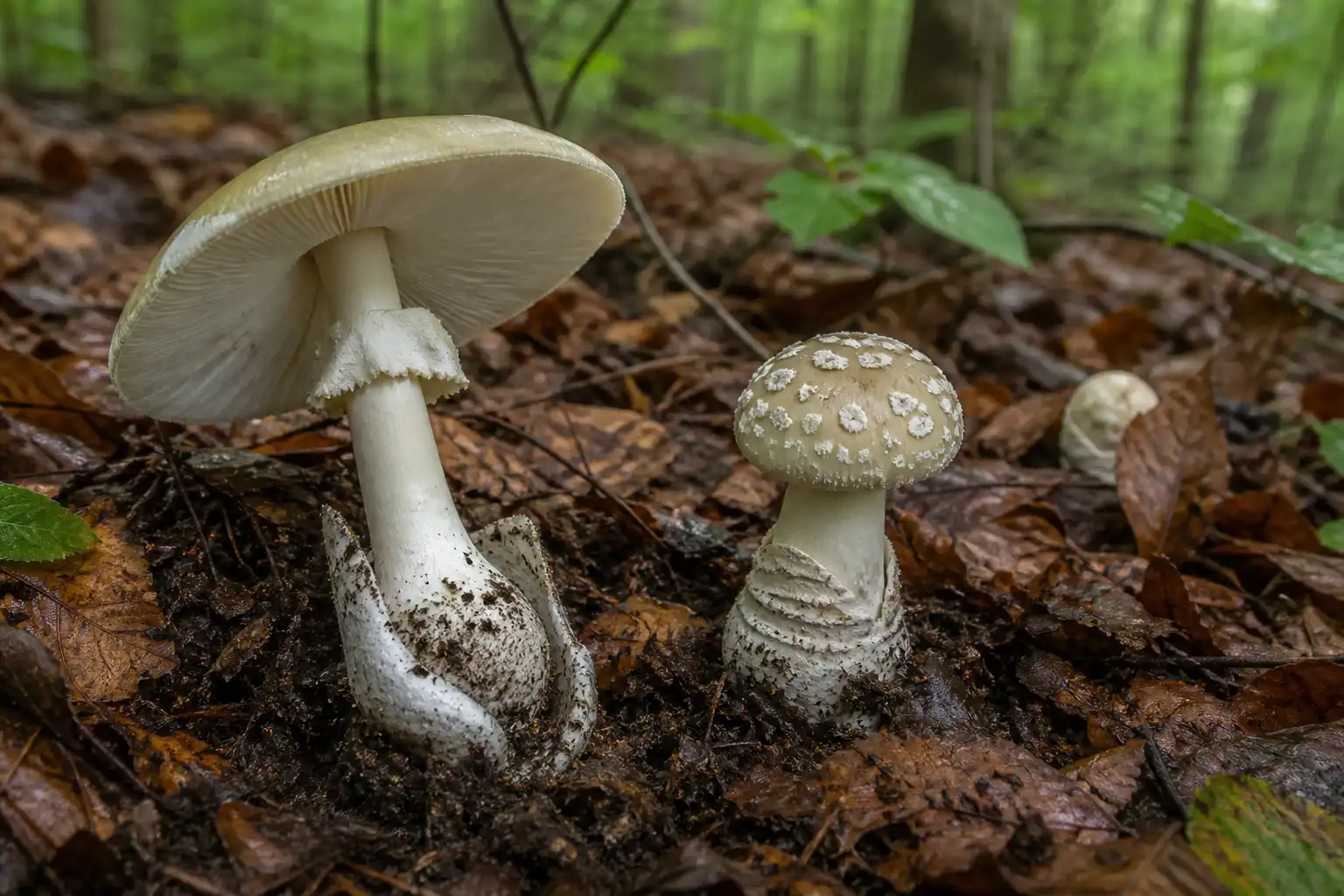
Amanita Identification: Veils, Complete Bases, and Safety Limits
Document Amanita using veils, complete stem bases, free gills, white spores, tree ecology, regional keys, and strict no-consumption safety limits.
identification
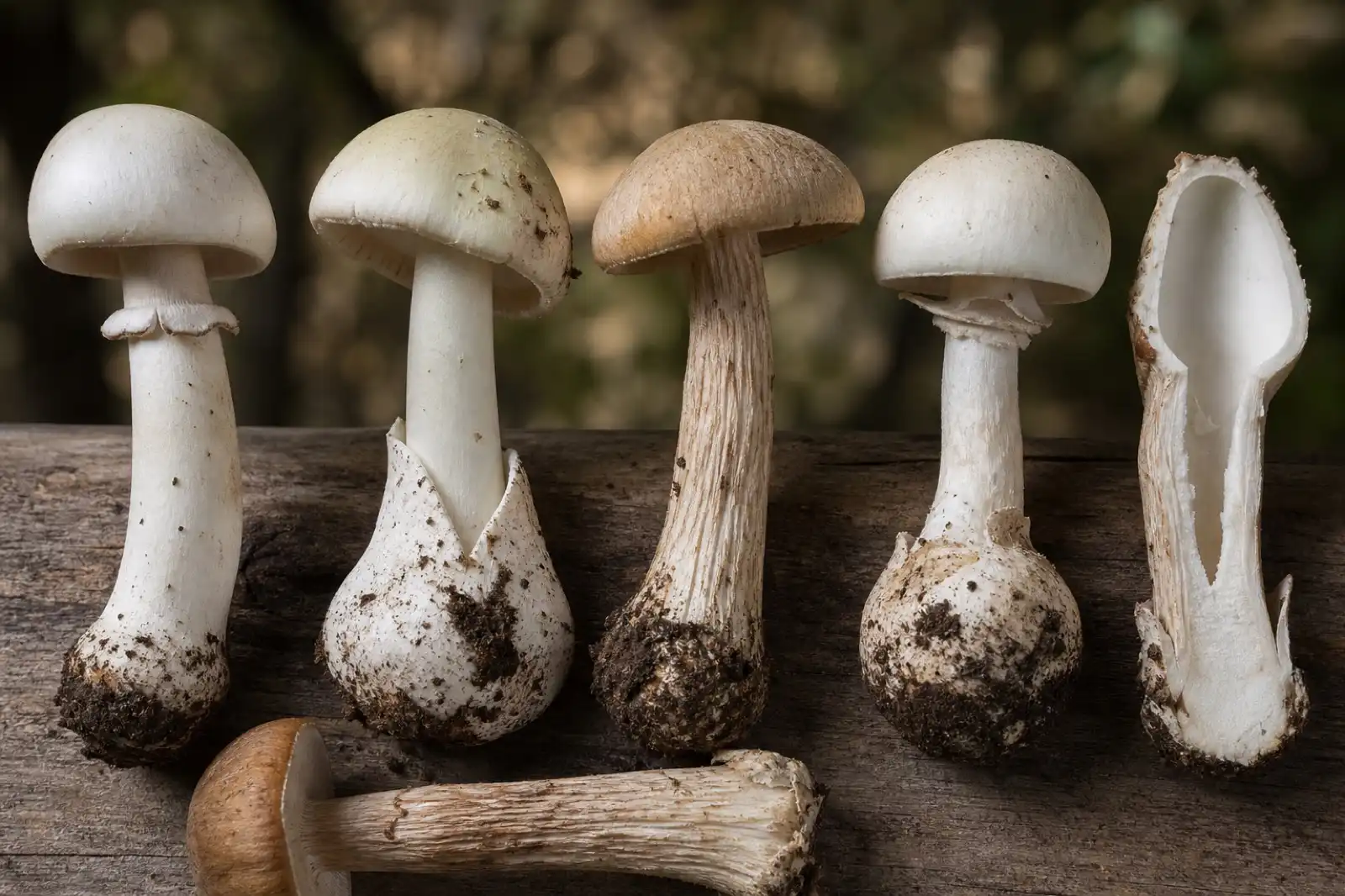
Mushroom Stem Features: Rings, Volvas, Texture, and Base
Document mushroom stem shape, attachment, rings, volvas, buried bases, internal structure, bruising, and texture without using one feature to decide edibility.
identification
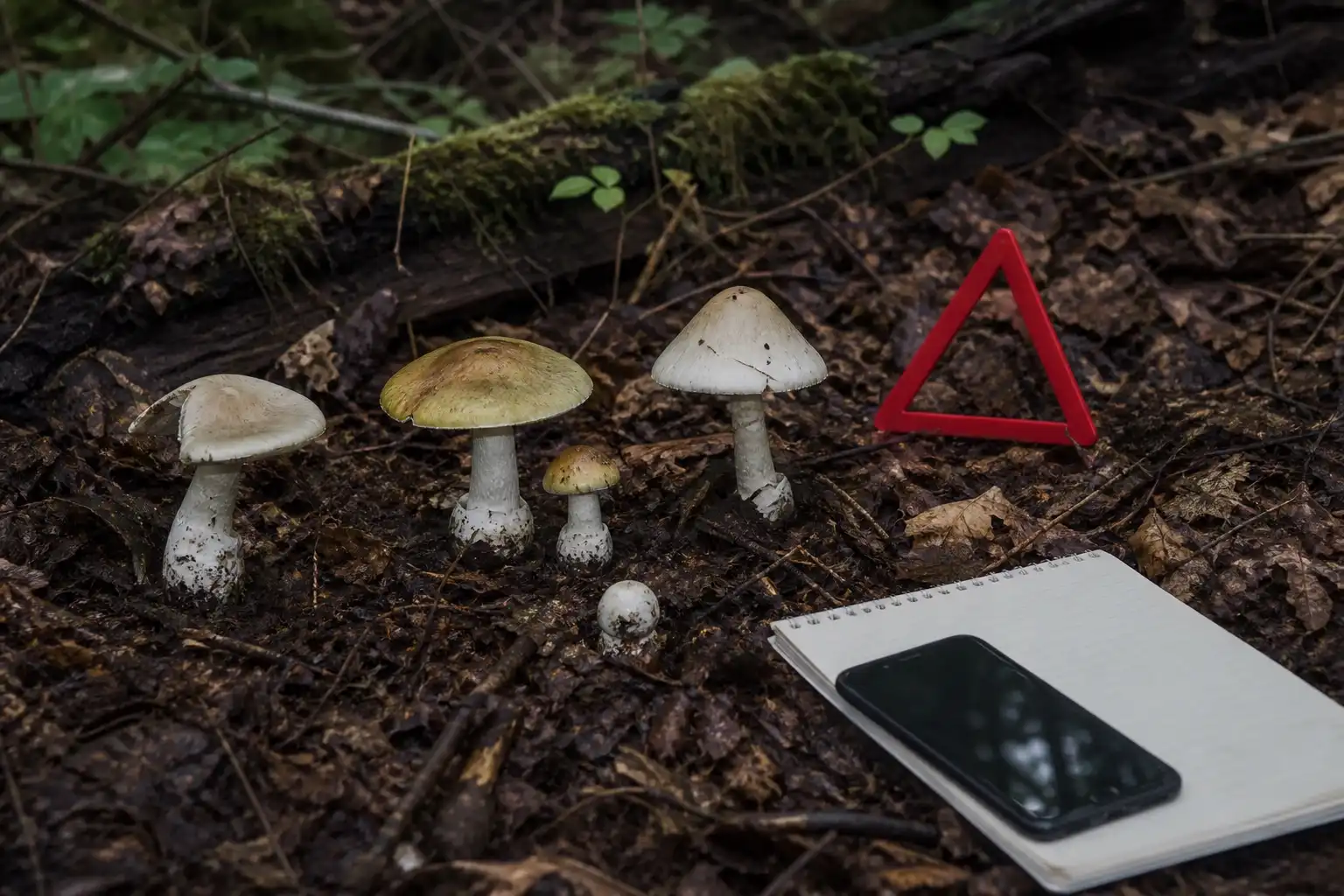
Poisonous Mushroom Warning Signs and Safety Rules
Learn why poisonous mushroom warning signs are unreliable alone, which safety rules matter, what to document, and when to seek urgent help.
Continue exploring
Browse more practical guides in Mushroom Encyclopedia or visit the mushroom encyclopedia.