Mushroom Encyclopedia
Jack-o'-Lantern Mushroom: Identification and Poisoning Safety
Identify jack-o'-lantern mushrooms by true decurrent gills, clustered wood growth, orange flesh, regional species, lookalikes, and poisoning response.
By MushroomScope Editorial Team · · Updated
Species context
Treat profiles as reference material
Species profiles summarize documented traits, taxonomy, and lookalikes, but natural variation can be substantial.
Use the safety checklist →Decision limit
A profile cannot authenticate a specimen
Do not eat a wild mushroom from an online match, single feature, or generated image.
Read the safety disclaimer →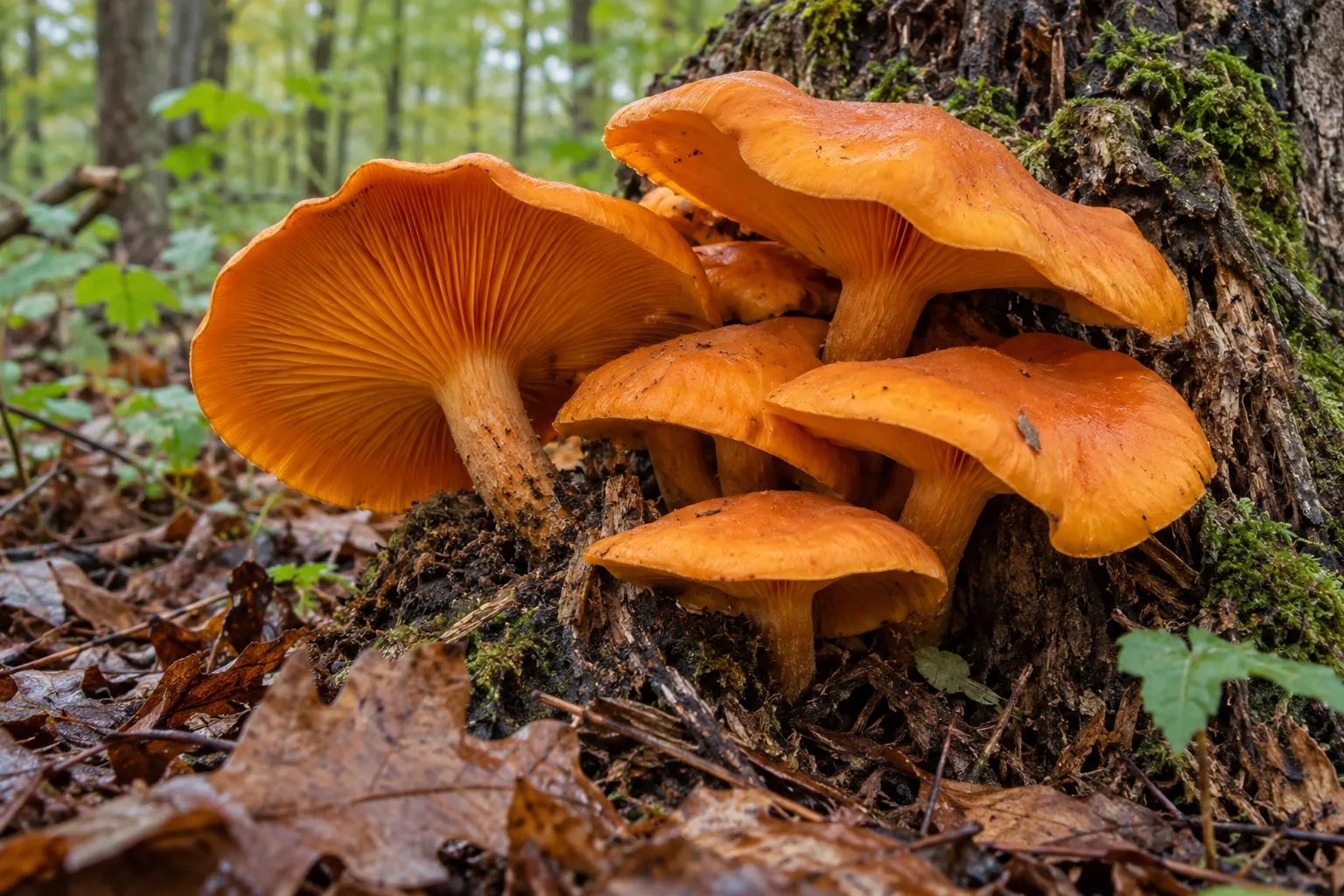
Quick facts
- Scientific name
- Omphalotus illudens
- Common names
- Jack-o'-lantern mushroom, Eastern jack-o'-lantern
- Taxonomy
- Omphalotus · Omphalotaceae
- Edibility context
- Inedible: Causes significant gastrointestinal poisoning and must not be eaten.
- Spore print
- White to pale cream.
- Toxicity context
- High: Omphalotus poisoning commonly involves nausea, vomiting, abdominal pain, and diarrhea; prompt poison-center advice is appropriate.
- Season
- June, July, August, September, October
- Growing difficulty
- Expert
- Regions
- eastern North America, temperate hardwood forests and urban plantings
Safety limit: These labels summarize documented context; they never authenticate a wild specimen. Cooking does not make a poisonous species safe.
Identify the evidence set, not the orange color
Jack-o’-lantern is a name used for several orange Omphalotus species, and the eastern North American O. illudens is the focus here. The useful field pattern combines sharp true gills, clustered growth from wood, orange flesh, and a compatible region. Orange color by itself is weak evidence. Chanterelles, false chanterelles, waxcaps, milkcaps, and other fungi can enter a photograph-based comparison.
Begin by preserving the whole attachment. Photograph the cluster before lifting it, clear loose litter gently, and trace the stems to the stump, root, or buried wood. Then photograph one cap from above, one underside in side light, and a lengthwise section. If the collection was cut at ground level, an important part of the evidence has already been lost.
This page cannot approve a wild mushroom for food. Jack-o’-lanterns are poisonous, and confusing them with chanterelles is a well-known route to gastrointestinal illness. Compare the complete collection with the chanterelle versus jack-o’-lantern guide and the chanterelle species profile, then seek local expertise whenever a use decision is involved.
Read the true gills under side light
The fertile surface consists of genuine gill blades. Each gill has two faces and a relatively sharp edge, and the blades run down the upper stem. This decurrent attachment can appear as long orange lines radiating from the stem into the cap. Use low side lighting and a close photograph to preserve the edges; direct flash can flatten the relief and make gills resemble blunt folds.
Select three primary gills beside the stem and follow each toward the margin. Record branching, shorter intermediate gills, crowding, and any cross-veins. Do not expect every specimen to look identical: age, crowding, insects, and drying can distort spacing. The decisive distinction from a chanterelle is not merely “lines underneath,” but thin projecting blades rather than rounded tissue folds.
A white to cream spore deposit may support the record, but it does not confirm the genus. Place a mature cap across black and white nonabsorbent surfaces, protect it from drafts, and label the print with the specimen number. Numerous unrelated mushrooms share pale spores. Regional keys may require microscopic spore measurements and tissue features when morphology is atypical.
Map the wood attachment and host
Jack-o’-lantern clusters often appear to rise from soil while actually connecting to buried roots. Expose only enough of the base to photograph the connection. Note whether the wood is living, recently dead, or advanced in decay; record bark, leaves, and tree form rather than guessing a host from one fragment. Oaks are frequent hosts for O. illudens, but a host impression cannot replace mushroom anatomy.
Draw a simple plan of the cluster. Count fruit bodies, note whether stems merge at one point, and measure the distance between separate clusters. A dense joined group attached to hardwood supports Omphalotus more strongly than several scattered orange caps in conifer litter. Still, root systems can produce separated clusters, and buried debris can make a wood fungus look terrestrial.
Return to the site after several days if it is safe and legal. Young convex caps may expand, flatten, and develop depressed or wavy centers. A dated sequence shows whether specimens share one base and prevents a weathered mature cap from defining the entire collection. Do not disturb a public site solely to obtain a name.
Cap, stem, flesh, and development
Caps range through yellow-orange, pumpkin orange, and deeper brownish orange. Young margins can be inrolled; mature caps may flatten or become shallowly funnel-shaped. Surface texture is usually smooth to finely fibrous rather than prominently scaly. Measure several caps because crowded clusters create asymmetric shapes and size alone separates nothing reliably.
Stems are orange and often firm, fibrous, curved, or tapered toward the shared base. They lack a volva. A ring is not part of the expected pattern. Split one representative specimen from cap center through stem base. Orange or yellow-orange flesh throughout is useful evidence, especially when paired with the external features, but camera white balance can shift the apparent hue.
Record odor without tasting. Words such as “mushroom-like” or “woodsy” vary among observers and have little power against contradictory anatomy. Photograph bruising immediately and at fixed intervals rather than relying on memory. Keep every section and spore print linked to the same specimen number; mixed orange mushrooms can fruit near one another.
Regional species boundaries matter
The name Omphalotus illudens is most appropriate in eastern North America. Western North America has O. olivascens and related regional concepts, while Europe and the Mediterranean include O. olearius and other taxa. Color, host preferences, and microscopic details vary. A page about one species should not silently convert every orange wood-growing cluster worldwide into that name.
Record country, state or province, elevation, habitat, host, and date. Consult a current regional key or herbarium record rather than importing a field mark from another continent. When the evidence supports only the genus, “Omphalotus species” is more accurate than a forced species determination.
Occurrence maps are sampling records, not proof of absence. Urban plantings can move host material, names can change, and older records may use broader concepts. Important or unusual collections deserve a dried voucher and expert review. Preserve notes with the material so another person can evaluate the conclusion.
Separate chanterelles and false chanterelles
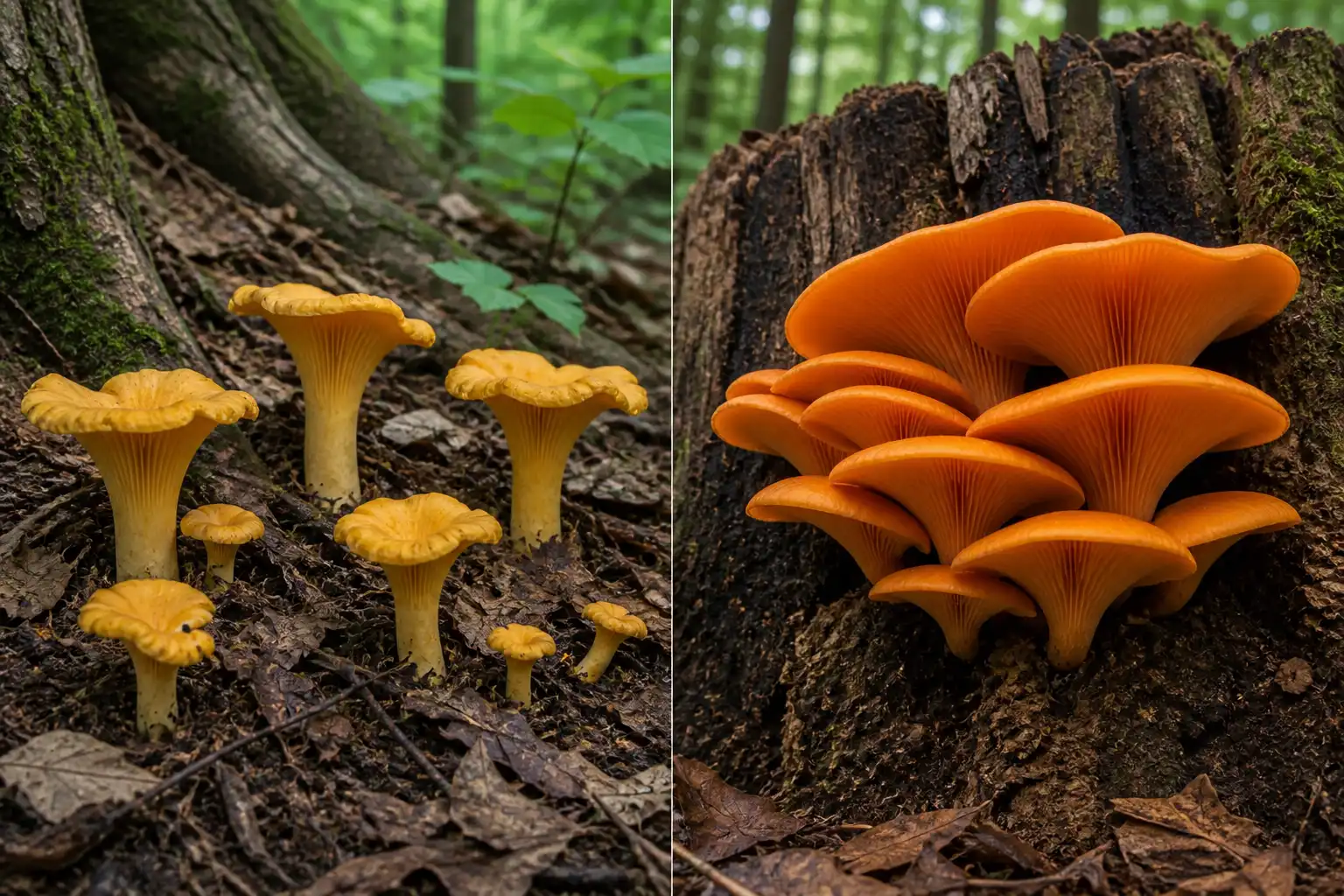
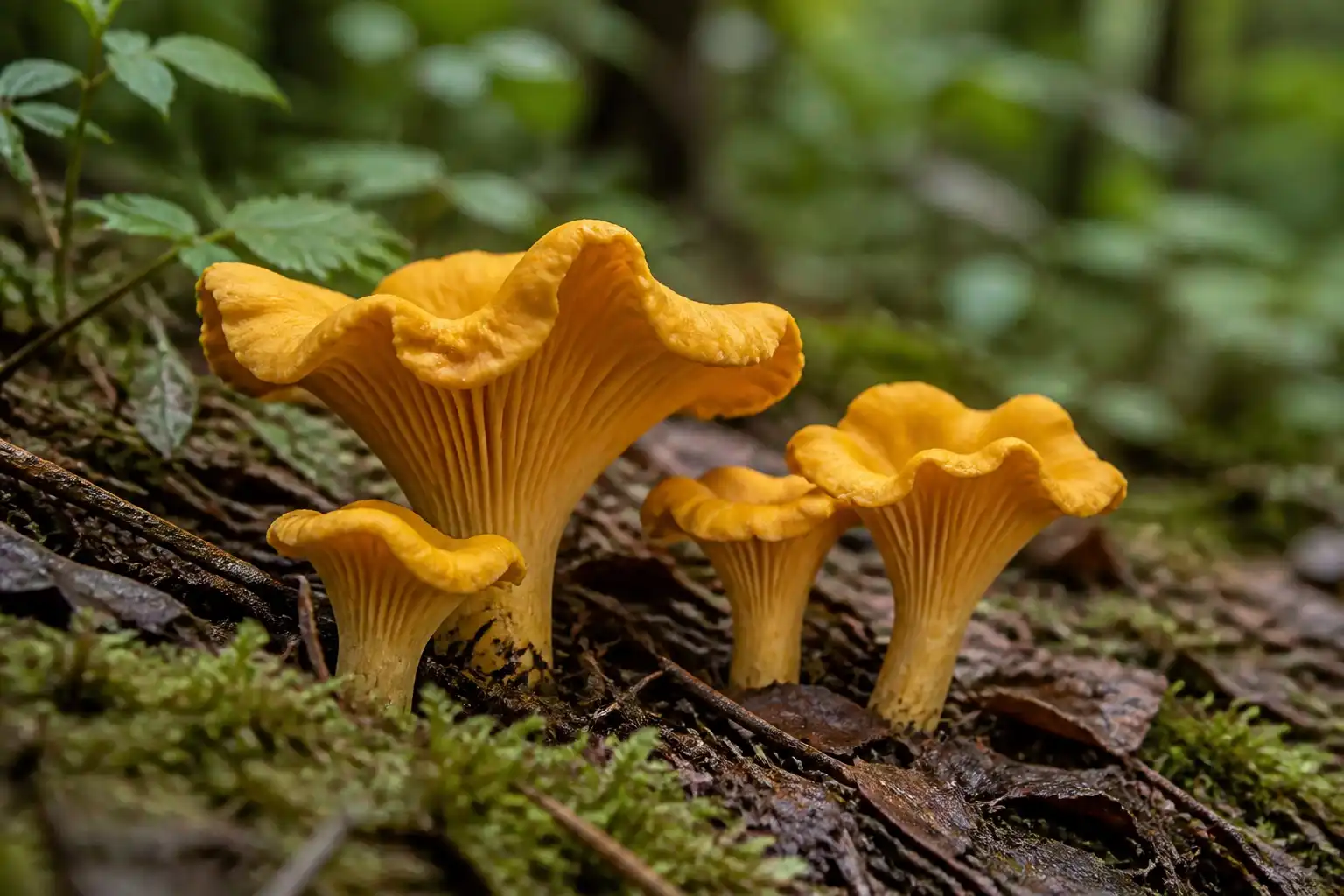
True chanterelles have blunt folds or ridges continuous with the cap flesh, not thin separable gill blades. They are mycorrhizal with living trees and typically arise from soil as individual or loosely grouped fruit bodies rather than a joined mass on a stump. Their flesh is often paler inside than the saturated orange exterior of a jack-o’-lantern. None of these traits should be used alone.
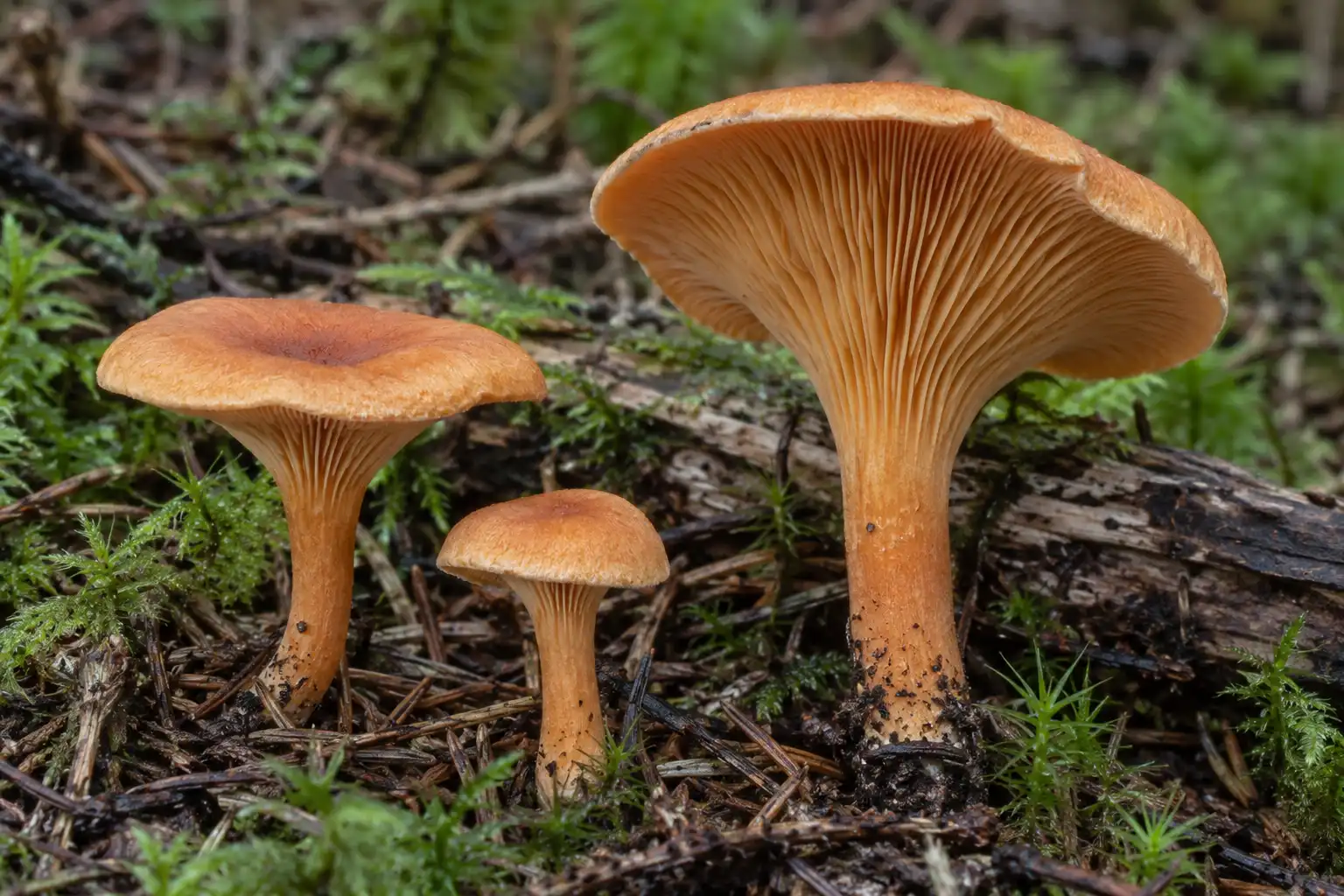
False chanterelle has true gills, so the underside needs closer attention. Its gills are commonly crowded and repeatedly forked, while its flesh is thinner and softer. It is often associated with conifer litter and very decayed woody debris. Review the dedicated false chanterelle guide rather than treating it as a spare label for every uncertain orange specimen.
Other orange-gilled mushrooms may require spore color, latex, bruising, odor, and microscopy. If the underside is hidden, the base is missing, or the habitat was not recorded, the correct outcome may be “unresolved.” An identification process is safer when it records missing evidence instead of rewarding confidence.
Bioluminescence is not a field test
Jack-o’-lantern gills can emit faint light, which inspired the common name. The effect depends on species, tissue condition, darkness adaptation, temperature, and observation method. It may be too weak for a person to see. A camera can also produce bright noise or long-exposure artifacts that resemble a glow.
Do not use visible luminescence as required proof, and never eat a mushroom because it failed to glow. If documenting the phenomenon for education, keep the specimen number, exposure settings, control frame, and ambient-light conditions. The normal-light anatomy and wood attachment remain more useful identification evidence.
Poisoning symptoms and immediate response
Omphalotus species contain compounds associated with gastrointestinal poisoning. Symptoms may include nausea, repeated vomiting, abdominal cramps, and diarrhea, sometimes beginning within hours. Severity varies with amount, person, and species, so a mild early period does not justify waiting for an online answer.
Contact a local poison center or emergency service promptly after a suspected ingestion. In the United States, Poison Control provides phone and online guidance; elsewhere use the official regional service. Do not induce vomiting unless instructed by a clinician. Urgent medical assessment is especially important for severe symptoms, dehydration, altered consciousness, breathing difficulty, children, older adults, pregnancy, or significant underlying illness.
Save uncooked mushrooms, cooked leftovers, trimmings, photographs, and packaging. Write down the time eaten, estimated amount, preparation, number of diners, symptom onset, and other foods or medicines. Keep suspected material away from additional diners and pets. Online groups can assist with documentation but must not delay care.
Build a defensible field record
Assign a collection number and photograph habitat, cluster, attachment, cap, gills, stem, base, and section with a scale. Measure several fruit bodies and record weather, host evidence, region, and recent rainfall. Make a labeled spore print when appropriate. Keep notes about which characters were observed and which were inferred.
Compare the collection against at least two consequential alternatives. For chanterelles, document true gills versus folds and wood attachment versus mycorrhizal soil growth. For false chanterelle, document gill branching, flesh, substrate, and cluster architecture. If any major character conflicts, reopen the identification rather than explaining the contradiction away.
The strongest conclusion may be genus-level. A local mycological society, herbarium, or experienced identifier can assess a voucher and current regional literature. The aim is not to attach a name rapidly; it is to preserve enough evidence that the name, uncertainty, and safety boundary can be checked later.
References
- North American Mycological Association. Mushroom Poisoning Syndromes. Syndrome and response context.
- Poison Control. Wild mushroom warning. Immediate poisoning guidance.
- Kuo M. Omphalotus illudens. North American morphology, ecology, and comparisons.
- Global Biodiversity Information Facility. Omphalotus illudens species record. Taxonomic and occurrence context.
- University of California Integrated Pest Management. Mushrooms and Other Nuisance Fungi in Lawns. Buried wood and lawn-fruiting context.
Editorial review dated October 18, 2026. No named mycologist or clinician reviewed this page; taxonomy, regional lookalikes, and poison-response contacts should be rechecked at each substantive revision.
Audit a cluster from buried wood to gill edge
Treat the cluster as a three-dimensional attachment problem. Place numbered markers beside each stem, then expose only enough soil to determine whether stems join one buried root, several wood fragments, or compact litter. Photograph the intact cluster, the common attachment, and a cleaned cross-section. Record host evidence separately: bark and wood anatomy are stronger than the nearest standing tree.
For each numbered cap, measure diameter, stem offset, gill depth, gill spacing at mid-radius, and the distance the gills descend. A chanterelle comparison should use the same views. True jack-o’-lantern gills are thin blades with sharp edges and measurable spaces; chanterelle ridges are blunt folds that fork and merge with the cap flesh. The chanterelle comparison explains that structural test without relying on orange color.
Cut one fruit body vertically from cap center through the full stem and attachment. Photograph the orange internal tissue under neutral light and record any insect tunnels or color changes. Do not combine the brightest cap, deepest gills, and most fused base from different clusters into one idealized specimen description.
Test glow claims without using darkness as clearance
Bioluminescence varies with species, tissue, age, temperature, moisture, camera sensitivity, and exposure. If documenting it, place a fresh gill-side sample in a dark controlled enclosure beside a nonluminescent reference, allow eyes and camera to adapt, and record exposure settings. Take a matched lights-on frame without moving the specimen. Long exposures can reveal weak emission that a person could not see, while sensor noise can manufacture colored speckles.
A failed glow test does not exclude Omphalotus, and a bright digital image does not confirm it. The result belongs in the observation record only after cluster architecture, wood attachment, true decurrent gills, regional range, and orange tissue have been documented. Never delay poisoning response to perform this experiment.
Source quality notes
MushroomScope cites sources that match the page scope, such as taxonomic databases, extension guidance, food-safety agencies, food-composition databases, and peer-reviewed or institutional health references. Sources support context and uncertainty; they do not turn an online page into specimen identification, medical advice, or a tested recipe record.
Frequently asked questions
How do jack-o'-lantern mushrooms differ from chanterelles?
Jack-o'-lanterns have thin, sharp true gills and usually grow in clusters from wood or buried roots. Chanterelles have blunt folds and a different ecology, but a local expert should resolve uncertain specimens.
Are jack-o'-lantern mushrooms poisonous?
Yes. Omphalotus species cause gastrointestinal poisoning and must not be eaten. Cooking does not make a mistaken collection safe.
Do jack-o'-lantern mushrooms always glow?
No. Gill bioluminescence can be weak, condition-dependent, and invisible to an observer. Absence of visible glow does not exclude Omphalotus.
Where do jack-o'-lantern mushrooms grow?
They fruit from hardwood, stumps, buried roots, or woody debris, often in dense clusters. Regional species and preferred hosts differ.
What should I do after someone eats a possible jack-o'-lantern?
Contact a poison center or emergency service promptly, especially if symptoms begin. Keep leftovers, photographs, and timing details; do not wait for an online identification.
Related guides
identification
Chanterelle vs. Jack-o-Lantern Mushrooms: Key Differences
Compare ridge-like folds, growth pattern, color, interior tissue, and habitat without treating an online comparison as an edibility verdict.
mushrooms
Cantharellus cibarius: Chanterelle Identification Guide
Learn chanterelle identification, false gills, habitat, season, poisonous lookalikes, edibility, nutrition, and why wild finds need local verification.
mushrooms
False Chanterelle (Hygrophoropsis aurantiaca): Identification Guide
Identify false chanterelle by its forked true gills, orange cap, conifer litter habitat, spore print, lookalikes, and conservative food-safety limits.
Continue exploring
Browse more practical guides in Mushroom Encyclopedia or visit the mushroom encyclopedia.