Identification
Chanterelle vs. Jack-o-Lantern Mushrooms: Key Differences
Compare ridge-like folds, growth pattern, color, interior tissue, and habitat without treating an online comparison as an edibility verdict.
By MushroomScope Editorial Team · · Updated
Safety first
Use as a field-record guide
Document the whole mushroom, habitat, substrate, and region before comparing names or photographs.
Open the identification safety hub →Decision limit
Do not use this as an edibility verdict
Wild mushroom consumption decisions require qualified local, in-person confirmation of the complete specimen.
Read the safety disclaimer →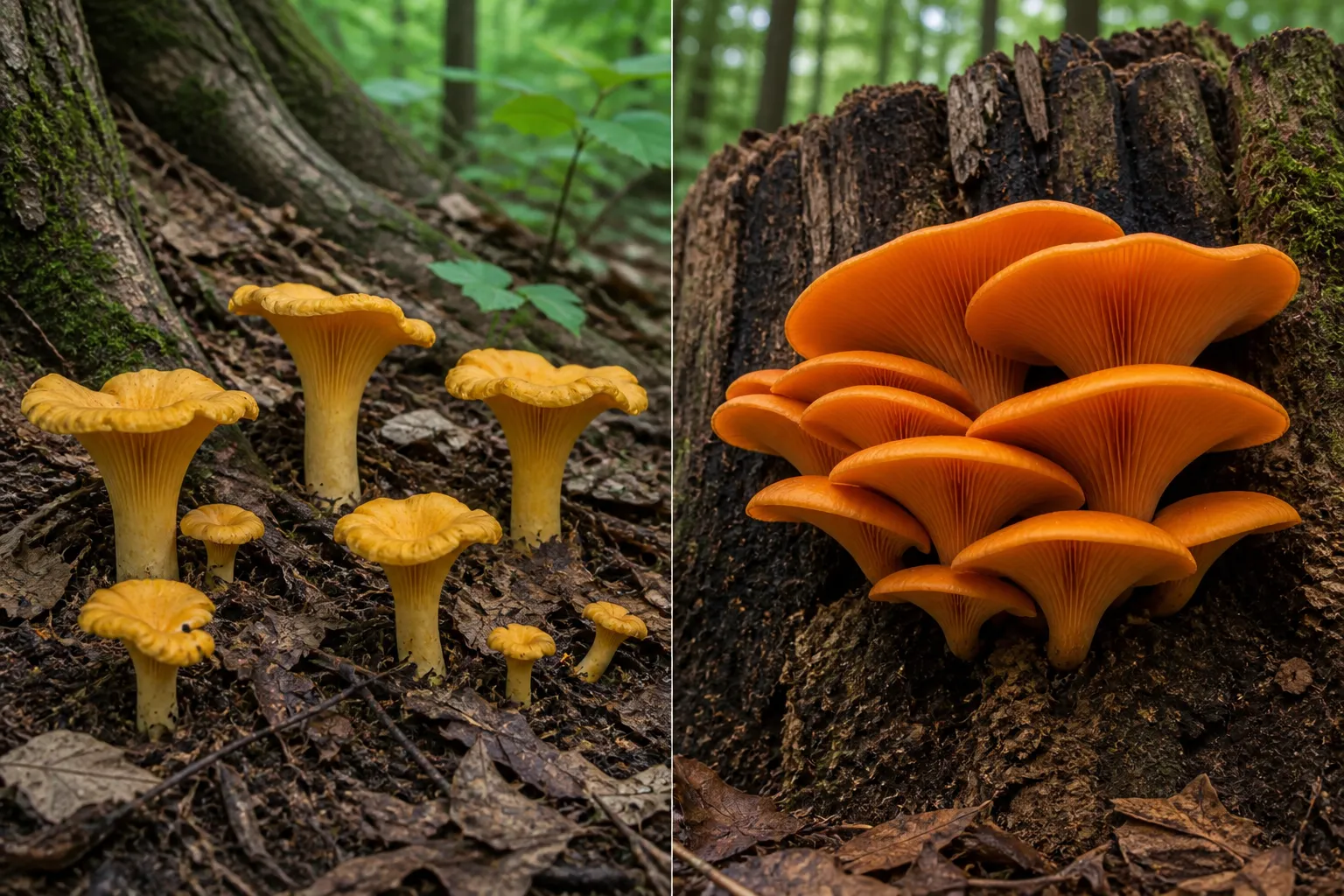
Begin with substrate, growth pattern, and underside structure
Compare ridge-like folds, growth pattern, color, interior tissue, and habitat without treating an online comparison as an edibility verdict. The central task is a high-risk lookalike comparison. A defensible observation separates what was directly seen from what was inferred. Common names, image-search results, and app suggestions can generate hypotheses, but none establishes identity or edibility.
Start by preserving the relationship between every orange fruit body and its substrate. Photograph the entire troop or cluster, then trace one base to soil, root, stump, or buried wood without mixing specimens from separate patches. Record nearby trees, whether stems share a fused base, and whether the mushrooms recur from the same woody point. These observations directly test the mycorrhizal-chanterelle versus wood-decaying-Omphalotus question; never taste an unidentified collection.
What to examine
- blunt forked ridges: Record the feature in plain language, add a measurement or photograph, and note variation among specimens.
- true blade-like gills: Record the feature in plain language, add a measurement or photograph, and note variation among specimens.
- clustered wood growth: Record the feature in plain language, add a measurement or photograph, and note variation among specimens.
- interior flesh color: Record the feature in plain language, add a measurement or photograph, and note variation among specimens.
- local expert confirmation: Record the feature in plain language, add a measurement or photograph, and note variation among specimens.
Treat orange color as low-weight evidence. Diffuse daylight, rain, fading, phone white balance, and exposure can make both groups appear yellower or redder. Give more weight to the underside: blunt, branching folds continuous with cap flesh support a chanterelle hypothesis, while numerous thin, sharp, separable blades support Omphalotus. If substrate, underside, or the cut interior contradicts the color impression, keep the record unresolved and use a current regional key.
A repeatable field method
- Photograph the group and its substrate before disturbance.
- Record cap, underside, attachment, stem, complete base, flesh, odor without inhaling closely, and any bruising.
- Measure several specimens and document young and mature stages.
- Make a spore deposit only when safe and useful; keep it away from food-preparation surfaces.
- Compare the complete character set with a regional key and current taxonomy.
- Keep conflicting or incomplete records unidentified.
Start with growth pattern and substrate
Chanterelles generally arise from soil as mycorrhizal partners of living trees. They may be solitary, scattered, or loosely grouped, but they do not normally form a dense fused cluster from one wood base. Jack-o’-lantern mushrooms grow from wood, stumps, roots, or buried wood and often form conspicuous clusters. Photograph the group before picking and inspect the attachment rather than assuming that a ground-level cluster is terrestrial.
Buried roots and stumps can hide the wood connection. Excavate carefully around one specimen where legal and photograph attached fibers or woody material. Conversely, chanterelles beside a log may still be growing from soil. Habitat is a strong clue only when the actual substrate and growth pattern are documented.
Both groups occur in more than one species and region. Color, season, host association, and size vary. Use a current local key and qualified local expertise rather than applying one North American or European comparison worldwide.
Compare false ridges with true blade-like gills
The underside is the most useful visible comparison. Chanterelles have blunt, shallow, forked ridges or folds that are part of the cap tissue and usually run down the stem. They can look wrinkled or vein-like. Jack-o’-lanterns have numerous thin, sharp-edged, separable true gills with a more regular blade structure.
Photograph the underside straight on and in side light. Focus close enough to show whether the structures are blunt folds or thin blades, and include where they meet the stem. Do not rely on an oversharpened or compressed image; digital processing can turn soft ridges into false sharp lines.
Touch or sectioning may help a trained examiner assess whether the underside is integral to the flesh, but no “rub the gills” shortcut establishes edibility. Young, damaged, waterlogged, or malformed specimens can obscure structure. When the photograph is ambiguous, keep the identification unresolved.
Examine flesh, stem, and cap together
Many chanterelles have pale solid flesh that contrasts with the yellow to orange exterior, while jack-o’-lantern flesh and stems tend to remain orange-toned. Cut one legally collected representative lengthwise through cap, stem, and complete base, then photograph it in neutral light. Record whether the stem is solid, fibrous, fused with neighboring stems, or hollowed by insects.
Chanterelle caps can be convex when young and become wavy or funnel-shaped; color ranges from pale cream to yellow or orange depending on species. Jack-o’-lantern caps can also become depressed and orange. This overlap is why an orange funnel shape is not enough.
Stem position, texture, and group attachment add evidence. A chanterelle often has a stem continuous with the cap, while a jack-o’-lantern cluster may have several stems joined at the base. Do not detach the stems before documenting that relationship.
Treat odor, color, and glow as supporting clues only
Chanterelles are often described as fruity or apricot-like, but odor varies with species, age, weather, and observer. Jack-o’-lantern odor is not a dependable opposite. Waft cautiously rather than inhaling deeply, never taste an unidentified mushroom, and do not let a pleasant smell override anatomy.
The reported bioluminescence of jack-o’-lantern gills is faint, inconsistent to observe, and dependent on fresh material and dark adaptation. Failure to see a glow does not rule the mushroom out. Long camera exposure can create an image that the eye did not see, while editing can exaggerate it. Do not use glow as a home safety test.
Orange intensity also changes with lighting and camera white balance. Photograph a neutral color reference in diffuse daylight and write a field note. A saturated phone photograph cannot separate the groups.
Build a side-by-side field record
For each collection, record region, date, nearby trees, exact substrate, solitary versus clustered habit, cap dimensions, underside structure, stem base, internal flesh, odor if safely observed, and spore deposit when a regional expert recommends it. Keep all images under one collection number.
A useful comparison reads: “scattered from soil under oak; blunt forked folds; pale solid flesh; no wood connection observed after careful excavation.” It does not read: “orange and smells good.” For a clustered orange mushroom on buried oak roots with thin crowded gills and orange flesh, jack-o’-lantern becomes a serious concern, but remote text still cannot authenticate the specimen.
Photograph young and mature fruit bodies. Young jack-o’-lantern gills may be less obvious, and old chanterelles may be distorted or insect-damaged. Never combine features from separate collections as though they came from one mushroom.
Understand why common lookalikes complicate the comparison
False chanterelles, waxcaps, milkcaps, and other orange mushrooms can enter the candidate set depending on region and habitat. Some have true gills but do not grow in dense wood-based clusters; others may have latex, brittle flesh, different spores, or different tree partners. Ruling out jack-o’-lantern does not automatically prove chanterelle.
Similarly, “chanterelle” covers multiple genera and species concepts. Some taxa have hollow stems, darker scales, different odors, or restricted ranges. A broad two-species infographic is a starting screen, not a complete key. Continue through a local key and compare every decisive character.
Apply conservative food-safety boundaries
Jack-o’-lantern mushrooms are associated with significant gastrointestinal poisoning. Cooking, soaking, freezing, or mixing a small amount into a meal does not make a mistaken identification safe. If a collection is densely clustered from wood or has true orange gills, do not eat it and seek qualified local help.
Even a true chanterelle identification does not answer freshness, pollution, individual tolerance, or legal-harvest questions. Avoid degraded, slimy, moldy, heavily insect-damaged, roadside, or chemically exposed specimens. Keep every collection separate through expert review and kitchen preparation so one uncertain mushroom cannot contaminate the batch.
Never use this page, an app, or a social-media vote as clearance to eat. A qualified local expert should examine the complete fresh material in person and distinguish all relevant regional lookalikes.
Respond promptly to a suspected exposure
If anyone may have eaten a jack-o’-lantern or another unidentified mushroom, contact local poison-control or emergency medical services immediately. Do not wait for symptoms, online replies, or a confident photo match. Follow professional instructions rather than inducing vomiting or using a home remedy.
Preserve uncooked mushrooms, cooked leftovers, cleaning scraps, packaging, and photographs when safe. Note time eaten, estimated amount, preparation, onset and type of symptoms, and everyone who shared the meal. Different mushrooms can be mixed in one dish, so retain all remaining material.
The poisonous mushroom warning guide explains why visual warning signs alone fail, while the chanterelle species guide provides broader taxonomic and ecological context.
Interpretation limits
Remote reviewers can point out a visible wood attachment or blade-like gills, but they cannot restore a discarded base, test whether folds are integral to the cap, or verify that every mushroom in a mixed basket came from one patch. Sequence data are meaningful only when tied to a documented voucher and trustworthy reference. For this comparison, confidence should fall sharply whenever substrate, complete underside, longitudinal section, or region is missing—regardless of how many people recognize the color.
Because jack-o’-lantern ingestion can produce severe gastrointestinal illness, call the local poison center or emergency service promptly after a suspected exposure rather than waiting for a crowd-sourced name. Keep specimens from the original patch, cleaning scraps, cooked food, photographs of the attachment, meal timing, and the number of people exposed. Do not induce vomiting unless a medical professional instructs you to do so.
Continue the dangerous-lookalike workflow
Continue with the chanterelle species guide for the regional Cantharellus problem and the gill-types guide for a closer examination of folds versus true blades. Neither page converts a photograph into food clearance; the purpose is to improve the evidence taken to a qualified local identifier.
Write the final comparison as evidence, not a verdict
Summarize substrate and growth pattern first, then underside structure, flesh color, stem attachment, region, and unresolved lookalikes. Preserve photographs of the complete collection. If true versus false gills remain ambiguous or buried wood was not checked, label the record unresolved and do not move it into a food workflow.
References
Source quality notes
MushroomScope cites sources that match the page scope, such as taxonomic databases, extension guidance, food-safety agencies, food-composition databases, and peer-reviewed or institutional health references. Sources support context and uncertainty; they do not turn an online page into specimen identification, medical advice, or a tested recipe record.
Frequently asked questions
Can chanterelle vs. jack-o-lantern mushrooms: key differences confirm that a mushroom is edible?
No. This guide organizes observations only. Never eat a wild mushroom unless a qualified local expert has examined the complete specimen in person.
Is one photograph enough for identification?
No. Photograph the cap, fertile surface, intact stem base, habitat, substrate, and several developmental stages, and record location and date.
What should I do when features conflict?
Keep the identification unresolved. Recheck local keys and current taxonomy, preserve the original observations, and seek qualified in-person help.
Related guides
identification
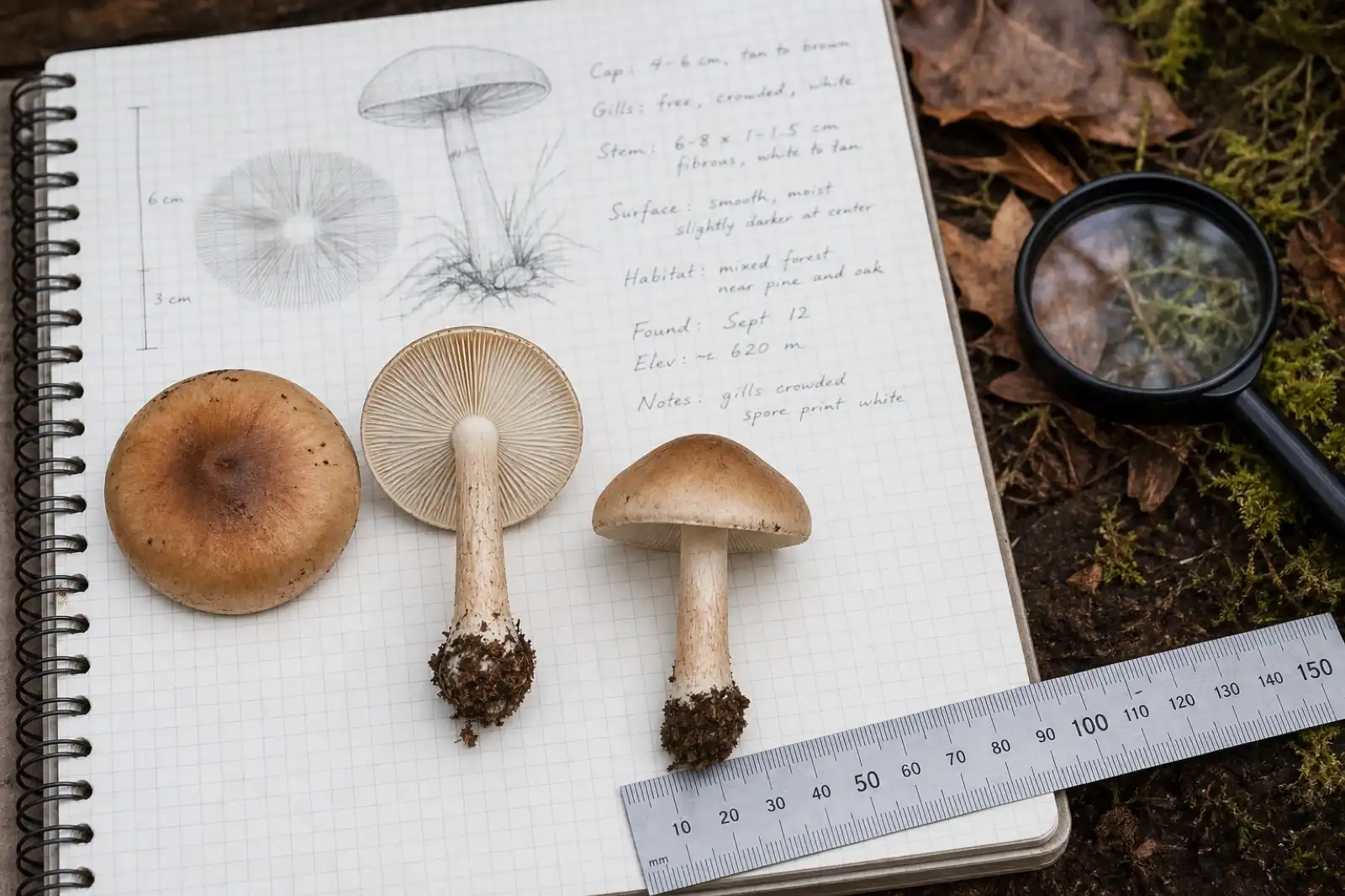
How to Identify Mushrooms: A Beginner's Field Guide
Build an identification from the whole specimen, substrate, habitat, spore deposit, and location—not from a single photograph.
identification
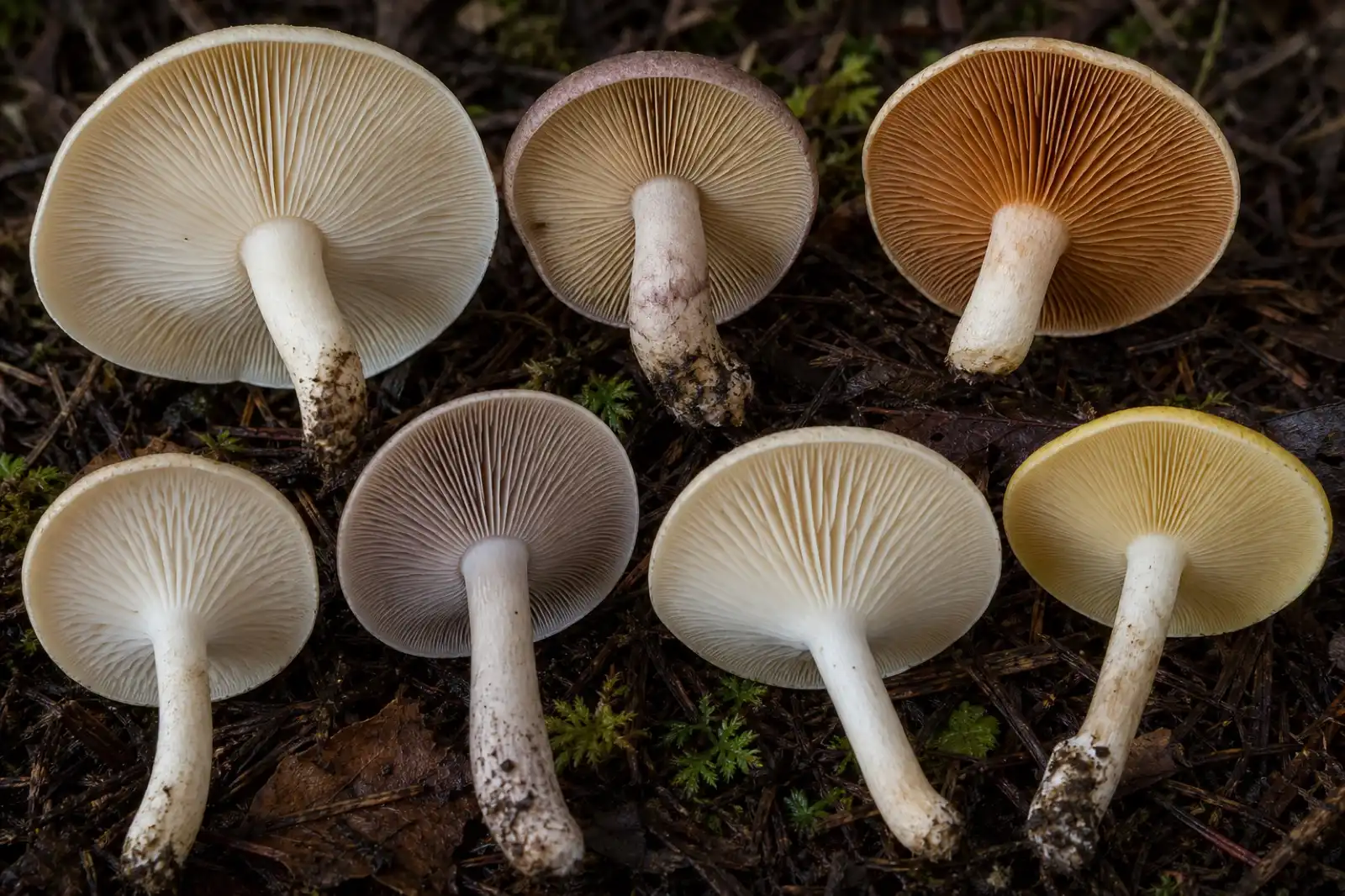
Mushroom Gill Types: Attachment, Spacing, and Color
Compare free, attached, notched, adnate, and decurrent mushroom gills while recording spacing, short gills, edge details, bruising, and color changes.
identification
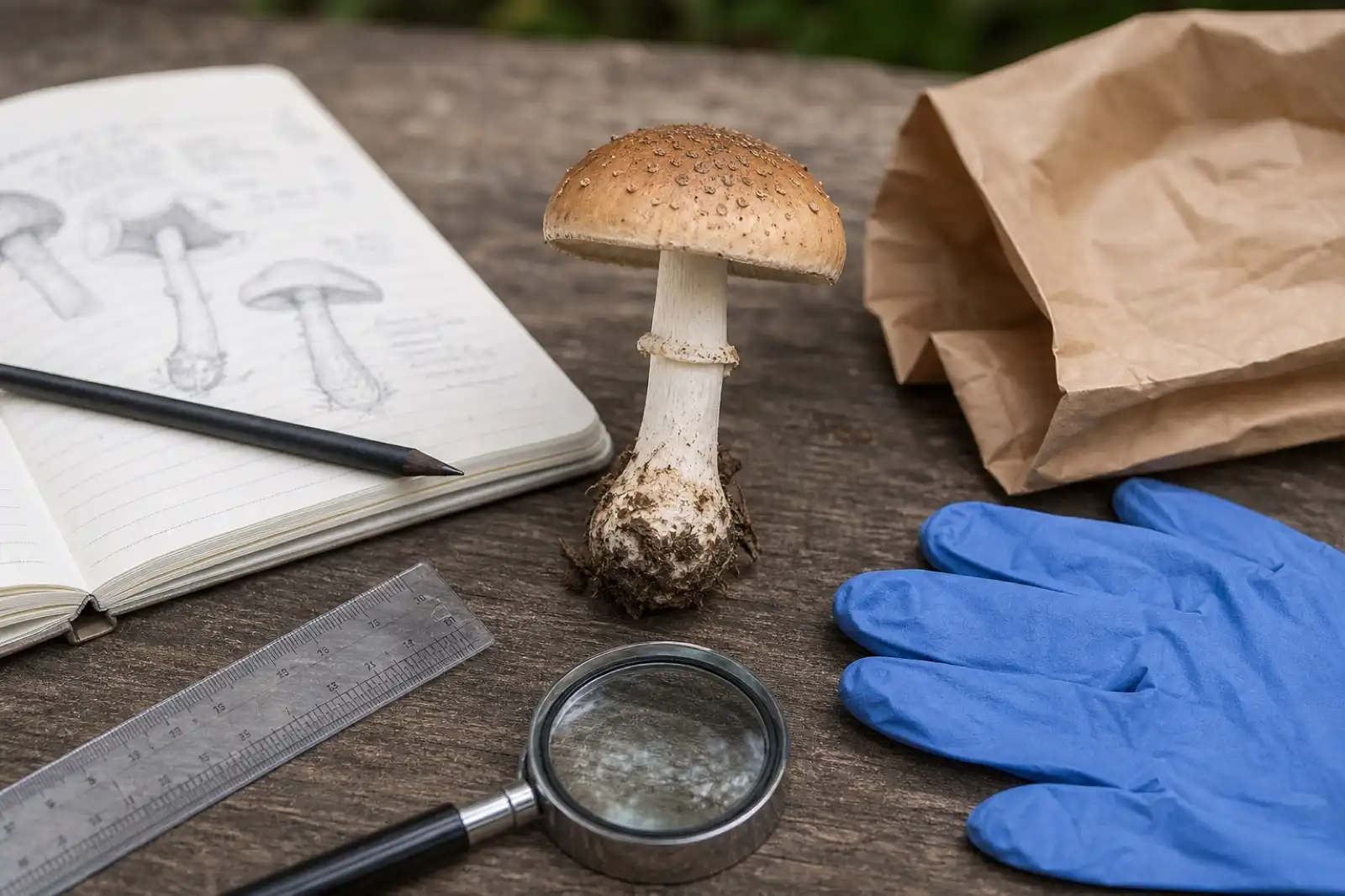
Mushroom Identification Safety Checklist
Use a conservative checklist before handling, documenting, or discussing any wild mushroom, especially when edibility is being considered.
Continue exploring
Browse more practical guides in Identification or visit the mushroom encyclopedia.