Mushroom Encyclopedia
Oak Bracket: Pseudoinonotus dryadeus Tree Guide
Document oak bracket by root-flare attachment, thick ochre brackets, amber droplets, pore changes, oak condition, decay limits, and lookalikes.
Species context
Treat profiles as reference material
Species profiles summarize documented traits, taxonomy, and lookalikes, but natural variation can be substantial.
Use the safety checklist →Decision limit
A profile cannot authenticate a specimen
Do not eat a wild mushroom from an online match, single feature, or generated image.
Read the safety disclaimer →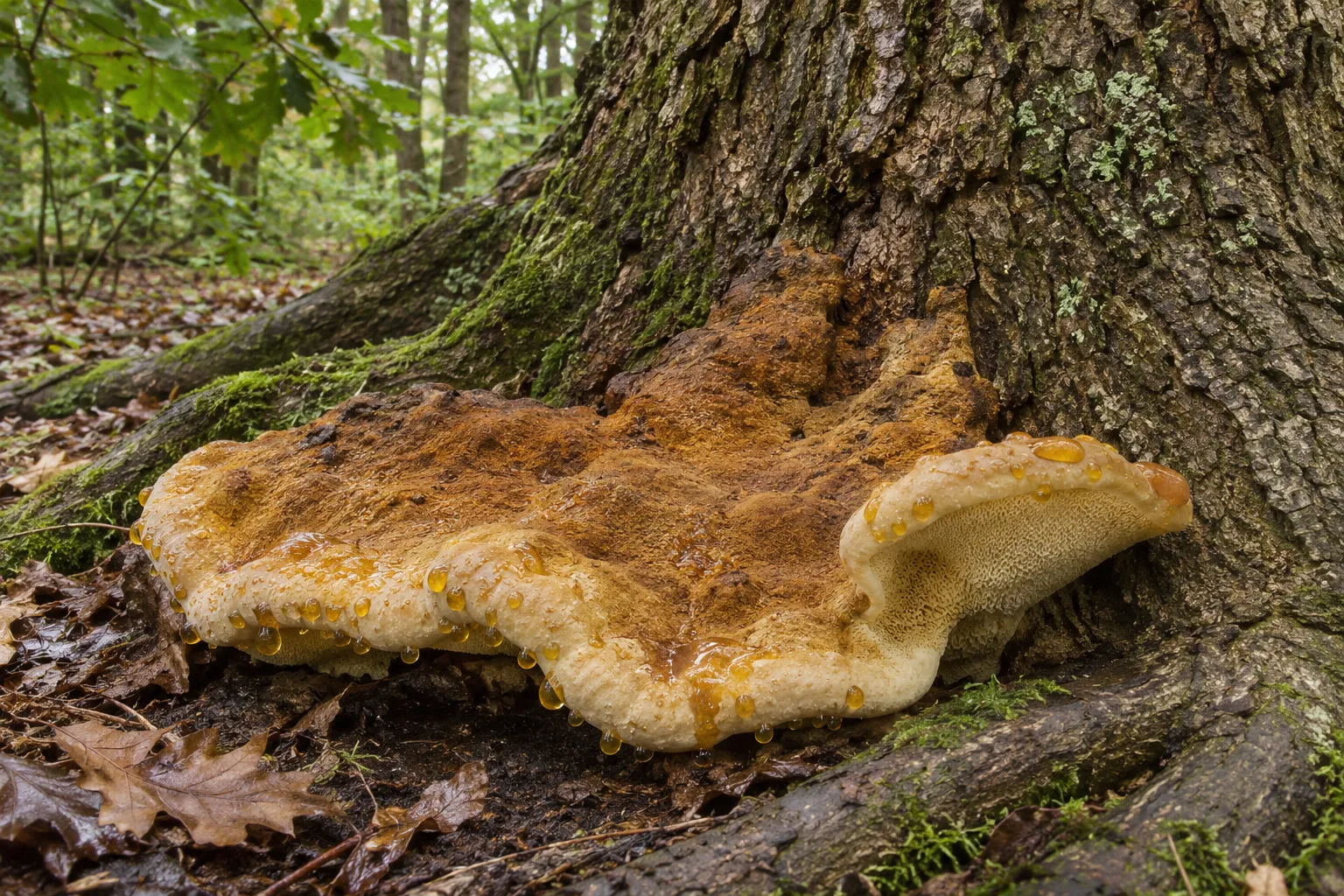
Quick facts
- Scientific name
- Pseudoinonotus dryadeus
- Common names
- Oak bracket, Weeping conk, Weeping polypore
- Taxonomy
- Pseudoinonotus · Hymenochaetaceae
- Edibility context
- Inedible: Tough mature tissue and tree-decay context make this a documentation subject, not a food species.
- Spore print
- Pale yellowish to whitish; microscopic confirmation and tissue characters are more useful than a field print alone.
- Toxicity context
- Unknown: No food recommendation is made; the principal practical concern is tree condition and misidentification rather than culinary use.
- Season
- July, August, September, October, November
- Growing difficulty
- Expert
- Regions
- Europe, North America, temperate regions with verified records
Safety limit: These labels summarize documented context; they never authenticate a wild specimen. Cooking does not make a poisonous species safe.
Oak bracket, Pseudoinonotus dryadeus, is a conspicuous basal polypore whose field value lies in its connection to a tree, not merely its amber droplets. A fresh fruit body may form a massive ochre cushion with a thick cream margin and beads of colored liquid. Older tissue becomes rough, corky, brown, and eventually black. A sound record connects that transformation to a complete root-flare attachment, host evidence, pore surface, spores, microscopy, and the limits of visual tree assessment.
This page owns the fungus and tree-context intent. The artist’s conk guide covers a harder perennial bracket with a writable pore surface, while the beefsteak fungus guide covers a red, fleshy oak-associated comparison. None of these pages can determine whether a tree is immediately hazardous.
Establish the attachment before naming the host
Photograph the entire lower trunk, buttresses, exposed roots, soil line, and fruit body in one frame. Then make closer views of the upper surface, margin, attachment, and pores. A bracket that seems terrestrial may be connected to a root just below the soil. Do not cut structural roots or excavate deeply to improve a photograph.
Confirm the tree using bark, buds, leaves, fruit, branching, and site records rather than one fallen leaf beside the fungus. Oak is the characteristic association, but leaves can blow under another tree and roots can extend beyond the crown. Record whether the tree is living, declining, dead, or reduced to a stump without converting that observation into a diagnosis of cause.
Measure an irregular bracket consistently
Oak bracket rarely offers a perfect semicircle. Record maximum width from attachment to outer edge, breadth along the trunk, thickness at margin and center, and height above soil. Use orthogonal photographs with a scale. A slanted camera can make a broad cushion appear thin, while leaf litter may conceal much of the lower surface.
Describe zones rather than assigning one cap color. The active margin may be cream or pale ochre; the central surface can be tan, rusty, granular, lumpy, or stained by droplets. Weathered tissue becomes progressively darker and may crack. Record wet and dry conditions because moisture changes gloss, saturation, and apparent texture.
Treat amber guttation as a timed observation
Fresh growing margins can exude clear to amber liquid. Photograph droplet size, distribution, surface zone, weather, and time. Revisit after a dry interval if possible. Guttation reflects active physiology and moisture conditions, but it is not unique to this species and may be absent from a valid old or dry fruit body.
Do not taste or handle exudate as an identification test. Rain beads, sap, insect honeydew, and water draining from bark can imitate droplets in a close image. A wider frame showing their origin on the bracket and repeated observation gives the claim more value.
Inspect the pore surface without breaking the bracket
Use a mirror or angled camera to record the underside where access is safe. Young pores are pale and fine, then become ochre or brown with bruising and age. Photograph an untouched area before any deliberate light pressure; destructive scratching is unnecessary when the fruit body is on a valued tree.
Count pores across a measured distance rather than estimating from magnification. Record tubes and flesh only from a naturally broken edge or an authorized sample. Thickness, color zoning, consistency, and any dark lines should remain linked to the same specimen. The absence of a conventional stem is expected, but a cropped attachment cannot demonstrate it.
Separate annual growth from persistent dark remains
Number fresh and old structures around the root flare. A soft, pale-edged fruit body may darken and harden through the season, while last year’s black remains persist nearby. Photographing both can falsely suggest a single perennial bracket unless their attachments and tissue continuity are checked.
Return at fixed intervals and record growth, drying, insect damage, collapse, and new emergence. This series supports an annual-fruiting interpretation at that tree. It does not reveal when the fungus first colonized the roots or how far decay extends inside wood.
Use spores and microscopy for the fungal record
Collect only with permission and without compromising a needed arboricultural inspection. A mature pore surface may release a pale deposit, but outdoor air movement and the bracket’s position can make prints difficult. Record failed attempts. Calibrated microscopy should document spores across an adequate count, wall and color characters, hyphae, setae or related structures required by a current key, and the sample location.
Keep dried material, images, host notes, and coordinates under one voucher code. Database occurrences and sequences should be evaluated for identification method and specimen provenance. A name attached to an unvouchered photograph is weaker than a modest record whose evidence can be rechecked.
Distinguish the main basal lookalikes
Artist’s conk forms a hard perennial shelf with layers of tubes; its fresh white pore surface stains brown when drawn upon. Beefsteak fungus is fleshy and red to liver-brown, with a distinctive tube construction. Giant polypore usually forms a rosette of multiple thinner fronds whose pale pores blacken after bruising. Other Ganoderma, Inonotus, and hymenochaetoid fungi require regional comparison.
Host and position narrow the field but do not decide it. Compare the complete architecture, active margin, upper texture, pore size and reaction, tissue consistency, season, spores, and microscopy. Reject a proposed name if the required structures were inaccessible or the host was not established.
Separate fungal identification from tree-risk assessment
A fruit body indicates that a fungus has established a relationship with woody tissue. It does not measure the cross-section of remaining sound wood, root anchorage, crown load, soil failure, wind exposure, or likelihood of failure on a particular day. The visible bracket may represent only one part of a larger below-ground process.
If the tree could reach people, buildings, roads, or play areas, document the site and contact a qualified arborist. A professional may integrate history, crown condition, root-zone changes, cavities, sounding, resistance drilling, tomography, excavation, or other methods as appropriate. Property owners should not drill or cut roots on the basis of a webpage.
Record recent trenching, paving, compaction, flooding, drought, grade change, construction, pruning, and storm damage. These factors can affect roots and stability independently of the fungus. Keeping them separate prevents the common error of making the bracket explain every symptom.
Monitor the tree without manufacturing certainty
Establish fixed photo points for the lower trunk, each fruit-body location, the crown, and the surrounding target zone. Repeat them after major weather and during the next fruiting season. Mark changes in bracket size, new emergence, crown dieback, soil heave, cracks, or root damage as observations with dates.
Monitoring is not a substitute for urgent action when movement, fresh cracking, hanging limbs, or other immediate hazards are present. Conversely, an old dark bracket alone does not justify a confident prediction or unqualified removal recommendation. Decisions belong to the owner and competent local professionals using site-specific evidence.
Audit the editorial image against bracket baselines
The 1536 × 1024 cover is an original AI-assisted editorial image. It was reviewed beside MushroomScope’s Smoky Bracket and Hairy Bracket natural-light photographs. It uses diffuse woodland light, restrained ochre and bark-brown color, a complete ground-level oak attachment, readable root flare, thick active margin, limited amber droplets, and a visible pore lobe. It has no text, watermark, logo, collage seam, stretching, or obvious floating attachment.
The image remains illustrative. It cannot establish host identity, internal tree condition, geographic occurrence, pore measurements, microscopy, or failure risk. Field evidence and qualified assessment must stand independently.
Build a reviewable oak-bracket record
Close the survey with a site sketch that shows trunk diameter, buttress orientation, bracket positions, paths, structures, and occupied areas. Photographs should retain a compass direction and a repeatable camera point. This makes later changes comparable and helps an arborist understand which roots or targets were outside the original frame. Do not publish a precise location for a private tree without permission.
Keep the fungal record and the management record as separate files linked by date. Taxonomic revision may change the accepted name without changing the observed bracket, while a later inspection may change the risk decision without changing the fungus. That separation prevents an outdated identification label from being mistaken for a current safety assessment.
- Photograph the full tree base, root flare, fruit body, and surrounding site.
- Confirm the host independently and map every fresh and old bracket.
- Measure cap zones, attachment, active margin, pores, and timed guttation.
- Compare artist’s conk, beefsteak fungus, giant polypore, and regional taxa.
- Keep voucher, spores, microscopy, host notes, and dates linked.
- Separate fungal naming from claims about decay extent or immediate risk.
- Escalate target-bearing trees to a qualified arborist rather than diagnosing online.
References
- NCBI Taxonomy Browser: Pseudoinonotus dryadeus — taxonomy and sequence-linked records.
- GBIF species search: Pseudoinonotus dryadeus — occurrence and voucher leads requiring record-level review.
- First Nature: Pseudoinonotus dryadeus — morphology, oak association, season, and comparison characters.
- Forest Research: principal decay fungi of trees — professional context for decay-fungus evidence and tree assessment.
Editorial status: reviewed by the MushroomScope editorial team on November 20, 2026; no named mycologist, arborist, pathologist, or clinician reviewed this page.
Source quality notes
MushroomScope cites sources that match the page scope, such as taxonomic databases, extension guidance, food-safety agencies, food-composition databases, and peer-reviewed or institutional health references. Sources support context and uncertainty; they do not turn an online page into specimen identification, medical advice, or a tested recipe record.
Frequently asked questions
Where does oak bracket usually fruit?
Fruit bodies typically arise low on the trunk, root flare, buttress roots, or apparently from soil above infected roots. Photograph the attachment and excavate only when lawful because the root context matters.
Do amber droplets prove Pseudoinonotus dryadeus?
No. Fresh brackets can exude amber droplets, but guttation occurs in other fungi and varies with weather and age. Attachment, host, structure, pores, spores, microscopy, and regional records must agree.
Does one oak bracket mean a tree will fall?
A fruit body indicates an established fungus but does not quantify remaining sound wood or immediate failure probability. A qualified arborist must assess the whole tree, site, targets, roots, crown, and decay extent.
Is oak bracket an annual or perennial fruit body?
The visible brackets are generally annual, although old blackened remains may persist. The fungus and decay can remain in the tree or roots beyond one fruiting season.
Can a web photograph diagnose oak root decay?
No. Photographs can document a hypothesis, not measure internal wood condition or tree stability. Avoid cutting roots or sounding the tree without appropriate ownership, training, and risk controls.
Related guides
mushrooms
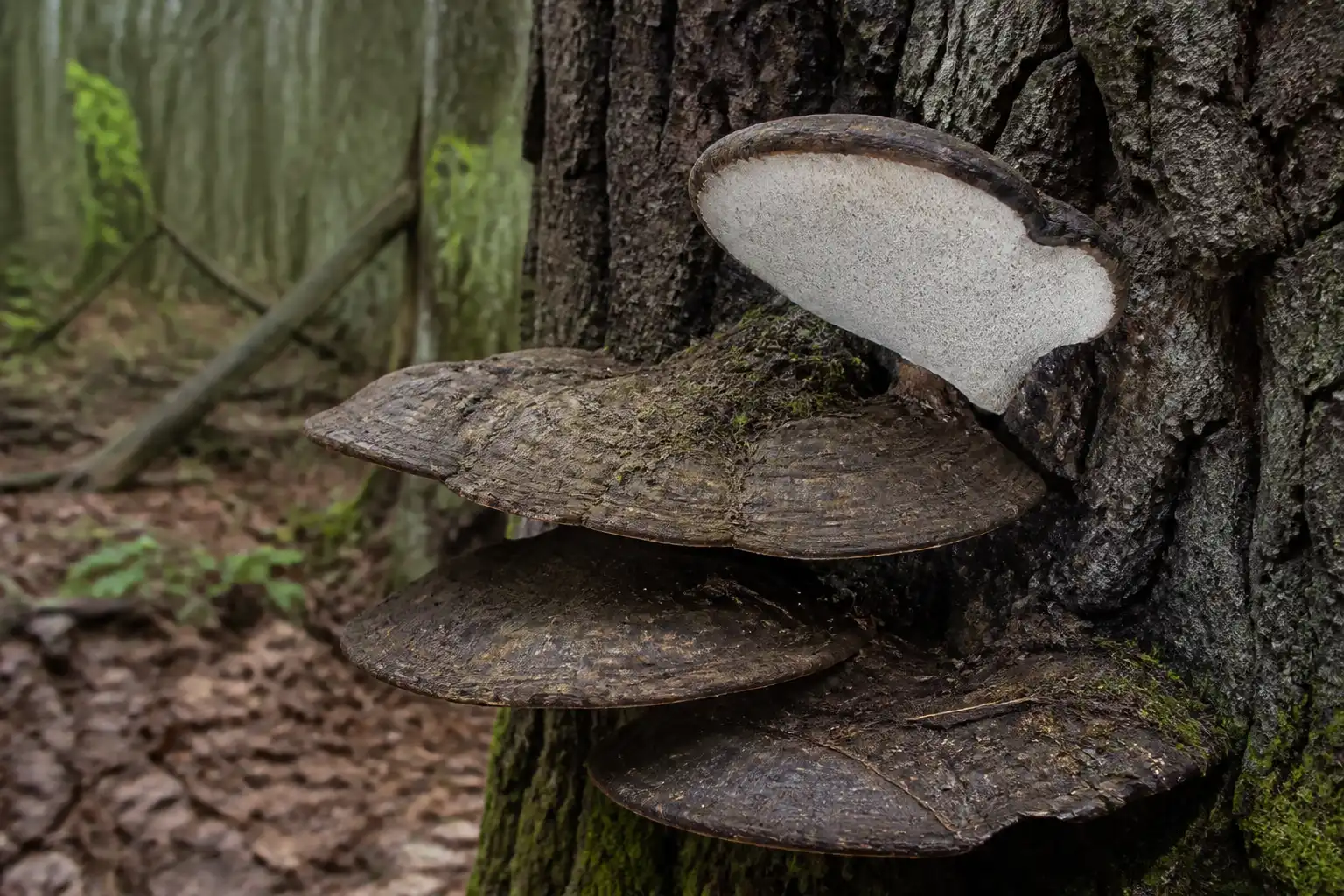
Ganoderma applanatum: Artist’s conk Species Guide
Learn Artist’s conk identification, habitat, season, lookalikes, safety, food context, and cultivation limits with current taxonomy and sources.
mushrooms
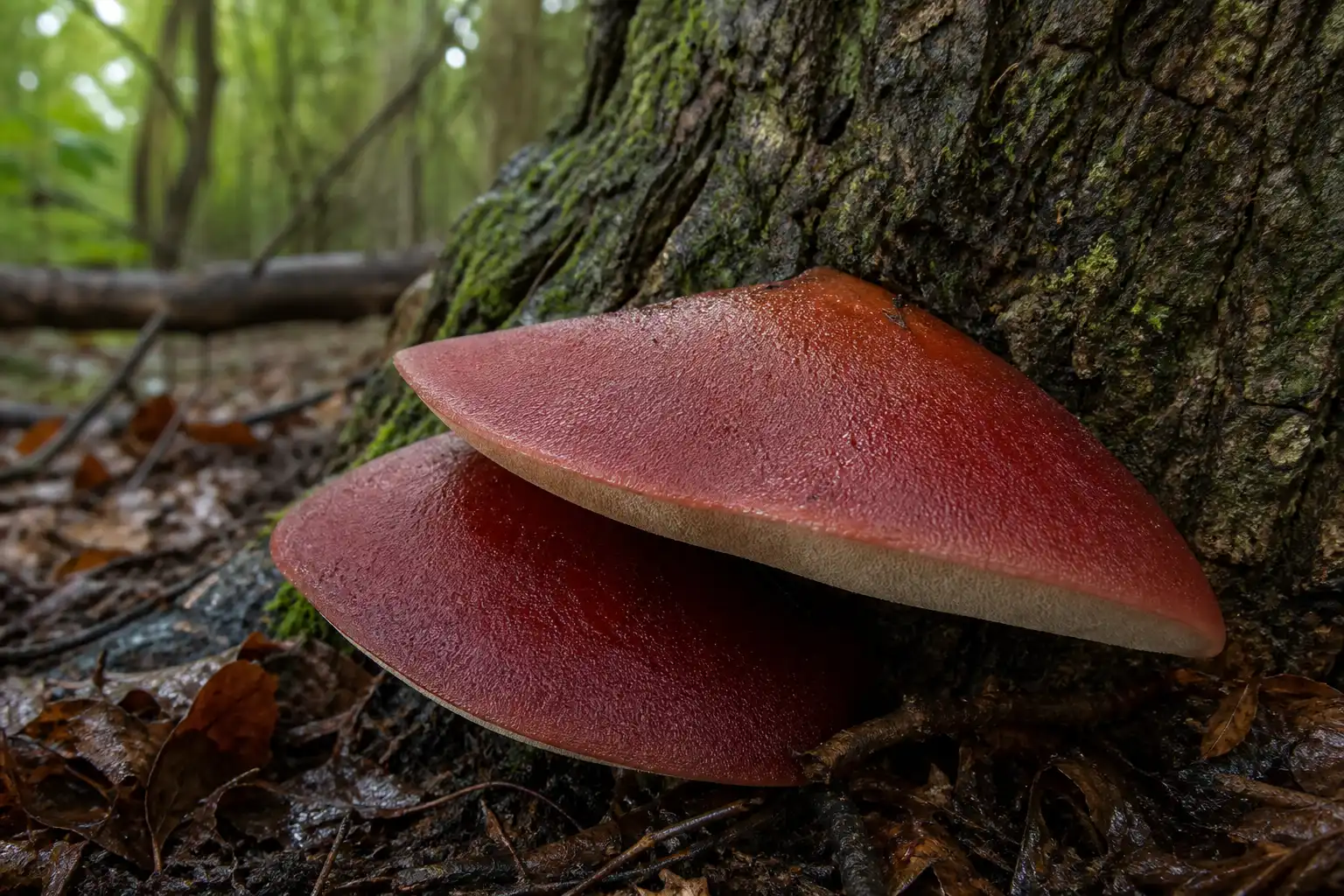
Beefsteak Fungus: Oak Ecology, Pores, and Lookalikes
Document beefsteak fungus by its red tongue-shaped brackets, separate tubes, pale pores, oak or chestnut host, white rot, and regional lookalikes.
identification
Using Habitat to Identify Mushrooms
Record substrate, associated plants, soil, wood type, moisture, elevation, and fruiting pattern as identification evidence.
Continue exploring
Browse more practical guides in Mushroom Encyclopedia or visit the mushroom encyclopedia.