Mushroom Encyclopedia
Shaggy Scalycap (Pholiota squarrosa): Identification Guide
Identify shaggy scalycap by its dry scales, rusty spores, clustered wood growth, host context, and differences from similar Pholiota species.
By MushroomScope Editorial Team · · Updated
Species context
Treat profiles as reference material
Species profiles summarize documented traits, taxonomy, and lookalikes, but natural variation can be substantial.
Use the safety checklist →Decision limit
A profile cannot authenticate a specimen
Do not eat a wild mushroom from an online match, single feature, or generated image.
Read the safety disclaimer →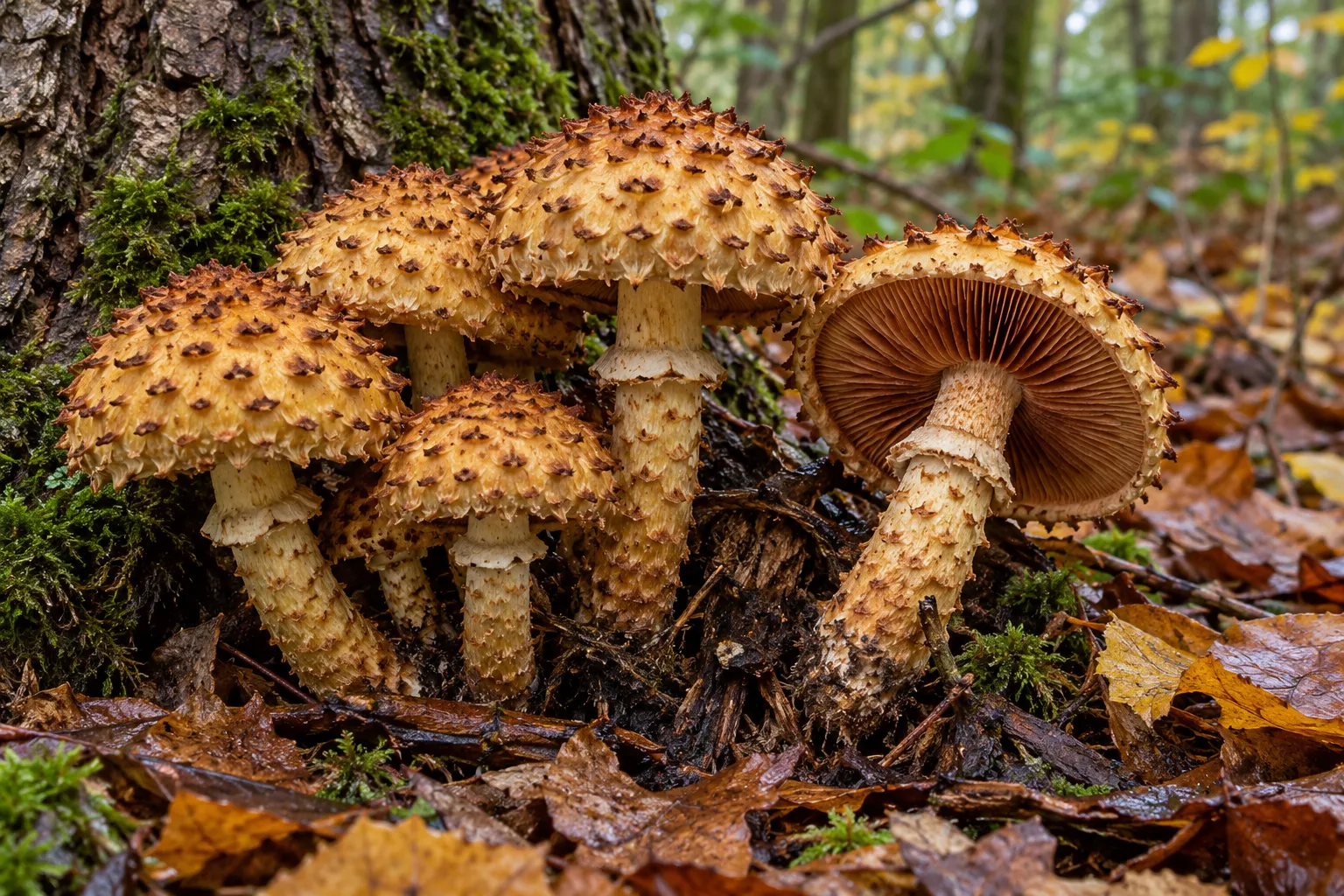
Quick facts
- Scientific name
- Pholiota squarrosa
- Common names
- Shaggy scalycap, Shaggy Pholiota
- Taxonomy
- Pholiota · Strophariaceae
- Edibility context
- Inedible: Not recommended for food; adverse gastrointestinal reactions and difficult lookalikes create an avoid-consumption boundary.
- Spore print
- Rusty brown.
- Toxicity context
- Moderate: Reported poisonings are mainly gastrointestinal; identity and individual reactions are uncertain enough that consumption is not advised.
- Season
- August, September, October, November
- Growing difficulty
- Expert
- Regions
- Europe, North America, temperate Asia, New Zealand
Safety limit: These labels summarize documented context; they never authenticate a wild specimen. Cooking does not make a poisonous species safe.
Start with the whole cluster, not one dramatic cap
Shaggy scalycap, Pholiota squarrosa, is a conspicuous wood-associated mushroom whose common name describes its most memorable surface: ochre caps and stems armored with darker, projecting scales. That appearance is useful for forming a hypothesis, but it is not a safe one-feature identification. Rain can flatten scales, old caps lose ornament, and several brown-spored wood fungi occupy a similar visual neighborhood. A defensible record combines the scale pattern with gill development, spore color, stem veil, substrate, host, region, and collection-level variation.
Photograph the entire group before removing anything. Show whether stems arise separately, converge at a buried root, or emerge directly from exposed wood. Record living bark, a cut stump, buried landscaping wood, or a dead trunk rather than writing only “on the ground.” A cluster beside a tree can originate from roots below the soil. That distinction matters both for identification and for deciding whether a tree-health assessment is warranted.
This guide is for documentation, not food approval. Older sources have disagreed about edibility, and illness has been reported. Similar clustered fungi include additional Pholiota, honey fungi, and other brown-spored groups. Treat an unresolved collection as inedible. If symptoms follow ingestion, contact a poison center or medical service promptly and preserve specimens and photographs.
Measure scale architecture before weather erases it
Young caps are rounded to convex and usually yellow-ochre or tawny. As they expand, they remain convex or become broadly convex. The diagnostic impression comes from numerous darker brown scales that stand away from the cap like small recurved triangles. Record whether those scales are dry, firmly attached, evenly distributed, and darker than the background. Include a ruler and photograph both a protected young cap and a rain-exposed mature cap.
Scale words are easy to use loosely. “Scaly” can describe flat fibers, cracked pigment, universal-veil patches, or true projecting tissue. Side lighting reveals height better than a direct flash. A close view of the margin can show whether scales continue to the edge and whether pale veil fragments remain. Do not clean or wash a cap before documenting it; that can remove the character the name highlights.
Weather is a major confounder. Prolonged rain can press scales down, darken the cap, and make surfaces appear shinier. Drying can exaggerate cracks. Insects remove patches irregularly. Compare several fruit bodies at different ages and retain the observation that the surface is normally dry. A genuinely gelatinous layer beneath the scales directs attention toward other Pholiota concepts, especially in North American keys.
Follow gills from pale youth to rusty maturity
The gills begin pale yellowish or olive-toned and become brown to rusty brown as spores mature. They are attached to the stem rather than free. Photograph naturally opened caps from below and note attachment, spacing, edge color, and developmental stage. A young cap with pale gills is incomplete evidence; a mature cap supplies the color transition needed to interpret the group.
Make a labeled spore deposit from a mature specimen on white and dark nonabsorbent surfaces. Shaggy scalycap produces a rusty-brown deposit. This separates it from honey fungi, whose spores are white, even when both form dense clusters at a tree base. Spore color does not by itself separate all Pholiota species, but it is an efficient branch point. The spore-print guide explains how to avoid confusing gill pigment with deposited spores.
Microscopy may be necessary where close species overlap. Spore dimensions, germ pore, cystidia, and cap-tissue construction can matter in technical keys. Measurements must come from calibrated equipment and multiple structures, not one selected spore. When the consequence is a distribution record or a difficult regional separation, retain dried material and consult a herbarium or experienced mycologist rather than forcing a species name from photographs.
Read the stem as two zones
The stem is typically pale yellowish to ochre, firm, and conspicuously scaly below the veil zone. A partial veil protects young gills and later leaves a fibrous or membranous ring area. Above that zone the stem may be smoother; below it, darker scales echo the cap ornament. Photograph an intact young veil, the mature ring zone, and the stem below it across several specimens.
The ring can collapse, stain brown from spores, or disappear with age. Its absence on a battered individual therefore has limited value. Conversely, a prominent skirt does not identify the species; many clustered mushrooms have rings. Describe position, texture, color, persistence, and spore staining instead of recording a yes/no checkbox.
Dig carefully around one stem base when collection is lawful. The goal is to reveal whether multiple stems share buried woody tissue, not to produce a clean studio specimen. Photograph soil and wood still attached. Avoid damaging living roots merely for a record. A useful collection number links the habitat frame, cap details, underside, stem, spore print, and any retained material.
Use host and decay position as evidence
Shaggy scalycap is recorded on dead wood and at the bases or roots of living trees, especially broadleaf trees, with some conifer records. Published interaction data include saprotrophic and parasitic relationships. That dual ecology is more informative than the vague label “forest mushroom.” Record the tree species where possible, whether the trunk is alive, the exact fruiting position, visible cavities, old pruning wounds, root disturbance, and whether the cluster recurs.
Fruit bodies do not quantify structural stability. They indicate that a wood-decay fungus is fruiting in association with woody material, but the extent and location of decay require inspection. For a large tree near people or property, document the mushrooms and ask a qualified arborist to assess the tree. Do not cut roots, inject chemicals, or remove mushrooms expecting that action to remove the established fungus.
Distribution records should include region and date because species concepts and lookalike frequency vary. The Natural History Museum recognizes the accepted name and common names in the British checklist context; NCBI supplies a stable taxonomic record. Neither source turns a photograph into a regional determination. Local keys and voucher-backed records remain the right level of evidence.
Separate dry shaggy caps from gelatinous scalycaps
The closest practical comparison is often Pholiota squarrosoides. North American treatments describe it as paler and capable of becoming viscid because of a gelatinous layer beneath the scales, particularly in wet weather. P. squarrosa is characteristically dry. This distinction should be tested on fresh material from the same collection, not inferred from a photograph taken after rain.
Members of the Pholiota adiposa complex and related golden scalycaps may have brighter yellow colors, appressed scales, or a distinctly viscid cap. Names applied to these fungi have shifted, and field morphology can overlap. Record texture before color: whether moisture sits on the surface, whether the context has a gelatinous layer, and whether scales project or lie flat. Regional microscopy or DNA may be the only honest resolution for an important record.
Cultivated nameko, Pholiota microspora, is marketed with a strongly gelatinous cap. The nameko guide explains that crop form and controlled substrate are not interchangeable with a wild shaggy cluster. A commercial name does not transfer edibility to a similar wild fungus.
Exclude honey fungus and sulfur tuft with spores and stems
Honey fungi (Armillaria) can form large clusters at roots and stumps and may carry a ring. Their caps can be scaly, but the decisive early split is a white spore deposit, not rusty brown. Gill color, stem construction, host symptoms, and regional species then refine the comparison. Never assume that clustering plus a ring equals either genus.
Sulfur tuft, Hypholoma fasciculare, also fruits densely from wood. It is smoother, more sulfur-yellow, lacks the coarse shaggy stem covering, and develops gray-green to dark gills with a purple-brown deposit. See the sulfur tuft guide for the bitter poisonous comparison. Tasting is unnecessary and inappropriate when safer structural characters exist.
Other brown-spored clustered mushrooms include Galerina, some Gymnopilus, and additional stropharioid fungi. A small rusty-spored wood mushroom must never be cleared because it lacks the exact look of a textbook photograph. Measure it through a regional key, and treat any uncertainty as a stop signal for consumption.
Keep food and tree-risk decisions conservative
Historical edibility labels for shaggy scalycap are inconsistent, while adverse gastrointestinal reactions have been reported. Preparation advice cannot correct an uncertain identification, an individual susceptibility, or a mislabeled older account. MushroomScope therefore treats the species as inedible and provides no cooking method. This is an evidence boundary, not a claim that every exposure has the same outcome.
After possible ingestion, note the time, estimated quantity, preparation, number of diners, and symptom onset. Preserve raw pieces, cooked leftovers, and photographs without delaying care. Contact the relevant poison center or medical service; severe, persistent, delayed, or systemic symptoms require urgent evaluation. Do not induce vomiting or self-treat from a web page.
For tree concerns, preserve a different evidence set: dated cluster photographs, tree species, recurrence, crown condition, cavities, site changes, and exact fruiting position. An arborist can integrate those observations with structural inspection. Removing fruit bodies may improve tidiness but does not demonstrate that decay has stopped.
Build a record that another person can audit
A strong record contains an overview, measured cap, scale close-up, underside at two ages, veil zone, lower stem, complete base, substrate interface, host, spore deposit, date, and broad locality. Note rain in the previous days because it affects surfaces. Keep images in neutral color and avoid filters that intensify yellow and brown.
Write conclusions at the level supported by evidence. “Dry, shaggy, rusty-spored Pholiota at a maple base” may be stronger than an unsupported species declaration. If the dry surface, projecting scales, stem zones, host, and regional key align, P. squarrosa becomes a reasoned hypothesis. Voucher microscopy or sequence data can raise confidence further.
No website can confirm that a wild mushroom is safe to eat. The value of this page is a repeatable observation workflow: document structures before they disappear, use spores to divide lookalikes, preserve ecological context, and keep food and tree-risk decisions separate from a visually appealing name.
References
For a yellow wood agaric whose cap scales are wine-purple rather than coarse ochre-brown, compare the plums and custard guide, including mature gill color, pale spores, conifer wood, and lack of a persistent ring.
- Natural History Museum. Pholiota squarrosa species dictionary. Accepted name, checklist, and common-name context.
- National Center for Biotechnology Information. Pholiota squarrosa taxonomy record. Current name and lineage.
- Biological Records Centre. Published interactions for Pholiota squarrosa. Host, substrate, and decay relationships compiled from the British and Irish checklist.
- Michigan State University Bonito Lab. Pholiota squarrosa profile. Genus and species context.
Frequently asked questions
What identifies a shaggy scalycap?
A strong record combines clustered wood growth, dry projecting scales on cap and lower stem, an upper ring zone, attached gills maturing rusty brown, and a rusty-brown spore deposit.
Is shaggy scalycap edible?
Treat it as inedible. Confusing lookalikes and reported gastrointestinal illness make it unsuitable for a food decision.
How does it differ from nameko?
Nameko is known for a strongly gelatinous cap, whereas shaggy scalycap is characteristically dry with coarse projecting scales. Regional keys are still necessary.
Does it harm trees?
It occurs on dead wood and at living tree bases or roots. Fruit bodies justify documentation and, for valuable trees, arborist assessment; they do not measure structural risk alone.
Can a photograph confirm it?
No. Weather changes scales, and close Pholiota species can require spores, microscopy, substrate, host, and regional literature.
Source quality notes
MushroomScope cites sources that match the page scope, such as taxonomic databases, extension guidance, food-safety agencies, food-composition databases, and peer-reviewed or institutional health references. Sources support context and uncertainty; they do not turn an online page into specimen identification, medical advice, or a tested recipe record.
Frequently asked questions
What identifies a shaggy scalycap?
A strong record combines clustered growth at wood or a tree base, dry projecting brown scales on an ochre cap and stem, attached gills maturing rusty brown, a ring zone, and a rusty-brown spore deposit.
Is shaggy scalycap edible?
Treat it as inedible. Reports of gastrointestinal illness and confusion with other clustered brown-spored fungi make it unsuitable for a food decision.
How does shaggy scalycap differ from nameko?
Nameko is cultivated for a conspicuously gelatinous cap surface, while shaggy scalycap is characterized by a dry surface with coarse projecting scales; regional Pholiota still require a full key.
Does shaggy scalycap harm trees?
It can occur as a saprotroph on dead wood and as a root or butt-rot associate on living trees, but fruit bodies alone do not measure structural risk. An arborist should assess a valuable tree.
Can a photograph confirm Pholiota squarrosa?
No. Scale condition changes with rain and age, several Pholiota overlap, and spores, substrate, host, region, and sometimes microscopy are needed.
Related guides
mushrooms
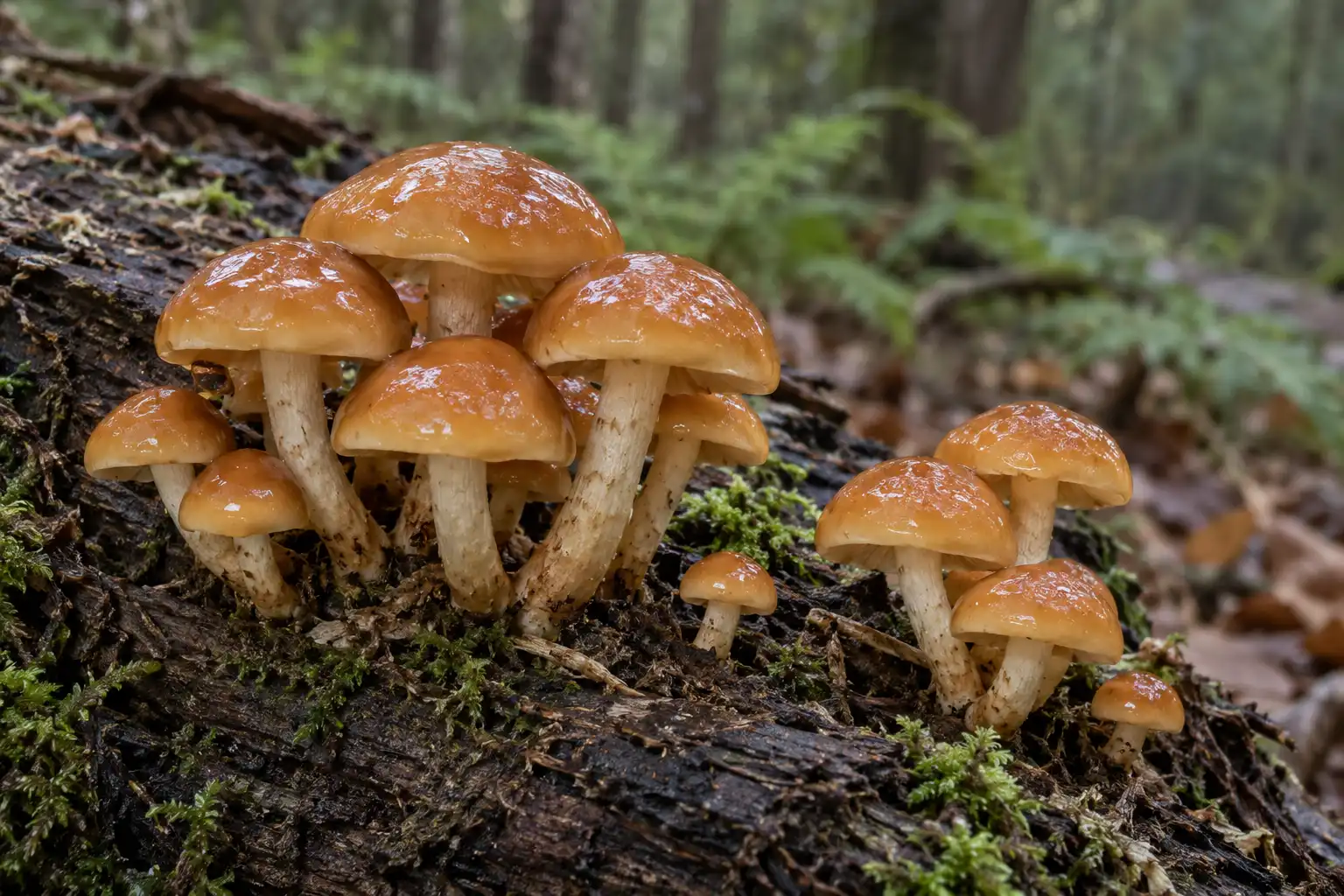
Nameko Mushroom: Glossy Caps, Hardwood Ecology, and Cultivation
Understand nameko mushrooms through their amber gelatinous caps, clustered hardwood growth, Japanese food use, lookalikes, and cool-fruiting cultivation.
mushrooms
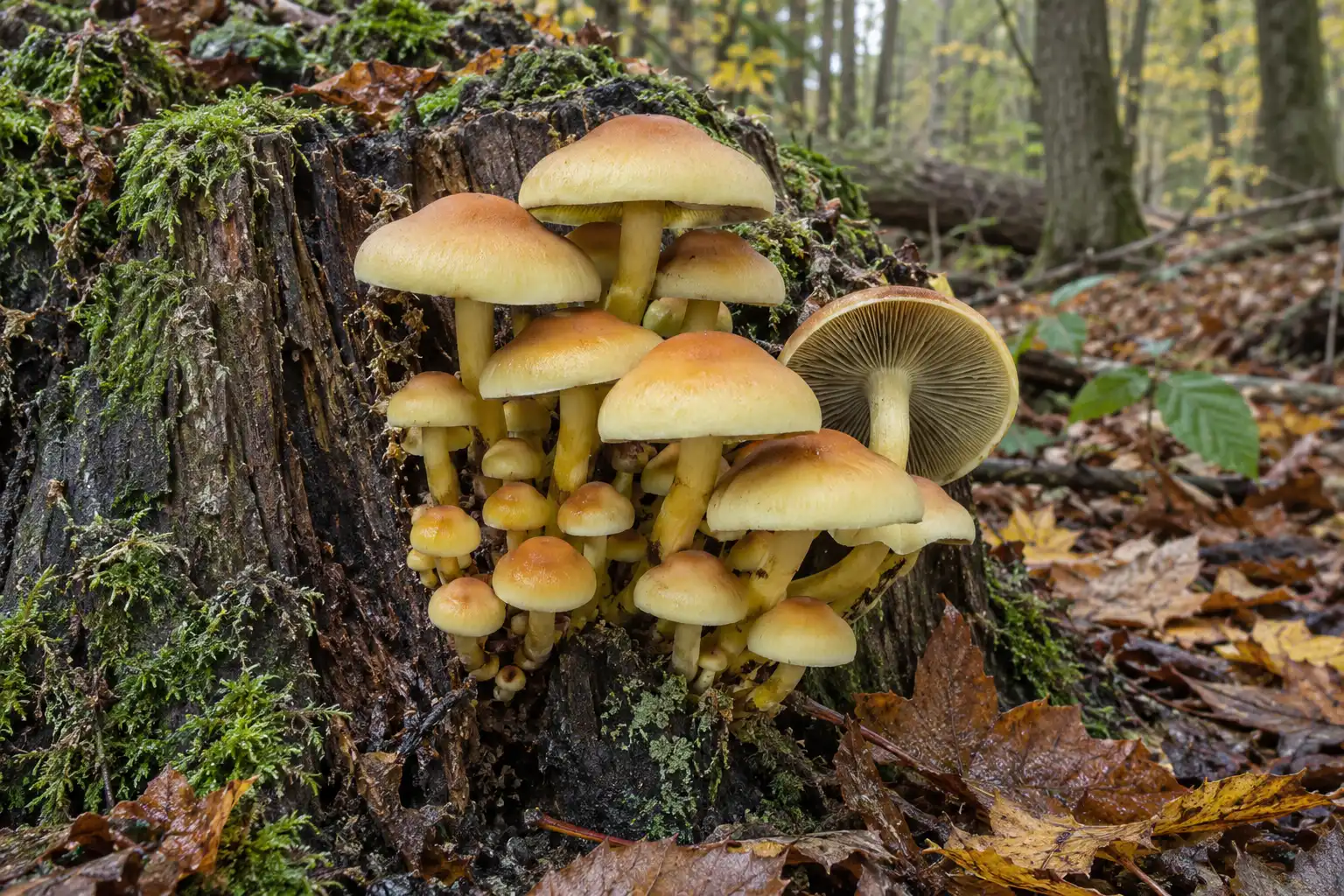
Sulfur tuft: Field Identification, Lookalikes, and Safety
Document sulfur tuft by clustered wood growth, yellow caps, olive-gray gills, purple-brown spores, ringless stems, and dangerous lookalikes.
identification
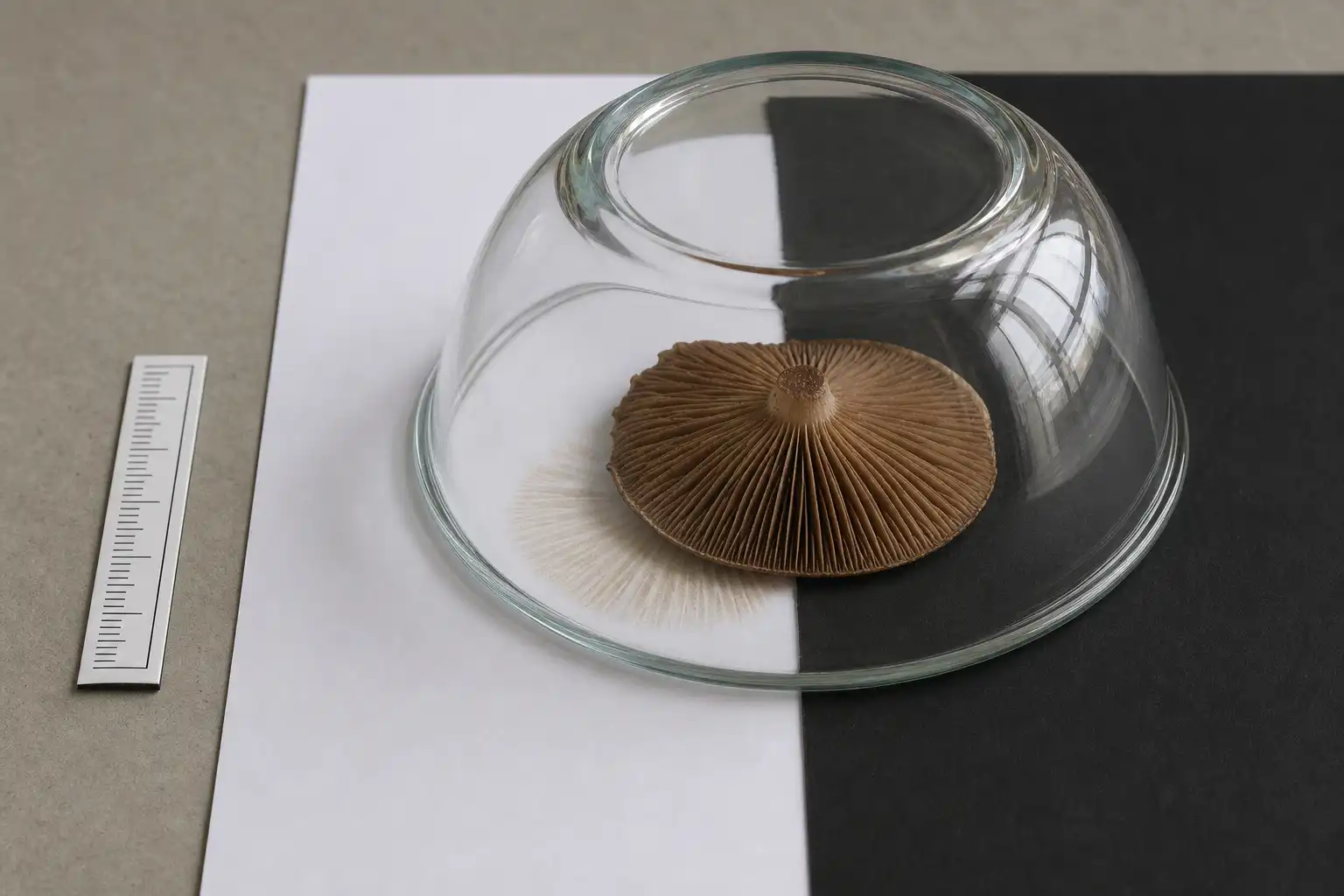
How to Make and Read a Mushroom Spore Print
Make a controlled mushroom spore print, record the result clearly, and understand why a print supports—but never proves—an identification.
Continue exploring
Browse more practical guides in Mushroom Encyclopedia or visit the mushroom encyclopedia.