Mushroom Encyclopedia
Plums and Custard: Purple Scales, Yellow Gills, and Wood
Document plums and custard by purple-scaled yellow caps, yellow gills, conifer wood, spore evidence, lookalikes, distribution, and safety limits.
By MushroomScope Editorial Team · · Updated
Species context
Treat profiles as reference material
Species profiles summarize documented traits, taxonomy, and lookalikes, but natural variation can be substantial.
Use the safety checklist →Decision limit
A profile cannot authenticate a specimen
Do not eat a wild mushroom from an online match, single feature, or generated image.
Read the safety disclaimer →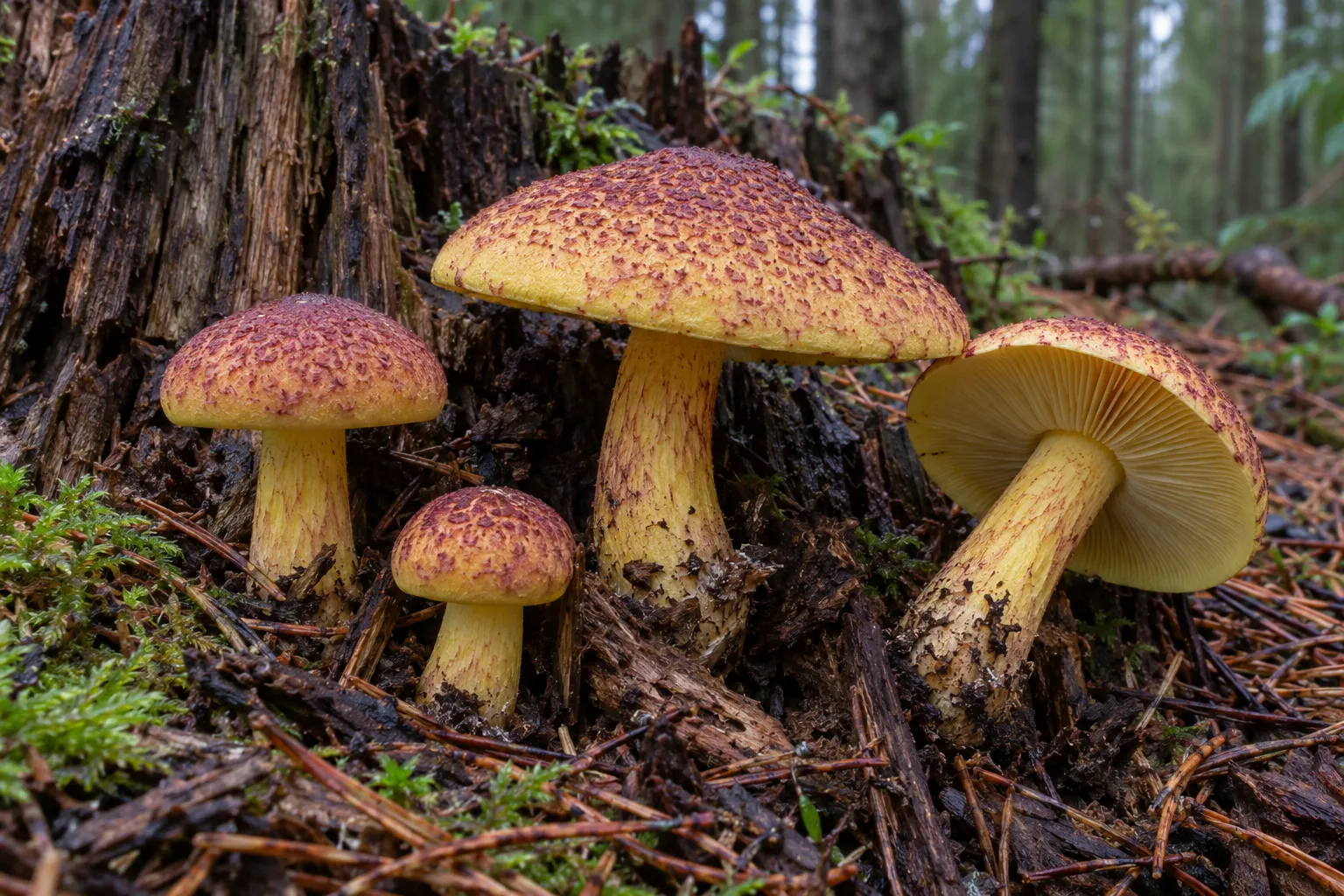
Quick facts
- Scientific name
- Tricholomopsis rutilans
- (Schaeff.) Singer
- Common names
- plums and custard, plum and custard mushroom
- Taxonomy
- Tricholomopsis · Tricholomataceae
- Edibility context
- Inedible: Treated conservatively as inedible because reports differ, culinary quality is poor, and remote identification cannot establish safety.
- Spore print
- White to pale cream; microscopy is useful when color and substrate do not resolve comparisons.
- Toxicity context
- Low: Misidentification, individual gastrointestinal reaction, spoilage, and contaminated substrate remain practical risks.
- Season
- August, September, October, November
- Growing difficulty
- Not Cultivated
- Regions
- Europe, North America, temperate regions with verified records
Safety limit: These labels summarize documented context; they never authenticate a wild specimen. Cooking does not make a poisonous species safe.
Start with the color pattern, then test it
Plums and custard, Tricholomopsis rutilans, has one of the most memorable palettes in temperate woodland: wine-purple scales lie over a custard-yellow cap, while the gills and stem remain yellow. That contrast is a useful search image, not a verdict. Weather can bleach the yellow, rain can flatten scales, and camera processing can turn red-purple into brown. A defensible record joins surface structure to gills, stem, spores, decaying wood, region, and age.
Photograph the entire group before handling it. Include the stump or log, bark remnants, cut end, needles, and nearby trees. Give each fruit body a number and show at least one young convex cap, one expanded cap, an underside, and the complete base. If mushrooms seem to arise from soil, test gently for buried wood without excavating living roots or dismantling the site.
Measure cap scales across a developmental series
Young caps are convex and may carry a dense dark purple-red covering. As the cap expands, the yellow ground color opens between fibrous scales. The center often stays more densely colored while the margin becomes yellower. Measure cap width, scale-patch width at center and margin, and the proportion of visible yellow background on several ages.
Use a hand lens to determine whether the purple material is attached fibrils or loose debris. Photograph in open shade with a neutral color reference. Wet scales can look nearly brown-black; dry caps may look pinker or more ochre. Preserve original files instead of pushing saturation until the common name appears obvious.
Check the margin for veil remnants but do not assume every fibrous edge predicts a ring. Record whether the cap is dry, tacky after rain, cracked, insect damaged, or abraded. A single worn cap may have lost much of the pattern, while a sheltered young neighbor preserves it.
Confirm yellow gills and their attachment
Turn one intact cap far enough to show the gills. They are crowded and yellow, often with shorter gills between those running from margin to stem. Photograph the stem junction directly so attached, notched, or slightly decurrent interpretations can be reviewed. The gill-types guide explains why an oblique underside image is insufficient.
Record gill color across age and after bruising. The important comparison is not simply “yellow”: it is whether mature gills stay yellowish or acquire a rusty-brown cast from maturing spores. Several unrelated wood agarics begin yellow and later reveal a brown-spored identity.
Make a spore deposit from a mature, undamaged cap on half black and half white nonabsorbent surfaces. T. rutilans should give a white to pale cream mass. A thin deposit can borrow color from paper, so record time, cap maturity, condensation, and deposit density. The spore-color guide provides a controlled method.
Preserve stem fibers and the wood attachment
The stem is yellow and can carry wine-red or purple-red fibrils, particularly toward the lower portion. It lacks a persistent ring and volva. Measure length, width at top and base, surface color, fiber density, interior condition, and bruising. Preserve the whole base: trimming it can hide both a veil clue and the direct wood connection.
Section one numbered specimen vertically. Photograph cap flesh, gill depth, stem interior, insect channels, and the interface with rotten wood. Fresh flesh is yellowish; waterlogging, larvae, freezing, and decay can change texture. Do not use a generic word such as “firm” without noting specimen condition.
If several stems arise from one stump, map their spacing rather than assuming a fused cluster. Document whether bases share the same crack, bark pocket, or buried fragment. This makes the saprotrophic relationship reviewable and distinguishes direct wood growth from a merely nearby tree.
Read conifer wood as evidence, not proof
Plums and custard is most often associated with decaying conifer wood. Stumps and fallen logs are straightforward when bark, cones, needles, branch arrangement, or forestry records support the wood identity. Advanced brown rot may erase those clues. In a mixed woodland, call the substrate “heavily decayed wood, probably conifer” unless the evidence is stronger.
Record log diameter, decay class, bark coverage, moisture, ground contact, shade, and surrounding tree species. A fruit body on a saw-cut stump has different host evidence from one apparently emerging two meters away through litter. Revisit the same wood after rain and map new fruit bodies; recurrence supports a persistent colony but does not independently confirm the species name.
Managed timber, old steps, buried boards, and woodchip paths can also support wood decayers. Note treatment, paint, road runoff, or other contamination. Even a correct identification does not turn a fruit body from treated wood into food.
Separate similar yellow wood agarics
Tricholomopsis decora is an important close comparison. It is often smaller and carries darker olive-brown to blackish scales on yellow, but size, scale color, and density overlap. Compare multiple ages, substrate, spore dimensions, cap-surface structure, and a current regional key. Do not force a purple-versus-black choice from a processed photograph.
Wood-growing Gymnopilus species can be yellow, orange, or scaled. Their spore deposits are rusty brown, and mature gills commonly shift toward rusty or orange-brown tones. Some contain psychoactive or toxic compounds. A pale-looking young gill surface cannot substitute for a mature spore record.
Scaled Pholiota species also occur on wood and generally produce brown spores. Veil tissue, a ring or ring zone, cap viscosity, scale architecture, gill maturation, and host all matter. The shaggy scalycap guide demonstrates why a dramatic scaled cap is a starting point for comparison rather than edible clearance.
Yellow Tricholoma species may occur on soil in mycorrhizal relationships rather than directly on a rotten stump. Buried wood can blur that distinction, so retain the entire attachment. A white spore deposit alone will not separate every pale-spored agaric.
Keep microscopy linked to the voucher
When macroscopic evidence is incomplete, microscopy should remain traceable to the photographed fruit body. Report equipment calibration, mount, number of spores measured, length and width ranges, shape, and any cap-surface or cystidial characters used by the chosen key. Do not paste measurements from a reference into a field record.
Dry representative cap, gill, stem, and basal tissue promptly with the collection number. Store the substrate description, coordinates at appropriate privacy, date, collector, image filenames, and provisional determination. A clean voucher allows a specialist to revisit an old name if regional taxonomy changes.
GBIF occurrence maps are useful for locating documented records, but a map point does not prove presence at a new site. Check the underlying record, identification basis, date, and geographic precision. An introduced or overlooked population should be documented, not rejected solely because a simplified range map lacks a dot.
Apply a conservative food boundary
Sources differ on edibility and often describe this mushroom as poor, bitter, or not worthwhile. Those statements cannot authenticate a collection or predict individual tolerance. Similar-looking wood agarics include brown-spored and potentially toxic taxa, and old specimens deteriorate rapidly. This guide therefore treats plums and custard as inedible and gives no preparation advice.
Do not taste unknown mushrooms to resolve a name. If illness follows wild mushroom ingestion, contact the relevant poison center or medical service and save uncooked material, leftovers, site photographs, preparation details, amount, and symptom times. Do not induce vomiting unless directed by a professional.
Build a contradiction-led record
A strong record contains the undisturbed group, confirmed or qualified wood substrate, cap measurements across ages, scale close-ups in neutral light, yellow gills and attachment, complete stems and bases, section, pale spore deposit, and microscopy when required. Run a contradiction audit: rusty spores, a persistent ring, a volva, soil attachment without wood, gills that mature brown, or a smooth unscaled cap should redirect the identification.
The cover is an original AI editorial image. It was checked beside Common Bonnet, Wrinkled Peach, and Scarlet Waxcap covers for natural light, restrained color, realistic wood and fungal textures, complete bases, clear yellow gills, plausible cap scales, clean crop, and absence of text or watermark. It illustrates the evidence plan; it cannot identify a reader’s specimen.
Run a matched scale-retention weather series
Choose six numbered caps on one wood unit: two young, two expanded, and two weathered. Photograph them in diffuse light with the same color reference and camera angle after a dry interval, immediately after natural rain, and again after the surfaces dry. Measure cap width, the width of five scale patches in fixed center and margin zones, and the percentage of exposed yellow ground estimated from a simple grid overlay.
The series tests persistence rather than inventing a diagnostic threshold. Rain can mat fibrils, abrasion can remove them, and cap expansion separates patches. A weathered cap with sparse purple material should remain linked to young neighbors, wood attachment, yellow gills, pale spores, and its numbered voucher. Do not wet caps manually or increase saturation to restore the common-name palette.
At each stage, photograph a mature gill sector beside a neutral card. Record whether the gills remain yellow, bruise, spot, or acquire deposited pigment. Place one clean glass slide beneath a mature cap and a blank slide beside it. A pale deposit supports Tricholomopsis; rusty residue redirects the record toward brown-spored wood agarics and must be confirmed microscopically rather than dismissed as dirt.
Divide the occupied log into equal 25 cm zones. Record bark cover, decay softness, ground contact, moisture, shade, and fruit-body stage in each zone after comparable rain events. Preserve zero-fruiting zones in the table. Recurrence can reveal where visible fruiting concentrates but cannot prove that one moisture reading caused it or define the full mycelial boundary.
This combined design adds evidence that a single portrait cannot: how scale contrast survives weather, whether mature gills remain consistent with pale spores, and whether fruiting recurs on the same conifer wood. The shaggy scalycap guide provides a related but separate brown-spored comparison; the distinction should be made with hymenium and deposit evidence, not just dramatic cap scales.
References
The listed sources support accepted taxonomy, specialist morphology, recording practice, regional comparison, and conservative poisoning response. They do not authenticate a photograph or provide food clearance.
Source quality notes
MushroomScope cites sources that match the page scope, such as taxonomic databases, extension guidance, food-safety agencies, food-composition databases, and peer-reviewed or institutional health references. Sources support context and uncertainty; they do not turn an online page into specimen identification, medical advice, or a tested recipe record.
Frequently asked questions
Why is Tricholomopsis rutilans called plums and custard?
The name refers to the contrast between wine-purple or reddish cap scales and the yellow cap background, gills, and stem. Color is memorable but does not replace structural and substrate evidence.
Does a purple-and-yellow cap identify plums and custard?
No. Record scale structure, yellow gills, stem surface, complete wood attachment, spores, region, age, and close comparisons.
What wood does plums and custard use?
It is most often recorded on decaying conifer wood, including stumps and logs. Buried wood can make a fruit body appear terrestrial, so preserve the attachment.
Is plums and custard edible?
Reports are inconsistent and quality is often described as poor. This guide treats it as inedible and does not clear a wild specimen for consumption.
Can the purple scales wash away?
Weather, age, and abrasion can reduce contrast and remove surface material. Photograph several ages and inspect attached scales with a hand lens.
Related guides
identification
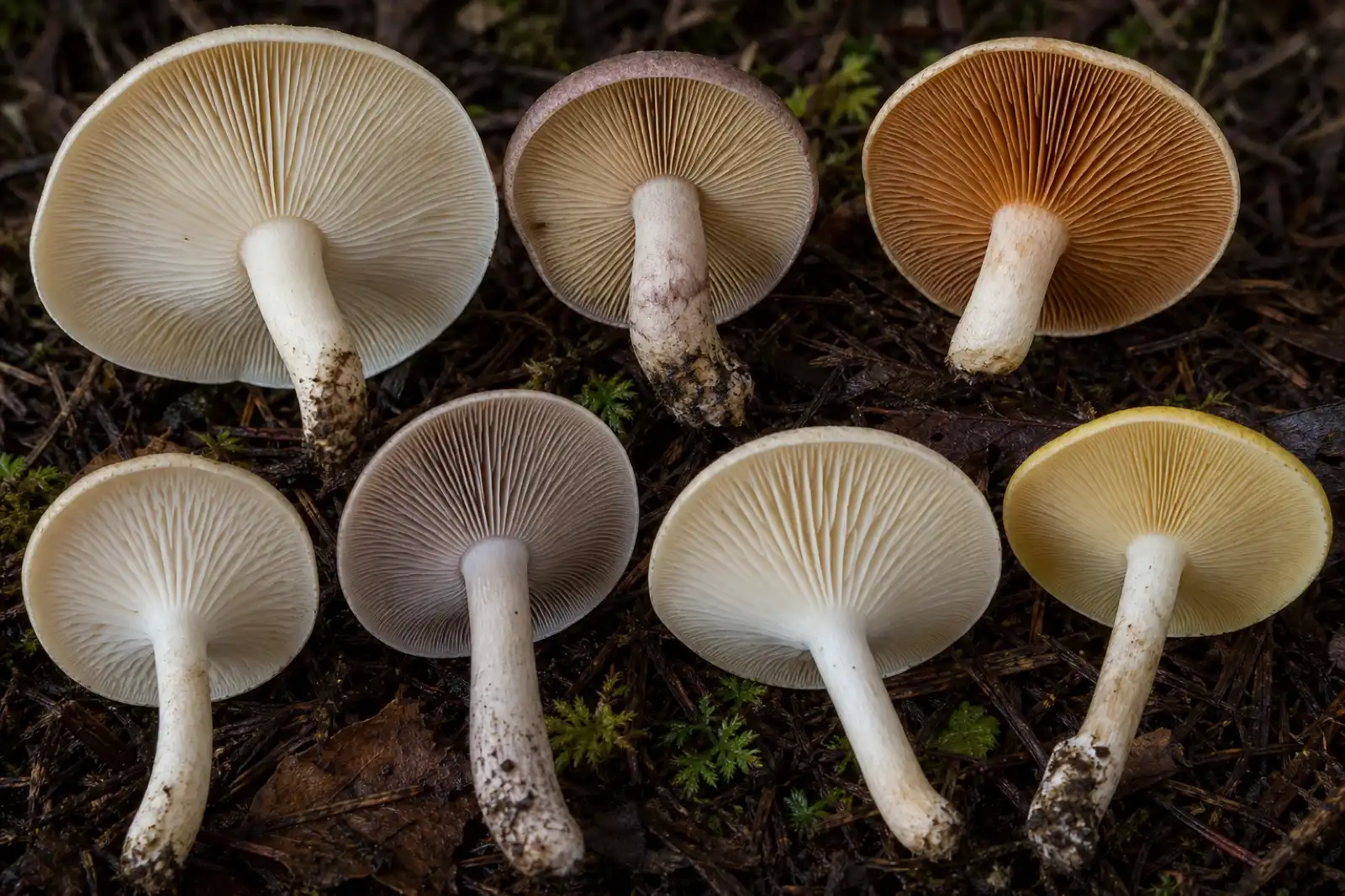
Mushroom Gill Types: Attachment, Spacing, and Color
Compare free, attached, notched, adnate, and decurrent mushroom gills while recording spacing, short gills, edge details, bruising, and color changes.
identification
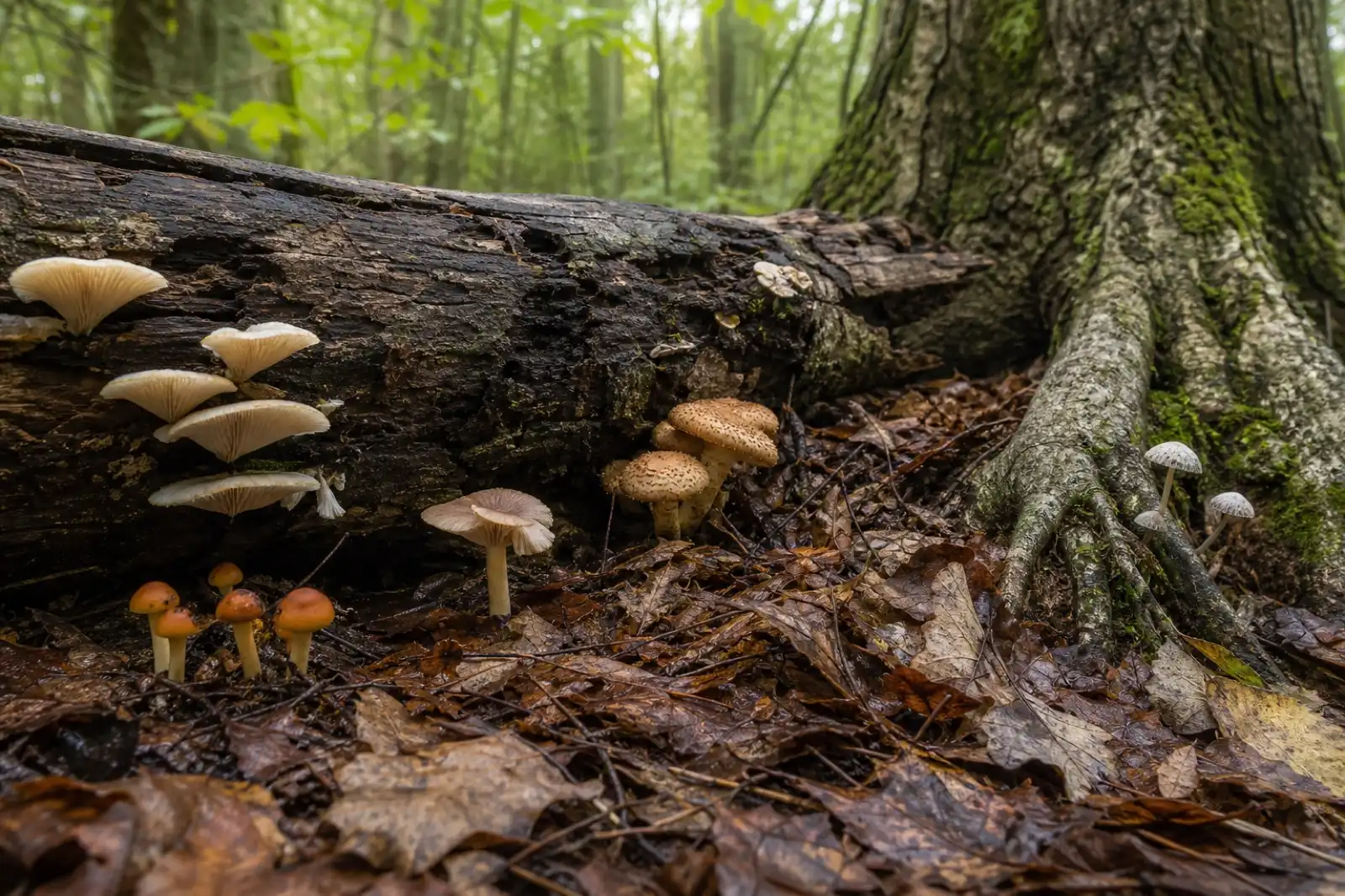
Using Habitat to Identify Mushrooms
Record substrate, associated plants, soil, wood type, moisture, elevation, and fruiting pattern as identification evidence.
identification
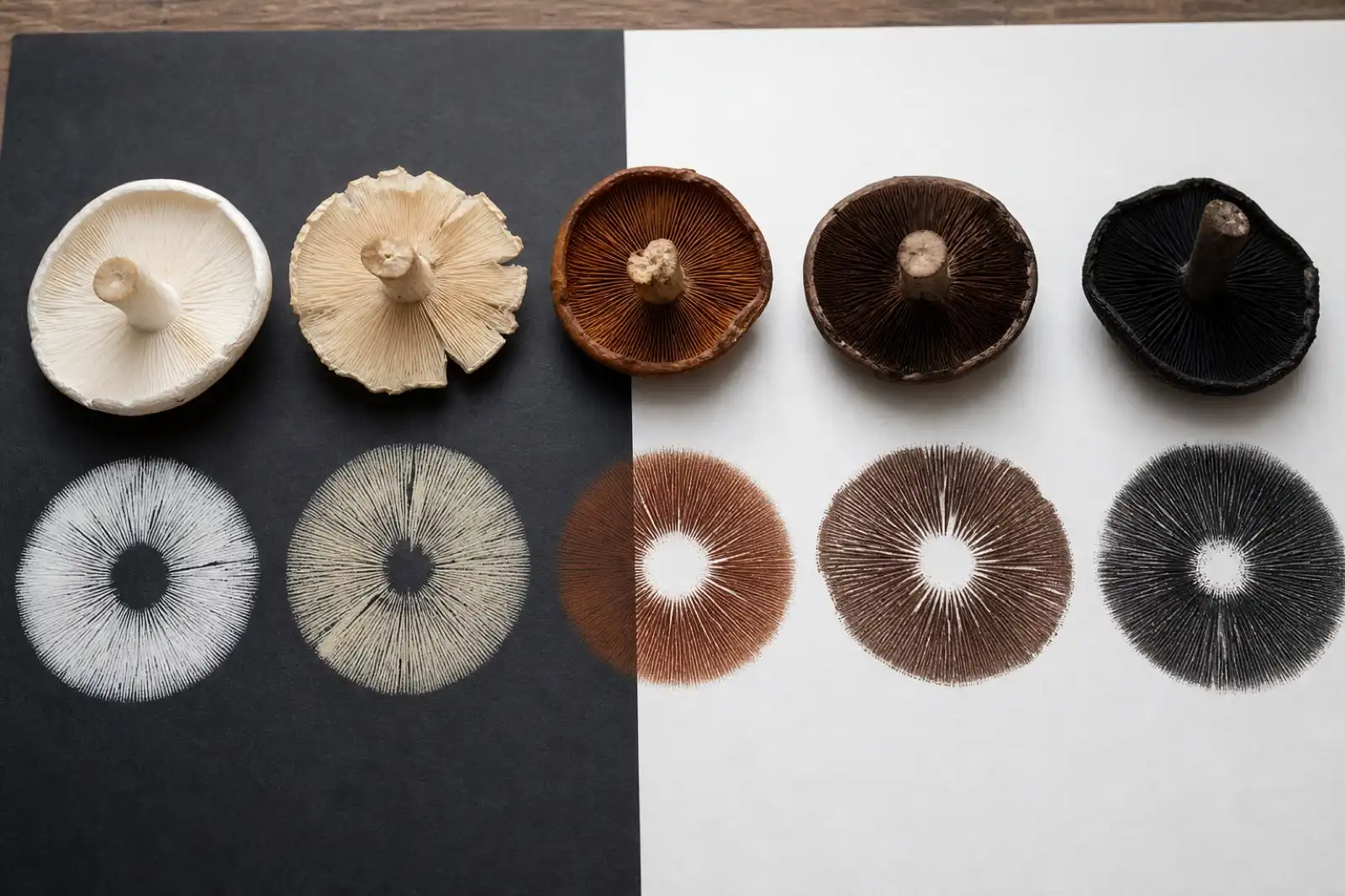
Mushroom Spore Print Colors and How to Record Them
Use a controlled spore deposit to distinguish broad color groups while recognizing that print color alone never identifies a species.
Continue exploring
Browse more practical guides in Mushroom Encyclopedia or visit the mushroom encyclopedia.