Mushroom Encyclopedia
Stinking Dapperling: Lepiota cristata Field Guide
Document Lepiota cristata by its small scaly cap, dark disc, free white gills, fragile ring, odor, litter habitat, spores, and hazardous Lepiota lookalikes.
By MushroomScope Editorial Team · · Updated
Species context
Treat profiles as reference material
Species profiles summarize documented traits, taxonomy, and lookalikes, but natural variation can be substantial.
Use the safety checklist →Decision limit
A profile cannot authenticate a specimen
Do not eat a wild mushroom from an online match, single feature, or generated image.
Read the safety disclaimer →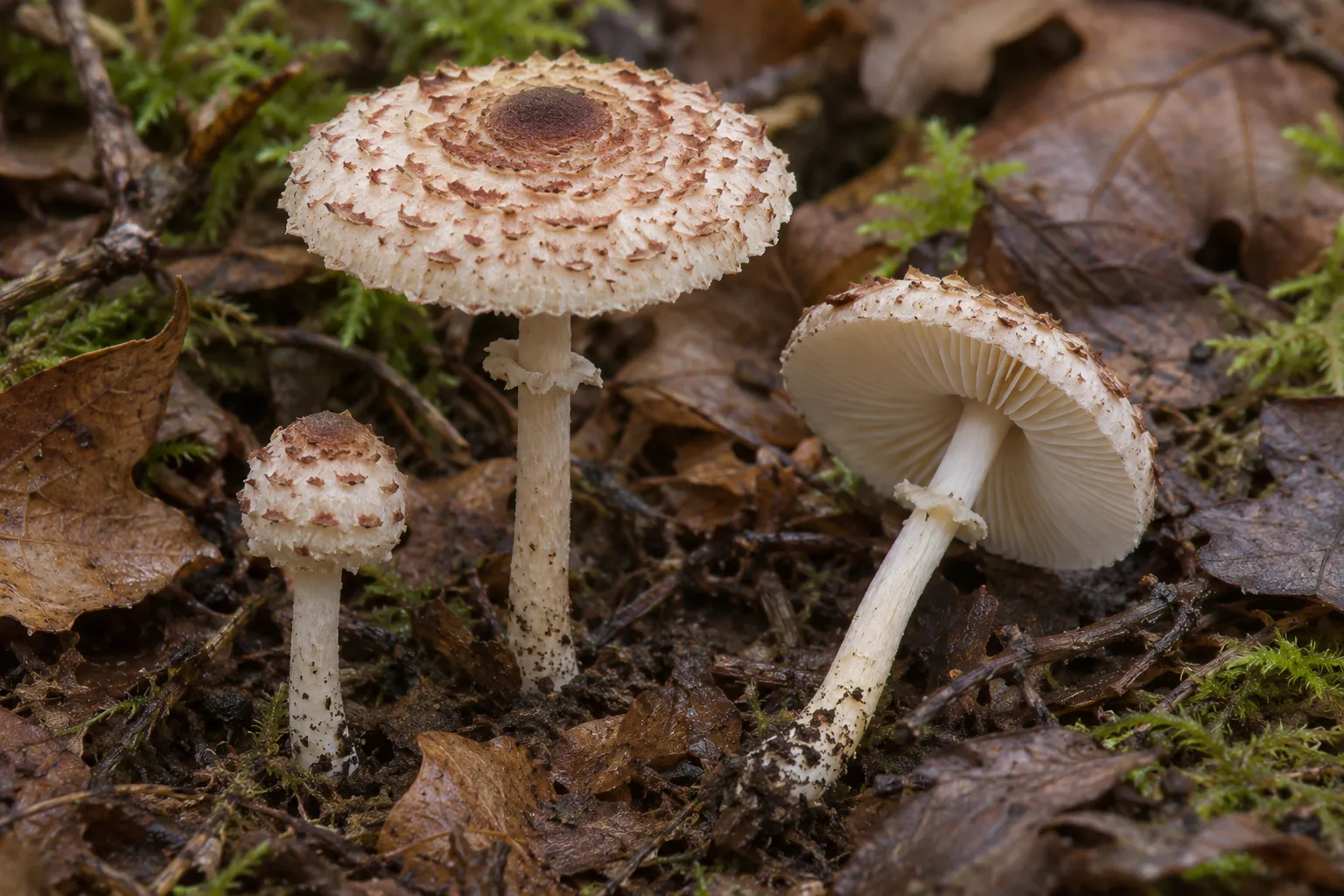
Quick facts
- Scientific name
- Lepiota cristata
- Common names
- Stinking dapperling, Stinking parasol
- Taxonomy
- Lepiota · Agaricaceae
- Edibility context
- Inedible: Do not eat small Lepiota. Some relatives contain amatoxins, and field-level uncertainty is consequential.
- Spore print
- White; microscopic spore shape and chemical reactions help separate small Lepiota.
- Toxicity context
- High: Treat ingestion of an unidentified small dapperling as a poison-control question; retain specimens and photographs and seek urgent professional guidance.
- Season
- July, August, September, October, November
- Growing difficulty
- Expert
- Regions
- Europe, North America, temperate occurrence records requiring regional verification
Safety limit: These labels summarize documented context; they never authenticate a wild specimen. Cooking does not make a poisonous species safe.
Stinking dapperling is a small mushroom with an outsized safety lesson. Its pale cap, brown scales, white gills, and ring resemble a miniature parasol, yet the small dapperlings include species for which a casual food decision can be dangerous. The responsible goal is therefore not to turn one photograph into a meal decision. It is to build a complete, reviewable record and to know when the evidence stops at Lepiota or a species group.
This guide treats Lepiota cristata as a field hypothesis. Names in this group have been applied differently across regions, and reliable species separation can require mature spores and other microscopic characters. Never taste a small dapperling to identify it.
Establish scale before interpreting the cap
Photograph the mushroom in place with a millimeter scale beside it. Measure cap width, total height, and stem width across young, expanding, and mature fruit bodies. “Small parasol” is not a measurement, and a close photograph can make a three-centimeter cap look imposing.
Show the entire group and surrounding litter. Record whether mushrooms are solitary, scattered, or loosely grouped, and whether they arise from mineral soil, deep leaf litter, compost, lawn thatch, or wood chips. Do not assume that nearby buried wood is the actual substrate without tracing an attachment.
Read the cap from disc to margin
The center usually retains a darker brown disc. Farther outward, the surface breaks into brown scales on a whitish to cream background. Record the size, spacing, and orientation of those scales rather than summarizing the cap as “brown and white.” Rain can wash scales away, while drying can exaggerate cracks between them.
Photograph a young cap, an intermediate one, and a mature expanded cap under the same neutral light. Note whether the margin carries veil fragments, whether the scales lift or lie flat, and whether handling causes staining. These details can route a key but do not independently prove the species.
Confirm free white gills
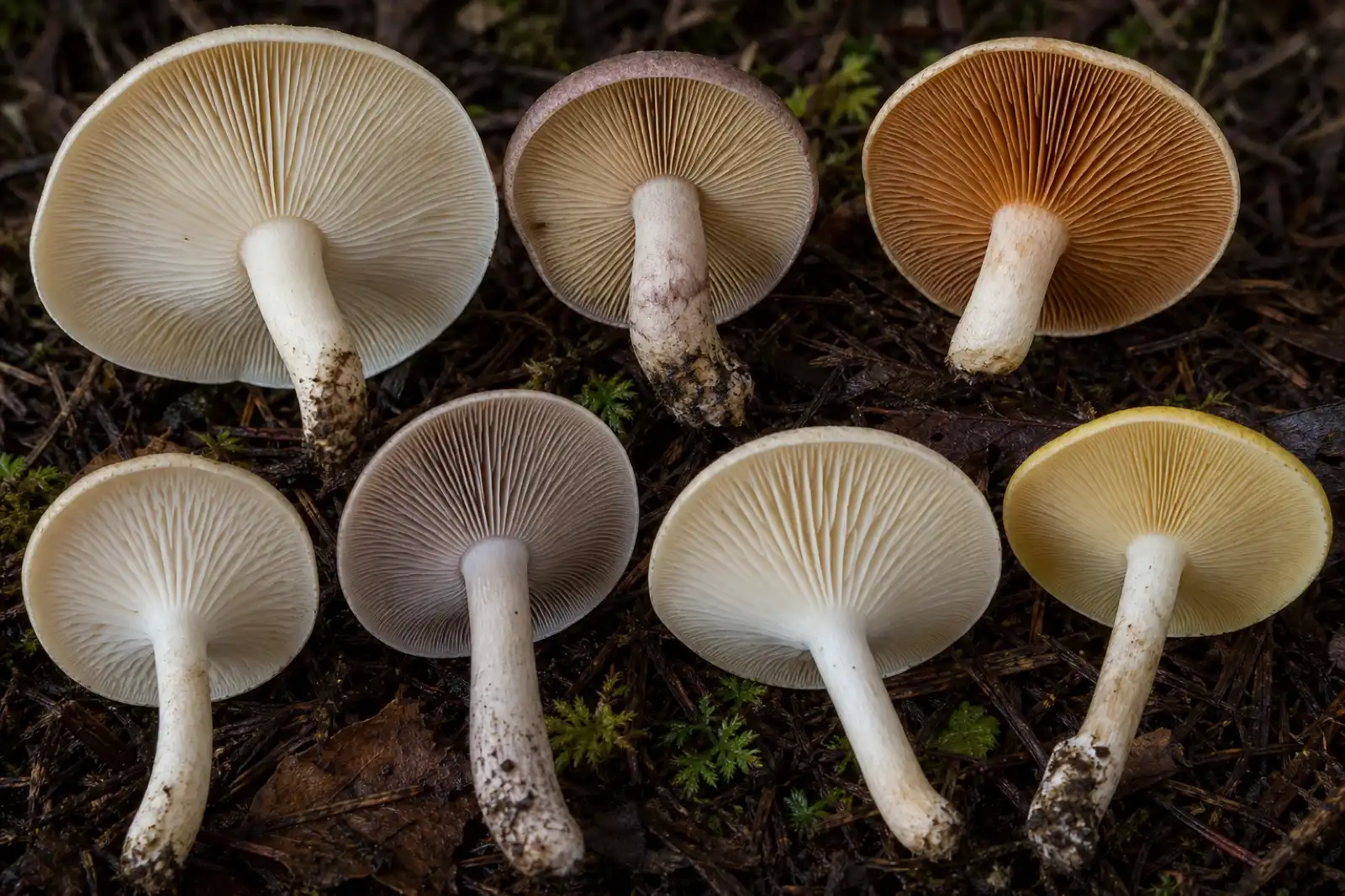
Take an angled underside photograph before removing the cap. The gills should be white to pale cream and free from the stem, leaving a narrow gap around it. Record crowding, shorter gills, edge color, and any discoloration with age. The gill-types guide provides neutral terms for this record.
Free white gills occur in many unrelated mushrooms, including hazardous ones. Their value comes from confirming the expected structural category and excluding attached-gill alternatives, not from declaring edibility.
Follow the partial veil through development
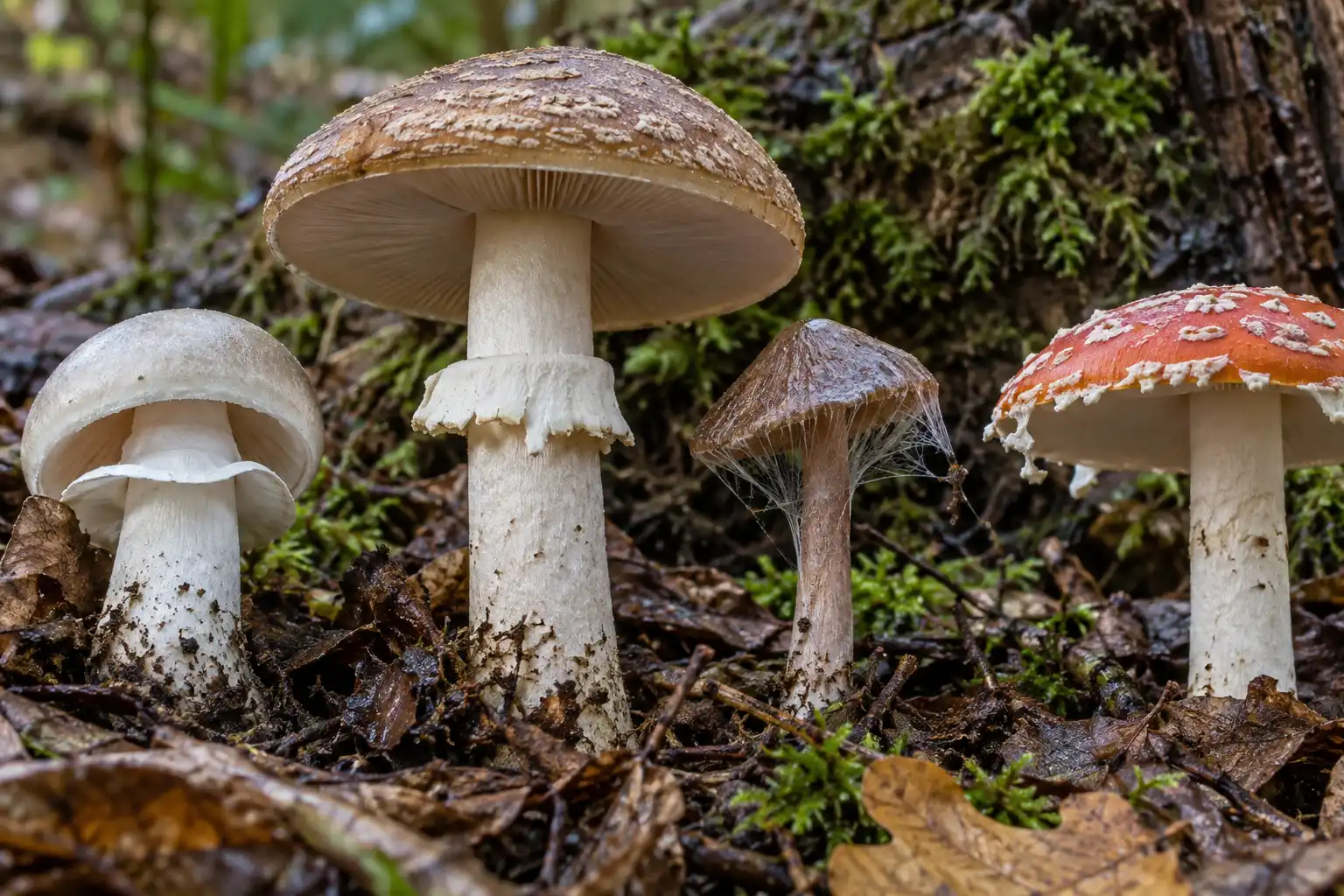
Young fruit bodies may show a partial veil between cap margin and stem. As the cap opens, it can leave a small, fragile ring or an incomplete ring zone. Photograph several ages because the ring may tear, collapse, or disappear. A missing ring on one weathered specimen is not proof of a naturally ringless species.
Use the veils and rings guide to record ring position, texture, persistence, and attachment. Do not describe a delicate dapperling ring as movable unless it was actually observed moving without damage.
Recover the complete stem base
Loosen soil around one lawful specimen and lift the base intact. Photograph it before brushing. Record taper, swelling, mycelial threads, adhering litter, and whether any sheath, cup, rim, or patch is present. A buried Amanita volva can be destroyed by pulling the stem straight upward.
The absence of a volva supports the intended pathway only when the complete base was seen. “No volva visible in the cropped photograph” is not usable negative evidence.
Treat odor as a recorded observation
Field accounts often describe L. cristata as rubbery, coal-gas-like, pungent, or otherwise unpleasant. Smell a fresh intact specimen and a gently bruised cap at a safe distance; do not inhale deeply or place tissue against the face. Ask observers to write their own descriptions before comparing notes.
Odor changes with age, temperature, moisture, and individual perception. A matching smell can support a larger character set, but an absent or unfamiliar odor cannot settle the identification.
Make a white spore deposit carefully
A mature cap may produce a white deposit. Use both dark and clear surfaces so a sparse pale deposit is not confused with condensation. Keep the cap tied to its field number and photograph the deposit before sampling it for microscopy.
White spores are expected across many dapperlings and Amanita species. The deposit is a routing character, not a safety certificate. Record whether it is genuinely white, cream, or too sparse to judge.
Microscopy addresses the difficult boundary
Small Lepiota identification often depends on spore dimensions and shape, cap-surface construction, cystidia, clamps, and reactions specified by a current key. Report mounting medium, calibration, magnification, number measured, range, and specimen maturity. Do not copy an ideal measurement from a guide into the observation.
When microscopy is unavailable, retain the strongest defensible label. “Small Lepiota, near the cristata group” with complete photographs is better than an unsupported exact name.
Compare other small Lepiota first
The most important lookalikes are not dramatic large mushrooms but other small dapperlings with overlapping scales, rings, and white spores. Some may contain amatoxins. Cap color or an unpleasant odor does not safely separate every regional taxon.
Use a local key and expert review. Preserve one mature voucher where lawful, keep collections from separate patches apart, and never combine an uncertain small dapperling with edible mushrooms.
Separate true parasols by architecture
The parasol mushroom guide covers a substantially larger Macrolepiota with a tall patterned stem, broad cap, and typically movable ring. Those traits are a comparison, not permission to eat a larger scaled mushroom. Poisonous Chlorophyllum and other lepiotoid fungi also enter the broader decision tree.
Document actual dimensions, stem ornamentation, staining, ring structure, spore color, and complete base rather than using “parasol-like” as a name.
Keep Amanita in the safety screen
A pale ringed mushroom with free white gills requires a complete-base check for universal-veil material. Young Amanita can be compact, and a volva may sit below the soil surface. Cap patches can wash away, leaving a deceptively plain surface.
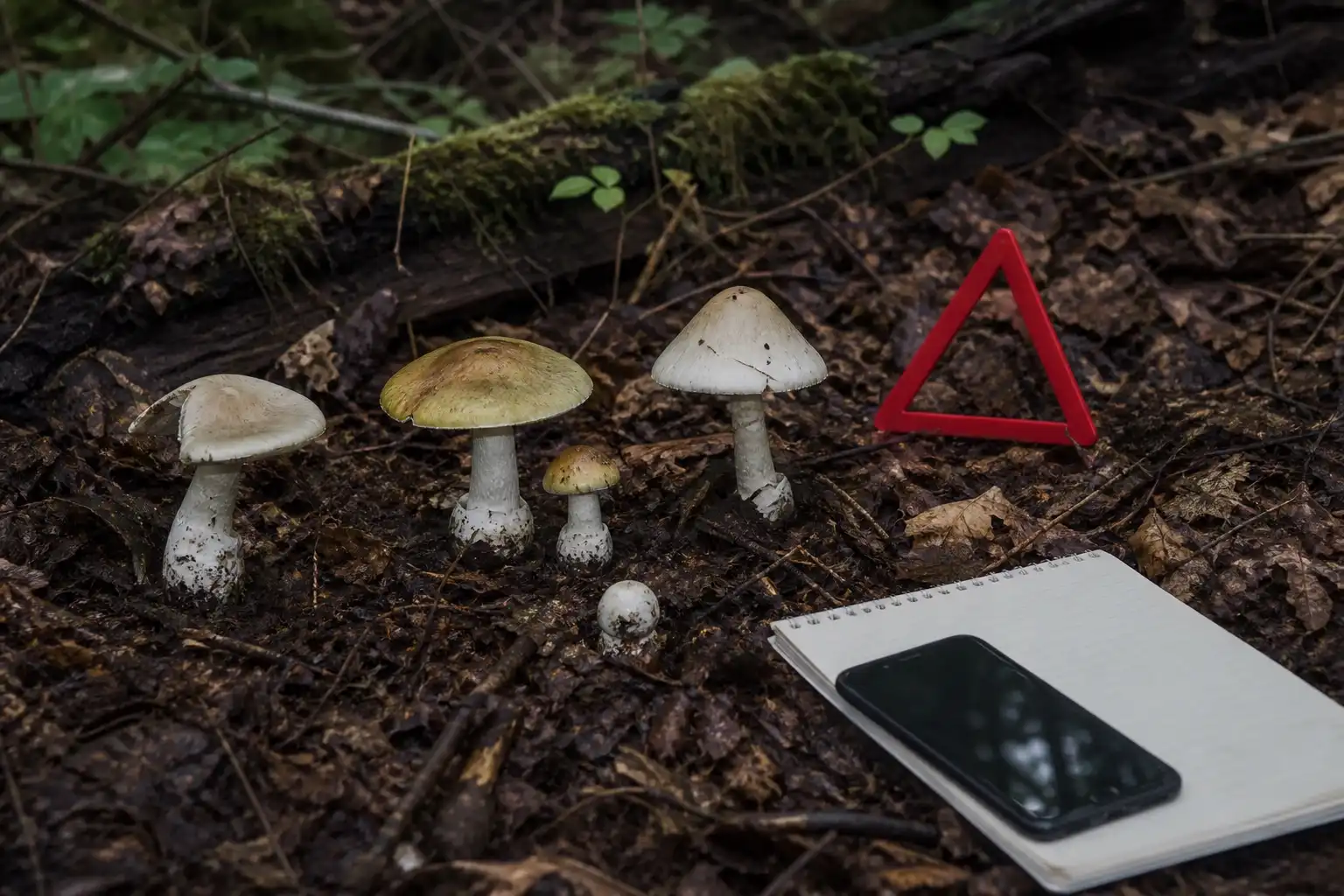
The poisonous mushroom warning signs page explains why several warning characters must be recorded together. Warning signs do not identify a species, but they should stop food use.
Map litter depth and disturbance
At each fruiting point, record litter depth, dominant leaves, wood-chip type if known, soil moisture, shade, recent landscaping, and distance to paths. A saprotrophic litter association differs from a mycorrhizal host claim; nearby trees do not prove that the fruit body is partnered with them.
Repeat the map after rain. New fruit bodies may follow moist pockets or disturbed chip margins, but one patch cannot establish a universal ecological rule.
Preserve evidence without spreading uncertainty
Photograph first, assign field numbers, and dry a minimal representative promptly when collection is legal and justified. Keep cap, ring remnants, complete base, spore deposit, habitat images, and microscopy attached to the same number. A loose dried cap separated from its stem has lost much of its value.
Do not move litter or suspect fungal material between parks and gardens. Clean tools and footwear when monitoring managed sites.
Respond conservatively to ingestion
This page makes no food recommendation. Small Lepiota can overlap visually with dangerously toxic relatives, and symptom-free early hours do not establish safety after a possible amatoxin exposure. Do not wait for a web identification if ingestion is known or plausible.
Contact local emergency services or a poison center promptly. Retain uncooked specimens, cooked leftovers, photographs, collection location, number eaten, preparation, time of exposure, and symptom timing. Do not induce vomiting unless a qualified professional directs it.
Audit the editorial image
The cover is an original AI editorial image, not a field photograph. It was checked against natural-light MushroomScope species imagery for restrained color, leaf-litter texture, readable complete stems, cap scales, a dark disc, free pale gills, and the absence of text or watermarks. Its rings are deliberately visible to teach which structure to document.
Generated anatomy cannot establish a specimen identity. Do not use its exact scale count, ring size, or stem proportions as a diagnostic standard.
Census scale loss across one developmental patch
Choose a compact patch whose fruit bodies share the same litter layer, then number unopened, expanding, mature, and weathered caps without rearranging them. Photograph each cap at a fixed scale under diffuse light and divide the radius into central disc, middle annulus, and outer margin. Record intact brown scale islands, exposed pale background, abrasion, adhering litter, and rain since the previous visit. Repeat after one natural wet interval if the site can be revisited without trampling it.
The resulting grid distinguishes developmental cracking from damage. A cap with few outer scales after heavy rain cannot simply borrow the pattern of a fresh neighbor, and a dark disc partly hidden by debris should be scored obscured rather than absent. This census adds patch-specific evidence without pretending that scale counts alone separate small Lepiota species.
Record odor as a blinded specimen-linked observation
Odor language around stinking dapperling is unusually variable: rubber, coal gas, pungent, or merely unpleasant. To make that evidence reviewable, place each lawfully collected numbered specimen in a separate ventilated container for the same short interval. Ask observers to write a description before seeing one another’s answers, and record whether the tissue was intact or freshly cut, its age, temperature, and the surrounding litter odor.
Agreement supports a repeatable sensory observation; disagreement is also data. Never intensify the test by tasting, heating, or prolonged close inhalation. An odor result cannot override a missing base, attached gills, colored deposit, or microscopy that points elsewhere.
Compare litter depth without assigning cause
Mark equal-area plots in shallow exposed litter, deeper accumulated litter, and a nearby apparently unoccupied control. Record litter depth, dominant material, soil contact, shade, moisture by one consistent method, and counts of young, mature, and collapsed fruit bodies. Keep footpath edges and mulched beds as separate habitat classes.
This comparison can reveal where visible fruiting occurred during the survey. It cannot establish that litter depth caused fruiting, identify the plant source of every fragment, or map the underground mycelium. Report zeroes and repeat dates rather than replacing them with a general claim that the species “likes rich soil.”
Build a reviewable record
- Photograph habitat and group arrangement before handling.
- Measure several developmental stages.
- Capture cap disc, scales, margin, free gills, ring, stem, and complete base.
- Record odor independently and never taste.
- Obtain a controlled spore deposit from a mature numbered cap.
- Apply a current regional key and microscopy when needed.
- Preserve uncertainty and keep food decisions outside the workflow.
That sequence does not guarantee a species name. It does prevent the most consequential shortcut: treating a miniature parasol appearance as evidence of safety.
Track scales from closed cap to flat cap
Choose three developmental stages from one mapped group and divide each cap into disc, middle, and margin zones. Record cap diameter, scale density, scale color, exposed ground color, and margin condition under fixed diffuse light. Expansion can spread an originally continuous brown covering into separated scales while the central disc remains dark, so different ages should not be treated as different patterns without measurements.
Repeat after natural rain and identify sectors lost to abrasion or slug feeding. This creates a scale trajectory tied to cap growth. It does not prove identity, but it makes “brown-scaled pale cap” more precise than a selected close-up.
Demonstrate free gills with an intact section
Before removing the cap, photograph the underside and mark the intended cut. Make a radial section through cap center and stem apex, then image the gap between gill ends and stem tissue with a scale. A shadow at the stem is not enough: camera perspective can make narrowly attached gills look free.
Compare two mature fruit bodies and preserve the sections with their specimen codes. Free white gills support a dapperling pathway, while deposit and microscopy test whether the collection belongs in the small Lepiota complex. Neither character makes it safe to eat.
Apply a risk-first small-Lepiota table
Create one row per specimen and columns for measured cap width, dark disc, scale distribution, gill attachment, ring state, complete base, odor protocol, deposit, spore measurements, and regional key result. Dangerous small Lepiota species can overlap in field appearance, so any missing base, mixed collection, or contradictory microscopy blocks a species-level food inference.
Do not average contradictory specimens into a synthetic “typical” mushroom. Split the collection, retain uncertain rows at genus level, and keep the poisonous-mushroom warning guide in its proper role: a risk screen, not a rule that clears specimens lacking a famous warning sign.
Frequently asked field questions
Does a bad smell confirm stinking dapperling?
No. Odor is subjective and varies with condition. It is supporting evidence only when cap, gills, veil, base, spores, microscopy, habitat, and region also agree.
Is the dark cap center always present?
It is commonly retained, but weathering, age, abrasion, and lighting can alter contrast. Record the whole developmental series instead of rejecting or accepting a specimen from one patch of color.
Can cooking make a small Lepiota safe?
No safe preparation is offered. Cooking does not correct a false identification and is not a dependable answer to amatoxin risk.
Why preserve the base?
The base can reveal a volva or other structure hidden in soil. Destroying it can remove the feature that redirects the identification toward a hazardous alternative.
What if microscopy is unavailable?
Use a broader label, document the complete observation, and seek a local expert. Exact species confidence should not exceed the available evidence.
References
- GBIF species search — Lepiota cristata. Taxonomic and occurrence records requiring dataset and region review.
- NCBI Taxonomy Browser — Lepiota cristata. Independent nomenclature and lineage checkpoint.
- First Nature — Lepiota cristata. European morphology, habitat, season, and odor context.
- North American Mycological Association — Mushroom Poisoning Syndromes. Conservative poisoning-response context.
Editorial review: November 6, 2026. This page has no named mycologist, toxicologist, clinician, or food-safety expert reviewer. Corrections should identify the claim, region, specimen evidence, and source so the record can be updated transparently.
Source quality notes
MushroomScope cites sources that match the page scope, such as taxonomic databases, extension guidance, food-safety agencies, food-composition databases, and peer-reviewed or institutional health references. Sources support context and uncertainty; they do not turn an online page into specimen identification, medical advice, or a tested recipe record.
Frequently asked questions
Why is Lepiota cristata called stinking dapperling?
Field descriptions often note an unpleasant rubbery, coal-gas, or pungent odor, but odor varies with age and observer and cannot establish the species by itself.
What cap pattern supports a stinking dapperling hypothesis?
A small pale cap with a darker brown central disc and concentrically scattered brown scales is typical, but cap size, gills, ring, spores, habitat, and microscopy must agree.
Are the gills attached to the stem?
They are free from the stem and remain white to pale cream, producing a white spore deposit. A clear underside view is essential.
Is stinking dapperling edible?
No food use is recommended. Small Lepiota include dangerously toxic species, and a web page or photograph cannot clear a collection for eating.
Can a small parasol-shaped mushroom be identified from a cap photograph?
No. The complete base, free gills, veil remnants, stem surface, odor, spore characters, ecology, region, and current local key are needed.
Related guides
identification
Mushroom Veils and Rings: Partial Veils, Cortinas, and Volvas
Document partial and universal veils, rings, cortinas, cap patches, and volvas across mushroom development without using any one remnant as an edibility test.
identification
Mushroom Gill Types: Attachment, Spacing, and Color
Compare free, attached, notched, adnate, and decurrent mushroom gills while recording spacing, short gills, edge details, bruising, and color changes.
identification
Poisonous Mushroom Warning Signs and Safety Rules
Learn why poisonous mushroom warning signs are unreliable alone, which safety rules matter, what to document, and when to seek urgent help.
Continue exploring
Browse more practical guides in Mushroom Encyclopedia or visit the mushroom encyclopedia.