Mushroom Encyclopedia
Tawny Funnel: Decurrent Gills and Leaf-Litter Arcs
Document tawny funnel mushrooms by cap development, decurrent gills, fibrous stems, leaf-litter arcs, white spores, lookalikes, and safety limits.
Species context
Treat profiles as reference material
Species profiles summarize documented traits, taxonomy, and lookalikes, but natural variation can be substantial.
Use the safety checklist →Decision limit
A profile cannot authenticate a specimen
Do not eat a wild mushroom from an online match, single feature, or generated image.
Read the safety disclaimer →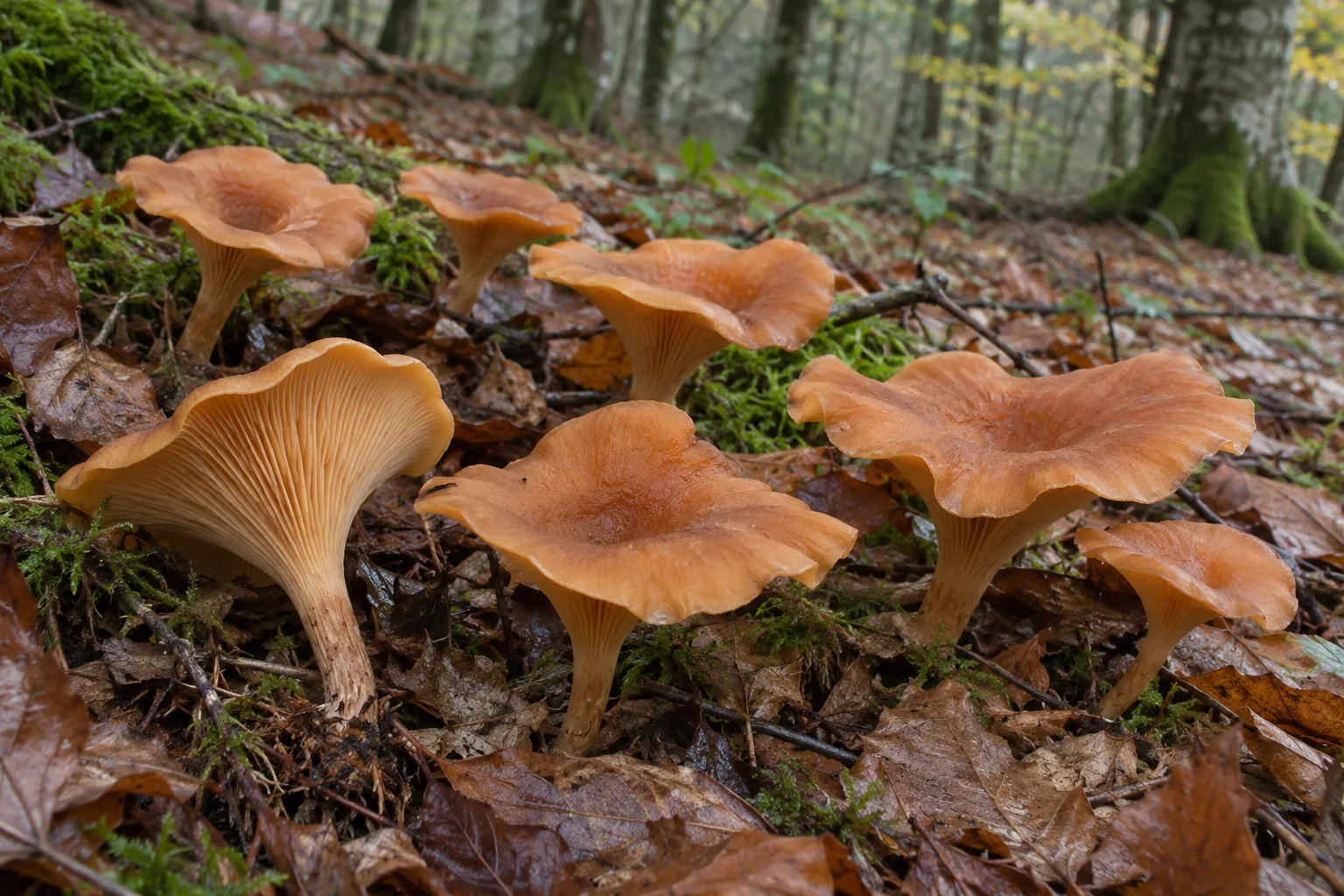
Quick facts
- Scientific name
- Paralepista flaccida
- Common names
- Tawny funnel, Tawny funnel cap
- Taxonomy
- Paralepista · Tricholomataceae
- Edibility context
- Unknown: No collection or preparation advice is given because remote identification and individual tolerance cannot be resolved here.
- Spore print
- White to very pale cream; useful in comparison but not diagnostic alone.
- Toxicity context
- Unknown: Conservative handling and no food clearance are appropriate when identification and reaction history are uncertain.
- Season
- September, October, November, December
- Growing difficulty
- Expert
- Regions
- Europe, temperate Asia, reported elsewhere where records are verified
Safety limit: These labels summarize documented context; they never authenticate a wild specimen. Cooking does not make a poisonous species safe.
Tawny funnel, Paralepista flaccida, is an orange-brown woodland litter mushroom whose mature cap becomes depressed and whose crowded gills run conspicuously down the stem. It often fruits in troops, arcs, or rings, making a colony visually memorable. None of those features is exclusive. A defensible record links cap development, gill architecture, stem fibers, complete base, pale spore deposit, litter connection, season, region, and comparison species.
This species page is separate from the common funnel guide, which covers a typically paler and more slender funnel, and the false chanterelle guide, which covers a differently constructed orange fungus often associated with conifer debris. The purpose here is documentation, not food permission.
Map the whole arc through the litter
Photograph the colony before touching it. Include enough ground to show whether fruit bodies are scattered, clustered, aligned, arcing, or closing into a ring. Measure the occupied diameter or length and the spacing between neighboring stems. Mark gaps caused by paths, roots, leaf piles, or trampling rather than mentally completing a perfect circle.
Growth pattern describes the underground colony but does not identify the species. Clouded agarics, fairy-ring fungi, common funnels, and many unrelated litter decomposers can make arcs. The useful observation is a repeatable map: compass direction, fixed landmarks, fruit-body counts by age, and a photograph from the same point after several days.
Verify the substrate at one carefully excavated base. Record litter depth, soil texture, fine roots, buried twigs, and whether the stem is actually attached to wood. A mushroom beside a log is not necessarily wood-growing, while a buried branch can be missed beneath leaves.
Measure a developmental cap series
Select young, middle-aged, and expanded specimens without combining their characters. Young caps can be convex or shallowly depressed with margins rolled inward. Mature caps often become broadly funnel-shaped with thin, wavy edges. Old or saturated caps may flatten, split, bleach, or turn irregular.
For each numbered cap, measure diameter, central depth, margin thickness, stem position, and height above the litter. Photograph overhead, in profile, and under neutral light. Describe color by zones: rusty orange, ochre, tawny brown, or paler dry bands may occur on one cap. A wet cap can look substantially darker than the same tissue after drying.
Test moisture change without turning it into a species claim. Photograph a cap in the field, then again after a measured indoor interval beside the same color reference. Hygrophanous change is useful documentation, but camera white balance, sunlight, and compression can manufacture apparent bands.
Confirm true gills and their descent
Take a square-on underside photograph and an oblique view with a millimeter scale. Tawny funnel gills are crowded and distinctly decurrent, usually pale orange, buff, or cream-orange. Record spacing, thickness, forks, cross-veins, short gills, edge condition, and how far the gills descend.
Cut one specimen vertically through cap center and stem. The section distinguishes a genuinely depressed cap from one whose margin merely turned upward. It also reveals how gill tissue joins the stem. Use the gill-types guide to keep three separate observations—attachment, spacing, and branching—instead of collapsing them into “funnel gills.”
False chanterelle can have repeatedly forked, crowded orange gills. True chanterelles have blunt ridges or folds rather than blade-like gills. Run a clean probe across the fertile surface only after photography: do not scrape away structure and then use the damaged view for comparison.
Record stem fibers and the complete base
Measure stem length and width at top, middle, and base. Note whether it is central or off-center, straight or curved, equal or tapered, and whether the color matches the cap. Photograph longitudinal fibers under side light. Tawny funnel lacks a ring and volva, but absence is credible only when the base was recovered intact.
Split the stem from apex to base. Record whether the interior is solid, stuffed, or becoming hollow; note insect channels, waterlogging, and any color change. Preserve the link between section, cap, gill view, and substrate record with the same specimen number.
White fungal felt around litter is not automatically a diagnostic basal feature. Photograph it before removal and retain attached leaves if a voucher is collected legally. Mycelium from more than one fungus can occupy the same decomposing layer.
Produce a controlled spore deposit
Use a mature, undamaged cap section across adjoining black and white surfaces. Cover it against drafts while allowing limited ventilation, and label time, humidity, and specimen. The expected deposit is white to very pale cream. Photograph it before folding or scraping because a thin pale deposit is easily confused with condensation or gill fragments.
Spore color helps reject mature pink-, brown-, and dark-spored mushrooms but does not prove P. flaccida. Common funnels, clouded agarics, and many other pale-spored woodland fungi overlap. When the print is weak, report it as inconclusive rather than converting reflected light into a color result.
Separate three orange-brown comparisons
Common funnel generally has a neater buff funnel profile and a more slender overall build. Compare matched mature fruit bodies, not a large tawny funnel with a young common funnel. Record cap-to-stem ratios, central depth, gill descent, and colony scale.
False chanterelle is often more vividly orange and may show a velvety cap plus intensely forked gills. It frequently occurs with conifer debris or rotten wood. Substrate, however, must be verified; conifer needles can blow into broadleaved litter and buried wood can disappear from view.
Clouded agaric is typically gray, thick-fleshed, and robust, with a stout pale stem and a different cap-development profile. Its gills may descend, so attachment alone cannot separate it. If color has washed out and the fruit bodies are damaged, measured construction and spore work matter more than a field nickname.
Treat names and range as evidence problems
Older literature may place this species in Clitocybe or Lepista, and the name Lepista inversa has been applied in ways that do not always match current treatments. Record the name used by each source and avoid merging observations solely because photographs look alike. Taxonomy is a hypothesis tied to specimens, not a cosmetic label.
GBIF occurrence points are leads, not automatic range proof. Open the record, check voucher institution, identifier, coordinates, date, and taxonomic interpretation. A map containing unreviewed citizen observations cannot establish that the species occurs in every shaded region.
When comparing older descriptions, copy the diagnostic characters into a table before reconciling names. Include cap diameter, cap moisture response, gill color and descent, stem texture, spore dimensions, habitat, and the author’s geographic scope. Two sources can use different names for overlapping concepts, or the same name for differently bounded concepts. Keeping the original wording tied to a citation makes the disagreement visible and prevents a modern label from silently rewriting an old record. Where microscopy or sequencing is unavailable, preserve the field number and report the identification confidence rather than pretending the nomenclatural problem has vanished.
Keep food claims outside the identification chain
Field guides and local traditions vary in how they treat tawny funnel as food. That inconsistency, plus lookalike risk and individual gastrointestinal reactions, makes remote culinary advice inappropriate. Cooking does not repair a wrong name, remove environmental contamination, or guarantee tolerance.
If illness follows mushroom ingestion, save uncooked and cooked remains, photographs, packaging, and meal timing. Contact local poison-control or emergency medical services promptly. Do not wait for an online vote, induce vomiting without professional direction, or assume that several unaffected diners exclude mushroom poisoning.
Audit the editorial image and its limits
The cover is an original 1536 × 1024 RGB AI editorial image with a unique source hash. It was compared side by side with MushroomScope’s Smoky Bracket and Hairy Bracket baselines for diffuse woodland light, restrained orange-brown color, realistic leaves and moss, complete visible bases, controlled depth of field, and coherent cap-to-gill construction. Review found no text, logo, watermark, collage seam, banding, stretching, floating bodies, or obvious fused anatomy.
The image is deliberately illustrative. It cannot establish exact gill branching, cap moisture response, substrate attachment, spore color, microscopy, chemistry, or location. Its bright readable gills should teach what to photograph, not what to eat.
Build an auditable tawny-funnel record
- Map the complete troop, arc, or ring before disturbance.
- Verify litter, soil, buried wood, and nearby trees separately.
- Measure young, mature, and old cap profiles in consistent light.
- Photograph blade-like gills square-on and confirm descent in section.
- Excavate one complete ringless and volva-free stem base.
- Make a labeled two-color pale-spore deposit.
- Compare common funnel, false chanterelle, clouded agaric, and local alternatives.
- State uncertainty and keep any food decision outside the web record.
References
- NCBI Taxonomy Browser: Paralepista flaccida — taxonomy and sequence-linked context.
- First Nature: Paralepista flaccida — morphology, season, habitat, and naming context.
- GBIF species search: Paralepista flaccida — occurrence leads requiring record-level verification.
- NAMA: mushroom poisoning syndromes — response context for suspected mushroom exposure.
Editorial status: reviewed by the MushroomScope editorial team on November 23, 2026; no named mycologist, toxicologist, clinician, or food-safety expert reviewed this page.
Source quality notes
MushroomScope cites sources that match the page scope, such as taxonomic databases, extension guidance, food-safety agencies, food-composition databases, and peer-reviewed or institutional health references. Sources support context and uncertainty; they do not turn an online page into specimen identification, medical advice, or a tested recipe record.
Frequently asked questions
Why is Paralepista flaccida called tawny funnel?
Mature caps often become orange-brown or tawny and develop a central depression with a wavy margin, but age and water can change both color and profile.
Do tawny funnel gills run down the stem?
Yes. The crowded pale-orange gills are distinctly decurrent, but attachment should be confirmed on an intact section because an upturned cap can exaggerate the effect.
Does tawny funnel grow in rings?
It can fruit in troops, arcs, and rings through woodland litter. Growth pattern supports the ecological record but is shared by many other fungi.
Is tawny funnel the same as false chanterelle?
No. False chanterelle is usually associated with conifer debris and has a different forked-gill pattern, color distribution, and cap texture.
Is tawny funnel edible?
This page offers no food clearance. Names, reactions, and lookalikes complicate the food record, and a website cannot verify a collected specimen.
Related guides
mushrooms
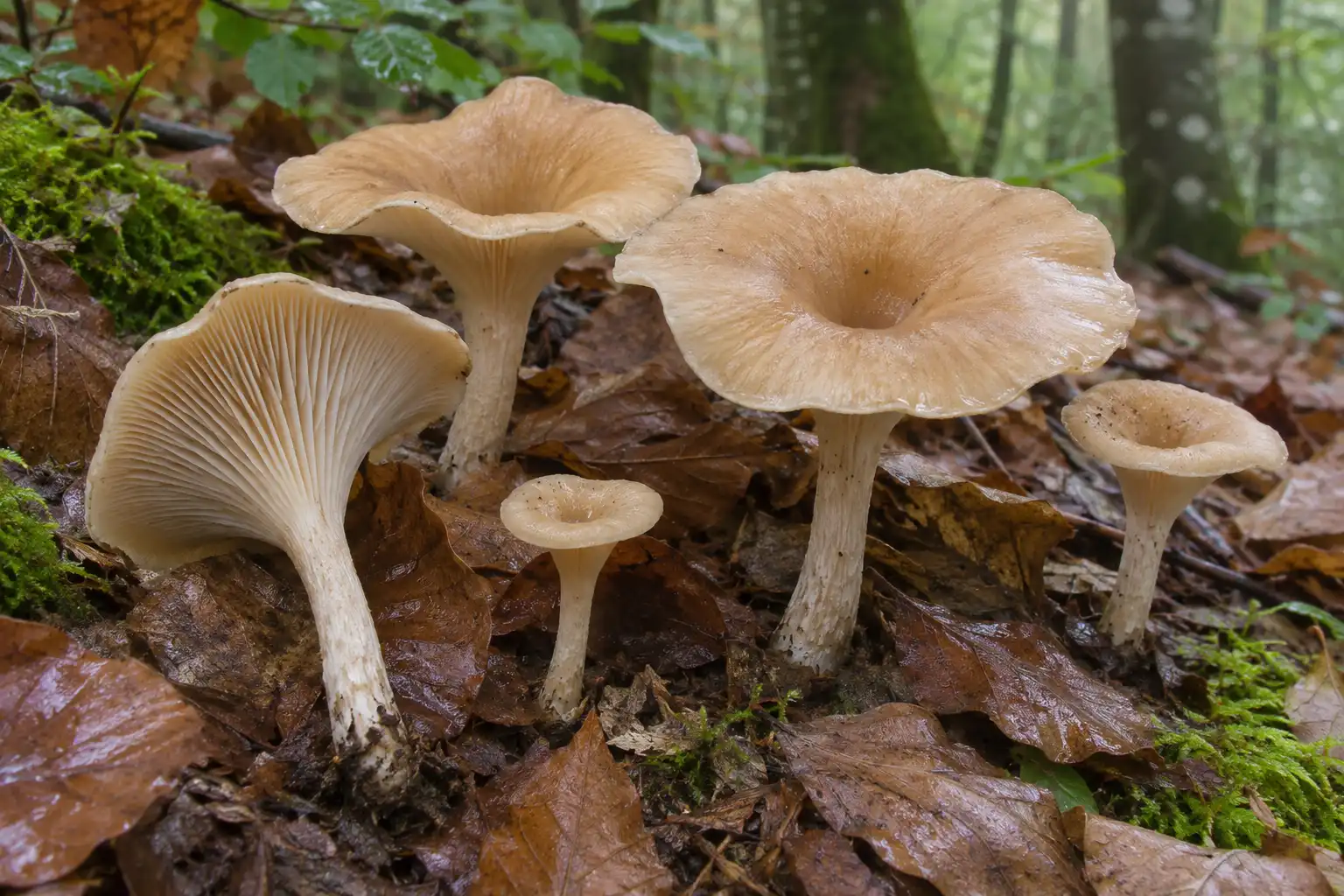
Common Funnel: Infundibulicybe gibba Field Guide
Document common funnel mushrooms by cap development, decurrent gills, stem texture, litter habitat, spore evidence, and lookalike separation.
mushrooms
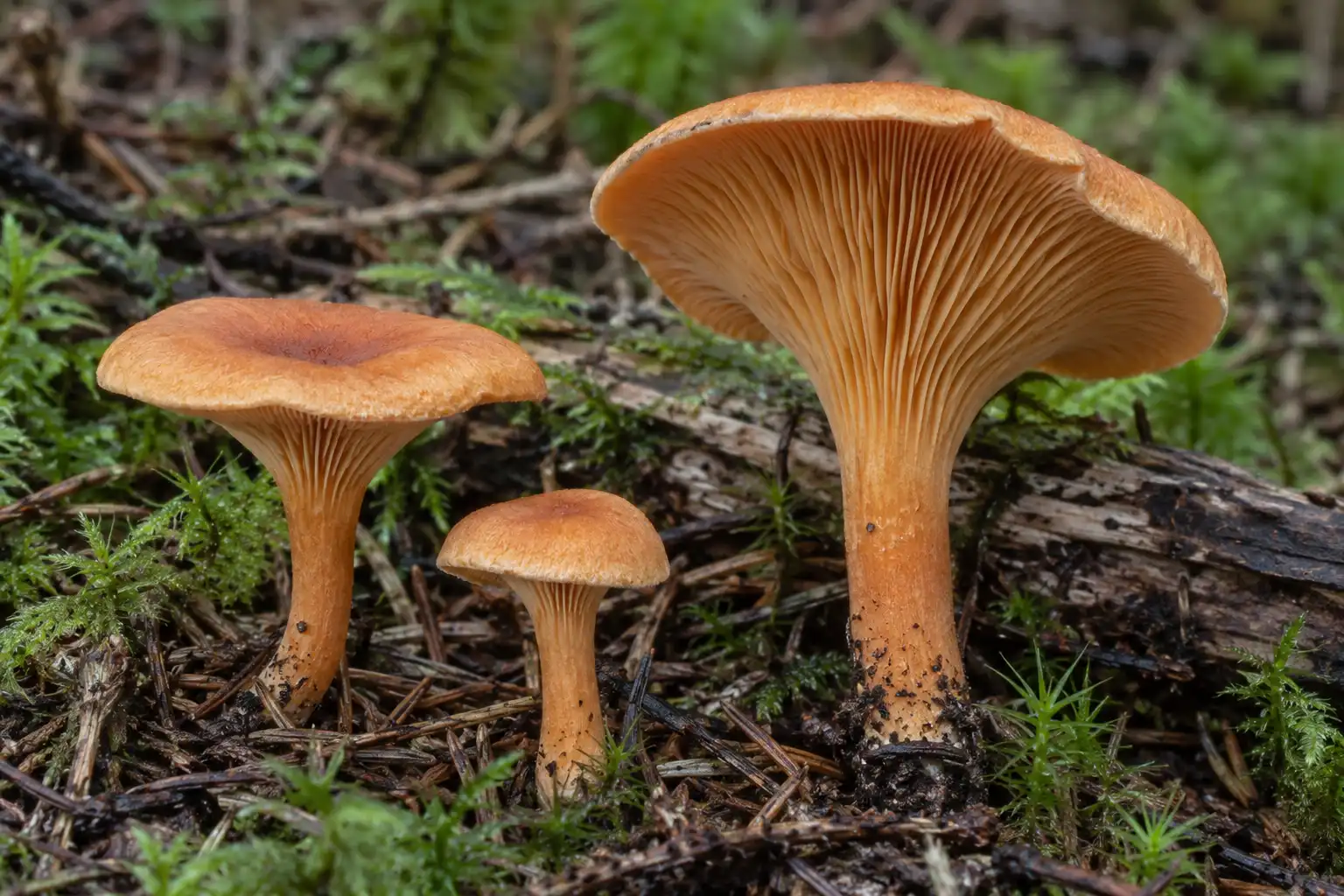
False Chanterelle (Hygrophoropsis aurantiaca): Identification Guide
Identify false chanterelle by its forked true gills, orange cap, conifer litter habitat, spore print, lookalikes, and conservative food-safety limits.
identification
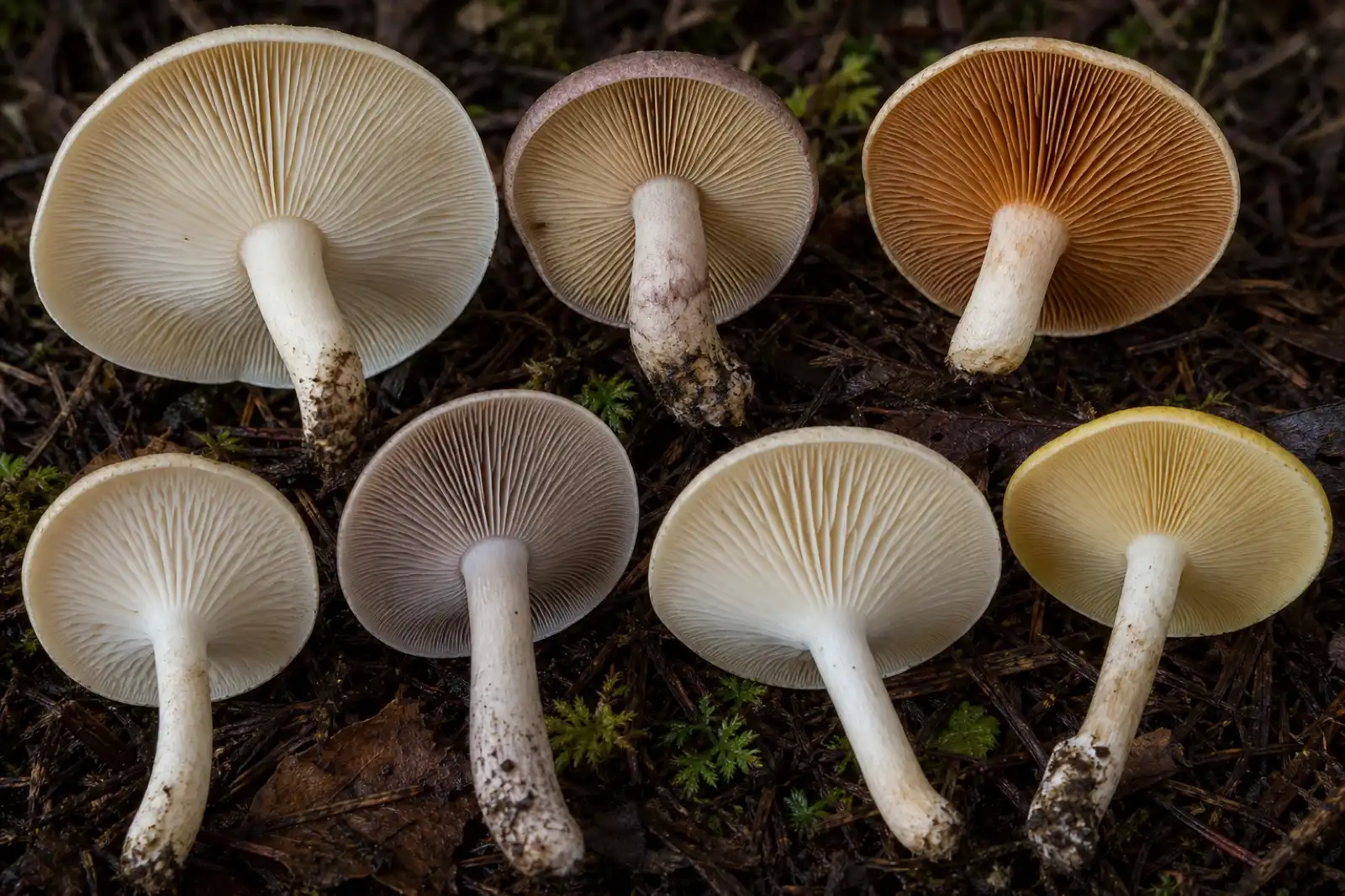
Mushroom Gill Types: Attachment, Spacing, and Color
Compare free, attached, notched, adnate, and decurrent mushroom gills while recording spacing, short gills, edge details, bruising, and color changes.
Continue exploring
Browse more practical guides in Mushroom Encyclopedia or visit the mushroom encyclopedia.