Mushroom Encyclopedia
Common Funnel: Infundibulicybe gibba Field Guide
Document common funnel mushrooms by cap development, decurrent gills, stem texture, litter habitat, spore evidence, and lookalike separation.
Species context
Treat profiles as reference material
Species profiles summarize documented traits, taxonomy, and lookalikes, but natural variation can be substantial.
Use the safety checklist →Decision limit
A profile cannot authenticate a specimen
Do not eat a wild mushroom from an online match, single feature, or generated image.
Read the safety disclaimer →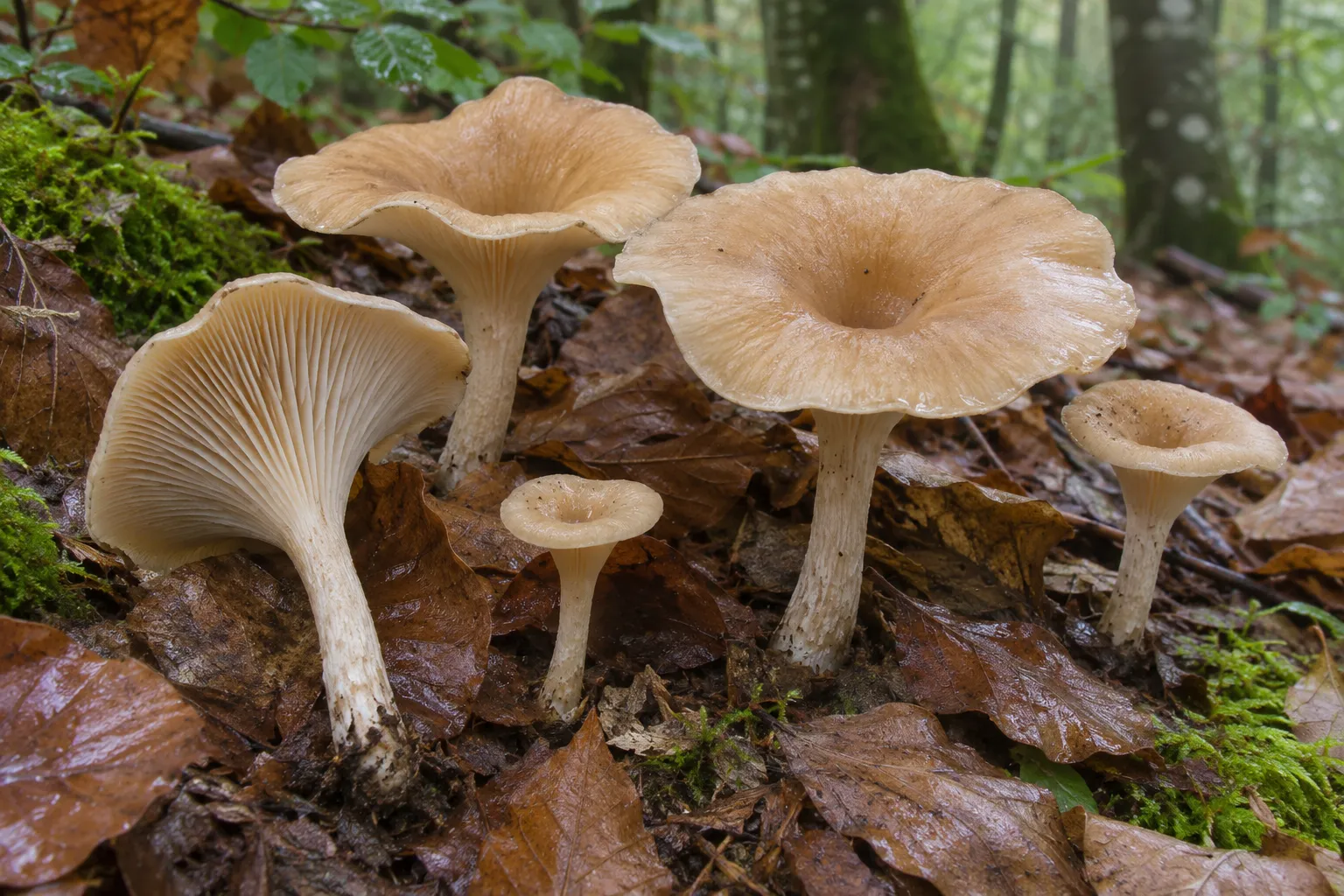
Quick facts
- Scientific name
- Infundibulicybe gibba
- Common names
- Common funnel, Common funnel cap
- Taxonomy
- Infundibulicybe · Tricholomataceae
- Edibility context
- Conditional: No food recommendation is made because pale funnel lookalikes are difficult to exclude remotely and regional traditions do not substitute for specimen-level identification.
- Spore print
- White; useful as a linked character but shared by many funnel-shaped agarics.
- Toxicity context
- Unknown: Risk centers on misidentification, including confusion with toxic pale funnels; never use a web page to clear a wild specimen for consumption.
- Season
- July, August, September, October, November
- Growing difficulty
- Expert
- Regions
- Europe, North America, temperate regions with verified records
Safety limit: These labels summarize documented context; they never authenticate a wild specimen. Cooking does not make a poisonous species safe.
Common funnel, Infundibulicybe gibba, is a litter-decomposing mushroom recognized by a sequence rather than a single funnel silhouette. Young caps can be convex or only shallowly depressed. Mature caps become distinctly funnel-shaped while pale crowded gills descend the stem. A useful record joins that development to measurements, a complete base, litter context, spore evidence, microscopy, and a regional key.
This page owns the species-level field-record intent. The aniseed funnel guide addresses a differently colored and scented comparison, while the trooping funnel guide covers a larger, more robust species. These pages are comparison aids, not remote food clearance.
Start with a mapped litter patch
Photograph the entire fruiting patch before lifting a specimen. Include tree litter, needles, fine sticks, moss, slope, and any buried woody material. A tight portrait can hide whether a cap emerged from soil, a compacted path edge, or a branch under the leaves. Record the observed substrate before assigning a tree association.
Mark a measured strip and count isolated mushrooms, arcs, dense groups, and age classes. Note whether stems share a buried base or merely stand close together. Revisit after rain if possible, using the same frame. This distinguishes new fruit bodies from caps that simply expanded or became water-darkened.
Follow cap development instead of demanding a perfect funnel
Measure several intact caps from button to mature stage. Young examples may be convex with a small central dimple; older caps flatten, deepen, and acquire a thin irregular margin. Record width, central depth, margin thickness, surface texture, and wet or dry state. Pale buff, tan, and ochre are descriptions, not identity tests.
Use diffuse light and a neutral color reference. Direct flash can erase shallow surface fibers and make a damp cap look varnished. Drought may crack or bleach margins, while heavy rain can deepen color and distort shape. Keep each observation tied to one numbered specimen.
Trace the gills down the same stem
Turn one complete specimen without cutting off its base. The gills should be pale and clearly decurrent, running down the upper stem rather than merely touching it. Photograph spacing, short-gill tiers, forks, edges, and the point where the longest gills end. The gill-types guide explains how to document attachment without forcing an ambiguous specimen into a category.
Decurrent gills occur in many unrelated mushrooms. Their value comes from combination with cap development, stem texture, litter ecology, spores, and microscopy. A dramatic underside photograph without scale or specimen continuity is visually useful but taxonomically weak.
Preserve the litter-bound stem base
Excavate around the stem rather than pulling it. Record length, width at top and base, curvature, surface fibers, bruising, internal texture, and any white cottony material binding leaf fragments. Common funnel lacks a true ring and volva, but damage can remove structures from a lookalike; absence is meaningful only on an intact specimen.
Split one stem lengthwise after exterior photographs. Note whether it is solid, stuffed, hollowing, tough, or brittle at the recorded age. Soil-stained fibers should not be described as innate scales. Keep base debris with the voucher because it documents the actual micro-substrate.
Treat odor as a controlled supporting observation
Odor descriptions are variable and easily contaminated by leaf litter, wet wood, hands, or containers. Record whether tissue was intact or cut, the time after handling, air temperature, and independent observer agreement. Do not manufacture an odor by repeatedly crushing unknown tissue or tasting it.
The absence of an anise note can help question an aniseed-funnel hypothesis, but it cannot prove common funnel. Odor sensitivity differs among people, old specimens lose volatile compounds, and nearby fungi can alter the perceived smell.
Make a specimen-linked spore record
Place a mature cap over adjoining dark and light nonabsorbent surfaces while preserving its number. Cover it loosely to reduce drafts and record duration and temperature. A white deposit is expected. Report a failed print honestly; immaturity, cold, dryness, or senescence can prevent deposition.
Under calibrated microscopy, record spore dimensions from an adequate count, shape, wall, mount medium, and the structures required by the selected key. Store photographs and measurements with the voucher. A database sequence is only as reliable as its specimen provenance and current taxonomic interpretation.
Separate pale funnels using falsifying characters
Aniseed funnel may retain blue-green or gray-green tones and an anise-like odor, but both traits can fade. Trooping funnel is normally larger, thicker-stemmed, and may retain a central boss even as the cap expands. Other Infundibulicybe and Clitocybe species overlap strongly in buff color and decurrent gills.
The toxic ivory-funnel group makes casual food conclusions especially unsafe. Record habitat precisely, but do not treat woodland versus grass as an absolute gate. Compare cap surface, stature, gill attachment, spore characters, tissues, and local keys. Reject an identification when the required character cannot be seen.
Use a cap-depth development series
Choose at least five fruit bodies spanning the visible age range without assuming they are genetically identical. Measure cap diameter and vertical depth from margin plane to center, then photograph a side profile at the same camera height. Repeat after a defined interval only if the mushrooms remain intact.
The series can show how a shallow depression becomes a funnel in that patch. It cannot establish a universal growth rate because moisture, temperature, disturbance, and specimen history differ. Retain failed or damaged observations instead of selecting only the most textbook shapes.
Test the litter interface without inventing a host
For lawful collection, lift a small block containing the complete base, adjacent leaves, mineral soil boundary, and any fine wood. Photograph layers before separation. Record whether mycelial fibers bind leaves, needles, or woody fragments and whether another fungus occupies the same material.
This micro-profile supports a litter-saprotroph interpretation. It does not prove a relationship with the nearest tree or reveal the full mycelial network. Root association requires independent anatomical or molecular evidence; proximity is not a host record.
Compare gill descent with a stem grid
Place an intact specimen on its side beside a scale and photograph the upper stem at right angles. On a duplicate image, mark the cap margin plane and measure how far the longest gills descend below it. Record gill endings around four stem quadrants rather than selecting the most dramatic run. Repeat on young, middle, and mature specimens.
The grid makes “decurrent” a reviewable observation and shows how apparent descent changes as the cap opens. It does not provide a universal cutoff or identify the mushroom alone. Curved stems, torn gills, and oblique photographs distort distance, so preserve raw frames and flag damaged quadrants.
Record margin translucency without confusing wetness and anatomy
Photograph the cap margin against diffuse side light while noting whether the surface is wet, merely damp, or dry. Measure the width of any visible radial translucency at several points and compare it with cap thickness. Do not soak a specimen to manufacture striations.
A thin hydrated margin can reveal underlying gill positions, while drying may erase them. This explains why field guides and photographs can disagree about a striate margin. The observation supports a developmental record but cannot separate common funnel from every pale litter funnel.
Keep edibility and exposure advice conservative
Published food traditions do not turn an uncertain funnel into a safe meal. Pale funnels include species containing muscarine, and photography cannot evaluate every microscopic character, contaminant, or individual sensitivity. Do not taste an unknown specimen as a shortcut.
If an unknown mushroom was eaten and symptoms occur, preserve remnants and photographs and contact local poison control or medical services. Record time, amount, preparation, other foods, symptoms, and people exposed. Do not delay care while waiting for an online identification.
Audit the editorial image against woodland baselines
The 1536 × 1024 cover is an original AI-assisted editorial image. It was opened beside the site’s Smoky Bracket and Hairy Bracket natural-light images. The frame uses diffuse woodland light, restrained buff and leaf-brown color, damp litter texture, complete bases, several developmental stages, and one readable decurrent-gill view. It contains no text, watermark, logo, collage seam, stretching, or obvious duplicated subject.
The image remains illustrative. Cap surfaces, gill spacing, and proportions cannot establish species identity, geography, microscopy, or edibility. Real specimens must be documented independently.
Build a reviewable common funnel record
- Map the patch and photograph litter context before collection.
- Measure several caps across developmental stages.
- Show cap, decurrent gills, stem, and intact base from the same specimen.
- Record odor with method and observer limits.
- Link a white deposit and calibrated microscopy to the voucher.
- Compare aniseed, trooping, ivory, and regional funnel lookalikes explicitly.
- Keep host, food, and safety claims inside the evidence.
The common funnel is only one member of a crowded litter-fungus comparison. A robust smoky-gray collection belongs on the clouded agaric evidence path, while an orange-brown colony with thin wavy caps requires the separate tawny funnel record. Use measured construction and mature spores rather than stretching this page to cover both.
References
- NCBI Taxonomy Browser: Infundibulicybe gibba — taxonomy and sequence-linked records.
- GBIF species search: Infundibulicybe gibba — occurrence and voucher leads requiring record-level review.
- First Nature: Infundibulicybe gibba (listed under Clitocybe gibba) — morphology, habitat, season, and comparison characters.
- North American Mycological Association: mushroom poisoning syndromes — conservative exposure-response context.
Editorial status: reviewed by the MushroomScope editorial team on November 19, 2026; no named mycologist, toxicologist, clinician, or food-safety expert reviewed this page.
Source quality notes
MushroomScope cites sources that match the page scope, such as taxonomic databases, extension guidance, food-safety agencies, food-composition databases, and peer-reviewed or institutional health references. Sources support context and uncertainty; they do not turn an online page into specimen identification, medical advice, or a tested recipe record.
Frequently asked questions
What field characters support a common funnel record?
Use a developmental series of buff depressed caps, pale crowded gills running down the stem, a slender fibrous stem, white spore deposit, litter habitat, microscopy, and a current regional key.
Is every buff funnel in leaf litter Infundibulicybe gibba?
No. Many pale funnel-shaped mushrooms overlap in color and silhouette, including toxic species; cap shape alone is not diagnostic.
Can common funnel be identified from one photograph?
No. A defensible record needs the complete stem base, underside, scale, substrate, developmental stage, spore and microscopic evidence, and geographic context.
Where does common funnel grow?
It is recorded as a litter saprotroph in deciduous and mixed woodland, often among leaves, needles, and fine woody debris.
Is common funnel safe to eat?
This page does not clear a collection for food. Similar funnel mushrooms include consequential lookalikes, and online images cannot establish identity or contamination status.
Related guides
mushrooms
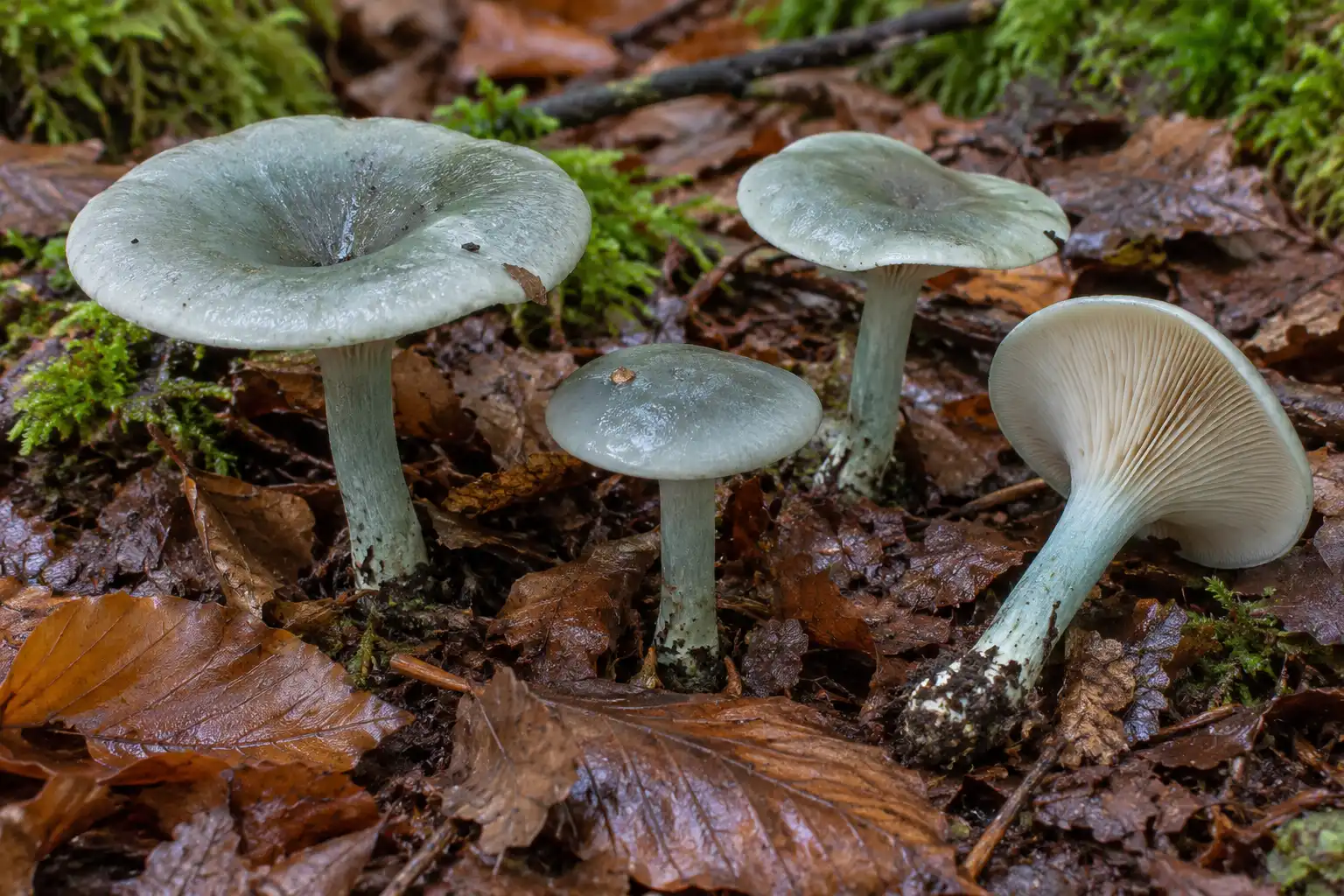
Aniseed Funnel: Clitocybe odora Identification Guide
Identify aniseed funnel using blue-green caps, decurrent gills, verified odor, woodland litter, spore evidence, lookalikes, and conservative safety limits.
mushrooms
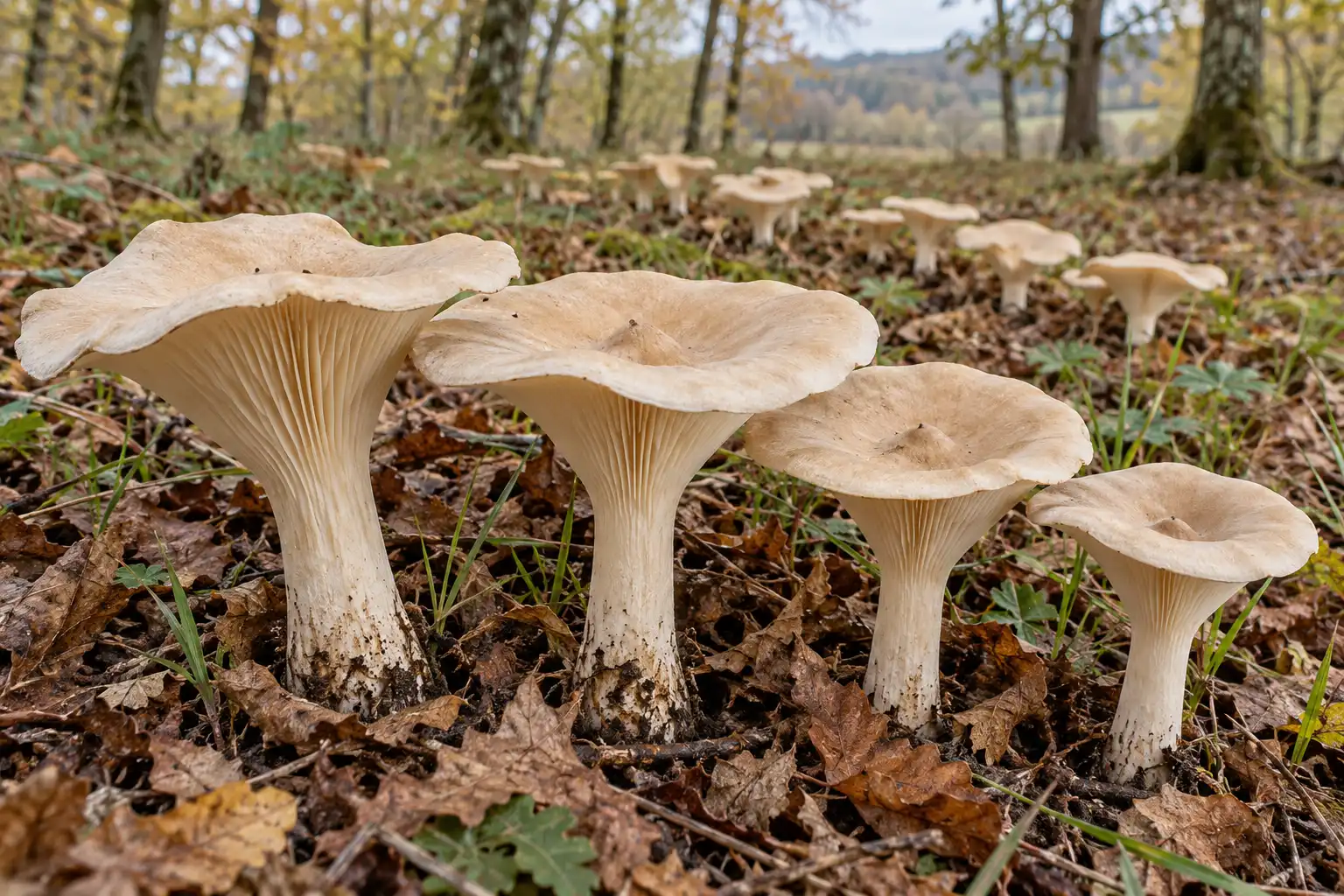
Trooping Funnel Mushroom: Rings, Gills, and Scale
Study the trooping funnel through its large buff cap, central umbo, decurrent gills, tall stem, rings and troops, lookalikes, and safety limits.
identification
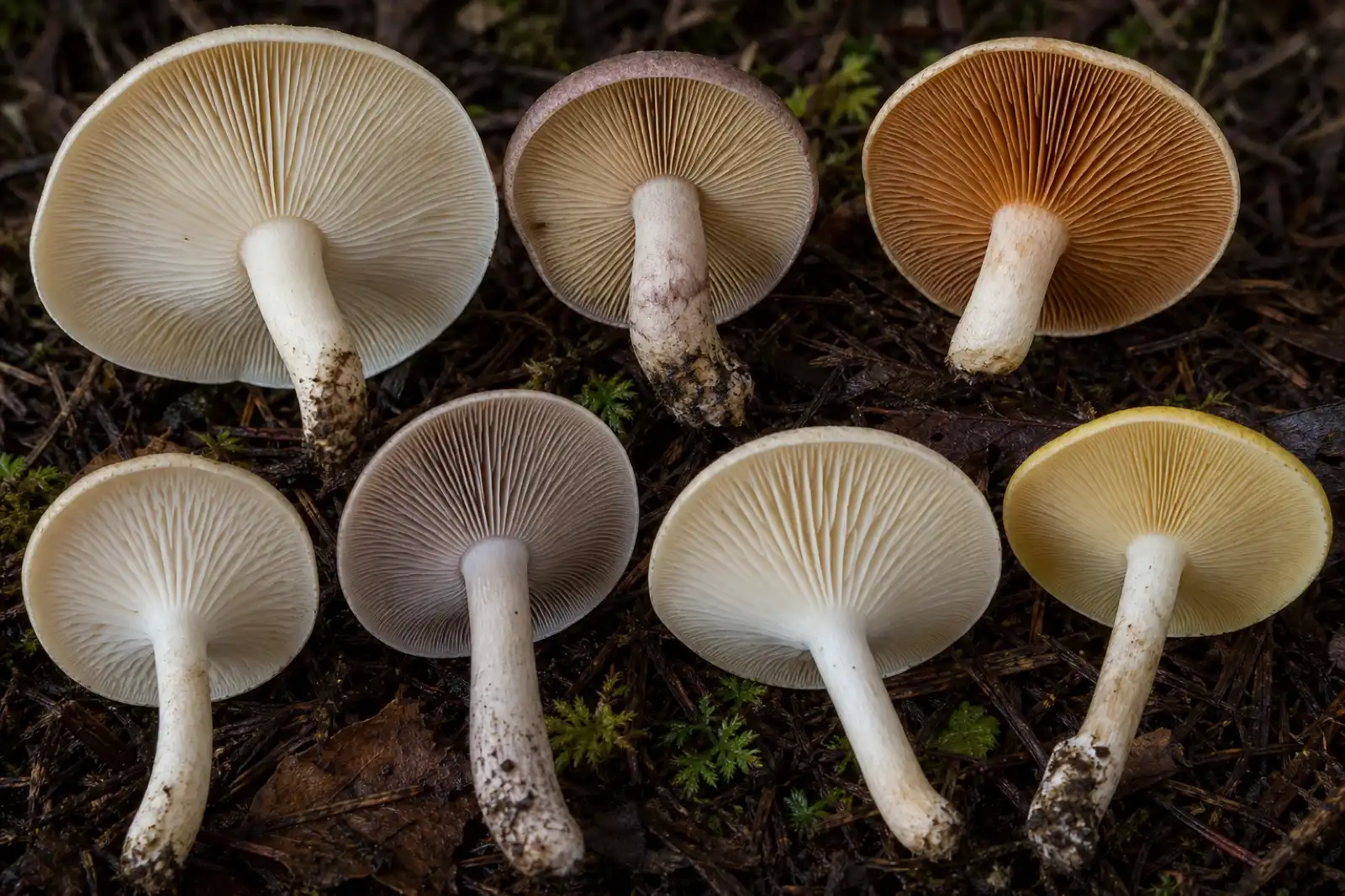
Mushroom Gill Types: Attachment, Spacing, and Color
Compare free, attached, notched, adnate, and decurrent mushroom gills while recording spacing, short gills, edge details, bruising, and color changes.
Continue exploring
Browse more practical guides in Mushroom Encyclopedia or visit the mushroom encyclopedia.