Mushroom Encyclopedia
Clouded Agaric: Gray Caps, Decurrent Gills, and Safety
Document clouded agaric by its gray cap, crowded decurrent gills, woodland litter, odor, spore deposit, lookalikes, and conservative food boundary.
Species context
Treat profiles as reference material
Species profiles summarize documented traits, taxonomy, and lookalikes, but natural variation can be substantial.
Use the safety checklist →Decision limit
A profile cannot authenticate a specimen
Do not eat a wild mushroom from an online match, single feature, or generated image.
Read the safety disclaimer →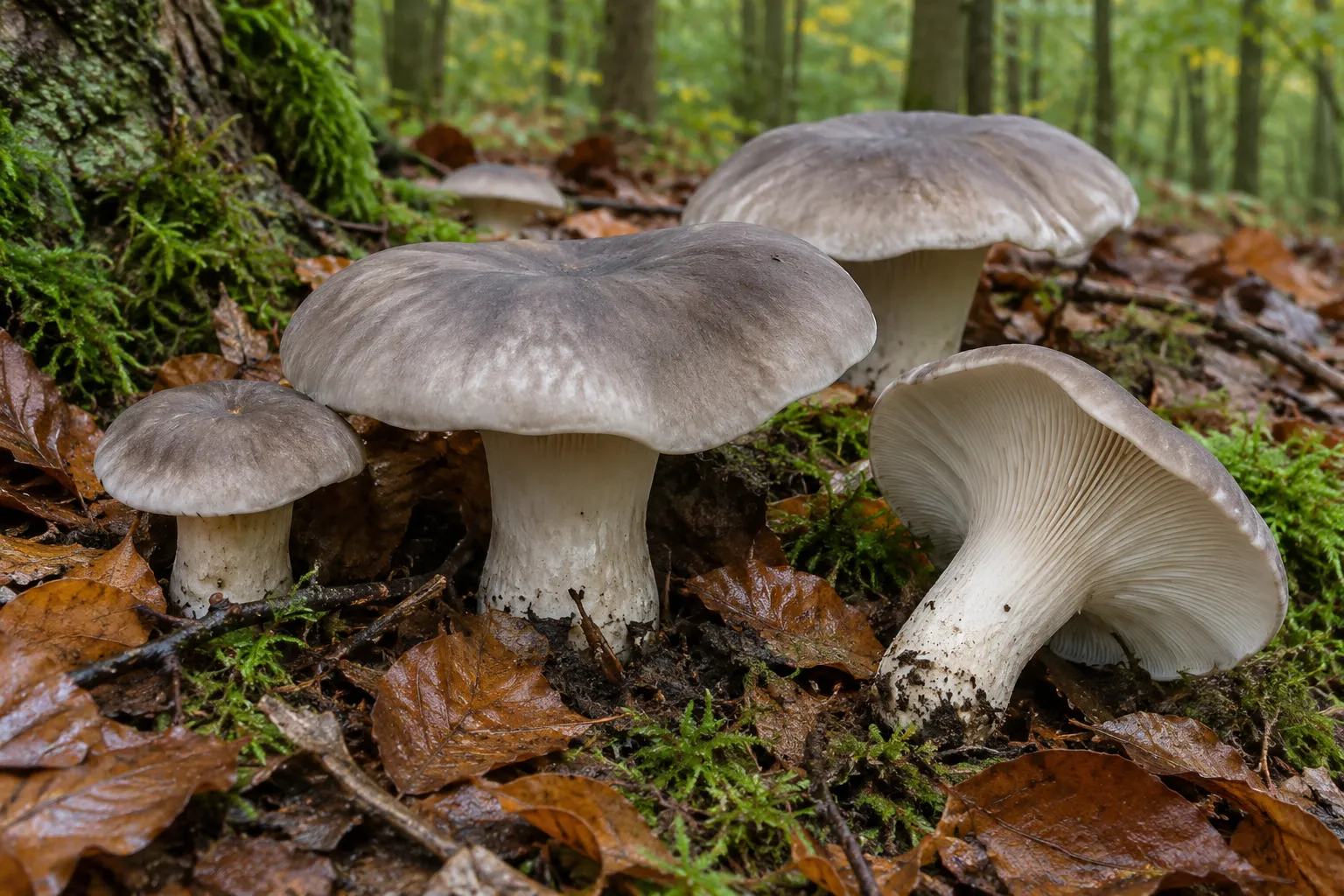
Quick facts
- Scientific name
- Clitocybe nebularis
- Common names
- Clouded agaric, Clouded funnel
- Taxonomy
- Clitocybe · Tricholomataceae
- Edibility context
- Conditional: Conflicting culinary history and documented gastrointestinal reactions make this unsuitable for remote food advice.
- Spore print
- White to pale cream; useful for excluding darker-spored candidates but not diagnostic alone.
- Toxicity context
- Moderate: Reported reactions and identification uncertainty require a conservative no-food boundary.
- Season
- September, October, November, December
- Growing difficulty
- Expert
- Regions
- Europe, western Asia, introduced or reported elsewhere where records are verified
Safety limit: These labels summarize documented context; they never authenticate a wild specimen. Cooking does not make a poisonous species safe.
Clouded agaric, Clitocybe nebularis, is a substantial gray woodland mushroom that often appears in troops, arcs, or rings through deep litter. Its irregular smoky cap explains the common name, but the useful field concept is a complete construction: a robust cap that changes from convex to nearly flat, crowded pale gills that run slightly down the stem, a stout ringless stem, white to pale spores, litter-based growth, and a cool-season woodland setting.
This page owns the species-level field-record intent. The common funnel guide covers a smaller, more slender buff funnel. The gill-types guide explains how to record attachment without forcing a name. A website photograph cannot establish edibility, and this species is particularly unsuitable for a visual food decision because culinary traditions conflict with reports of gastrointestinal reactions.
Record the colony before lifting a mushroom
Begin with a wide photograph showing the full fruiting pattern and nearby trees. Mark whether bodies are scattered, tightly trooping, arranged in a partial arc, or forming a ring. Measure the occupied length and spacing between caps. A dramatic arc is ecological evidence of an expanding underground mycelium, not a species character by itself; many litter fungi produce similar patterns.
Confirm that stems enter soil and litter. Pulling one specimen upward can bring attached leaves that make a buried-wood fungus appear terrestrial, while rotten roots or twigs can make a litter fungus appear wood-associated. Excavate one base carefully, photograph it in place, and record whether there are cords, a bulb, attached wood, compacted soil, or only interwoven humus.
Tree identity is supporting context rather than proof. Photograph bark, buds, fallen leaves, and the canopy separately. In mixed woodland, list every plausible nearby tree instead of assigning the nearest trunk. Record slope, drainage, litter depth, recent rain, frost, and disturbance such as mowing or path work.
Follow cap shape through several ages
Measure at least one young, middle-aged, and expanded cap. Young caps are usually convex with margins rolled inward. Mature caps broaden and may flatten or become shallowly depressed, while old caps can become wavy or irregular. Photograph each from directly above and at cap level so the same specimen’s shape and margin can be compared.
Describe zones rather than choosing a single color word. A cap can contain lead gray, smoky brown, buff-gray, and paler cloudy patches. Water darkens tissue, drying can bleach it, and rubbed bloom can create false contrast. Include a neutral gray card when color matters. Avoid treating phone auto-enhancement as a measured character.
Record diameter, center-to-margin profile, margin thickness, surface texture, cracks, debris adhesion, and bruising. A cap that looks smooth from above may show fine fibers under raking light. Slug feeding and frost can remove the bloom that made the fresh colony recognizable.
Prove the gill attachment on an intact section
Turn one cap without breaking the stem. Take square-on and oblique underside views with a millimeter scale. The gills should be crowded, pale cream to buff, and broadly attached, often descending a short distance down the stem. Record forks, short gills, edge color, spacing at mid-radius, and any spotting or bruising.
The word “decurrent” is easily overused when a cap is funnel-shaped. Cut one fruit body vertically through cap center and stem. A real section shows where gill tissue meets the stem, whether it continues downward, and whether the cap is truly depressed or merely upturned at the margin. Compare two ages because attachment can appear different as caps expand.
Use the gill-types guide to separate attachment from shape. Do not infer spore color from gill color. Young Entoloma sinuatum can have pale gills before pink spores accumulate, which is one reason a single young specimen is a poor basis for a high-consequence decision.
Document the stem and complete base
Measure length, width at apex, middle, and base, then note taper, compression, fibers, cavities, discoloration, and litter embedded around the base. The clouded agaric stem is commonly stout and pale, without a ring or a cup-like volva. Absence must be documented on an excavated base; a broken stem cannot demonstrate that a structure was never present.
Split the stem lengthwise and photograph the interior next to the cap section. Record whether it is solid, stuffed, or hollow and whether insects or water damage have altered it. Keep the section tied to the numbered field specimen. Combining the cap of one body, gills of another, and base of a third can manufacture a character set no individual possessed.
Treat odor as a controlled observation
Clouded agaric often has a strong, distinctive odor, but published comparisons and human descriptions vary. Smell an intact cap, a fresh gill surface, and a cut section separately outdoors, then repeat after a fixed interval. Write the observer’s own description before consulting a guide. “Pleasant,” “floral,” “meal-like,” or “unpleasant” are interpretations, not calibrated chemical tests.
Odor weakens in cold, dry, old, or waterlogged material and differs among observers. Never taste an unknown mushroom to settle the record. The odor documentation guide explains blind comparisons and contamination controls for field notes.
Make a clean two-color spore deposit
Place a mature cap section across adjacent black and white nonabsorbent surfaces beneath a ventilated cover. Label specimen, date, start time, and humidity. A white to pale cream deposit supports the working concept and helps exclude mature pink-, brown-, or dark-spored candidates. Dust, condensation, gill fragments, and reflected surface color can imitate a weak print, so photograph the deposit in neutral light and retain the source cap.
A pale print does not identify C. nebularis. Many unrelated woodland mushrooms share it. Use the deposit only after cap development, gill attachment, stem structure, litter connection, and region have been recorded.
Separate the most important lookalikes
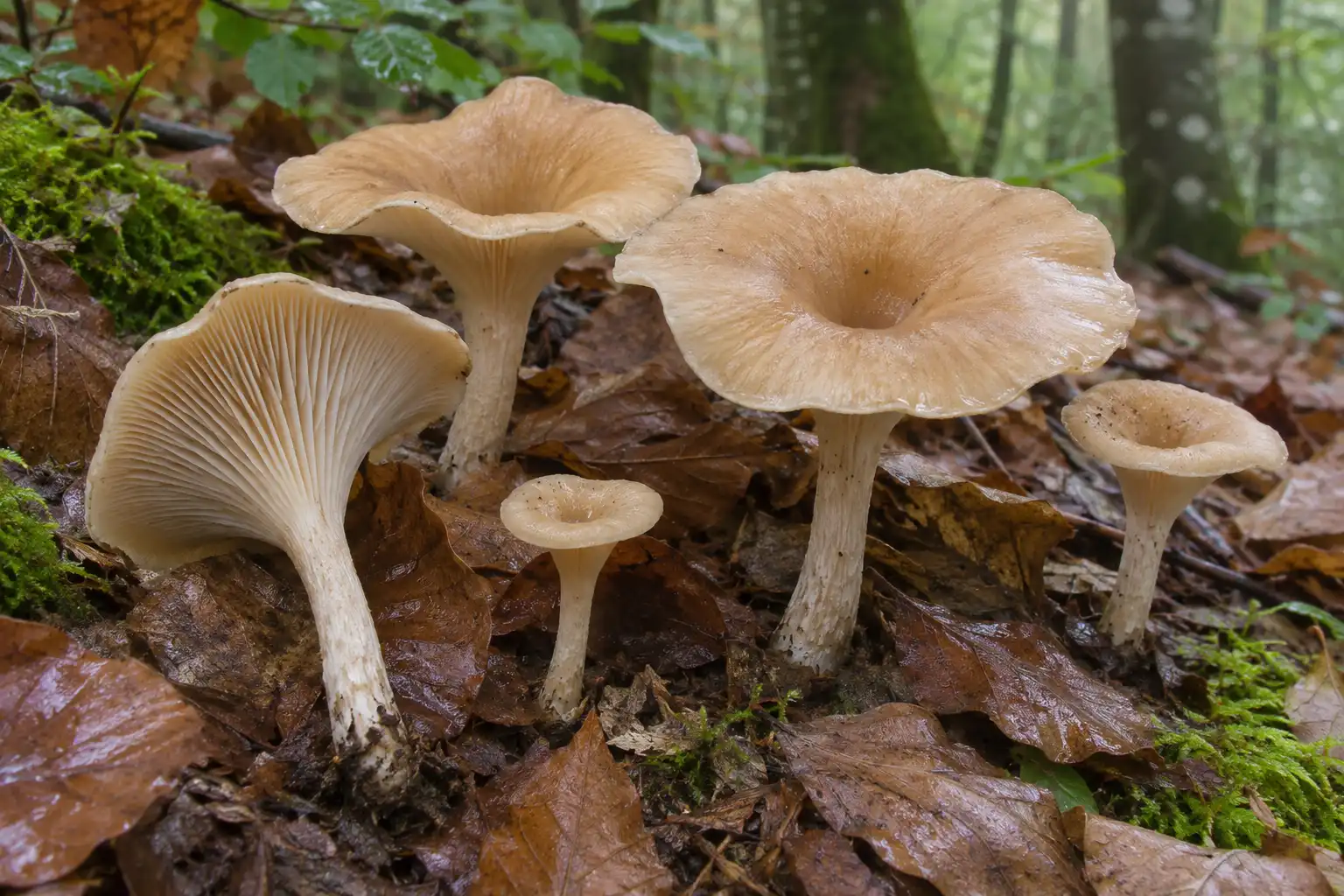
Common funnel is typically smaller and more slender, with a tan to buff cap that becomes clearly funnel-shaped and a proportionally thinner stem. Compare measured dimensions and a matched developmental series rather than isolated portraits. Large, waterlogged common funnels and small clouded agarics can overlap in color.
The livid entoloma, Entoloma sinuatum, deserves explicit exclusion because it can cause serious gastrointestinal illness. Mature gills and the spore deposit move toward salmon pink, the attachment differs, and the overall cap-and-stem construction should be checked in a local key. Do not wait for obvious pink gills on a young body.
Wood blewits may share a robust litter habitat but often retain violet tones when young and yield a pinkish-buff deposit. Pale Tricholoma species tend to have notched rather than descending gills and are associated with living trees. If the record lacks mature spores, a complete base, or a defensible local comparison, stop at a broader group.
Keep the food boundary conservative
Some older or regional sources describe clouded agaric as edible after special preparation; other evidence and poisoning records associate it with gastrointestinal illness or intolerance. Preparation history does not turn an uncertain field identification into safe food, and repeated consumption claims are not a clinical guarantee. MushroomScope does not recommend collecting it for food.
If anyone becomes ill after mushroom ingestion, preserve uncooked and cooked material, photographs, packaging, and timing information. Contact local poison-control or emergency medical services promptly rather than waiting for a crowd-sourced name. The NAMA poisoning-syndrome resource describes why symptom timing matters, but it does not replace local care.
Audit the editorial cover and its limits
The cover is an original 1536 × 1024 RGB AI editorial image. It was compared side by side with MushroomScope’s Smoky Bracket and Hairy Bracket baselines for diffuse woodland light, restrained color, realistic wet leaves and moss, complete attachment, controlled depth of field, and the absence of text, watermarks, logos, collage seams, banding, stretching, or obvious fused anatomy. Its source file and hash are unique within the public image set.
The image shows a plausible gray colony and a readable decurrent-gill view, but it is not a voucher. Exact cap bloom, gill spacing, odor, spore color, substrate connection, microscopy, and regional occurrence remain unverified. Use it to understand the article’s evidence categories, never as a matching test.
For a repeat visit, place two unobtrusive ground markers outside the colony and photograph from the same height and compass bearing. Record which numbered caps expanded, collapsed, or disappeared and whether new pins arose along the mapped arc. This distinguishes a real developmental sequence from a collection of unrelated ages and makes weather-driven changes in cap color easier to interpret. Remove any temporary marker before leaving the site.
Build an auditable clouded-agaric record
- Photograph the whole troop, arc, or ring before disturbance.
- Verify a litter-and-soil connection and record nearby trees conservatively.
- Measure young, mature, and old cap profiles under consistent light.
- Photograph crowded gills and confirm attachment in vertical section.
- Excavate one complete ringless, volvate-free stem base.
- Record odor without tasting and make a clean two-color spore deposit.
- Exclude mature pink-spored entolomas and compare common funnels and blewits.
- Keep the food conclusion separate from the identification hypothesis.
For a massive cream grassland funnel rather than a smoky litter mushroom, use the giant funnel guide and compare measured cap profile, gill descent, stem build, substrate, and ring geometry.
References
- NCBI Taxonomy Browser: Clitocybe nebularis — taxonomy and sequence-linked records.
- First Nature: Clitocybe nebularis — field morphology, habitat, season, and food caution.
- GBIF species search: Clitocybe nebularis — occurrence leads that require voucher and geography review.
- NAMA: mushroom poisoning syndromes — conservative response context for suspected exposures.
Editorial status: reviewed by the MushroomScope editorial team on November 23, 2026; no named mycologist, toxicologist, clinician, or food-safety expert reviewed this page.
Source quality notes
MushroomScope cites sources that match the page scope, such as taxonomic databases, extension guidance, food-safety agencies, food-composition databases, and peer-reviewed or institutional health references. Sources support context and uncertainty; they do not turn an online page into specimen identification, medical advice, or a tested recipe record.
Frequently asked questions
What makes a clouded agaric look clouded?
Its cap often has an uneven smoky gray or gray-brown bloom with paler cloudy patches, but rain, age, and handling can flatten that pattern, so color is not enough for identification.
Do clouded agaric gills run down the stem?
They are typically crowded and attached broadly, often running a short distance down the stem. The exact attachment should be photographed on several intact fruit bodies.
Where does Clitocybe nebularis grow?
It fruits from woodland litter, often in troops, arcs, or rings beneath broadleaved or coniferous trees. A soil-and-litter connection should be verified rather than inferred from the photograph.
Can clouded agaric be eaten?
This guide gives no food clearance. The species has conflicting culinary history, can cause gastrointestinal illness, and can be confused with other pale or gray woodland mushrooms.
Is a gray cap and strong odor enough to identify it?
No. Cap development, gill attachment, stem construction, spore deposit, substrate, growth pattern, region, and lookalikes must agree, and odor varies among observers.
Related guides
mushrooms
Common Funnel: Infundibulicybe gibba Field Guide
Document common funnel mushrooms by cap development, decurrent gills, stem texture, litter habitat, spore evidence, and lookalike separation.
identification
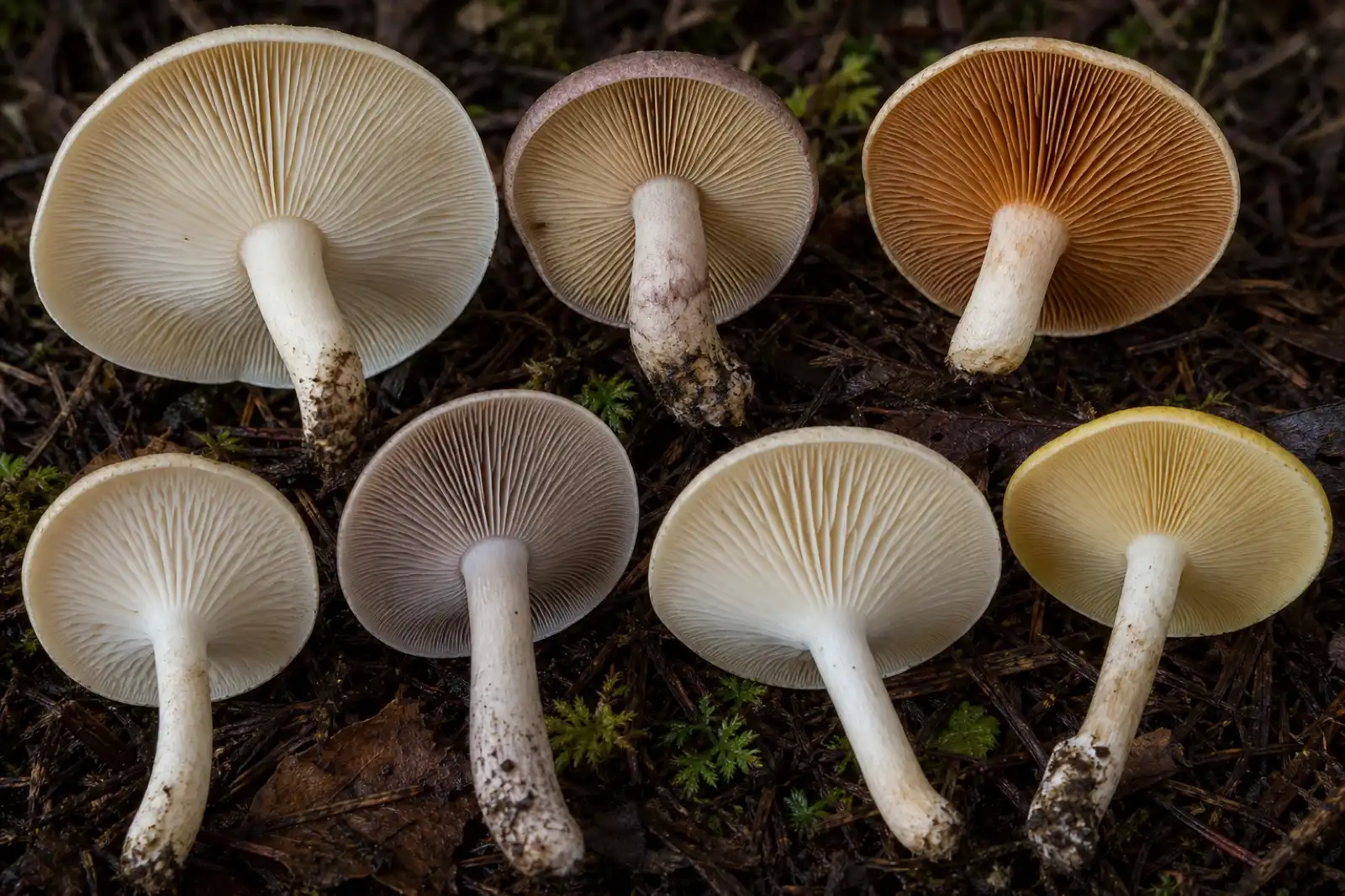
Mushroom Gill Types: Attachment, Spacing, and Color
Compare free, attached, notched, adnate, and decurrent mushroom gills while recording spacing, short gills, edge details, bruising, and color changes.

identification
Mushroom Odor in Identification: How to Record It Safely
Learn to record mushroom odor safely, compare fresh and cut tissue, control for handling, and never treat smell as an identification or edibility test.
Continue exploring
Browse more practical guides in Mushroom Encyclopedia or visit the mushroom encyclopedia.