Mushroom Encyclopedia
Giant Funnel: Leucopaxillus giganteus Field Guide
Document giant funnel through its broad cream funnel, decurrent crowded gills, stout stem, grassland rings, lookalikes, and conservative field methods.
By MushroomScope Editorial Team · · Updated
Species context
Treat profiles as reference material
Species profiles summarize documented traits, taxonomy, and lookalikes, but natural variation can be substantial.
Use the safety checklist →Decision limit
A profile cannot authenticate a specimen
Do not eat a wild mushroom from an online match, single feature, or generated image.
Read the safety disclaimer →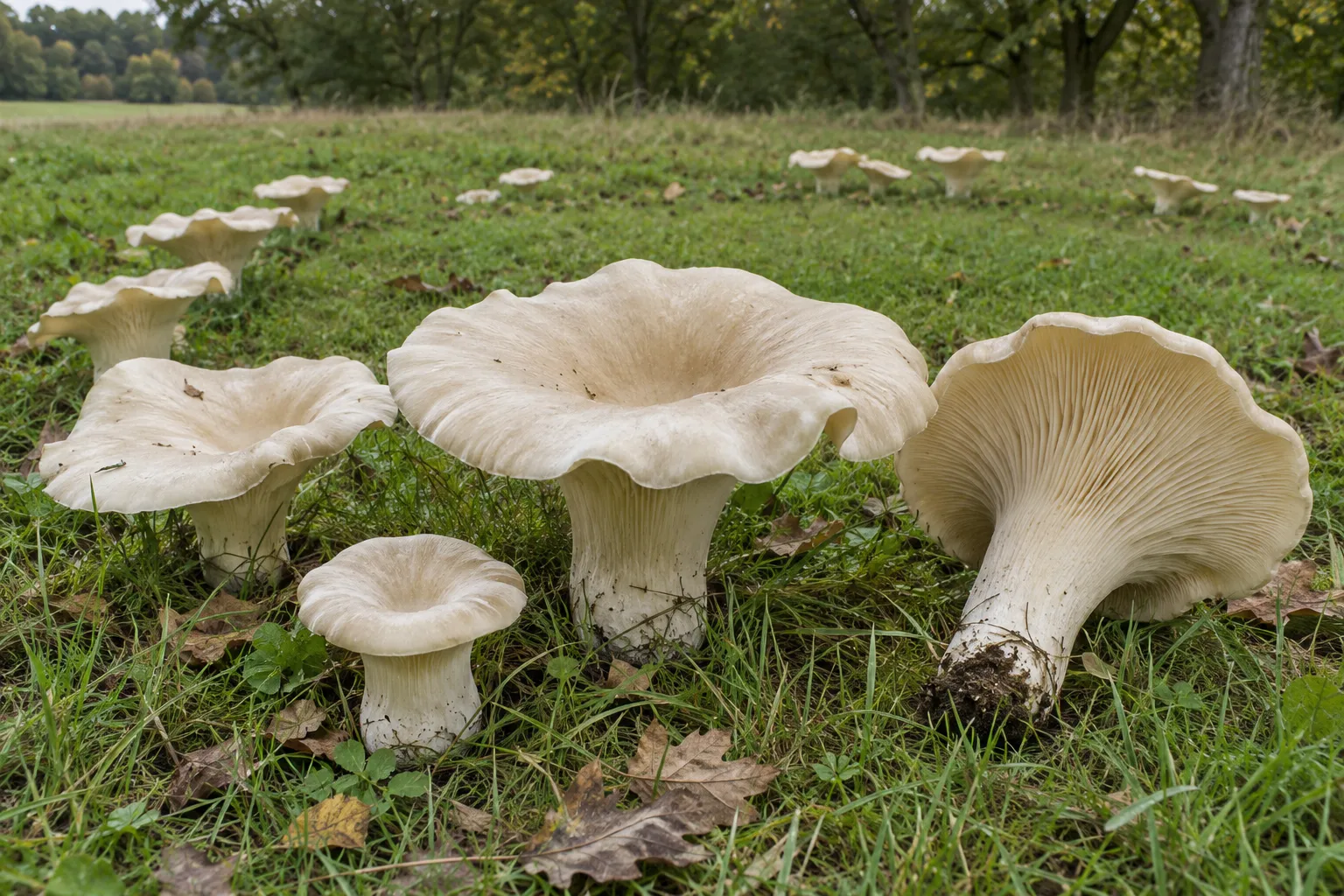
Quick facts
- Scientific name
- Leucopaxillus giganteus
- Common names
- Giant funnel, Giant leucopax
- Taxonomy
- Leucopaxillus · Tricholomataceae
- Edibility context
- Conditional: Culinary reports do not clear a field collection; regional interpretation, confusing pale funnels, age, contamination, preparation, and individual tolerance matter.
- Spore print
- White.
- Toxicity context
- Unknown: Misidentification and gastrointestinal reactions remain material risks; uncertain large white funnels should not be eaten.
- Season
- August, September, October, November
- Growing difficulty
- Expert
- Regions
- Europe, temperate regions represented by verified records
Safety limit: These labels summarize documented context; they never authenticate a wild specimen. Cooking does not make a poisonous species safe.
Giant funnel is a scale-and-pattern identification problem. Leucopaxillus giganteus can produce cream fruit bodies wide enough to dominate a pasture, with thick depressed caps, crowded gills running down stout stems, and sweeping arcs through grass. Yet ring formation and funnel shape are shared traits, and an oversized photograph can hide proportions. A defensible record measures the fungus, maps the colony, and keeps every microscopic observation tied to a specimen.
This page owns the giant-funnel species intent. The trooping funnel guide covers a generally more slender, often bossed comparison, while the gill identification guide explains attachment terms. No image or webpage can authenticate a collection for food.
Prove size with repeatable measurements
Photograph the whole group before touching it. Place a scale beside three representative caps and record diameter, central depression depth, stem length, and stem width. Include young, expanding, and mature fruit bodies. “Giant” without measurements is circular evidence, while a single close-up can make an ordinary funnel look enormous.
Measure the cap along two axes because mature margins become irregular. Record turf height and camera distance as additional scale controls. Do not select only the largest damaged cap; report a range and identify which measurement belongs to which specimen code.
Reconstruct cap development
Young caps may be convex with a distinctly inrolled margin. As they expand, the center flattens and then depresses, eventually forming a broad funnel with a wavy or lobed edge. Photograph the same marked fruit body from a fixed point across several days where site access permits.
Describe cream, ivory, buff, and dirty-white zones under neutral light. Rain can darken the surface, dry weather can crack or roughen it, and grass or soil may stain the margin. A radial section through a mature cap shows the thick central flesh and the thinning margin more reliably than a top view.
Trace the gills down the stem
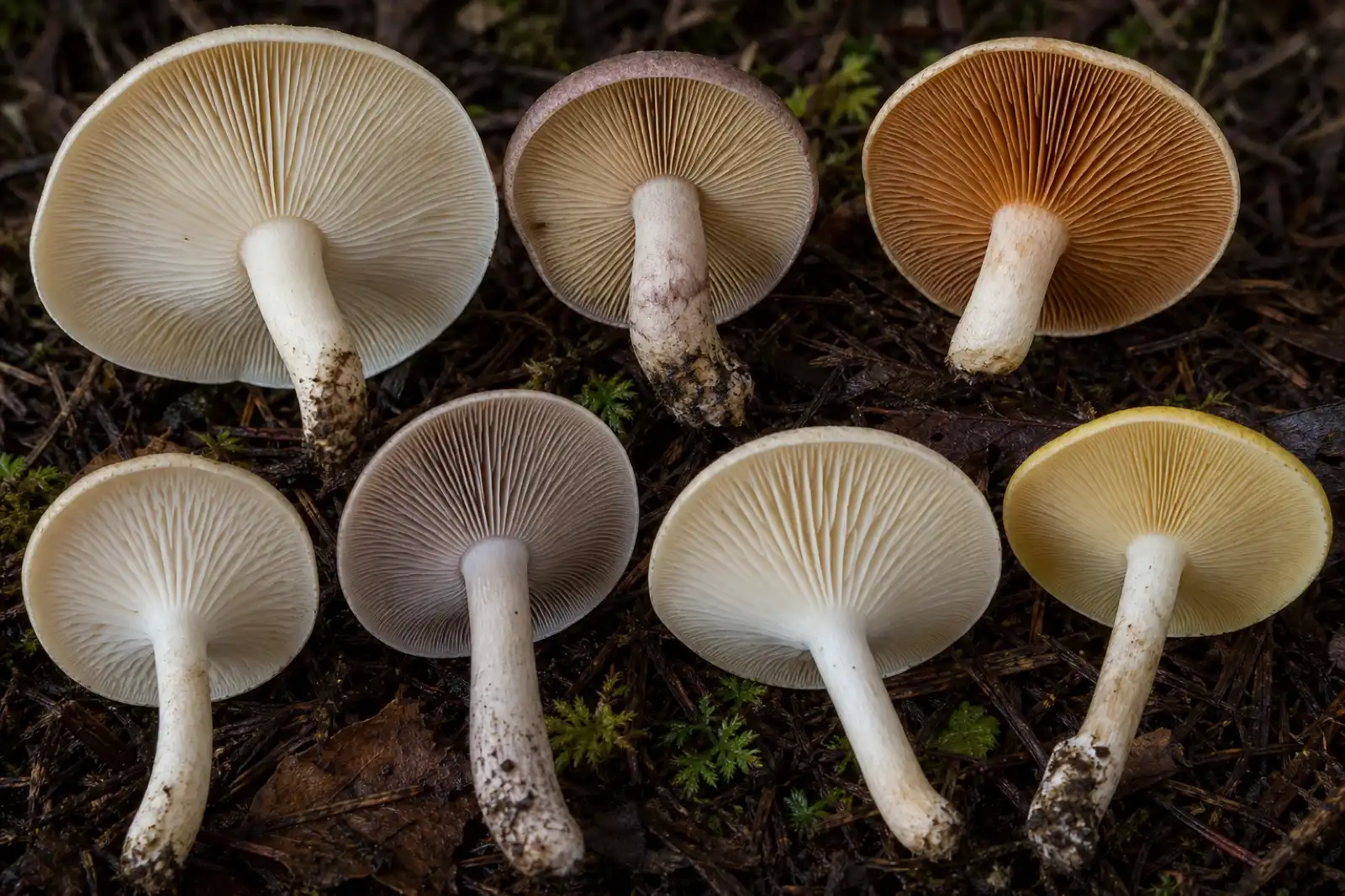
Crowded pale gills should run distinctly down the stem. Use a side view and a radial section to show the attachment. Record gill spacing near the margin and stem, branching, shorter gills, edge color, and whether the gill layer can be separated from cap flesh. Avoid describing every folded or forked line as a separate gill.
The clouded agaric guide provides a gray woodland comparison with different cap and odor context. Color should not override the full construction. Old giant funnels can soil and gray; pale clouded agarics can wash out in bright exposures.
Excavate the base without inventing a volva
The stem is stout, pale, and solid, commonly short relative to cap width. Cut stems in half lengthwise and record whether flesh is continuous, chambered, insect-tunneled, or waterlogged. Excavate one lawful representative with the base intact before cleaning. There should be no ring or volva.
Dense turf can wrap the base into a false cup. Photograph attachment in place, then loosen soil carefully and photograph again. Note attached rhizomorph-like strands without assuming they prove a species. Restore the turf and avoid digging multiple holes along a conspicuous ring.
Map the fairy ring as geometry, not folklore
Stand outside the colony and map each fruit body or cluster with distance and bearing from a fixed point. Fit an arc only after plotting; do not draw a perfect circle through scattered mushrooms. Record breaks caused by paths, mowing, trees, dry soil, and recent disturbance.
Estimate radius from several points and repeat in later seasons. An expanding arc can support a persistent below-ground colony, but annual fruit-body positions are weather-dependent and do not directly measure the entire mycelium. Other fungi form rings, so geometry is ecological context, never a species verdict.
The habitat identification guide helps distinguish soil fruiting from buried wood. Probe only minimally and lawfully. A cap beside a stump may still emerge from turf, while buried roots or landscaping debris can complicate a simple “pasture” label.
Record grass response without claiming causation
Some rings show darker, taller, dead, or unchanged grass in zones around fruiting. Photograph across the ring with a scale and note color, height, soil moisture, fertilizer history, irrigation, animal urine, and mower pattern. Compare inside, on, and outside the arc.
Do not claim the mushroom killed or fertilized grass from one visit. Nutrient release, drought, compaction, pathogens, and management can produce similar bands. A repeated matched transect, including a nearby control area, turns the visual pattern into a testable observation.
Make a specimen-linked white deposit
Select a mature but firm cap. Place sections across dark and transparent nonabsorbent surfaces, cover against drafts, and label the setup with the specimen code. White spores are expected. A weak deposit, reflected gill color, or condensation on paper is not a valid alternative color.
Microscopy should report mounting medium, calibration, number measured, full range, and the tissue or deposit used. Record spore shape and surface, and preserve a lawful dried portion when a regional expert may review it. Measurements copied from a guide belong to the guide, not to the field collection.
Separate three practical lookalike problems
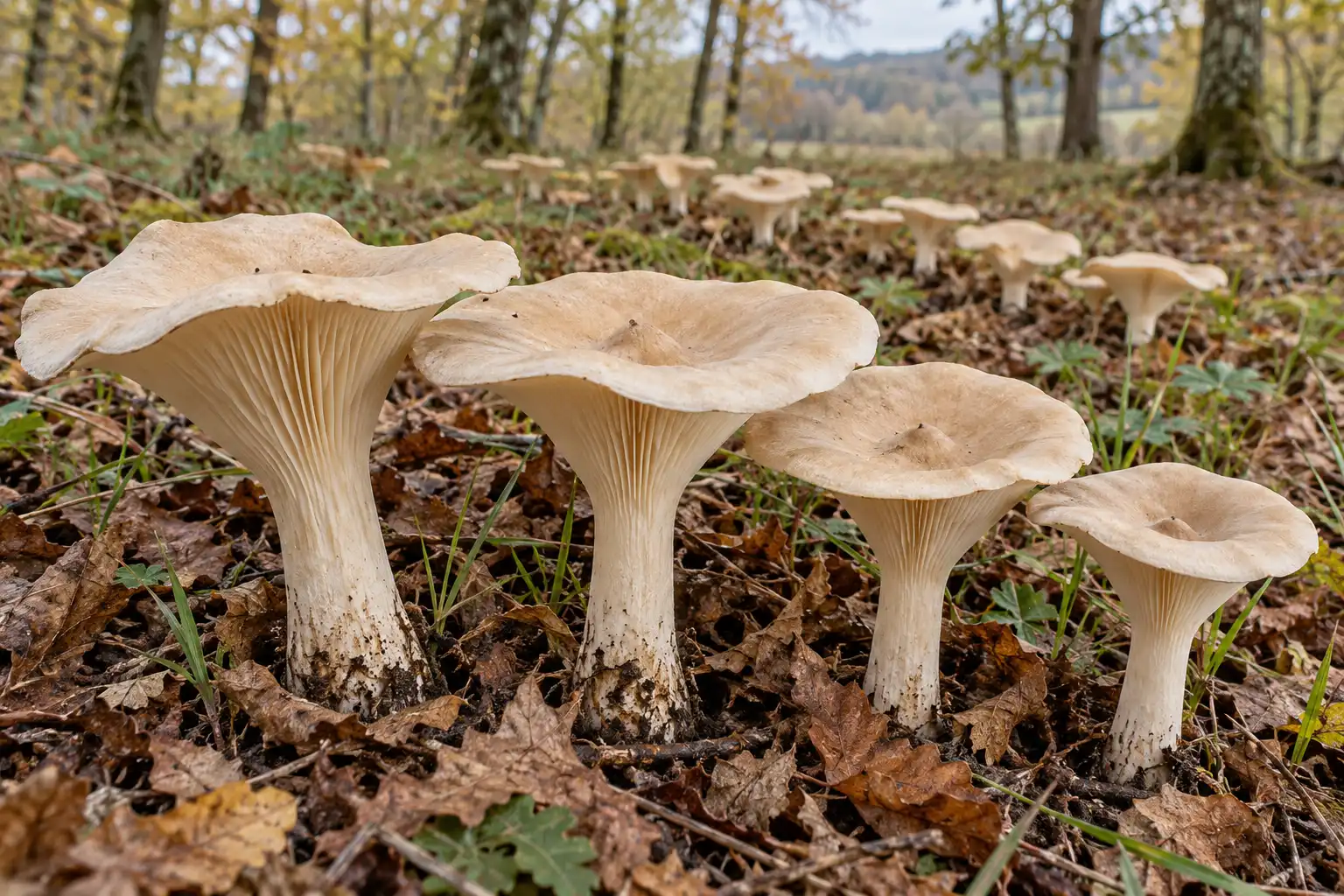
Trooping funnel, Infundibulicybe geotropa, can also form rings and large pale funnels. It often has a more elongated stem and a persistent central boss, but those traits overlap with stage. Compare full measured series, cap profile, gill attachment, flesh, deposit, microscopy, and the regional key rather than applying a single size cutoff.
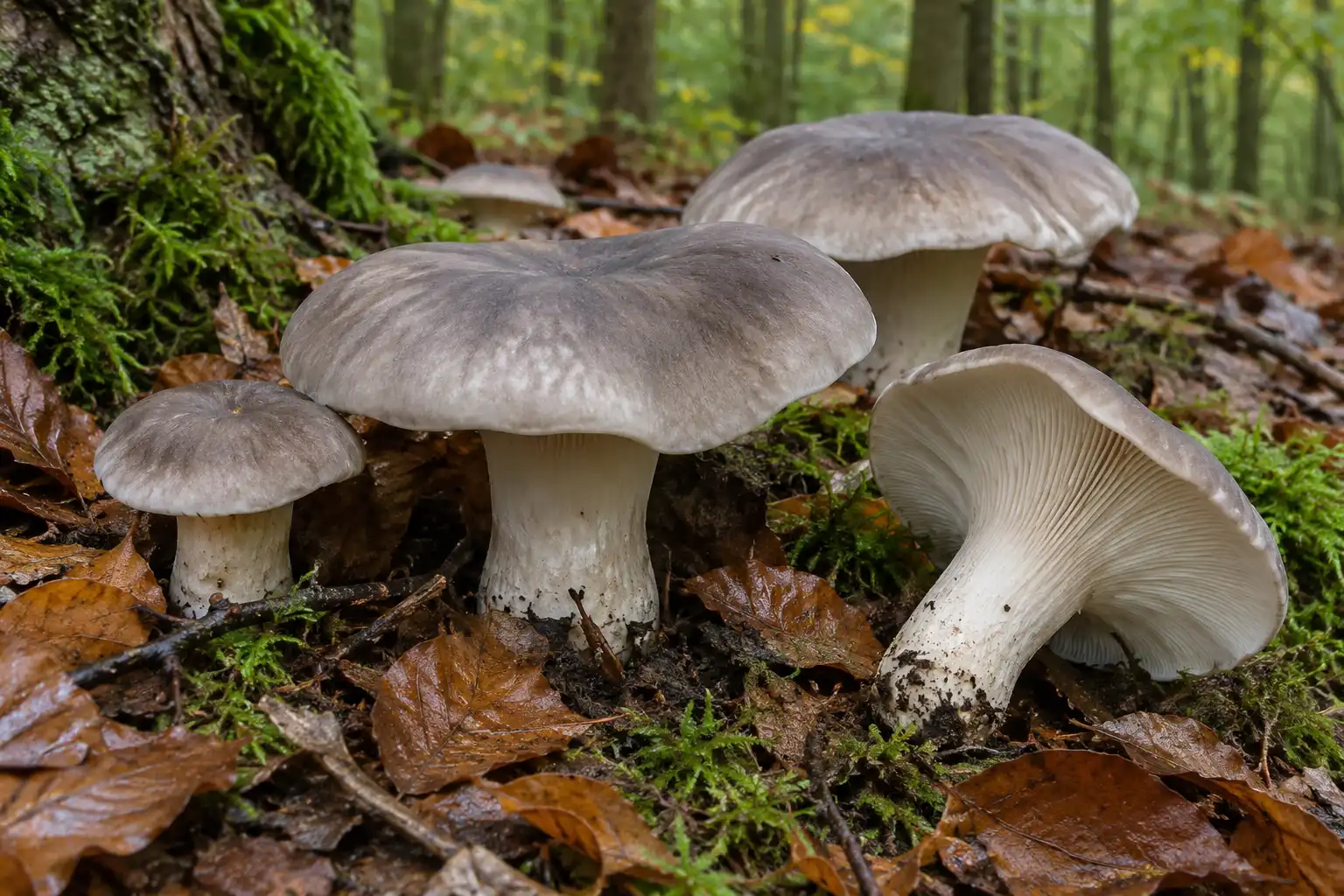
Clouded agaric, Clitocybe nebularis, is typically smoky gray or buff and associated with woodland litter, but faded caps and grassy woodland edges confuse the simple color rule. Record odor without tasting, substrate, cap texture, gill behavior, and microscopic evidence.
Small white lawn funnels in the Clitocybe dealbata/rivulosa complex are a consequential toxic comparison. They are normally much smaller, but a mixed ring or overlapping flush is possible. Never assume every pale cap in one arc is the same species, and never allow a large specimen to “clear” smaller neighbors for food.
Audit every fruit body in a mixed arc
Assign codes before collecting. For each code, record cap width, profile, gill attachment, stem dimensions, base, deposit, and condition. Map outliers such as smaller whiter caps or gray litter-associated mushrooms. Photograph contact zones where two arcs may cross.
This prevents a common evidence failure: microscopy from one large cap being used to label all mushrooms in the photograph. If two morphologies remain, treat them as two collections. Do not combine tissue for sequencing or food preparation.
Keep food reports behind the evidence boundary
Giant funnel has been reported as edible in some sources and unsuitable or reaction-prone in others. Those reports do not authenticate a specimen or predict tolerance. Older caps can be insect-damaged or waterlogged, and grassland sites may carry pesticides, animal waste, roadside contamination, or mixed species.
This guide does not recommend eating wild giant funnels. Seek qualified local confirmation and current regional guidance for any food decision. If illness follows mushroom consumption, contact local poison or emergency services promptly and preserve uncooked material, trimmings, photographs, map location, estimated amount, and meal timing.
Build a revisit record that can test change
Mark two permanent viewpoints outside the ring and photograph with the same lens, height, and compass direction. On each visit, log rainfall interval, soil-surface moisture, mowing, fruit-body counts by stage, maximum cap diameter, and gaps in the arc. Keep “not detected” separate from “absent”: tall grass, mowing, frost, and a shortened search can all hide fruiting.
Compare the mapped radius only when enough points define the same arc. A few mushrooms farther out do not by themselves prove annual expansion. If multiple pale-funnel morphologies appear, map them with separate symbols and retain separate vouchers. The value of the series is its audit trail, not a perfectly circular diagram.
Frequently asked questions in context
How large must a giant funnel be?
There is no safe single cutoff. Measure several specimens and compare the entire anatomical and ecological record. Young giant funnels can be smaller, while camera framing can exaggerate ordinary species.
Does mowing destroy the ring?
Mowing can remove fruit bodies and alter detection, but absence after mowing does not prove the underground colony is gone. Record management timing and use comparable search effort on later visits.
Is the cover image a locality record?
No. It is an original AI editorial image with no voucher, collection date, verified scale, or microscopy. It illustrates which views to capture but cannot support distribution or identification claims.
References
- Global Biodiversity Information Facility. Leucopaxillus giganteus species record. Taxonomic and occurrence context.
- First Nature. Leucopaxillus giganteus, Giant Funnel. Field characters, habitat, and comparison notes.
- National Center for Biotechnology Information. Leucopaxillus giganteus taxonomy. Independent nomenclatural and lineage checkpoint.
- North American Mycological Association. Mushroom Poisoning Syndromes. Poisoning-response context.
Editorial review: November 26, 2026. This article has editorial review only and no named mycologist or clinician review. Taxonomy, regional comparisons, food reports, and poison-response contacts should be rechecked at every substantive update.
Source quality notes
MushroomScope cites sources that match the page scope, such as taxonomic databases, extension guidance, food-safety agencies, food-composition databases, and peer-reviewed or institutional health references. Sources support context and uncertainty; they do not turn an online page into specimen identification, medical advice, or a tested recipe record.
Frequently asked questions
What supports a giant funnel record?
Combine the very broad cream funnel cap, inrolled then wavy margin, crowded decurrent pale gills, stout solid stem, white deposit, grassland ring or arc, and regional microscopic evidence.
Does a fairy ring prove giant funnel?
No. Many fungi form rings and arcs. Map the pattern, then identify fruit bodies through anatomy, deposit, microscopy, ecology, and a current regional key.
How is giant funnel different from trooping funnel?
Giant funnel is usually much broader and heavier, often loses a neat central boss, and can form expansive rings. Size overlaps, so compare cap profile, gill attachment, flesh, deposit, spores, and site pattern.
Can one photograph identify a large white funnel?
No. Similar pale funnel-shaped mushrooms include species with different risk profiles. Record the complete base, gills, flesh, odor without tasting, deposit, habitat, and regional microscopy.
Is giant funnel edible?
This page does not approve a wild collection for food. Reports and tolerance vary, large pale funnels have consequential lookalikes, and identity, freshness, contamination, and individual reaction remain separate questions.
Related guides
mushrooms
Trooping Funnel Mushroom: Rings, Gills, and Scale
Study the trooping funnel through its large buff cap, central umbo, decurrent gills, tall stem, rings and troops, lookalikes, and safety limits.
mushrooms
Clouded Agaric: Gray Caps, Decurrent Gills, and Safety
Document clouded agaric by its gray cap, crowded decurrent gills, woodland litter, odor, spore deposit, lookalikes, and conservative food boundary.
identification
Mushroom Gill Types: Attachment, Spacing, and Color
Compare free, attached, notched, adnate, and decurrent mushroom gills while recording spacing, short gills, edge details, bruising, and color changes.
Continue exploring
Browse more practical guides in Mushroom Encyclopedia or visit the mushroom encyclopedia.