Mushroom Encyclopedia
Trooping Funnel Mushroom: Rings, Gills, and Scale
Study the trooping funnel through its large buff cap, central umbo, decurrent gills, tall stem, rings and troops, lookalikes, and safety limits.
Species context
Treat profiles as reference material
Species profiles summarize documented traits, taxonomy, and lookalikes, but natural variation can be substantial.
Use the safety checklist →Decision limit
A profile cannot authenticate a specimen
Do not eat a wild mushroom from an online match, single feature, or generated image.
Read the safety disclaimer →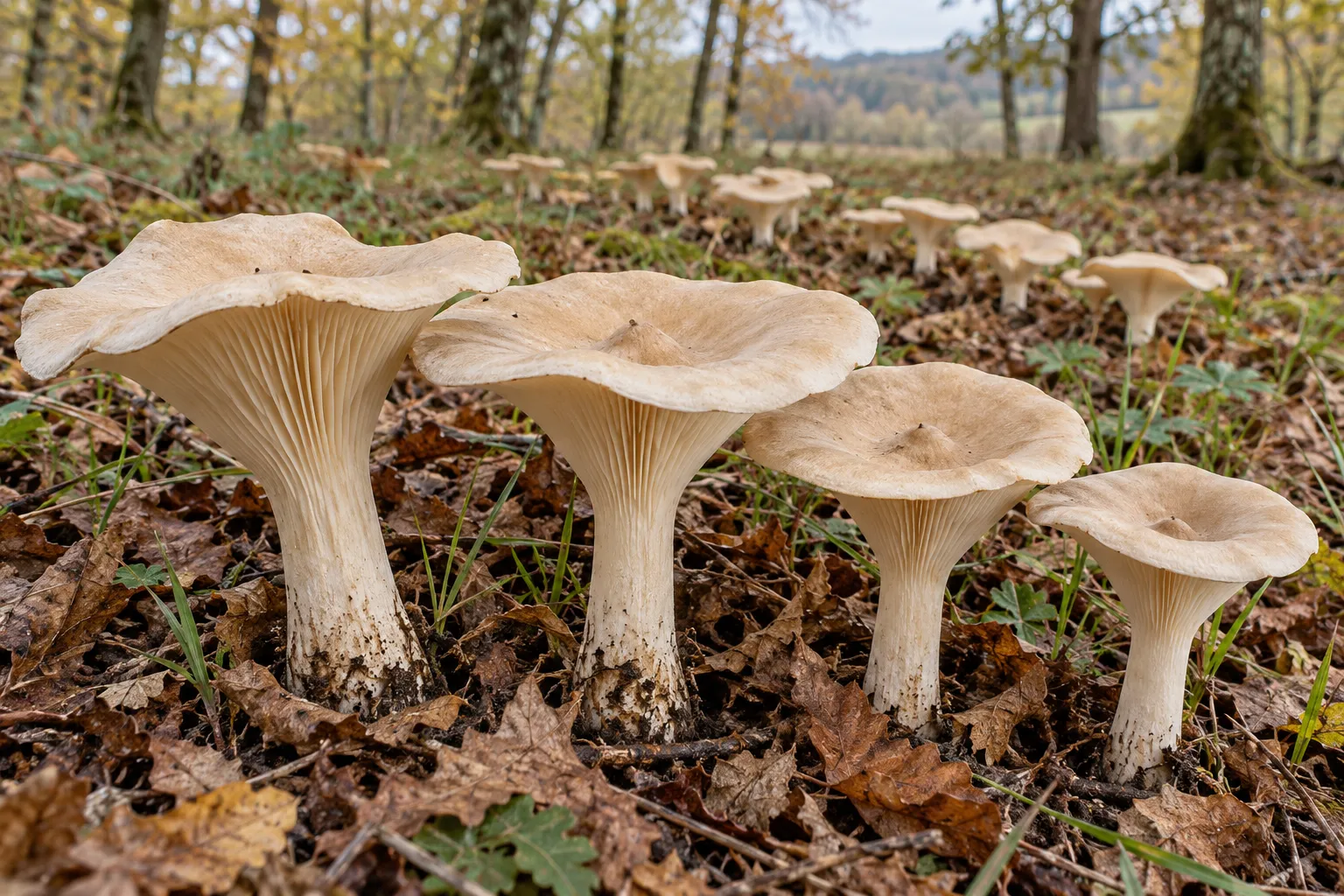
Quick facts
- Scientific name
- Infundibulicybe geotropa
- Common names
- trooping funnel, monk's head
- Taxonomy
- Infundibulicybe · Tricholomataceae
- Edibility context
- Edible: Published culinary context does not provide remote clearance; local identity, age, preparation, contamination, and individual response matter.
- Spore print
- White to pale cream; print color alone is not diagnostic.
- Toxicity context
- None Known: Confusion with other pale funnels, including species with gastrointestinal or muscarinic risk, makes complete identification essential.
- Season
- August, September, October, November, December
- Growing difficulty
- Expert
- Regions
- Europe, western Asia, reported introductions or analogous records elsewhere requiring verification
Safety limit: These labels summarize documented context; they never authenticate a wild specimen. Cooking does not make a poisonous species safe.
The trooping funnel, Infundibulicybe geotropa, is a large pale mushroom that may form lines, crescents, or wide rings through autumn litter. A mature cap becomes depressed like a shallow funnel, yet often retains a small central bump. Crowded cream gills descend the tall pale stem. The combination of scale, umbo, decurrent gills, solid stature, and troop-like pattern is more useful than the beige color shared by many unrelated fungi.
Large rings can be visually persuasive and still contain more than one species. Identification requires complete fruit bodies at several ages, measured anatomy, a spore deposit, habitat and geographic context, and a current regional key. This guide teaches documentation; it cannot confirm edibility from a photograph.
Map the troop before sampling
Stand back and photograph the complete fruiting pattern with a compass direction or fixed landmark. Mark each visible fruit body on a simple plan and measure the chord and approximate radius of any arc. Record gaps, overlapping lines, and whether the pattern crosses paths, roots, hedge boundaries, or changes in vegetation.
Do not assume a circle proves one underground individual or predicts annual expansion. Soil disturbance, mowing, moisture, buried organic matter, and separate mycelia can shape apparent patterns. Repeat fixed-position photographs provide better evidence than a single dramatic ring image.
Measure cap scale and profile
Choose young, middle-aged, and expanded specimens. Measure cap width, total height, central depression, and umbo height with a ruler in the same plane as the feature. Young caps may be convex with a pronounced boss. Mature caps spread broadly and become funnel-shaped while the boss may persist as a small nipple-like point.
Record the dry surface texture, pale cream-to-buff color, margin shape, cracks, and weather damage. The edge may remain rolled when young and become wavy with expansion. Size is important because small funnel mushrooms create a different risk set, but exceptional size never identifies the species by itself.
Photograph the central umbo honestly
The central bump is useful only when it is truly part of the cap. Leaf fragments, insect damage, water pools, and a torn center can create false relief. Photograph the same cap from above and in low side light, then cut one expendable specimen vertically through the center to show the profile.
State when the umbo is absent, flattened, or ambiguous. Old trooping funnels can lose the textbook silhouette. A record that documents exceptions is more valuable than one arranged to display only ideal specimens.
Follow the gills down the stem
Turn an intact specimen sideways and photograph where several gills meet the stem. In I. geotropa, pale crowded gills run distinctly down it. Measure that descent and note short gills, forks, bruising, insect channels, and any color change with age. The gill-types guide provides a consistent method for recording decurrent attachment.
Strongly decurrent gills occur in many funnel-shaped mushrooms and in oyster-like fungi. Confirm that the stem is central and the mushroom grew from soil or litter rather than laterally from wood. A broken substrate connection makes this distinction less reliable.
Inspect the entire stem and base
Excavate one representative base carefully where collection is allowed. The stem is typically tall, pale, fibrous, and substantial, sometimes widening toward the base. It should lack a ring and volva. Photograph the base before cleaning so soil, litter, cords, attached leaves, and possible buried wood remain interpretable.
Slice the specimen lengthwise. Record whether the stem is solid, stuffed, hollowed by insects, waterlogged, or tough with age. A mature tall stem can be much firmer than the cap. Do not infer that an apparently ringless mushroom lacks a ring if the upper stem is abraded or incomplete.
Trace the actual substrate
Trooping funnels commonly fruit from soil among leaf litter, woodland grass, clearings, hedges, and open deciduous woods. Move only loose litter and determine whether the base enters humus or attaches to buried wood. Photograph nearby vegetation and record canopy composition, soil moisture, slope, management, and recent disturbance.
The visible leaves are not necessarily the nutritional substrate. Use the habitat identification guide to separate where the mushroom appears from what its mycelium may be using. Avoid claiming a particular tree association without direct evidence.
Make a mature spore deposit
Place a mature cap section on contrasting dark and light surfaces, cover against drafts, and label it with the field number. A white to pale cream deposit is expected. Photograph the massed deposit with a neutral reference. Sparse isolated spores can make any color look misleadingly pale.
Many large pale funnels also produce pale deposits. Microscopy may be required for spore dimensions, shape, surface, and tissue characters specified by the regional key. Link every slide to the original cap; mixed ring collections are easy to confuse after processing.
Separate the giant funnel comparison
Leucopaxillus giganteus, often called the giant funnel, can form rings and broad pale funnels. It may reach a larger diameter and often lacks the neat persistent central boss emphasized for the trooping funnel, but size and umbo overlap with age. Compare cap profile, stem proportions, gill structure, flesh, deposit, microscopy, and local distribution together.
A useful field record measures the largest and median cap rather than quoting only one giant specimen. Photograph a vertical section from both candidate forms if they coexist. Do not turn “large ring-forming funnel” into a species label.
Compare clouded and smaller funnels
The clouded agaric, Clitocybe nebularis, is usually grayer and clouded or frosted across the cap, with a different overall profile and odor, but faded material can become pale. Smaller Clitocybe-like fungi introduce more serious safety concerns because some contain muscarine. Common-name boundaries and genus placements also change across books.
Record scale in every image. A close-up can make a small toxic funnel look imposing. When decisive microscopic or geographic characters are absent, stop at a broader group. Food reputation must never be transferred among lookalikes.
Keep fairy rings from becoming a shortcut
Many grassland and woodland fungi form arcs or rings as mycelium grows through suitable ground. The fairy ring champignon is smaller, has a tough pliant stem, widely spaced gills, and different grassland ecology. The fairy ring champignon guide shows why growth pattern needs anatomical support.
Measure vegetation changes separately from fruiting. Greener or dead grass can reflect nutrient release, drought, treatment, compaction, or other organisms. A mushroom ring is an observation, not a diagnosis of lawn condition.
Run a non-destructive size transect
Lay a tape beside—not across—the troop and record cap width, height, developmental stage, and nearest-neighbor distance at fixed intervals. Photograph from the same end under similar light. Repeat after rain and several dry days without moving fruit bodies.
This transect can show staggered emergence and changing cap profile. It cannot prove growth rate for mushrooms missed between visits or establish that all fruit bodies share one genotype. Record mowing, trampling, animal damage, and missing observations.
Voucher and microscopy workflow
Assign field numbers before collection. Photograph site, pattern, cap top, side profile, gills, full base, vertical section, and spore deposit. Dry representative mature material promptly with the label protected from heat and moisture. Keep specimens from separate arcs or suspiciously different forms in separate packets.
Record microscope calibration, mount medium, magnification, number of spores measured, and which key was used. Name changes can make older records hard to interpret, so retain synonyms reported by the source while stating the name used for the final determination.
Food and poisoning boundaries
The trooping funnel has published culinary use in parts of Europe, especially when young enough to avoid a tough stem. That history applies only to correctly identified, clean, suitable material. Pale funnel-shaped mushrooms include difficult and potentially hazardous comparisons, and no photograph can assess every specimen in a ring.
Obtain in-person confirmation from a qualified local identifier before considering food use. Keep collections separate, reject spoiled or contaminated material, follow reliable regional preparation advice, and account for individual intolerance. Cooking cannot make a poisonous lookalike safe.
If symptoms occur after a wild-mushroom exposure, contact local emergency or poison-control services promptly. Keep raw remnants, cooked leftovers, photographs, location, and timing. Do not delay treatment while trying to complete an online identification.
Editorial and image limits
This article has editorial review only and no named mycologist, toxicologist, clinician, or food-safety expert reviewer. GBIF, NCBI, and the Natural History Museum support taxonomic and occurrence context, while NAMA supports conservative poisoning response. None authorizes ingestion.
The original AI cover was compared with natural-light Chanterelle and Scarlet Waxcap site baselines. It passed checks for restrained autumn color, visible central stems and bases, plausible decurrent gills, repeated-but-not-duplicated fruit bodies, habitat texture, and absence of text or watermark. It is an editorial illustration rather than identification evidence.
The common funnel guide covers a generally smaller, more slender litter species; compare measured stature, any persistent central boss, colony pattern, and microscopy rather than treating every depressed cap as interchangeable.
The giant funnel guide treats the broader, heavier Leucopaxillus giganteus intent with cap measurements, decurrent-gill sections, and fairy-ring geometry rather than a single size cutoff.
References
Compare blue-green color and a recorded anise odor in the aniseed funnel guide; funnel shape alone cannot separate these woodland species concepts.
- Global Biodiversity Information Facility. Infundibulicybe geotropa search. Taxonomic and occurrence context.
- National Center for Biotechnology Information. Infundibulicybe geotropa taxonomy search. Independent nomenclatural checkpoint.
- Natural History Museum. Infundibulicybe geotropa species record. UK species-name and classification checkpoint.
- North American Mycological Association. Mushroom Poisoning Syndromes. Conservative poisoning-response context.
Editorial status: reviewed by the MushroomScope editorial team on October 28, 2026; no named mycologist, toxicologist, clinician, or food-safety expert reviewed this page.
Source quality notes
MushroomScope cites sources that match the page scope, such as taxonomic databases, extension guidance, food-safety agencies, food-composition databases, and peer-reviewed or institutional health references. Sources support context and uncertainty; they do not turn an online page into specimen identification, medical advice, or a tested recipe record.
Frequently asked questions
Why is it called the trooping funnel?
Fruit bodies often appear in lines, arcs, or rings—troops—while mature caps become broadly funnel-shaped.
Does a trooping funnel keep a central bump?
A small central umbo can remain visible within the depressed mature cap, although age and damage may flatten it.
How do its gills attach to the stem?
The pale crowded gills run distinctly down the stem, a decurrent attachment that should be photographed in side profile.
Is every large pale funnel in a ring Infundibulicybe geotropa?
No. Several large funnel-shaped fungi overlap in color and growth pattern; scale, umbo, gills, stem, spores, habitat, and regional keys must agree.
Can the trooping funnel be identified as edible online?
No. Food decisions require examination of the complete local collection by a qualified identifier; web images cannot exclude toxic lookalikes or poor condition.
Related guides
identification
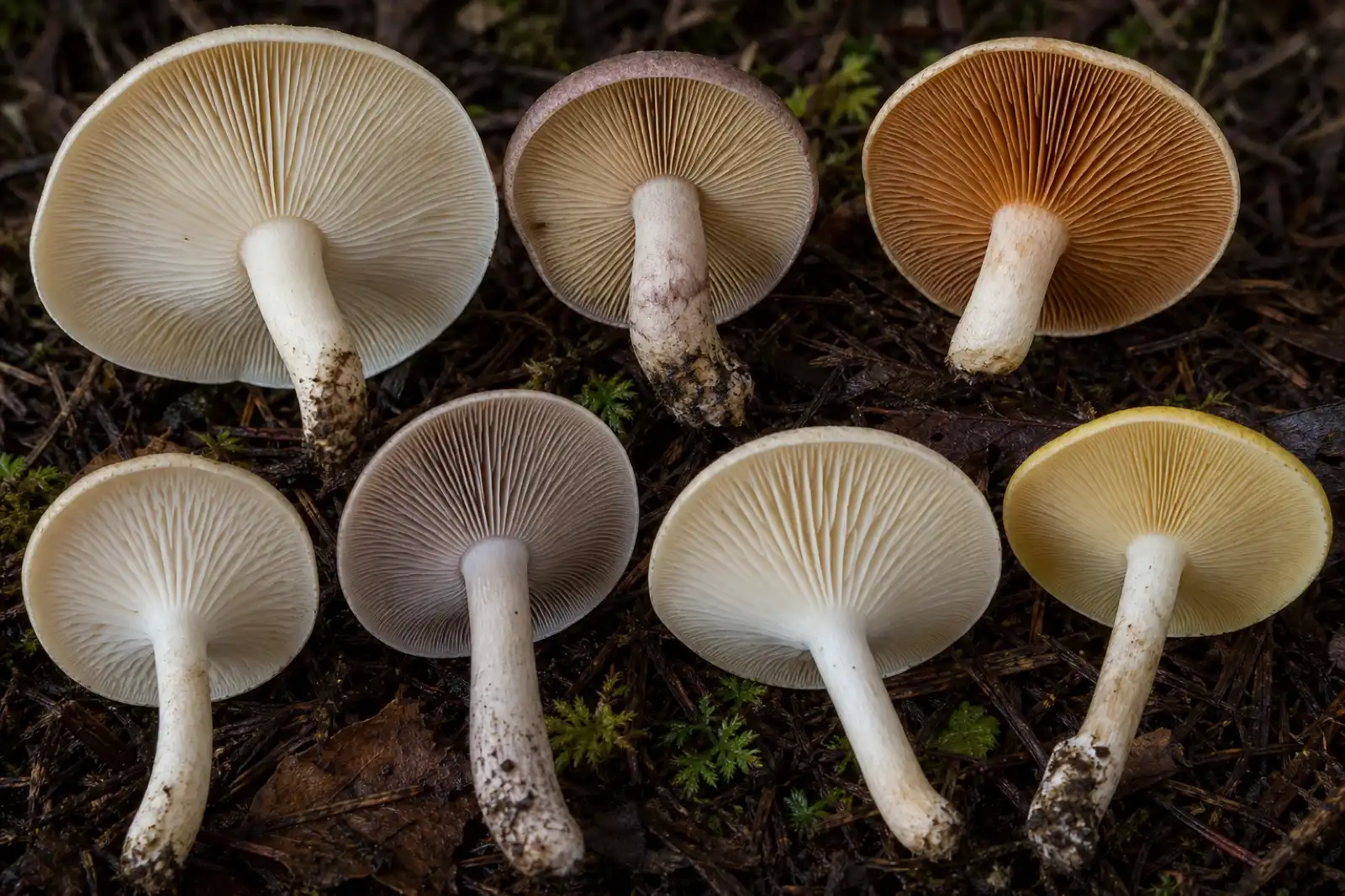
Mushroom Gill Types: Attachment, Spacing, and Color
Compare free, attached, notched, adnate, and decurrent mushroom gills while recording spacing, short gills, edge details, bruising, and color changes.
identification
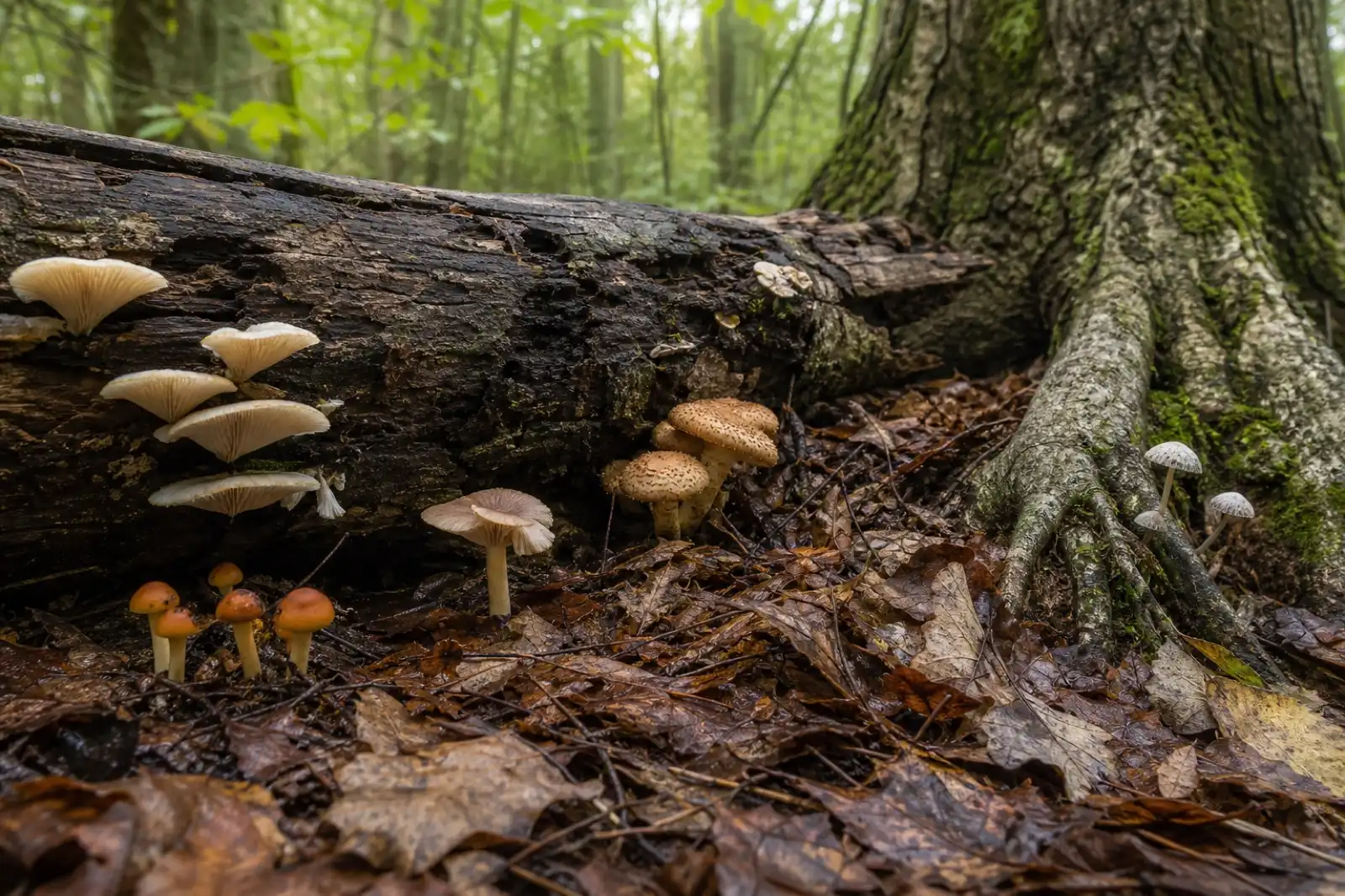
Using Habitat to Identify Mushrooms
Record substrate, associated plants, soil, wood type, moisture, elevation, and fruiting pattern as identification evidence.
mushrooms
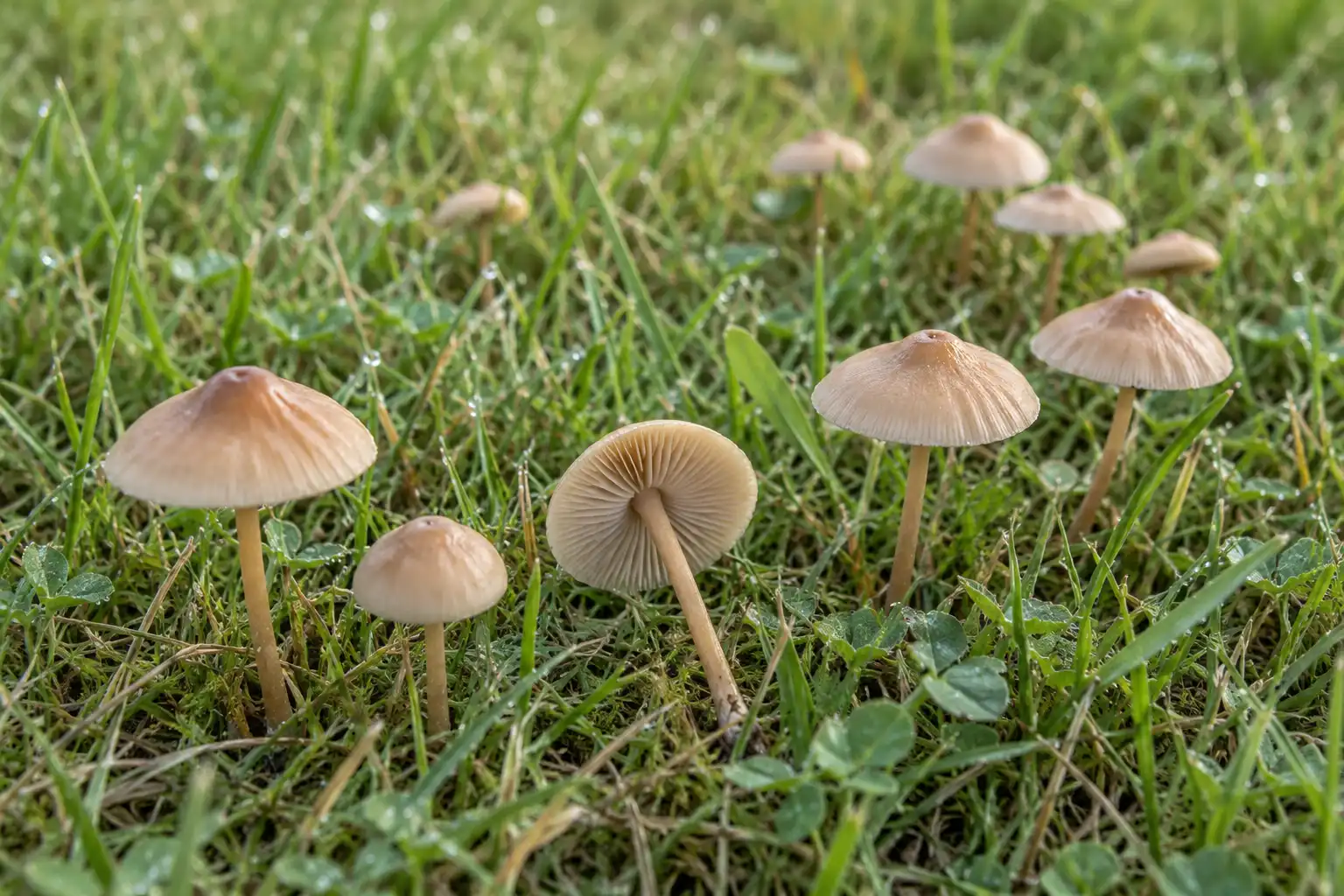
Fairy Ring Champignon: Marasmius oreades Identification Guide
Document fairy ring champignons through dry umbonate caps, spaced gills, wiry stems, lawn arcs, rehydration, spore evidence, and safety limits.
Continue exploring
Browse more practical guides in Mushroom Encyclopedia or visit the mushroom encyclopedia.