Mushroom Encyclopedia
Fairy Ring Champignon: Marasmius oreades Identification Guide
Document fairy ring champignons through dry umbonate caps, spaced gills, wiry stems, lawn arcs, rehydration, spore evidence, and safety limits.
By MushroomScope Editorial Team · · Updated
Species context
Treat profiles as reference material
Species profiles summarize documented traits, taxonomy, and lookalikes, but natural variation can be substantial.
Use the safety checklist →Decision limit
A profile cannot authenticate a specimen
Do not eat a wild mushroom from an online match, single feature, or generated image.
Read the safety disclaimer →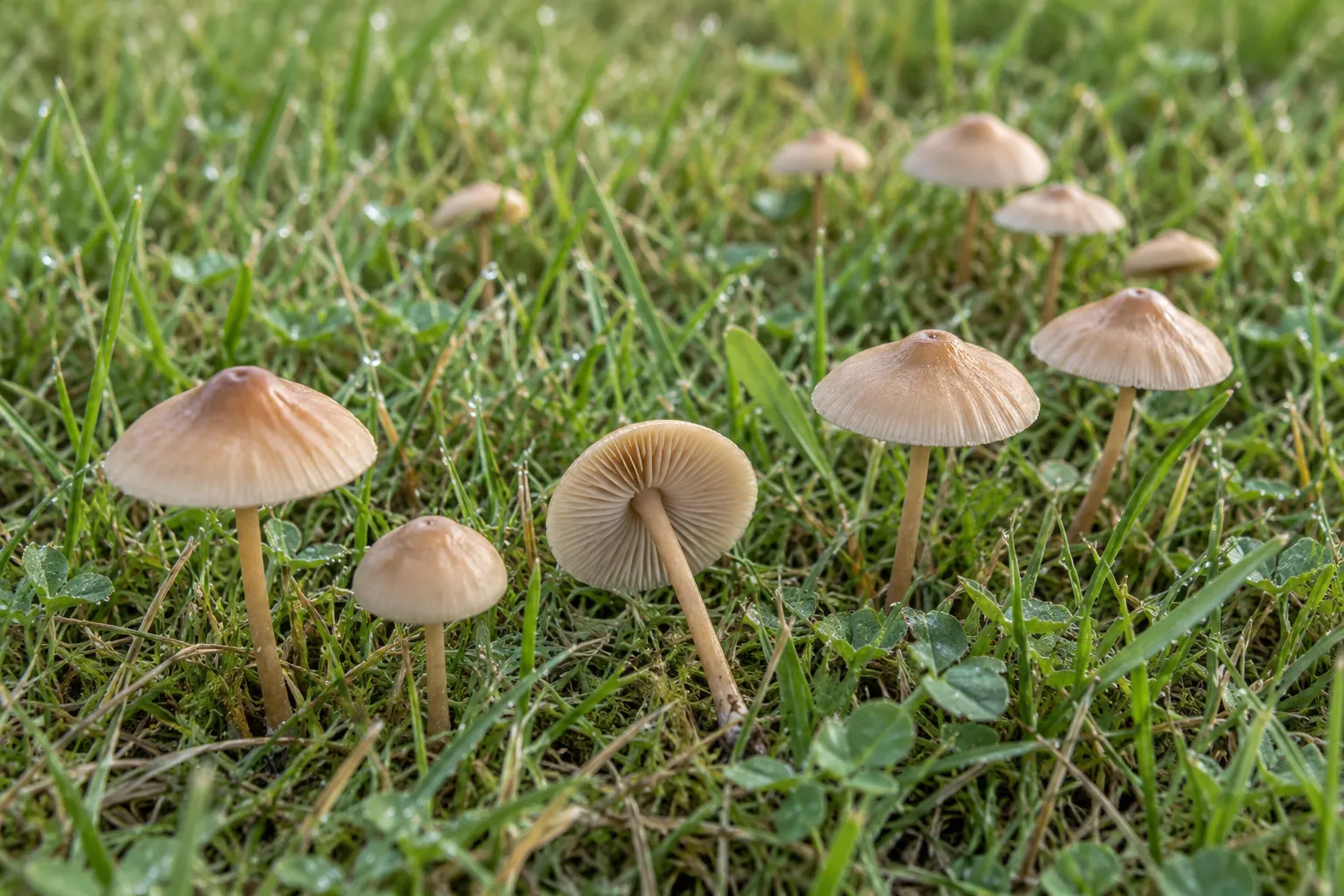
Quick facts
- Scientific name
- Marasmius oreades
- Common names
- Fairy ring champignon, Fairy ring mushroom, Scotch bonnet
- Taxonomy
- Marasmius · Marasmiaceae
- Edibility context
- Conditional: Has a culinary history after expert identification and cooking, but small lawn mushrooms require conservative separation from toxic lookalikes.
- Spore print
- White.
- Toxicity context
- Moderate: Confusion with toxic small lawn mushrooms and environmental contamination makes remote food clearance unsafe.
- Season
- April, May, June, July, August, September, October, November
- Growing difficulty
- Expert
- Regions
- Europe, North America, temperate regions represented by verified records
Safety limit: These labels summarize documented context; they never authenticate a wild specimen. Cooking does not make a poisonous species safe.
The fairy ring champignon is named for a growth pattern that many unrelated fungi can produce. Marasmius oreades often fruits in arcs, lines, or circles in grass, but the ring is ecological context rather than an identity card. The useful character set combines a dry buff cap with a low umbo, pale spaced gills, a tough wiry stem, white spores, grassland substrate, and the ability of dried fruit bodies to revive after moisture.
Small pale lawn mushrooms demand conservative handling because toxic species can share the habitat and a superficially similar cap. This guide is for documentation, not remote food approval. Keep children and pets from unknown fruit bodies, avoid casual taste tests, and use the identification safety checklist when a tidy ring creates premature confidence.
Map the arc before collecting a specimen
Photograph the whole fruiting pattern from several meters away. Mark the center, inner and outer edges, interruptions, and whether mushrooms form a true circle, a partial arc, parallel lines, or scattered groups. Use fixed landmarks and a measured radius so a later flush can be compared with the same patch.
The underground mycelium grows through soil and organic matter. Fruiting may occur near an advancing edge, while grass behind or beside it can be darker, dry, or visually unchanged. Fertilizer bands, buried construction material, irrigation, pet urine, and mowing can also create lawn patterns. A green ring therefore does not prove M. oreades.
Follow the cap from moist tan to dry cream
Young caps are convex to bell-shaped and often warm tan when moist. As they expand and lose water, they can become paler cream or buff while retaining a slightly darker low central umbo. The thin margin may appear faintly striate when light passes through it. This water-linked color change is called hygrophanous and should be recorded as a sequence.
Select several stages from the same flush. Measure cap width, photograph each under consistent light, and note recent rain and time since collection. Do not combine a wet dark cap and a sun-bleached old cap into two species without checking the rest of the character set. Equally, do not explain every color difference as drying when gills and stems also disagree.
Inspect gill spacing and attachment in side light
Fairy ring champignon gills are pale and relatively thick, with noticeable space between neighboring full-length gills. Their attachment can be narrow or nearly free. Use a clean side view and a longitudinal section to show where the gills meet the stem. The gill-type guide provides vocabulary for recording attachment without turning one angle into a species verdict.
Count full-length gills across a defined quarter of the cap rather than relying on “widely spaced.” Record shorter intermediate gills separately. Mature, dry, and rain-soaked caps can distort spacing, so compare fruit bodies at equivalent stages. Crowded gills running distinctly down the stem contradict the expected pattern and raise concern for funnel-like lawn species.
Test stem toughness without calling it proof
The slender stem is pale near the top and often darker tan below. It lacks a ring and volva. Its fibrous, wiry construction is unusually resistant to a clean snap: it may bend, twist, or split lengthwise while many fragile lawn mushrooms break readily. Record that response on one collected specimen rather than repeatedly damaging the patch.
Toughness is comparative and affected by drying. A dehydrated stem from another species can also become wiry, and decay can weaken a genuine specimen. Photograph the complete base, surface fibers, and cap attachment. Absence of a ring matters only when the upper stem has not been stripped by weather, slugs, or handling.
Make a white spore deposit rather than guessing from pale gills
Use a mature cap over contrasting dark and clear nonabsorbent surfaces, covered against drafts. M. oreades should leave a white deposit. The test helps contradict brown-spored lawn mushrooms, including many Conocybe, but it does not separate every white-spored species.
Link the print to the exact specimen code and photograph it in neutral daylight. A faint or absent deposit is inconclusive. If microscopy is needed, document calibration, mounting medium, number of spores measured, and length-by-width range. Copying a spore dimension from a reference does not transform a photograph into measured evidence.
Document drying and revival as a controlled observation
Members of Marasmius are famous for marcescence: fruit bodies can dry, persist, and revive their form after moisture returns. To document this without confusing age and identity, photograph a naturally drying fruit body at a marked site, note weather, and revisit after rain. Do not pour water on a public patch or assume a revived appearance means the material is fresh enough to eat.
For a permitted collected specimen, record mass and dimensions before air drying, then expose it to a controlled humid chamber without allowing standing water. Photograph the change and discard the sample from any food use. Many tissues change with moisture; revival is supporting biological context, not a unique identification test.
Separate a fruiting ring from the underground organism
A ring expands because mycelium uses resources and grows outward unevenly through soil. Obstacles, soil compaction, irrigation, nutrient patches, and previous disturbance deform the geometry. Several fungal individuals or species can also overlap. The visible mushrooms are temporary reproductive structures, not the whole ring.
Record turf condition inside, on, and outside the arc. Note irrigation, fertilizer, thatch, buried roots, recent soil work, and fungicide use. If lawn management is the question, identify the organism and diagnose soil conditions before treatment. Removing caps does not remove the underground mycelium, while indiscriminate chemical treatment may not address the cause.
Distinguish the most consequential lawn lookalikes
White funnel and related Clitocybe species can fruit in grass and may contain muscarine. They more often show crowded gills descending the stem, a flatter or depressed cap, and less wiry construction, but no short checklist safely excludes them. Weathered fruit bodies overlap, and regional expertise matters.
Many Conocybe are delicate lawn mushrooms with thin fragile stems and cinnamon-to-rusty spores. A verified brown deposit contradicts fairy ring champignon. Small Mycena, Gymnopus, and other marasmioid fungi require attention to substrate, gill attachment, stem texture, spores, microscopy, and current taxonomy.
Do not use ring formation to overrule a contradictory spore print or gill pattern. Do not use smell or a taste test to rescue an uncertain determination. If the specimen set includes two different stem types or spore colors, treat it as a mixed collection.
Keep meadow habitat separate from lawn contamination
Grassland is not automatically clean. Road verges can accumulate traffic residues; treated lawns can carry pesticides or herbicides; parks may receive pet waste; former industrial or fill sites can have unknown soil contaminants. These exposure questions remain after the species name is resolved.
Record land use, recent applications, proximity to roads and drains, and permissions. A historic pasture and a chemically managed sports field are different collection contexts even when the mushroom looks identical. Never infer that cooking removes metals, pesticides, or every environmental contaminant.
Build a checkable collection series
- Photograph the complete arc and record a measured radius.
- Select a few developmental stages without clearing the patch.
- Excavate full bases and keep specimens individually coded.
- Measure cap and stem; photograph wet and dry color where possible.
- Show gill spacing and attachment with side light and a section.
- Record stem flexibility and make a mature spore deposit.
- Compare the whole series with a current regional key and qualified expertise.
Keep the collection together with date, precise but responsibly shared locality, grass management, recent weather, and original photographs. A lawn-service receipt can be more relevant to a food decision than another close-up of the cap.
Keep culinary reports behind local confirmation
Fairy ring champignon has a culinary history, and dried caps appear in some traditions. That fact does not authorize a web user to eat an unknown small lawn mushroom. Identity, toxic lookalikes, contamination, freshness, legality, allergy, and cooking are independent gates.
If qualified local expertise confirms food material, use only sound specimens from a known clean site, discard tough stems and damaged caps, refrigerate promptly, and cook thoroughly. Do not mix an uncertain second species into the same basket. If symptoms follow mushroom consumption, seek urgent local medical or poison advice and retain uncooked material, trimmings, photographs, location, and meal timing.
Frequently asked questions in context
Does the ring expand every year?
It may expand as mycelium grows, but fruiting depends on moisture, temperature, soil resources, disturbance, and lawn management. Absence of mushrooms one year does not prove the underground fungus is gone.
Is a central bump enough to identify the cap?
No. A low umbo is common in many small mushrooms. It becomes useful only with the hygrophanous cap sequence, spaced pale gills, wiry stem, white spores, and matching ecology.
Can mowing eliminate the fungus?
Mowing removes temporary fruit bodies but not the soil mycelium. Management should begin with the actual turf objective, soil conditions, and a defensible identification rather than a cosmetic cap-removal claim.
Why are mushrooms sometimes on only part of the circle?
Soil barriers, uneven moisture, compaction, nutrient patches, and incomplete fruiting can break a geometric ring into arcs. A partial arc still does not identify the species.
For a larger, thick-fleshed spring grassland species with very crowded pale gills, compare the St George’s mushroom guide. The season and ring habit overlap, but stature, gill spacing, stem texture, and spore evidence keep the two intents separate.
References
- Global Biodiversity Information Facility. Marasmius oreades species record. Taxonomic backbone and occurrence context.
- National Center for Biotechnology Information. NCBI Taxonomy Browser — Marasmius oreades. Independent lineage and nomenclature checkpoint.
- North American Mycological Association. Mushroom Poisoning Syndromes. Poisoning syndromes and response context.
- U.S. Food and Drug Administration. Selecting and Serving Produce Safely. General handling guidance for verified food products.
Editorial review: October 20, 2026. This article has editorial review only and no named mycologist or clinician review. Taxonomy, regional lookalikes, land-use exposure, and poison-response contacts should be rechecked at every substantive update. For the contrasting large woodland form, see the trooping funnel guide. Its broad depressed cap, central umbo, tall substantial stem, and crowded decurrent gills separate the intent from this small, wiry grassland species.
Source quality notes
MushroomScope cites sources that match the page scope, such as taxonomic databases, extension guidance, food-safety agencies, food-composition databases, and peer-reviewed or institutional health references. Sources support context and uncertainty; they do not turn an online page into specimen identification, medical advice, or a tested recipe record.
Frequently asked questions
Does a ring of mushrooms prove they are fairy ring champignons?
No. Many fungi fruit in arcs or rings. Marasmius oreades requires its own cap, gill, stem, spore, ecology, and regional comparison evidence.
What does a tough flexible stem contribute to identification?
The slender stem is notably fibrous and resistant to snapping compared with many fragile lawn mushrooms. It is a supporting character, not a standalone safety test.
Why can dried fairy ring champignons revive after rain?
Marcescent fruit bodies can dry and later regain a fresh-looking form when moistened. Rehydration should be documented, but it does not prove the species or freshness for food use.
Can an online photograph confirm that a lawn mushroom is edible?
No. Small pale lawn mushrooms include consequential lookalikes, and a photograph cannot resolve all structures, spores, condition, or contamination. Seek qualified local confirmation.
Do fairy rings damage grass?
The underground fungus can alter water and nutrient availability, producing darker growth, dry zones, or no visible turf effect. A ring pattern alone does not identify the fungus or dictate treatment.
Related guides
identification
Mushroom Cap Shapes: A Practical Identification Guide
Compare mushroom cap shapes from convex and bell-shaped to flat, depressed, funnel-shaped, and uplifted, while recording age, margin, surface, and profile.
identification
Mushroom Gill Types: Attachment, Spacing, and Color
Compare free, attached, notched, adnate, and decurrent mushroom gills while recording spacing, short gills, edge details, bruising, and color changes.
mushrooms
Field Mushroom (Agaricus campestris): Identification and Safety Guide
Learn how to document field mushroom features, distinguish key lookalikes, and use local expert confirmation before any wild-food decision.
Continue exploring
Browse more practical guides in Mushroom Encyclopedia or visit the mushroom encyclopedia.