Mushroom Encyclopedia
Field Mushroom (Agaricus campestris): Identification and Safety Guide
Learn how to document field mushroom features, distinguish key lookalikes, and use local expert confirmation before any wild-food decision.
By MushroomScope Editorial Team · · Updated
Species context
Treat profiles as reference material
Species profiles summarize documented traits, taxonomy, and lookalikes, but natural variation can be substantial.
Use the safety checklist →Decision limit
A profile cannot authenticate a specimen
Do not eat a wild mushroom from an online match, single feature, or generated image.
Read the safety disclaimer →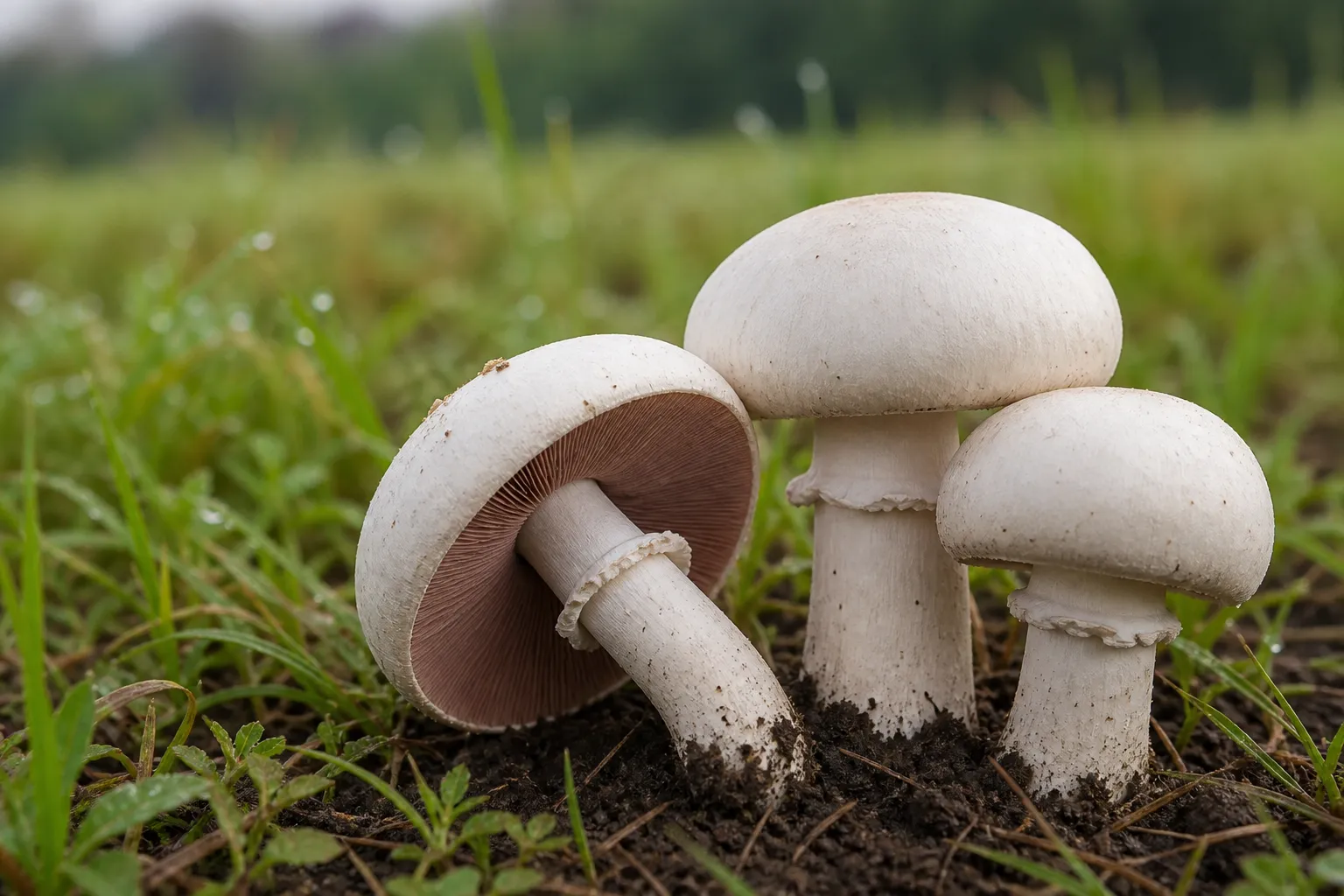
Quick facts
- Scientific name
- Agaricus campestris
- Common names
- Field mushroom
- Taxonomy
- Agaricus · Agaricaceae
- Edibility context
- Edible: This database label is context, not remote clearance of a wild specimen; identity, preparation, spoilage, contamination, and individual reaction matter.
- Spore print
- Dark chocolate brown.
- Toxicity context
- Low: Risk includes misidentification and individual reaction. Consult current local toxicology guidance before any food decision.
- Season
- May, June, July, August, September, October
- Growing difficulty
- Not Cultivated
- Regions
- Europe, Asia, North America, other temperate regions
Safety limit: These labels summarize documented context; they never authenticate a wild specimen. Cooking does not make a poisonous species safe.
Identify the meadow-mushroom character sequence
Treat Agaricus campestris as a sequence of changing characters, not simply as a white mushroom in grass. In the Missouri Department of Conservation account, the cap is 1–4 inches (about 2.5–10 cm) wide, curved when young and nearly flat at maturity; the crowded free gills move from light pink through chocolate to nearly blackish brown. Its short stem is listed at 1–2 inches (about 2.5–5 cm), with a delicate ring that can disappear. Those measurements describe Missouri material, not a worldwide identification key, but they give a field record testable proportions instead of adjectives alone.
Photograph at least two ages before disturbing the group. Show the intact grassland setting, cap surface, genuinely free gill attachment, full stem and undisturbed base, then make a lengthwise section. Record whether the flesh changes and whether the stem base or cap edge stains rapidly yellow. A blackish- to chocolate-brown spore deposit supports an Agaricus hypothesis; it does not resolve the species. A missing ring on an old specimen is less informative than a present ring on a younger one, while a missing base makes the record unsafe for comparison with pale Amanita.
Read grassland ecology at the scale of the fruiting arc
Field mushroom is a soil saprotroph of lawns, meadows and pasture rather than a wood-decayer or tree-root symbiont. The fruit bodies may appear scattered, crowded or in arcs as the underground mycelium expands through suitable organic matter. An arc is ecological context, not a species character: many unrelated grassland fungi form rings. Map the whole arc, note turf management and photograph the point where each stem enters soil. Buried wood, a tree root or a compost-rich edge should widen the comparison set.
Season must be localized. Missouri records emphasize July–September, while the broader site data span May–October because latitude, rainfall, soil temperature and land management shift fruiting. GBIF maps occurrence records, but mapped points reflect collecting effort and name usage as well as biological range; they should not be read as proof that a specimen belongs to the species. Record recent rain, mowing, grazing, fertilizer or fungicide use, roadside exposure and nearby trees. These details help both identification and a separate contamination assessment.
Separate three different comparison problems
- Yellow-staining Agaricus: A. xanthodermus and regional relatives may yellow strongly at the stem base or cap margin and produce a phenolic, ink-like or hospital-disinfectant odor. Weak staining or odor does not clear a specimen.
- Pale Amanita: destroying-angel species retain white mature gills and a white spore deposit and may have a saclike volva. A buried or broken base can conceal the most consequential character.
- Other grassland agarics: several brown-spored lawn mushrooms overlap in size, color or ring condition. Species-level separation may require microscopic spore measurements and a regional key.
These are different tests: gill maturation and spore color establish a broad group; base structure screens a dangerous pale-mushroom problem; staining, odor and microscopic features divide species within Agaricus. No single result substitutes for the others. The possible comparison set changes by region, and some separations require microscopy or DNA. Image-recognition tools can organize observations but cannot clear a specimen for consumption.
Food and safety context
Field mushroom has a documented food-use context when the organism is correctly identified and the material is fresh, clean, and cooked. That reputation does not transfer to a wild specimen identified online. Individual allergy, gastrointestinal intolerance, spoilage, environmental contamination, and cross-contamination remain possible. Cooking does not make a poisonous species safe.
If anyone becomes ill after a grassland Agaricus meal, stop serving it and contact the local poison service or urgent medical care. Preserve an uncooked cap and complete stem base, cooked leftovers, photographs of the collection site, and the time and amount eaten. The yellow-staining response, odor notes, site history, and gill-stage photographs may help a professional investigation; they are not a reason to delay care.
Distinguish field mushroom from the cultivated button crop
Field mushroom and the supermarket button, cremini and portobello crop all belong to Agaricus, but the commercial crop is generally A. bisporus. A market resemblance does not make a lawn collection the escaped form of a familiar food. This page therefore does not turn grassland ecology into a home-growing recipe. Anyone seeking a controlled crop should begin with authenticated commercial culture and the relevant species method, not tissue from a wild collection. The cremini species guide explains the button–cremini–portobello developmental relationship without merging that cultivated-food intent into this field-identification page.
How to document a find
- Map the arc, ring, or scattered pattern in the grass before lifting a specimen.
- Record mowing, irrigation, livestock, fertilizer, pesticide, pet waste, roadside runoff, and recent soil disturbance.
- Photograph closed, pink-gilled, brown-gilled, and fully expanded stages when the same collection provides them.
- Excavate the complete base and record ring structure, gill attachment, cut-flesh changes, odor location, and timed yellowing at the cap margin and stem base.
- Measure several specimens, retain the field number with a dark-brown spore deposit, and compare the record with a current regional Agaricus key and local expertise.
Build an Agaricus evidence matrix before applying a species name
The common name is useful for searching, but it is not an identification method. Agaricus campestris is the current name used by the GBIF species record; a name record tells readers what taxon is being discussed, not what a particular collection is. Start with an intact, mature specimen and a second specimen at a different stage. A button can hide its gills and a very old cap can conceal a ring, so one photograph rarely supplies the details that matter.
For a learning record, photograph the whole group in place, then the cap, gills, full stem, and undisturbed base. Add a size reference only after those views are secured. Note whether the gills are genuinely free of the stem and whether their colour moves from pinkish to dark brown as spores mature. The Missouri Department of Conservation describes meadow mushroom gills as free and changing from light pink to dark brown or nearly black, with a dark spore print; its account is a helpful feature checklist, not permission to eat a collection. Compare that sequence with our guide to gill attachment and record uncertainty rather than forcing a match.
Use a four-column field matrix rather than a list of attractive matches. In the first column, record characters expected for the field-mushroom concept: open grassland, free gills, a pink-to-brown gill sequence, dark-brown spores, a fragile ring, and no volva. In the second, record contradictions such as persistent white gills, a white deposit, a saclike base, vivid basal yellowing, or a phenolic odor. The third column contains missing observations; the fourth states what could resolve them, such as returning for a younger stage, making a print, or consulting a local key. Missing evidence is not negative evidence.
The site also matters. Field mushrooms are associated with open grass and pasture, while a collection from deep woodchip, a compost pile, or inside woodland asks for a wider comparison. Record recent turf treatment, proximity to roads or industrial land, grazing, and any unusual odour or staining. Those notes do two jobs: they make a later identification discussion more useful, and they keep an apparent species name from being mistaken for a food-safety assessment.
Follow the developmental sequence, not a single specimen
A young field mushroom can keep its gills hidden behind the partial veil, while an old specimen may have lost the ring and flattened its cap. Photographing several ages turns those apparent inconsistencies into a sequence. The useful sequence is closed pale cap and intact veil, opening cap with pink free gills, then a flatter cap with chocolate-brown fertile surface. A collection that never shows that progression needs a different explanation.
Measure cap width, stem length, and stem thickness on at least three fruit bodies. The Missouri account’s 1–4 inch cap and 1–2 inch stem are a regional reference, not universal cutoffs. Ratios can still expose a poor comparison: a persistently tall, slender mushroom with a structured basal cup tells a different story from a short-stemmed grassland Agaricus. Record rain and drying because wet caps can look darker and old gills can approach black.
Make staining observations repeatable. Note the exact site tested—cap edge, cut flesh, or stem base—the time to first color, the strongest color reached, and whether it fades. “No yellow” written ten minutes after handling is not equivalent to observing a freshly cut base for the first minute. Odor records should name the tissue and stage too; crushing the stem base may reveal a phenolic odor that was not obvious from an intact cap.
Use lookalikes as separate safety screens
The two comparisons below are reasons to pause. They are not a two-step key and they do not exhaust regional possibilities.
Yellow-staining Agaricus
Several Agaricus species can have pink-to-brown gills. The yellow-stainer, Agaricus xanthodermus, is often reported with rapid bright yellow staining, especially at the stem base or cap margin, and an unpleasant phenolic or chemical odour. Test descriptions vary by specimen condition, so an absent smell or weak stain is not a clearance. The practical point is narrower: a strong yellow stain or phenolic odour is contradictory evidence for a field-mushroom hypothesis. Stop any food plan, keep the sample separate, and take it to an experienced local identifier.
White-gilled Amanita species
Pale mushrooms are not interchangeable. The Missouri field guide specifically contrasts meadow mushroom’s dark spore print and coloured mature gills with destroying-angel Amanita species, which have white gills, a white spore print, and a cup-like volva at the base. A buried or broken base can hide that last feature. Never trim or discard the base before it is photographed, and never decide that a missing volva was absent merely because the sample was pulled from compact soil. Read the wider mushroom identification safety checklist before treating any white mushroom as food.
Why a spore print helps but does not finish the job
A dark brown deposit supports an Agaricus-type hypothesis and is useful when paired with free gills and an intact base. It cannot resolve every Agaricus species, rule out every local lookalike, or overcome a contradictory habitat. Make the print from a mature cap on contrasting paper, label it with date and collection, and keep the cap with its own notes. Our spore-print guide explains the mechanics. Do not use a print to decide that a mixed basket is safe: each collection needs its own complete record.
Audit the grassland before discussing food use
“Pasture” is not one exposure category. A lightly managed meadow, a dog-exercise lawn, a roadside verge, a recently treated sports field, and a livestock concentration area may all grow similar-looking mushrooms but present different contamination histories. Record land use, recent pesticide or fertilizer application, runoff, road distance, grazing, and visible waste. These observations cannot prove chemical safety; they can identify reasons not to collect.
The fruiting pattern can also clarify ecology. Mark the positions of several caps on a sketch or phone map. An expanding arc across turf supports a soil saprotroph, whereas a tight cluster above buried roots or wood should prompt a substrate check. Carefully expose only enough soil at one base to see whether it is attached to buried material, then restore the site. Nearby trees should be recorded even though field mushroom is not treated here as a mycorrhizal species, because tree-associated lookalikes can fruit through grass.
Keep the regional species boundary visible
The name Agaricus campestris has a long history and broad reported distribution. A GBIF map aggregates records made under that name across different dates, methods, and taxonomic standards. It is useful for finding records and institutions, but its points do not convert a local photograph into a verified species. The Queensland Mycological Society sheet is likewise evidence for a documented regional concept, not a universal key.
When a local guide divides the field-mushroom complex more narrowly, keep the record at genus or group level until its microscopic or molecular requirements are met. Spore dimensions, cheilocystidia, pileipellis structure, and DNA may matter in difficult collections. A public observation should state which key was used, the region it covers, and which required characters were unavailable. That restraint preserves a useful record instead of forcing an internationally familiar name onto regional material.
Food context: separate identity, condition, and exposure
Some field guides list A. campestris as edible, but that label belongs to an accurately identified organism in a particular context. It does not evaluate the mushroom in a reader’s hand. Three separate questions must all have a solid answer: is the identification supported by a complete specimen and local expertise; is the site and material suitable for food; and is the person consuming it able to tolerate it? Cooking does not turn a toxic lookalike into food, and it does not solve spoilage or environmental contamination.
If a person or pet has eaten an unknown wild mushroom, do not induce vomiting or wait to see whether symptoms appear. Save the remaining material, trimmings, and clear photographs; note the time, amount, and symptoms; then contact the local poison service or urgent medical care. North Carolina Poison Control warns that internet tricks and folk tests cannot distinguish safe from poisonous mushrooms and recommends trained identification for wild material. Emergency resources differ by country, so use the local emergency or poison service rather than relying on a number printed on a general web page.
Reader decision checklist
Use this checklist to decide whether an observation is strong enough for learning, not whether it is safe to eat. For Field mushroom, the record is stronger when these points are answered in writing: free gills mature from pink toward chocolate brown; no volva is present at the complete base; yellow-stainer odor and staining checks are recorded; grassland setting is clean enough to discuss. If one of these points is missing, mark the identification as tentative and collect more evidence before comparing it with food, cultivation, or supplement information.
A useful field-mushroom entry pairs each proposed character with its exclusion value. Free gills progressing from pink to chocolate brown support Agaricus but do not settle the species. An intact base without a volva helps address Amanita, while the absence of rapid chrome-yellow staining and a phenolic or inky odor weighs against the yellow-stainer group only when the tests were actually performed on fresh material. Record contradictions beside matches instead of hiding them in a final confident name.
For a public observation, state which regional concept of A. campestris the key uses and whether microscopy or sequence data were absent. “Field mushroom” is applied broadly in casual records, while grassland Agaricus boundaries and names differ among regions. A responsible caption can say that the macroscopic record is consistent with the local key while leaving the observation at genus or group level when decisive regional characters were not examined.
Keep a dated record even when no specimen is collected. For this grassland Agaricus, preserve the stage sequence, free-gill view, intact base, staining times, odor location, print color, site-management history, and the regional key consulted. Repeated observations after rain and drying are more informative than repeating the same cap photograph.
Run staining and odor observations as timed tests
An Agaricus note is more useful when it records where a reaction happened and how quickly it developed. Photograph the cap edge and stem base before handling, make a small controlled rub or cut, and record the immediate color beside a second observation several minutes later. Note whether the reaction is confined to damaged tissue, strongest at the base, or absent in the photographed area. “No yellow seen” is weaker than a timed record because lighting, age, handling, and the part tested all affect what an observer can see.
Odor deserves the same discipline. Record whether it was checked at the cap, cut flesh, or stem base and whether it was present before or after bruising. Do not translate a faint or unfamiliar smell into a confident species decision. Phenolic or ink-like descriptions are warnings to investigate yellow-staining relatives, while a pleasant mushroom odor is not evidence that a specimen is edible. Keep odor and staining as separate columns so one impression cannot silently substitute for the other.
Preserve a collection series without mixing individuals
A developmental series can show the pale-to-pink-to-chocolate gill progression, veil rupture, ring persistence, cap expansion, and changes in staining. Photograph several stages in place, then give every collected specimen its own identifier. Do not combine caps and stems from adjacent fruit bodies: the complete base, gills, and cap must remain linked if the record is to exclude a volva-bearing lookalike or document a staining reaction accurately.
Choose one mature, intact specimen for a labeled spore deposit and retain a younger specimen for veil and gill-stage photographs. Record cap width, stem dimensions, gill attachment, ring position, base shape, and the location of any color change with a scale in frame. If a regional key requires microscopic characters, dry a representative voucher under an appropriate local protocol or work with a mycological group; a phone photograph cannot supply missing spore measurements or tissue structure.
Taxonomy note: field Agaricus names can be applied broadly in older sources, so local keys, gill maturity, staining behavior, and base structure should all be reviewed before publication. This page has editorial review only and has not been checked by a named field mycologist or toxicologist.
Continue the grassland Agaricus comparison
Large anise-scented grassland collections require a different comparison path. The horse mushroom guide documents its double ring, timed yellowing and complete-base record without treating those traits as food clearance.
References
- Global Biodiversity Information Facility. Agaricus campestris species record. Taxonomic name and occurrence context.
- Missouri Department of Conservation. Meadow mushroom. Field characters, spore-print context, and Amanita comparison.
- Queensland Mycological Society. Agaricus campestris record (PDF). Documented morphology and grassland habitat record.
- North Carolina Poison Control. Mushrooms. Conservative response guidance for unknown mushroom exposure.
Editorial review: September 28, 2026. This page has no named mycologist reviewer; taxonomy, regional range, land-management risks, and poison-response contacts should be rechecked at every substantive update.
Source quality notes
MushroomScope cites sources that match the page scope, such as taxonomic databases, extension guidance, food-safety agencies, food-composition databases, and peer-reviewed or institutional health references. Sources support context and uncertainty; they do not turn an online page into specimen identification, medical advice, or a tested recipe record.
Frequently asked questions
Can Field mushroom be identified from one photograph?
No. Identification requires the complete specimen, fertile surface, attachment, substrate, habitat, region, developmental stage, and sometimes microscopy or DNA.
Is wild Field mushroom safe to eat?
This page cannot clear a wild specimen for food. Obtain in-person confirmation from a qualified local identifier and follow local guidance; cooking cannot make a poisonous lookalike safe.
Where does Field mushroom grow?
It is associated with open grassland and pasture settings, but habitat only supports an identification; a regional field guide and a complete specimen still matter.
What is the spore print of Field mushroom?
The expected deposit is dark chocolate brown, but print color overlaps among fungi and cannot confirm this species by itself.
What should I do if a wild mushroom was eaten by mistake?
Do not wait for an online answer. Preserve leftovers and photographs, then contact a local poison service or urgent medical care; symptoms and risk vary by species and exposure.
Related guides
identification
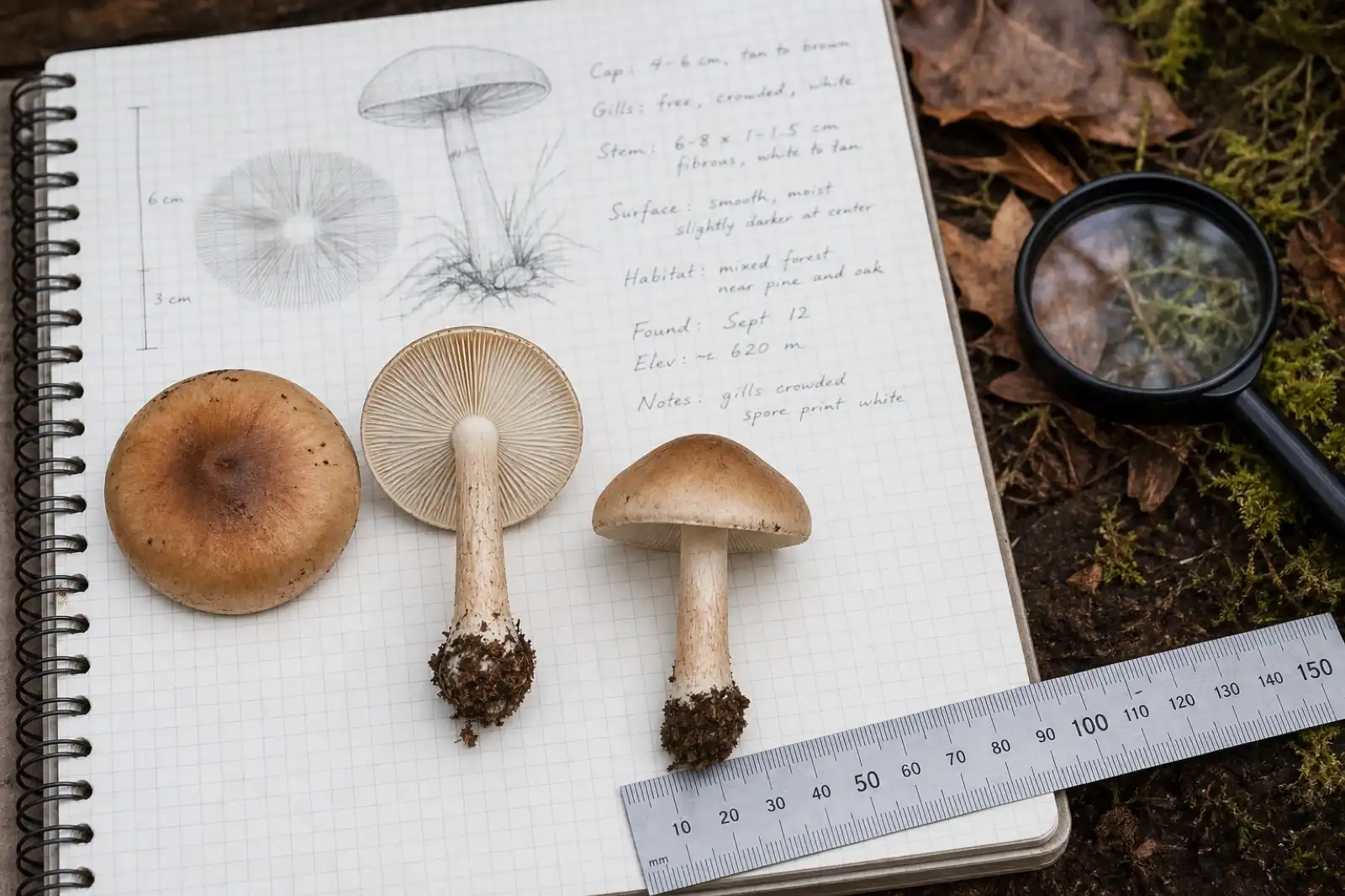
How to Identify Mushrooms: A Beginner's Field Guide
Build an identification from the whole specimen, substrate, habitat, spore deposit, and location—not from a single photograph.
identification
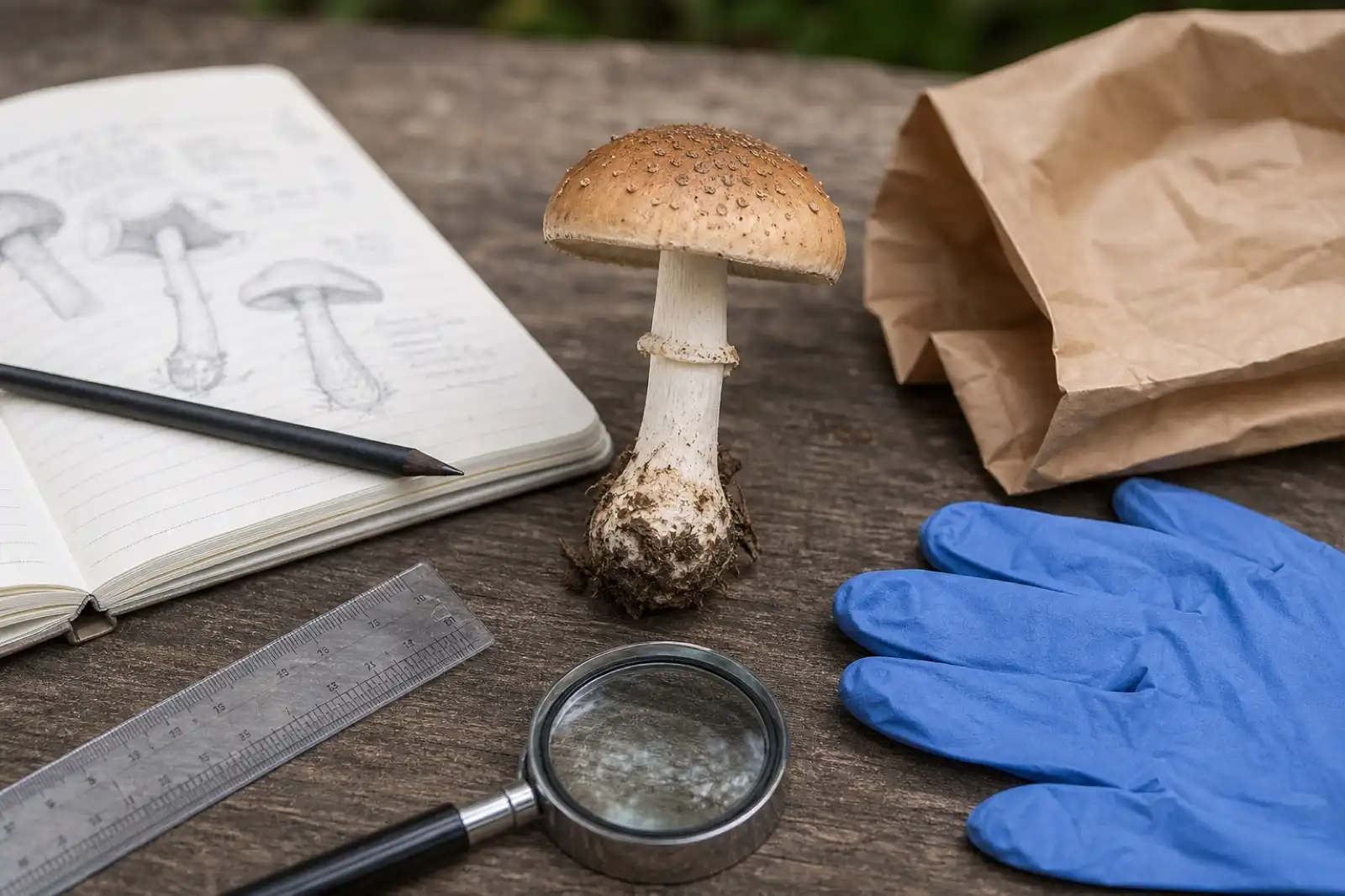
Mushroom Identification Safety Checklist
Use a conservative checklist before handling, documenting, or discussing any wild mushroom, especially when edibility is being considered.
identification
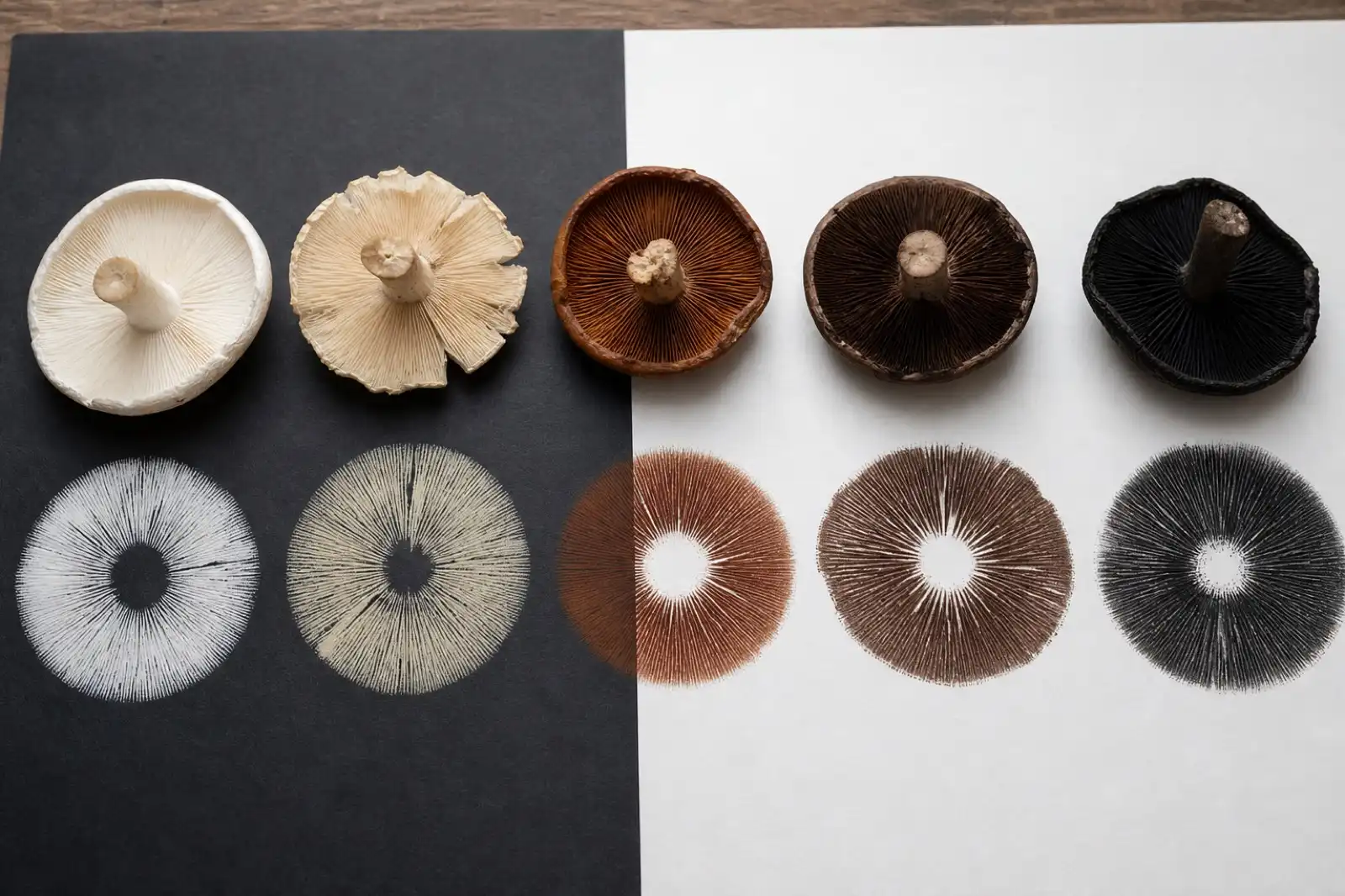
Mushroom Spore Print Colors and How to Record Them
Use a controlled spore deposit to distinguish broad color groups while recognizing that print color alone never identifies a species.
Continue exploring
Browse more practical guides in Mushroom Encyclopedia or visit the mushroom encyclopedia.