Mushroom Encyclopedia
Horse Mushroom: Ring, Odor, Staining, and Lookalikes
Document Agaricus arvensis using its free maturing gills, double ring, anise odor, slow yellowing, grassland ecology, and toxic yellow-stainer checks.
By MushroomScope Editorial Team · · Updated
Species context
Treat profiles as reference material
Species profiles summarize documented traits, taxonomy, and lookalikes, but natural variation can be substantial.
Use the safety checklist →Decision limit
A profile cannot authenticate a specimen
Do not eat a wild mushroom from an online match, single feature, or generated image.
Read the safety disclaimer →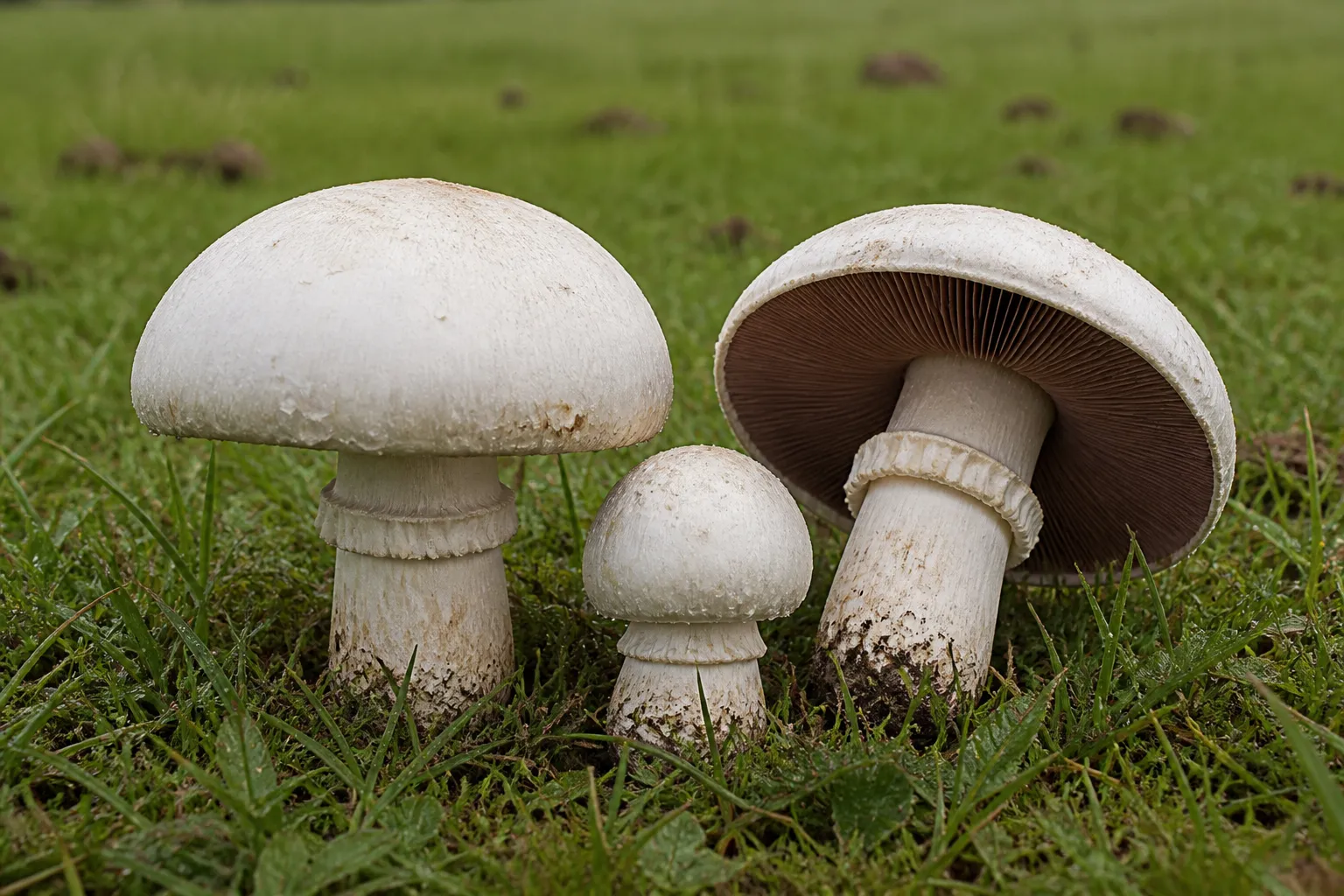
Quick facts
- Scientific name
- Agaricus arvensis
- Common names
- Horse mushroom
- Taxonomy
- Agaricus · Agaricaceae
- Edibility context
- Edible: This database label is context, not remote clearance of a wild specimen; identity, preparation, spoilage, contamination, and individual reaction matter.
- Spore print
- Dark brown.
- Toxicity context
- Low: Risk includes misidentification and individual reaction. Consult current local toxicology guidance before any food decision.
- Season
- June, July, August, September, October, November
- Growing difficulty
- Not Cultivated
- Regions
- Europe, Asia, North America
Safety limit: These labels summarize documented context; they never authenticate a wild specimen. Cooking does not make a poisonous species safe.
The horse mushroom, Agaricus arvensis, is a large pale grassland mushroom whose name is often applied too quickly. Its useful field pattern is not merely “big and white.” A defensible record combines free gills that darken as spores mature, a substantial double ring, an intact stem base without a volva, slow rather than instant yellowing, an anise-like odor when present, and a pasture or other nutrient-rich grassland setting.
Those characters overlap with other Agaricus, including toxic yellow-staining species. Weather, age, handling, and the observer’s sense of smell can weaken the expected pattern. This guide therefore explains what to record and how the evidence fits together; it cannot confirm that a photographed mushroom is safe to eat.
Start with the changing gill color
An unopened button hides its gills behind a partial veil. Once the cap expands, the crowded gills are free from the stem and commonly progress from pale gray-pink through deeper pink-brown to chocolate or dark brown. Photograph several naturally occurring ages from the same group. A single old specimen only proves that its gills are now brown; it does not show the developmental sequence.
“Free” describes attachment, not spacing. Use a side view or a clean lengthwise section to show the narrow gap between mature gills and stem. Do not force the cap from a young specimen merely to produce this view. A dark brown to purple-brown deposit can support the Agaricus pattern, but several related species produce a similar print.
Examine both surfaces of the double ring
As the cap opens, the partial veil remains on the stem as a broad ring. Horse mushroom descriptions emphasize a robust double ring; the lower surface may have a toothed or cogwheel-like pattern. That underside is often missed when a record contains only a cap view.
Photograph the ring from above and below before it tears. Note whether it is thick, movable, pendant, weathered, or stuck against the stem. Ring architecture contributes evidence, but damage by rain, slugs, mowing, or handling can remove it. The absence of a clear ring on an old specimen is a reason to lower confidence, not permission to ignore the character.
Time the yellowing instead of writing “stains yellow”
Horse mushrooms can acquire yellow tones with age or bruising, especially on the cap. The dangerous comparison is not yellow versus no yellow; it is the location, intensity, speed, and persistence of the reaction. Photograph an untouched cap edge and stem base, then the same marked areas immediately after a gentle rub or cut and again after a measured interval.
Rapid chrome-yellow color at the cut or rubbed stem base is a warning associated with the Agaricus xanthodermus group. A slow, muted yellowing elsewhere does not by itself establish A. arvensis. Record temperature, dryness, age, and whether the tissue was already discolored, because a damaged or desiccated fruit body may give an indistinct reaction.
Record odor at the stem base without tasting
Fresh horse mushrooms are often described as smelling of aniseed or almond. Yellow stainers are commonly described as phenolic, inky, iodine-like, or medicinal, particularly at the damaged stem base and sometimes during cooking. These descriptions are useful but subjective: people differ in sensitivity, and cold, wet, old, or contaminated mushrooms may smell weak or confusing.
Use plain notes such as “sweet anise-like odor at fresh cut base” or “sharp medicinal odor after bruising,” and ask another observer to record an independent impression. Never taste an unknown specimen to settle an odor disagreement. No odor result overrides rapid bright yellowing or an incomplete base.
Keep the entire stem base in the photograph
The stout pale stem can be slightly bulbous, but a horse mushroom has no volva. That negative character is only meaningful when the entire base is recovered and photographed in place. Cutting the stem at soil level destroys the view needed to assess an Amanita possibility.
Loosen soil around one representative specimen where collection is legal, lift it intact, and photograph attached soil and surrounding grass before cleaning. A sac, cup, rim, or concentric volval material at the base redirects the identification away from Agaricus. White-gilled Amanita do not follow the pink-to-brown gill sequence, yet an unopened pale button can conceal both gills and base characters.
The stem-features guide shows how rings and basal structures should be documented. The broader identification safety checklist explains why missing one high-consequence feature stops a food decision.
Measure the cap and note its surface condition
The cap begins rounded and expands broadly, often reaching 8–20 cm in mature European descriptions and occasionally larger. Fresh surfaces are white to cream and may be smooth or finely scaly; older caps can become yellow-brown, crack, or collect soil. Measure several specimens rather than selecting the largest individual as representative.
Size is especially vulnerable to misleading comparisons. Moisture, nutrition, crowding, developmental stage, and regional species concepts all affect it. Record cap diameter, stem length and width, ring position, and the scale used in photographs. Do not use a large cap as the primary reason for choosing the common name “horse mushroom.”
Read the grassland as ecological evidence
Horse mushrooms are saprotrophs associated with decomposing organic matter in permanent pasture, meadows, bridle paths, verges, and other nutrient-rich turf. They may form arcs or large fairy rings. Record whether the site is grazed, manured, mown, irrigated, or recently disturbed, and whether several fruit bodies follow a curve.
The setting also carries contamination questions. Roadside soil, treated lawns, industrial land, dog-walking areas, and heavily manured sites are not interchangeable with clean pasture. A correct species name would not remove risks from pesticides, metals, fecal contamination, spoilage, or unlawful collection. Ecology supports identification and separately informs whether material should be left in place.
Fruiting is commonly reported from late summer through autumn in temperate regions, but local rainfall and temperature matter more than a calendar label. Persistent or late mushrooms can be waterlogged or frost-damaged. Include recent weather and tissue condition in the field record.
Separate horse mushroom from the yellow-stainer group
The toxic yellow stainer, Agaricus xanthodermus, is the comparison that deserves an explicit exclusion record. Its fruit bodies can also be pale, ringed, free-gilled, and brown-spored. The most useful field warnings are rapid intense yellowing at the stem base and a phenolic or inky odor. NAMA describes section Xanthodermatei as a globally distributed group characterized generally by phenolic odors, transient yellow discoloration in parts of the fruit body, and mild to substantial toxicity.
Variation prevents a two-box test from becoming a verdict. Staining may fade, odor may be weak, and other yellow-staining Agaricus occur. Photograph the reaction sequence, preserve an uncooked specimen, and use a current regional key. If a phenolic odor or rapid chrome-yellow base reaction is present, remove the collection from any food workflow and seek local expertise.
Compare other large grassland Agaricus
The Agaricus urinascens complex and other large pale agarics can share grassland habitat, a substantial ring, brown spores, and impressive size. Differences may depend on spore dimensions, veil construction, odor, staining, and the taxonomic treatment used by a regional author. A broad internet name cannot resolve that neighborhood consistently across continents.
Build a comparison table in field notes with rows for cap surface, gill sequence, ring upper and lower surfaces, stem base, odor location, timed staining, spore dimensions, habitat management, and region. Mark unknowns explicitly. Microscopy should record mounting method, calibration, number of mature spores measured, and range rather than one convenient measurement.
GBIF currently treats Agaricus arvensis as an accepted species and lists numerous historical synonyms and infraspecific names. Occurrence maps are useful for locating records to investigate, but they combine different dates, sources, and determination standards. A mapped point is not proof that a fresh collection belongs to the same concept.
Build a repeatable field sequence
- Photograph the undisturbed group, growth pattern, and managed or unmanaged grassland context.
- Record date, recent rain, temperature, mowing, grazing, manure, road proximity, and chemical treatment.
- Select one permitted representative and recover the entire stem base.
- Photograph cap, gill attachment and color, ring from both sides, and intact base in natural light.
- Measure the cap and stem; describe texture and tissue condition.
- Record odor at the fresh stem base without tasting.
- Photograph cap-edge and base staining at the start and after a measured interval.
- Make a mature spore deposit and retain material for a regional expert if needed.
The spore-color guide can help standardize the deposit setup, but print color is only one column in this sequence. The field mushroom guide covers the smaller Agaricus campestris intent and should not be treated as a synonym page for A. arvensis.
Keep food use separate from identification confidence
Horse mushroom has a history of food use, but an edibility label describes a correctly identified organism in suitable condition. It does not transfer through a photograph, app result, common name, or one matching trait. Wild material requires in-person confirmation by a qualified local identifier who can examine the complete collection and apply a regional key.
If confirmed material is used, exclude polluted sites, damaged tissue, insect-heavy or waterlogged specimens, and any collection with uncertain storage. Cook it and try no large serving of an unfamiliar food. Individual allergy or gastrointestinal intolerance remains possible. General produce hygiene applies, but washing and cooking cannot neutralize a poisonous lookalike or remove every environmental contaminant.
If symptoms occur after a wild-mushroom meal, contact local emergency services or a poison center promptly. Preserve uncooked material, cooked leftovers, trimmings, photographs, meal timing, and information about everyone who ate it. Do not wait for an online vote, and do not induce vomiting unless a medical professional directs it.
Why this is not a beginner cultivation target
Wild horse mushrooms appearing in pasture do not provide a tested home-growing protocol. Reproducing a grassland fruiting system requires authenticated culture, controlled substrate formulation, microbial and environmental management, and confirmation that the resulting fruit bodies match the culture. Cloning an uncertain wild mushroom only preserves uncertainty.
For beginner food production, use authenticated commercial cultures of established cultivated species and follow supplier-specific parameters. Keep lot, inoculation, substrate, temperature, contamination, and harvest records. This species page does not convert a field observation into a cultivation recipe.
Evidence boundaries and editorial review
GBIF supports the current backbone name and occurrence context. First Nature supplies a detailed European field description including cap range, gill development, double-ring structure, spore dimensions, grassland ecology, anise odor, and the rapid-yellowing yellow-stainer comparison. NAMA supplies the broader toxicology boundary for phenolic yellow-staining Agaricus. NCBI is used as an independent nomenclature checkpoint, while FDA guidance supports general produce handling rather than species identification.
No named mycologist or clinician reviewed this article. Its language remains editorial and deliberately conservative. Regional species concepts, toxicology advice, and emergency contacts should be checked against current local sources before use.
Build an Agaricus collection series, not a single-specimen verdict
Large grassland Agaricus can change quickly after emergence. Link at least three stages from the same fruiting patch: a closed specimen showing veil attachment, a partly opened specimen exposing ring construction, and a mature specimen with dark chocolate-brown gills. Record cap diameter, stem length, base width and gill color for each individual. This separates developmental change from differences between two species sharing the same pasture.
Time reactions on a fresh longitudinal cut. Note the first color at 15 seconds, the strongest color by two minutes and any fading after ten minutes at the cap margin, central flesh and stem base separately. Horse mushroom candidates may show slow yellowing and an anise-like odor, whereas intense chrome yellow at the base paired with an inky or phenolic odor increases concern for the yellow-stainer group. Neither reaction is an edibility test; the complete base, ring, mature gills, habitat and regional species set still have to agree.
Pasture history can resolve apparent contradictions. Record whether the site is old grazed grassland, fertilized amenity turf, a stable margin or newly imported topsoil, plus recent rain and mowing. A fruit body beside a tree is not automatically mycorrhizal, and a lawn occurrence does not distinguish horse mushroom from hazardous Agaricus lookalikes. Preserve one lawful dried voucher with the field photographs when a regional expert needs microscopy or sequencing.
References
- Global Biodiversity Information Facility. Agaricus arvensis species record. Taxonomic backbone and occurrence context.
- National Center for Biotechnology Information. NCBI Taxonomy Browser. Independent lineage and nomenclature checkpoint.
- North American Mycological Association. Mushroom Poisoning Syndromes. Poisoning response and syndrome context.
- U.S. Food and Drug Administration. Selecting and Serving Produce Safely. General handling guidance for mushrooms used as food.
- First Nature. Agaricus arvensis, Horse Mushroom. European field characters, measurements, double-ring structure, season, ecology, odor, spores, and yellow-stainer comparison.
- North American Mycological Association. The Mycophile 47(4). Section Xanthodermatei context: phenolic odors, yellow discoloration, global distribution, and toxicity range.
Last editorial review: September 24, 2026. This revision added a linked developmental series, timed tissue-specific reactions and pasture-history controls. Taxonomy, regional range, and poison-response contacts should be rechecked at every substantive update.
Source quality notes
MushroomScope cites sources that match the page scope, such as taxonomic databases, extension guidance, food-safety agencies, food-composition databases, and peer-reviewed or institutional health references. Sources support context and uncertainty; they do not turn an online page into specimen identification, medical advice, or a tested recipe record.
Frequently asked questions
What should be visible in a horse mushroom field record?
Show the intact base, free gills at more than one age, both sides of the substantial ring, cap and cut-base staining, habitat, and a dark brown spore deposit; no single character confirms the species.
How does the horse mushroom differ from a yellow stainer?
Horse mushrooms may yellow slowly and often smell of anise, while the toxic yellow-stainer group commonly develops rapid bright chrome-yellow color at the stem base and a phenolic or inky odor. Variation means local expert confirmation is still required.
Does a horse mushroom have pink gills?
Young exposed gills can be pale gray-pink, then deepen through brown as spores mature. Very young buttons may hide the gills behind a veil, so gill color must be interpreted with developmental stage.
Where should a horse mushroom record its habitat?
Record the exact grassland setting, turf management, nearby roads or livestock, growth pattern, soil moisture, and recent weather. A pasture or fairy ring supports ecology but does not establish identity or food safety.
Can a photographed horse mushroom be declared edible?
No. A webpage or image cannot exclude toxic Agaricus, an Amanita with a missed base, contamination, spoilage, or individual reaction. Obtain in-person confirmation from a qualified local identifier before any food decision.
Related guides
identification
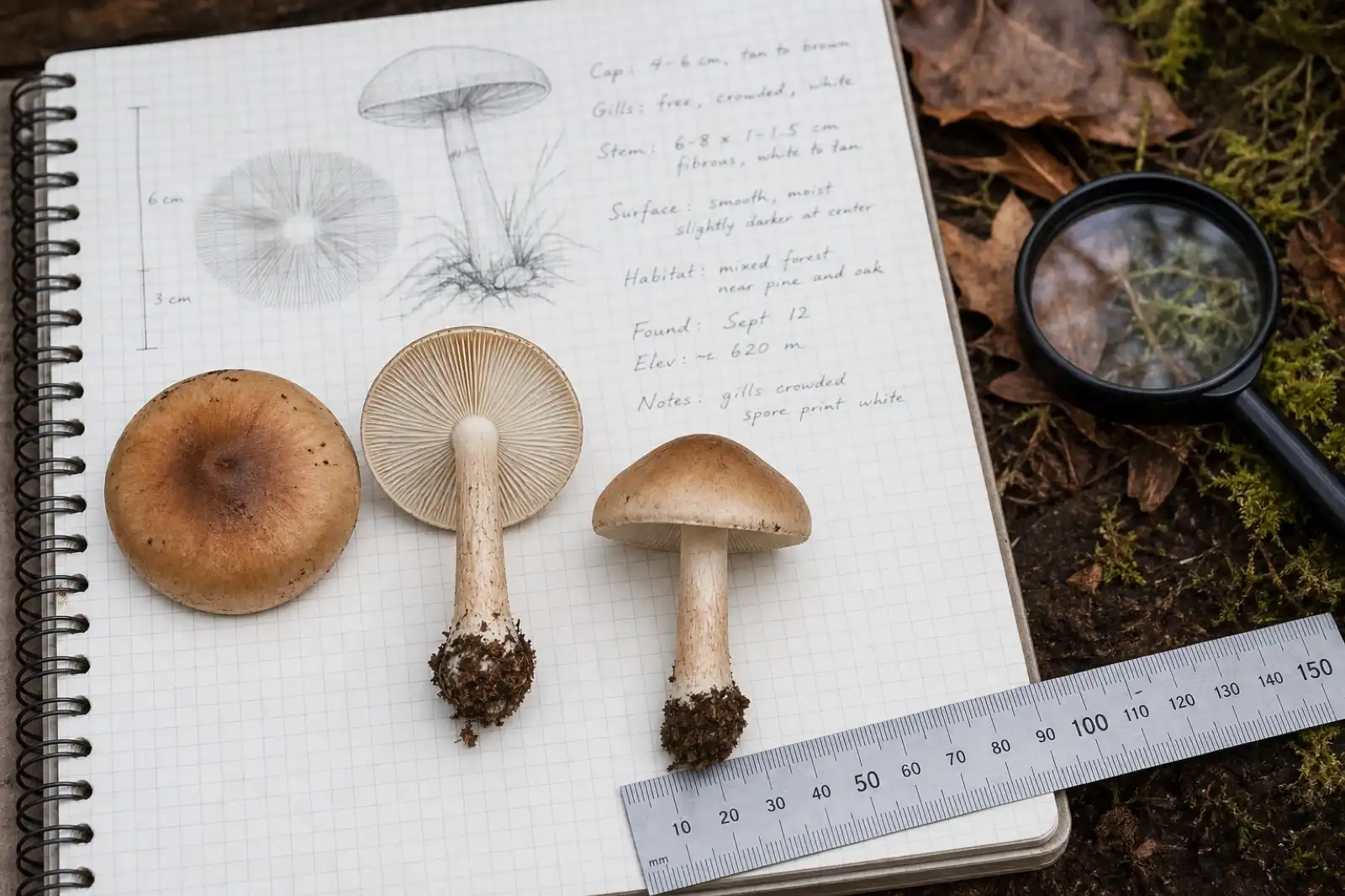
How to Identify Mushrooms: A Beginner's Field Guide
Build an identification from the whole specimen, substrate, habitat, spore deposit, and location—not from a single photograph.
identification
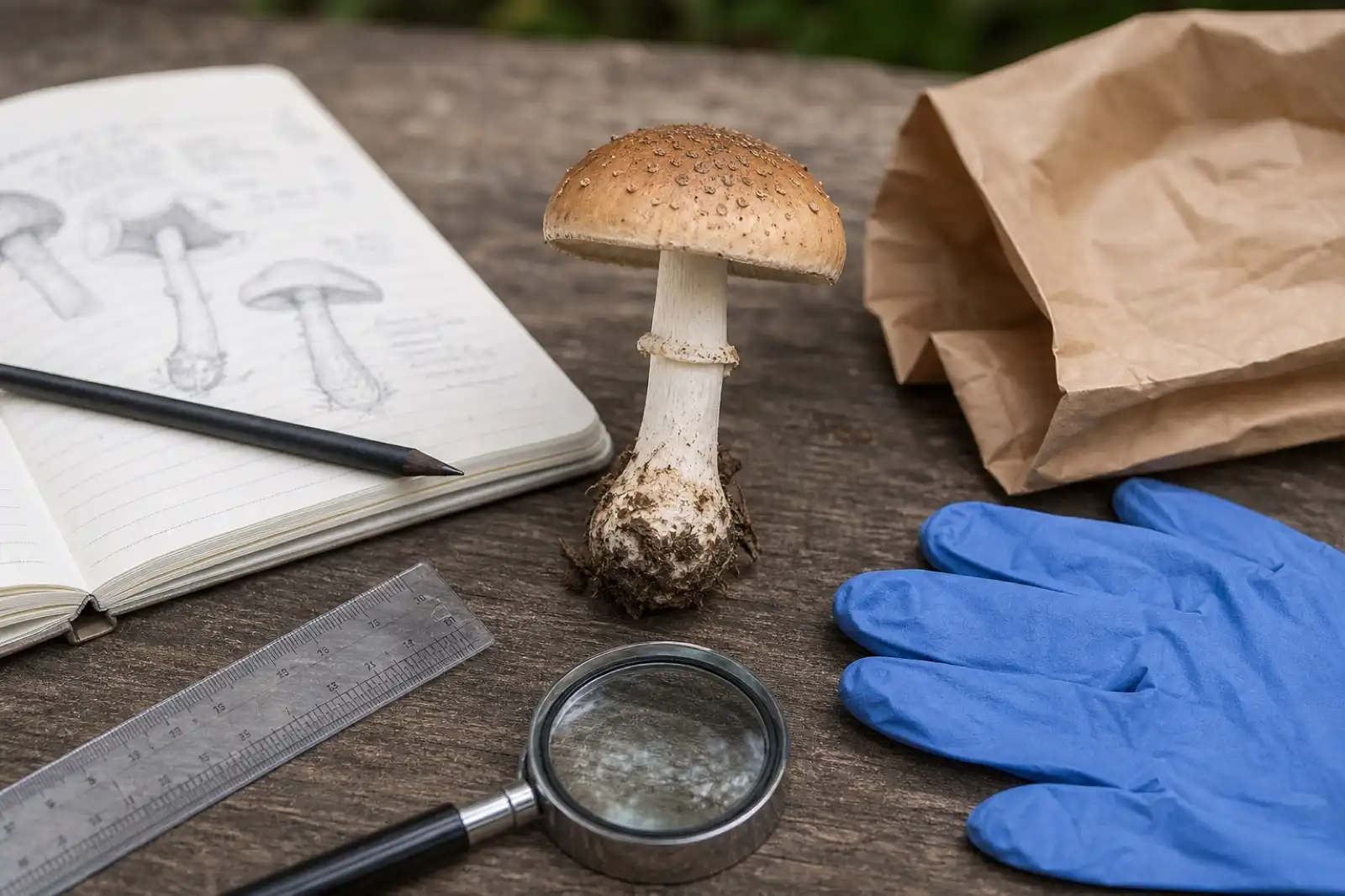
Mushroom Identification Safety Checklist
Use a conservative checklist before handling, documenting, or discussing any wild mushroom, especially when edibility is being considered.
mushrooms
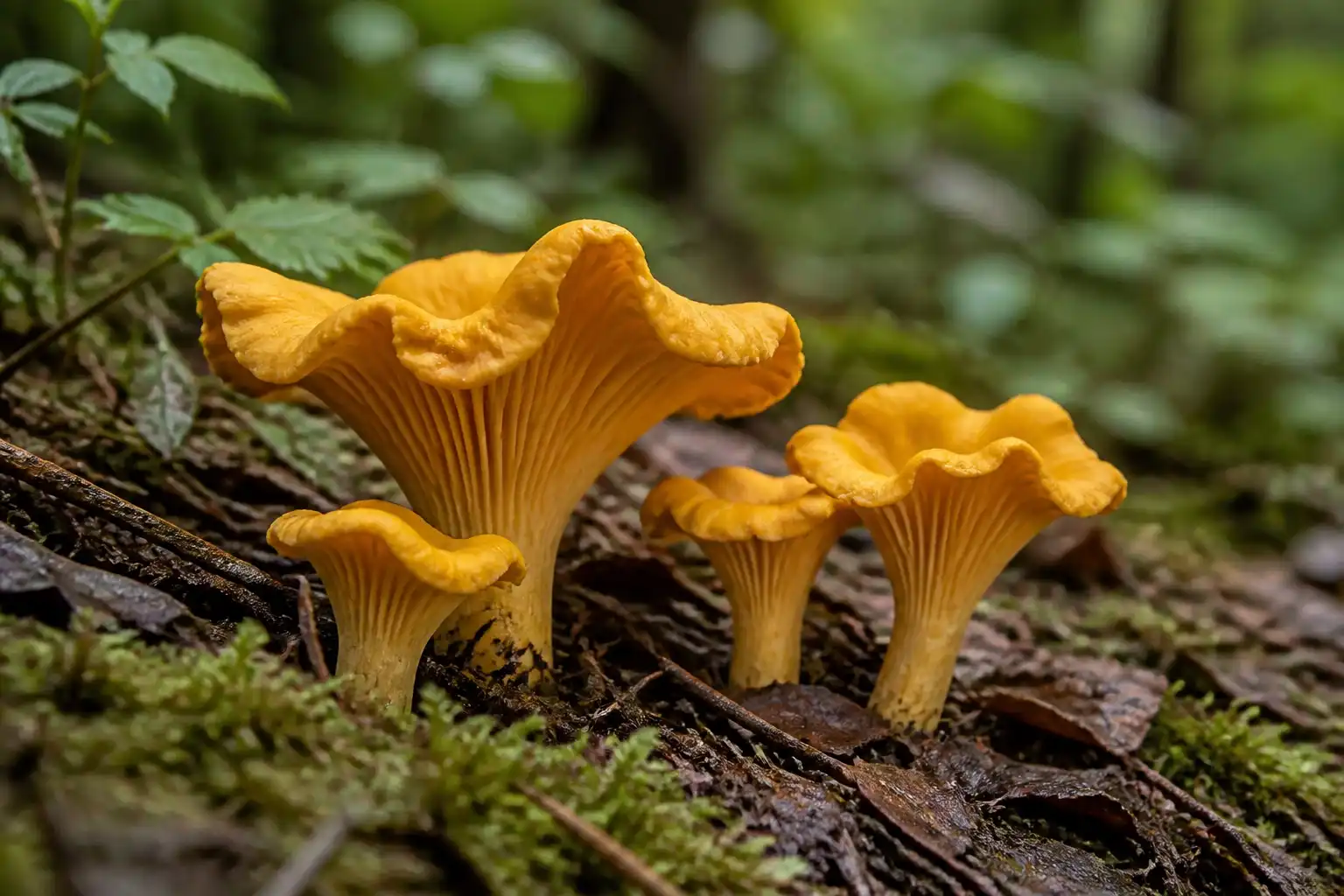
Cantharellus cibarius: Chanterelle Identification Guide
Learn chanterelle identification, false gills, habitat, season, poisonous lookalikes, edibility, nutrition, and why wild finds need local verification.
Continue exploring
Browse more practical guides in Mushroom Encyclopedia or visit the mushroom encyclopedia.