Mushroom Encyclopedia
Aniseed Funnel: Clitocybe odora Identification Guide
Identify aniseed funnel using blue-green caps, decurrent gills, verified odor, woodland litter, spore evidence, lookalikes, and conservative safety limits.
By MushroomScope Editorial Team · · Updated
Species context
Treat profiles as reference material
Species profiles summarize documented traits, taxonomy, and lookalikes, but natural variation can be substantial.
Use the safety checklist →Decision limit
A profile cannot authenticate a specimen
Do not eat a wild mushroom from an online match, single feature, or generated image.
Read the safety disclaimer →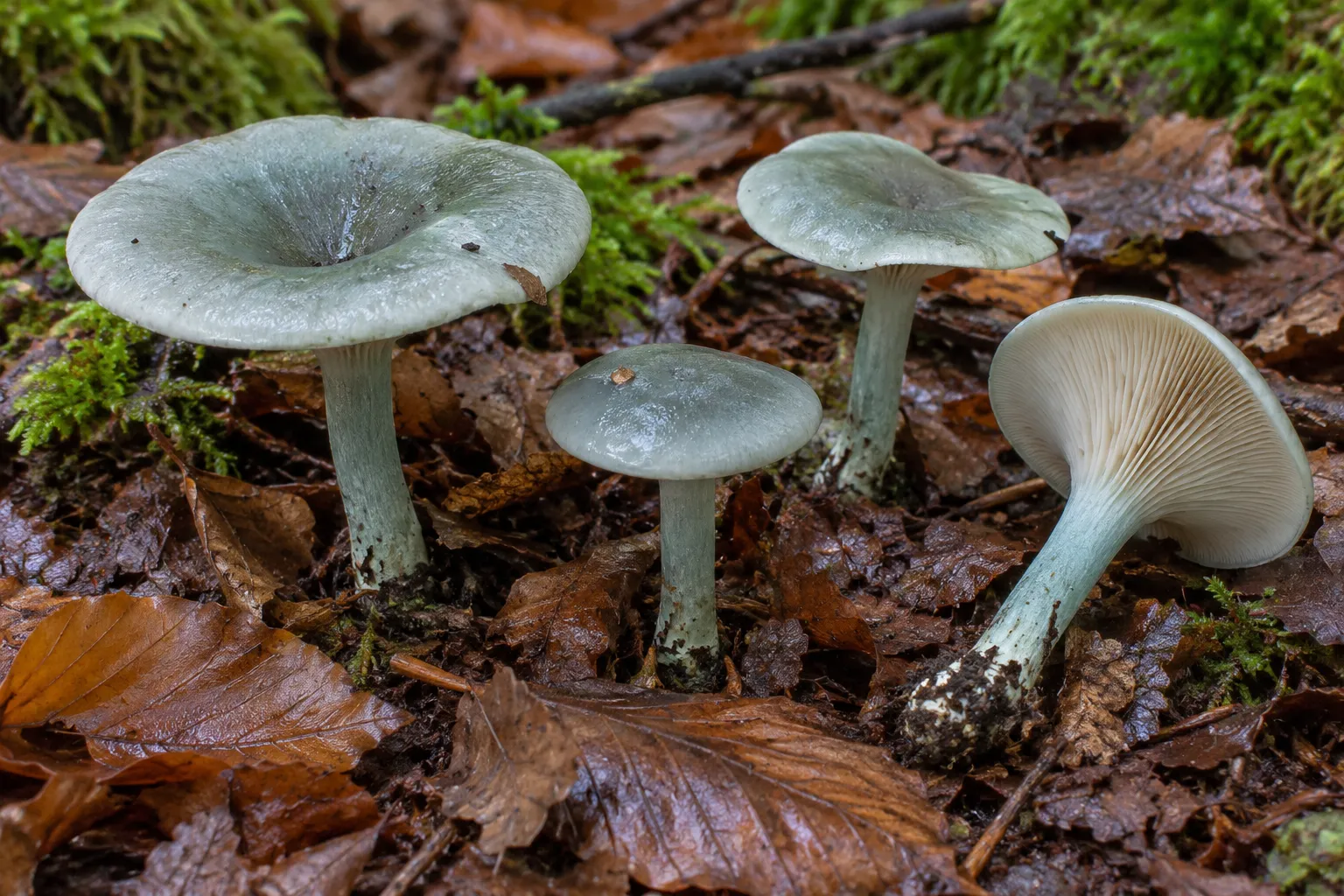
Quick facts
- Scientific name
- Clitocybe odora
- Common names
- Aniseed funnel, Aniseed toadstool
- Taxonomy
- Clitocybe · Tricholomataceae
- Edibility context
- Unknown: Not recommended here for food; exact identification within funnel-shaped agarics is safety-critical.
- Spore print
- White.
- Toxicity context
- Unknown: The wider comparison set contains poisonous species, so odor and color cannot be used as consumption clearance.
- Season
- August, September, October, November
- Growing difficulty
- Not Cultivated
- Regions
- Europe, parts of Asia and North America in the reported species concept
Safety limit: These labels summarize documented context; they never authenticate a wild specimen. Cooking does not make a poisonous species safe.
Aniseed funnel is memorable because fresh mushrooms can combine blue-green color with an anise or fennel odor. Those features are useful only as part of a complete record. Color fades, human odor perception varies, and the broader funnel-shaped comparison set contains species that should not be eaten. This guide focuses on documenting Clitocybe odora, not converting a sensory match into a food decision.
Read the cap as an aging sequence
Young caps begin convex and may show a low central boss. They broaden, flatten, and often develop a shallow depression or funnel. Fresh color ranges from blue-green to gray-green; older, dry, sunlit, or rain-washed material can become much paler. Photograph several ages together before choosing one “typical” color.
Record diameter, margin shape, surface moisture, bruising, and whether the center is truly depressed. A camera can shift blue-green toward cyan or gray, so include a neutral reference under diffuse daylight and keep an unedited original. Do not increase saturation to make a weak specimen fit the name.
Confirm pale gills that run down the stem
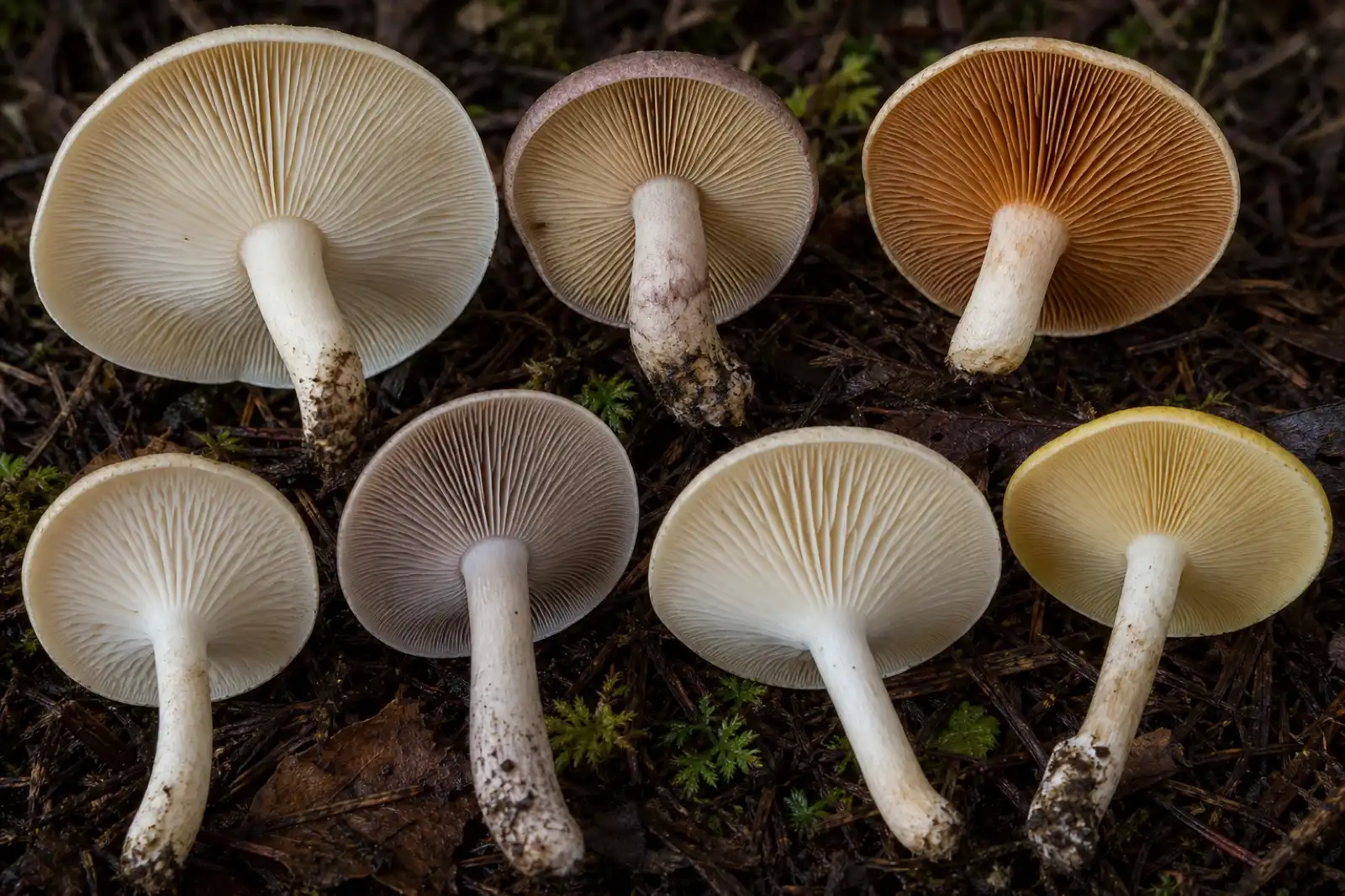
The gills are pale cream to grayish, comparatively crowded, and decurrent. Photograph the underside square-on and in side profile so attachment can be checked. The gill-types guide explains why “funnel-shaped” and “decurrent” describe different evidence.
Follow the stem to its complete base. It is usually slender and similarly blue-green or gray-green, without a ring or volva. Leaf litter may hide the lower stem and any attached mycelium. A cut stem cannot establish the absence of basal structures, so document the intact base before cleaning.
Test odor as a recorded observation
Smell an intact fresh fruit body first. If collection is permitted, expose a small fresh section and note who assessed it, at what distance, and how quickly. Common descriptions include aniseed, fennel, or sweet aromatic notes. Do not taste, deliberately inhale spores, or place tissue against the face.
Odor is variable. A cold, old, waterlogged, frozen, or dried specimen may be weak; people also differ in sensitivity and vocabulary. Ask observers to record independently before comparing notes. “No odor detected by two observers in weathered material” preserves more information than forcing a yes-or-no field.
Anchor the record in woodland litter
Aniseed funnel is recorded from deciduous and mixed woodland litter, often with beech. Show the mushrooms before disturbance, then photograph litter layers, nearby trees, and the complete attachment. Record whether the cluster emerges from leaf litter, mineral soil, buried wood, or an old stump.
Nearby beech leaves support context only when they belong to the same substrate and canopy. Windblown leaves can cover buried wood or another tree’s root zone. The habitat guide gives a method for separating immediate substrate, probable host context, and surrounding vegetation.
Separate lookalikes with conjunctions, not one clues
Other Clitocybe species can share a funnel form, pale decurrent gills, white spores, or a sweet odor. Clitocybe fragrans is generally paler and smaller but can smell similar. Weathered aniseed funnels may lose the color that first distinguished them. Regional keys may require spore dimensions and other microscopic characters.
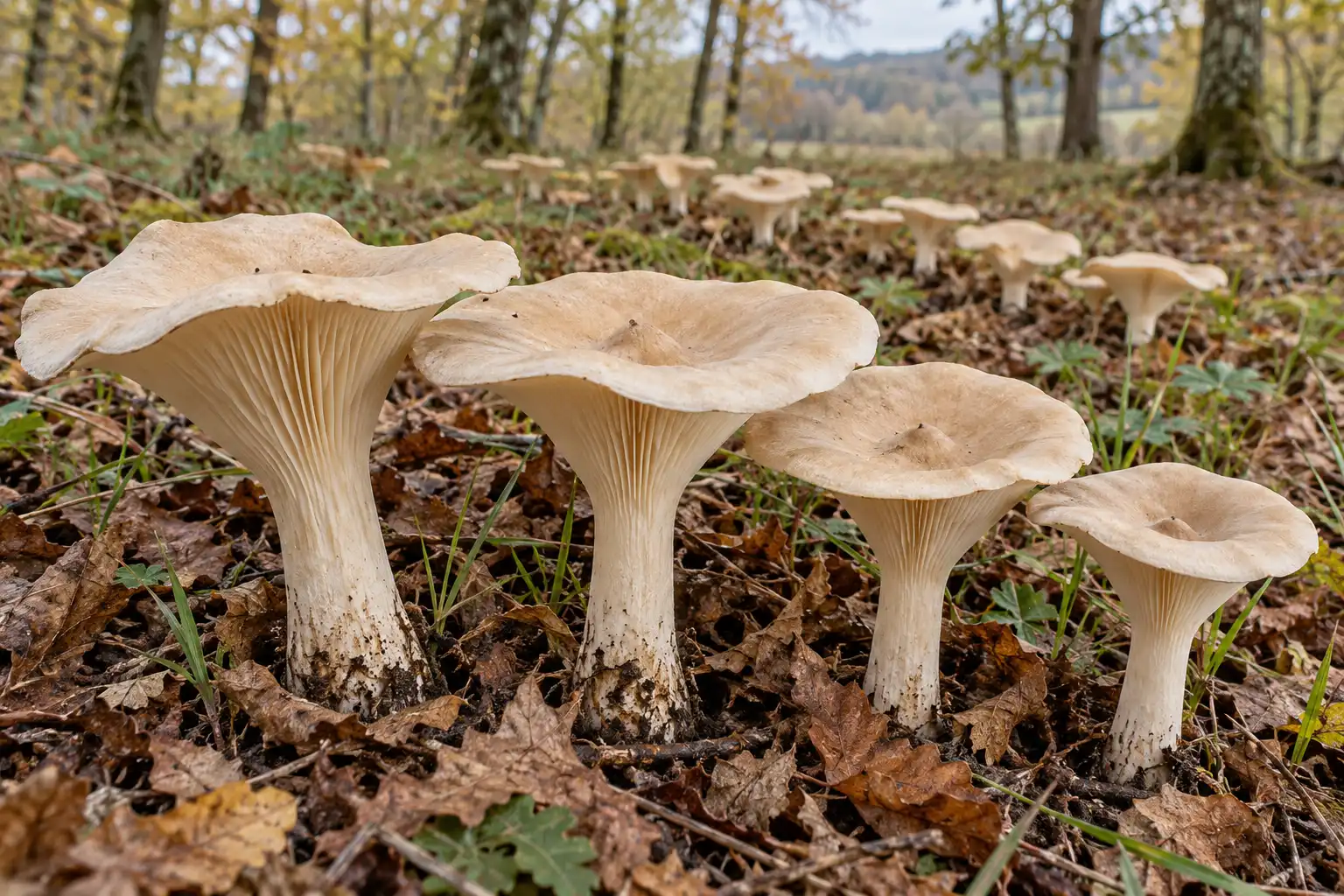
The larger trooping funnel guide covers a robust buff species concept that often forms troops or rings. Size, color, odor, gill geometry, stem proportions, habitat, and range should converge. One matching trait should start a comparison, never finish it.
Make a useful spore deposit
Choose a mature but sound cap and place portions over light and dark nonabsorbent surfaces, protected from drafts. Label the specimen before separating the cap. A white deposit supports the expected profile but overlaps many funnel-shaped fungi.
Record duration, humidity, whether a visible deposit formed, and the specimen number. Do not report “no spores” as a color: immaturity, age, desiccation, and handling can prevent deposition. When exact identification matters, retain lawful material for microscopic measurement by a competent identifier.
Keep the food boundary conservative
This page does not recommend eating aniseed funnel. Historical or regional food statements cannot authenticate a reader’s collection, and the wider Clitocybe comparison set includes poisonous species. Anise odor is not a toxin test. Cooking does not repair mistaken identity, spoilage, environmental contamination, or individual reaction.
If illness follows wild mushroom exposure, contact the relevant poison center or emergency service promptly. Retain uncooked material, trimmings, photographs, location, meal details, and timing. Do not wait for an online identification. The safety checklist applies to every unresolved funnel.
Use a specimen-linked observation table
Give each mushroom or small cluster a number. Record cap diameter and color, developmental shape, surface condition, gill attachment and spacing, stem dimensions, complete-base evidence, odor method, substrate, nearby trees, and photograph numbers. Use the same identifier on any spore deposit or voucher.
This prevents evidence from different mushrooms being combined into an ideal specimen. A vivid young cap and a strongly scented old cap may belong to the same colony, but that relationship must be shown. If two forms differ sharply, record them separately until evidence connects them.
Document without manufacturing confidence
A good final determination states its boundary. Examples include “probable C. odora based on fresh color, decurrent gills, strong anise odor, white deposit, and regional woodland context” or “blue-green Clitocybe; odor weak and microscopy unavailable.” The second is not a failed record; it accurately preserves uncertainty.
Do not use an AI image, app score, or common-name gallery as evidence. The cover here was generated as an original editorial illustration and openly labeled as such. It passed a visual check for crop, clarity, woodland context, complete bases, gill visibility, restrained color, and absence of text or logos, but it documents no wild collection.
Do not improvise cultivation or extracts
Aniseed funnel is not presented as a home food crop, flavoring project, or medicinal ingredient. A culture would need authenticated source material, a voucher, contamination controls, defined media, and verification that any fruit bodies match the isolate. Mycelial growth alone does not prove a useful or safe crop.
Aromatic compounds studied in isolated material do not establish that a wild fruit body, extract, or homemade preparation is safe or effective. This page makes no dose, treatment, nutrition, or performance claim.
Apply taxonomic and geographic limits
Database names and mapped records can change as specimens are revised. A record outside a familiar range deserves careful review rather than automatic expansion of the range. Check the accepted name, synonyms, regional literature, voucher quality, and date accessed.
Editorial review is by the MushroomScope team. No named mycologist, clinician, or toxicologist reviewed this page. Identification and poisoning decisions should use current local expertise and services.
Run an independent odor check without suggestion bias
If several observers are available, ask each person to write a description before anyone says “anise.” Supply the same numbered fresh specimen and keep the distance and tissue condition comparable. Later, group descriptions such as fennel, licorice, sweet, floral, or no odor detected. This avoids turning a memorable common name into a prompted answer.
Repeat the test only when it will add information. Crushing every fruit body damages the colony and can blend soil or litter odors into the result. One intact observation and one small fresh section are normally more useful than repeated handling. Note respiratory sensitivity and stop if an observer is uncomfortable; odor work never requires deep inhalation.
Check whether blue-green color survives a neutral workflow
Make one frame with the mushroom, a neutral gray reference, and ambient habitat under diffuse daylight. Avoid mixed flashlight and daylight illumination. Export a second image without color edits and compare it with the camera original. If the apparent green vanishes when white balance is corrected, describe the uncertainty instead of selecting the most saturated version.
Also inspect flesh and stem separately. Surface algae, leaf stains, bruising, and reflected green vegetation can change a photograph. A genuine color observation should be visible across more than one tissue or specimen and should remain linked to notes made at the site.
Escalate an unusual record with a complete evidence packet
For a record outside the expected region or season, assemble locality at appropriate precision, habitat, substrate, multiple ages, complete bases, cap and gill measurements, independent odor notes, spore deposit, microscopy where available, and a lawful voucher. Ask a regional recorder or herbarium to review the packet rather than posting only the most striking image.
Record the identifier, date, key or literature used, confidence, and any later correction. An unusual but well-documented Clitocybe record can remain valuable even if it is ultimately assigned to another species; the evidence, not the first name, is the durable result.
For a smaller buff litter funnel without dependable blue-green color, compare the common funnel field guide, especially its cap-development series and decurrent-gill record. Color or odor alone does not separate the pair.
Run a blind odor persistence series
Anise odor is unusually useful for this species, but expectation easily contaminates the observation. Place numbered, uncut specimens in separate ventilated paper packets. Ask two observers who have not seen the proposed name to describe each packet with their own words at collection, after a fresh cut, and again after two hours. Do not offer “anise” as a choice. Record temperature, moisture, observer, delay, and whether the odor becomes stronger in the gills, cap flesh, or stem base.
Repeat the trial with a common funnel from the same woodland when available. A durable sweet, anise-like odor across multiple C. odora fruit bodies is more useful than one prompted sniff. Weak odor in waterlogged or old material should reduce confidence rather than be rewritten as a positive result. Preserve a dried fragment: odor retained or recovered after gentle rehydration can become another documented comparison, although storage contamination must be excluded.
Quantify the blue-green fading boundary
Select three numbered caps spanning young, mature, and weathered stages. Photograph each under the same diffuse light with a neutral card, then sample color at the center, mid-radius, and margin without digitally increasing saturation. Repeat after a dry interval. Record whether blue-green remains in protected cap fibers, gill edge, or upper stem even as exposed surfaces fade toward buff.
This grid separates a biological fading sequence from reflected foliage, cyan phone white balance, or isolated stains. Link the grid to cap diameter, surface moisture, and odor score. A specimen that is merely buff, has no persistent anise odor, and never shows protected blue-green tissue belongs in the broader litter-funnel comparison until microscopy and a regional key support a narrower name.
References
- Global Biodiversity Information Facility. Clitocybe odora species record. Accepted-name and occurrence context.
- National Center for Biotechnology Information. Clitocybe odora taxonomy search. Independent lineage and sequence-linked context.
- First Nature. Clitocybe odora field account. Macroscopic comparison, habitat, and season context for Britain and Ireland.
- North American Mycological Association. Mushroom Poisoning Syndromes. General syndrome and response context.
Editorial status: substantive MushroomScope editorial review on November 21, 2026; no named expert review. The original AI image is licensed as MushroomScope original editorial work and is explicitly not identification evidence.
Source quality notes
MushroomScope cites sources that match the page scope, such as taxonomic databases, extension guidance, food-safety agencies, food-composition databases, and peer-reviewed or institutional health references. Sources support context and uncertainty; they do not turn an online page into specimen identification, medical advice, or a tested recipe record.
Frequently asked questions
What does aniseed funnel smell like?
Fresh intact tissue is commonly described as strongly aniseed or fennel-like, but odor perception varies and weathered mushrooms may be weak. Odor supports, but never proves, identification.
Is every blue-green funnel Clitocybe odora?
No. Color changes with age and weather, cameras distort it, and other fungi can appear greenish. Gill attachment, odor, anatomy, habitat, range, and regional comparisons must agree.
How should odor be tested safely?
Smell intact tissue first, then a small broken section at arm's length if permitted. Do not taste, inhale spores deliberately, or rely on one person's perception.
Can this page confirm that an aniseed funnel is edible?
No. The Clitocybe group includes difficult and poisonous species. A webpage or image cannot clear a wild collection for food.
What should a field record include?
Keep habitat, substrate, several ages, cap and gill views, complete bases, measurements, odor method, spore deposit, region, date, and any retained voucher together.
Related guides
mushrooms
Trooping Funnel Mushroom: Rings, Gills, and Scale
Study the trooping funnel through its large buff cap, central umbo, decurrent gills, tall stem, rings and troops, lookalikes, and safety limits.
identification
Mushroom Gill Types: Attachment, Spacing, and Color
Compare free, attached, notched, adnate, and decurrent mushroom gills while recording spacing, short gills, edge details, bruising, and color changes.
identification
Mushroom Identification Safety Checklist
Use a conservative checklist before handling, documenting, or discussing any wild mushroom, especially when edibility is being considered.
Continue exploring
Browse more practical guides in Mushroom Encyclopedia or visit the mushroom encyclopedia.