Mushroom Encyclopedia
Weeping Widow Mushroom: Gill Droplets, Veil, and Ecology
Document weeping widow mushrooms through fibrous caps, veil remnants, gill droplets, dark spores, disturbed-soil ecology, lookalikes, and safety limits.
By MushroomScope Editorial Team · · Updated
Species context
Treat profiles as reference material
Species profiles summarize documented traits, taxonomy, and lookalikes, but natural variation can be substantial.
Use the safety checklist →Decision limit
A profile cannot authenticate a specimen
Do not eat a wild mushroom from an online match, single feature, or generated image.
Read the safety disclaimer →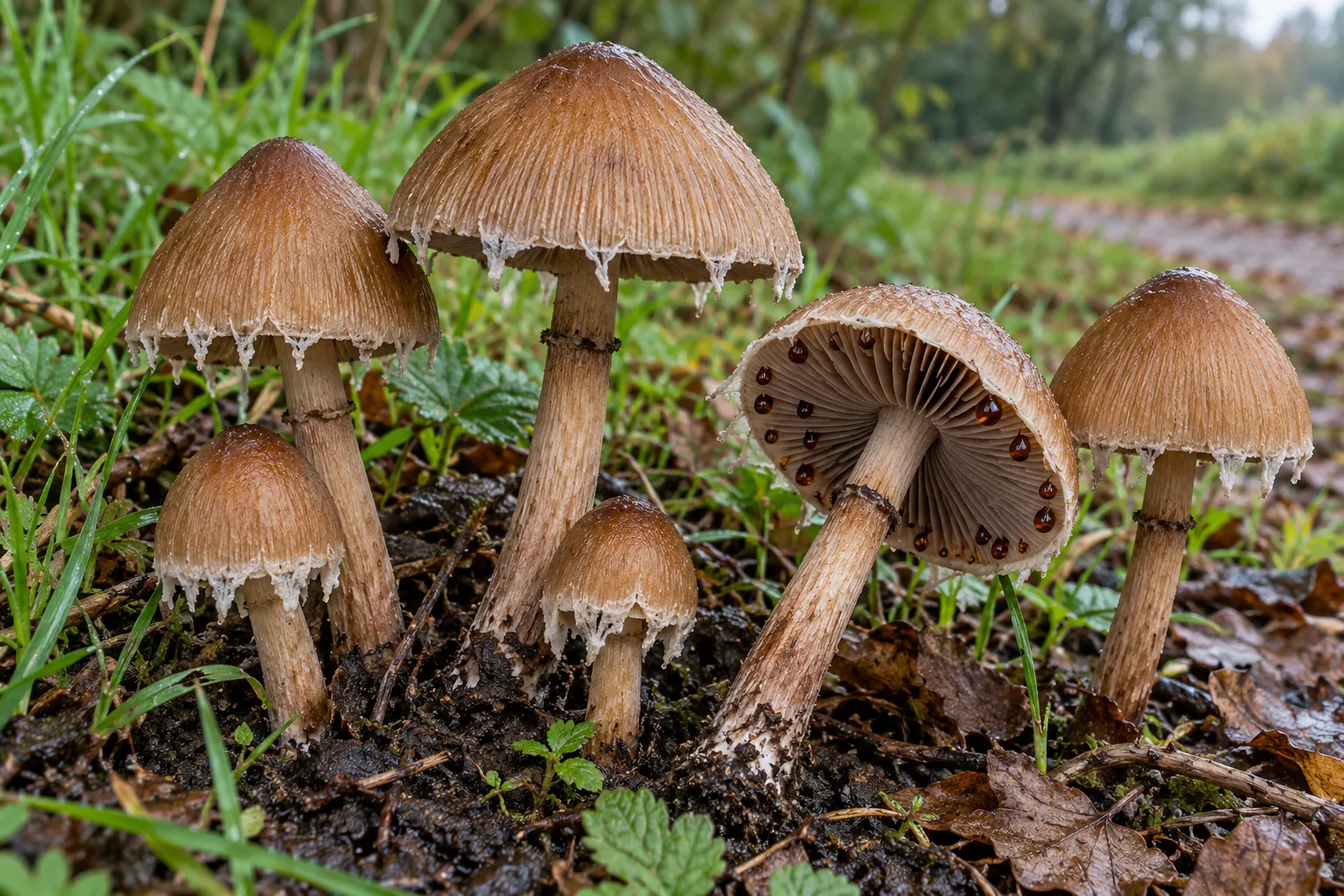
Quick facts
- Scientific name
- Lacrymaria lacrymabunda
- Common names
- Weeping widow, Weeping widow mushroom
- Taxonomy
- Lacrymaria · Psathyrellaceae
- Edibility context
- Inedible: Treated here as unsuitable for food because fragile dark-spored lookalikes and variable descriptions make a conservative boundary appropriate.
- Spore print
- Very dark brown to blackish brown.
- Toxicity context
- Low: Misidentification, contamination, spoilage, and individual gastrointestinal reactions remain possible; unknown exposures need local poison guidance.
- Season
- April, May, June, July, August, September, October, November
- Growing difficulty
- Expert
- Regions
- Europe, North America, temperate Asia, Australia, other regions represented by verified records
Safety limit: These labels summarize documented context; they never authenticate a wild specimen. Cooking does not make a poisonous species safe.
Weeping widow is named for a striking but easily overvalued observation: droplets can bead along the gill edges and darken as spores mature. Lacrymaria lacrymabunda is better treated as a complete evidence set—a tawny fibrous cap, ragged veil remnants, fragile ring zone, mottled dark gills, dark spores, rich disturbed soil, and a developmental series. The “tears” are supporting evidence, never a verdict.
This species also clarifies an important family-level distinction. It belongs to Psathyrellaceae with many fragile dark-spored mushrooms, but it does not normally dissolve its cap into black liquid as common inky cap does. Documenting that negative character requires time: a fresh intact cap and a later observation are more useful than a single wet old specimen.
Start with cap fibers before rain flattens them
Young caps are convex to bell-shaped and tawny, cinnamon-brown, or ochre-brown. Dense radial fibers or fine woolly fibrils run from the darker center toward the margin. Moisture can deepen the color; drying can make the cap paler and emphasize zones. Photograph several ages under neutral light before handling or rain mats the surface.
Use side lighting and a scale to show whether the covering consists of integrated fibers, loose veil patches, adhering debris, or smooth wet skin. Record cap height, width, center color, margin curvature, and any cracking. “Brown and hairy” collapses distinct structures and is not enough for comparison.
The fibers can appear coarser toward the center or break into small tufts. Older caps may flatten and lose their neat texture. A weathered specimen therefore needs young companions from the same patch; it should not borrow surface characters from an unrelated nearby mushroom.
Preserve the ragged veil and ring-zone evidence
Pale veil tissue may connect the young cap margin to the stem. As the cap expands, that tissue tears into dangling marginal fragments and a fragile fibrillose ring or ring zone. Dark spores can stain the remaining fibers. Photograph the margin from several angles and the complete stem before rubbing, carrying, or making a print.
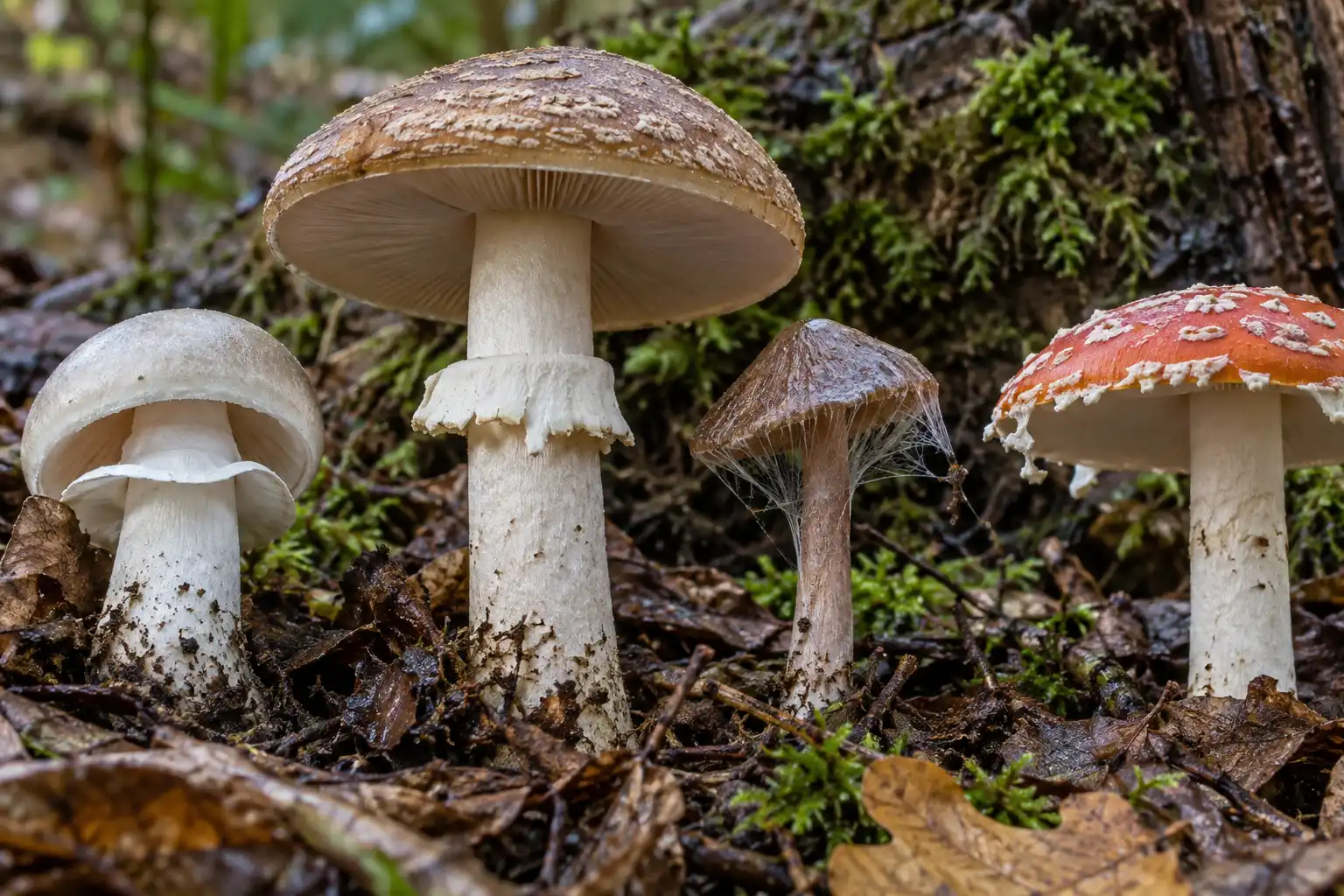
A persistent membrane ring is different from scattered fibers, and a dark band can be spores rather than original tissue. Describe what is physically present: loose threads, a partial collar, a stain, or an intact ring. The veil and ring guide provides a vocabulary for keeping those observations separate.
Absence also needs care. Rain, slugs, age, and handling can remove a weak veil. A smooth stem on one mature specimen does not prove the collection was always ringless. If veil architecture controls a key, seek unopened buttons and keep them linked to the same patch and substrate.
Record gill droplets as a timed observation
Turn one expanding cap without breaking the stem. Gills begin grayish or brownish and become mottled darker as spores mature. Clear droplets may appear at their edges, later looking dark because spores accumulate in or around them. Photograph the same gills at fixed intervals with consistent light and no artificial misting.
Note whether droplets occur on every gill, only near the margin, only after rain, or only on one developmental stage. Record air humidity and surface wetness. Rain beads across the whole underside, insect exudate, and bacterial slime do not have the same evidentiary meaning as repeated edge droplets on an otherwise coherent specimen.
Do not taste or touch droplets to judge composition. Their presence does not establish toxicity or edibility. Their value lies in a documented relationship to gill maturation, cap veil, spores, and the rest of the specimen.
Follow gill color without expecting deliquescence
The crowded gills become mottled dark brown to nearly black as spores mature. They can look uneven because adjacent areas mature at different rates. Despite the common-family resemblance to inkcaps, the cap should not normally proceed through organized self-digestion into black fluid.
Revisit the patch. If margins consistently liquefy and collapse in an orderly wave, redirect the comparison toward Coprinopsis or Coprinellus. If old caps merely rot after rain, describe decay rather than calling it deliquescence. A time series protects against both mistakes.
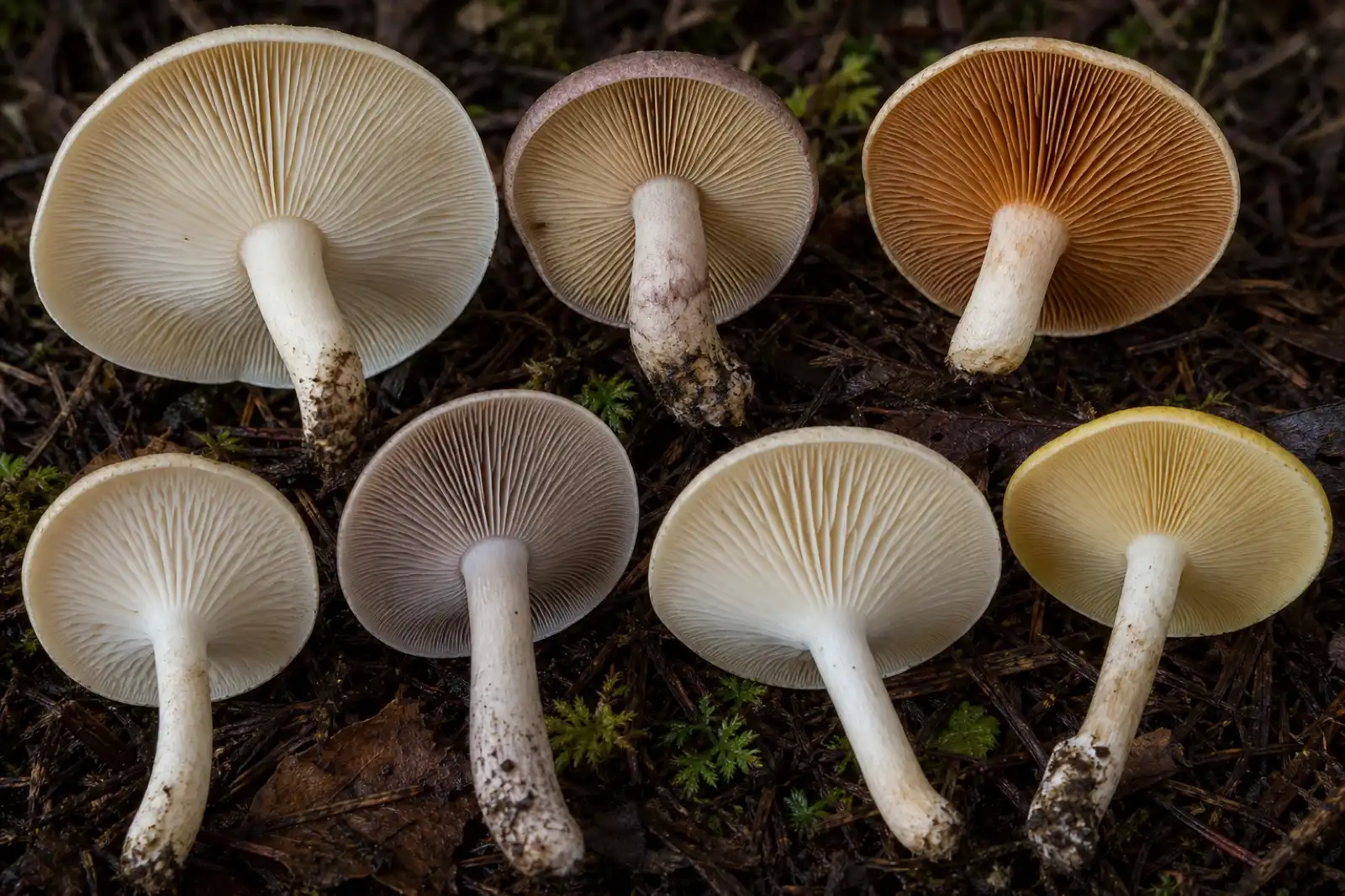
Gill attachment should be photographed while tissue is intact. Record whether gills meet the stem, their spacing, edge color, and any droplets. The gill-types guide helps standardize the view, but no attachment category identifies this species alone.
Make a dark-spore record with chain of custody
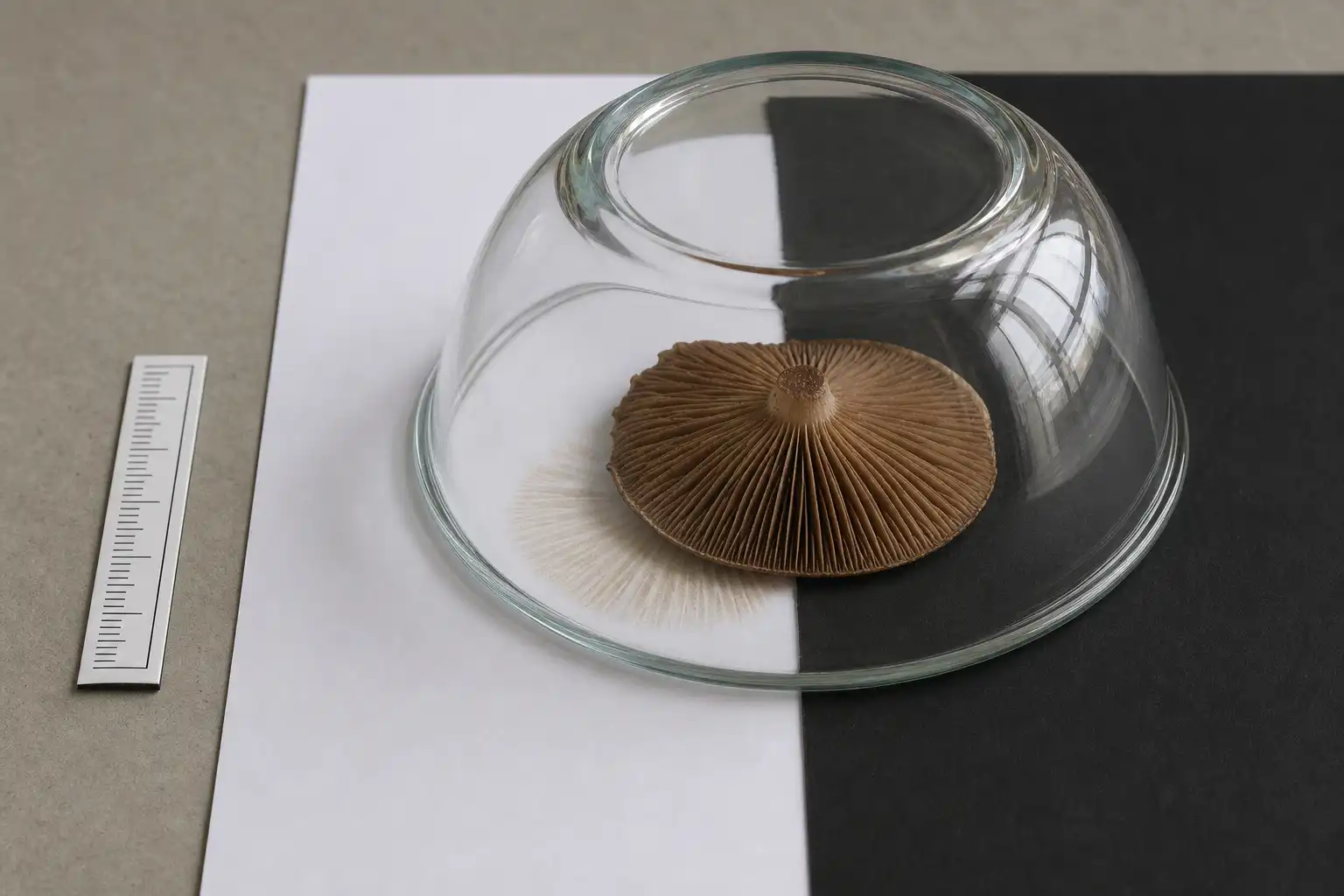
Place a mature cap over both pale and dark nonabsorbent surfaces. Protect it from drafts and retain the complete stem and field code beside the setup. A very dark brown to blackish-brown deposit supports the hypothesis, while a white, pink, or rusty-orange deposit redirects the identification.
Dark spores occur across many unrelated or related mushrooms. Record color in daylight, deposit thickness, and whether a wet gill smear contaminated the result. The spore-print method is useful only when the cap, stem, cluster photograph, and substrate remain linked.
Microscopy may be necessary. Report calibrated spore length and width, shape, germ pore, number measured, mounting medium, and relevant cystidia or cap-surface structures. A copied measurement range is not evidence observed from the collection.
Map disturbed soil and hidden organic matter
Weeping widows occur in lawns, gardens, path margins, woodland edges, parks, and wood-rich disturbed soil. Fruit bodies can appear terrestrial while feeding on buried woody fragments or enriched humus. Photograph the wider patch, gently expose one attachment, and record chips, roots, buried boards, compost, irrigation, and recent landscaping.
This is saprotrophic ecology, not a proven partnership with the nearest living tree. Note tree cover as habitat context, but distinguish it from the material directly attached to the fungus. A line of fruiting along a former stump or path bed can be more informative than one nearby trunk.
Urban and garden settings create exposure variables. Pet waste, pesticide treatment, road splash, treated timber, and imported mulch matter to condition and safety but do not identify the species. Keep those fields separate from morphology.
Separate weeping widow from common inky cap
Common inky cap usually forms tight clusters of smoother gray bell-shaped caps from stumps, roots, or buried wood. Its gills blacken and the cap margin deliquesces. It is also associated with a clinically important alcohol interaction. Weeping widow is tawny and conspicuously fibrillose, retains ragged veil evidence, may show gill-edge droplets, and should not undergo that same organized dissolution.
Use the common inky cap guide for that separate intent. Never transfer the inky cap’s food history, alcohol warning interval, or smooth gray appearance to a weeping-widow hypothesis. Family resemblance does not make toxicology interchangeable.
Mica caps and other clustered dark-spored fungi can further complicate the site. Keep attachment-level clusters separate and do not pool loose caps for printing. Wood substrate, cap granules, grooves, veil, deliquescence, spores, and microscopy need one chain of custody.
Treat the name as a regional hypothesis
Older sources may use Psathyrella velutina or related combinations for this mushroom. Preserve the exact name used by each record and check current databases rather than silently rewriting literature. A transfer between genera changes the label, not the photographs or voucher evidence.
Widely mapped names can conceal uncertain or historical identifications. Before claiming a regional range, check record date, geographic precision, identifier, voucher status, and whether the source reflects the modern concept. Stop at genus or family when the visible characters do not resolve the local alternatives.
Keep food decisions closed
Edibility labels for this species vary among popular sources, while the mushroom is fragile, difficult to separate from other dark-spored taxa, and often grows in contaminated disturbed ground. MushroomScope therefore treats it as unsuitable for food. That boundary is not a claim that every exposure causes poisoning; it is a decision not to convert uncertain identification into dietary advice.
Cooking does not repair a wrong name or remove every hazard. If illness follows an unknown mushroom exposure, contact local poison services or medical care and preserve uncooked specimens, trimmings, meal remains, photographs, location, amount, and timing. Severe symptoms require emergency care rather than an online identification.
Build an auditable collection record
- Photograph the undisturbed patch and substrate at several scales.
- Record cap fibers before rain or handling alters them.
- Preserve young marginal veil and the complete stem ring zone.
- Photograph gill color and droplets at fixed intervals.
- Link the spore deposit and any microscopy to one numbered specimen.
- Revisit to distinguish ordinary decay from true deliquescence.
- Compare local Psathyrellaceae and state missing evidence plainly.
This workflow prevents the cap of one mushroom, droplets of another, and spores of a third from becoming an imaginary specimen. A careful “consistent with Lacrymaria” record can be more valuable than an unsupported species claim.
Frequently asked questions in context
Are the gill droplets actually tears?
No. “Weeping” is a visual common name. The droplets are fungal or environmental moisture that may darken with spores; they do not imply sensation and are not unique to this species.
Why is the ring sometimes missing?
The veil is fragile. Expansion, rain, abrasion, slugs, and age can leave only scattered fibers or a spore-stained zone. Seek young specimens and report the evidence rather than forcing present or absent.
Can a lawn patch be cultivated?
Spontaneous fruiting from rich soil or buried debris is not controlled cultivation. A credible culture study needs authenticated material, sterile transfers, documented substrate and conditions, and verified fruit bodies; it should remain separate from food use.
References
- Global Biodiversity Information Facility. Lacrymaria lacrymabunda species record. Taxonomic backbone and occurrence context.
- National Center for Biotechnology Information. NCBI Taxonomy Browser — Lacrymaria lacrymabunda. Independent nomenclature checkpoint.
- North American Mycological Association. Mushroom Poisoning Syndromes. Conservative poisoning-response context.
- Natural History Museum. Lacrymaria lacrymabunda Species Dictionary. Accepted-name and historical-synonym context.
Editorial review: October 21, 2026. This page has editorial review only and no named mycologist, toxicologist, or clinician review. Taxonomy, distribution, lookalikes, and poison-response contacts should be rechecked at every substantive update.
Source quality notes
MushroomScope cites sources that match the page scope, such as taxonomic databases, extension guidance, food-safety agencies, food-composition databases, and peer-reviewed or institutional health references. Sources support context and uncertainty; they do not turn an online page into specimen identification, medical advice, or a tested recipe record.
Frequently asked questions
Why is it called the weeping widow mushroom?
Young and expanding gills can carry clear droplets that darken as spores accumulate, creating a tear-like appearance. The droplets are a developmental observation, not a unique species test.
What characters support Lacrymaria lacrymabunda?
A tawny fibrous cap, ragged pale veil at the margin, a fragile ring zone, mottled darkening gills with edge droplets, dark spores, and disturbed rich soil together support the hypothesis.
Is weeping widow an inkcap?
No. It is a dark-spored relative in Psathyrellaceae, but its cap does not normally digest into black ink like a deliquescing common inky cap.
Can gill droplets confirm the species?
No. Moisture, guttation, spores, age, and other species can produce droplets or wet gill edges. Veil, cap fibers, spores, substrate, microscopy, and region must also agree.
Is weeping widow safe to eat?
This page does not recommend it as food or clear any wild specimen. Identity, regional lookalikes, condition, contamination, and individual response require conservative local expertise.
Related guides
identification
Mushroom Gill Types: Attachment, Spacing, and Color
Compare free, attached, notched, adnate, and decurrent mushroom gills while recording spacing, short gills, edge details, bruising, and color changes.
identification
Mushroom Veils and Rings: Partial Veils, Cortinas, and Volvas
Document partial and universal veils, rings, cortinas, cap patches, and volvas across mushroom development without using any one remnant as an edibility test.
identification
How to Make and Read a Mushroom Spore Print
Make a controlled mushroom spore print, record the result clearly, and understand why a print supports—but never proves—an identification.
Continue exploring
Browse more practical guides in Mushroom Encyclopedia or visit the mushroom encyclopedia.