Mushroom Encyclopedia
Common Inky Cap: Alcohol Interaction, Habitat, and Lookalikes
Identify common inky cap by smooth gray clustered caps, buried-wood ecology, black deliquescence, and its important delayed alcohol interaction.
By MushroomScope Editorial Team · · Updated
Species context
Treat profiles as reference material
Species profiles summarize documented traits, taxonomy, and lookalikes, but natural variation can be substantial.
Use the safety checklist →Decision limit
A profile cannot authenticate a specimen
Do not eat a wild mushroom from an online match, single feature, or generated image.
Read the safety disclaimer →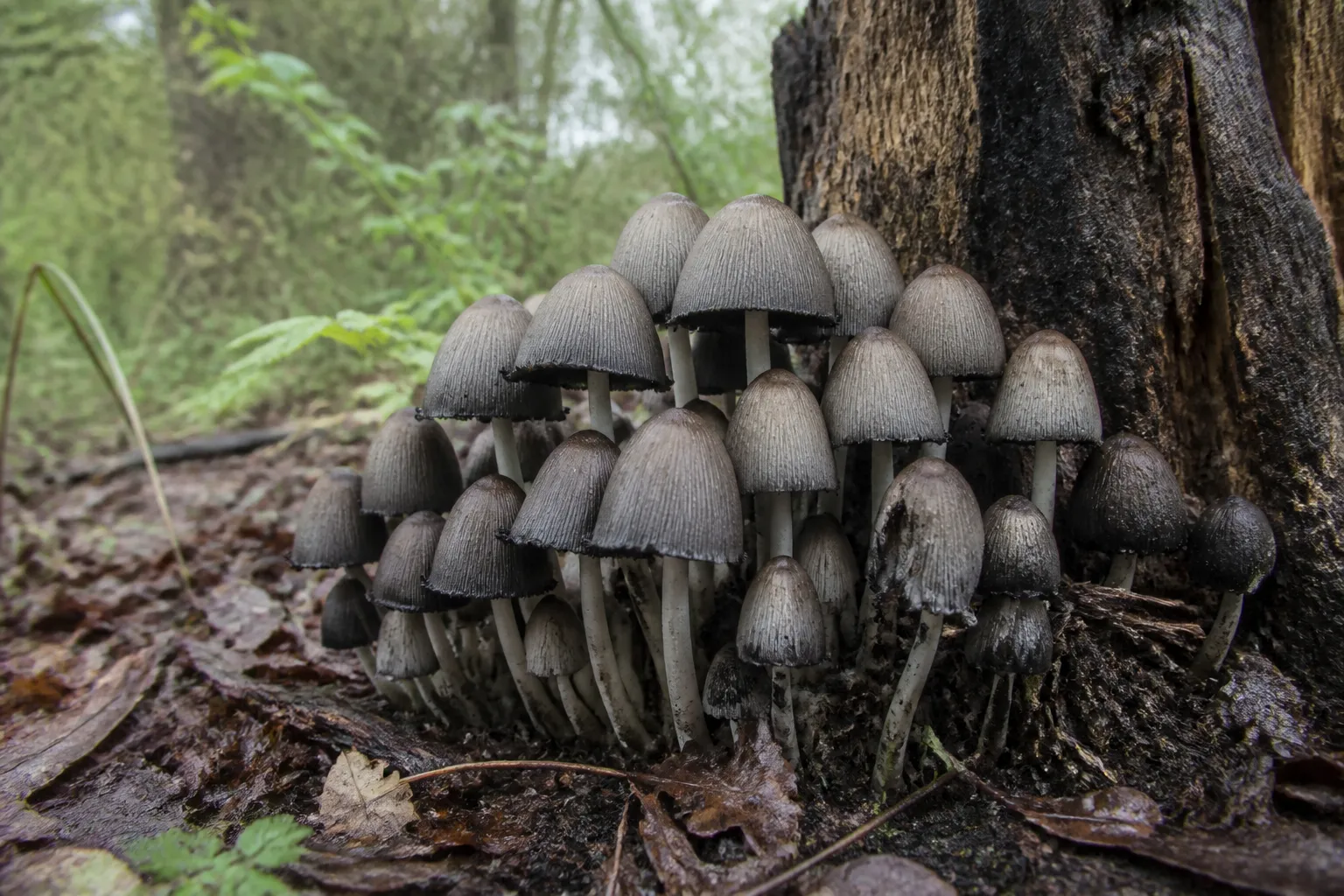
Quick facts
- Scientific name
- Coprinopsis atramentaria
- Common names
- Common inky cap, Common inkcap, Tippler's bane
- Taxonomy
- Coprinopsis · Psathyrellaceae
- Edibility context
- Conditional: Historical food use is overshadowed by a clinically important alcohol interaction and identification uncertainty; this guide does not recommend consumption.
- Spore print
- Black.
- Toxicity context
- High: Coprine-associated alcohol reactions can occur when alcohol is consumed around the exposure; NAMA notes reactions even days later.
- Season
- April, May, June, September, October, November
- Growing difficulty
- Not Cultivated
- Regions
- Europe, Asia, North America, temperate regions elsewhere
- Recorded synonyms
- Coprinus atramentarius
Safety limit: These labels summarize documented context; they never authenticate a wild specimen. Cooking does not make a poisonous species safe.
Common inky cap has two inseparable search intents: how to recognize the mushroom and why alcohol changes its risk. Treating it as merely another edible-looking ink cap hides the most important fact. Coprinopsis atramentaria is associated with a coprine syndrome in which alcohol around the exposure can provoke flushing, palpitations, racing heart, warmth, headache, and other symptoms.
This page therefore does not offer a “safe cooking” recipe or a universal waiting period. It explains the field profile, close comparisons, and the toxicology boundary so a reader knows when to stop.
The characteristic clustered profile
Fruit bodies commonly appear in dense troops with stems pressed together. Young caps are egg-shaped to elongated bells, smooth gray or gray-brown, and darker at the center. Fine radial grooves become more obvious as caps expand. Mature margins blacken and liquefy.
Clusters often seem to grow from soil but connect to buried roots or timber. Photograph the whole group before separating it. Growth habit is much less clear after twenty similar stems are placed in a basket.
Smooth cap rather than shaggy scales
The cap surface is comparatively smooth, sometimes with fine fibrils or limited veil remnants, but it does not carry the conspicuous upturned white scales of shaggy mane. Moisture can make it slightly glossy; drying can lighten the outer cap.
Color alone is weak. Gray-brown bell caps occur in several decomposer genera. Combine surface texture with cluster density, radial striation, gill progression, black spores, and the wood relationship.
Gill change and deliquescence
Crowded gills begin pale, turn gray, and then black as spores mature. The cap margin digests itself, producing black liquid that helps release spores. This change can progress quickly after collection.
Document young, middle-aged, and dissolving specimens. A black puddle cannot reveal the original cap texture, veil, or gill attachment. An entirely old collection may be recognizable as an ink-cap group without supporting a species-level identification.
Stem and base characters
The pale stem is smooth to finely fibrous, hollow, and usually lacks a persistent ring. There is no loose sac-like volva. Closely packed stems may curve outward as the cluster expands.
Lift the base with attached substrate where permitted. Look for dark decayed wood, roots, or a stump below the soil. Never trim a white mushroom’s base before dangerous comparisons have been considered.
Black spores are necessary but not specific
A mature cap can produce a black spore deposit. Use a cap that has darkened but not liquefied completely. The result supports an ink-cap hypothesis, but multiple related taxa have black spores.
Microscopic spore size, shape, germ pore, cystidia, and cap-veil features may be needed within difficult groups. A field guide should state that limit rather than inflate a black print into certainty.
Measure one cluster as a developmental series
A useful record separates change through time from variation between specimens. Mark three to five fruit bodies in one undisturbed cluster and record cap height, widest diameter, margin position, gill color, and the fraction of the rim that has liquefied. Repeat the photographs from the same angle after a fixed interval. Do not combine measurements from different clusters as though they describe one individual.
This series answers practical questions that a detached mature cap cannot. It shows whether grooves were present before expansion, whether the cap opened before deliquescence, and whether every member of the troop followed the same schedule. Include one ruler frame and one wider substrate frame; close-up images without the buried-wood context lose part of the identification evidence.
If the purpose is expert confirmation, retain one young, one intermediate, and one mature specimen separately labeled to the same collection number. A mixed bag of blackening caps destroys the age sequence and makes microscopic measurements harder to connect to the correct macroscopic stage.
Buried wood explains “soil” clusters
Common inky cap is a decomposer associated with stumps, roots, buried hardwood, gardens, path edges, and disturbed urban ground. A cluster beside a removed tree may follow the old root system for years.
Record whether a tree was recently removed, which hardwoods are nearby, and whether mushrooms trace a line or arc. Lawn treatment, road splash, pet use, and industrial history also matter if anyone proposes food use—though this page does not recommend it.
Development can be recorded over one day
Photograph a safe patch at fixed intervals without disturbing it. Young gray bells may expand and blacken within hours under warm moist conditions. This time series shows how one troop can look like several different mushrooms.
Developmental evidence is especially useful for separating a smooth common inky cap from a prematurely labeled “shaggy mane.” It also explains why transported specimens arrive in poor condition.
The coprine-alcohol interaction
NAMA describes an Antabuse-like syndrome associated with Coprinopsis atramentaria. Alcohol consumption can be followed by tachycardia, palpitations, tingling, warmth, flushing, headache, heavy limbs, and salivation. The mushroom meal and alcohol do not need to occur at the same moment.
NAMA notes that alcohol as much as five days after eating inky caps has triggered reactions. That observation is not permission to assume a precise five-day cutoff for every person. Exposure amount, identification, metabolism, medications, underlying conditions, and alcohol sources vary.
Hidden alcohol sources complicate advice
Alcohol may occur in beverages, cooking extracts, sauces, medicines, or other products. A reader cannot be given individualized clearance through a species article. The conservative editorial response is to avoid consuming this mushroom and seek current professional guidance after an exposure.
Do not intentionally “test” the interaction. A previous uneventful meal does not establish safety for a later collection, particularly when identification may differ.
Why the reaction can outlast the mushroom meal
Coprine is discussed as a precursor whose metabolite interferes with aldehyde dehydrogenase, an enzyme involved in alcohol metabolism. When that pathway is inhibited, acetaldehyde can accumulate after alcohol exposure and produce an Antabuse-like pattern. This mechanism explains why the question is not simply whether mushroom and alcohol were swallowed together. It does not provide a home method for measuring residual risk in an individual.
An exposure history should cover more than the obvious drink served with dinner. Record the mushroom meal date and amount, every later alcoholic beverage or alcohol-containing preparation, symptom onset, heart rate if safely available, medicines, and relevant health conditions. Preserve the collection evidence. Do not delay poison-center or medical advice while trying to calculate a personal clearance time from a general article.
The absence of symptoms after one exposure has several possible explanations: the mushroom may have been different, the dose may have varied, alcohol timing or amount may have differed, or the person may simply not have reacted on that occasion. None validates the next meal. Conversely, flushing and palpitations have other causes, so a clinician should evaluate the complete situation rather than accepting a self-assigned mushroom syndrome.
This is also why the page keeps Coprinopsis atramentaria separate from the entire ink-cap category. Common names and the shared habit of deliquescence do not prove identical chemistry. Toxicology statements should follow a defensible species determination, while unresolved clustered gray ink caps retain the more conservative avoidance boundary.
Symptoms require prompt professional advice
If symptoms occur after eating a wild mushroom, contact local emergency services or a poison center promptly. Report the mushroom and alcohol timeline. Keep uncooked specimens, trimmings, photographs, packaging, and meal leftovers for professional identification.
Do not self-diagnose coprine syndrome and assume every symptom will pass. Chest symptoms, fainting, breathing difficulty, severe vomiting, confusion, or any worsening condition require urgent assessment.
Shaggy mane is visually and chemically separate
Shaggy mane, Coprinus comatus, starts as a tall white cylinder covered in shaggy upturned scales. Common inky cap starts as a smoother gray-brown bell and usually forms tighter clusters from woody substrates. Both can yield a dark deposit, so use the mushroom spore-color guide as one documented character rather than treating blackening tissue as a complete identification.
Common-name overlap should never transfer an alcohol claim. NAMA lists shaggy mane among mushrooms with other reported alcohol-associated reactions but distinguishes the classic coprine syndrome. Conservative advice should acknowledge uncertainty rather than promise safety.
The dedicated shaggy mane guide follows the white scaled cylinder through its expanding and blackening stages. Use that comparison to test cap surface, young outline, growth pattern, and substrate—not to approve either collection for food.
Mica cap comparison
Mica caps, Coprinellus micaceus, are usually smaller and honey-brown. Fresh dry caps may carry sparkling veil grains resembling mica, although rain removes them. They also cluster on or near wood and deliquesce, making ecology alone insufficient.
Photograph cap granules before rain or handling, gill color by age, stem surface, and substrate. Species in these groups may require microscopy, and mixed fruitings on one stump are possible.
Closely related smooth inky caps
Names such as Coprinopsis romagnesiana and allied taxa may overlap in cap color and cluster form. Veil development, cap scales, spores, and regional taxonomy matter. A broad C. atramentaria group identification can be more defensible than a precise label based on one photo.
Do not turn ambiguity into false certainty because toxicology is inconvenient. If a smooth clustered inky cap cannot be resolved, the alcohol boundary should remain conservative.
A field-record sequence
- Photograph the entire cluster and nearby stump or tree history.
- Record exact substrate, land use, date, weather, and region.
- Photograph clean young cap surfaces and radial grooves.
- Capture pale, gray, and black gills at different ages.
- Preserve complete stems and bases from representative specimens.
- Make a black spore deposit before caps dissolve.
- Use microscopy and a regional key when close smooth ink caps remain plausible.
The identification safety checklist helps record missing evidence and prevents food use from driving the name.
Why this guide does not recommend eating it
Historical reports may label common inky cap conditionally edible without alcohol. That phrasing can understate delayed interaction, hidden alcohol sources, carcinogenicity concerns discussed by NAMA, close lookalikes, and individual variability. The user value here is a clear avoidance boundary, not a recipe.
Cooking does not remove every mushroom toxin or solve identification. A clean habitat and fresh cap do not neutralize coprine-associated risk.
Observation and ecological value
The species is useful for studying decomposition, buried root systems, and rapid cap development. A recurring garden cluster can be mapped and photographed without being eaten. Note whether fruiting follows an old stump footprint or appears after soil disturbance.
Leave enough specimens to complete spore release and support insects. Do not open dissolving material on kitchen surfaces.
Cultivation is not a beginner food project
Although the fungus is saprotrophic, multiplying it for food would magnify the identification and toxicology problem. Beginners should choose authenticated species with established cultivation and handling standards.
The beginner growing guide provides safer project comparisons. Never clone an unidentified inky cap into grain intended for food production.
Image and editorial limits
The cover is an original AI editorial illustration checked for smooth gray clustered caps, radial grooves, woody substrate, pale stems, natural scale, and distinction from shaggy mane. It is not a voucher image and cannot determine identity or alcohol risk.
Review status is editorial. No named toxicologist or clinician reviewed this draft, and no passage should be read as diagnosis or treatment advice.
Frequently asked questions
Does boiling remove the alcohol interaction?
This guide makes no detoxification claim. Cooking is not a reliable way to erase the species’ toxicology boundary.
Is one drink enough to trigger symptoms?
Individual exposure and response vary. Do not test a threshold; contact a poison center or clinician after a concerning exposure.
Can common inky cap grow without visible wood?
Yes. Roots and timber may be buried beneath soil or turf, so document tree and stump history.
Are black gills proof of common inky cap?
No. Many ink-cap relatives develop black gills and deliquesce. Cap veil, cluster form, substrate, spores, region, and microscopy matter.
Can an app assess alcohol risk from a photo?
No. It cannot verify identity, dose, hidden alcohol exposure, medications, or individual health factors.
References
- Global Biodiversity Information Facility. Coprinopsis atramentaria species record. Used to check the accepted name and occurrence-record context; a database record does not identify a reader’s specimen.
- National Center for Biotechnology Information. Taxonomy Browser: Coprinopsis atramentaria. Used for the current taxonomic lineage and synonym check.
- North American Mycological Association. Mushroom Poisoning Syndromes: Coprine. Direct support for the implicated species, symptom pattern, delayed alcohol interaction, and NAMA’s conservative avoidance advice.
- U.S. Food and Drug Administration. Selecting and Serving Produce Safely. General handling context for verified produce; it does not establish identity or make common inky cap a recommended food.
Editorial review: September 8, 2026. No named toxicologist or clinician reviewed this page. Recheck toxicology wording, accepted taxonomy, and emergency contacts at every substantive revision.
Source quality notes
MushroomScope cites sources that match the page scope, such as taxonomic databases, extension guidance, food-safety agencies, food-composition databases, and peer-reviewed or institutional health references. Sources support context and uncertainty; they do not turn an online page into specimen identification, medical advice, or a tested recipe record.
Frequently asked questions
What does common inky cap look like?
It usually forms dense clusters of smooth gray to gray-brown bell-shaped caps with radial grooves, pale hollow stems, crowded gills, and margins that blacken and dissolve.
Why is alcohol dangerous with common inky cap?
The species is associated with a coprine syndrome in which alcohol consumed around the mushroom exposure can trigger flushing, racing heart, palpitations, warmth, and other symptoms.
How long can the alcohol interaction remain relevant?
NAMA reports reactions when alcohol was consumed as much as five days after eating inky caps. This page does not provide individualized clearance or a guaranteed safe interval.
How is common inky cap different from shaggy mane?
Common inky cap has smooth gray clustered bells, often from buried wood; shaggy mane begins as a tall white cylindrical cap covered with conspicuous upturned scales.
Can common inky cap be safely identified online for food?
No. Regional lookalikes, mixed clusters, developmental change, alcohol exposure, contaminants, and individual health factors require conservative in-person expertise.
Related guides
identification
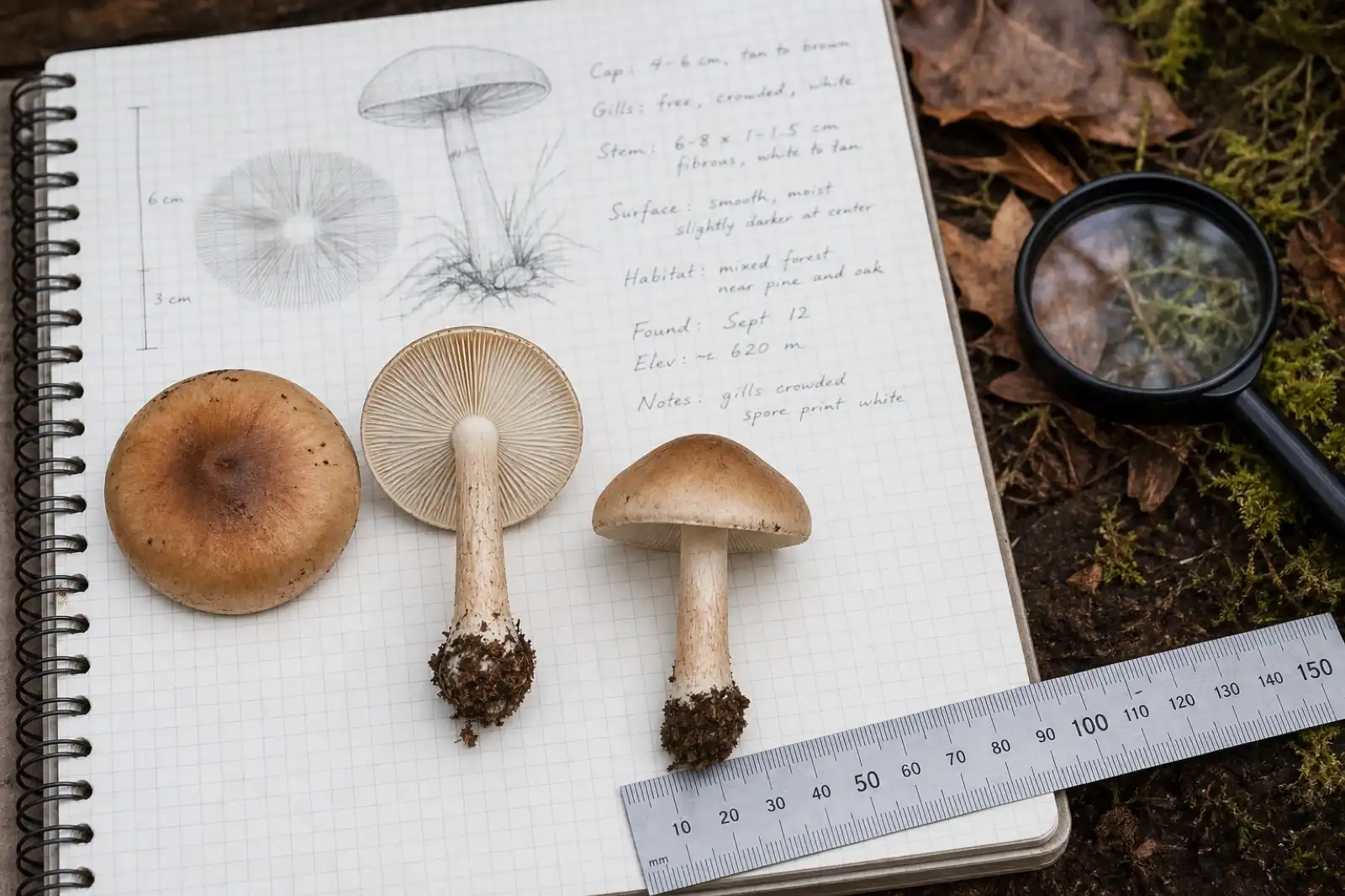
How to Identify Mushrooms: A Beginner's Field Guide
Build an identification from the whole specimen, substrate, habitat, spore deposit, and location—not from a single photograph.
identification
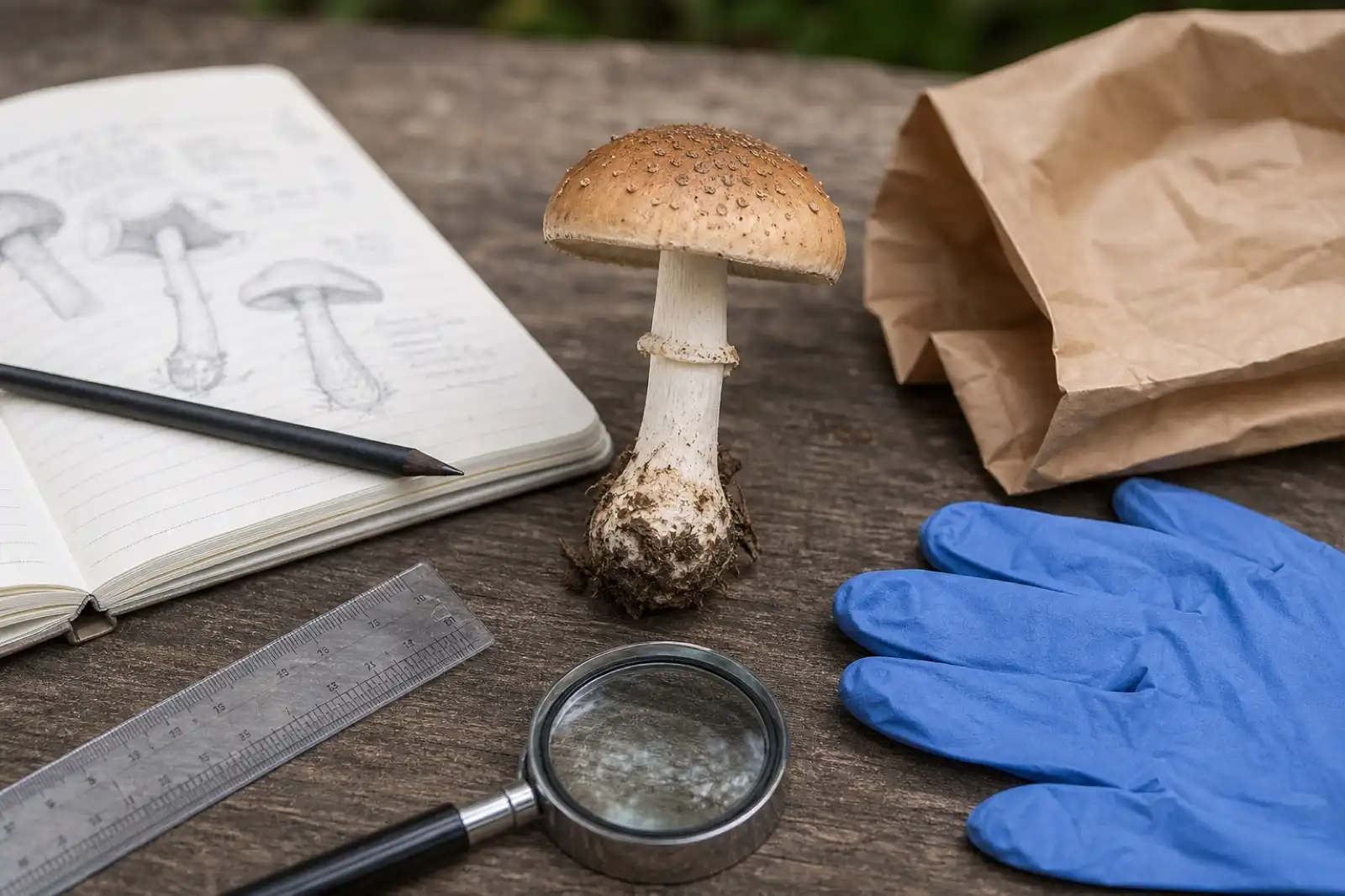
Mushroom Identification Safety Checklist
Use a conservative checklist before handling, documenting, or discussing any wild mushroom, especially when edibility is being considered.
identification
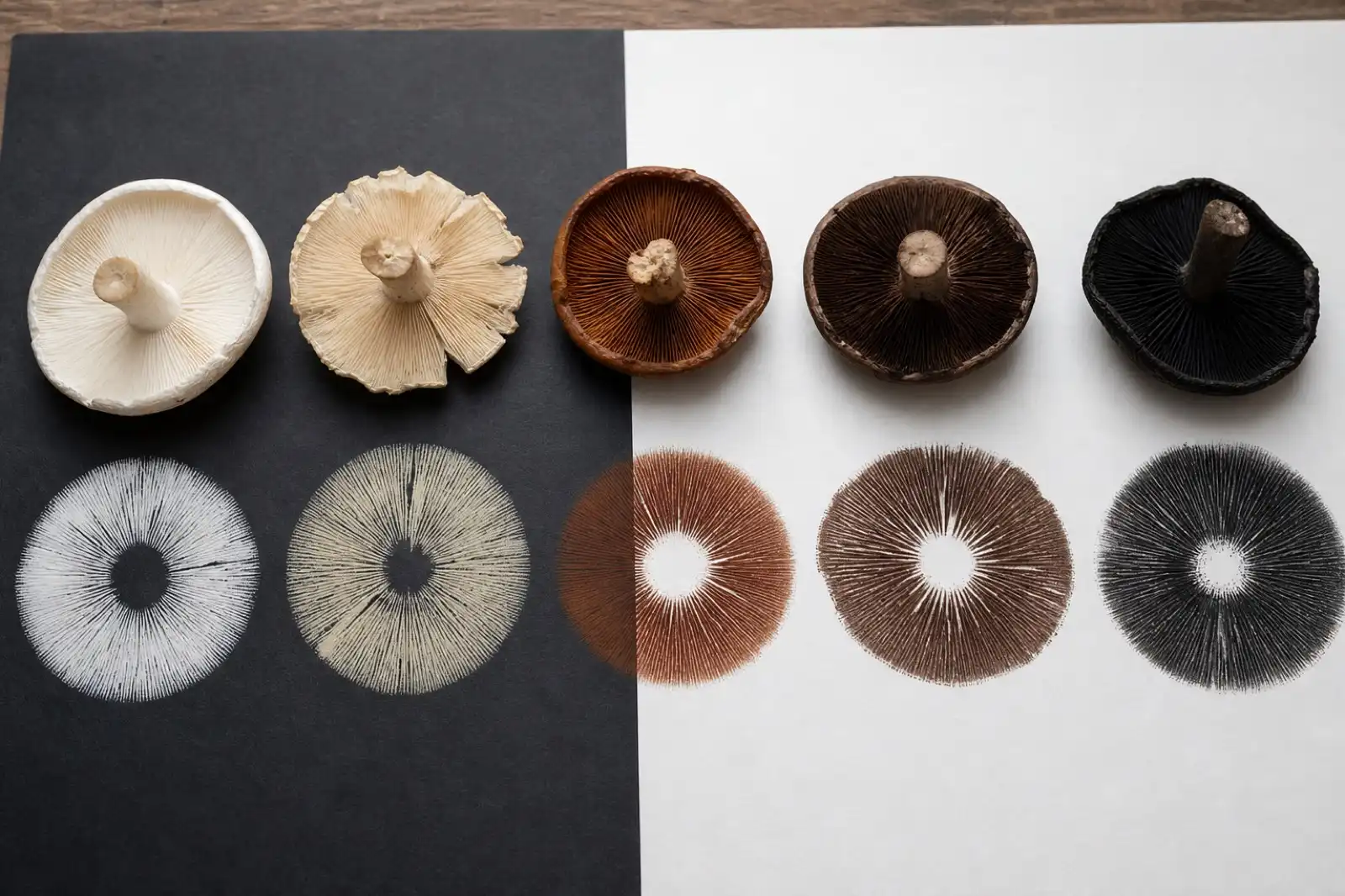
Mushroom Spore Print Colors and How to Record Them
Use a controlled spore deposit to distinguish broad color groups while recognizing that print color alone never identifies a species.
Continue exploring
Browse more practical guides in Mushroom Encyclopedia or visit the mushroom encyclopedia.