Mushroom Encyclopedia
Wrinkled Peach Mushroom: Reticulate Caps and Deadwood Ecology
Document wrinkled peach mushrooms by pink reticulate caps, pale gills, eccentric stems, hardwood attachment, moisture response, range, and lookalikes.
By MushroomScope Editorial Team · · Updated
Species context
Treat profiles as reference material
Species profiles summarize documented traits, taxonomy, and lookalikes, but natural variation can be substantial.
Use the safety checklist →Decision limit
A profile cannot authenticate a specimen
Do not eat a wild mushroom from an online match, single feature, or generated image.
Read the safety disclaimer →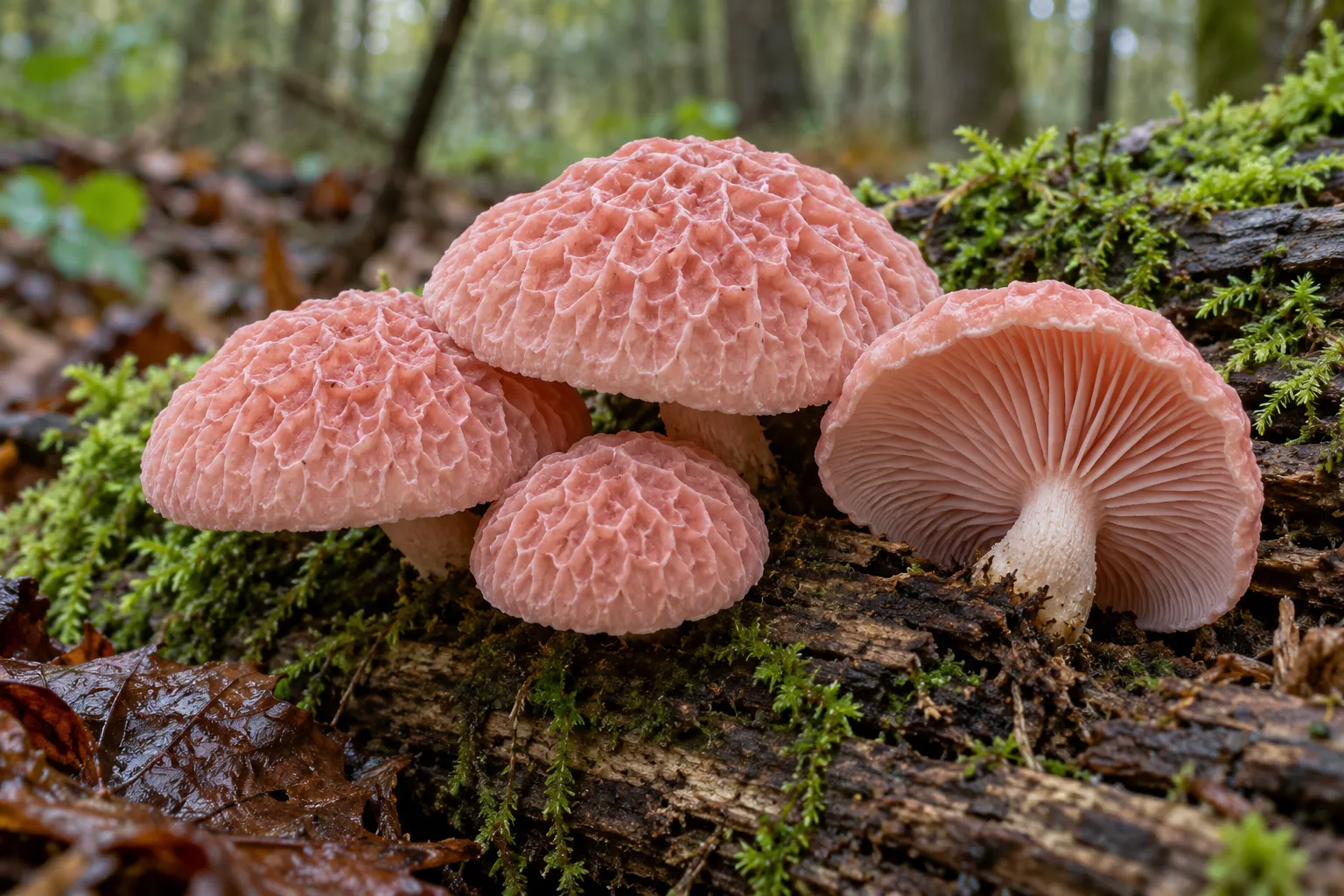
Quick facts
- Scientific name
- Rhodotus palmatus
- Common names
- Wrinkled peach, Netted rhodotus, Rosy veincap
- Taxonomy
- Rhodotus · Physalacriaceae
- Edibility context
- Unknown: No food recommendation is made; correct identity, freshness, substrate exposure, and local guidance require more than a visual web comparison.
- Spore print
- Pinkish to salmon buff.
- Toxicity context
- Unknown: Absence of a prominent poisoning history is not evidence of safety. Treat an unknown ingestion through local poison or medical services.
- Season
- August, September, October, November, December
- Growing difficulty
- Expert
- Regions
- Europe, North America, temperate Asia, other regions supported by verified vouchers
Safety limit: These labels summarize documented context; they never authenticate a wild specimen. Cooking does not make a poisonous species safe.
Begin with relief, not pink color
The memorable feature of the wrinkled peach is not simply a pink cap. Fresh, hydrated caps can carry raised ridges that intersect into an irregular network, with lower translucent-looking valleys between them. Photograph the surface under soft side light so the relief is visible without aggressive sharpening. Record cap diameter and count ridge intersections across a fixed one-centimeter line rather than describing every textured pink mushroom as “netted.”
Weather can alter the signal. Saturated caps may look gelatinous and deeply veined, while drying can flatten the network, pale the color, and make the surface look merely puckered. Very young or old fruit bodies may not show the textbook pattern. A useful record therefore joins cap relief to gills, stem position, wood attachment, developmental stage, spore deposit, region, and—when a consequential record is being made—microscopy or a preserved voucher.
Photograph the wood attachment before moving anything
Rhodotus is a wood decomposer. Show the fruit body meeting the substrate, including whether the stem is central, eccentric, lateral, or apparently absent because it emerges from a vertical face. Record whether the wood is a standing snag, stump, fallen trunk, buried fragment, or worked timber. A cap placed on a log for photography destroys this ecological evidence, so make an in-place series first.
The species is frequently associated with elm in literature and records, but “on elm” is supporting evidence rather than a diagnosis. Photograph bark, end grain, leaves or buds when present, and the surrounding trees. State host confidence as confirmed, probable, possible, or unknown. The habitat documentation guide provides a way to separate direct attachment from a tree that merely stands nearby.
Read the gills and stem as a connected structure
Turn one intact mature fruit body without detaching the cap from its stem. The gills are crowded and typically pale pinkish, cream-pink, or salmon tinted. Record their attachment at the stem and whether apparent decurrence is genuine or caused by a tilted, short stem. Include a close view of the gill edges and note bruising, droplets, insect grazing, and age-related discoloration.
The stem can be central on a horizontal log and strongly off-center on a vertical face. That plasticity is an expected response to growth orientation, not automatically evidence of two species. Measure stem length and width, photograph its surface, and retain the basal connection. A short stem hidden behind the cap should not be reported as absent.
Use a developmental series instead of one ideal cap
Number three to five fruit bodies spanning button, expanding, and mature stages. Measure cap width, ridge prominence, stem position, and gill color for each. Young caps may be more domed and smooth; expanding caps can develop the strongest network; weathered caps may lose relief or split. A table exposes that progression more honestly than selecting only the most photogenic specimen.
Return after rain if the site can be revisited without damage. Photograph the same numbered cap from the same angle and note precipitation, air temperature, and hours since rainfall. The purpose is not to derive a universal moisture formula. It is to separate reversible hydration changes from growth, decay, slug damage, or camera processing.
Distinguish netted relief from scales and cracking
A reticulate surface is made of connected raised ridges. Scales are discrete pieces of surface tissue, while drought cracks divide tissue into blocks. Use a macro view that crosses several features and a side-lit profile that shows whether material is raised, detached, or split. Do not scrape a rare or small colony simply to prove texture.
The rooting shank guide covers a different wrinkled-cap pattern: brownish radial wrinkles paired with a long rooting stem arising from soil over buried wood. Porcelain fungus can share beech wood, translucency, and pale gills, but its cap is smooth and conspicuously slimy rather than pink and reticulate. Pink oyster clusters have a different shelf-like body plan and strongly decurrent gills.
Describe decay stage and microclimate
Estimate wood decay with observable criteria: bark retention, resistance to a blunt probe, visible cubical or fibrous breakdown, moss cover, and whether the log holds its form when gently pressed. Do not assign a numbered decay class unless the scale is named. Photograph a cross-section only where an existing break exposes it; avoid cutting habitat for a routine observation.
Map shade, slope, ground contact, nearby water, and airflow. A log suspended above soil dries differently from one embedded in wet leaf litter. Repeated fruiting on one piece of wood can reveal a narrow moisture window, but it does not establish a global seasonal rule. Link each revisit to rainfall and temperature records rather than saying the species “likes rain” without scale.
Treat distribution maps as leads, not identification
Occurrence portals combine preserved specimens, photographs, literature records, and datasets with different verification. Filter by basis of record, institution, date, coordinate quality, and whether a voucher or image can be checked. A nearby point raises plausibility; it cannot name a new collection. An empty map area may reflect limited collecting or data sharing rather than genuine absence.
Rhodotus has attracted conservation attention in parts of its range because suitable mature decayed hardwood and humid woodland conditions can be patchy. Do not convert a regional status into a global claim. Check current local red lists and collecting rules before removing material, and prefer photographs plus a minimal voucher only when a legitimate scientific purpose and permission justify it.
Collect spores without manufacturing certainty
Place a mature cap over contrasting surfaces while preserving its orientation and allowing limited airflow. A pinkish or salmon-buff organized deposit supports the Rhodotus hypothesis but is not unique. Condensation, cap pigment, and gill fragments are not a spore print. Label the cap, deposit, field number, and time together.
Microscopy may examine spore dimensions and ornamentation, gill cystidia, cap structure, and clamp connections under a current regional treatment. Report calibration, mount medium, sample size, range, and the structure measured. Values copied from a guide are expectations, not observations. If DNA is used, connect the sequence to the same photographed voucher and report locus, quality, database date, and competing matches.
Keep food decisions outside a visual match
This page does not recommend eating wrinkled peach mushrooms. A visually plausible name does not resolve local taxonomy, old or contaminated wood, decay, individual sensitivity, or the reliability of a historical edibility statement. Do not taste an unknown specimen as an identification test, and do not transfer advice from pink oyster mushrooms merely because both can be pink and wood-associated.
If an unknown mushroom has been eaten, contact the relevant poison center or medical service rather than waiting for a crowdsourced name. Preserve uncooked material, cooked leftovers, photographs, collection location, estimated amount, time eaten, and symptom timeline. Do not induce vomiting unless a qualified service directs it.
Build a claim-ready observation packet
A strong packet contains an in-place habitat view, whole-log context, direct attachment, cap surface under neutral light, underside, stem, measurements from multiple stages, spore-deposit evidence, host-confidence notes, weather context, and a dried voucher where permitted. Give every item the same field number. Keep edited photographs separate from originals and disclose color or contrast adjustments.
Before publishing a species-level claim, write one paragraph for Rhodotus and one for the strongest alternative. Identify the evidence that contradicts each hypothesis. If substrate, gills, or spore evidence is missing, use a broader label and state what would resolve it. An honest genus-level or provisional observation is more useful than a confident name built from one dramatic cap texture.
Audit photographs for color and surface artifacts
Pink caps are vulnerable to misleading processing. Save a raw or unedited original, include a neutral gray reference in one frame, and record whether the camera applied vivid color, portrait blur, HDR, noise reduction, or computational macro stacking. Review the cap edge at full size for halos and repeated texture. Sharpening can turn gentle folds into false scales, while stacking errors can invent seams across gills or duplicate a ridge.
Make a second series in open shade rather than mixing flash, warm sunlight, and forest-green reflected light. If white balance is corrected, disclose the reference and retain the original. Color supports the identification only after anatomy and substrate are established. A careful report may describe salmon, peach, rose, or pinkish buff across different fruit bodies instead of forcing every pixel into one named shade.
The editorial image on this page is an original AI-assisted illustration, not a photographed collection. It is designed to show the intended combination of reticulate cap, pale gills, short stems, and hardwood context, but it cannot document natural variation or prove a field name. Readers should compare real specimens with current regional keys, verifiable vouchers, and locally appropriate expertise.
Frequently asked questions
Why is it called the wrinkled peach mushroom?
Fresh caps can be peach-pink and crossed by raised intersecting ridges that make a netted or wrinkled surface, although moisture, age, and weather can weaken that pattern.
What wood does Rhodotus palmatus grow on?
It is a saprotroph of well-decayed hardwood, historically associated strongly with elm but also reported on other broadleaf hosts; direct attachment and host confidence should be recorded.
Are the gills pink?
The crowded gills are commonly pale pinkish to salmon or cream-pink and attach to the stem; cap color alone is not sufficient for identification.
Can a smooth pink cap still be Rhodotus palmatus?
Possibly. The reticulate relief varies with hydration and development, so substrate, gills, stem position, spore evidence, microscopy, and region must be considered together.
Is wrinkled peach edible?
This guide makes no food recommendation. An online comparison cannot verify a collection, and edibility reports do not resolve identity, condition, contamination, or individual response.
References
Source quality notes
MushroomScope cites sources that match the page scope, such as taxonomic databases, extension guidance, food-safety agencies, food-composition databases, and peer-reviewed or institutional health references. Sources support context and uncertainty; they do not turn an online page into specimen identification, medical advice, or a tested recipe record.
Frequently asked questions
Why is it called the wrinkled peach mushroom?
Fresh caps can be peach-pink and crossed by raised intersecting ridges that make a netted or wrinkled surface, although moisture, age, and weather can weaken that pattern.
What wood does Rhodotus palmatus grow on?
It is a saprotroph of well-decayed hardwood, historically associated strongly with elm but also reported on other broadleaf hosts; direct attachment and host confidence should be recorded.
Are the gills pink?
The crowded gills are commonly pale pinkish to salmon or cream-pink and attach to the stem; cap color alone is not sufficient for identification.
Can a smooth pink cap still be Rhodotus palmatus?
Possibly. The reticulate relief varies with hydration and development, so substrate, gills, stem position, spore evidence, microscopy, and region must be considered together.
Is wrinkled peach edible?
This guide makes no food recommendation. An online comparison cannot verify a collection, and edibility reports do not resolve identity, condition, contamination, or individual response.
Related guides
mushrooms
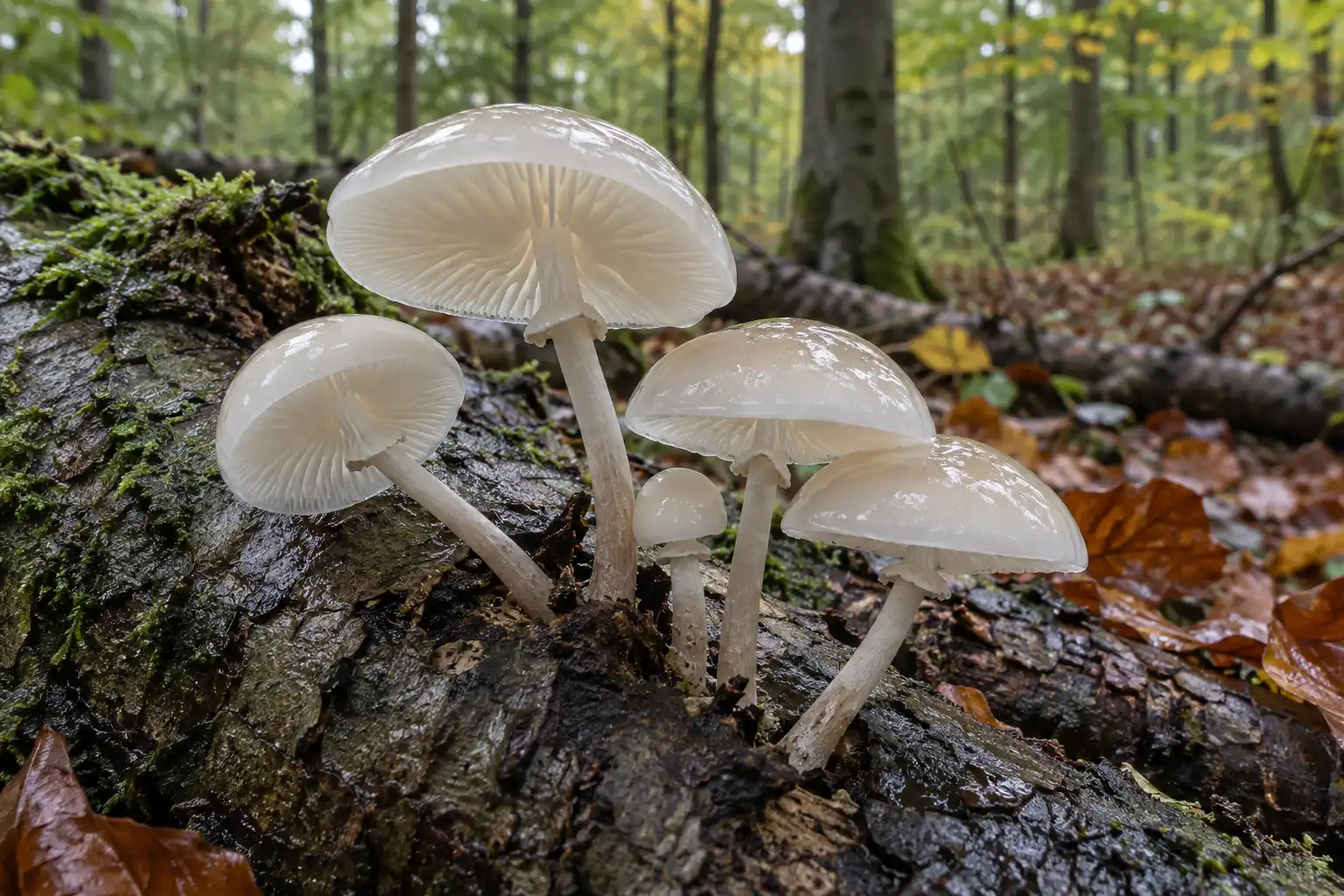
Porcelain Fungus (Mucidula mucida): Identification Guide
Identify porcelain fungus by its translucent slimy cap, white gills, ringed stem, beech-wood habitat, growth orientation, season, and lookalikes.
mushrooms
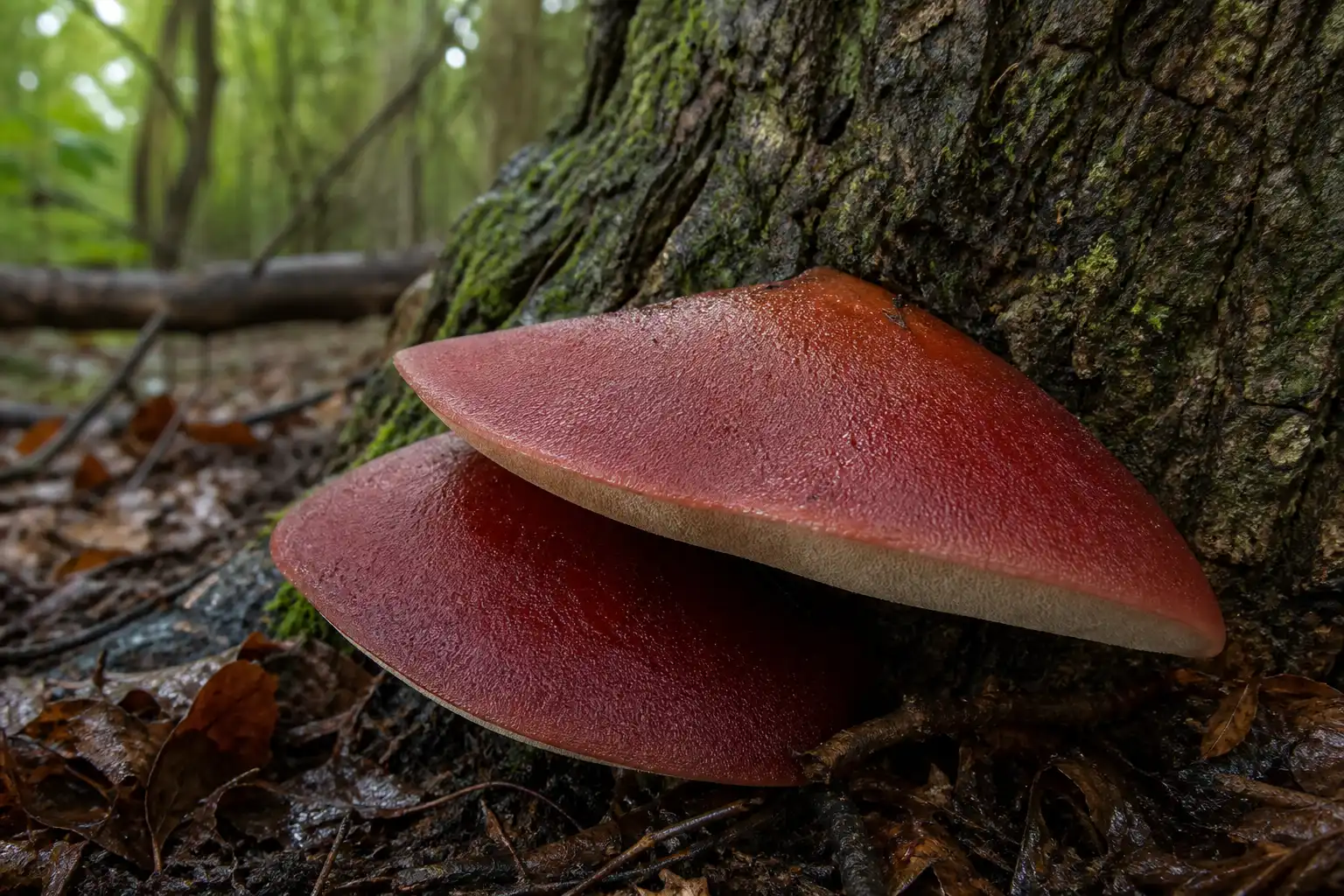
Beefsteak Fungus: Oak Ecology, Pores, and Lookalikes
Document beefsteak fungus by its red tongue-shaped brackets, separate tubes, pale pores, oak or chestnut host, white rot, and regional lookalikes.
mushrooms
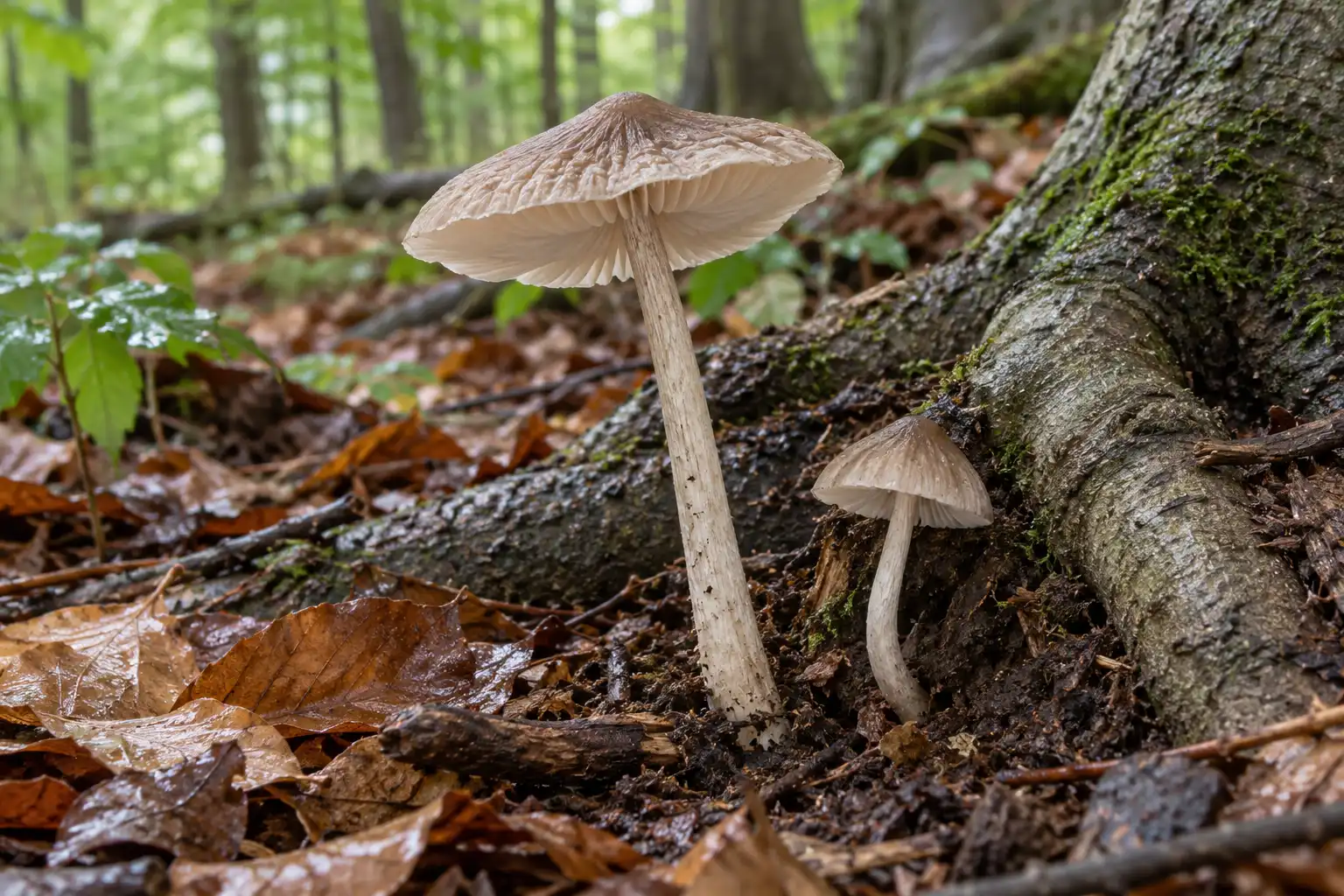
Rooting Shank Mushroom: Pseudorhiza, Cap, and Habitat
Document rooting shank by wrinkled tan caps, white gills, ringless stems, a buried pseudorhiza, woody attachment, and regional lookalikes.
Continue exploring
Browse more practical guides in Mushroom Encyclopedia or visit the mushroom encyclopedia.