Mushroom Encyclopedia
Rooting Shank Mushroom: Pseudorhiza, Cap, and Habitat
Document rooting shank by wrinkled tan caps, white gills, ringless stems, a buried pseudorhiza, woody attachment, and regional lookalikes.
Species context
Treat profiles as reference material
Species profiles summarize documented traits, taxonomy, and lookalikes, but natural variation can be substantial.
Use the safety checklist →Decision limit
A profile cannot authenticate a specimen
Do not eat a wild mushroom from an online match, single feature, or generated image.
Read the safety disclaimer →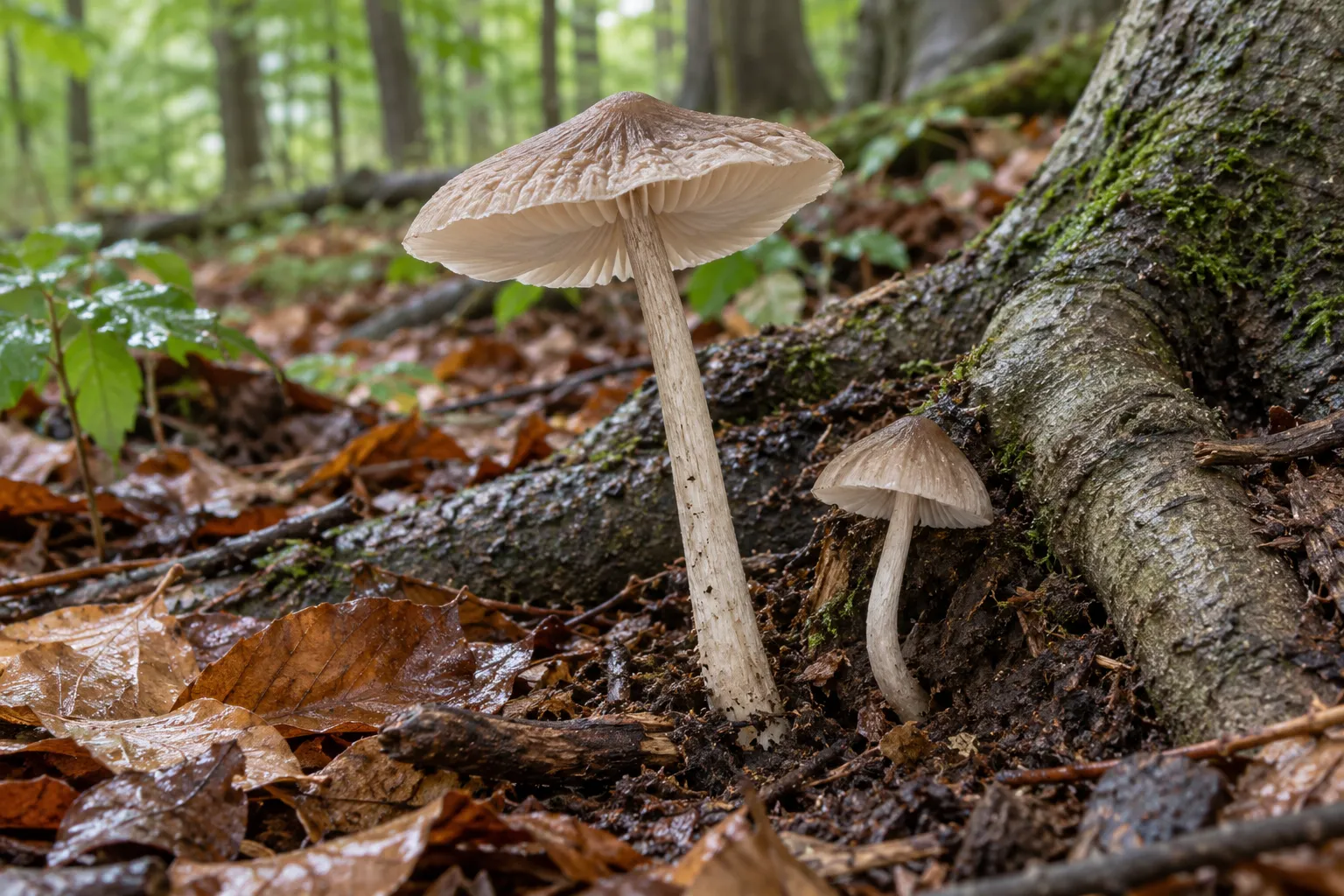
Quick facts
- Scientific name
- Hymenopellis radicata
- Common names
- Rooting shank, Rooting oudemansiella, Deep root mushroom
- Taxonomy
- Hymenopellis · Physalacriaceae
- Edibility context
- Unknown: Food reports do not substitute for certain identity, local taxonomy, clean habitat, freshness, and expert confirmation.
- Spore print
- White.
- Toxicity context
- Unknown: No remote image can clear an intact collection, and long-stemmed pale-gilled lookalikes include species with different risk profiles.
- Season
- June, July, August, September, October, November
- Growing difficulty
- Expert
- Regions
- Europe, temperate Asia, records interpreted regionally in the Northern Hemisphere
Safety limit: These labels summarize documented context; they never authenticate a wild specimen. Cooking does not make a poisonous species safe.
The rooting shank mushroom turns an apparently ordinary woodland agaric into a lesson about hidden substrate. The name commonly refers to Hymenopellis radicata, a tall ringless mushroom with white gills, a tan to gray-brown wrinkled cap, and a stem that continues below ground as a long tapering pseudorhiza. That buried extension connects to decaying roots or wood; it is not a plant root.
A cap photograph misses the most important evidence. A responsible record shows the intact above-ground mushroom, the carefully exposed pseudorhiza when collection is lawful, surrounding trees, buried wood, gill attachment, spore color, and regional limits. This page explains that workflow without treating it as food clearance.
Record the untouched mushroom before excavation
Begin with habitat photographs at three scales: woodland setting, the mushroom in relation to a tree or stump, and the complete visible fruit body. Measure the height above ground, cap width, distance to the nearest trunk, slope, soil cover, and whether buried woody fragments are visible.
The stem often looks unusually long even before excavation. Do not pull it. A quick tug usually snaps the narrow underground extension and erases the feature behind the common name. Mark the soil line on a photograph, then loosen soil gradually around one side with a small tool when site rules allow.
If collecting is prohibited or would damage roots, leave the mushroom in place. “Pseudorhiza not examined” is a valid limitation. A protected site does not become exempt because an underground character would be useful.
Expose the pseudorhiza without calling it a root
The visible stem narrows below soil and may continue for a surprising distance toward buried wood. This tapering extension is the pseudorhiza. Follow it laterally as well as downward; buried roots and branches rarely align with the photographer’s preferred direction.
Document its length, width at the soil line, taper, branching or lack of branching, color, texture, and final attachment. It may terminate at a buried root, stump fragment, branch, or highly decayed wood that resembles dark soil. Photograph the connection before detaching it.
A broken tapered base can still support a rooting habit, but it cannot demonstrate the full attachment. Label the break honestly. Do not reconstruct missing length from a hole or from another specimen in the group.
The habitat identification guide explains why visible soil is not necessarily the nutritional substrate. Rooting shank is a useful example: the fruit body appears terrestrial while the fungus is using buried woody material.
Read the moist, wrinkled cap
Caps are often tan, gray-brown, or warm brown with a broad darker umbo. Moist surfaces can look glossy, and radial wrinkles or vein-like ridges may be conspicuous around the center. The margin can become paler and weakly translucent when hydrated.
Photograph the cap in diffuse natural light. Include an oblique angle so that the umbo and relief are visible; a straight overhead image can flatten the wrinkles. Record recent rain, surface moisture, cap diameter, color distribution, and any cracking or insect damage.
Drying changes the cap. Gloss can disappear, wrinkles may look sharper, and colors may pale. A dry smooth-looking specimen should not be forced into or out of the identification on texture alone. Compare multiple fruit bodies and describe actual hydration.
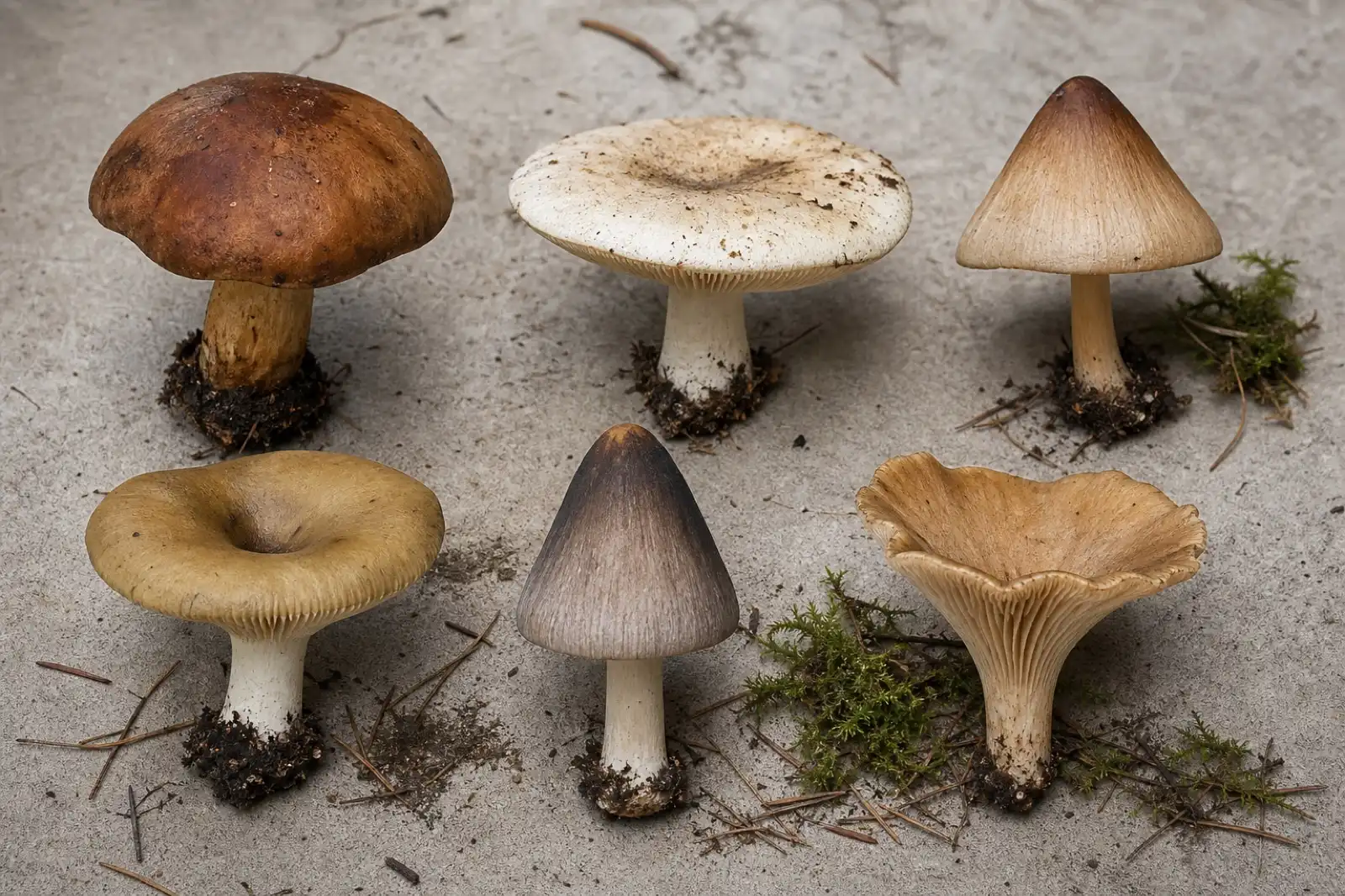
The cap-shapes guide provides terms for convex, broadly convex, plane, and umbonate profiles. Use measurements and profiles rather than metaphors such as “umbrella-like,” which fit many unrelated mushrooms.
Photograph the broad white gills and their junction
Turn the cap carefully without breaking the underground stem. Gills are white to cream, broad, and often relatively well spaced. Record whether they meet the stem broadly, narrowly, or with a notch. A vertical section through the center can clarify the junction after in-place photographs are complete.
Do not confuse a torn junction with naturally free gills. The deer mushroom guide describes Pluteus, whose free gills mature pink and produce a pink-brown print. Rooting shank retains pale gills and a white deposit.
Photograph young and mature specimens. Persistent white gills across maturity are more useful than whiteness in a young cap, because many pink- or brown-spored mushrooms begin pale before spores accumulate.
Make a white spore print carefully
Place a mature cap across dark and white nonabsorbent surfaces, cover it, and label it. A heavy deposit should be white. Sparse spores on white paper can be invisible, while condensation can mimic a pale halo, so use the dark half to confirm density.
A white print supports the identification pathway but is not specific. Many woodland agarics share it. Keep the result tied to the wrinkled umbonate cap, ringless fibrous stem, buried pseudorhiza, gill attachment, region, and microscopy.
Do not combine caps from separate locations on one printing surface. A print must stay traceable to one numbered collection if it is to support later expert review.
Describe the stem above and below the soil line
The aerial stem is long, slender, and fibrous, pale near the top and sometimes browner below. It lacks a ring and volva. Photograph every side, including the soil line, because texture and color can shift along its length.
Cut one documented specimen lengthwise after the pseudorhiza is exposed. Record whether the interior is solid, stuffed, or hollow; how fibrous it is; and whether any color changes occur. The tough stem texture sometimes contrasts with a thin cap, but texture alone does not establish identity.
An intact base should not show a membranous cup. A volva would redirect the comparison toward other groups and would be a serious safety signal. A ring or clear ring zone also demands a different pathway rather than being dismissed as debris.
Distinguish lookalikes by hidden and visible characters
Other Hymenopellis species
Several long-stemmed species share a rooting base and pale spores. Field appearance may overlap strongly. Specialists compare cap-cuticle cells, spore dimensions, cystidia, clamp connections, geography, and DNA. When these data are absent, a genus-level or group-level record may be more defensible than H. radicata.
Deer mushroom
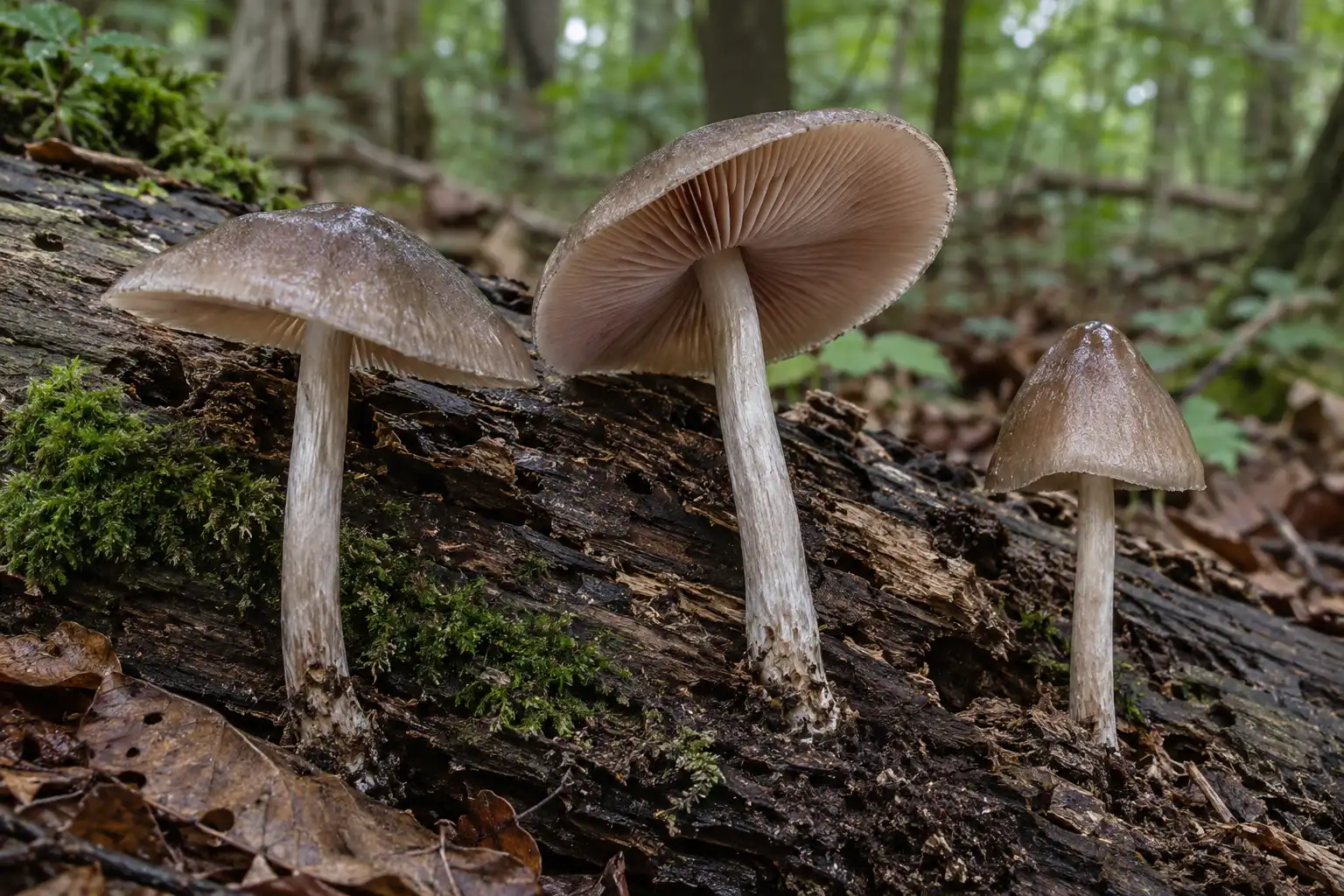
Brown Pluteus can grow from buried wood and appear to rise from soil. Its gills are truly free, mature pink, and yield a pink-brown print. It lacks the characteristic deep tapering pseudorhiza. Excavation, gill junction, and spore color prevent an overhead cap resemblance from controlling the decision.
Porcelain fungus
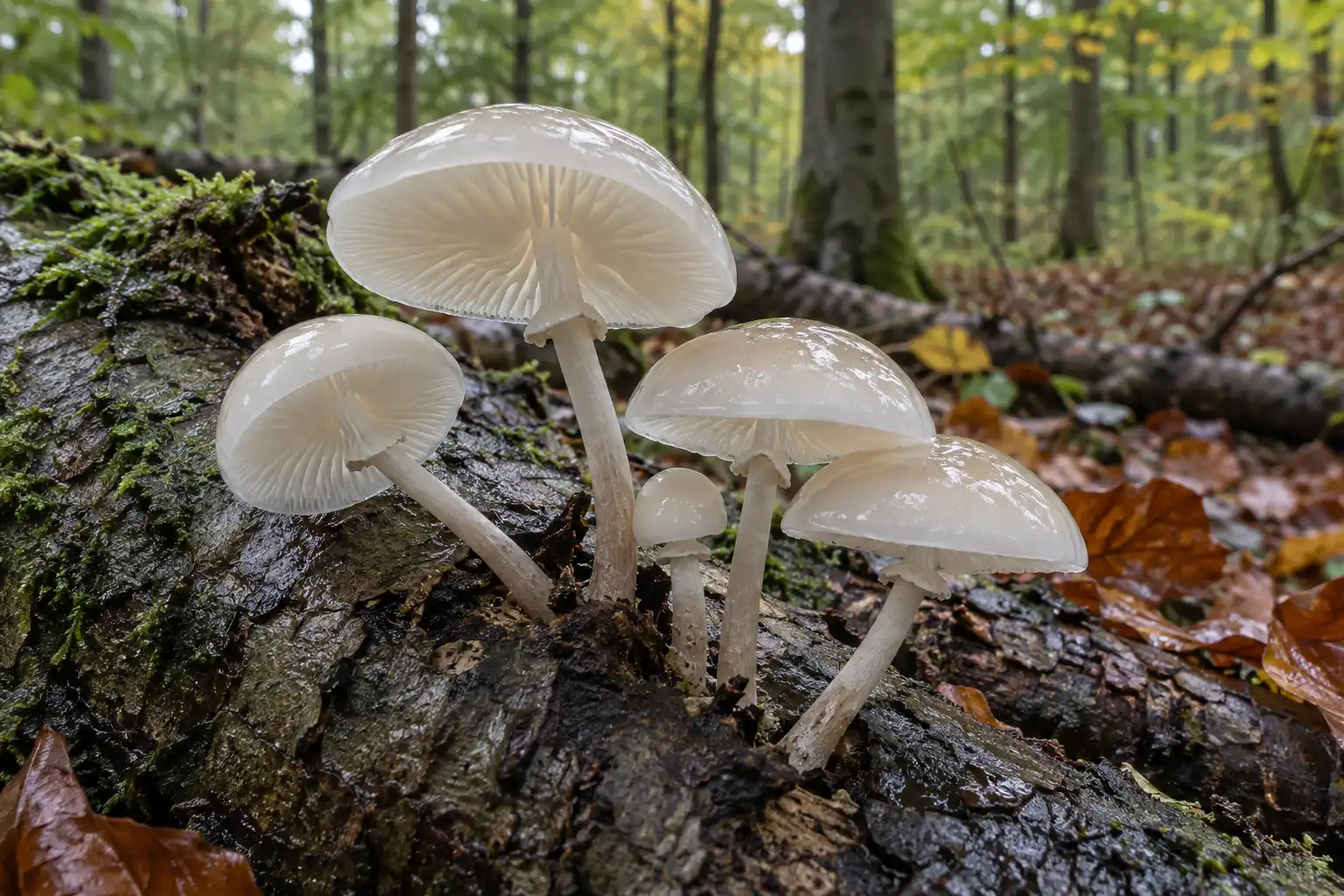
Porcelain fungus is also placed in Physalacriaceae in current treatments. It typically fruits directly from beech wood in clusters, with translucent white slimy caps and a delicate ring. The porcelain fungus guide shows how exposed beech attachment and growth orientation differ from a solitary terrestrial-looking fruit body connected to buried wood.
Other rooting collybioid mushrooms
Rooting or narrowed stem bases occur outside this species. Some mushrooms extend into litter without reaching wood; others connect to buried cones, roots, or sclerotia. Record the terminal substrate rather than treating any long base as the same pseudorhiza.
Keep taxonomy and geography visible
Older sources commonly use Oudemansiella radicata or Xerula radicata. Many modern databases place the species in Hymenopellis. These combinations reflect changing genus concepts, and not every record filed under an older name has been re-evaluated with current species limits.
Search all major combinations when reviewing literature, but preserve the exact name used by each source. Record database, access date, region, and accepted-name decision. North American and Asian lookalikes should not be assigned a European species name solely because an international photo page looks similar.
For a formal identification, measure mature spores and document number, range, and mount. Examine cap-cuticle construction and cystidia. Compare with a recent regional key or fungarium material rather than a global image search.
Understand what buried wood means ecologically
The fungus decomposes woody material below the visible surface. A fruit body near a living tree does not prove that it is parasitizing healthy roots, nor does it reveal the structural condition of the tree. The wood may be an old dead root, buried stump, or detached branch.
Record whether the connected wood is living, dead, or too decayed to determine. At a tree with visible defects, mushrooms are one observation among many. A qualified arborist evaluates load, targets, roots, crown, decay, and site history; a species page cannot provide a risk rating.
In natural woodland, buried-wood decomposition is part of nutrient cycling. Avoid trenching around living roots merely to obtain a dramatic pseudorhiza photograph. One carefully documented specimen is usually more informative than excavating an entire group.
Separate identification from food use
Some regional guides discuss rooting shank as edible or of limited culinary value, often noting the tough stem. That history does not verify a specimen. Related species, incomplete bases, contaminated sites, decay, individual response, and regional taxonomy remain separate concerns.
Never use the cover image, an app suggestion, or one wrinkled cap as permission to eat. Cooking cannot correct a mistaken species or remove all environmental hazards. Seek local in-person expertise for a real collection.
If illness follows mushroom exposure, contact emergency services or Poison Control promptly. Preserve uncooked specimens, trimmings, cooked leftovers, photographs, site details, and a timeline; do not wait for an online identification.
Field record checklist
- Woodland setting, nearest tree, stump evidence, and visible soil context photographed
- Cap width, height, moisture, broad umbo, and radial wrinkles recorded
- White broad gills and natural gill-stem junction shown
- Long ringless fibrous stem photographed above the soil line
- Pseudorhiza excavated only where lawful and traced to buried wood
- Breakage or unexamined base stated rather than reconstructed
- Heavy white spore deposit linked to the collection
- Hymenopellis relatives, deer mushroom, porcelain fungus, and other rooters compared
- Region, date, key, microscopy limits, and accepted-name source archived
Frequently asked questions
How long can the pseudorhiza be?
It can extend well beyond the visible stem, but length varies with burial depth and substrate. Measure the actual intact extension rather than quoting a universal size.
Is the mushroom attached to a living tree root?
Not necessarily. It commonly connects to dead buried wood or decaying roots. Fruiting near a tree does not by itself establish parasitism or tree risk.
Does a white print prove rooting shank?
No. White spores are widespread. The buried pseudorhiza, cap texture, ringless stem, gill junction, ecology, region, and microscopy must agree.
Why are older names important?
Observations and literature may be filed under Oudemansiella radicata or Xerula radicata. Searching those names prevents evidence from disappearing during taxonomic changes.
Can I dig up every specimen to confirm it?
No. Respect land rules and living roots. One careful excavation where permitted, or a documented limitation where it is not, is enough for responsible observation.
Separate a pink netted wood mushroom
Do not confuse the rooting shank’s brownish wrinkled cap and long buried stem with the pink raised network of a wood-attached wrinkled peach mushroom. Showing the complete base and attachment resolves more than cap texture alone.
References
The linked GBIF and NCBI searches provide nomenclatural and occurrence checkpoints; Kew documents fungarium context; NAMA and Poison Control support conservative exposure response. Species-level assignment should use current regional literature and microscopy where field characters overlap.
Source quality notes
MushroomScope cites sources that match the page scope, such as taxonomic databases, extension guidance, food-safety agencies, food-composition databases, and peer-reviewed or institutional health references. Sources support context and uncertainty; they do not turn an online page into specimen identification, medical advice, or a tested recipe record.
Frequently asked questions
What is a rooting shank pseudorhiza?
It is a long tapering underground extension of the stem that connects the fruit body to buried wood or roots; it is not a plant root and often breaks during collection.
Can rooting shank be identified without excavating the base?
A wrinkled tan cap and long stem may suggest it, but the intact tapering pseudorhiza and buried woody connection are central evidence and should be documented when lawful.
Why does the cap look strongly wrinkled?
The moist cap surface can be radially wrinkled or veined, especially around the broad central umbo. Drying, age, and lighting change how prominent that texture appears.
Is rooting shank safe to eat?
This page cannot verify food safety. Identity, regional taxonomy, site condition, contamination, freshness, and individual response require local assessment.
What older scientific names may appear?
Field guides and databases may use Oudemansiella radicata or Xerula radicata. Preserve source names and check a current regional taxonomic treatment.
Related guides
mushrooms
Deer Mushroom: Free Gills, Pink Spores, and Hardwood Habitat
Document deer mushrooms by fawn caps, free gills, pink spores, ringless stems, hardwood attachment, and Entoloma or Volvariella differences.
mushrooms
Porcelain Fungus (Mucidula mucida): Identification Guide
Identify porcelain fungus by its translucent slimy cap, white gills, ringed stem, beech-wood habitat, growth orientation, season, and lookalikes.
identification
Mushroom Cap Shapes: A Practical Identification Guide
Compare mushroom cap shapes from convex and bell-shaped to flat, depressed, funnel-shaped, and uplifted, while recording age, margin, surface, and profile.
Continue exploring
Browse more practical guides in Mushroom Encyclopedia or visit the mushroom encyclopedia.