Mushroom Encyclopedia
Deer Mushroom: Free Gills, Pink Spores, and Hardwood Habitat
Document deer mushrooms by fawn caps, free gills, pink spores, ringless stems, hardwood attachment, and Entoloma or Volvariella differences.
Species context
Treat profiles as reference material
Species profiles summarize documented traits, taxonomy, and lookalikes, but natural variation can be substantial.
Use the safety checklist →Decision limit
A profile cannot authenticate a specimen
Do not eat a wild mushroom from an online match, single feature, or generated image.
Read the safety disclaimer →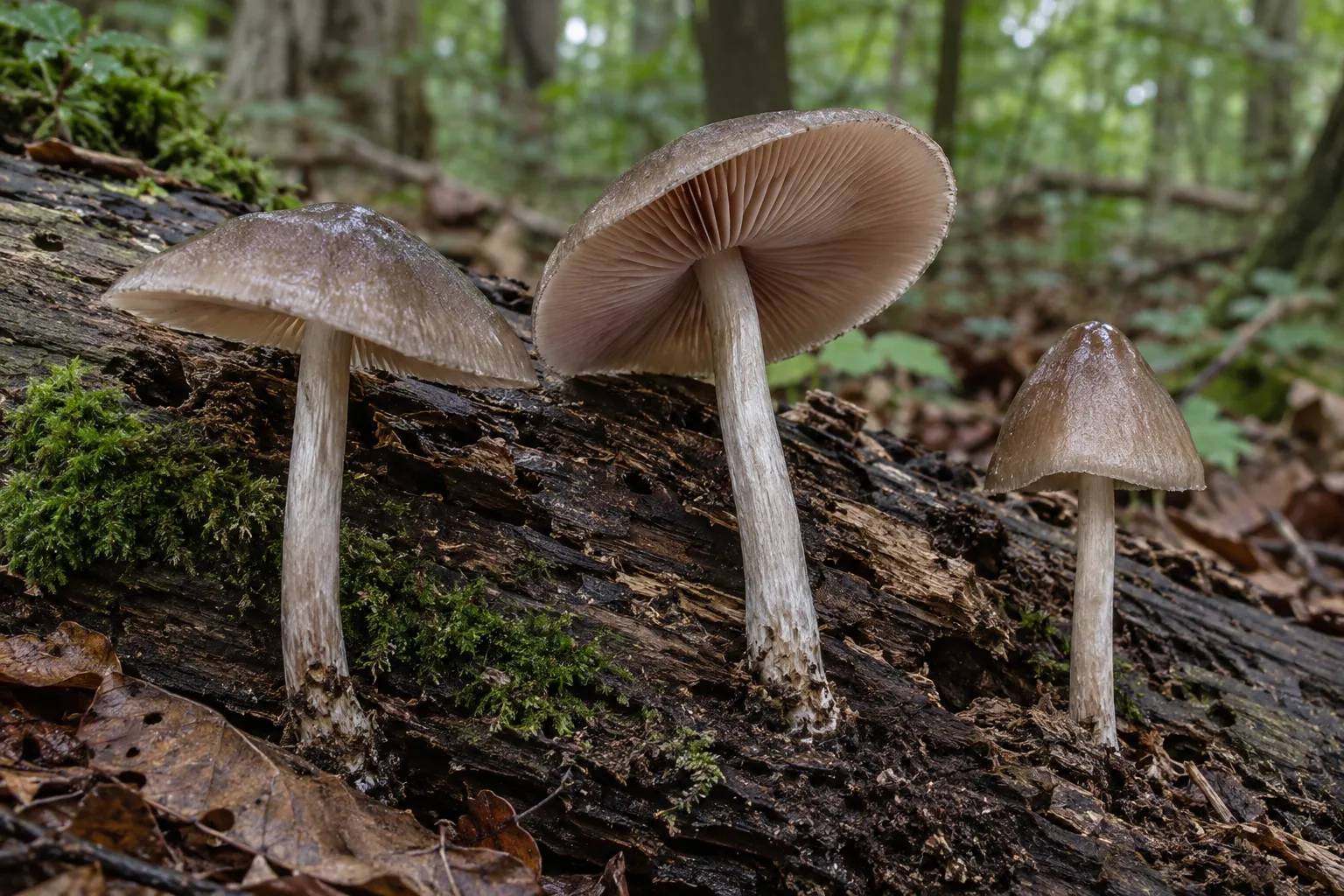
Quick facts
- Scientific name
- Pluteus cervinus
- Common names
- Deer mushroom, Deer shield
- Taxonomy
- Pluteus · Pluteaceae
- Edibility context
- Unknown: Food reports are not remote clearance, and similar Pluteus or other pink-spored mushrooms require specialist separation.
- Spore print
- Pink to pinkish brown.
- Toxicity context
- Unknown: Do not infer safety from genus-level appearance; misidentification, decay, contamination, and individual response remain material risks.
- Season
- May, June, July, August, September, October, November
- Growing difficulty
- Expert
- Regions
- Europe, North America under regionally interpreted names, temperate Northern Hemisphere records
Safety limit: These labels summarize documented context; they never authenticate a wild specimen. Cooking does not make a poisonous species safe.
The deer mushroom name most often points to the Pluteus cervinus complex: medium-sized brown mushrooms that decompose wood and release pink spores. The useful field signal is not the deer-brown cap alone. It is the combination of free gills, pink maturation, lack of a ring and volva, and direct woody attachment. Even that combination usually establishes Pluteus more confidently than it establishes one species.
Species limits and names in the cervinus group have changed as microscopic and DNA evidence have accumulated. A careful record therefore separates what can be seen in the field from what requires a regional monograph, microscope, or sequence. This page builds that record without treating a photograph as food clearance.
Begin with the attachment to wood
Photograph the mushroom before moving it. Show the cap, stem, log or stump, bark if present, decay stage, and nearby tree material. Then trace the stem base gently. A specimen that seems to rise from soil may be connected to a buried root, chip, or branch. Calling it terrestrial without excavation removes one of the strongest ecological clues.
Deer mushrooms are saprotrophs: they obtain resources from dead woody material rather than forming a mycorrhizal partnership with living tree roots. Record whether the substrate is a standing snag, stump, fallen trunk, structural timber, chip bed, or buried root. If the host can be identified, state how; loose bark color is rarely enough.
Fruit bodies often appear singly or scattered rather than in dense fused clusters. Multiple stems can emerge along the same log because the mycelium occupies a larger volume of wood. Map their spacing instead of describing every group on one trunk as a cluster.
Confirm that the gills are truly free
Turn a mature cap sideways and inspect the junction between gills and stem. In Pluteus, the gill edges stop before reaching the stem, leaving a narrow collar-like gap. Cut a cap vertically through the center when the gap is hard to see. Do not confuse gills torn away during handling with naturally free attachment.
Young gills are pale, often white. As spores develop they become flesh-pink or salmon-pink. Photograph at least two maturity stages when possible. Pink gills on an old damaged mushroom are less informative than the sequence from pale young plates to a uniform mature spore color.
The mushroom gill types guide explains free, attached, notched, and decurrent junctions. That distinction matters because Entoloma also has pink spores but normally retains attached or notched gills.
Make a controlled pink spore print
Place a mature cap across white and dark nonabsorbent surfaces and cover it against drafts. Label the print with the collection number. A sufficiently heavy deposit should look pink to pinkish brown rather than white, rusty brown, chocolate brown, or black.
Reflected cap color can tint sparse spores, and wet paper can create misleading halos. Judge a real deposit collected from mature gills. The spore print guide gives a reproducible setup and explains why spore color narrows a comparison but rarely finishes it.
A pink deposit supports Pluteus, Volvariella, Volvopluteus, or Entoloma comparisons depending on other anatomy. It does not prove P. cervinus. Keep the spore result paired with gill attachment, base structure, substrate, and microscopy.
Read the cap without relying on “deer brown”
Caps typically begin bell-shaped or convex and expand toward broadly convex or nearly flat. Colors range through gray-brown, smoky brown, fawn, and date-brown. The center may be darker or weakly streaked by radial fibrils. Surfaces can look slightly glossy when wet but are not normally covered in a thick gelatinous layer.
Measure cap diameter and photograph it dry and wet if weather changes naturally. Color alone is unstable under shade, rain, age, and camera processing. The common name is a visual analogy, not a diagnostic pigment standard.
Check the margin for splitting, translucence, or striation, but interpret these with hydration. A waterlogged thin margin may reveal gill lines that disappear as it dries. Note actual state rather than promoting a temporary moisture effect to a species character.
Document the ringless, volva-less stem
The stem is generally pale and longitudinally fibrillose, sometimes with brown fibers toward the base. It lacks a partial-veil ring. Photograph the entire circumference so that a damaged ring is not mistaken for natural absence.
Excavate the base even though Pluteus is not expected to have a volva. Free pink gills plus a cup or sack at the base redirect the comparison toward Volvariella or Volvopluteus. A torn or buried volva can be missed when a mushroom is snapped off at ground level.
Record whether the stem joins exposed wood directly or passes through soil to buried wood. Include a close image of the contact. This single photograph often resolves an apparent conflict between “growing on soil” and a wood-decay ecology.
Treat odor as supporting evidence
Descriptions of the cervinus group sometimes mention a radish-like or earthy odor. Odor varies with temperature, age, hydration, observer, and storage. Smell fresh intact material and a newly cut section, then record the comparison in ordinary language.
Do not taste an uncertain mushroom. Taste is unnecessary for the field workflow and does not resolve the important pink-spored lookalikes. Strong chemical, rotten, or sour odors may reflect decay or contamination rather than species identity.
Separate the principal lookalikes
Other Pluteus in the cervinus complex
Several brown Pluteus overlap in cap color, size, free pink gills, and hardwood habitat. Specialists compare cap-cuticle cells, spore dimensions, pleurocystidia and their hooks, clamp connections, and geography. DNA may reveal lineages that older field guides grouped under one name. When those data are absent, “Pluteus cervinus group” can be the most defensible label.
Volvariella and Volvopluteus
These also have free gills and pink spores. Their volva is the crucial macroscopic warning: a cup or sack surrounds the base. It may be buried, fragile, or coated in soil. Never evaluate a free-gilled pink-spored mushroom whose base was left behind.
Entoloma
Many Entoloma produce pink angular spores, and some brown woodland species appear superficially similar. Their gills are attached, adnexed, or notched rather than truly free. Most relevant species fruit from soil, though habitat alone is not enough. Microscopy readily separates angular Entoloma spores from the smooth spores expected in Pluteus.
Pale-spored wood mushrooms
Several Megacollybia, Gymnopus, and related wood-associated mushrooms have gray-brown caps. A white spore deposit and different gill junction remove them from the deer-mushroom pathway. Do not infer pink spores from beige old gills.
Use microscopy to test a species-level name
Prepare notes before microscopy so that laboratory observations remain tied to one voucher. Measure mature spores and record the number measured, mount medium, and range. Examine cystidia on the gill face and edge, including whether thick-walled forms have apical hooks. Inspect the cap cuticle and search relevant tissues for clamp connections.
These characters are not decorations added after a visual guess. They are evidence that can support or reject a regional species concept. Compare them with a current key written for the collection’s continent; a European description should not be transferred automatically to North American material.
Dry a representative voucher with collection number, date, coordinates generalized as appropriate, substrate, host notes, photographs, and print. A preserved collection allows a later expert to revisit an uncertain name without relying on memory.
Place the fungus in its decay context
Finding fruit bodies confirms active reproduction, not the full boundaries or rate of decay inside a log. Wood moisture, temperature, competing organisms, and decay stage control when mushrooms appear. Absence of caps does not mean absence of mycelium.
Deer mushrooms contribute to nutrient cycling by decomposing dead wood. On a natural fallen log, that activity is part of forest succession. On structural timber, the practical question becomes why the wood stayed wet and whether a qualified building or tree professional should assess the substrate. A mushroom name does not quantify structural integrity.
Keep the food-safety conclusion conservative
Field guides vary in how they describe the edibility of Pluteus cervinus, and species-level confidence can be difficult. That combination makes a remote eating recommendation inappropriate. Old specimens also deteriorate quickly, accumulate larvae, and may grow from contaminated urban wood.
Do not treat pink spores as an edible-group signal. They occur across mushrooms with different risk profiles. A local expert must evaluate the intact specimen, and the separate questions of identity, freshness, site contamination, legality, and individual reaction must all be answered.
If symptoms follow mushroom exposure, contact emergency services or Poison Control promptly. Preserve specimens, cooked leftovers, photographs, collection location, and a timeline. Online discussion should not delay medical advice.
Identification checklist
- Fruit bodies traced directly to dead hardwood or buried woody material
- Smooth to finely fibrillose gray-brown or fawn cap measured and photographed
- Gills shown to be naturally free, not torn away
- Young pale and mature pink gill stages documented when available
- Thick pink to pink-brown spore deposit collected from a mature cap
- Stem photographed on all sides with no ring
- Complete excavated base showing no volva
- Region, date, host evidence, and wood-decay stage recorded
- Microscopic characters compared with a current regional key before a confident species name
Frequently asked questions
Why are young deer mushroom gills white?
The pink color comes from maturing spores. Immature gills may be white, so a young specimen alone cannot demonstrate the mature color. Pair developmental photographs with a print from an expanded cap.
Is every ringless brown mushroom on a log a Pluteus?
No. Many unrelated decomposers share that outline. Free gills and a pink deposit are key additional characters, and the complete base still needs examination.
Can odor distinguish Pluteus cervinus?
Not reliably by itself. A radish-like odor may support a comparison, but observers and specimens vary. Anatomy, spores, substrate, region, and microscopy carry more weight.
Does a volva always remain obvious?
No. It may be buried, damaged, or stuck in the substrate. Excavating the entire base is the only responsible way to use its presence or absence.
What should a useful photo set include?
Include habitat and log, cap surface, mature and young gills, gill-stem junction, entire stem, excavated base, wood attachment, section, and spore deposit. Keep every image linked to one numbered collection.
The rooting shank guide covers another mushroom that can appear terrestrial above buried wood, but differs through its deep pseudorhiza, white spores, and non-free pale gills.
The Common bonnet guide adds a second wood-decayer comparison: its attached pale gills, white deposit and clustered slender stems differ from the free gills and pink deposit expected in mature deer mushrooms.
References
The cited databases and professional safety resources support taxonomic searching, placement, wood-decay context, and conservative response to exposure. Species-level interpretation should use a current regional Pluteus treatment and, where necessary, microscopy or DNA evidence.
Source quality notes
MushroomScope cites sources that match the page scope, such as taxonomic databases, extension guidance, food-safety agencies, food-composition databases, and peer-reviewed or institutional health references. Sources support context and uncertainty; they do not turn an online page into specimen identification, medical advice, or a tested recipe record.
Frequently asked questions
What is the fastest way to recognize a deer mushroom group record?
Look for a ringless mushroom attached to decaying wood with free gills that mature pink and a pink-brown spore deposit. That combination suggests Pluteus but does not by itself prove P. cervinus.
Can deer mushrooms appear to grow from soil?
Yes. A fruit body may attach to buried roots, chips, or wood. Carefully trace the stem base and document the actual substrate instead of labeling it terrestrial from the surface view.
Does a pink spore print identify Pluteus cervinus?
No. Pink spores narrow the comparison, but Entoloma, Volvariella, and many other Pluteus require gill attachment, base anatomy, habitat, microscopy, and regional treatment.
Is a deer mushroom safe to eat?
This guide cannot approve a specimen for food. Species uncertainty, decay, site contamination, individual reactions, and lookalikes require local in-person expertise.
Why is microscopy often important in Pluteus?
Cap-cuticle construction, spore dimensions, clamp connections, and the shape of cystidia help separate similar brown Pluteus species that overlap strongly in field appearance.
Related guides
mushrooms
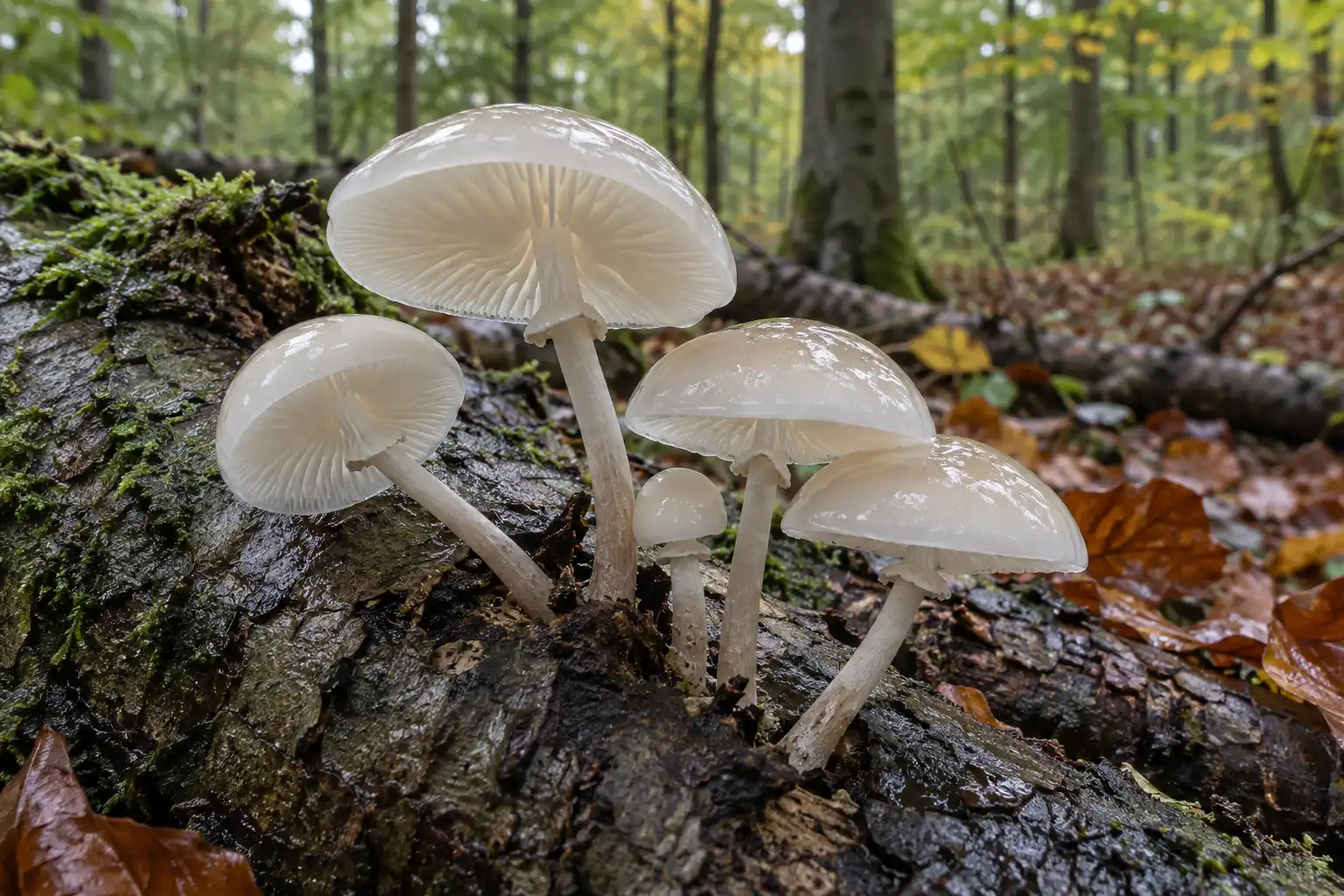
Porcelain Fungus (Mucidula mucida): Identification Guide
Identify porcelain fungus by its translucent slimy cap, white gills, ringed stem, beech-wood habitat, growth orientation, season, and lookalikes.
mushrooms
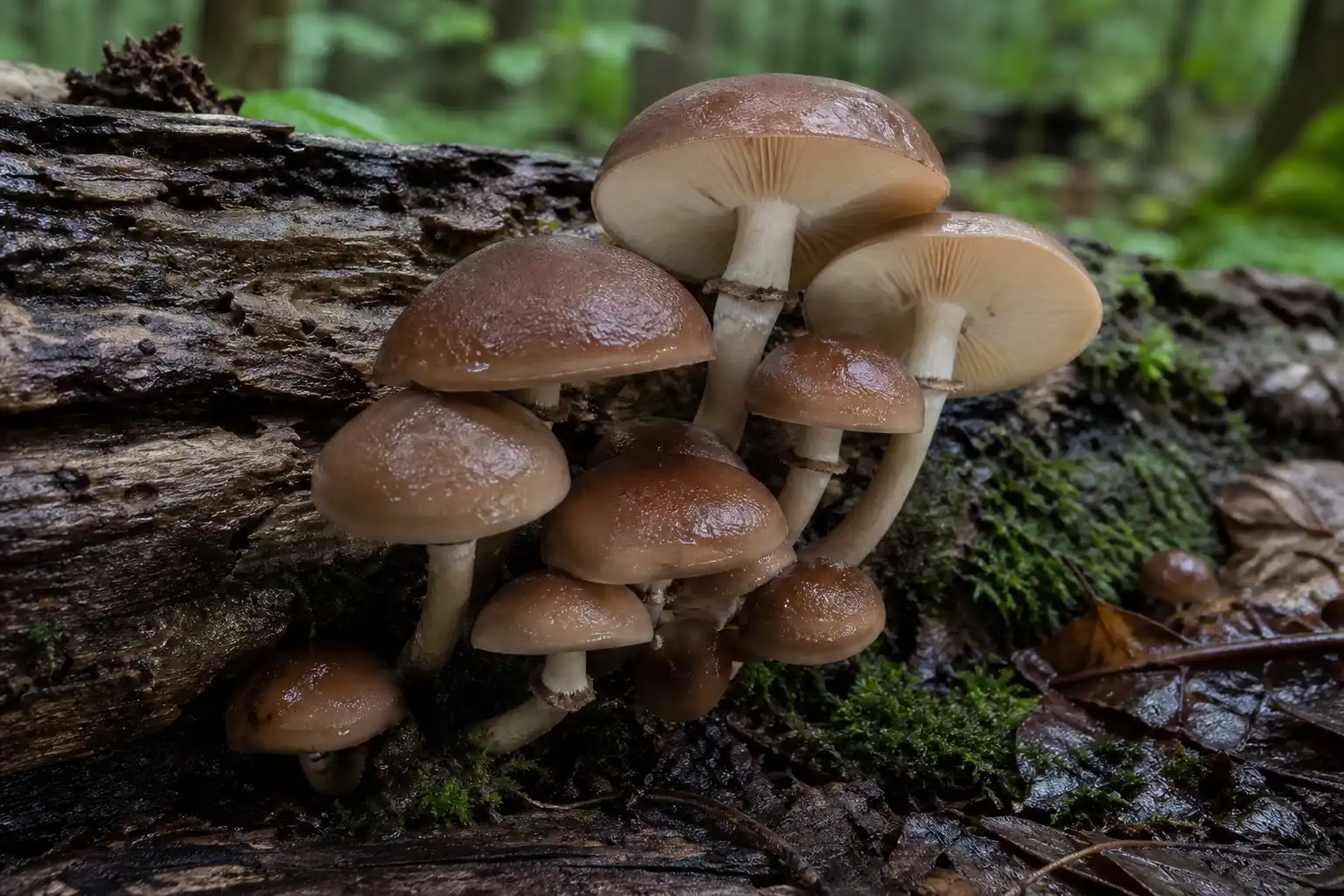
Pioppino Mushroom Guide: Taxonomy, Cultivation, and Cooking
A sourced Pioppino guide covering Cyclocybe aegerita taxonomy, wood-decay ecology, cultivated form, food safety, cooking, and lookalike limits.
identification
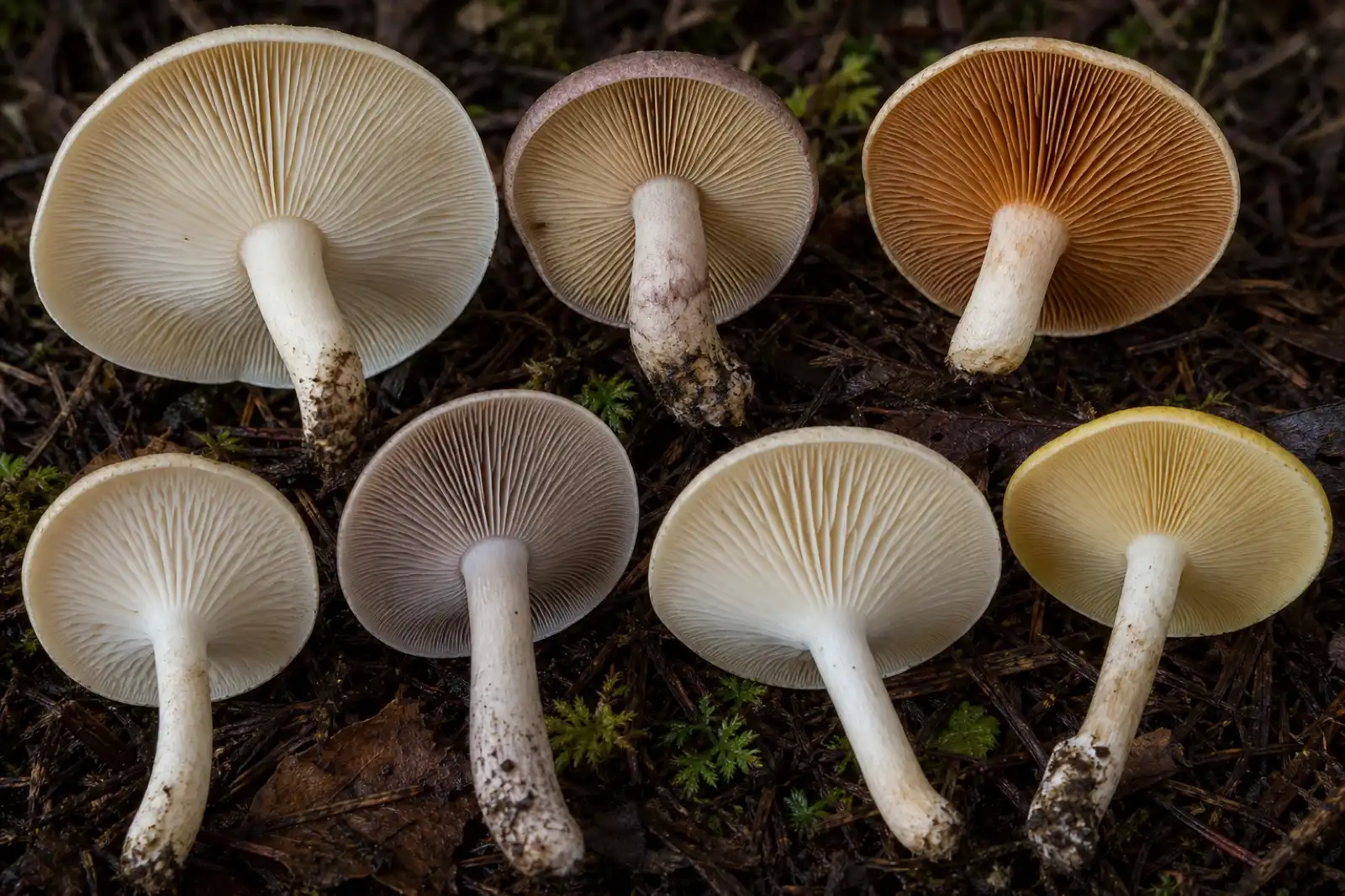
Mushroom Gill Types: Attachment, Spacing, and Color
Compare free, attached, notched, adnate, and decurrent mushroom gills while recording spacing, short gills, edge details, bruising, and color changes.
Continue exploring
Browse more practical guides in Mushroom Encyclopedia or visit the mushroom encyclopedia.